
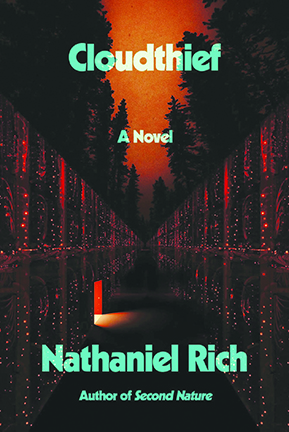
(MCD/Farrar, Straus and Giroux, 281 pages)
Some books take a while to grow on you; some endear themselves right from the start. The latter was my experience with Nathaniel Rich’s Cloudthief, a witty and smart crime novel with a deceivingly dull cover that does it no favors.
The protagonist is Tim, a freelance climate journalist in New York City, struggling to make ends meet by writing articles for magazines that pay by the word. He is “pathologically nonthreatening: not too tall, not too strong, not too quick, not too surprising, and not at all noticeable. Strangers were deeply unintimidated by me.”
After student-loan payments, health insurance and rent, he clears about $20,000, “enough for a weekly burrito, a monthly bender, a quarterly taxi.” When things are especially tough, as they are when we meet him, he rents out his tiny apartment for the night while he crashes on a friend’s couch.
But the night Tim is about to bunk with his friend Ces, Ces has other ideas. A brilliant eccentric whose main job is designing web pages, he’s hatched a plan to break into mini-storage units in Manhattan and steal anything of value in order to sell it. Tim is dubious but Ces has rented one of the storage units, so it’s not technically breaking and entering to enter the facility. So Tim follows along, guiltily aware that he is now, “according to the letter of the New York City Administrative Code, a misdemeanant.”
But things will get worse. And, as Tim muses, “The guilt, as with any sin, felt most acute at first occurrence. Each subsequent commission, no matter how severe, did not intensify the original guilt. Each crime alleviated it.”
Tim and Ces will part ways when they encounter a woman living in one of the storage units. Virginia has arranged her unit to lock from the inside, and she only goes outside for a few hours each night, when no one will notice her odd comings and goings.
Tim, still more journalist than thief, is intrigued and convinces Virginia to let him come in and interview her about her life, why she chose it and how she pulls it off, telling her (and himself) that it would be a great magazine story. But they become more than interviewer and subject, and together hatch a plan to pull off a much greater heist than breaking into mini-storage units. They decide to break into a data center near Tulsa, Oklahoma, and steal its most valuable data, an act they justify because of (a) the evil that technology companies perpetuate by collecting and selling our data and tracking us and (b) they are so desperate and broke.
Virginia is broke because she has chosen to take herself completely offline in order to escape from Big Tech’s all-knowing eye. She’s mastered the art of hiding not only from people but from Google, having realized that the best way to assure anonymity is to create lots of you’s. She also has acquired a lot of skills that will come in handy as she and Tim enact their plan.
Tim’s situation is more sympathetic. His financial struggles, aside from having low income in a high-cost city, are exacerbated by the fact that he is financially responsible for his sister, named Zoe, who has a genetic disease causing her to progressively lose her hearing and sight. Their parents are out of the picture, and Zoe is still able to live on her own, but both brother and sister know that at some point she is going to need full-time care.
All of this is happening in an America that is increasingly feeling the effects of a warming planet, which both Tim and Virginia refer to as “the Collapse.” Both are increasingly nihilistic, which enables them to easily make decisions that would have given others pause. They are also convinced that they can pull off the heist because of poor security in rural states. As Tim explains to Zoe, “This treasure trove is just sitting there. In giant empty warehouses surrounded by cornfields.”
Several perspective-shifting twists propel the story forward, as if a data-center heist isn’t enough to hold our attention. But the most compelling part about Cloudthief is how intelligent it is. Rich doesn’t assume that we know anything about data centers or how technology tracks us, but he explains everything in a way that is not insulting to readers. (One exception: how he uses initials to ostensibly disguise actual companies — as if we don’t know what G. and M. mean — although to be fair, the publisher’s legal team might have made that decision.) The dialogue between characters, even minor ones, is snappy and smart, and everything about the story seems thoughtful, from the contrast between mini-storage units and vast data centers, to the rich symbolism offered in a book that both Virginia and Tim treasure, a memoir by a French woman who spent 111 days in an underground cave.
And the data-center break-in, as it turns out, is but a prelude to another crime, which takes place in Boston and again, pivots the story in an unforeseen way.
Cloudthief is a story of descent, both societal and individual, and although it tries to leave us with a sense of hope, not everyone will experience it that way. Still, it’s the rare novel that will equally appeal to both women and men, and even rarer, teach you how to live in a storage unit, if that’s on your bucket list. B+
Featured Photo: Cloudthief, by Nathaniel Rich