1931 Fruit Cookies

This recipe is adapted from one in a recipe booklet put out by Robin Hood Flour in 1931. It makes about two dozen cookies.

Wet ingredients

  • ½ cup (1 stick) butter – The team at Robin Hood called for shortening, because it was the Great Depression, but my philosophy is that if you can use butter, why wouldn’t you? (That’s a rhetorical question. I understand that there actually are reasons, but I’m making a point here.)
  • 1 cup (198 g) sugar – It dissolves into liquids so well that it is often classified as a wet ingredient.
  • The zested rind of two lemons – The Robin Hood team suggested the zest from a large orange.
  • 2 eggs – This is a good idea. No notes.
  • 2 Tablespoons fresh squeezed lemon juice – The original recipe called for orange juice.

Dry ingredients

  • 2 cups (240 g) all-purpose flour – Needless to say, this recipe specified Robin Hood flour.
  • 2 teaspoons baking powder
  • ¼ teaspoon salt
  • 2 teaspoons dehydrated lemon juice powder (Optional. I realize that most bakers don’t have any of this on hand, but you should really consider picking some up. It helps bump the lemony flavor without throwing off a recipe’s dry-to-wet ratio. It makes a super-lemony cake frosting.)

Delicate prima donna ingredient

  • 1 cup (180 g) dried blueberries – The 1931 recipe called for raisins, but lemon and blueberries are a classic pairing.

With your stand or hand mixer, cream the butter and sugar together, then beat in the eggs, one at a time. Then mix in the lemon zest and lemon juice.

In a medium-sized bowl, whisk the dry ingredients together, then add the dry mixture to the wet one at slow speed. Carefully mix the dried blueberries into the dough.

Cover the dough with a piece of waxed paper, and chill it in your refrigerator for about 45 minutes. While it’s chilling, preheat your oven to 375°F.

After reading a couple chapters of a good book, scoop the dough onto parchment paper or a silicone mat, one Tablespoon at a time. (I have a miniature ice cream scoop that does a lovely job of this.) Flatten the blobs with a wet fork, the way you would with peanut butter cookies.

Bake for about 12 minutes — all ovens are a little different — until the edges have browned slightly. Let the cookies cool on the baking sheet.

These are not fancy cookies, but they are gently sweet, and lemony, with tiny bursts of blueberry flavor. These are a good gift for a friend who’s having a hard time, without making a big deal about it.

Featured photo: 1931 Fruit Cookies. Photo by John Fladd.

The meringue’s the thing

A taste of the finicky world of French macarons

Ashley Savoy is the owner of Savvy Sweets and Treats in Bow (387-0241, savvysweetsandtreats.com), a home bakery specializing in sweet baked goods. She sells cakes, cupcakes and cookies, but has developed a following for her French-style macarons.

Savoy said a common misconception new customers make is confusing macarons — meringue-based cookies that sandwich a sweet filling — with macaroons, the chewy coconut cookies popular around Passover.

“There’s a difference between the two,” she said. “Sometimes people use the two words interchangeably. However, if you went to Europe and you said a macaron, most people would know exactly what you were talking about and not think of the coconut cookie at all.”

Macarons have a reputation among home bakers for being temperamental and difficult to consistently get right. Savoy said she only learned to make them as part of the courting process when she started seeing her now-husband.

“I started because macarons were one of my husband’s favorite cookies when we first started dating. And I thought, ‘I can definitely do this. I bake all the time.’ I had no idea what I was getting myself into.” She taught herself the basics of macarons, but, she said, “they’re like a dysfunctional baking cookie because once you figure it out and you get it and you know how to cook them they’re not that bad, but getting there can be really quite a love-hate relationship.”

Now she feels like she has a handle on macaron-making.

“When I go to an event, I bring probably a maximum of nine flavors,” she said, “but I would say that I make well over 200 different flavor combinations at this point.” She has a core stable of the chewy meringue cookies, but the variety of fillings is enormous. “You can flavor your cookie, which adds an extra level of flavor to it. But [for] the filling on the inside there’s just like a slew of things that you can do with that. You can use a ganache; you could do a buttercream, you can do an ermine frosting — that’s a frosting that is a little bit less sweet and it’s made with flour.”

One of the hallmarks of good Parisian-style macarons is their vivid colors. For Savoy, the colors serve an additional purpose.

“A lot of times,” she said, “ I do salted caramel and I [make it with] a blue shell, which is mostly just for my own sanity and to remember what it is. Some use more natural food coloring, but almost all macarons have some sort of food coloring and that’s how you get that vibrant coloring. Sometimes people bite into one of my blue macarons, and then their whole mouth turns blue and they’re like, ‘Oh my goodness!’”

The key to a good macaron, Savoy said, is mastering meringue.

“I think meringues are much friendlier than they get a rep for,” she said. “It’s easy to break a meringue, but I would say that there are a couple of things that you can do to ensure that your meringue is going to be the best it can be. The first thing is wiping all of your equipment down with either lemon juice or some vinegar — something acidic. That’s going to remove any fat residue that might be left there. Sometimes even soap residue can affect [the egg whites in your meringue]. The other trick to meringue is that you need to whip them for far longer than you think you’re going to. It’s better to over-whip your meringue than it is to under-whip it. The stiffer meringue is a little bit more forgiving than the loose meringue, which might lose all structure altogether. And then that’s when you get those like flat, weird-looking brown ones.”

Macarons
Ashley Savoy sells her baked goods, including macarons, at Concord’s Winter Market (downtownconcordwinterfarmersmarket.com), at selected events, and through Savvy Sweets and Treats’ website at savvysweetsandtreats.com.

Featured photo: Courtesy photo.

Pies for Pi Day

It’s 3.14 times as delicious as any other day

This Saturday, March 14, is one of the happiest days of the year for math enthusiasts. Written numerically, the date is 3/14, and of course 3.14 is the number pi (π) rounded to the nearest hundredth. “Pi Day,” also thought of as “Pie Day,” is a day of celebration for geometry fans, pun enthusiasts and of course pie lovers.

Canterbury Shaker Village (288 Shaker Road, Canterbury, 783-9511, shakers.org) will embrace Pi Day this year. From 1:30 to 3 p.m. on March 14 the museum will host a Pi Day event with an informal lecture on the history of pie and its connection to Canterbury’s Shaker community — they were considered brilliant cooks and bakers. The event will allow guests to eat pie, and let pie enthusiasts mingle and share their collected passion.

“It actually is a very nice pie symposium,” said Garrett Bethmann, Manager of Communications and Engagement for the Shaker Village. “It’s just easy breezy as, you know, just like the smell [of a fresh-baked pie] coming out of your window. We just want people to have as sweet a time as pie is.”

“We’ll be playing a little bit with that mathematical concept as well as showing how pie [the pastry] fits into that. We’ll look at how pie has been used in American culture over the years, and how Shakers thought about pie and how they incorporated them into their daily life. I saw recently we got some floor plans that had an integrated pie safe situated in it for one of our buildings. It was certainly on their mind. And so we’d like to showcase how that looks and how people can learn about it.”

The baking community will also be celebrating Pi Day.

“Oh, we’ve gota Pi Day menu!” said Brittani Randal, co-owner of The Sunflower Bakery and Cafe (50 Broad St., Nashua, 505-0794, thesunflowerbakerycafe.com). “Last year, the number of pies we could make was just based [on] what we could bake from our house, and now that we have our [brick and mortar bakery] those numbers don’t even count anymore. Last year we had eight to 10 [types of pie], but that didn’t include our black bottom pie, which has been our most popular pie so far, and I don’t think we were offering the strawberry dream pie either, so there will probably be at least 10 [varieties of pie].” She said one of Sunflower’s corporate clients has already ordered 250 individual-sized pies for Pi Day.

Denise Nickerson, owner of The Bakeshop on Kelley Street (171 Kelley St., Manchester, 624-3500, thebakeshoponkelleystreet.com) plans to go all out for Pi Day this year.

“We’re going to have every single kind of pie you can think of,” Nickerson said. “We’re going to have probably 25-plus [types of pie], depending on what people order. People come up with some interesting ideas and we’re planning to have as many different pies as we can. Our most popular, of course, is apple or chocolate cream. We’ll definitely have those. Lime is really popular and we’ll go from there.” The Bakeshop has a reputation for outstanding doughnuts. “We’re making some kind of a pie doughnut,” Nickerson said, “but that’s still under development; my team is working on it.”

For 24 hours, from midnight to midnight, on Pi Day all locations of the Red Arrow Diner (112 Loudon Road, Concord, 415-0444; 137 Rockingham Road, Londonderry, 552-3091; 61 Lowell St., Manchester, 626-1118; 149 DW Highway, Nashua, 204-5088, redarrowdiner.com) will offer all slices of pie for $3.14, according to a statement from its corporate office.

Alison Ladman, owner of Crust and Crumb Baking Co. (126 N. Main St., Concord, 219-0763, thecrustandcrumb.com), said her plans for Pi Day are simple: “All we’re doing is baking a whole lot of pies. We want to make sure we don’t run out, and we recommend that any customers who have their heart set on a particular type of pie should pre-order online to make sure we still have some for them.”

Featured photo: Pies from The Sunflower Bakery and Cafe. Courtesy photo.

The Weekly Dish 26/03/12

Cutting edge learning: LaBelle Winery Derry (14 Route 111, Derry, 672-9898, labellewinery.com/labelle-winery-derry) will host a cooking class focusing on knife skills Thursday, March 12, from 6 to 7 p.m. Led by LaBelle chefs, this class will guide you through knife techniques, maintenance and safety, according to the website where you can purchase tickets.

What does ice do in a drink? CodeX B.A.R. (29 Main St., Nashua) will hold a home bartending workshop Sunday, March 15, beginning at 4 p.m. The topic will be “The Art of Dilution.” Learn why some drinks are stirred while others are shaken, and how ice, temperature and motion affect the texture and flavor of a drink. The cost is $34.99, which includes two cocktails to enjoy during the class.

Dinner with a pot of gold: There will be a St. Patrick’s Mystery Wine Dinner at Averill House Vineyard (21 Averill Road, Brookline, 244-3165, averillhousevineyard.com) Tuesday, March 17, from 6:30 to 8:30 p.m. The Leprechaun’s Secret is a wine dinner and mystery experience combining gourmet dining, interactive storytelling and paired wines. Tickets are $59 per person through the vineyard’s website.

Espresso martinis: In celebration of National Espresso Martini Day, the Rose and Rye Diner will hold a Tini Tasting Friday, March 13, from 6 to 8 p.m in the Arts Alley complex (20 S. Main St., Concord, 406-5666, artsalleyconcordnh.com). Three espresso martinis will be paired with desserts. The cost for this 21+ event is $71.21 through eventbrite.com.

Irish cookie decorating: There will be a Luck of the Icing cookie-decorating class Wednesday, March 18, from 6 to 8 p.m. at Smitty’s Cinema & GameLAB Tilton (630 W. Main St., Tilton, 286-3275, smittyscinema.com/movie-theater/tilton) with Kate from Confections by Kate (723-5187, confectionsbykatenh.com). Tickets start at $32.50 through eventbrite.com.

Spanish or French wines? Wine on Main (9 N. Main St., Concord, 897-5828, wineonmainnh.com) will host a tasting event called “Spain vs. The Loire” on Wednesday March 18, from 6:30 to 8 p.m. Taste selections from the Loire Valley and Spain. Tickets are $40 per person through Wine on Main’s website.

Running the Numbers

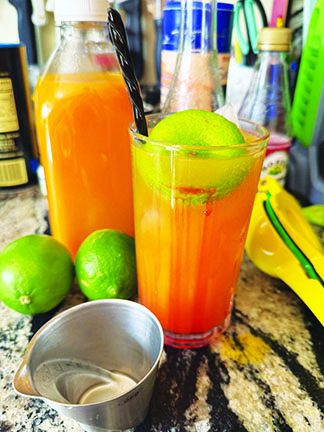
  • A 2-inch chunk of cucumber – I like using the long, skinny English cucumbers; they seem to have a little more flavor. Go ahead and wash it, but don’t bother peeling it. The peel will add color and flavor to the finished drink.
  • 2 ounces chili-lime rum – I’ve been using Captain Morgan’s for this. I do not regret it.
  • 1 6-ounce can of pineapple juice

Muddle the cucumber thoroughly in the bottom of your cocktail shaker. This means smooshing it up with a stick. If you don’t have a muddler you can use a wooden spoon, or a beer bottle if it fits, or if you’re up for a project you can actually go outside and find a stick (wash it before using it). I’ve heard of a guy who cut off the handle of a child’s baseball bat, presumably not while his child was using it. The point is that you want to crush this chunk of cucumber, body and spirit, until it is the consistency of applesauce.

Add the rum, and shake your rum & cuke for 20 seconds or so. This is what is called a “dry shake,” meaning without ice. When you muddle herbs or fruits or vegetables, you do it for three reasons:

1. By smashing your cucumber up, you’ve given it a lot more surface area to interact with the alcohol.

2. You’ve broken up the cell walls inside the cucumber and released some of the flavor compounds from their tiny prisons. (If you are really committed to breaking up the cells of the cucumber, you can freeze it first. Ice crystals will poke holes in the cell walls before you even get to it with the muddler.)

3. So now you have all these flavor compounds floating around unattached. Some of them like water just fine and will dissolve into it without complaint. Others are pickier and are waiting around for some alcohol to bond with. By dry shaking your rum & cuke before diluting it with melting ice, you’re swooshing the flavor and color chemicals around in an alcohol solution. On a molecular level you’ve kick-started a party. As you shake it up you’ll hear a “slosh-slosh” sound, but the botanical molecules will hear Ozzy Osborne’s “Crazy Train.”

At this point go ahead and add a handful of ice to the shaker, as well as the contents of the miniature can of pineapple juice.

Shake the mixture for another 30 seconds or so, then strain it over fresh ice in a Collins glass. It will have a gratifyingly foamy head on it. This drink is best suited to drinking with a straw.

This is a mildly refreshing drink. The cucumber flavor team has spread throughout the pineapple juice, keeping it from being too sweet. There is a subtle citrussy spiciness from the flavored rum.

Featured photo: Photo by John Fladd.

Organic farming in NH

Winter conference returns

Of the many events and conferences taking place at this time of year, one that probably escaped your notice is the Winter Conference of the Northeast Organic Farming Association of New Hampshire, taking place at Colby Sawyer College this weekend. This year’s conference is actually happening a month later than usual, said Kyle Jacoby, a program manager for the Association.

“It’s not our first ever conference in March, but it’s been a little while, so we’re excited to see what March brings us,” Jacoby said. “We always get a lot of people in our evaluations and through comments that say community is a big part of the event and the organization, so we really leaned into that with our theme this year, ‘Taking Root and Nourishing Community.’ We really like the word ‘nourishing,’ sort of an action of taking root, really feeding into all these connections between land and people and our practices.”

A core concept of organic farming is being aware and mindful of where our food comes from, Jacoby said, and this year’s conference will address the concerns of many different groups who are interested in that. He said this year’s conference will have “over 20 workshops for everyone from farmers to home growers, permaculturists, and educators. So we really have a full gamut of different workshops for all types of learners, farmers, home growers, home livestock [keepers], herbalists, hobbyists, educators, nonprofits and professionals. So we’re really excited about all those workshops.”

This conference’s workshops will span a wide range of interests from the technical (Soil Carbon Dynamics and Farm-Scale Management) to the academic (Carrying Seeds Forward: African Diasporic & Indigenous Traditions in New England Agriculture) to the narrative (Starting From Scratch: What We Learned Starting Our Farm). The concept of inclusivity extends to this year’s keynote speakers, Jacoby said. “We’re really excited. We decided this year it was going to be really valuable and important to uplift some local voices and some local initiatives, and so we connected with Dave Trumbull of Good Earth Farm and Sarah Hansen of Kearsarge Gore Farm, two farmers who’ve been really involved in a farmer collaborative CSA [Community Supported Agriculture] called Local Harvest CSA. They’re going to share some of their lessons and stories from this farmer collaborative and from their perspective as farmers in the state about how we come together as a community and connect with one another.”

“We also have things like our Green Market Fair, and a lot of exhibitors, raffles, different activities for people to engage in,” Jacoby said. The Green Market, he explained, is an ongoing activity throughout the conference where organizations can exchange information, and attendees can make connections and build support networks. “We have a number of nonprofits or small businesses [and] some of our local co-ops or organizations that work to support farmers, like Northeast SARE, which is Sustainable Agriculture Research and Education, the MOSCA, the certifying agency that a lot of our farmers now have turned to to get certified. And we’ll have Rimmel Greenhouse, the Hampshire Herbal Network, the Granite State Grazers, Kearsarge Food Hub, High Mowing Organic Seeds, Witching Hour Provisions, the UNH Extension. So it goes on and on.”

Jacoby said more people have started to pay attention to food production in recent years, and this conference — like NOFANH itself — provides a way for those people to turn their interest into action.

“A lot of the things we see — both anecdotally and through data that we’ve seen – that there’s just increasing demand nationally for organic food and we have a lot of farmers in the state, and home growers too, who believe a lot in the philosophy and the principles of organic and want to ensure that they’re doing that … for themselves but also for the their communities.”

NOFANH
The 2026 Winter Conference of the Northeast Organic Farming Association of New Hampshire will take place Saturday, March 7, at Colby Sawyer College in New London. For more information about the conference, or to register for it, visit nofanh.org/winterconference.

Featured photo: Photo courtesy of Tamworth Distillery

Stay in the loop!

Get FREE weekly briefs on local food, music,

arts, and more across southern New Hampshire!