Show and tell at the Canterbury Shaker Village
By John Fladd
jfladd@hippopress.com
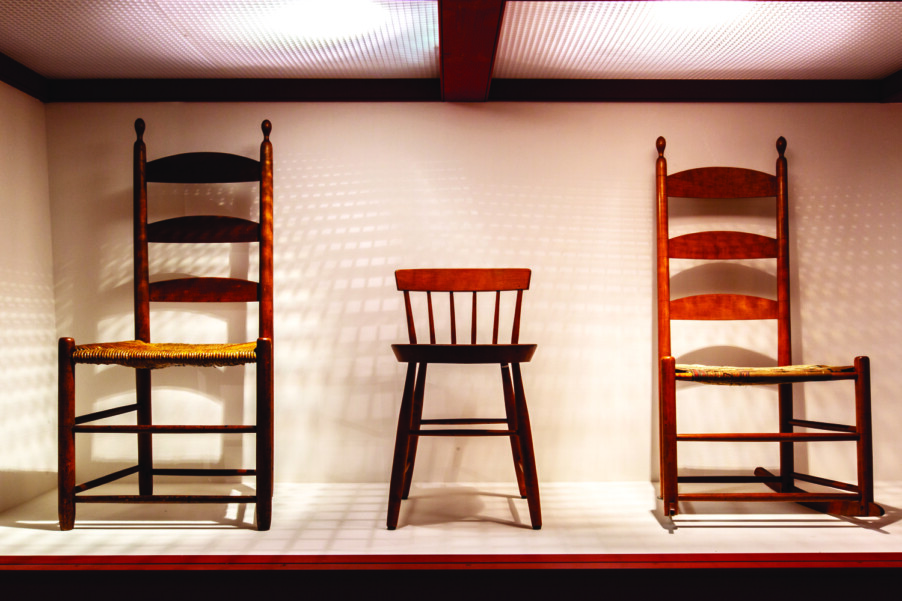
According to Garrett Bethmann of the Canterbury Shaker Village Museum, our modern conception of the Shakers — devout Protestants who lived in self-contained communities across the United States in the 1700s and 1800s — is intimately tied in with the objects they made. “I think the first thing [people think of] is certainly the more stereotypical artifacts and objects that feel very classified as Shaker and very much kind of have that Shaker aesthetic of clean lines, very efficient-looking use, very simple … look to them. So, you know, that’s kind of where you get into your furniture, your oval boxes, your brooms.”
On Saturday, Sept. 26, the Shaker Village Museum will present an interactive look at some of those objects, called “Artifact Speed Dating — Canterbury Shaker History in 10 Objects.” This event is part of “We Want More History!,” an initiative by the Organization of American Historians to present historical education at events on the same day at “libraries, parks, museums, and other civic spaces” across the country, according to the initiative’s website. “It responds to heightened public interest in history and historical interpretation. Historians and educators are positioned as scholars and teachers committed to the public good through evidence-based, contextualized understanding of the past, in order to promote excellence in scholarship, encourage wide public discussion, and advocate for history. It ensures that national commemorations reflect the full, complex story of the people and places that make up the United States.”
Which is where the Shakers and their objects come in.
Shirley Wajda, the Shaker Museum’s curator of research and collections, will lead an exploration of different Shaker objects and how we can determine when an object was made or used.
“It will be a lecture,” Bethmann said, “that allows people to see objects close up. It will be in the spirit of, ‘Check this out! Here is a little bit of history, information and context.’ It will be an interactive lecture.”
“The importance of establishing dates for particular artifacts,” Bethmann said, “is to be able to identify when a certain object was used … because that can be insightful as to how they used it and what they were using it for.”
By looking at objects the Shakers owned, Bethmann said, we gain a deeper understanding of the world around them and what kind of technology was available to them.
“I think the objects that can grab people’s attention,” he said, “are the objects that are less associated with Shakers [in particular]. For instance, one thing I always find cool when I’ve walked around the [Shaker] Village is in one of our areas we have a telephone. Seeing a telephone, electrical wires, and seeing an object that is more tied to a modern America or to kind of a contemporary outlook that doesn’t necessarily include our antiquated and kind of folkloric romanticism of them, I think people will always find those types of objects interesting because they find themselves saying, ‘Huh, really? I didn’t think this type of society would be into that type of technology or that type of innovation.’ In fact, Shakers in general were relatively welcoming and inclusive of innovative technologies and things that made their lives easier. Objects like that are more closely associated with American culture, and not Shaker-specific, and can be attention-grabbing for [modern] people.”
The objects themselves are being kept under wraps until the actual event, Bethmann said. “We’re not going to talk about the specific items because that would be a spoiler.”
Artifact Speed Dating — Canterbury Shaker History in 10 Objects
Where: Canterbury Shaker Village, 288 Shaker Road, Canterbury, 783-9511, shakers.org
When: Saturday, Sept. 26, from 2 to 3:30 p.m.
Tickets: General admission tickets are available through the museum’s website for $20, or $10 for museum members.
More: shakers.org and wewantmorehistory.org.
Featured photo: Courtesy photo.