
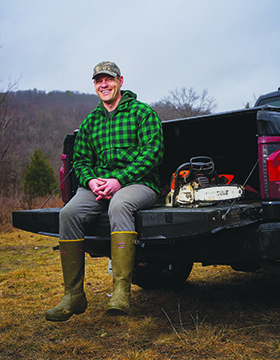
Ethan Tapper brings The Forest Year to Gibson’s
When Ethan Tapper began the follow-up to his New England Book Award winner, How to Love a Forest: The Bittersweet Work of Tending a Changing World, he was aiming for something lighter, like an almanac. His 2024 debut made the case that cutting trees, spraying invasive plants and hunting deer can be acts of devotion.
This one, he decided, should go down easier.
“I was like, I just want to write a book about how much I love birds, flowers and seasons,” Tapper said in a recent Zoom interview. However, he realized, “It’s impossible to write about loving all that stuff and not also address what we do to take care of it. If we go deep enough on this topic, it invariably becomes about stewardship.”
Tapper will talk about and read from his new book, The Forest Year: Finding Hope in a World Worth Saving, at Gibson’s Bookstore on Saturday, Oct. 24. He’ll also sign copies and take audience questions. The evening completes a busy day in Concord that begins with a UNH event, “How To Love An Urban Forest” at the Society for the Protection of NH Forests.
Like his first book, The Forest Year’s focal point is Bear Island, a 175-acre parcel in Vermont he purchased in 2017. The previous owner had high-graded it — logging the healthiest, most valuable trees and leaving the rest. Tapper recalled it as the most degraded forest he had ever seen, and set out to revive it. Today, it’s “diverse, beautiful and healthy,” he effused.
His model for the latest book was Aldo Leopold’s 1949 classic A Sand County Almanac, a work he believes still sounds radical. Leopold helped popularize phenology, the tracking of the seasons through nature. “It’s this cool practice of, like, observing the first serviceberry flower of the year, or when I hear the first warblers singing,” Tapper explained.
At the core of his stewardship argument is a rejection of two “delusions”: that ecosystems can continue to be exploited without consequence, and that forests battered by invasive species, deer overpopulation and climate change can heal simply by having a fence put around them. In some, cutting, culling or herbicides are warranted; in others they aren’t.
Tapper calls The Forest Year a book about hope, not alarm.
With protections for endangered species, public lands and wetlands under pressure, he worries about despair turning into apathy. “That’s one of the scariest and least helpful things human beings can do,” Tapper said. “When we’re hopeful, we actually do stuff …. I’ve started to believe that hope is a practice, and it’s also a responsibility.”
That responsibility doesn’t require a private forest, he continued — people can do it in their own backyards.
At his UNH talk on urban forests, he’ll suggest homeowners plant native species and make yards “more complex and rich with life than just a mowed lawn.” He also urges people to connect with local land trusts and conservation groups. As a county forester, he had a hard time getting people to show up.
Now audiences ask him where to start.
“I’m so glad to hear that, because your conservation community has been waiting to hear from you, and they’re ready,” he said. “The other part is connecting with those local conservation organizations, local land trusts and community groups, seeing where you can do the most good with advocacy and also with volunteering.”
The Forest Year’s central theme is staying, committing to one place, though Tapper acknowledges the irony of preaching this as he moves from one speaking engagement to another. “But I always come home,” he said, noting that travel, like his social media channels, helps build “the biggest platform possible from which to advocate for ecosystems.”
His online presence has grown to 400,000 followers, but it began as a line in his first book’s marketing plan.
Tapper’s DIY streak suits his punk band, The Bubs, still very active. “It’s the only thing I do that’s not about forests,” he said, adding, “If we only did things that were necessary, we wouldn’t make any music.” He makes a similar case for independent bookstores like Gibson’s, whose existence in an economy built on convenience is almost an act of resistance.
“These bookstores aren’t just going to magically be here,” he said. “The same thing is true for forests.”
Ethan Tapper – The Forest Year
When: Saturday, Oct. 24, 6:30 p.m.
Where: Gibson’s Bookstore, 45 S. Main St., Concord
Tickets: RSVP at gibsonsbookstore.com, 224-0562
Also: “How To Love an Urban Forest: A Conversation With Ethan Tapper,” 1:30 p.m., The Society for the Protection of NH Forests Conference Room, 54 Portsmouth St., Concord, register at ethantapper.com
Featured photo: Ethan Tapper. Photo by Corey Hendrickson.