
The many tasty uses for this green-skinned nut
Pistachios are beautiful, delicious and green. They make a pie crust shockingly good, and in the hands of an expert bartender they will make you completely rethink the whole concept of a mai tai.
And yet, until relatively recently, most of us rarely thought much about pistachios, or about the Emirate of Dubai. That changed with the craze for Dubai chocolate, which became suddenly famous about a year ago.
The Dubai craze
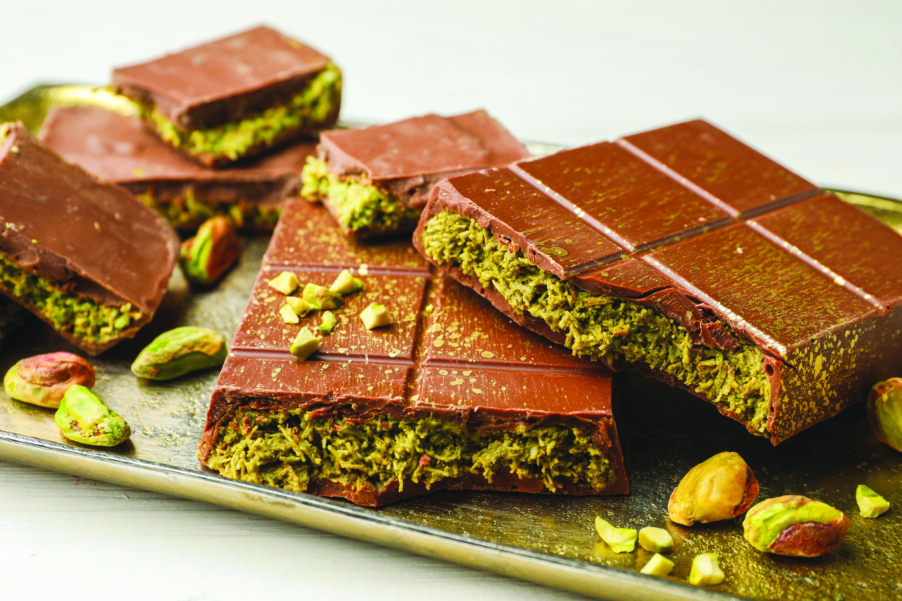
Made popular by Fix Dessert Chocolatier, an ultra-high-end chocolate shop in Dubai, “Dubai chocolate” is a style of dark chocolate filled with chopped filo pastry, tahini (sesame paste) and pistachios. Jaime Metzger, the manager of Granite State Candy Shoppe in Manchester, said customers started asking for it about a year ago.
“I think it was roughly last summer that it started to pop up all over the place,” Metzer said, “and it became a craze; it became a trend like all these new things, and then it kind of fizzled like trends do. But suddenly it came back again!”
The ingredient in Dubai chocolate that enthusiasts seem to have latched onto is pistachios. It might be their exotic green color, or their rich, slightly woody flavor, but it’s an element that customers feel strongly about, according to Trina Bird, the Head Baker at Lighthouse Local in Bedford. As it turns out, she said, pistachios can be a bit temperamental to work with.
“A lot of [makers] use pistachio cream,” Bird said. “Pistachio paste is all natural; it’s literally just pistachios, salt and a little bit of oil. But pistachio cream typically has sugar in it or white chocolate, which gives it a sweet creaminess. At first I was trying to make Dubai chocolate-treats with just the pistachio paste because I didn’t trust the ingredients in the ‘cream.’ But then what I figured out is I could use the paste and have our chocolate lady whip me up some white chocolate and I will drizzle a small amount of that in to promote emulsion, and that gives it what people want — they want that sweet spreadability.”
The key, under-appreciated ingredient in Dubai chocolate, Bird said, is the crushed filo dough, or kadayif. Because pistachios are pretty oily, pistachio paste has a tendency to leak out of whatever you’ve put it in. The threads of kadayif provide a matrix to help keep it in place.
Pistachio Butter
2 cups (250 g) roasted, salted pistachio nuts
1 teaspoon flavorful olive oil
Pinch of salt
Combine all ingredients in your food processor or blender, and blend until you break their spirit. First, the mixture will grind into a floury powder, but if you keep grinding/blending/processing it, the pistachios’ oil will start to be forced out and it will form a stiff paste. It will try to play on your emotions and pretend that it has no more to give, but if you keep working it, it will eventually break down into a runny peanut butter consistency. At this point, taste it to see if it needs more salt.
Alternatively, you could just buy some pistachio butter at the store.
Pralines and halvah
But clearly pistachios have a bigger role to play outside of Dubai chocolate. Pistachios have been grown in Iran for more than 8,000 years and are a critical part of food cultures throughout the Middle East. According to Master Chocolatier Richard Tango-Lowy, owner of Dancing Lion Chocolate in Manchester, while pistachios have a distinctive flavor, that flavor lends itself to a large number of applications.
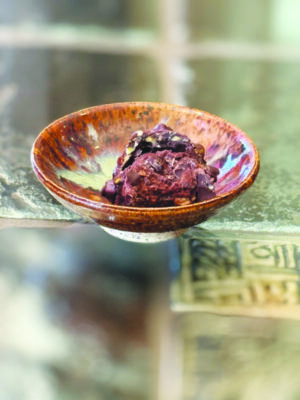
“When you taste pistachios,” he said, “they have a fairly unique, almost like slightly woody flavor to them when you pay attention. They’re native to Iran, where some of the most interesting foods are from. Hence, it’s common in Persian food. It’s an [ingredient] that you can easily use in savory applications. We tend to sort of pigeonhole things a lot, but the reality is [that] pistachios can go in a lot of different directions. If you’re doing a fish or chicken dish with some pistachio and brown butter, or maybe some Persian lime or something, it would be really good. Or, of course, you can go in the sweet direction with it.”
“We might do a praliné,” Tango-Lowy said, “which is kind of what Dubai chocolate is, which is cooking the nuts in molten sugar to make like a brittle. You lay it out for a day or so until it completely crystallizes and it’s really nice and hard. And then you break it up and grind it to a paste, and you get this beautiful sort of caramelly, nutty [building block], and you have a lot of control of the flavors you want to bring out of it. So those sorts of techniques are actually pretty old. Pralinés go way back in France but a lot of this stuff actually does go back to Persia.”
Another classic sweet way of using pistachios, Tango-Lowy said, is in halvah, a dry, crumbly, fudge-like confection.
“We’ve been doing a lot of halvah lately,” he said. “People are used to it with sesame seeds, but it’s also very frequently made with pistachios. And there are so many different ways of making halvah, depending on where you’re talking about. You have Israeli halvah. In Iran they put flour in their halvah, which is really different — wheat flour, which completely surprised me when I learned about it. It’s a much softer thing; it’s served for dessert. You scoop it or eat it with a fork. It’s a very different take on halvah. And you have Greek halvah, which is a different thing, yet again.”
“At its most fundamental,” Tango-Lowy explained, “you’re basically toasting sesame seeds, or in this case pistachios, grinding them into a paste with whatever spices you want, then pouring over hot sugar syrup and stirring it until it crystallizes. Halvah’s pretty easy to make. But then you can do it with other nuts. We’ve made halvah with pecans and maple.”
Moka Pot’s Pistachio Sauce
1 1/4 cups (125 g) shelled, raw, unsalted pistachios
2 Tablespoons unsalted butter
3/4 cup (190 g) whole milk or light cream, divided
4 ounces (115 g) high-quality white chocolate, chopped
2 Tablespoons confectioner’s sugar
1/4 teaspoon kosher salt
Boil the pistachios for three minutes, then drain them and rub them with a towel, to remove the skins. Set them aside to dry.
Combine the butter and about a third of the milk, and heat until the butter has melted. Add the chopped white chocolate and stir it until everything has come together. You can put the bowl over a pot of simmering water, or heat everything in your microwave, a few seconds at a time.
Add the pistachios, powdered sugar, salt, and the white chocolate mixture to a blender, and blend everything until it forms a paste. Add any remaining milk to the mixture, and blend it until it reaches a consistency you like. Remember that it will stiffen up as it cools, so you can probably afford to make it a little runny.
Pistachio latte
According to Angie Castro Andrade, cafe manager and co-owner of The Moka Pot in Manchester, pistachios make a staggeringly good latte.
“It gives it more of a nuttiness,” she said. “I like that creaminess to it, so when we decided to build a latte around it, I wanted to make the pistachio element myself. It turned out to be a little tricky. It’s full of oils, which doesn’t mix well with the espresso. We tried to just use the paste and it turns out that it just destroys the milk. So it’s like super hard to use just straight up.” Ultimately, she said, she and her team deconstructed the whole idea of a pistachio syrup, and broke it down to its very basic elements.
“We blanched [fresh pistachios],” she said. “Then we let them sit, and then like pulled the skin off of them. We cooked them down with white chocolate and milk and cream. It made this thick, like, almost like, chocolate sauce.” The white chocolate acted as an emulsifier, Castro Andrade said. “It was sweet, but not overbearing. “It was really, really good on its own. We were very tempted to just take it by the spoonful and eat it. But with the coffee, it was very delicious. We made a latte with it for St. Patrick’s Day because of the color. Everyone always uses mint for this sort of thing, and we wanted to go in a different direction; we called it The Nutty Irishman.”
By the scoop
For anyone over the age of 30 the word “pistachio” brings up memories of pistachio ice cream. Today it seems like an old-fashioned ice cream flavor, like rum-raisin, that probably is a bit of a food relic. You’d think that, said Victoria Riese, manager of the Puritan Backroom Restaurant in Manchester, but you’d be wrong.
“We have a couple of super-old-fashioned flavors that have had a real resurgence in popularity over the past few years,” Riese said. “Orange-pineapple is one, and pistachio is the other. At the Puritan, we make really good ice cream. But I think pistachio overall, that flavor is very in vogue right now. I think it all plays together. People are seeing more pistachio flavor out there, and they’re coming in and they’re asking for it. And our pistachio ice cream is very good.”
Pistachio is one of The Puritan’s original ice cream flavors, probably going back to when the restaurant started in 1917, Riese said. “I asked our ice cream maker, and he makes about 30 pints of it a week to sell. That’s on top of the [pistachio] ice cream we serve here at the restaurant and for takeout.”
Pistachio Ice Cream
¾ cup (180 g) pistachio butter (see page 10)
¾ cup + 2 Tablespoons (180 g) sugar
2⅔ cups (660 g) half and half
pinch of salt
⅛ teaspoon vanilla
Combine all ingredients in a blender or food processor until thoroughly combined.
If you have an ice cream maker: Chill this ice cream base for several hours, then churn according to the manufacturer’s instructions.
If you do not have an ice cream maker: Pour this base into a large zippered plastic bag. Lay it on its side in your freezer until it has frozen solid. Break it into chunks, then blend it in your blender. It will break down into soft-serve consistency (which is what an ice cream maker would produce). Spoon it into freezing containers, and harden it in your freezer for two hours or overnight.
This is a simple classic pistachio ice cream. How green it is will depend on the pistachios in your pistachio butter.
Other treats
According to baker Trina Bird, the taste of pistachios works extremely well in baked goods.
“It’s a very pure flavor,” Bird said. “It’s not like it’s a strong flavor, but it insists upon itself.” Because of its woody richness, it’s complemented by floral flavors like rosewater, she said. It’s a classic Middle Eastern combination. “Our baker who makes all our scones,” she said, “makes a rosewater-pistachio scone and it is so popular!”
What a baker needs to keep in mind when they bake with pistachios, Bird said, is giving the pistachios the support they need. Toasted pistachios are fine sprinkled on top of baked goods, or added inside a muffin or a scone, but if someone wants to really highlight pistachios’ flavor and color, they will probably want to use pistachio paste, which means they’ll have to face the runniness issue again.
“I like to swirl it into a brownie or a blondie,” Bird said. “That way, as the base bakes super-firm; it will hold the pistachio in a sort of a matrix. That’s why [pistachio] is also a great filling for a cupcake — it’s completely surrounded by cake that keeps it from running away.”
Other drinks
Phil Mastroianni is the co-owner of Fabrizia Spirits in Salem. His company makes premium limoncello, but also pistachio liqueur.
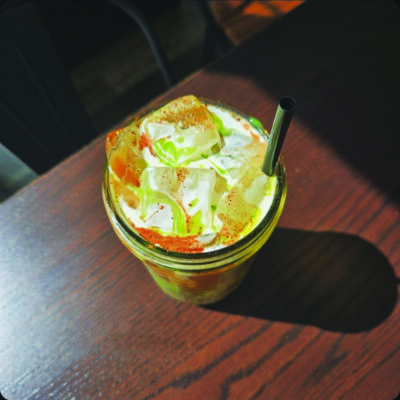
“A lot of our customers in the North End of Boston were telling us, ‘You know, we’re getting more people that are asking for pistachio martinis. Would you consider making [a pistachio liqueur]?,’” he remembered. “And so I went into the lab and it was without a question the most challenging recipe we’ve developed. What I found out is while there’s like more or less one recipe for limoncello — lemon zest, alcohol, sugar and water — there’s no set recipe for pistachio liqueur. … At the time, I started buying some pistachios from California. We tried roasted ones. We tried fresh ones, then just dry, not roasted. And ultimately we came up with a recipe to launch a pistachio liqueur. And the only change we’ve ever made to that recipe is a couple of years in when it was doing well and we said, wait a minute, we bring our lemons in from Sicily, and Sicily is known for pistachios. We started buying our pistachios directly from one family on the backside of Mount Etna in the small town of Bronte — which is famous throughout the world but definitely in Italy — for its pistachios.”
The key to great-tasting pistachios, Mastroianni said, is toasting them.
“What people really like about pistachios,” he said, “what I’ve learned even from my own consumer standpoint is that what we like about the pistachio is as much the toasting and the taste of the charred pistachio. In our liqueur, the toasty, almost decadent pistachio flavor is, in my opinion, what really connects people’s minds with their enjoyment of our final product.”
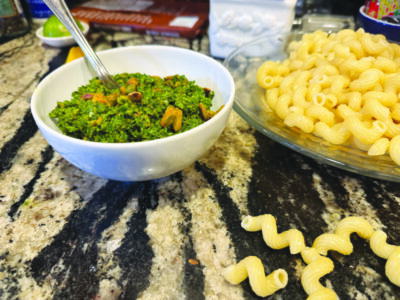
Pistachio Pesto
½ cup (65 g) roasted, shelled, salted pistachio nuts
2 Tablespoons fresh squeezed lemon juice
1 clove of garlic, peeled
sea salt to taste
freshly ground black pepper to taste
1 1/2 cups (about 75 g) fresh basil leaves
1/2 cup (about 25 g) fresh parsley or cilantro
¼ cup or so (about 55 g) of your favorite olive oil
¼ cup (about 15 g) of grated parmesan cheese – not the dust in the green tube
Some of the measurements above are a bit vague. One of the liberating things about making pesto is that it is very much a “handful of this” and “a pinch of that.” Do you have super-flavorful basil in your garden? You might want to add less — or more — of it. Did you forget to buy actual Parmesan cheese but find a mummified lump of cheese at the back of the refrigerator that you can grate with your food processor? Cool.
Add the pistachios, lemon juice, garlic, and herbs to your food processor or blender. (If you’re feeling really old-school, you could pound all this in a large mortar and pestle.) Mix/chop/grind it up, until it forms a paste. Drizzle in the olive oil, a little at a time. If you try to pour the whole amount in at once it will be too much for your pesto to deal with emotionally, and it will break into an oily mess. You know that hole in the lid or your blender, or the little holes in the insert for your food processor? This is what they are there for.
Mix everything until you are happy with it.
Transfer the pesto to a bowl, and mix the cheese in. If you can manage to get it to the table before it is all “tasted” away by kitchen bystanders, serve this pesto on a twisty ridged pasta that will hold onto it.