
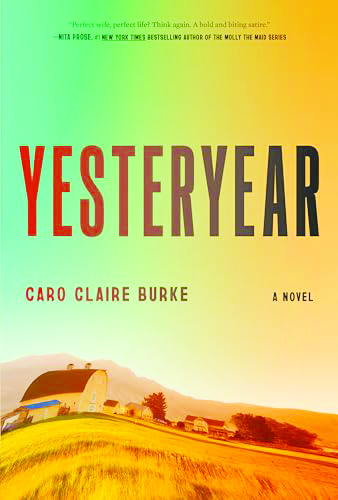
(Alfred A. Knopf, 391 pages)
One of the stranger things to emerge from the internet is the tradwife influencer, a woman who uses the most modern of technology to promote a lifestyle that is decades or even centuries old.
Natalie Heller Mills is that woman, though the fictional creation of Caro Claire Burke’s soon-to-be-blockbuster novel Yesteryear. Think Ballerina Farm or Nara Smith or any other influencer with millions of followers who makes her own butter in which to fry eggs that she has collected from her yard in a flowing dress. Then give her an affable, aimless husband who is part of a political dynasty, a $5 million infusion in cash and a staff. It’s a novel made for our time, which is why Amazon has already acquired the film rights.
Burke brings a cynical eye to the enterprise, not so different from the “Angry Women” in the Instagram comments that Natalie is always complaining about. A blurb on the book cover calls it a “bold and biting satire,” but it’s darker than that, and Yesteryear tests how long a reader is willing to stick with a narrator who is deeply unlikeable.
When we meet Natalie, on “the last day of the life I imagined for myself,” she is living her best life, or at least the best life she presents to the world, on a 500-acre farm in Idaho, where she lives with her husband, Caleb, and five improbably named children: Clementine, Stetson, Samuel, Jessa and Junebug. Other than giving birth, she does very little mothering. Or farming. Two nannies who share small quarters in a barn do the child care and homeschooling, while Natalie mostly putters about being filmed while she does things like make sourdough boules with herbs positioned in the shape of a Nativity scene.
Natalie’s followers on social media love her and hate her. She mostly hates them. “It was a symbiotic relationship. I was a shark, and they were five million tiny fish, nipping at the nutrients along my belly,” she observes. “Little idiots. They were desperate to eat me. They had no idea I was the one who was keeping them alive.”
She built a profitable business, follower by follower, by showing them carefully curated images of her idyllic life and then selling them things in her online store. She has no moral qualms about putting her kids out into the world on social media, “Their best selves preserved inside the four walls of my phone like little bugs preserved in amber.”
But there are signs that things aren’t quite what they seem to be. She’s estranged from her sister, who also has five kids, and is mildly obsessed with the career path of her college roommate, Reena, even while having contempt for the life Reena has chosen. Clementine, turning 13, suddenly doesn’t want to be photographed. Her producer and videographer of two years has suddenly given notice, leaving a cryptic note that says, “I don’t think you’re a bad person. I think you’re just confused.” There are allegations of assault and adultery.
As bad as all that is, nothing is as bad as Natalie waking up one morning, freezing cold, in her house that isn’t her house anymore but is a rough cabin with no modern amenities, showing the date as 1855. In this house, she has a husband, also named Caleb, and four children, who look somewhat like hers but aren’t. But they all seem to think she is their mother.
When Caleb and Natalie had moved into the ranch they called Yesteryear, they’d spent untold money gutting it of modern renovations and making it look old but in a luxurious way: It had modern kitchen appliances but all hidden from view, a clawfoot tub “dripping in natural light” and a $30,000 chicken coop with doors that open and shut automatically. This was pioneer living, the kind that her great-great-grandparents lived. Terrified, she tries to flee, but finds this new version of her husband has turned abusive.
From there, we go back and forth into Natalie’s old life, and Natalie’s new life, slowly learning how the magical, fictional Yesteryear world came to be, and trying to figure out, with Natalie, how and why she came to be in this new, horrible place. Is it a reality show that she’s been deposited in without her consent? Is she going mad or being drugged? Which world is real?
It is a long time getting to the answers; Burke has shrewdly plotted this corn maze, although she overplays her hand with symbolism that is rich with contempt for religious zeal. Natalie was raised by a religious woman, and she makes a show of piety herself in ways that at times seem overly calculated. In one memorable line, she muses, shockingly, that Mary Magdalene was a woman who understood her assignment. It’s a line that will thrill the secular elites, but perhaps not land so well in the deep South. Then again, as we learn from the opening pages, Natalie is not meant to win our hearts, but to mess with our heads.
This is not a book that will warm your heart in any way, but it will keep you engrossed as it spins you every which way like a clothes dryer (which you will appreciate all the more for having spent some time in Natalie’s 1855 world). I closed the book wanting to shake it off like a bad dream. Will I watch the movie, which Anne Hathaway has already signed on to? Absolutely, because once she is in your head, Natalie will not easily leave. She’s not the Hannibal Lecter of tradwives, but she’s definitely no Ballerina Farm either — or rather let’s hope Ballerina Farm is no Natalie Heller Mills. A
Featured Photo: Yesteryear, by Caro Claire Burke