
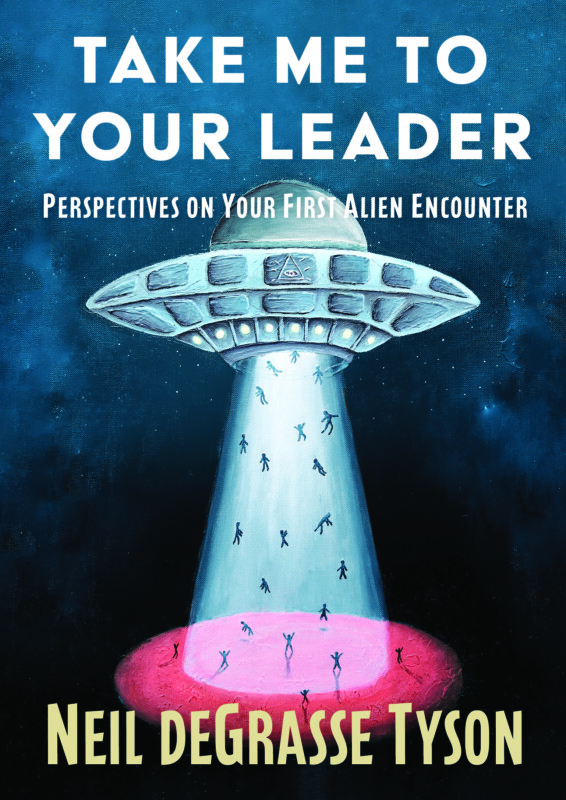
(Simon Six, 226 pages)
Aliens are having a moment.
Of course, it could be argued that they’ve been having a moment since 1961, when Betty and Barney Hill, a Portsmouth couple on their way home after visiting Canada, said they encountered a mysterious disc-shaped aircraft near Franconia. Their story is among the most famous of so-called alien abductions.
The Hills, however, appear only briefly in Neil deGrasse Tyson’s Take Me To Your Leader, a semi-serious handbook of alien adventures. Capitalizing on the current interest in all things extraterrestrial, driven in part by the new Steven Spielberg film Disclosure Day and the slow drip of formerly classified UAP [formerly known as UFO] videos coming from the government, the book proposes to tell us how to interact with our new alien friends (or overlords) when they come.
Tyson, according to his publisher, is America’s favorite astrophysicist, so you might think he would bring a serious, scholarly bent to the subject. You would be wrong. The book, at times, is more like a BuzzFeed reporter ran a couple of questions about aliens through Claude, and out came this manuscript.
Tyson begins by talking about aliens in popular culture. There have been a lot of aliens in movies and TV shows, probably more than you recall. And as he recounts them, Tyson wonders why they are always so human-looking and predictable, with a few exceptions, like Project Hail Mary.
“Once, just once, I want to see a gray Alien portrayed with a full head of coiffed hair,” he writes.
Humans pride ourselves on our intelligence and imagination, but we probably shouldn’t. Voltaire conceived of aliens 23 miles tall, and astronomer Frank Drake of aliens the size of a pinhead, and Tyson offers 12 archetypes of aliens, but few of us go beyond little green men.
That may be because, as Tyson points out, there is just 2 percent of DNA that separates us from the chimpanzee. He invites us to consider the differences in capabilities between humans and chimps, and then to consider aliens that are 2 percent more advanced than us — or 20 percent. “For all we know, they created Earth as a literal aquarium-terrarium for their own amusement,” as we do with fish, turtles and ants. “Do they know we built their domicile? Do they know we are looking in on them through transparent walls? Do they care?”
And of course, building a world like ours, or the one in The Matrix, is “nothing that a smart Alien couldn’t accomplish in an afternoon.”
Tyson, director of the Hayden Planetarium at the American Museum of Natural History in New York City, brings a wrecking ball to every commonly held notion about extraterrestrials. In a chapter on what alien technology would look like, he concludes that “smooth, rotating flying saucers are not a thing,” because the staid, steady laws of physics are literally universal. He goes on to explore what’s known as Fermi’s Paradox (named for the Italian-American physicist Enrico Fermi), the conundrum presented by the probability that life exists outside our planet and the lack of actual evidence for it. That lack of evidence should relieve us, given our vast vulnerabilities. As Tyson notes, “The world’s fastest human, Jamaican sprinter Usain Bolt, would be easily caught and eaten by a half dozen different species of mammal predators.” That said, it could also be the case that the evidence for aliens is just not apparent to mere mortals: “We are three-dimensional creatures. Nothing to stop an Alien from living in four or five or more dimensions. If they never deigned to pass through our measly three dimensions, we would never know they were there,” Tyson writes.
So where does America’s favorite astrophysicist stand on all of this? Do aliens exist or not? In his conclusion, Tyson offers his response to an invitation he received to inspect purportedly alien mummies recovered in Peru. In declining, he encouraged the team to publish their research in a peer-reviewed journal and offer samples of the specimens to scientists for analysis. “We do this for findings much less extraordinary than what you have presented. … So it will never be about what I think, it’s about the quality of the data and its verification.” (Reviewer’s note: Scientists later said the “mummies” were dolls made with human bones.)
So until there is a peer-reviewed study of alien remains, he says, “Alien visitations will remain a belief system like any other.”
It’s notable that throughout Take Me To Your Leader Tyson says things like, “Nobody knows how or why that happened.” I’m not sure if it’s reassuring or disturbing that astrophysicists still know so little about the universe, but rest assured, Tyson knows much more than most of us.
Regardless, when it comes to aliens and alien culture, this is a thin and often frothy take on the subject. You can do better with Matthew Hongoltz-Hetling’s The Ghost Lab, published last year. C —Jennifer Graham
Featured Photo: Take Me To Your Leader, by Neil deGrasse Tyson