
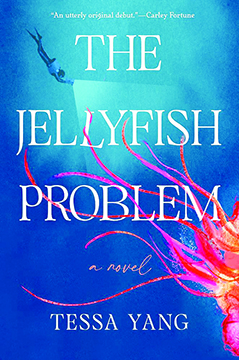
(Berkley, 373 pages)
You’d never know it from the title, but Tessa Yang’s The Jellyfish Problem is a good, old-fashioned ghost story, the kind to lose yourself in on chilly weekends in October when you’re not out pumpkin spicing or leaf peeping. It’s a bit fantastical, as ghost stories usually are, and asks us to care a bit too much about an invertebrate that lacks a brain and heart. But this is a mystery/thriller informed by marine science, and we will learn about jellyfish whether we want to or not. The author, Tessa Yang, clearly intends for us to appreciate jellyfish more after reading her debut novel, but that may not be the effect.
Dr. Jo Ness is a marine biologist who has been obsessed with jellyfish since childhood, when she came across one at the beach and admired “a raw gray thing slouched on the sand like an angel’s lung dropped from heaven.” All grown up now, she worked her way into a job at a struggling aquarium where she tends jellyfish in the first, tiny stages of life while working on a book about jellyfish with her best friend — a brash South American scientist named Aldo who has a remarkable resistance to animal venom.
Jo, who always said she liked jellyfish more than people, made an exception for Aldo, but he died in a scuba accident seven months ago, and Jo is still mourning. They were diving together but became separated in poor visibility, and Jo is wracked by the sense that she was responsible for Aldo’s death.
His loss was the second blow since she finished college: The first was becoming estranged from her college best friend, Nadia, a woman with whom she thought she had the makings of a romantic relationship. But Nadia went AWOL after commencement and they haven’t spoken in 11 years. She knows nothing about Jo’s current life other than that she had been obsessed with jellyfish. Then she unexpectedly calls and tells Jo she is living on an island off the coast of Maine and that they have a “jellyfish problem.”
Nadia doesn’t offer much more information and admits she hasn’t seen the creature herself. But Jo, listless and miserable since Aldo’s death, has plenty of accrued leave and books a cross-country flight, interested not only in the mysterious jellyfish but also in the possibility of rekindling her relationship with Nadia, or at least learning why it abruptly ended.
What she finds there, however, is nothing she expected. Nadia is happily married and nowhere to be found. The jellyfish is singular, not plural. It is said to be a massive, brightly colored, luminescent creature that appears for three days at the time of the full moon and has a strange effect on the locals who see it. They regard the jellyfish as not a fascinating object of study but a literal sea monster, the kind that Jo’s Japanese mother used to tell her stories about when she was a child.
Complicating matters is the geographic isolation of Shattering Point, “800 acres of spruce forest and granite shorelines and bracing, choppy waters that deter all but the gutsiest swimmers.” Twenty-two miles off the Maine coast, the island is reachable by ferry twice a week, but only during the summer season. Other times, to get on or off the island, you have to take an air taxi or catch a ride with the mail boat, which only goes out once a week.
Even though the island relies on tourists during the summer, Jo is not universally welcomed. Some of the islanders are hostile to her, and as she tries to find Nadia and unravel the mystery of the jellyfish, which the people of Shattering Point call Clementine, there is a bitter divide about what should be done about the jellyfish. The danger is not exaggerated or imagined: People are physically affected by even seeing Clementine, and one man has to be hospitalized.
That said, Clementine is not the ghost of this story, but an apparition that Jo begins seeing, which she understands to be a yōkai, a supernatural being that her mother used to tell her about.
The relationship Jo has with her mother is one of the many layers in the story: Her father, who used serve as an intermediary of sorts between mother and daughter, is dead, and their relationship is both distant and fraught, in part because the mother is resistant to her daughter’s sexual orientation and had been hoping that Jo would marry Aldo.
Each chapter of The Jellyfish Problem begins with an excerpt of the book that Jo and Aldo were writing, which serves not only to only impart jellyfish information but also to give us a glimpse of the closeness between the two. The conversation in the document’s editing notes grows poignant over time, and Jo begins to speak to her dead friend in editing mode, as if hoping he could see it. It’s a small but smart thing that Yang does to break up a novel that can feel overly long at times, especially when the suspension of disbelief is called for repeatedly.
When the explanation of everything arrives, it is — well, let’s just go with unusual: perhaps not wholly satisfying, but consistent with the novel’s intelligent foundation and supernatural overlay. The quirkiness of the story, however, is eclipsed by the gorgeous writing. Yang has the voice of a poet and hardly a page goes by without some elegant sentence construction that makes you take note of its grace. Give her bonus points, also, for assigning a cameo role to the University of New Hampshire. Wildcats beat jellyfish every time. A
Featured Photo: The Jellyfish Problem, by Tessa Yang