Getting the most from our state parks

Explore camping, hiking and puzzle-solving at New Hampshire’s outdoor gems

New Hampshire has 93 state parks offering recreation for outdoor-lovers (or just the outdoor curious) of all interests. And not all the action is up north — there are several parks in and close to the southern part of the state providing you a place to camp, hike and have other adventures out in the fresh air. Looking for something new to do this summer? Here are some ideas to help you get the most out of our state parks.

Camp it up

Get away at a local state park

By Matt Ingersoll

mingersoll@hippopress.com

You don’t need to go far to find a campsite within New Hampshire’s state park system — there are 23 campgrounds statewide with a total of 1,419 campsites, offering a wide variety of opportunities from tents and cabins to some RV sites with water, sewer and electric hookups.

New Hampshire has experienced a steadily large increase in outdoor recreational activity across the board, including camping in state parks and private campgrounds. According to Shawn Hamilton, deputy supervisor of state park operations, the 2021 calendar year saw a record-breaking number of campers — more than 135,000 — within the state park system. Two years earlier, in 2019, a total of 118,000 campers utilized the parks, also a record at the time.

“We have campers who have been coming to the state parks every summer for 50 to 60 years, and that’s not an exaggeration,” Hamilton said. “It’s almost like a badge of honor for them, something that they take pride in. … It’s such a nostalgic experience for people to go back every summer and experience what they have with their parents, and now they share it with their kids.”

Campgrounds within the New Hampshire state park system are operationally self-funded, and there are all kinds of ongoing projects to improve their quality and accessibility. Bear Brook State Park in Allenstown, for instance, has 110 sites with recently renovated cabins, Hamilton said. Five dishwashing stations were also recently installed at Greenfield State Park’s campsites.

A majority of the state park campgrounds offer traditional tent camping or cabins, but there are three — Hampton Beach State Park, Franconia Notch State Park and Ellacoya State Park in Gilford — that have full-service RV parks with hookup sites.

“We just recently upgraded the amperage at Hampton Beach State Park to better accommodate some of the newer RVs that are coming on to the market,” Hamilton said. “We’re planning to do the same at Ellacoya in the near future.”

Other sites, like Pawtuckaway State Park in Nottingham, offer multiple activities to campers.

“You can go to the beach one day, rent some boats and go out on the water … but then at the same time, the next day you can go out on the hiking trails,” Hamilton said, “so I think that type of versatility in terms of what we offer is really what people respond to. … At most of the parks we offer playgrounds as well. We make a concerted effort to add and upgrade the playgrounds so that the kids are fully occupied and having fun for the whole day.”

While July and August are two busiest months of the year for camping in the state parks system, Hamilton said the season runs from April through October. Campsite reservations can be made on the state park’s website up to 11 months in advance of your arrival date.

“Some of the campgrounds offer a couple hundred sites just in and of themselves … so there’s a lot of opportunity within each park as well,” Hamilton said.

Where to camp at some of New Hampshire’s state parks

Here’s a list of southern- and central-area campgrounds and RV parks within New Hampshire’s state parks system. Campsite reservations can be made online 24 hours a day and up to 11 months in advance. Visit nhstateparks.org or call 1-877-nhparks (647-2757) to reserve your spot. Rates cover two adults and up to four children on the site (maximum number of adults per site is four, with a maximum of six people total). A fee of $6.50 applies for all reservations, with $10 per night for each additional adult and $5 per night for each additional child.

Bear Brook State Park
61 Deerfield Road, Allenstown, 485-9869
Cost: Ranges from $25 to $55 per night, depending on the site (no hookups)
At more than 10,000 acres, this is the largest developed state park in New Hampshire. Campers have two options within the park — Beaver Pond Campground (600 Lower Road, Deerfield), as well as the cabins at Bear Hill Pond (15 Bear Hill Pond Road, Deerfield), featuring two sizes occupying up to four or six people. The cabins are furnished but do not have electricity. There is also an Adirondack-style lean-to shelter overlooking Smith Pond. Renters have access to two wide wooden bunks, a stone cook place and two outhouses inside.

Ellacoya RV State Park
266 Scenic Road, Gilford, 293-7821
Cost: $47 per rig per night (includes water, electric and sewer hookups)
Located on the southwest shore of Lake Winnipesaukee, Ellacoya State Park features an RV campground with 37 available sites by reservation only. Each offers three-way hookups. All of the sites are open daily to reserve now through Columbus Day weekend (no tents or pets are allowed inside the RV park).

Greenfield State Park
52 Campground Road, Greenfield, 547-3497
Cost: $25 per night (no hookups)
This 400-acre park features 256 campsites that are available by reservation only, including family group campsites with two Adirondack-style shelters. RVs are welcome in sites where they fit, but no hookups are available. Leashed pets are permitted in the campground but are prohibited in the park’s day-use and beach areas.

Hampton Beach RV State Park
160 Ocean Blvd., Hampton, 926-8990
Cost: $50 per rig per night (includes water, electric and sewer hookups)
According to the New Hampshire state parks website, this is the only RV park directly on the coast, at the mouth of the Hampton River. The park is located south of the main part of Hampton Beach on Route 1A, at the Seabrook town line. There are 28 sites that are open for reservations now through Columbus Day weekend. Camping units must be able to hook up all three services (water, electric and sewer) and be self-contained — no pop-ups or tents are allowed.

Monadnock State Park
169 Poole Road, Jaffrey, 532-8862
Cost: $25 per night (no hookups)
Gilson Pond Campground became the first new camping area in the New Hampshire state parks system in more than 40 years when it opened in July 2010. Located just down the road from the headquarters area of Monadnock State Park, Gilson Pond Campground has 35 sites that can accommodate tents and pop-ups, as well as five remote hike-to sites. There are several trails leaving the area that lead to the summit of Mount Monadnock.

Mount Sunapee State Park
86 Beach Access Road, Newbury, 763-5561
Cost: Ranges from $23 to $29 per night, depending on the site (no hookups)
Mount Sunapee State Park has a campground with 11 sites that offer either lean-tos or tent platforms. The sites are wooded and are for tent camping. One campsite is non-reservable and available for walk-in campers.

Pawtuckaway State Park
7 Pawtuckaway Road, Nottingham, 895-3031
Cost: Ranges from $25 to $30 per night, depending on the site (no hookups); cabin reservations are $65 per night or $360 per week
This state park’s campground includes nearly 200 wooded sites, providing many views of Pawtuckaway Lake. Each campsite has an open fire ring, a picnic table, flat areas for a tent, and a parking space. There are no hookups at any of the sites, but the bathhouses are equipped with running water, flush toilets and 24-hour-access coin-operated showers. There’s also a camp store where canoe and kayak rentals are available, as well as a public canoe and kayak launch. Pets are not allowed in the campground or beach area of the park.

Pillsbury State Park
100 Pillsbury State Park Road, Washington, 863-2860
Cost: $23 per night (no hookups)
Pillsbury State Park’s campground is open for reservable stays now through Columbus Day weekend. Amenities include handicap-accessible pit toilets, a playground, a kayak and canoe rentals, firewood and a boat launch for non-motorized boats. Eleven of the 41 campsites are remote and accessible by foot or canoe only.

Parks and treks

Hike the day away in a local state park

By Katelyn Sahagian

ksahagian@hippopress.com

New Hampshire is home to a variety of state parks with trails carving through them, showing off the state’s beauty to new and experienced hikers alike.

“Science has proven that a lot of the healthy chemicals in our bodies rise when we are in green space, so just being [in nature] is really important for people,” said Jake King, a co-founder of Thrive Outdoors, a team-building and leadership organization based in Manchester.

State parks are popular places to take a hike, and many are home to everything from beginners’ nature walks to advanced mountain passes. King said that it’s important to differentiate the two.

group of young people posing on rocks at top of mountain after hike
Pleasant Mountain hike with Gear Up. Photo courtesy of Thrive Outdoors.

It’s important for people who are new to getting into nature and walking to do something on the easier side, like going up to New Hampshire Audubon’s McLane Center in Concord.

“There are nature walks, and they shouldn’t be considered hikes,” King said. “People who are going to start hiking are going into more remote areas and [taking] on more of a challenge.”

Hiking has always been a popular pastime in the Granite State, said Kimball Rexford, the creator of TrailsNH.com. But during the height of the pandemic, he said, it has exploded in popularity.

“Since Covid, like everything, all popular hikes are more than double than what they used to be, maybe even triple,” Rexford said. “It’s starting to come down and people are less nervous being around others, but during Covid, hiking was through the roof.”

Across the board, the most recommended trail on both the Hike NH and Girls Hike NH Facebook groups was Pawtuckaway State Park’s South Loop. Many group members suggested that people take the hike up to the fire tower for a beautiful view.

Rexford suggested a more challenging trail within Pawtuckaway State Park.

“I usually do the North Loop,” he said. “It has a long bony ridge, meaning it’s rocky. It’s a lot of bang for your buck.”

King’s favorite trail, the Cardigan Loop, is for hikers who feel comfortable with the activity, but the trail isn’t extremely challenging by any means.

“It’s got beautiful views and it’s not super remote,” he said. “People walk their dogs and run on the trail. It’s not [as] if you were to go up the [White Mountains] where you won’t see someone for days.”

While Rexford’s website is a good place to find what’s currently popular and trending for hiking, people who are members of hiking Facebook groups, like Hike NH, will help and offer suggestions for their favorite paths.

“Pawtuckaway is unbeatable for what it is,” commented Randall Schanck, a member of Hike NH, in response to the Hippo asking for state park hiking recommendations. “[It is] big enough to explore for a long day and [there is] so much to see if you know where to look. It might as well be Jurassic Park.”

Terra Anna Merry, a member of Girls Hike NH, also said that she enjoys hiking in Pawtuckaway, but added that there were beautiful hikes in Northwood Meadows State Park in Northwood, Odiorne Point State Park in Rye, and Bear Brook State Park in Allenstown.

Rexford said that the Granite State has a seemingly endless number of trails, peaks and loops for avid hikers to explore.

“There’s a lot of everything,” he said. “You could spend a lifetime hiking in New Hampshire and not do it all.”

Where to go hiking in New Hampshire’s state parks

The Hippo reached out to the local Facebook groups Hike NH and Girls Hike NH for suggestions from members on the best trails to hike within New Hampshire’s state parks. Here’s a list of what we received for responses. Visit nhstateparks.org for more details on each trail.

Bear Brook State Park
157 Deerfield Road, Allenstown, 485-9869
Trail: Catamount Loop
Difficulty: Strenuous

Cardigan Mountain State Forest
658 Cardigan Mountain Road, Orange, 227-8745
Trail: Mount Cardigan Loop
Difficulty: Moderate

Miller State Park
13 Miller Park Road, Peterborough, 924-3672
Trail: Wapack Trail
Difficulty: Moderately strenuous

Monadnock State Park
169 Poole Road, Jaffrey, 532-8862
Trail: Wantastiquet-Monadnock trail
Difficulty: Moderately strenuous

Northwood Meadows State Park
755 First New Hampshire Turnpike, Northwood
Trail: NALMC Trail
Difficulty: Moderate

Odiorne Point State Park
570 Ocean Blvd., Rye, 436-7406
Trail: Odiorne Point Trail
Difficulty: Easy

Pawtuckaway State Park
7 Pawtuckaway Road, Nottingham, 895-3031
Trail: South Mountain Tower Trail
Difficulty: Moderate

Rhododendron State Park
424 Rockwood Pond Road, Fitzwilliam, 532-8862
Trail: Wildflower Trail
Difficulty: Easy

Wellington State Park
614 W. Shore Road, Bristol, 744-2197
Trail: Peninsula Nature Trail
Difficulty: Easy

Winslow State Park
475 Kearsarge Mountain Road, Wilmot, 526-6168
Trail: Rollins Trail
Difficulty: Moderate

Hiking difficulties source: National Park Service, nps.gov

Essential hiking gear
Visit hikesafe.com for more details.
• Pocket knife
• Rain jacket and pants
• Fire starter
• First aid kit
• Whistle
• Headlamp or flashlight
• Water and food
• Warm clothing
• Compass
• Map

The non-hiker’s guide

State park fun for the hiking-averse

By Hannah Turtle

hturtle@hippopress.com

Maybe hiking isn’t your thing. Maybe you don’t look forward to a trudge among the flora and fauna amid the summer heat. Luckily, this does not exempt you from enjoying the many state parks in southern New Hampshire.

Outside of hiking, there are a plethora of activities available for park-goers, including educational and beautiful historic sites, boating activities and the exciting hunt for geocaches.

Historic sites

For those interested in learning some local history, or for museum-frequenters who want to get outside this summer, here are some great options:

Fort Constitution Historic Site
25 Wentworth Road, New Castle, 271-3556
Located on a peninsula on the northeast corner of New Castle island, the ruins of Fort Constitution provide a great picnic spot for those interested in American history. First used during the War of 1812, the Fort also served as a training site during the Civil War, and was updated in 1897 to be used during the Spanish-American War, as well as World Wars I and II. Returned to the state in 1961, it now sits as a historic landmark with gorgeous views of the water. Source: nhstateparks.org

Fort Stark State Historic Site
211 Wildrose Lane, New Castle, 271-3556
Historically known as Jerry’s Point, Fort Stark sits on the southeastern peninsula of New Castle Island. Built following the Spanish-American War, the fort helps preserve the history of the island as an important military operation used during World War II. Of note is the Ordnance Machine Shop Museum, which displays military artifacts as well as a detailed history of the fort. Source: nhstateparks.org

Robert Frost Farm Historic Site
122 Rockingham Road, Derry, 432-3091
See the farmhouse of the late renowned poet Robert Frost, where he lived with his family from 1900 to 1911. In addition to being the setting for some of Frost’s most acclaimed poems, the site offers a variety of activities for visitors, including poetry readings and a self-guided tour of the property. Source: nhstateparks.org

Wentworth-Coolidge Mansion
375 Little Harbor Road, Portsmouth, 436-2233
Home to New Hampshire’s first royal governor, Benning Wentworth, the Wentworth-Coolidge mansion is a feat of 18th-century architecture. With tours of the sprawling mansion available every day this summer (which include a spy closet), and a gorgeous waterside walking path, the site is a must-see for fans of local history. Additionally, the grounds are covered in purple lilacs, descendents of the first European stock imported by Wentworth. Source: nhstateparks.org

White Island Historic Site
Rye, 271-3556
Visit New Hampshire’s only off-shore lighthouse on White Island for a whole day’s worth of historic sights. Originally built in 1820 and rebuilt in 1859, the lighthouse has seen many influential visitors and residents. Acclaimed poet Celia Thaxter was the daughter of the lighthouse’s keeper and wrote many of her works about that period. White Island itself is nestled in the Isles of Shoals, originally known as the Smith Islands (named after Jamestown settler Capt. John Smith). Source: lighthousefriends.com

Geocaching

Originating in 2000 in Oregon, geocaching has had a recent resurgence in popularity amid Covid. By downloading the free “Geocaching” app available for any smartphone, users can hunt for hundreds of hidden treasures called “caches” all over various area parks. The app gives mysterious clues as to the exact location of each cache, and turns any regular hike into an interactive scavenger hunt. It’s perfect for families with curious children, and for anyone who enjoys solving a mystery. When a cache is found, simply sign your name in the log book and leave it for the next person to find.

There are geocache locations hidden in every local state park, and the larger walking trails provide opportunities for finding upwards of 10 caches. For a geocaching challenge that doesn’t require the app download, we’ve hid our own geocache in one of New Hampshire’s state parks — test your mettle and see if you can solve the riddle and find our cache:

Whose cache this is I think I know
His box is rather hidden, though
He will not see me crossing here
Beneath my feet the water flows.

My little phone seems sure it’s near
I’ll wait until the coast is clear
The gurgle of my much-loved brook
Is all that I do long to hear.

I’ll give my weary legs a break
For coming here was no mistake
The only other sound’s the croak
Of that which is my spot’s namesake

These woods are lovely dark and deep
But I have promises to keep
And caches to find before I sleep

Canoeing and kayaking

According to nhstateparks.org, canoe and kayak rentals at applicable state parks are $15 per hour, $30 for four hours, $50 for a full day, or $150 for a full week. Oars and life vests are provided. Boaters must have a driver’s license to rent within the state parks system.

Bear Brook State Park
61 Deerfield Road, Allenstown, 485-9874
Admission cost: $4 ($2 for kids ages 6 to 11)

Clough State Park
455 Clough Park Road, Weare, 529-7112
Admission cost: $4 ($2 for kids ages 6 to 11)

Ellacoya State Park
266 Scenic Road, Gilford, 293-7821
Admission cost: $5 ($2 for kids ages 6 to 11); no rentals available but visitors can bring their own boats

Greenfield State Park
52 Campground Road, Greenfield, 547-3497
Admission cost: $4 ($2 for kids ages 6 to 11)

Livermore Falls Recreational Area
86 Livermore Road, Holderness, 238-9284
Admission cost: $5 per car; no rentals available but visitors can bring their own boats

Odiorne Point State Park
570 Ocean Blvd., Rye, 436-7406
Admission cost: $4 ($2 for kids ages 6 to 11); no rentals available but visitors can bring their own boats

Pawtuckaway State Park
7 Pawtuckaway Road, Nottingham, 895-3031
Admission cost: $5 ($2 for kids ages 6 to 11)

Pillsbury State Park
100 Pillsbury State Park Road, Washington, 863-2860
Admission cost: $4 ($2 for kids ages 6 to 11)

Silver Lake State Park
138 Silver Lake Road, Hollis, 465-2342
Admission cost: $4 ($2 for kids ages 6 to 11); kayak rentals available only

Wentworth State Park
297 Governor Wentworth Hwy., Wolfeboro, 569-3699
Admission cost: $4 ($2 for kids ages 6 to 11); no rentals available but visitors can bring their own boats

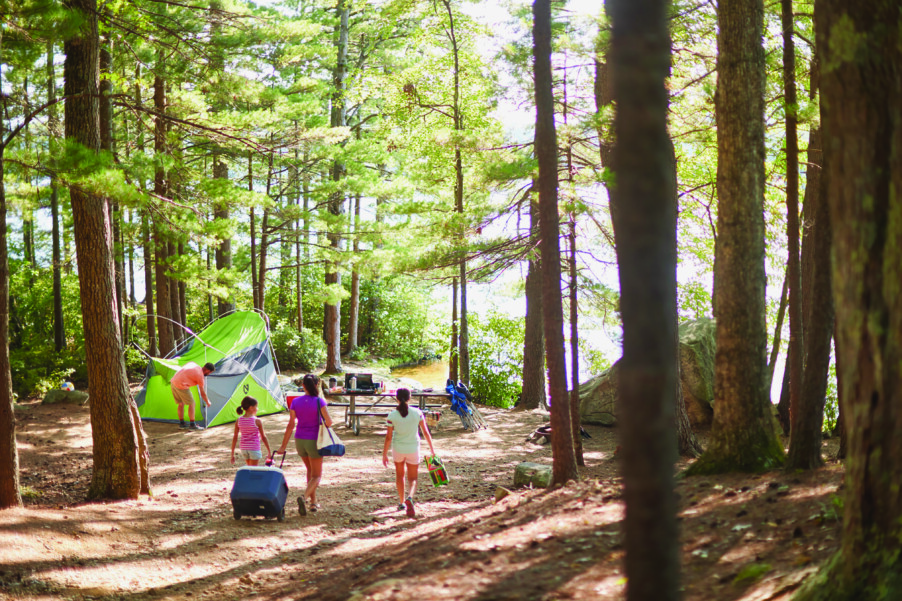
Featured photo: Camping at Pawtuckaway State Park in Allenstown in Nottingham. Photo courtesy of New Hampshire State Parks.


A better way to zoom

Add a little action to your day with go-karts, bumper boats and laser tag.

Summer is all about breaking out of your daily routine. Put a little excitement in your weekend (or your afterwork or your staycation) by checking out some local, low-time-commitment but big-fun-payoff activities such as go-karts, bumper boats and laser tag.

Speedy fun with go-karts

Find fast(-ish) paced excitement and friendly competition at area tracks

By Katelyn Sahagian

ksahagian@hippopress.com

Parents against kids, siblings against each other — the go-kart racetrack has a way of turning even the most devoted of couples into competitors, said Michael Accomando, the owner of Mel’s Funway Park.

“Everybody that hits the track and they get so excited. You’ve got to look at it from the point of view of a kid who wants to beat their mother or father, or their older siblings, through the eyes of people who can’t drive regular cars,” said Accomando. “You look at one big official race that’s started, but there’s always more within those little groups.”

Accomando said that his entire fleet has been tuned up and is ready for racers. His track has tight turns and a bridge for karters to go over and under. He said that his favorite part is seeing how excited the kids get while racing.

“If you’re a young young kid, you feel like you’re really zipping around a track,” Accomado said, adding that the karts don’t go faster than 20 miles per hour.

Go-karts were first created in the 1950s, and some tracks in New Hampshire have been around for 40 years, like Weirs Beach Go-Kart Track in Laconia.

Owner Tom Hickey said that he was 14 years old when his parents bought the track. Now, he comes up every summer to open up the course.

Hickey said he loves seeing the generations that have come through, from kids racing around the track to parents sharing the experience with their children.

Go-kart fun facts
Go-karts were invented in 1956 in Glendale, California, by Art Ingels, who was a fabricator at Kurtis Kraft, a dominant manufacturer of the Indianapolis 500 race cars. He put a discarded two-cycle lawn mower motor into a tube-frame “kart” and created the world-famous miniature race car.
Source: Petrolicious.

“They know me by name and they say they used to come as a kid and it’s a generation thing,” Hickey said. “You see families come back year after year.”

While these karts are much slower, and safer, than the ones professional racers use, there are still safety parameters that all locations follow.

Drivers at most locations have to be taller than 58 inches, and all have slightly different requirements for passengers. At Chuckster’s, passengers can be as young as 3 with a licensed driver. Weirs Beach only allows passengers ages 4 to 9.

Karts are equipped with kill switches, and operators can lower the speeds of all the karts for safety purposes, like if a driver spins out or isn’t driving safely.

Throughout the years, Hickey said, he’s noticed that people will always come back to do more and more laps.

“I always say to my workers that people don’t get sick of pizza or coffee, so people won’t get sick of go-karts,” Hickey said.

Where to go karting

Chuckster’s
9 Bailey Road, Chichester
Hours: 10 a.m. to 9 p.m. daily
Price: $8 for one ride, $33 for five. Passengers ride free.
Visit: chuckstersnh.com.

Daytona Fun Park
104 Endicott St. East, Laconia
Hours: 11 a.m. to 7 p.m.
Price: $8.75 for single ride, $24.50 for three, $75 for 10. Passengers are $2 additional for each ride and passengers must be under 54 inches tall.
Visit: daytonafunparknh.com

Mel’s Funway Park
454 Charles Bancroft Hwy., Litchfield
Hours: 10 a.m. to 10 p.m. Sunday through Thursday, 10 a.m. to 11 p.m. Friday and Saturday.
Price: $9.50 for one ride, $42.50 for five rides
Visit: melsfunwaypark.com

Weirs Beach Go-Kart Track
582 Endicott St. North, Laconia
Hours: 10 a.m. to 9 p.m. daily
Price: one race is $9, six for $48
Visit: wbgokarts.com

Bump and splash

Everybody becomes a kid in a bumper boat

By Katelyn Sahagian

ksahagian@hippopress.com

Bumper cars are one of the oldest amusement rides, dating back to the early 1920s. While bumper boats aren’t as old, they add a little bit of pizazz to the process of crashing vehicles into one another.

Like their land counterparts, bumper boats have drivers smashing into each other, but water makes everything a little more chaotic, especially when the boats are equipped with water cannons.

Sophie Genest, 7, takes aim for her grandfather, John Leblanc. photo by Katelyn Sahagin

“If you squirt the old guy on the dock he’ll take out a hose, he’ll take out a hose and take ’em down,” John Crawford, who is the owner of Daytona Fun Park and is also the old guy on the dock, joked. “There have been a few guys that I’ve squirted too much, but we all have fun.”

While Daytona has had bumper boats for years, the attraction is new to Chuckster’s Family Fun Park this year.

“We just opened them up a month ago,” said Mark Blasko, the owner of Chuckster’s. “It’s a super fun way to cool off. We’ve learned that even when it’s not hot it’s still heavily used.”

Bumper boats float on a pool called a pond and are propelled with a small motor. The circular boats are designed to be nearly impossible to capsize, said Blasko, and all of the parks had height restrictions of 44 inches.

The boats at all the locations have water cannons that shoot water approximately 30 feet in an arc, making aming and driving a bigger challenge.

Bumper boats fun fact
The first iteration of bumper boats, called Dodgem Boats, was featured at the 1933 Chicago’s World Fair. The small motorboats sat two adults and were made entirely out of wood.
Source: “A Short History of Bumper Cars Going Bump In The Night,” By Seth Gussow for Automobile Magazine.

The Chuckster’s bumper boat pool has an island in the center featuring the park’s woodchuck mascot spraying a waterfall over the boaters. Despite its being only open for a month, Blasko said that there’s been a line for the boats almost every day.

In Crawford’s eyes, bumper boats are so popular because anyone can have fun on them.

“I like to say we have kids of all ages come here,” Crawford said. “It’s great to see the 70- and 80-year-old ‘kids’ get in the boats with their kids and grandkids and have a good time.”

Where to find bumper boats

Chuckster’s
9 Bailey Road, Chichester
Hours: 10 a.m. to 9 p.m. daily
Price: $7 per ride, passengers are free
Visit: chuckstersnh.com

Daytona Fun Park
104 Endicott St. East, Laconia
Hours: 11 a.m. to 7 p.m.
Price: $9.50 for single ride, $2 additional per passenger
Visit: daytonafunparknh.com

Mel’s Funway Park
454 Charles Bancroft Hwy., Litchfield
Hours: 10 a.m. to 10 p.m. Sunday through Thursday, 10 a.m. to 11 p.m. Friday and Saturday.
Price: $9 for one ride, $40 for five rides.
Visit: melsfunwaypark.com

Pew! Pew! Pew!

Tag, you’re it, with lasers

By Hannah Turtle

hturtle@admin

Jack Walsh contributed to this story.

When asked about the draw of laser tag, Mel’s Funway Park owner Mike Accomando sums it up in one sentence: “It takes a grown-up, and it makes them a kid all over again.”

A popular activity for kids and adults alike, laser tag is exactly what it sounds like, a game in which participants use infrared-emitting light guns to “tag” targets. Or, as Accomando puts it, “people run around in the dark shooting each other, but nobody gets hurt.”

Laser tag is by no means a new activity in the area, but the many venues in which it can be played have multiplied over the years. Now, there’s outdoor laser tag at AG Paintball in Weare, and even mobile laser tag services that come to you.

One such service, offered by Next Level Tag, includes various scenarios such as “zombie apocalypse” and a hostage situation. There’s even a “bomb scenario,” in which players must defuse a laser bomb before the device “explodes.” At AG, you can play a “gold rush” game or have a similar zombie-like experience with “infection survival” (Covid not included).

Venues like Mel’s Funway Park still offer the traditional laser tag experience, perfect for groups or even lone players, and for adults and kids alike, including a robust “laser maze.” One piece of advice, though: Don’t tamper with the emergency exits.

“Once a kid thought the emergency door was an emergency room where you could hide,” Accomando said. “So, in the middle of the game, he ran through the emergency door and set off the fire alarm in the building. It was a lot of work for us, but I thought it was pretty funny.”

The thrill of the chase without the possibility of actual bodily harm is something that connects all the laser tag options in the area, but winning a game requires a sharp mind and a good battle strategy.

XTremeCraze, which opened in Londonderry in early 2019, hosts a large arena of around 10,000 square feet. Games take place hourly, sometimes every other hour, with 44 open player slots. There are a variety of different game modes, and each holds different objectives that lead to victory.

“Our game modes are super interactive,” XTremeCraze general manager Leo Batista said. “They allow you to essentially play a team style game like you would in a video game, but [you can] play it in a real-life form with your friends.”

Batista’s personal favorite game mode is “Headquarters,” a mode where players take over sectors to accumulate points, all while tagging out opponents.

For those looking to have a leg up in laser tag strategy, Accomando recommends finding cover and staying low.

“People are normally looking and aiming higher. When you find a spot and stay low, you kind of disappear in the dark,” he said. “Then, you’ll have an opportunity to shoot other people’s lasers without them even knowing what hit them.”

Where to play tag (with lasers)

AG Paintball
158 Deering Center Road, Weare
Hours: Monday to Friday, appointment only; Saturday and Sunday, 8 a.m. to 5 p.m.
Tickets: $20 per person
Visit: agpaintball.com

Block Party Social
51 Zapora Drive, Hooksett
Hours: Monday to Thursday, 10 a.m. to 10 p.m.; Friday and Saturday, 10 a.m. to midnight; Sunday, 10 a.m. to 10 p.m.
Tickets: $22 per person
Visit: blockpartysocial.com

Fun City
553 Mast Road, Goffstown
Hours: Monday, 3 to 8 p.m.; Tuesday to Thursday, 10 a.m. to 8 p.m.; Friday and Saturday, 10 a.m. to 10 p.m.; Sunday, 10 a.m. to 8 p.m.
Tickets: $8 per game
Visit: funcitygoffstown.com

Mel’s Funway Park
454 Charles Bancroft Hwy., Litchfield
Hours: Monday to Thursday, 10 a.m. to 10 p.m.; Friday and Saturday, 10 a.m. to 11 p.m.; Sunday, 10 a.m. to 10 p.m.
Tickets: $8 for each 10-minute game
Visit: melsfunwaypark.com

Next Level Tag
Booking: packages vary, basic package $350 for 12 players
Visit: nextleveltag.com

XtremeCraze
4 Orchard View Drive, Londonderry
Hours: Tuesday to Thursday, noon to 8 p.m.; (Thursday Junior Jumps from 10 a.m. to noon); Friday, noon to 9 p.m.; Saturday, 10 a.m. to 9 p.m.; Sunday, 10 a.m. to 8 p.m. Closed for private events on Mondays, except for school holidays. Reservations are strongly recommended.
Visit: xtremecraze.us/londonderry

Featured photo: Kristen Powers takes the lead in her go-kart race against Bruce Jache at Mel’s Funway Park. Photo by Katelyn Sahagian.

The wrong crib for this baby

by Jeff Rapsis

All politics is local — and our region’s inability to bring passenger rail back to Manchester, Nashua and the rest of the Merrimack Valley is a good example of that.

However, this old saying might offer the key to finally making progress, even as state lawmakers in Concord are maneuvering to ban using state money on the long-stalled project.

How? I think the issue is that in New Hampshire, as in most places in America, public transit projects such as this naturally fall to a state’s transportation department to plan and oversee.

But in the Granite State, a majority of residents feel they’ll see no real benefits from Manchester and Nashua joining Boston’s commuter rail network. Hence the opposition and inaction, even though civic officials in Manchester and Nashua, the state’s two largest cities, have pushed it for decades.

What to do? I think it’s time for leaders in the Merrimack Valley to recognize that the state DOT is simply the wrong crib for this baby. A majority of the state (and hence the Legislature, which funds the state DOT) will simply never be convinced to make the investment.

So instead, a group of civic leaders from Concord south to Nashua should band together and craft a plan to fund it on their own.

This would require the creation of an entity similar to a tax increment financing district, but on a larger scale. It might function like a regional planning agency, but with the power to propose and implement taxes or other funding mechanisms (subject to voter approval) to raise revenue for restarting and operating passenger rail.

It wouldn’t be easy. But the Merrimack Valley is the most heavily populated area of New Hampshire, home to 561,000 of the state’s 1.3 million residents. It boasts the state’s largest concentration of business activity.

Surely this area on its own could generate the estimated $300 million all-in investment needed to extend passenger rail north from Lowell, Mass., and the annual subsidy of about $13 million.

In return, we’d reap the benefits of improved access to Boston, the region’s economic hub.

And here’s an idea to start you thinking: Why not impose a $5 fee on anyone boarding a Boston Express Bus to Logan Airport, with the revenue earmarked for passenger rail?

Jeff Rapsis, a Bedford resident, is Associate Publisher and a co-founder of the Hippo.

High school diplomas outdated?

What does a high school diploma get you? Some might say that someone with a high school diploma will earn more money over their lifetime than someone who hasn’t earned a diploma. That may be true, but do you credit the diploma for the extra earnings? Does that diploma tell you anything about the specific skills that an individual would bring to the workplace? I believe that the high school diploma has largely outlived its usefulness and that the end game in high school should no longer be to simply earn a diploma.

What does a high school diploma tell you about someone? For example, if someone got a B in biology, can anyone tell me what that person knows and is able to do with what he or she learned in biology? How did they get the B? Did they get it because they got a B average on their tests? Was it because they passed their homework in on time? Did they regularly participate in class discussions? Did they do well on the final exam? Maybe they were nice to the teacher. Whatever they did, it translated into a B. Even if we assume that they did fairly well in their biology class, how much of what they were taught will they actually retain even two weeks after the exam?

And what are colleges supposed to translate from your grades in high school? Why is it that 40 percent of college freshmen need to take remedial courses in either math or language arts? Can we assume that their high school transcripts were interpreted by the admissions officers to be that these students actually had skills in those areas? Then how come they had to take remedial courses?

I believe the high school diploma’s usefulness is coming to an end, and that the new coin of the realm for high schools will be certifications and career credentials; something that will give confidence to anyone who has interest in someone holding one of these credentials that they have achieved the skills necessary to perform the associated tasks, be it a welder’s license, a massage therapist’s license, an associate’s degree in a specific field, etc. These credentials not only give someone confidence that you have the requisite skills but they immediately carry weight in the marketplace when seeking specific jobs.

Career-related credentials are coming soon to a high school near you and they will be a welcome improvement over the outdated notion of a diploma.

Fred Bramante is a past chairman and memtber of the New Hampshire State Board of Education. He speaks and consults on education redesign to regional, state and national organizations.

A little dirt, a little risk

Learning and fun on Head’s Pond Trail in Hooksett

By Dan Szczesny

danszczesny@gmail.com

I can’t think of a better word than feral to describe my daughter’s love for the outdoors, so for now, I’m going with that.

We’ve raised Little Bean to be as unafraid of the traditional challenges of nature as possible. Mud. Wind. Snow. Dirt under the fingernails. All fair game.

The constraint of goal-setting when on the trail can often stifle exploration. The mountaintop will always be there, but hey, look at that cool rock! That sort of thing.

There’s a whole line of child psychology, in fact, that studies a developing field called Risky Play. Remember when you were a kid and you spent basically the whole day outside, unsupervised, doing things that adults today would be horrified to learn you were doing? Well, folks like Mariana Brussoni, a professor at the University of British Columbia, remembers. She says it was good for you, and a little of that today would also be good for kids.

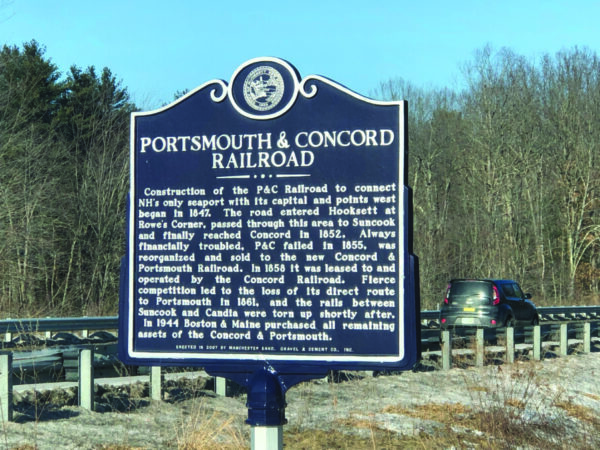
The Head’s Pond Rail Trail runs along a 1.7-mile section of the famous Portsmouth and Concord Railroad line. Between 1847 and 1861 the line connected New Hampshire’s Seacoast to Concord. Photos by Dan Szczesny.

Risky Play done in the context of a relatively safe space is “really a fundamental way for them to figure out the world — how the world works, how their body works,” she says.

This was on my mind recently during a hike with Little Bean along the Head’s Pond Trail in Hooksett. This amazing little jewel of a rail trail sits right off Route 3 and is built along a 1.7-mile section of the old Portsmouth and Concord Railroad line, which dates back to 1847. Back then, it connected the coast to the capital and ran right through Hooksett. Today, it’s a super fun family hike during any season. Flat. Wooded. Water and rocks all over.

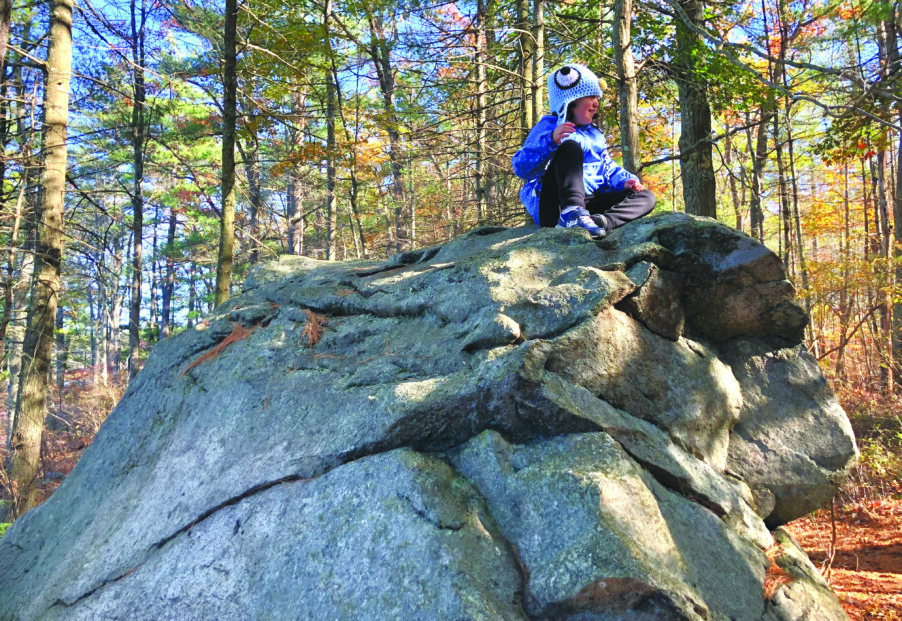
We love this trail, in part because it’s the home of Sheep Rock, a huge glacier erratic that looks like a sheep head, and a rock that we included in our Field Guide NH Rocks That Rock. On this trip, we were thrilled to have a crew from New Hampshire Public Radio accompany us to the rock.

All that was great. Except for the ice. And except for the fact that my daughter wanted badly to engage in Risky Play, the one thing we taught her to do and the one thing I wished, just this once, she wouldn’t!

How would this group of professionals with microphones and an itinerary react to my daughter taking great running head starts and sliding on the ice on her knees, screaming at the top of her lungs? How would they react to her being distracted by a cool branch or an icicle in the middle of asking her a question about rocks?

Well, pretty well, it turns out.

To their credit, the crew took their cues from Little Bean, letting her lead in her own way, letting her be a little crazy because sometimes crazy just means joyful and joyful is OK.

Push too hard and you’ll lose them. Keep them boxed up and they won’t come back. Let them be in a little bit of controlled danger to find their own footing.

There’s a more universal lesson here as well about the power of creating your own story, of building memory and self-worth. There’s lots of places to do this, but hiking with kids, I’ve found, lends itself best to forging bonds, building a history and boosting confidence.

But you need to be patient. And you need to exist in the same space as your kid, not the other way around.

We reached our destination that day, and by the time Little Bean sat atop that rock shaped like a sheep, her knees were filthy, her hair was a tangled web and she had bruises on both elbows. In other words, it was a good hike, and more importantly, it was her hike.

Featured photo: The author’s daughter sits atop Sheep Rock, just off the Head’s Pond Rail Trail in Hooksett. Sheep Rock is listed in the NH Rocks That Rock 25 field guide, a collection of the state’s most famous and historic rocks and boulders. Courtesy photo.

The rail trail connection

Imagining a walkable New Hampshire

By Dan Szczesny

news@hippopress.com

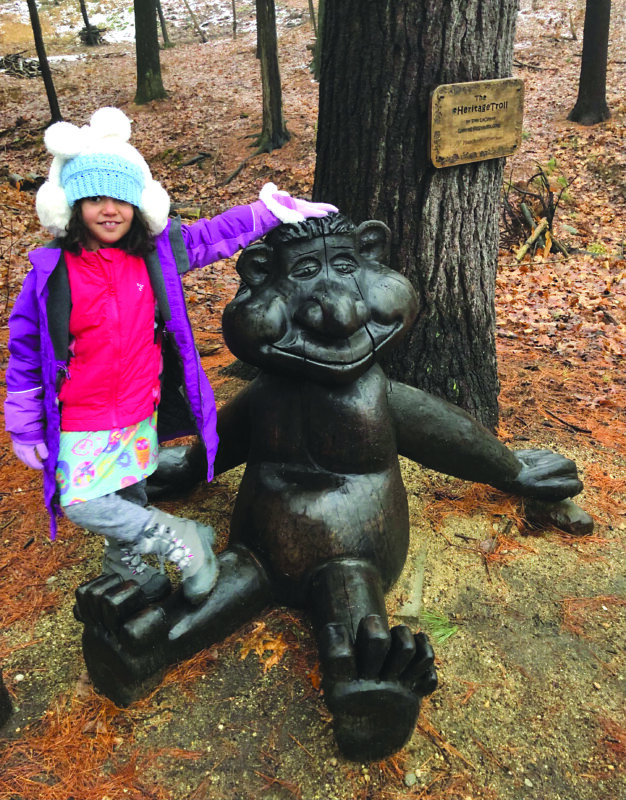
This all started with a troll; more specifically, the Heritage Troll, a large wooden sculpture built by artist Tom LeComte and placed along a trail behind Stark Park in Manchester. My daughter, ever the little explorer, took about one minute to find the troll, and about 10 seconds to ask, “Are there more?”

Finding the answer to that question took me down a decades-long road of city planning and sustainable design, all of which may be coming to a head this spring in a way that could change the infrastructure of transportation in the Merrimack Valley.

But first, the troll.

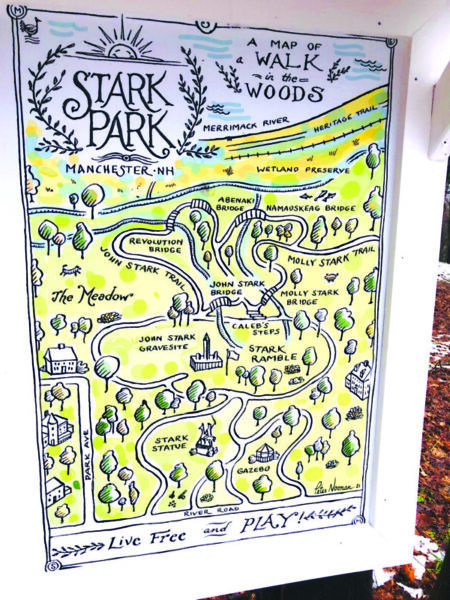
mounted map of park trails, illustrated by artist Peter Noonan
Mounted map of Stark Park trails, illustrated by artist Peter Noonan

The installation is part of the newly refurbished trail system behind the park that organizers call Walk in the Woods. In the summer and fall of 2021, the lower 15 acres of Stark Park were redesigned and landscaped back to the walking park originally envisioned when the Heritage Trail was designed and built along the Merrimack River. Charming bridges now span babbling brooks, park benches are set up to rest weary feet, and a tree troll — sitting nearly as high as my daughter is tall — now casts a watchful eye out over the river.

During our hike I noticed how close the new (old) trail system is to the Merrimack River. But there are no spur trails to take a walker out there and the reason is the active set of railroad tracks that runs from Manchester to Concord along the river and divides the park from the river.

For 12 years various biking/walking and developing groups have been trying to convince Pan Am Railways to allow rail trails to be built alongside their active tracks, said Jason Soukup, the board secretary of Manchester Moves, one of the organizations working on rail trail projects around the city. The problem right now is liability.

“We found a gap in New Hampshire law, compared to other states like Maine, in the current Rec Use Law on the books that doesn’t protect the railway,” he said. “We’re trying to change that.”

Last year Pan Am sold the railway to CSX Transportation, a railway company that already has established active use railroad lines right next to rail trails around the country.

“If we give them liability protection, they’ll do it,” said Soukup.

On Jan. 20, House Bill 1579 (The Rail with Trail Bill) was introduced into the House Judiciary Committee for study. This May, when the railroad sale is finalized, supporters say passing the bill will protect the railway from liability and open the door to rail trail development.

Beside Manchester Moves, the bill is supported by a wide coalition of rail trail supporters, including the New Hampshire Rail Trail Coalition, The City of Manchester, the Friends of Stark Park, New Hampshire DOT and the Rails to Trails Conservancy in Washington, D.C.

While it may seem strange that such a coalition is putting this much support behind a fairly obscure bipartisan bill, there’s a much larger picture here to consider.

Should the bill pass and the railway relent to allow a rail trail to be built alongside its tracks, that would connect a critical 31-mile “gap” in the Granite State Rail Trail. The nearly contiguous 125-mile rail trail that runs from Salem to Lebanon is missing one critical section: the piece between Manchester and Concord. Connect that part along the active tracks, and one could in theory walk or bike the entire length of the trail without having to touch a road.

“Imagine, for tourism and connectivity, being able to get on your bike and ride safely wherever you want,” Soukup said. “A community you can connect to without having to use a car is a better community.”

Rail Trail supporters have never been so close to making the statewide corridor a reality. And rail trails, in general, make perfect routes for beginner walkers who want to experience hiking during all seasons.

But while we wait for May, Walk in the Woods and the Heritage Trail, which continues on for another two miles behind the Youth Services Center off River Road, is open for exploration.

Meanwhile, to answer my daughter’s question, the Manchester Trolls may well be multiplying. Word has it that plans are in the works to find homes for several others, including somewhere along the Rockingham Trail. And don’t be surprised if Arms Park suddenly becomes a troll home.

“This all falls under the umbrella of making our neighborhoods better,” Soukup said. “We want to encourage people to stay here, explore local places, and that means investing in those places.”

Dan Szczesny is a long time journalist and hiker and a member of New Hampshire’s 4,000-footer club. He’s written travel memoirs about Nepal and Alaska and about hiking with kids. His latest books include The White Mountain: Rediscovering the Hidden Culture of Mount Washington and NH Rocks That Rock: An Adventure Guide to 25 Famous Boulders in the Granite State. He lives in Manchester with his wife and daughter. See danszczesny.com

Featured photo: The author’s daughter finds the Rail Troll, a sculpture by artist Tom LeComte. Photo by Dan Szczesny.

Stay in the loop!

Get FREE weekly briefs on local food, music,

arts, and more across southern New Hampshire!