
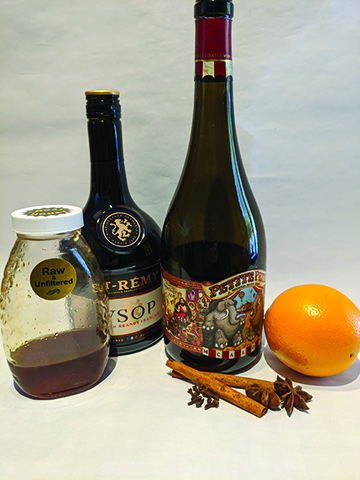
Mulled wine by the fire

Looking for a winter drink? Warm up with spices

The days are getting shorter and the nights cooler. The holiday season is upon us and the first snow has arrived. Wish to gather with friends? One way to gather with another couple or two is in your driveway or back yard around the firepit sipping on mulled wine.

Hot spiced wine, or mulled wine, has been around forever, it seems. Depending on its cultural origins, it may be known as glühwein, vino caliente, glögg, vin brulé, bisschopswijn, vin chaud, candola, vinho quente, or by other monikers. Mulled wine exists in just about every European culture and the recipes for making it appear to be limitless. In England mulled wine is known as Wassail, a name whose origins are Anglo Saxon. Like Christmas, this hot punch transformed itself from pagan rites to revolve around the coldest, darkest nights of the year. In its earliest form it was a drink made from mulled ale, curdled cream, roasted apples, eggs, cloves, ginger, nutmeg and sugar. It was served from huge bowls on New Year’s Eve and Twelfth Night (Jan. 6). This warm drink took on a significant cultural identity as through the centuries it was used to toast the holidays.

Hot mulled wine can be a simple concoction prepared in a slow cooker or over the flames of that fire pit. In its simplest forms the ingredients consist of a bottle of robust red wine, an orange (or oranges) sliced into rounds, a half dozen whole cloves, a couple of cinnamon sticks, some star anise, honey to taste, and if you want, a measure of brandy. It takes literally five minutes to make and is scalable from two servings to enough for a large holiday gathering (for next year).

For the wine, I selected Petite Petit by Michael David (originally priced at $19.99, on sale at the New Hampshire Liquor & Wine Outlets at $12.95). This wine is 85 percent petite sirah and 15 percent petit verdot. It is large and fruity with aromas of dark fruit, raspberry and plum. To the taste the black cherry “jammy” flavor comes through with some oak on the edges. This wine is perfect to use as a base for this concoction, as it will hold up well with the additions of fruit and spices. It is well-stocked throughout the state, and the price is so attractive! The petite sirah produces a deep-colored, robust, full-bodied peppery wine, with some tannins, that ages well. The petit verdot, used in blending the famous Bordeaux wines, has a dry, full-bodied taste of blackberry. Like the petite sirah, the strong tannins and high alcohol in the wine from this varietal allow it to age beautifully. It is perfectly matched to the petite sirah! These grapes are grown in Lodi, in San Joaquin County, in the center portion of California’s Central Valley. With long hot summers, these grapes are allowed to ripen well to produce a lot of sugar.

Now, how to make mulled wine: Combine your ingredients in a saucepan and give them a stir. Heat the wine until it just barely reaches a simmer over medium heat. Remember, alcohol boils off at 173 degrees (F), so be careful. Reduce the heat, cover and let simmer for 15 minutes or so. Using a strainer remove the cloves, cinnamon sticks and star anise, and serve in heat-proof mugs garnished with the fruit and cinnamon sticks. Remember, this recipe is very flexible. You can include apple cider or orange juice in the mix. You can use sugar instead of the honey for a sweetener, although it is not as rich as honey. Additional fruit can include thinly sliced apples or frozen pitted cherries. Additional spices can include ginger, peeled and sliced, and a vanilla bean cut open from end to end. The options are limitless and the possibilities endless.

Don’t let the cold, dark December days (and Covid) get to you. Invite a couple or two to gather around the fire pit and share the warmth of the holidays with a steaming mug of hot mulled wine. Savor the moments and cherish the memories of this time when we must be ever so creative in how we can remain connected.

Featured Photo: Courtesy photo

Wines for giving thanks

Wines to consider for your Thanksgiving menu

“This Thanksgiving will be unlike all other Thanksgivings!”

We have heard that expression far too many times, haven’t we? We will all be hunkered down, safe in our households, seated for our traditional feast, but there will be differences around us, some subtle, some not-so-subtle. Crazy Uncle Larry who begins his Thanksgiving Day cocktail hour at 10 a.m. will be (thankfully) absent and the feast may be a bit simpler, a bit smaller. For the early afternoon, we plan to have another couple over for hors d’oeuvres in the driveway, surrounded by patio heaters! For our dinner, instead of a large turkey, we will have a roast duck. It will be smaller and simpler but still very enjoyable!

We still need to celebrate with our friends and family, and with wine paired to the extended courses. The possibilities are endless.

Chic Barcelona Brut Cava (originally priced at $14.99, on sale at the New Hampshire Liquor & Wine Outlets at $7.99) is a bargain not to be passed up. A blend of 35 percent macabeu, 35 percent xarello and 30 percent parellada grapes, this wine hails from the Penedès region of Catalonia, Spain, south of Barcelona, where the climate is Mediterranean with continental influences meaning that it tends to have cold winters and slightly milder summers than the interior countryside produces full and fresh wines resulting in a slower maturation of the grapes. Cava is the chief wine of this region and it is made in the traditional, or Champagne, method, which means it has a second fermentation in the bottle. The color of this wine is a light straw. The tiny bubbles that rise from the bottom of the glass are not as intense as with Champagne and the nose is bright and fresh, lacking in the yeasty brioche nose one identifies with a Champagne. To the tongue, the taste is fresh and citric but lacking in length. This is an excellent accompaniment to hors d’oeuvres, and a great way to start the meal. Alcoholic content is 11½ percent.

Höpler Grüner Veltliner, 2019 (originally priced at $16.99, on sale at the New Hampshire Liquor & Wine Outlets at $14.99) is an Austrian wine from the eastern part of the country, from vines planted along the Danube River and on the banks of Lake Neusiedl. The Höpler winery is located in Burgenland, just 45 minutes from Vienna. The soils range from gravel with some clay to rich, fertile well-draining silt. Cold winters allow the vines to go dormant, but hot summers with substantial sunshine and humidity rising from the nearby lake allow the grapes to develop a balance between fruit, flavor and great acidity. The color is straw with a strong overtone of green. The green results from the selection of greener grapes, producing a wine that is more aromatic than the wine made from grapes that are more yellow. To the nose the wine has notes of lime and minerality, along with some white pepper spice. This wine falls between sauvignon blanc (acid and green grassy notes) and riesling (tropical and mineral notes). To the taste, this wine has tropical fruit — pineapple with lemon-lime acidity. This is an ideal wine to cool and just sip, alongside the cava, to enjoy along with oysters, or to transition to the main course, the bird.

Schug 2017 Sonoma Coast Pinot Noir (originally priced at $32.99, on sale at the New Hampshire Liquor & Wine Outlets at $14.99) is a blend of pinot noir grapes from select vineyards located in the western portion of Carneros, a region on the coast of the San Pablo Bay. A cool, breezy climate allows the grapes to mature slowly and retain their natural acidity, with bright flavors of red cherries, raspberries and spice. There is also a touch of tart pomegranate on the tongue. The wine is aged in large neutral oak casks and older French oak barrels to keep new oak flavors to a minimum. The finish is long and reminds me of cranberry, and therefore perfect to pair with that bird! It will nicely cut through the buttery fat of the bird’s side dishes.

So, while the Thanksgiving celebration may be small and ever so intimate, it should be savored. The pandemic will pass; the memories will live on. Happy Thanksgiving.

Sherry, sherry, baby

Give the world’s oldest fine wine a chance

Whenever I think of sherry, the fortified wine, I cannot help thinking of Frankie Vallee singing “Sherry, Baby” in that Jersey Boys falsetto voice. Wait, I may have said too much, and yes, I occasionally tune into “60’s on 6” on Sirius radio!

Sherry (the wine) has a bad reputation, linked to proper ladies drinking ever so politely from little glasses. However, it should not have such a limited audience. It is more than a beverage option for tea, served with small sandwiches and polite fruit creams. It should be served chilled and enjoyed along a fireside, wrapped in a blanket.

Sherry has a long and storied past. At about 2,000 years old, it is the world’s oldest fine wine, made principally from the palomino grape, along with a couple of others in Jerez, Andalucia, Spain. It has been imitated in other regions, but never with any success outside of Jerez. In fact, the EU has dictated the name can only apply to wines from Jerez. It can range from the driest, most delicate fino to the richest, most pungent oloroso. The wine is made in a traditional manner. The grapes are harvested and the wine is made in exactly the same manner as any other dry white wine, but in the following year the wine is fortified with alcohol and other wine to raise the strength to 14.5 percent. A skin of naturally occurring yeast, called flor, forms along the surface of the wine, which makes a barrier between the surface of the wine and the air within the cask, preventing the wine from oxidizing and imparting that “nutty” character sherry has. The amount of flor on the wine determines the direction the sherry will take, from fino, which is fortified to 15.5 percent, to oloroso, 17.5 percent.

On the bottle labels you may find the term “solera system.” One might call this “quality control.” It is a system of mixing young wines with older wines to ensure consistency, but it is more than that. Typically, there are four tiers to the stand of oak barrels sherry is stored in. Each year two thirds of the wine of the oldest in the tier will be blended with one third of the wine of the following year’s vintage. The wine is tapped off from each successive barrel, allowing new wine to be replenished in the top level. The fino soleras are emptied periodically to maintain the freshness of the wine. A good fino has spent five years rotating through these barrels. The oloroso soleras, however, may not be completely emptied.

Sherry comes in a variety of styles. Fino is the palest and driest of the Jerez styles. It has a citric quality to it. Amontillado is aged beyond five years and has a light shade of almond to it. It is still dry but more complex, rich and spicy. Oloroso sherries spend about 10 years in the solera and while still dry are mixed with other sweet wines to produce “cream sherries.” Sometimes sherries are made from other grapes, such as muscatel or Pedro Ximénez, a grape dried in the sun to produce extremely sweet wine. Sherries can be dated but dating them follows a complex formula because of the mixing of vintages, and sometimes there are individual vintages from single casks, but these are rare and can be pricey.

So, what sherries are available in New Hampshire? Sadly, the New Hampshire Liquor & Wine Outlets have somewhat meager offerings. Of the 76 stores only four varieties of sherries are offered in many of the stores. This is unfortunate because there is a wealth of types of sherries to explore. Our first is Dry Sack Medium Jerez-Xérès-Sherry, available at the New Hampshire Liquor & Wine Outlets at $13.49 per bottle. This wine is the color of weak tea and has a dry “nutty” character to it.

Our next sherry is Savory & James Fino Deluxe Dry Sherry, available at the New Hampshire Liquor & Wine Outlets at $9.99 per bottle. The color of this sherry is a very pale straw. To the nose and mouth it is a very dry, light sherry with strong citric notes. One can compare this to a dry vermouth.

Our last sherry is Harveys Bristol Cream Solera Sherry, available at the New Hampshire Liquor & Wine Outlets at $13.99 per bottle. Perhaps the standard by which all other sherries are compared, it is a rich, smooth, full sherry with creamy notes, as its name defines.

Pick up a bottle or two to enjoy by the fire as the weather gets cooler. And remember, you don’t have to invite Grandma to enjoy new experiences with this fine fortified wine.

Stay in the loop!

Get FREE weekly briefs on local food, music,

arts, and more across southern New Hampshire!