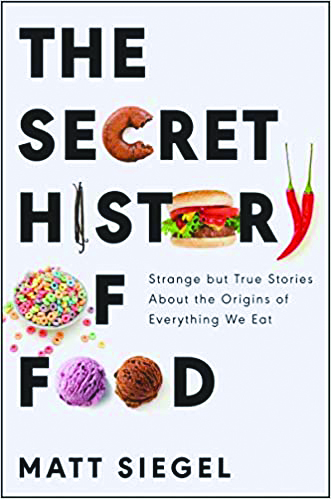
The Secret History of Food, by Matt Siegel

The Secret History of Food, by Matt Siegel (Ecco, 194 pages)

Matt Siegel is obsessed with food — not with eating it, but with learning about it. Siegel’s first book, The Secret History of Food, was born of his pastime of reading about the origins of the things we eat, going down the rabbit holes of history via Google searches and library books.

This means that many of the stories the former English professor tells here have already been told by someone else in formats less engaging. Siegel (not to be confused with the longtime Boston DJ) lives in Richmond and is a hunter-gatherer of the quirky detail, the sort of information that sticks to the brain, and he writes in the folksy style of beer-fueled conversation. His is a voice that sometimes seems too conversational; a grimmer editor might have cut a number of weak jokes. But too much editing and this would be a lengthy magazine article instead of a book.

Siegel begins by arguing that it’s not just eating food but cooking it that changed the earliest humans into modern man, because the process of cooking food changed us into more social creatures, with “larger brains, larger gatherings, more free time, and more collaboration.” In a way, cooking domesticated humans much like humans domesticated wolves, as did the gradual development of table manners. People in Asia and Europe, for example, replaced bladed utensils with chopsticks and rounded dinner knives, for example, to cut down on mealtime stabbings, Siegel writes.

From there, he leads a global tour of foodstuff, to include corn, cereal, vanilla, ice cream and pie, the latter of which was a primary means of fattening the early colonists in New England.

New Englanders didn’t invent pie, but we perfected it, having wrenched it from the hands of the English, who primarily stuffed it with “birds and nightmarish sea creatures.” Back then, Siegel writes, a pie crust wasn’t something to be enjoyed; it had a practically indigestible coating that was seen as a disposable container — “the inedible Tupperware of the Dark Ages.”

“Far from being a delicacy or dessert, it was merely a convenient way of congealing various bits of bird and beast into something portable and relatively stable,” Siegel writes. The name derived from the word magpie, the bird, which should have been our first warning. And the colloquialism “eating humble pie” appears to come from the unsavory pies that household servants used to make for themselves with animal guts unused by their employers.

New Englanders, before they turned the pie crust into a container for fruit, spices and custard, also indulged in meat pies, to the point where a pie of some kind was a staple at every meal, regardless of time, causing one 19th-century physician to write that the “brave men who made up the Boston Tea Party … were pie-biters from Boston.” The physician added, “the Yankee pie is a mighty stimulator of energy … conducive to vigilance, aggressiveness and longevity.” Not everyone agreed; someone in England once criticized Ralph Waldo Emerson’s custom of having pie for breakfast, prompting The New York Times to publish a defense of Emerson’s eating habits, which led to a years-long cross-Atlantic debate.

While Siegel’s pie report is the most New England-centric of the book’s content, his other stories are no less compelling, to include the chapter called “Honey Laundering,” which covers every aspect of the one food that that never goes bad (it can crystallize or turn cloudy, but even then is fine to eat). Among the most interested honey facts: Beehives have historically been weaponized, lobbed at enemy ships; beekeeping was a craft kept alive by the Christian church because beeswax was needed for candles; and you definitely want to buy local honey, even though there are few laws that guarantee its safety and source. (The cheap honey in grocery stores may contain chemicals and pesticides, and some counterfeit honey consists of corn syrup and yellow food coloring.)

Vanilla, Siegel writes, is the victim of slander, because despite its reputation for blandness it is the second most expensive spice to grow (behind saffron). Vanilla beans are the product of a type of orchid, and the pods take years to mature. “So you could probably have a kid and put them through kindergarten in the same time, and for less aggravation, than it would take to seed and harvest your own vanilla crop.”

Also, you probably don’t know what vanilla really tastes like, Siegel says, because up to 99 percent of “vanilla” flavoring in food comes, horrifyingly, from “things such as wood pulp, tree bark, rice bran, chloroform, or castoreum,” a secretion extracted from the nether regions of North American beavers.

From there, Siegel segues into a cornucopia of facts about ice cream, which include Thomas Jefferson’s recipe for ice cream (just a guess, but the cheapest brand at your supermarket is probably better) and how ice cream came to be classified as “essential foodstuffs” during World War I, which may be the best thing Herbert Hoover ever did.

And on he goes. Like his own reading journey that led to this book, Siegel coaxes the reader through turn after turn in a rabbit hole of information, marrying easy prose with weird facts, such as the Aztecs’ obsession with chili peppers (used for medicine, face washing and torture) and how common foods such as tomatoes and potatoes were once considered poisonous and satanic. The best chapter, however, is on the strange origins of boxed breakfast cereal, and let’s just say if John Kellogg were alive today he would be canceled and no one would eat corn flakes or Grape-Nuts (the recipe for which is said to have been stolen from a sanitarium safe).

There’s little original material in this book, but the selection and presentation are fresh, and Siegel is an able and entertaining curator of the information. Also, he named his dog Waffle, so bonus points for that. B+


Book Notes

Another football season, another book about Tom Brady and Bill Belichick — oh, wait.

TB12’s defection to the South disrupted a cottage industry, dissecting the 20-year partnership between the New England Patriots coach and his star quarterback.

One of the most prolific writers on the subject was Michael Holley, a former Boston Globe sports writer turned NBC broadcaster whose books include 2016’s Belichick and Brady (Hachette, 394 pages), 2011’s War Room (It Books, 352 pages) and 2004’s Patriot Reign (It Books, 256 pages). So inquiring minds might wonder what Holley is writing about now.

Turns out he, too, has defected to another camp: shockingly, the Pittsburgh Steelers.

Holley collaborated with former Steelers coach Bill Cowher to produce Cowher’s memoir, Heart and Steel, published in June (Atria, 288 pages). For those with short memories, Cowher coached the Steelers for 15 seasons before Mike Tomlin took over in 2007. The book is not just about his football career but also about the challenges of suddenly becoming a single father of three daughters after losing his wife and father within a period of three months. Highly recommended for the bye week for anyone who possesses a Steelers’ terrible towel.

But fear not, Patriots fans. The cottage industry continues with Seth Wickersham’s It’s Better to Be Feared: The New England Patriots’ Dynasty and the Pursuit of Greatness (Liveright, 528 pages). You just have to wait a few weeks. Set for release Oct. 12, Wickersham’s book will test whether the public will still buy books with both Brady and Belichick on the cover. The publisher promises a “full, behind-the-scenes story of the Patriots” by the ESPN senior writer, with insight on Belichick’s “tactical ingenuity” and Brady’s “unique mentality.”

For those who’d rather look ahead than look back, check out Lars Anderson’s Chasing the Bear, How Bear Bryant and Nick Saban Made Alabama the Greatest College Football Program of All Time (Grand Central Publishing, 304 pages). The Pats’ new quarterback, Mac Jones, hails from Alabama.

Finally, for those of you who’d rather have a root canal than watch football, there’s ammunition for your case in Against Football (Melville House paperback, 208 pages), Steve Almond’s 2014 “reluctant manifesto” against the sport. Almond is a Massachusetts writer who not only hates football but hates the Patriots, just so you know. He’s most famous lately for a New York Times podcast, “Dear Sugars,” hosted with Wild author Cheryl Strayed.

Book Events

Author events

KERRI ARSENAULT Author and journalist presents her investigative memoir Mill Town: Reckoning with What Remains. Thurs., Sept. 9, 6 p.m. The Music Hall, 28 Chestnut St., Portsmouth. Tickets start at $60 for a small table with two copies of the book included Visit themusichall.org.

R.W.W. GREENE Author presents Twenty Five to Life. Bookery Manchester (844 Elm St., Manchester, bookerymht.com), Fri., Sept. 10, 5:30 to 7 p.m.

MARGARET PORTER Author presents The Limits of Limelight. Gibson’s Bookstore, 45 S. Main St., Concord. Tues., Sept. 14, 6 p.m. Visit gibsonsbookstore.com or call 224-0562.

AMY TIMBERLAKE Newbery Honor winning author presents her second Skunk and Badger book, Egg Marks the Spot. Virtual event via Zoom, hosted by Gibson’s Bookstore in Concord. Tues., Sept. 21, 7 p.m. Visit gibsonsbookstore.com or call 224-0562.

JEFF BENEDICT Author presents The Dynasty. Gibson’s Bookstore, 45 S. Main St., Concord. Wed., Sept. 22, 6 p.m. Visit gibsonsbookstore.com or call 224-0562.

DAVID SEDARIS Humor writer presents. Capitol Center for the Arts (44 S. Main St., Concord, ccanh.com), Sun., Sept. 26, 7 p.m. Tickets start at $49.

Book sales

MULTI-BOOK AUTHOR SIGNING AND SALE A Freethinker’s Corner(652 A Central Ave., Dover, 343-2437, freethinkerscorner.com), Sat., Sept. 18, noon to 4 p.m.

MULTI-BOOK CHILDREN’S AUTHOR SIGNING AND SALE A Freethinker’s Corner(652 A Central Ave., Dover, 343-2437, freethinkerscorner.com), Sat., Sept. 25, noon to 4 p.m.

FRIENDS OF BROOKLINE PUBLIC LIBRARY TWO-DAY BOOK SALE Featuring hardbound and paperback books of all fiction and nonfiction genres, plus CDs, DVDs and audio books, for sale. 4 Main St., Brookline. Saturday, Sept. 25, and Sunday, Sept. 26, 10 a.m. to 2 p.m. Visit brooklinenh.us/brookline-public-library/pages/friends-of-the-brookline-public-library.

Poetry

DOWN CELLAR POETRY SALON Poetry event series presented by the Poetry Society of New Hampshire. Monthly. First Sunday. Visit poetrysocietynh.wordpress.com.

SLAM FREE OR DIE Series of open mic nights for poets and spoken-word artists. Stark Tavern, 500 N. Commercial St., Manchester. Weekly. Thursday, doors open and sign-ups beginning at 7 p.m., open mic at 8 p.m. The series also features several poetry slams every month. Events are open to all ages. Cover charge of $3 to $5 at the door, which can be paid with cash or by Venmo. Visit facebook.com/slamfreeordie, e-mail slamfreeordie@gmail.com or call 858-3286.

Featured photo: The Secret History of Food.

Bring Your Baggage and Don’t Pack Light, Essays by Helen Ellis

Bring Your Baggage and Don’t Pack Light, Essays by Helen Ellis (Doubleday, 176 pages)

Resist the temptation to dismiss Helen Ellis because of her previous titles, Southern Lady Code and American Housewife, which sound like something Paula Deen might have written.

Ellis was, in fact, raised in Alabama, but shrugged that life off early in her 20s to move to New York City in hopes of becoming a writer. Before that dream was realized, however, she made a name for herself as — no joke — a high-stakes poker player. When the writing career came, it was jump-started by an anonymous Twitter account she called “American Housewife” with the handle @WhatIDoAllDay. Her timeline was richly sardonic, the MiracleGro for popularity on that platform, and a brand was born.

Her fourth book is a collection of essays called Bring Your Baggage and Don’t Pack Light, mostly composed of foul-mouthed reflections on aging, periodically interrupted by foul-mouthed reflections on cancer and other indignities of life. It begins benignly enough, with Ellis reporting that she is heading for Panama City, Florida, “aka ‘The Redneck Riviera,’” with four friends for a jaunt she calls the “grown-ass ladies’ trip,” the highlight of which is a night out to see a TV psychic, Theresa Caputo, star of a show called Long Island Medium.

After the national anthem, which everyone sang while facing an American flag projected onto the screen, the TV psychic explained that she goes “where the Spirit leads” and that occasionally she gets hot, because perimenopause. This caused Ellis to whoop and clap. “God bless this woman for yelling ‘menopause’ in a crowded theater.” she writes. “I wasn’t sure if I believed in her power, but I believed we could be friends, so she had me now, and I was rooting for her.”

And Ellis is off, with her particular brand of humor, which is a combination of Nora Ephron without the divorce and Erma Bombeck without the kids. Married for 25 years and happily childless, Ellis identified ironically as a housewife until just a few years ago, when she started owning the title “writer” after years of being famous as a pearl-wearing poker player. That distinction is one that makes her a “character,” which she explains is different from a naturally funny person. “A character wants to be the life of the party. Or the life of a seven-hour flight delay. Or the life of a Piggly Wiggly checkout line.”

For the perplexed, Piggly Wiggly is a chain of supermarkets mostly in the South. That, and the pearl-wearing, however, is about Southern as Ellis gets. There’s some of the late Texas humorist Molly Ivins in her, but she would be right at home in the cast of Sex and the City, and her humor is as racy in places as that of Carrie Bradshaw. There is, for example, the chapter in which she admits that she and her husband speculate about the sex lives of their friends. For example, she will say, after long-married friends leave, “There’s no way they’re still having sex,” to which her husband will respond, “Shh, they’re still in our hallway.”

She writes of salivating over a velour housecoat in the Vermont Country Store catalog, and the potential effect it would have on her husband’s libido. She says he would rather come home and catch her in a pyramid scheme than in that robe.

Ellis nails the one-liners in this short string of folksy anecdotes, as when she describes garage-sale regulars as “people who want to profit from your poor life decisions.” She used to wear all black to her poker games because “I myself am a pop of color,” which is shown to be true in stories about accompanying friends to have a baby or to get Botox in possibly illegal circumstances. She and her husband don’t drive (“yes, we will wing it in a zombie apocalypse” but having never owned cars, they “are not confident drivers’’), and as such have collected many comical stories involving public transportation, such as taking long bus rides to casinos. She distrusts technology (“The cloud is tech talk for something Bill Gates or Mark Zuckerberg invented to store your political preferences, porn searches and high school reunion pictures”) and invents descriptions of her friends when storing their contact information in her phone; rather than John or Mary, for example, they are the “the grifter,” “the puzzler,” “the saint” or “the zookeeper.”

In short, she’s your zaniest friend, on steroids and on her third drink, still possessed of the presence of mind to write everything down.

The collection, however, doesn’t rise to Sedarisian heights, however, because it’s too frothy. David Sedaris is one of the greatest humorists working today because there is a point to everything he writes, no matter how hilarious. There’s not much of a point behind these stories than to make us laugh, or to mildly rage. Ellis’s mother used to tell her, “Helen Michelle, you’re not for everyone,” although she’s probably for everyone who spends more than seven hours a week on Twitter. Hers is a particular brand of humor, for the perpetually caustic with short attention spans. The title notwithstanding, the book packs light and wants a bit more baggage. C+


Book Notes

Can a funny title alone sell a book?

Probably not if the content is wretched, but some publishers seem to be lapping up bad puns these days. Witness the success of the Chet and Bernie mystery series by Spencer Quinn, which features narration by a dog and titles like Scents and Sensibility and (reviewed here recently) Tender is the Bite.

The mystery genre seems especially prone to punnage, given that there is also an “undercover dish mystery series” by Julia Buckley that includes the titles The Big Chili, Pudding Up With Murder and Cheddar Off Dead.

Then there’s the Avery Aames mystery series built entirely around cheese that includes the groan-inducing titles To Brie or Not To Brie, As Gouda as Dead, The Long Quiche Goodbye and Days of Wine and Roquefort. (Aames also has a novel entitled Cheddar Off Dead, and Connecticut author Korina Moss has a Cheese Shop mystery coming out with that title in the spring of 2021, indicating that publishers like bad puns so much they’re willing to reuse them.)

Perhaps most impressive is the “Bought the Farm” mystery series by Ellen Riggs, if not for its punnage, just for the sheer volume of words.

Riggs’ titles include the forthcoming How to Get A Neigh With Murder (for now, only available on Kindle pre-order), and the previously published Dogcatcher in the Rye, Dark Side of the Moo, Till the Cat Lady Sings, Twas the Bite Before Christmas and Swine and Punishment.

For a more erudite look at puns and why we love them, check out John Pollack’s The Pun Also Rises (Avery paperback, 240 pages).

Pollack, a journalist and former speechwriter for President Bill Clinton, knows something of which he writes, having won the O’Henry World Pun-Off competition in 1995. Yes, that’s a real thing. This year’s contest is scheduled for Oct. 23. Check it out at punoff.com.

Featured photo: Bring Your Baggage and Don’t Pack Light.

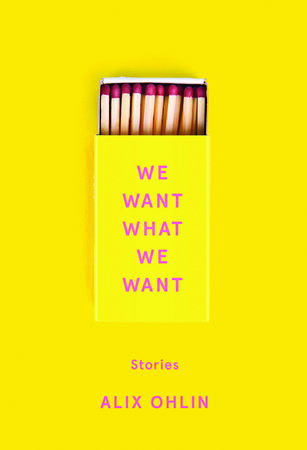
We Want What We Want, by Alix Ohlin

We Want What We Want, by Alix Ohlin (Knopf, 256 pages)

The short-story collection We Want What We Want by Alix Ohlin is billed as women’s fiction, so it’s strange to see it named one of the best books of the summer by Esquire, a magazine aimed at men.

That’s a testament to the Vancouver writer and college professor who has been published in The New Yorker and anthologized in Best American Short Stories. Or maybe it was just wrong to call this women’s lit in the first place.

Regardless, it’s a taut and memorable collection that brings to mind the quote “I would have written a shorter letter if I’d had more time.” (That’s often attributed to Mark Twain, although the sentiment was also expressed by Henry David Thoreau, Martin Luther and Cicero.) Ohlin’s stories are polished; her characters, succinct; and her narration, both comfortable and provocative. You will know the people who populate this book even if they do things that surprise and sometimes shock you.

Consider the story “Risk Management,” crafted around two women who work in a dental office. At first, it seems to be about a character named Little, who comes across as someone kind of like Angela on the TV show The Office, a woman who works with “blistering efficiency” despite her perfectly sculpted gel nails. “The filing, the phones, the calming of patients made hostile by tooth pain; there was nothing she couldn’t handle.”

When the narrator, Valerie, almost by accident, gets invited to Little’s apartment for dinner, however, she sees a different side of her coworker, and the evening conjures secrets and an unexpected intimacy. The story is not flashy or explosive but in Ohlin’s hands utterly engrossing.

Likewise, the story “Casino” suggests at the beginning that it’s about a fractured relationship between two sisters, one of whom is oblivious to the other’s resentment of her sister’s perfectly coiffed life, with a Lincoln Navigator and a five-bedroom McMansion. “Even her complaints are part boast,” Sherri thinks about her sister, Tricia. “She has to mention her busy husband and the two hundred thousand he rakes in a year. Her children’s after-school activities for the gifted are just so freaking expensive and time-consuming.” Tricia only deigns to visit Sherri in January “after she’s suffered through another Christmas that failed to live up to her Martha Stewart-generated expectations.”

But there is a deeper conflict in the story, which Ohlin slowly reveals as the sisters go out for a night at a recently opened casino, and by the end, the story is not so much about this fractious relationship but another one that Sherri has, and Tricia turns out to be her ally.

“The Point of No Return” has the feel of a short novella, spanning decades of friendship between two women, Bridget and Angela, who met in their 20s at the restaurant where they were waitresses. “Angela was from Vancouver, and some dewy freshness that Bridget associated with the West Coast seemed to cling to her always, even when she was sleep deprived or drunk.” Bridget was dismayed when Angela announced she was getting married. “She was used to a constant exchange of friends and lovers, and the idea that one of these relationships should be considered permanent struck her as considerate. It went against the way they all were trying to live: skipping lightly on this earth, skirting the folly of human certainty.”

Early in their relationship, Angela is the rescuer of the somewhat immature Bridget, but these roles reverse later in their lives, and Bridget eventually finds herself standing alone, outside the strange circle that Angela’s life has become, and even her own family.

Ohlin’s gift is to present these strange characters in a way that seems cozily familiar to the reader and then to summarize their existential dilemmas in a jewel of a paragraph like this: “Sometimes she saw her life as a tender thing that was separate from herself, a tiny animal she had happened upon by chance one day and decided to raise. It was terrifying to think how small it was, how wild, how easily she could fit it in the palm of her hand.”

There are 13 stories in this collection, which ultimately is more poignant than funny, although Ohlin displays a sharp wit, even in a story knit around a funeral, “FMK,” in which two characters try to lure a rebellious child inside for the service, and one suggests that there would be snacks afterward, possibly brownies, and the other unleashes on her with fury. “‘Jake has food sensitivities,’ she hissed, as if I was supposed to know.”

On a primal level, Ohlin’s stories appeal because she knows what her readers want: characters who need kicking get kicked, characters who need killin’ get killed, characters who need loving get loved. But she also has a Hollywood screenwriter’s knack for crafting sentences that drag you into the next, such as “When I was twelve years old, my father hired a private detective to follow my mother around” and “We’d been to this funeral home twice before — at least, I think we had?” — sentences that dare you to stop reading.

And although Ohlin is an alumna of The New Yorker, this collection doesn’t have the haughty feel of some of the magazine’s short fiction, which sometimes seems calibrated to mock the reader. It is accessible while deeply thoughtful, a nice bridge from the frothy reads of summer to whatever sober titles arrive in the back-to-everything rust of fall. A


Book Notes

We interrupt this summer to bring you foreign policy, as served up in Afghanistan, which is the sort of place that most people pay little attention to unless it’s front and center in the news. As such, much of the commentary on social media regarding America’s withdrawal is informed by Wikipedia, if even that.

So here are some titles that you might want to check out if you would like a more nuanced education on what’s happening in Kabul:

Sarah Chayes examined corruption in multiple nations in Thieves of State (W.W. Norton paperback, 272 pages) but focuses on Afghanistan in a book praised by Sebastian Junger, among others. Chayes, who has worked as a journalist and military adviser, argues that government corruption is responsible for the rise of the Taliban and other insurgent forces.

The Underground Girls of Kabul by Jenny Nordberg (Crown paperback, 384 pages) helps to explain why the Taliban’s takeover is so troubling for women’s advocates and why many parents there choose to disguise their daughters as sons until puberty makes that impossible.

Anand Gopal’s No Good Men Among the Living (Picador paperback, 320 pages) is about “America, the Taliban and the war through Afghan eyes” and was a finalist for both the Pulitzer and the National Book Prize. The New York Times review when it was published in 2014 called it “essential reading for anyone concerned about how America got Afghanistan so wrong.” Probably time for a sequel, but some people are still saying it’s the best book about Afghanistan in the past two decades.

Blood Washing Blood(Dundurn, 408 pages) is a new book by a former officer in Canada’s Army that is getting good reviews for its history of conflict in Afghanistan over the past century.

And finally, if you’ve never read anything by Khaled Hosseini, the Afghan-American novelist best known for The Kite Runner (Riverhead paperback, 400 pages) and A Thousand Splendid Suns (Riverhead paperback, 432 pages), get thee to an independent bookseller website and order one of his haunting novels. His most recent book, Sea Prayer (Riverhead, 48 pages), isn’t a novel, but a poetic letter from father to son that was inspired by the 3-year-old Syrian boy whose body washed up on a beach in 2015. There are no first-world problems in this author’s body of work.


Books

Author events

R.W.W. GREENE Sci-fi author presents new novel Twenty-Five to Life. Gibson’s Bookstore, 45 S. Main St., Concord. Thurs., Aug. 26, 6:30 p.m. Visit gibsonsbookstore.com or call 224-0562.

SHARON RASK HUNTINGTON Author presents Mirabelle’s Metamorphosis. Joint event with MainStreet BookEnds of Warner and the Pillsbury Free Library. Thurs., Aug. 26, 10:30 a.m. Jim Mitchell Community Park, East Main Street, Warner. Visit mainstreetbookends.com.

L.R. BERGER New Hampshire poet to hold release party of latest book Indebted to Wind. Sat., Aug. 28, 4 p.m. MainStreet BookEnds of Warner, 16 E. Main St., Warner. Visit mainstreetbookends.com.

MONA AWAD Author presents All’s Well. The Music Hall Historic Theater, 28 Chestnut St., Portsmouth. Thurs., Sept. 2, 7 p.m. Tickets cost $13.75. Visit themusichall.org or call 436-2400.

KERRI ARSENAULT Author and journalist presents her investigative memoir Mill Town: Reckoning with What Remains. Thurs., Sept. 9, 6 p.m. The Music Hall, 28 Chestnut St., Portsmouth. Tickets start at $60 for a small table with two copies of the book included Visit themusichall.org.

Poetry

DOWN CELLAR POETRY SALON Poetry event series presented by the Poetry Society of New Hampshire. Monthly. First Sunday. Visit poetrysocietynh.wordpress.com.

SLAM FREE OR DIE Series of open mic nights for poets and spoken-word artists. Stark Tavern, 500 N. Commercial St., Manchester. Weekly. Thursday, doors open and sign-ups begin at 7 p.m., open mic at 8 p.m. The series also features several poetry slams every month. Events open to all ages. Cover charge of $3 to $5 at the door, which can be paid with cash or by Venmo. See Facebook or call 858-3286.

Book Clubs

BOOKERY Online. Monthly. Third Thursday, 6 p.m. Bookstore based in Manchester. Visit bookerymht.com/online-book-club or call 836-6600.

GIBSON’S BOOKSTORE Online, via Zoom. Monthly. First Monday, 5:30 p.m. Bookstore based in Concord. Visit gibsonsbookstore.com/gibsons-book-club-2020-2021 or call 224-0562.

TO SHARE BREWING CO. 720 Union St., Manchester. Monthly. Second Thursday, 6 p.m. RSVP required. Visit tosharebrewing.com or call 836-6947.

GOFFSTOWN PUBLIC LIBRARY 2 High St., Goffstown. Monthly. Third Wednesday, 1:30 p.m. Call 497-2102, email elizabethw@goffstownlibrary.com or visit goffstownlibrary.com

NASHUA PUBLIC LIBRARY Online. Monthly. Second Friday, 3 p.m. Call 589-4611, email information@nashualibrary.org or visit nashualibrary.org.

Featured photo: We Want What We Want.

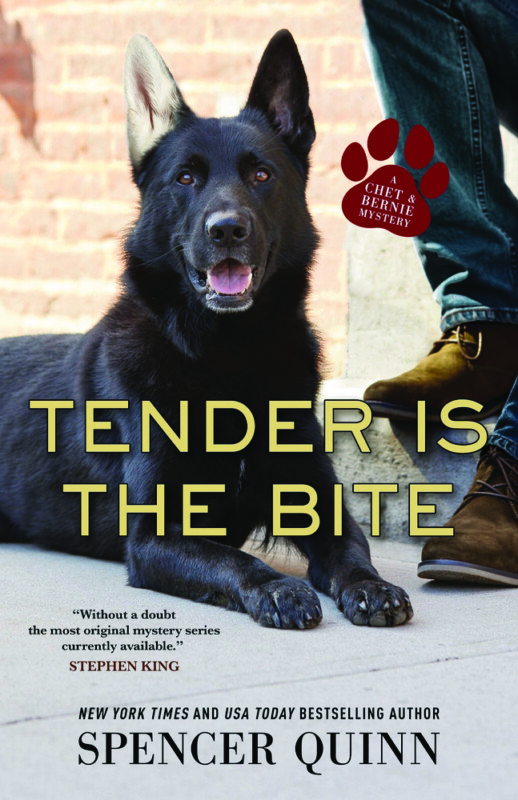
Tender is the Bite by Spencer Quinn

Tender is the Bite, by Spencer Quinn (Forge, 263 pages)

I would say that I am late to the Chet & Bernie series, only I am late in the way you are late to a dentist’s appointment or a barely tolerated neighbor’s cocktail party. That is to say, I’m late primarily because I didn’t want to go.

Sure, the titles are great — Dog on It, The Sound and the Furry, Scents and Sensibility, Heart of Barkness, to name a few — and Stephen King couldn’t be more ebullient, calling Chet & Bernie “the most original mystery series currently available” and saying that author Spencer Quinn “speaks two languages — dog and suspense — fluently.”

That said, the narrator is a dog. And I have an irrational hatred of pen names. (Mr. Quinn, if your books are really that good, wouldn’t you want the world to know that it was Peter Abrahams who wrote them?) And have I mentioned the narrator is a dog?

That said, people lap this stuff up. Since the first book in the series was published in 2008, the author has turned out 10 more and they’re all highly rated on Amazon. So, maybe I was … wrong? You can’t like something if you’ve never tried it.

On to Tender is the Bite, the 11th book in the series that is about the adventures of Bernie Little, a divorced dad who runs a not-especially-profitable detective agency (but still drives a Porsche) and is accompanied everywhere by the lovable Chet, who narrates the story.

Chet admits that he’s not the smartest human in the room, “in fact, not human. I bring other things to the table.” Those would include his senses of smell and hearing, which are much sharper than those of his human, which he is constantly pointing out. For example, when Chet and Bernie are waiting outside someone’s door, Bernie starts to knock for the second time even though his dog has already discerned that a small and possibly barefoot woman was already on the way to open it. “I glanced at Bernie’s ears: not tiny for a human, not at all — and very nice looking in my opinion — but was that all they were for? Just stuck on his head for beauty?”

And with that, they’re off, Bernie trying to solve a case, a modern-day Sherlock with a furry John Watson taking notes, making wry observations, showing his teeth when required, not getting human jokes. Yes, Chet/Quinn/Abrahams is genuinely funny, and yes, it is, as King observed, a fresh way of delivering an old genre. Or was, 13 years ago. Now, however, it seems sort of formulaic, the sort of book that the author can write while he’s cutting the grass and talking on the phone. Open document; insert plot; rewrite the jokes.

In this particular document, Bernie is determined to track down a young woman who had been following his Porsche until he turned the tables and followed her. He learns only that her name is Mavis, before she suddenly turns fearful and bolts, but not before Bernie writes down her license plate number, allowing him to use his network of confidantes (probably illegally) to obtain information to track her down.

From there Chet and Bernie are sucked into a vortex of intrigue that involves two frightened women, a ferret named Griffie, potentially evil Ukrainians and American politicians battling it out for an election that is still a year away. (Quinn shows a deft touch by setting up the political battle with Bernie’s neighbors each putting up opposing yard signs and then offering him one. The nastiness seems vaguely familiar.)

When the humor is good, it is very good indeed, and Chet sometimes seems like a canine David Sedaris, as when he’s musing about a heaven “of the dogs, by the dogs, for the dogs” or making a smart reference to Schrödinger’s cat. But as the mystery unravels it feels more like a Nancy Drew or Hardy Boys book with expletives than Sherlock Holmes, and Chet’s fawning about how beautiful and smart and wonderful Bernie is — while completely in line with what probably goes on in a dog’s brain — grows wearisome, as does his frequent use of the word “perp.”

The appeal of the series is not a mystery. As the saying goes, if you like this sort of thing, this is the sort of thing you’re going to like. There’s zero chance you will like this series if you’re not as obsessed with dogs as Chet is with Bernie. But the fact that you like dogs, or mysteries, or dogs and mysteries, doesn’t mean you will like Bernie and Chet.

For those who do, however, it’s a glorious year. There’s another book coming in October, one for the holidays. It’s a Wonderful Woof, of course. C


Book Notes

It’s something of a shock to come across books that are purportedly bestsellers a week or two before they’ve been released, but that’s because of advance sales, which aren’t hard to rack up if you’re Barack Obama or Sean Hannity.

So how are Rodney Habib and Karen Shaw Becker on Amazon’s bestseller list two months before The Forever Dog(Harper Wave, 464 pages) is released? It’s not just because of a compelling cover, which features a dog wearing a Superman-like cape, or even the subject matter, which is how to get the longest possible lifespan for your dog.

Habib is a telegenic “pet influencer” which is to say he has a vast social media following on the subject of pet health, with 3 million followers alone on Facebook, where this week he warns of the dangers of rawhide while recommending dogs have strawberries for snacks. His website gives no academic credentials, but his co-author is a veterinarian. Both are heavily pushing presales on their respective websites; hence, a bestseller is born from two people most people have never heard of, two months in advance.

Only vaguely related to dogs is a new memoir in paperback that’s getting buzz: I Named My Dog Pushkin (And Other Immigrant Tales) by Margarita Gokun Silver (Thread, 266 pages). It’s a comic memoir, “notes from a Soviet girl on becoming an American woman,” and you gotta love any author who dedicates her book to her thesaurus, as Silver did.

Another new paperback worth a look, especially in light of the new United Nations climate report, is Warmth, Coming of Age at the End of Our World (Penguin, 272 pages) by Daniel Sherrell.

Sherrell, recipient of a Fulbright grant in creative nonfiction, gives thoughtful voice to a generation convinced that their future is that of climate refugees because of what he simply calls “the Problem.” Whether you consider Sherrell a kindred soul or an overwrought Cassandra, Warmth appears to be an elegant meditation on living with climate-fueled sense of doom.


Books

Author events

• JEFF SHARLET Author and journalist will present his books, as part of the Tory Hill Author Series, including his newest, This Brilliant Darkness: A Book of Strangers. Sat., Aug. 21, 7 p.m., to be held virtually via Zoom. Tickets are $5. Visit toryhillauthorseries.com/jeff-sharlet.

AMY MAKECHNIE Author presents her second middle-grade novel Ten Thousand Tries. Sat., Aug. 21, 2 p.m. MainStreet BookEnds of Warner, 16 E. Main St., Warner. Visit mainstreetbookends.com.

R.W.W. GREENE Sci-fi author presents new novel Twenty-Five to Life. Gibson’s Bookstore, 45 S. Main St., Concord. Thurs., Aug. 26, 6:30 p.m. Visit gibsonsbookstore.com or call 224-0562.

MONA AWAD Author presents All’s Well. The Music Hall Historic Theater, 28 Chestnut St., Portsmouth. Thurs., Sept. 2, 7 p.m. Tickets cost $13.75. Visit themusichall.org or call 436-2400.

SHARON RASK HUNTINGTON Author presents Mirabelle’s Metamorphosis. Joint event with MainStreet BookEnds of Warner and the Pillsbury Free Library. Thurs., Aug. 26, 10:30 a.m. Jim Mitchell Community Park, East Main Street, Warner. Visit mainstreetbookends.com.

L.R. BERGER New Hampshire poet to hold release party of latest book Indebted to Wind. Sat., Aug. 28, 4 p.m. MainStreet BookEnds of Warner, 16 E. Main St., Warner. Visit mainstreetbookends.com.

KERRI ARSENAULT Author and journalist presents her investigative memoir Mill Town: Reckoning with What Remains. Thurs., Sept. 9, 6 p.m. The Music Hall, 28 Chestnut St., Portsmouth. Tickets start at $60 for a small table with two copies of the book included Visit themusichall.org.

Poetry

• POETRY IN THE MEADOW Featuring readings with poets Chad deNiord, Kylie Gellatly and Samantha DeFlitch. Sun., Aug. 22, 4:30 p.m. The Word Barn Meadow, 66 Newfields Road, Exeter. $5 suggested donation. Visit thewordbarn.com.

DOWN CELLAR POETRY SALON Poetry event series presented by the Poetry Society of New Hampshire. Monthly. First Sunday. Visit poetrysocietynh.wordpress.com.

SLAM FREE OR DIE Series of open mic nights for poets and spoken-word artists. Stark Tavern, 500 N. Commercial St., Manchester. Weekly. Thursday, doors open and sign-ups beginning at 7 p.m., open mic at 8 p.m. The series also features several poetry slams every month. Events are open to all ages. Cover charge of $3 to $5 at the door, which can be paid with cash or by Venmo. Visit facebook.com/slamfreeordie, e-mail slamfreeordie@gmail.com or call 858-3286.

Book Clubs

• BOOKERY Online. Monthly. Third Thursday, 6 p.m. Bookstore based in Manchester. Visit bookerymht.com/online-book-club or call 836-6600.

GIBSON’S BOOKSTORE Online, via Zoom. Monthly. First Monday, 5:30 p.m. Bookstore based in Concord. Visit gibsonsbookstore.com/gibsons-book-club-2020-2021 or call 224-0562.

TO SHARE BREWING CO. 720 Union St., Manchester. Monthly. Second Thursday, 6 p.m. RSVP required. Visit tosharebrewing.com or call 836-6947.

GOFFSTOWN PUBLIC LIBRARY 2 High St., Goffstown. Monthly. Third Wednesday, 1:30 p.m. Call 497-2102, email elizabethw@goffstownlibrary.com or visit goffstownlibrary.com

BELKNAP MILL Online. Monthly. Last Wednesday, 6 p.m. Based in Laconia. Email bookclub@belknapmill.org.

NASHUA PUBLIC LIBRARY Online. Monthly. Second Friday, 3 p.m. Call 589-4611, email information@nashualibrary.org or visit nashualibrary.org.

Featured photo: Tender is the Bite.

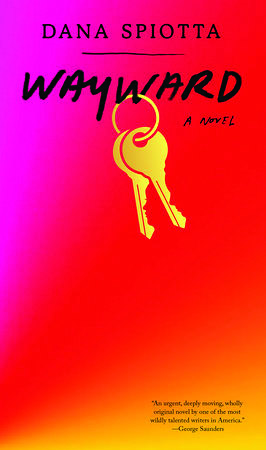
Wayward by Dana Spiotta

Wayward, by Dana Spiotta (Knopf, 270 pages)

In 2013, New Hampshire author Howard Mansfield published a gorgeous ode to the physical structure that, if we are lucky, we come to see as a home, not a house. Dwelling in Possibility examined what Mansfield called “the soul of shelter,” the nourishment that we get from a pile of lumber, concrete, steel and stone.

Dana Spiotta does this, too, in her new novel Wayward, which is about a woman who, traumatized by the 2016 election, impulsively buys a run-down house and walks out of her marriage.

There were, of course, other catalysts for the decision that are revealed over time. But in setting up a wholly unexpected type of unfaithfulness — a woman falling in love with an illicit house — Spiotta taps into a rarely explored subject: the emotional connection that many people have to their homes, even when, to the world, it may seem irrational. “The house was falling apart. The house was beautiful,” Sam thinks to herself as she falls for a century-old cottage after being the only person to show up for the open house. (Apparently, bored women go to open houses as a form of recreation — who knew?)

She was seduced by its tile-lined fireplace, custom-built storage benches and old wood, which made her own house, with its gas fireplace and perpetually distracted husband, look hopelessly bourgeois.

Sam makes an offer on the house and decides to leave her husband without thinking much about the consequences, only vaguely aware that “saying yes to this version of her life would mean saying no to another version of her life.”

When she tells Matt, he is standing at the blender, making a post-workout smoothie, and doesn’t stop what he is doing, suggesting that Sam is making a bold and empowering decision that will radically improve her life. In fact, life is never that simple.

The decision fractures an already tense relationship with Sam’s 16-year-old daughter, who has just begun a secretive relationship with a much older man. And the complexities of leaving the suburbs and navigating a new life in the city, with a couple of amusingly woke friends, complicates Sam’s life as she attempts to ignore the worsening condition of her own mother, Lily, who has pancreatic cancer.

Meanwhile, her husband seems determined to love her back into the family home, writing Sam checks to cover her expenses, including the full cost of the house (“It’s your money, too,” he tells her) and sending her flowers on the first day she sleeps there. “Dusty peach-colored peonies, her favorite. Her leaving had made him attend her, but he didn’t understand that wasn’t her intention at all. Sam just wanted to be alone in her house.”

Matt’s graciousness thrusts Sam into a place of “phony poverty, fake independence” as her part-time job as a tour guide at the Clara Loomis House couldn’t have paid even her small bills.

The family tensions ramp up to a satisfying crescendo, but the real pleasure in Wayward is Spiotta’s grasp of the mundane, as in her treatment of Sam’s of chronic insomnia (which will be utterly relatable to anyone who has ever bolted awake at 3 a.m. and not been able to get back to sleep) and necessary but painful tensions that both physically and emotionally tear apart older teens and their parents. She also has a shrewd wit that leavens the novel’s serious themes.

“You do seem deranged,” Matt says to Sam as they discuss the election of someone they loathed (a person never mentioned by name, but the novel starts in 2017). She is deranged, but in the way that we all are these days: overwhelmed, underfunded, desperately trying to do right by other people while doing right by ourselves, to stay asleep the whole night, take care of our children, take care of our parents, take care of the planet. This is a thoroughly contemporary novel, with its Facebook groups of outraged women (WWW: Women Won’t Wilt, and Central New York Crones) and soliloquies on higher education and other contemporary frustrations. (Sam sees the college admissions process as a sort of Hunger Games.)

It is also a solidly regional novel; you will learn more than you want to about Syracuse, New York, to include its architecture and history. And apparently Clara Loomis, the namesake of the historical house at which Sam works, is an invention of the author, which is a bit confusing given that she is linked to real people, such as Elizabeth Cady Stanton. At the end, the novel shape-shifts with letters and journal entries from Loomis, which complicates the work in ways that are not all positive. There is also no obvious resolution to many of the family’s struggles; people who like an ending neatly tied with a ribbon may grumble at the conclusion.

Wayward is not chick lit; it’s too smart a book for that. But it’s definitely a novel for women, and women of a certain age. For that demographic, it’s a slam dunk, especially if the women lean Democrat. A-


Book Notes

The announcement of book award nominees in the summer is the equivalent of pumpkin-spice products emerging in August. It’s way too early. We still haven’t finished our beach reads.

But the long list for the Booker Prize came out this week, and if nothing else, it’s confirmation of the Hippo’s good taste. Three books on the list were reviewed here and given A’s: Klara and the Sun by Kazuo Ishiguro (Knopf, 321 pages), No One is Talking About Thisby Patricia Lockwood (Riverhead, 224 pages) and Great Circle by Maggie Shipstead (Knopf, 608 pages).

The award, given each November, is for the best novel written in English and published in Britain or Ireland. The inclusion of American authors is a perennial source of friction in the U.K., although interestingly the British novelist Ishiguro has been supportive of the change, made in 2014. (In addition to his current nomination, Ishiguro won the Booker Prize in 1989 for The Remains of the Day.)

Besides Lockwood and Shipstead, two other Americans are on the long list this year: Nathan Harris and Richard Powers; Harris for The Sweetness of Water (Little, Brown and Co., 368 pages) and Powers for Bewilderment(W.W. Norton, 288 pages), which hasn’t even been released yet. Its release date is Sept. 21.

Meanwhile, props to the U.K. publication The Guardian, which each year runs a “Not the Booker Prize” contest, because, in its words, “the judges of Britain’s most prestigious literary award pick the wrong book too often.” The readers of The Guardian’s book blog vote on their favorites. Last year’s winner was Hello Friend We Missed You, by Richard Owain Roberts, which was published in the U.S. in paperback this year (Parthian, 200 pages) and is described on Amazon as “bleakly comic.”

Alas, the author only won a Guardian coffee mug. The Booker Prize winner this year, to be announced Nov. 3, will collect $69,000.


Books

Author events

JOYCE MAYNARD Author presents her new novel Count the Ways. Phenix Hall, 38 N. Main St., Concord. Thurs., Aug. 5, 7 p.m. Visit gibsonsbookstore.com or call 224-0562.

SADIE & CORBIN RAYMOND Authors present 121 Days: The Corbin Raymond Story of Fighting for Life and Surviving a Traumatic Brain Injury. Gibson’s Bookstore, 45 S. Main St., Concord. Tues., Aug. 10, 6 p.m. Visit gibsonsbookstore.com or call 224-0562.

KATE SHAFFER & DEREK BISSONNETTE Authors present The Maine Farm Table Cookbook. Outside the Music Hall Historic Theater, 28 Chestnut St., Portsmouth. Thurs., Aug. 12, 6 p.m. Tickets cost $60 for a small table (two people), $120 for a medium table (four people), $180 for a large table (six people). Visit themusichall.org or call 436-2400.

PETER FRIEDRICHS Author presents And the Stars Kept Watch. Virtual event, hosted by Toadstool Bookstores, located in Nashua, Peterborough and Keene. Tues., Aug. 17, 6 p.m. Visit toadbooks.com or call 673-1734.

R.W.W. GREENE Sci-fi author presents new novel Twenty-Five to Life. Gibson’s Bookstore, 45 S. Main St., Concord. Thurs., Aug. 26, 6:30 p.m. Visit gibsonsbookstore.com or call 224-0562.

MONA AWAD Author presents All’s Well. The Music Hall Historic Theater, 28 Chestnut St., Portsmouth. Thurs., Sept. 2, 7 p.m. Tickets cost $13.75. Visit themusichall.org or call 436-2400.

Poetry

DOWN CELLAR POETRY SALON Poetry event series presented by the Poetry Society of New Hampshire. Monthly. First Sunday. Visit poetrysocietynh.wordpress.com.

SLAM FREE OR DIE Series of open mic nights for poets and spoken-word artists. Stark Tavern, 500 N. Commercial St., Manchester. Weekly. Thursday, doors open and sign-ups beginning at 7 p.m., open mic at 8 p.m. The series also features several poetry slams every month. Events are open to all ages. Cover charge of $3 to $5 at the door, which can be paid with cash or by Venmo. Visit facebook.com/slamfreeordie, e-mail slamfreeordie@gmail.com or call 858-3286.

Book Clubs

BOOKERY Online. Monthly. Third Thursday, 6 p.m. Bookstore based in Manchester. Visit bookerymht.com/online-book-club or call 836-6600.

GIBSON’S BOOKSTORE Online, via Zoom. Monthly. First Monday, 5:30 p.m. Bookstore based in Concord. Visit gibsonsbookstore.com/gibsons-book-club-2020-2021 or call 224-0562.

TO SHARE BREWING CO. 720 Union St., Manchester. Monthly. Second Thursday, 6 p.m. RSVP required. Visit tosharebrewing.com or call 836-6947.

GOFFSTOWN PUBLIC LIBRARY 2 High St., Goffstown. Monthly. Third Wednesday, 1:30 p.m. Call 497-2102, email elizabethw@goffstownlibrary.com or visit goffstownlibrary.com

BELKNAP MILL Online. Monthly. Last Wednesday, 6 p.m. Based in Laconia. Email bookclub@belknapmill.org.

NASHUA PUBLIC LIBRARY Online. Monthly. Second Friday, 3 p.m. Call 589-4611, email information@nashualibrary.org or visit nashualibrary.org.

Featured photo: Wayward.

Noise, by Daniel Kahneman

Noise, by Daniel Kahneman, Olivier Sibony and Cass R. Sunstein (Little, Brown Spark, 398 pages)

Five years ago, writing in Harvard Business Review, the esteemed psychologist and economist Daniel Kahneman joined with a few other enviably smart people to discuss the concept of noise: not the kind your neighbors make while you’re trying to sleep, but the kind that clouds judgments, sometimes to devastating effect.

This kind of noise, as Kahneman describes it, is the wide variance in outcomes that we might think should be similar but instead are all over the map. One of the most obvious examples of this is in criminal justice, where one person might get a 20-year sentence for a crime, while another gets five years and community service. That makes the criminal justice system particularly noisy, in Kahneman terms.

But even if you don’t plan on going to jail, noise in human judgment probably affects you, as people such as doctors and loan officers also have wide discretion in their decisions. It’s not just unusual — it’s unnervingly common— for physicians to offer different diagnoses a few weeks apart when researchers present them with the exact same case.

And completely unrelated things such as whether people have eaten recently and whether their sports team won over the weekend can affect the decisions they make.

It’s an important subject and one worthy of consideration, more so if you’re in a noisy profession or at the mercy of one. And so fans of Kahneman, whose 2011 book Thinking, Fast and Slow was universally lauded, might be excited to delve into his latest, Noise, A Flaw in Human Judgment, written with Olivier Sibony and Cass Sunstein. Unfortunately, most of us would be better off just reading the Harvard Business Review article from 2016, which lays out the principles of noise without causing the reader unnecessary pain.

Noise is a scholarly book written for a scholarly audience that is at the forefront of the literary conversation only because Thinking, Fast and Slow was so well-received. Had this manuscript fallen into the hands of a publisher who knew nothing of the authors or their past credits, it would have been cut in half or, equally likely, still languish in the slush pile.

To their credit, the authors did try to simplify their subject for a mass audience. Or at least one of them did. You never know, with three authors, who is writing at any given point, and Noise is erratic in its understandability. You might say the book itself is noisy.

Some chapters read like AP psychology, others like an Ivy League dissertation. (Example: “You may have noticed that the decomposition of system noise into level noise and pattern noise follows the same logic as the error equation in the previous chapter, which decomposed error into bias and noise.”) Not that they didn’t give us warning. In the opening to the book, the authors suggest some readers might want to skip the first four parts of the book (there are six) and go straight to Part 5, essentially skipping half the book.

But people who do that will miss some of the book’s interesting content, including how the free-throw averages of NBA players have the wide variability of noise despite the hoop always being 10 feet away and the ball always weighing 22 ounces. That’s because the players are susceptible to the same lottery-like forces that we are in our daily lives. We are not the same people that we were 10 years ago, or even 10 minutes ago, because of variables such as mood, stress and fatigue. So decisions in ordinary life can be noisy as well, although they can rarely be documented as such.

So what to do about this problem? Kahneman, Sibony and Sunstein have some solutions. One is to adopt the social-science concept known as the “wisdom of crowds.” Researchers have shown that while individuals may not be great at guessing things, whether the number of gumballs in a glass bowl or the number of airports in the U.S., as a group we come close, when researchers combine individual guesses into an average or mean. Taking the average of four independent judgments can reduce noise by half, the authors write.

Outside a social-science lab, the best way to leverage this finding in our daily life is to get other people’s opinions (independent ones, not people with the proverbial dog in the fight) and make a decision that best represents the mean. If you don’t have time or inclination to consult others, social science has another solution: create an “inner crowd” by coming up with your own best guess, and then basically challenging your own decision: Assume your first decision is wrong and consider why. Then make a different decision, based on these reasons. Often, the best decision will lie in the space between your first and second choices.

That’s one strategy in creating a personal form of “decision hygiene,” which the authors suggest. But they write about a nebulous topic and concede that it’s nearly impossible to know how good decision hygiene helps. “Correcting a well-identified bias may at least give you a tangible sense of achieving something. But the procedures that reduce noise will not. They will, statistically, prevent many errors. Yet you will never know which errors. Noise is an invisible enemy, and preventing the assault of an invisible enemy can yield only an invisible victory.”

Like Kahneman’s previous work, for which he won a Nobel Prize in 2002, the theories put forth in Noise will be considered groundbreaking and this book will likely win awards that have nothing to do with its readability. Outside the academy, it’s a hard row to hoe, but there’s value in skimming. C

Book Notes

The 2020 Olympic Games, postponed because of the pandemic, kick off this weekend, but don’t feel too sorry for the athletes competing a year late and without spectators.

Things could be worse, and in fact have been, as you will learn in Total Olympics by Jeremy Fuchs (Workman, 336 pages), who promises to reveal “every obscure, hilarious, dramatic and inspiring tale worth knowing.”

The worst in recent memory has to be the 1972 Olympics, the year of the Munich massacre. But in terms of sheer hassle and inconvenience for the athletes, consider 1948, when London finally got around to holding the 1944 games (canceled because of the war). The city was so spent and countries were so broke that this was dubbed the “Austerity Games” with athletes making their own uniforms and bringing their own food. But they pulled it off and let it be known that a Dutch mother of two won four gold medals in track and field and became known internationally as “the Flying Housewife.” It looks to be an entertaining read between commercials.

For a narrower look, specific to track-and-field athletes, check out The Fastest Men on Earth by Neil Duncanson (Welbeck, 384 pages). It’s a new paperback that tells the stories of 25 Olympic sprinters, including superstar Usain Bolt.

Also worth a look: Olympic Pride, American Prejudice by Deborah Riley Draper and Travis Thrasher (Atria, 400 pages), billed as “the untold story of 18 African Americans who defied Jim Crow and Adolf Hitler to compete in the 1936 Berlin Olympics.” The hardcover edition came out last year; a paperback will be issued in September.

And for those of you with zero interest in the Olympics, celebrated science writer Sam Kean has a new book out this month. The Icepick Surgeon (Little, Brown and Co., 369 pages) is an entertaining, if deeply disturbing, look at rogue scientists throughout the ages. An introductory quote by Dr. Thomas Rivers sets it up nicely: “All I can say is, it’s against the law to do many things, but the law winks when a reputable man wants to do a scientific experiment.”


Books

Author events

JOYCE MAYNARD Author presents Count the Ways. Toadstool Bookstore, 12 Depot Square, Peterborough. Sat., July 24, 11 a.m. Visit toadbooks.com or call 924-3543.

GIGI GEORGES Author presents Downeast: Five Maine Girls and the Unseen Story of Rural America. Toadstool Bookstore, Somerset Plaza, 375 Amherst St., Route 101A, Nashua. Sat., July 24, 2 to 4 p.m. Visit toadbooks.com or call 673-1734.

JESS KIMBALL Author presents My Pseudo-College Experience. Virtual event, hosted by Toadstool Bookstores, located in Nashua, Peterborough and Keene. Tues., July 27, 6 to 7 p.m. Visit toadbooks.com or call 673-1734.

CATHLEEN ELLE Author presents Shattered Together. Virtual event, hosted by Toadstool Bookstores, located in Nashua, Peterborough and Keene. Thurs., July 29, 6 p.m. Visit toadbooks.com or call 673-1734.

KATE SHAFFER & DEREK BISSONNETTE Authors present The Maine Farm Table Cookbook. Outside the Music Hall Historic Theater, 28 Chestnut St., Portsmouth. Thurs., Aug. 12, 6 p.m. Tickets cost $60 for a small table (two people), $120 for a medium table (four people), $180 for a large table (six people). Visit themusichall.org or call 436-2400.

MONA AWAD Author presents All’s Well. The Music Hall Historic Theater, 28 Chestnut St., Portsmouth. Thurs., Sept. 2, 7 p.m. Tickets cost $13.75. Visit themusichall.org or call 436-2400.

Poetry

DOWN CELLAR POETRY SALON Poetry event series presented by the Poetry Society of New Hampshire. Monthly. First Sunday. Visit poetrysocietynh.wordpress.com.

SLAM FREE OR DIE Series of open mic nights for poets and spoken-word artists. Stark Tavern, 500 N. Commercial St., Manchester. Weekly. Thursday, doors open and sign-ups beginning at 7 p.m., open mic at 8 p.m. The series also features several poetry slams every month. Events are open to all ages. Cover charge of $3 to $5 at the door, which can be paid with cash or by Venmo. Visit facebook.com/slamfreeordie, e-mail slamfreeordie@gmail.com or call 858-3286.

Book Clubs

BOOKERY Online. Monthly. Third Thursday, 6 p.m. Bookstore based in Manchester. Visit bookerymht.com/online-book-club or call 836-6600.

GIBSON’S BOOKSTORE Online, via Zoom. Monthly. First Monday, 5:30 p.m. Bookstore based in Concord. Visit gibsonsbookstore.com/gibsons-book-club-2020-2021 or call 224-0562.

TO SHARE BREWING CO. 720 Union St., Manchester. Monthly. Second Thursday, 6 p.m. RSVP required. Visit tosharebrewing.com or call 836-6947.

GOFFSTOWN PUBLIC LIBRARY 2 High St., Goffstown. Monthly. Third Wednesday, 1:30 p.m. Call 497-2102, email elizabethw@goffstownlibrary.com or visit goffstownlibrary.com

Featured photo: Noise.

Stay in the loop!

Get FREE weekly briefs on local food, music,

arts, and more across southern New Hampshire!