Pub band

Celtic crushers Rebel Collective hit Bank of NH Stage

Concord’s Capitol Center for the Arts continues its happy trend of bringing homegrown acts to the smaller Bank of NH Stage when Rebel Collective appears there on July 23. The raucous, Celtic-infused sextet started out at True Brew Barista, a nearby Bicentennial Square hub for local bands before the owners retired and closed it in July 2020.

At that time, 2015, the group consisted of three cousins on main instruments and a rhythm section, and was a casual affair. “We’d always joked about doing a pub band,” guitarist and singer Michael Green said by phone recently. “One year, we decided to throw something together and have a show, and we had a lot of fun.”

After True Brew, they went on to play St. Patrick’s Day events, at Manchester’s Shaskeen and Salt hill Pub in the Upper Valley. Their sound was informed by Green’s roots. “I am about half Irish, with my grandmother being straight off the boat. That said, it wasn’t part of my upbringing really, and it was through the music of the Pogues and Dropkick Murphys that I started getting into the history of Ireland and my own ancestry.”

When the band got booked to play the New Hampshire Highland Games, Scottish songs were added to their set, creating a boozy hybrid that sets them apart. They’ve opened shows for the Dropkicks, Flogging Molly and Derek Warfield, all the while writing original songs, a few of which appear on 2018’s Old Sad State.

The title cut of that EP is a true, if half remembered, story of a wild night “with a bottle of Pogues whiskey, singing for the fair maidens and hoping they’ll feel frisky” that ends “out in the street, singing for salvation in the moonlight.” Though the hooch is named after Green’s “favorite band forever,” he’s no fan, not by a long shot.

“It’s god-awful and I don’t recommend it,” he said, but he is thankful that, as Shawn Colvin once noted, he got a tune out of it. “We weren’t feeling too good the next morning, but I’m lucky in the fact that I might make bad decisions, but at least they usually make good songs.”

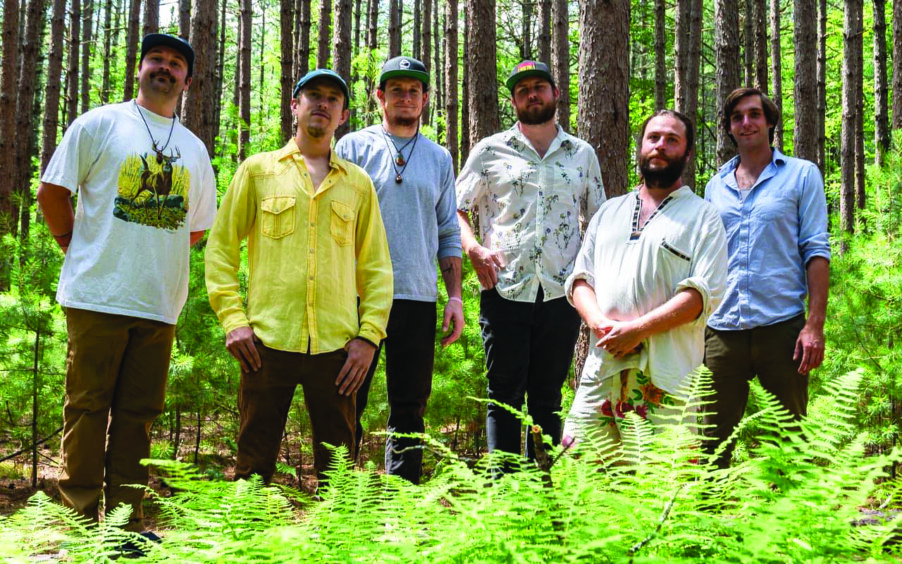
Rebel Collective changed significantly when accordion player and high harmony singer Brian Waldron moved to Florida in 2021. Brought on board were fiddler Esther Bostick and guitarist Jordan, whom Green calls Granddaddy SG for his 1960s vintage Gibson. With Green, Ross Ketchum on mandolin, guitar and vocals, and Pete Provencher and Connor Veazey on drums and bass, the new direction is “really similar in a lot of ways” to what they were doing before, Green said, but with an edge that comes from swapping a squeeze box for a rocking ax.

“It’s not heavy, but it’s not clean, and it really fills up the sound … we’ve committed to making a bigger, cohesive sound,” he said. “It’s led to having more fun [and] while we miss having Brian’s beautiful voice we gain by having other singers. Our gang vocals are a little bit thicker. We’re the same, just different.”

After releasing one studio effort, they’re not in a hurry to make another record. They have plenty of other novel pursuits to fill the time, including a Flag Hill Whiskey release party in the fall, along with another Highland Games. Besides, given their Celtic Crush repertoire, audiences often can’t tell the band’s own material from cover songs, which pleases Green.

“I’ve had people come up and thank me for playing this old traditional song, and they’re talking about one of my originals; I don’t correct them,” he said. “It’s a kind of a barometer; if you’ve written a song and it immediately resonates like they’ve heard it before, you know you really wrote a good one. I let them say their piece and take it as a compliment.”

The Concord show will benefit Court Appointed Special Advocates (CASA) of New Hampshire, a nonprofit the band has been helping out for years, including playing their annual fundraiser and tasking one of their dancers to high step crowds into filling a tip jar at shows. “We were able to raise a couple thousand for CASA last year,” Green said. “So we’re really excited to take this great opportunity at this great event and use it as a way to continue doing our work for them.”

Rebel Collective
When: Saturday, July 23, 8 p.m.
Where: Bank of NH Stage, 16 S. Main St., Concord
Tickets: $18 at ccanh.com

Featured photo: Rebel Collective. Courtesy photo.

Graham Nash Q&A

Rock legend talks music, photography and politics

Though he’s happy a live re-recording of his first two solo albums is doing well, Graham Nash often wishes that the music on 1971’s Songs For Beginners and 1974’s Wild Tales didn’t still resonate the way it did in the Watergate era. A vocal opponent of the previous administration — he has an upcoming record with a track called “Golden Idol” aimed at proponents of the “Big Lie” — Nash isn’t optimistic about the country he became a citizen of in 1979.

“I’m pleased that my music seems to have lasted a couple of decades, but at the same time it’s a pain in the ass that we have not learned from our history,” he said by phone recently. “I think what I’m seeing now, unfortunately, is the fall of the American Empire. I think that we are completely divided as a people, and a divided nation can’t last very long.”

Nash is a two-time Rock & Roll Hall of Famer, with his first band The Hollies, and with Crosby, Stills, Nash & Young. Despite their acrimonious 2016 breakup, the supergroup reunited earlier this year to demand that Spotify remove their music in protest of Joe Rogan, who frequently hosts vaccine deniers and Covid-19 skeptics on his podcast.

In early July, CSNY was back on Spotify. The interview with Nash happened earlier, on June 24. At that time, he spoke of steps taken by the streaming service that hint at reasons for the group’s eventual reversal. “They have put genuine Covid-19 information on a million podcasts and that is a great step forward,” he said. “They’re now recognizing that people like Rogan and his guests were spreading misinformation and disinformation.”

Last November, Nash published a book of photographs called A Life In Focus. His passion for pictures dates back to the first one he took, of his mother, in 1953, and learning darkroom technique as a child from his father. The shot of his mom, in repose and unaware of her son’s camera, is among the collection’s best.

Pictures of icons like Joni Mitchell, David Crosby, Jackson Browne, even ’60s supermodel Twiggy, are equally candid. It’s the only way, asserts Nash. “Having had probably hundreds of thousands of photographs taken of me, I know … the face that you put on because you want to look cool,” he said. “I give that face sometimes when people are taking pictures of me [and] I don’t like that face. So my best portraits of people are taken when they have no idea that I’m there.”

Nash also has a skillful eye for street scenes, like a shot of a well-dressed woman staring into the window of an expensive jewelry store as a homeless man sleeps mere inches from her. “I use a camera to capture surreal moments that happen in front of me,” he said. “Which they seem to do a lot.”

That said, he believes social media trivializes the art. “There are [millions of] smartphones in this world and maybe only a hundred photographers,” he said, adding, “I don’t use my camera as my memory. I don’t want a picture of me in Mickey Mouse ears at Disneyland, I don’t take pictures that match my couch, or kittens with balls of wool. I don’t take landscapes — I’d rather remember the landscape.”

He loves gear — an IRIS 3047 printer he bought in 1989 for his company Nash Images is now in the Smithsonian — and he also enjoys playing with the process of photography. There’s a distinctive shot of fellow musician Dave Mason in the book that’s basically a smudged Polaroid, taken in his suite at New York’s Plaza Hotel in the mid-1970s. “In those days, if you had a ballpoint pen, a sharp instrument or something, you could move the emulsion around,” he explained. “As a matter of fact, Elton John just bought that picture.”

Politics are intertwined with both his music and photography. In the Wild Tales track “Prison Song,” Nash alludes to his father spending a year in high-security lockup for unknowingly buying a stolen camera from a co-worker to give him as a gift. It made Nash a lifetime foe of unjust authority, along with his ire at being spanked by his school principal for ditching class to buy Bill Haley concert tickets in 1958.

With him at the Haley performance was best mate Allan Clarke; the two would later start The Hollies. Years later, they’re working together again, on Clarke’s solo record. “I’m very pleased to be able to sing with Allan after all this time,” Nash said. “He had to leave the Hollies because he had throat trouble, but it may have been psychosomatic … his excuse to be able to leave. Because right now, he’s singing very well.”

Nash has no regrets about skipping school that day. The experience both confirmed, to quote his 2013 autobiography, that “justice was malleable and subjective … too much politics involved,” and launched him on a lifetime of music. “The truth is … I’ve lost houses, and I’ve lost relationships; I have not lost my ticket to that show. I have it in my wallet as we speak.”

An Evening with Graham Nash
When: Wednesday, July 20, 8 p.m.
Where: Colonial Theatre, 609 Main St., Laconia
Tickets: $50 to $100 at coloniallaconia.com

Featured photo: Graham Nash. Photo by Amy Grantham.

Balance of power

Marsalis brings Democracy! Suite to NH

By Hannah Turtle

hturtle@hippopress.com

Legendary jazz musician Wynton Marsalis is slated to play Jimmy’s Jazz and Blues Club in Portsmouth on Saturday, July 9.

Marsalis’ newest work is called The Democracy! Suite, one he wrote during lockdown. The record is based on his idea that jazz music is a metaphor for democracy. In a recent interview, he had plenty to say about the album.

“If we just think about the things that are required for democracy. The one thing is: no king. The basis is, you have a constitution, you distribute power. Our music has that type of distribution of power. I might be the leader of the band, but when we start playing, the president of the band is the drummer, not the trumpet player. The drummer is playing all the time, making decisions. There’s an actionable form to create a plurality, it’s designed to prevent kleptocracy. Now, we aren’t really doing good with that right now, but it’s checks and balances,” said Marsalis.

“You’ve got the legislative branch, the executive branch and the judicial branch. In jazz, if you look at the rhythm section, each instrument represents that. The judicial branch is represented by the bass, that’s the final word on harmony, it’s at the bottom. The executive branch is the drums, that’s the quick power. And, the legislative branch is the piano — it has all the keys.”

Though ideas of democracy and the constitution have been a hot-button issue lately, Marsalis is not worried about our ability to persevere.

“The fundamentals of democratic living are not based on the time you live in, it’s based on the principles themselves. For example, there was a time in America when we had slaves, but it was antithetical to principles of freedom, so we fought it,” he said

“Jazz has three fundamental components. One is improvisation. That’s the personal freedom, that’s the part that everyone agrees on. The second component is swing, and we don’t agree on that. Swing has the African component, and America struggles to deal with its own African-ness. Swing is also the collective part, it’s the ‘we.’ We just don’t agree on the ‘we.’ Our dream is what we can individually do: I can get a house, I can make some money. We don’t think of the community, the collective thought. We want to have the bass vamp the same four notes, have the drums replaced by something electronic that plays a loop, all that is the decision that I don’t want to deal with the ‘we,’” Marsalis said.

He brings it back to the beginning.

“It’s the desire to change the plurality to something that an individual can dominate. But we have an actionable form too, it’s a chorus that goes around and around in a cycle. The energy pulls from the bottom up, it doesn’t go top down. The top is just where the instructions come from. For example, elections are run by states, not by the federal government. Polls are local. A poll worker is just a person in the community. That’s how our music is. We get people from communities, they don’t have to be from a certain kind of family, and we just play.”

That final fundamental jazz component is the blues. It’s something Marsalis spoke of reverently. “The blues has an optimism that’s not naive. Stuff doesn’t go your way a lot of the time, but you can’t give up. Use your will, get into the struggle, and create the change you want to see.”

On that note, I had just one more request for Marsalis, to describe his music to readers who might not be familiar. At that, he was back to a simple answer: “I really don’t know. There’s a lot of it. I’ve done like a hundred and fifteen records. They’re all different. The one thing about the music is that it’s collective. Every time, I play with great musicians, and we play together.”

The Wynton Marsalis Septet
Where: Jimmy’s Jazz and Blues Club, 135 Congress St., Portsmouth; 888-603-JAZZ
When: Saturday, July 9, 7:30 and 9 p.m.
Tickets: $125 to $195 at jimmysoncongress.com

Featured photo: Wynton Marsalis. Photo by Lawrence Sumulong.

Laughter as medicine

Jimmy Tingle’s Humor for Humanity

Though he’s a political comedian, and maybe the only standup who attended Harvard’s Kennedy School of Government, Jimmy Tingle doesn’t lean left or right in his joke-telling. Yes, he ran for Lieutenant Governor in Massachusetts’s 2018 Democratic primary, but on stage, he’s there for everyone.

Tingle believes, to paraphrase the old Burt Bacharach/Hal David song, that’s what the world needs now.

“People don’t need to be beat up rhetorically; people want to laugh,” he said in a recent phone interview. “I don’t shy away from what’s going on, but I don’t want to be finger-pointing at people and turning on them, making people feel like there’s no hope, that we’re not making progress. Because we are.”

Tingle calls his new campaign Humor For Humanity, and aims to draw laughs and do good. “It’s basically using humor to illuminate the human condition and where we are in the country right now,” he said, “but it’s also a social enterprise that raises spirits, funds and awareness for nonprofits, charities and social causes. Our mission is your mission … humor in helping, humor in healing, humor in hope — ha, ha, ha!”

Proceeds from a pair of upcoming shows at The Music Hall in Portsmouth will benefit the Friends of Moldova Refugee Relief charity. Tingle’s Harvard classmate Maia Sandu is president of Moldova, which borders Ukraine and has been severely impacted by the Russian invasion of that country. “I’ve done some low-level fundraising for [the cause] in the past couple of months,” Tingle said, “but this will be a more direct deposit to the organization.”

Tingle was inspired to become a comic by Dustin Hoffman’s portrayal of Lenny Bruce in the 1974 Bob Fosse-directed biopic. “That just illustrated what comedy could be besides what I grew up on — The Three Stooges, Honeymooners, Jackie Gleason,” he said. “When I watched that movie back in college, while we were discussing … all the challenges that were front and center in the country at that time, coming out of the Vietnam War, I saw what comedy could be as well. It just resonated with me.”

His show is autobiographical, beginning with Tingle’s days as a street performer in Cambridge, doing standup in the city’s burgeoning ’80s comedy scene. He’ll talk about working at the Ding Ho club, where he was a fixture, then moving to one-man shows, running through a ‘greatest hits’ of some of those, then touch on his time as a 60 Minutes correspondent.

The evening concludes in the present, where Tingle remains an optimist. “Things that were revealed during the pandemic, like racial equity [and] treating these subjects with humor, but also, I would like to think, insight and, again, progressive commentary.” That last word reflects a continuum rather than an ideology, Tingle stressed. “I like to think we’re making progress; we gotta keep making progress.”

Along with live work, Tingle has a podcast that’s hosted comics like Colin Quinn, Marc Maron and Paula Poundstone, as well as activists like John Rosenthal, the founder of Stop Handgun Violence.

“It’s not just about entertainment, but that’s … first and foremost on my agenda,” he continued. “I want to be funny as well as as positive and uplifting as I can be, and also hopeful regarding the situation that’s going on. The doom and gloom is overwhelming, and the division in the country is overwhelming. I want to be less partisan and more unifying about the human condition, and what we all have in common.”

After two years of uncertainty, Tingle feels it’s the least he can do.

“I just want people to come out and have a good time and leave the theater hopefully feeling uplifted and more positive,” he said. “More hopeful than they were when they went in. I’ve had a lot of people say, ‘Thank you so much for doing this show. It’s exactly what I needed, because I haven’t been out of the house in two years. It was so good to be back out and laughing with people.’”

Jimmy Tingle
When: Saturday, July 16, at 6 and 8:30 p.m.
Where: The Music Hall Lounge, 131 Congress St., Portsmouth
Tickets: $30 at themusichall.org

Featured photo: Jimmy Tingle. Courtesy photo.

Hometown reveal

Dakota Smart holds release show for debut LP

Like many performers, Dakota Smart used the pandemic’s forced down time to woodshed new material. He wrote over 100 songs, a few of which are part of his first full-length album, Leap of Faith. He plans to perform several more at a release show for the new record on July 8 at Foster’s Tavern in Alton.

The Lakes Region hamlet is Smart’s home town, and the venue was the site of his first paying gig. His high school band Organized Chaos performed there when it was called JP China; the restaurant/bar reopened with a new name on Memorial Day and features live music on Fridays and Saturdays.

“It was my first introduction to actually doing what I love professionally,” Smart said recently by phone. Now that his first proper long-player is complete, “being able to play in my home town for people who have watched me for years is really moving … a special experience.”

Smart brought his piano and ukulele skills to make the pop/rock effort at Rocking Horse Studios in Pittsfield. Produced by Brian Coombes and Josh Kimball, members of the studio’s house band backed him — guitarist Myron Kibbee, Eric Wagley on drums and bass player Brenden Harisiades, with extra spice provided by cellist Jeremy Harman and Wesley Thurber on trumpet.

Thurber’s interplay with Smart’s ukulele elevates standout track “Lovely Lady,” first released as a single last September. “I love trumpet, and I think it works really well with ukulele songs,” Smart said.

The rousing “Believe” finds Smart on his primary instrument, piano, and showcasing his songwriting talents. The tune is a rousing “climb on a back that’s strong” number, with rising horns evoking Fleet Foxes, with impressively mature lyrics.

This sophisticated wordplay isn’t entirely surprising, given that he wrote about being a lonely college boy on “Sunrise In New York” while he was still in high school. “It was a song about me, predicting the future,” he said of the 2019 track.

Lately, he’s become more comfortable telling other people’s truths.

“I got to a point where I was writing songs about my own experience, but I felt as though I didn’t have a lot to write about,” he said. “One of the things I often say is I believe the best songwriters start off as the best listeners. There are thousands of stories out there, between friends, families and people you’re going to meet in your everyday experience. A lot of them motivate you more than your own.”

There’s still a confessional element to the new disc, which ranges across “a bunch of different moods between slow songs, fast songs, happy and sad stuff,” Smart said, adding, “I have a pretty good fluctuation between writing about myself and other people … there’s definitely a mix between the two, and I’ve definitely expanded upon that.”

Along with Leap of Faith, Smart plans to unveil some even newer material at the upcoming show.

“I’m actually going to be playing a lot of songs that have not been released yet,” he said. “I’m going to be not only showing people the brand new album, but I’m also going to be giving them a sneak peek of stuff that is going to come.”

Smart received multiple New England Music Awards nominations in 2021, and he recently made a career-building trip to the music Mecca of Nashville.

“I was invited through the Extreme tour,” he explained. “You go down and partake in the Nashville Objective.” He was one of 20 finalists who played for a panel of industry leaders, A&R types and Grammy nominees, after surviving a selection process that began with over 1,000 artists.

“It’s not a talent show, you’re not being judged,” he stressed. “It’s a group of people who are passionate about music that really want to help out upcoming artists and be a part of their upbringing. The real goal of going down there and doing what I did was to make connections and nurture these new relationships. It turned out really great; I made a lot of new friends within the industry, and it was amazing.”

Dakota Smart
When: Friday, July 8, 6:30 p.m.
Where: Foster’s Tavern, 403 Main St., Alton Bay
More: dakotasmart.com

Featured photo: Dakota Smart. Courtesy photo.

Goners back

John Hiatt returns with beloved band

For his 1987 album Bring The Family, John Hiatt had a band of heavy hitters: guitarist Ry Cooder, Nick Lowe playing bass, and drummer Jim Keltner. But he knew they wouldn’t be with him to tour in support of that career-defining disc. So when Asleep at the Wheel’s Ray Benson suggested he seek out Sonny Landreth, Hiatt listened.

“He spoke of him in terms of, ‘He’s the other slide guitar player,’” Hiatt recalled in a recent phone interview. “He knew Ry wasn’t coming out with us, so he was recommending Sonny as the other guy who could do the job…. Indeed, it turned out to be the case.”

Landreth brought a rhythm section of David Ranson and Ken Blevins to audition for Hiatt, a process that took one run through “Memphis In The Meantime” to complete. After months on the road elevating that and other Bring The Family tunes, the band, now called The Goners, went into the studio with iconic producer Glyn Johns to make Slow Turning.

The band reunited in 2018 to celebrate that album’s 30th anniversary. Now, fresh from touring with Jerry Douglas in support of their 2021 collaboration Leftover Feelings, Hiatt is back with his old group and an expanded setlist that includes songs from the two albums they made together in the early 2000s, The Tiki Bar is Open and Beneath This Gruff Exterior.

“We’re extending out to them, with the exception of the first A&M album (Family); but we toured that so extensively it feels like it’s theirs in my mind,” he said. “Mainly drawing from those four, and there are things included in those records that I haven’t played in a long time. So we’re kind of excited about that.”

Asked about the ease with which his infrequent touring unit gets back into form, Hiatt chuckled. “We’ll see,” he said. “We don’t like rehearsing too much — save it for the night. We’re kind of a weird, I don’t know, punk band — except for Sonny, who’s a virtuoso. The rest of us are good at what we do, but we just do one or two knuckleheaded things.”

Along with his own output, other artists have recorded Hiatt’s tunes extensively, from Three Dog Night to Bonnie Raitt, whose version of “Thing Called Love” helped reboot her career. Bob Dylan did Hiatt’s “The Usual” for the soundtrack to Hearts of Fire. Hiatt can’t name a favorite, though hearing the Neville Brothers do “Washable Ink” stands out. “Because I love them so much … but there’s been a lot of thrills, spills and chills getting songs covered.”

As to his own songs, Hiatt is taciturn. “They’re like kids [and] you don’t have a favorite child — it’s against the law,” he said. “I love them all; they grow up and go out, and some of them excel in different ways than others. But again, it’s like children — you love them all until the bitter end.”

With two dozen albums spread across almost 50 years, Hiatt allows that the muse is easier to summon as he approaches age 70 and awaits the birth of his first grandchild, courtesy of daughter Georgia Rae — but only a little bit.

“The biggest problem I think you have to get by is you gotta get past that guy, John Hiatt, who writes songs,” he said. “I do remember when I was younger and I got a little bit of notoriety, the sort of modest career that I’ve had, you kind of get scared by your own ghost, you know? So in that respect, I think it’s easier. But they’re maybe fewer and farther between.”

That said, he has enough new material for a record and hopes to hit the studio sometime in the next six months. “I don’t know what it will be, if I’ll do it acoustic, just me,” he said. “I’ve always wanted to make just a solo record.”

The upcoming tour has Hiatt considering another possibility. “I have thought about getting The Goners back together with Glyn Johns and making a record,” he said, rising at the notion that watching the Get Back documentary may be part of his inspiration.

“Wasn’t he amazing in that?” he said of Johns, who also helmed the follow-up to Slow Turning, 1990’s Stolen Moments. “And no different, no different — that’s what’s so great about him. I mean, we’re no Beatles, and he was a much younger man, but he was just as forthcoming and easy going with us back in ’88 as he appeared to be on the Let It Be tapes. He’s a great guy; he’s holding a lot of cards.”

John Hiatt & the Goners Featuring Sonny Landreth w/ Chris Trapper
When: Saturday, June 25, 8 p.m.
Where: Colonial Theatre, 609 Main St., Laconia
Tickets: $49 and up at etix.com

Featured photo: John Hiatt. Photo by David McClister.

Stay in the loop!

Get FREE weekly briefs on local food, music,

arts, and more across southern New Hampshire!