
Pull them, freeze them, dry them, eat them Pull them, freeze them, dry them, eat them
My vegetable garden is cranking out free food like crazy. Some things need to be harvested right away, some can wait and get bigger, and some will soon be so plentiful that I will be giving them away and freezing lots for use this winter.
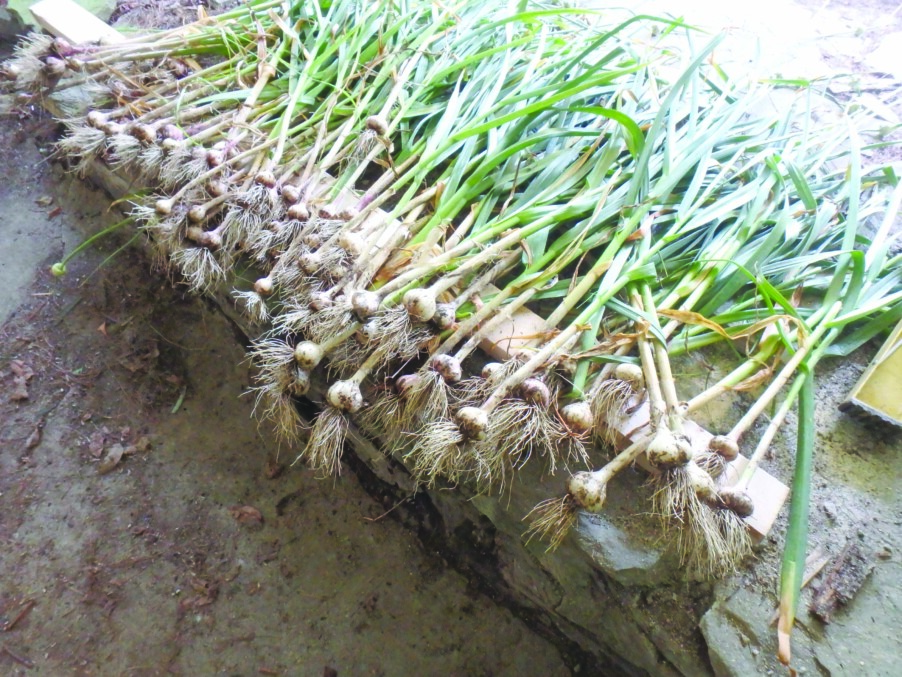
Let’s start with garlic. Garlic produced tall, curly stems called scapes a few weeks ago. They can be used for making pesto (in lieu of garlic, but my basil wasn’t ready). My garlic bulbs will soon be ready to harvest, and by then I will have lots of basil and then I will make pesto.
How do you know when it’s time to pull garlic? Pay attention to those long green blades, the leaves of your garlic. Generally a garlic plant will have about seven leaves. When three leaves have started to dry up and turn brown, it’s time to harvest them. But don’t wait until all the leaves have browned, or the skin over the bulb will be dry and fall apart, letting the bulbs fall apart, and store poorly.
You don’t get to eat your garlic the day you pull it. It takes time — a week or more — for the outer skin of the bulb to dry up enough that you can pull the cloves apart and separate them. I mean, you can cut one apart in case of emergency, but it’s best to let them dry out a bit.
I generally hang my complete garlic plants in bunches (bulbs up, stems down) from the ceiling in my cool basement. I’ve read that some of the goodness of the garlic is in the stem and leaves, and that it will migrate to the bulb during the curing period, so best not to cut off the stems right away. After it cures for a week I’ll cut off the stems. Garlic will store well in a cool dry place for months.
People who don’t know me gasp when I tell them I grow about 40 tomato plants each year, including over a dozen Sungold cherry tomatoes. They ask, “What do you do with all of them?” Of course I eat them every day, often three times a day. But I put up most for winter: I freeze big tomatoes whole, and dry the cherry tomatoes in a food dehydrator.
The easiest way to freeze tomatoes is simply to put whole, clean tomatoes in freezer-grade zipper bags in the freezer. I put the bags on cookie sheets until the tomatoes have turned into “red rocks,” then can stack the bags. In winter, I’ll use them in soups or stews instead of buying canned tomatoes. Canning is way too much work for me.
The cherry tomatoes I slice in half and dry for several hours. It can take up to 12 hours, depending on the dryer, then store in the pantry in quart jars or zipper bags. I start the process at high heat — say 150 degrees — for 20 minutes, then drop the temp to 125 or 130 so that I don’t damage the vitamins in the tomatoes. You can take them out when brittle, or earlier when they are leather-like. They store well in a cupboard, in the fridge, or in a freezer. I’ll add a handful to a soup or stew and they will really provide a pop of summer when I bite into one. Apples and pears store well for trail snacks after dehydrating.
I have two dryers: a Nesco American Harvester and an Excalibur. I prefer the Excalibur because it is more energy-efficient and faster. But it costs more, and the Nesco does a fine job, too. There are plenty of others I haven’t tried.
People make jokes about gardeners sticking big zucchinis in parked cars because they don’t know what to do with them. The answer? Visit your garden every day, part the leaves to see what is growing there, and pick those squash before they get huge. Sauté them with a little garlic, onion or tomato and they are delicious. My dear dog Rowan sometimes gets some lightly steamed squash added to his dinner — he loves a bigger dinner, and it’s low-calorie.
Summer squash can also be stored frozen. Cut them into cubes and blanch them for 60 seconds. NOT MORE. That means you drop them into a big kettle of rapidly boiling water, then pull them out and put in cold water in the sink. Blanching pots are sold with an inner pot with holes in the bottom so you can remove the veggies quickly after draining the hot water back into the pot. The hot immersion kills an enzyme that makes food age and not store well in the freezer.
What other veggies need blanching? Brussels sprouts, broccoli, beans, kale. I don’t blanch tomatoes, peppers, apples, pears or leeks. Never blanch any vegetable too long: you don’t want to cook them; they will be soggy later. And for best results it is good to eat frozen foods in Year 1, not Year 4 or 5. If you eat your beans soon after picking, they don’t have to be blanched before freezing.
My Grampy was an amazing organic gardener back in the 1940s through the 1960s. His wife died in 1954 and he never remarried, but he had lots of lady friends that he visited each week in summer, delivering his tomatoes, carrots, cucumbers and more. He even shared his tomatoes with the checkout women who worked at the local A&P grocery store! “They are so nice to me all year, and probably they don’t have time to garden,” he explained to me. So, honoring Grampy’s tradition, I like to share my garden veggies, too.
Henry can be reached by email at henry.homeyer@comcast.net or by USPS at PO Box 364, Cornish Flat, NH 03746.
