
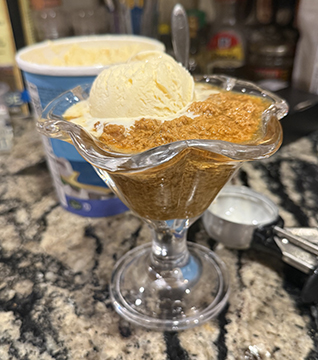
Traditionally the most fall-ish dish in New England was arguably this pudding. Over the past few decades it has slipped into obscurity, but it is warm and hearty and almost requires you to wear flannel. This recipe is adapted from a collection of holiday recipes that ran in the Boston Globe on Dec. 23, 1923.
- 1 cup (156 g) yellow cornmeal
- “A lump of butter the size of an egg” – let’s call it ¼ cup (½ stick)
- “1 cup molasses” – Molasses was the inexpensive sweetener of choice in New England for generations. For modern tastes it is a little bitter. Let’s go half-and-half with molasses and maple syrup: ½ cup (170 g) molasses, and ½ cup (156 g) maple syrup.
- 1 egg
- 1 teaspoon salt
- ½ teaspoon each ground ginger and cinnamon – alternatively, 1 teaspoon of pumpkin pie spice
- 1 quart (4 cups/908 g) milk
- 1/3 cup chopped, crystalized ginger (around 50 g)
- Another 2 cups (454 g) cold milk
- 1 cup (227 g) water
The original 1923 recipe recommends cooking everything on the stovetop, then baking it in a bean pot. If you cook it in an oven-proof pot, you can cook it, then move it to the oven. I like to use a 3-gallon soup pot with a tight-fitting lid.
Preheat your oven to 275°F — the 1923 recipe recommended a “slow oven.”
In your oven-proof pot, bring the quart of milk to a boil over medium heat.
Turn the heat down to medium-low, and whisk in the cornmeal, butter, molasses/maple syrup, egg, salt and spices. (If you’re worried about the egg cooking before you can get it mixed in properly, maybe stir it in with the molasses and syrup before you add them.) Whisk continuously until the mixture comes back to a boil and thickens up, then stir in the crystalized ginger pieces.
Mix the remaining milk and the water together, then gently pour them on top of the cornmeal mixture. If you pour it over the back of a spatula, it should go on top without splashing. Your goal here is to top the pudding with a layer of liquid.
Cover the pot with a lid, and transfer it to the oven. Bake it for four hours.
After the four hours are up, remove the pot from the oven, and set it aside to cool.
You can take the lid off and look inside if you want to, but be aware that at this point the pudding is the stuff of nightmares. A hundred years ago puddings were commonly made using a process called “wheying.” A pudding would be baked covered with a layer of milk — or even cream, if you were fancy. As it baked, the dairy fats and proteins would get absorbed into the main body of the pudding, leaving a layer of whey on top. It is supposed to be there. But to modern eyes it just looks wrong. It is better for your peace of mind not to look at it until the pudding has had a chance to meditate and self-actualize.
After half an hour or so, whisk the whey back into the pudding, then serve it warm, with a scoop of vanilla ice cream.
Featured photo. Photo by John Fladd.