
How adding smoke can transform your favorite flavors
When most people think of smoky food, their minds go immediately to barbecue.
David Mielke is the co-owner of Smokehaus Barbecue in Amherst. He said one of the reasons we are so drawn to smokiness is that it has been with us for so long.
“Smoking meat goes way, way back…,” he said. “Originally it was used to cure meats so people could hold them for long periods of time. As time went on, I think people have figured out that you can use smoke to impart flavor.”
A smoking tradition
For Mielke, choosing what type of wood to burn is as important as choosing the right cut of meat.
“In the barbecue world,” he said, “when we use smoke we’re very particular about the type of wood that we use. There’s all sorts of different types and each gives you a different flavor. I’m very particular about really wanting wood that only comes from New Hampshire. So I only use red oak. There are a lot of other barbecue places that use hickory and pecan wood and stuff like that, but it just doesn’t grow here. That’s a southern Texas thing. We don’t do that here. Honestly, I think that red oak really gives a really nice sweet flavor to the flavor profile that I’m looking for for my meat. My oak is green. It’s not seasoned. It’s not dried. It’s green. It comes from a friend’s property. He does wood for a living and he splits it from the tree and it comes right here. What happens is when it’s green like that it still has all of its moisture content. So you get a lot longer burn time with it, a lot longer smoke time. So when I smoke, I smoke for 14 hours. My brisket and my pork goes for 14 hours.”
Mielke said the “low and slow” method of cooking meats means he can focus on cuts that are more flavorful. The most flavorful cuts, though, come from muscle groups that get a lot of exercise during an animal’s life and can be extremely tough unless they are cooked a long time to break down connective tissue into something silky and delicious.
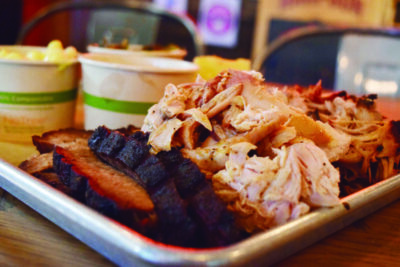
“The chest of the cow and the chest of the pig,” he said, “are very hard-working muscles. So you need to have a longer smoke time to be able to break those muscles down.”
“Our main items going [through the smoker],” Mielke said, “are half chickens, brisket, pulled pork, which is the butt.” (In spite of their names, the pork “butts” and “picnics” come from the shoulder and upper arm of a hog.) “I use the butt and the picnic, so it’s all one,” he said. “It’s a bone-in butt that I use, because I think it adds the best flavor. It takes longer to cook it but it adds flavor and I think it helps render the meat down better. I also do St. Louis-style ribs. I used to do baby backs, but I do St. Louis-style now. They’re pork, just a different section of the rib. So the baby back is like the top section of the rib cage, closer to the spine, and the St. Louis is a little further down the rib, you know, more toward the belly, and they are a little bit bigger,” Mielke said.
Mielke said traditional southern side dishes have a natural affinity for smoke.
“I like collard greens a lot,” he said. “We cook it for six hours to where it basically melts in your mouth. It has vinegar in it, which is one of those things that people seem to really like with barbecue.” Creamed corn is another natural with smoky barbecue, he said. “I make a creamed corn from scratch. That’s a very Texas thing, by the way. Nobody up here does it. I think that goes really well with smoked meats because it’s very balanced.”
Smoked, in a glass
And then there’s smoked beer.
Mike Neel is the owner of Candia Road Brewing Co. in Manchester. At any given time, his brewpub has at least one smoked beer on tap.
“Right now, we’ve got two,” he said. “We’ve got Grodziskie, which is a lighter, Polish-style wheat lager, and we have Brennenator, which is a darker Helles-style lager.”
While Neel and his staff make most of their beer on site, he said, they subcontract out the smoke.
“All of the smoked malt that we use was smoked at Blue Ox Malt House in Lisbon Falls, Maine. They have a small program, which has been growing. They’ve been working with distilleries to do smoked peat malt and other smoked malts to do smoked whiskeys. Grodziski is an oak-smoked wheat, where the Brennenator has a mix of alderwood and maple smoke,” Neel said.
Neel said that while a taste for smokiness can vary widely, he generally looks at smoke as an accent flavor. About a fifth of the malt he uses to brew his smoked beers is actually smoked. “Quantities really do matter,” he said. “How much you put into the beer will determine your overall effect. So Grodziskie is 20 percent of smoked malt that went into that beer.”
Because it is a light lager, he explained, it has a crispness that lets the smoke stand out.
“Brennenator is also 20 percent,” he said. “However, that is a higher ABV [Alcohol By Volume] beer. It does have some other character malts, like crystal malts to make it a little bit sweeter. It’s a sweeter style, and the sweetness covers up the amount of smoke that comes to the front when you taste it. It’s funny, the percentage of smoke malt is exactly the same between both beers. So how much it comes through, I think, has a lot to do with the character grains that are going in as well. [Some other brewers] use more smoked malt, but 20 percent is already a little terrifying for us; we throw that to a consumer and hope that it’s not too much. But there are breweries out there like Schlenkerla, who has been making smoked rauchbier in Germany for hundreds and hundreds of years. Some of theirs are 100 percent smoked malt. A lot of people will tell you it is wildly too smoky. Others will tell you that it’s perfect.”
Neel said that while he, personally, would drink a smoked beer with anything, it goes especially well with seafood.
Smoked, on the rocks
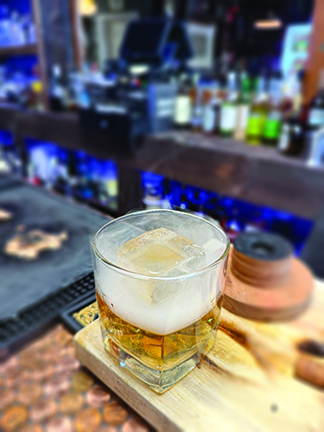
While many spirits traditionally have smoky flavor profiles — peaty scotches and some traditional tequilas, for example — for the past few years adventurous bartenders have been deliberately adding smoke to cocktails. James Brownell is a bartender at Nashua speakeasy CodeX — though at work he goes by the name Rusty. According to him, there are some drinks that are enhanced by adding smoke.
“It just adds one characteristic to the cocktails that we make,” he said, “primarily, old-fashioneds, sometimes Negronis, Boulevardiers or Manhattans. We use applewood here; it’s mostly universal. But you don’t always just have to smoke wood. You can smoke herbs and spices as well — like thyme, sage, cinnamon for various other flavors, for the oils to connect to the glass.”
Rusty said the bartenders at CodeX have two main ways of adding smoke to their cocktails.
“We either smoke the glass itself by turning it upside-down over burning wood chips,” he said. “The oils from the wood cling to the glass. So as you pour the liquid into the glass, it combines over time as the drink warms.”
“Or,” Rusty continued, “we use a top smoker, which draws the smoke into the glass from the top of the glass instead of having it vertically flipped over.” He indicated a top-smoker, a wooden disk with a pipe-like bowl in its center.
“We light some wood chips here,” he said, pointing to the bowl, “and the smoke gets sucked down into the glass.” If the drink has been properly chilled, he explained, the air left at the top of the glass will be cold and less dense than the air in the bar, and that creates negative air pressure that will draw the smoke down. ”It adds a little less smoke,” he said, “but it adds a little bit more of a show. It provides the smoke on top of the cocktail so that the guest gets that full whiff of smoke and the flavor from the wood itself. Instead of infusing the bottom smoke, the top smoke only does the top of the cocktail — not throughout the glass.”
Rusty said there are many different ways to smoke cocktails. “Another method a lot of bars use,” he said, “is they smoke the ice cubes as well, which works really well with a top-smoker, so that the smoke infuses into the cube. So what I like to do is smoke the cube and the glass. And then once the cocktail is chilled, pour it into there so that you get the smoke with the cube and the glass. And then you still get the show as well. So when you’re pouring the cocktail into here, you can see all the smoke come out of the glass.”
Smoked cheese
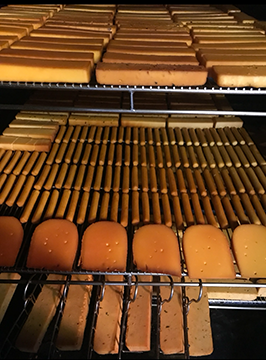
I don’t know how cheese-focused you are, but you’ve probably noticed that at any event where a cheese platter has been put out, the smoked Gouda always disappears first. (Followed by the pepper jack, but the smoked Gouda gets snagged first. Often by me.)
Fox Country Smoke House in Canterbury has a reputation for outstanding smoked cheeses. Owner Bill Annis said Fox Country produces 13 different smoked cheeses.
“The extra-sharp cheddar is our No. 1 seller,” he said. “And then my personal favorite is the horseradish cheddar. But we also do a pepper jack, we do a ghost pepper, and another popular one is Gouda. Then we do the specialties — Swiss, mozzarella, and provolone. We even do string cheese.”
Annis said he smokes about 600 pounds of cheese each week, but that can vary depending on the type of cheese and the time of year.
“Your mozzarella and your other soft cheeses are the hardest ones to do in the summer months. When you get a hot, humid day and night, that’s a challenge. During the winter months or cold weather, we try to do all the smoking at night, and the cheese is in [the smoker] for about 18 hours — a nice slow smoking. That runs at least once a week, and then when we get into the holidays, three times a week,” he said.
The smokehouse has been in business since 1969, Annis said. “We still use the original smokehouse, in that one room. We use hickory to smoke everything. It’s in sawdust form. It’s basically a chainsaw. It’s a very, very fine grind. The machine that we use now works on a line like a pellet stove. It has an auger, it drops the sawdust onto a hot plate and that creates the smoke for us.”
Annis said that because the cheese is a handmade product, some of it will be exposed to more smoke than other cheese in the same batch. “Any cheese that’s over that pipe gets much darker than the stuff on the other side of the room, which is much lighter. I prefer a milder smoking, but I do have customers who want the darkest possible.”
All about the wood
Smoke enthusiasts — competitive barbecuers, for instance — have strong opinions about which woods should be used to smoke particular foods. Jay Beland is a pitmaster at Lemay & Sons in Goffstown, a custom slaughter house and specialty butcher shop. According to him, successful smoking comes down to paying attention to details.
“If you’re smoking cheese,” he advised, “you have to watch the temperature [in your smoker] to make sure it doesn’t go over 100 degrees — otherwise it will start to melt. And then you need to use a milder wood, like apple, hickory or cherry. Stay away from the mesquites — mesquites will be too strong for cheese. It’ll give it a burnt flavor. You want a subtle smoke flavor and those will give you a subtle smoke flavor. I stick with apple wood for the most part. I like hickory — the most universal wood to use, and it works with most foods. I will mix in cherry sometimes, but if I’m having people over who don’t really like a strong smoke flavor, then I’ll use apple, because apple can be more subtle.”
If this all seems complicated and specialized, Beland said to think about the flavors of iconic smoked foods.
“Most bacon that you get is smoked in hickory,” he said. “It’s the most-known smoke flavor So a lot of times, you know when I have my smoker going, my neighbors say, ‘Wow, it smells like bacon!’ Or if I get it on my sweatshirt and I go somewhere, because I smell like smoke, they’ll say, ‘Do you smell like bacon?’ And I have to admit that I do.”
“Pork is a great thing to smoke for the summertime,” Beland said. “With pork, I would always go with hickory because if you think about hickory you think of bacon and bacon’s pork. You put hickory on a pork butt, you put hickory on ribs, that gives it that smoke that tastes like bacon. It’s a familiar smoke with people and it complements the pork.”
Beland said that more aggressive woods have a place in smoking.
“I like to use mesquite on beef cuts,” he said, “but I will use it sparingly. I like to get wood chunks and mix it with a lump charcoal. When I’m grilling at home, I use a Big Green Egg, and I will only put like one large chunk in the whole bundle because a little bit of mesquite goes a long way. You don’t want to overpower with mesquite because then it’s boom, it hits you hard, and it’s not tasteful.”
For seafood — especially mild fish and shellfish — Beland recommends using the same woods you might use for smoking cheese.
“I like to use hickory or cherry,” he said. “I’ve done tuna, I’ve done salmon, I’ve done haddock, swordfish, I’ve done scallops. And crab cakes; crab cakes are delicious on the smoker. I’d recommend that heavily. You get a nice crab cake, it’s delicious.”
Beland said another good rule with smoking is that the denser a food is, the longer it needs to be smoked. He loves to smoke cheese crackers — not surprisingly, with hickory — and he generally smokes them like cheese, at a cool temperature, for 45 minutes or so.
“Cheese puffs are too light to take much smoke, though,” he advised. “They aren’t dense at all. I smoke them for 15 minutes, maximum, but they are really, really good.”
The smoke panel
Smokehaus Barbecue 278 Route 101, Amherst, 249-5734, smokehausbbq.com
Candia Road Brewing Co. 840 Candia Road, Manchester, 935-8123, candiaroadbrewingco.com
CodeX 29 Main St., Nashua, facebook.com/CodeXBARNH
Fox Country Smoke House 164 Briar Bush Road, Canterbury, 783-4405, foxnh.com
Lemay & Sons 116 Daniel Plummer Road, Goffstown, 622-0022, lemayandsonsbeef-bbq.com
Smoke your own
What if you want to smoke something at home? Primitive humans were smoking meat hundreds of thousands of years ago. It’s got to be pretty straightforward, right?
It turns out, if you want a dedicated smoking rig, the type designed for professional barbecuers, you’ll probably spend over $1,000 for a not-great one. The top pros have custom-built rigs that can run upwards of $30,000.
Is there a way to dip your toe into food smoking cheaply enough to try it out and see if you even like it? Spoiler alert: There is and you probably will.
In 2007, Alton Brown dedicated an episode of his Food Network show Good Eats to this problem. For cold smoking — smoking food at a low temperature without actually cooking it — he suggested using a large cardboard box. It should be a couple of feet on each side, he said. He opened each side of the box, then punched several holes near the top and inserted a couple of long wooden dowels through the box, making a resting place for one or more of the cooling racks you might use after baking a cake. (You could also use the grate from your charcoal grill.) The general idea is to suspend a food — Brown smoked a salmon; you might want to start with cheese — above a heating element. He bought a $10 single-burner hot plate from the and placed it in the bottom of the box with a pan of sawdust on it. The concept was pretty straightforward. Use the hot plate to smolder the sawdust, which will make smoke that will rise up and smoke your food. Keep the flaps of the box shut, but open them from time to time to check on whatever you’re smoking.
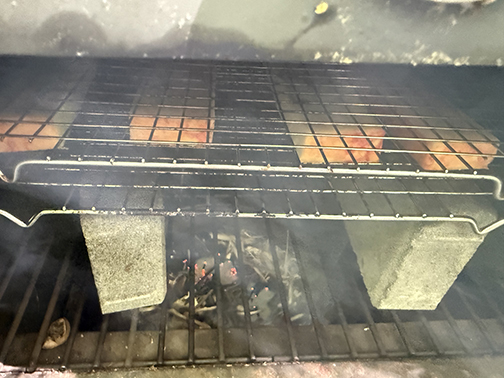
Here’s what I’ve been doing:
A well-meaning relative who doesn’t cook bought my wife and me an extremely affordable wood-fired pizza oven a couple of years ago. As it turns out, it is made of thin steel and doesn’t retain heat very well. Pizzas require a very hot temperature — upwards of 700 degrees — and this thing couldn’t make toast. And I got really frustrated trying to keep the fire lit and the smoke kept blowing in my face every time I opened the door, and — hey, maybe —.
So we’ve started using the “pizza oven” as a smoker. We use that same one-burner hot plate in the firebox, and suspend baking racks on top of bricks in the oven compartment to give them some distance from the heat source. We place slabs of cheese between two baking racks and suspend them in the smoke. A quick internet search reveals that the cheapest hot plates are still between $10 and $15. Wood chips for grills are available online or in any hardware or department store.
The key, we’ve found, is to flip the racks every 10 to 15 minutes, ideally when the weather is cool, in order to keep the cheese from melting through the holes in the cooling racks and forming cheese stalactites. Every smoking rig — especially a homemade one like this — will be different, and probably require different smoking times. There’s also the matter of your taste in smokiness. For us, 45 minutes to an hour is about right. We’ve smoked several different types of cheese at this point, but the winners seem to be muenster and pepper jack. We just buy the big bricks of cheese at the supermarket and cut them into slabs.
Featured photo: Smoked cocktail at CodeX. Courtesy photo.