
The summer movie frontier?
Who doesn’t love summer movie space aliens?
(Spoilers ahead — I don’t really know how to proceed without a little bit of secret-spilling.)
It is perhaps a mild spoiler to say that Disclosure Day (PG-13, in theaters now), directed by Steven Spielberg, is about extraterrestrial beings. It is maybe a bigger spoiler to say the movie is specifically about what happens as the existence of those aliens goes from being a secret held by the government for some 80 years to being something that a wider group of people, perhaps even the whole world, knows.
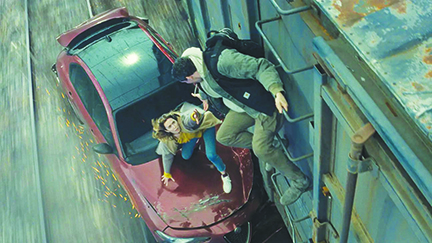
As we see in trailers, TV weatherperson Margaret Fairchild (Emily Blunt) is suddenly capable of speaking an unEarthly clicky language, which she breaks into during one of her live broadcasts. Margaret’s moment of on-air strangeness leads her to fear she’s had a medical issue. But we see the reaction that footage of the episode gets from a secretive quasi-government agency run by Noah (Colin Firth), who is already scrambling the troops after one of his tech guys, Daniel (Josh O’Connor), made off with some highly classified video footage. And we see the reaction of a group led by Hugo (Colman Domingo), who seems to be directing Daniel in his heist. As Noah’s people chase Margaret, who doesn’t understand why she’s suddenly a wanted woman any more than she understands why she can suddenly read everyone’s thoughts, and Daniel, the two seem drawn to each other. Fairly early, we learn about the big secret Daniel is so desperate to get out to the public when he shows his girlfriend Jane (Eve Hewson) some of the stolen footage starting with, bestill Fox Mulder’s heart, the Roswell crash in 1947.
I think we’re supposed to be watching basically regular people being pulled into this big secret — how would they handle this information, how would they react to learning the part they are playing, do they think the world can handle knowledge of aliens? There are moments that exemplify this: Jane talks to a nun played by Elizabeth Marvel and they weigh the meaning of aliens, the reaction they’d expect the world to have.
My problem is that these conversations frequently can’t break off the page to feel like a real conversation, these people never quite feel like real people to me. Emily Blunt feels off-key here. It’s as though she was given too many notes about exactly what tone to strike and ends up feeling like two or three character ideas smooshed into one person. Josh O’Connor, meanwhile, feels like he’s just hitting the one character note, just a lump of doe-eyed Big Emotion. Colman Domingo is maybe doing something interesting — isn’t he always? — but it feels like it’s from a different movie. And Colin Firth is just serving up angry British authority, take it or leave it, no side of fries.
For every “that’s an interesting idea” the movie has many story elements that are unnecessary, don’t fully make sense or don’t feel like they were developed beyond the idea stage. A running subplot throughout this movie is that international tensions have the whole world on the brink of war. We see people hoarding gas and buying out supermarkets. This element is maybe meant to heighten tension or underline the destructive tendencies of humans or some other thing I just didn’t get. For me, though, it was one of the extra accessories that Coco Chanel wants you to take off before leaving the house.
There are elements of the chase that are fun and well-constructed, though the movie is never as energetic as its most John Williams-y of John Williams scores seems to want us to think it is. I feel like there are ideas here, things that could have gone in either a more popcorn fun direction or something that felt more like a stripped down gritty sci-fi adventure reminiscent of 1970s Spielberg. For me, though, the movie never pulled together into something that was either a thrilling ride or a compelling thought experiment.
A few days later I rewatched that 1977 grittier Spielberg sci-fi: Close Encounters of the Third Kind (available for rent or purchase and streaming on Peacock). In many ways, this is the spikier, low fi version of Disclosure Day. We get many of the same elements — strange occurrences, the “what’s happening to me,” a chase with officialdom — though there is more chase and a shorter timeline in Disclosure Day. Characters played by Richard Dreyfuss and Melinda Dillon see clearly not-from-here crafts flying in the sky and come away from the experience with thoughts of Devil’s Tower National Monument stuck in their heads. Desperate to figure out what they’ve seen and what they’re experiencing, the two unwind — first Dreyfuss’s character as he scares his family (including his wife played by Teri Garr) and then Dillon’s character when her young son, seeing brightly lit “toys,” runs after a UFO and is abducted. I highly recommend this double feature — I think I had more fun thinking about Disclosure Day after watching Close Encounters. The movies are, as your serious film academics might say, in conversation with each other and are both interesting reflections of their times.
I also used the outer space theme of Disclosure Day as an excuse to catch up with March release Project Hail Mary (PG-13, available for purchase). Based on the Andy Weir book, Project Hail Mary is directed by Phil Lord and Christopher Miller, the team who wrote and directed The Lego Movie and wrote the animated Spider-Verse films, with a screenplay by Drew Goddard, who also wrote Weir’s other book-to-film, The Martian. This movie is exactly as good as all those names promise.
Ryan Gosling here is, similar to Matt Damon in The Martian, the one person working alone for a good chunk of the movie. He plays Ryland Grace, a middle school teacher who is also a molecular biologist and has been kicked out of standard scientific work for some kooky ideas about the conditions required for life to develop. Luckily, Eva Stratt (an excellent performance from Sandra Hüller) is in the kooky ideas business. The head of an international scientific project, Eva is trying to figure out astrophage, a substance that is traveling from Venus to the sun and appears to be dimming the sun’s light. Scientists all over the world are working on the project and she calls Grace in to study a sample of the astrophage gathered on a recent space mission. We watch as Grace joins the project to try to figure out what astrophage is and how they could possibly reverse the potentially world-ending effects it’s having on the sun.
All of this is viewed in flashback as Grace, in the movie’s present, wakes up to find himself alone on a space craft with no memory of much of anything — who he is, where he is, why he’s there, why a robot is trying to shave off his extremely long beard.
Similar to The Martian, Project Hail Mary is a movie of questions and whiteboards and smart people tackling small problems with duct tape and plywood in order to get the information needed to tackle bigger problems. It is optimistic in its view of science and people doing science — this isn’t callous tech-dinguses trying to figure out how to monetize some crappy thing that nobody really needs anyway. It’s people, all curious and fallible, working together, across borders and language barriers, to figure things out with the ultimate aim of saving the world. This might be my favorite brand of save-the-world adventure movie? No magical stuff or superpowers, just middle-aged nerds who can mock things up with Home Depot supplies. This movie does everything right — Gosling’s performance, space visuals, showing people thinking through things and showing Gosling working out a puzzle by himself that includes a really solid vocal performance (by James Ortiz).
Featured photo: Disclosure Day.
