
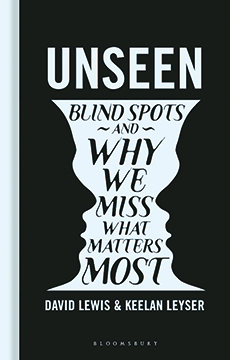
(Bloomsbury Sigma, 273 pages)
At first glance, Unseen looks like a typical make-your-life-better book, a compilation of research distilled for a general audience by a social scientist or academic. But early on, Keelan Leyser and the late Dr. David Lewis put readers on notice that Unseen is different, given that one of the authors describes himself as “magician, mentalist and pickpocket.”
OK, we’re in.
It’s not every day one has the chance to get life advice from a pickpocket.
Thankfully, Leyser’s light-fingeredness is in the interests of social science rather than a product of criminal intent. The success of both magicians and pickpockets depends on their ability to manipulate attention.
“Whether secretly removing a watch from someone’s wrist or making a pack of cards appear to turn into a block of glass in someone’s hands, the principles remain the same: the brain’s attention can be redirected through calculated psychological triggers,” Lewis and Leyser write.
In short, both magicians and pickpockets expose our cognitive blind spots, the ways in which we go through life “looking, not seeing.” In Unseen the authors convey these lessons leaving our wallets untouched. The everyday workings of the human body, especially the eye and brain, may seem miraculous, but we are largely unconscious of the way in which its processes fail us, sometimes catastrophically.
Researchers say that human error is responsible for 70 percent of vehicle accidents and 80 percent of aviation accidents, and cognitive blind spots play as much a role in this as inattention or exhaustion. In fact, we are most likely to suffer from blind spots when we are one of the “3 Fs” — fatigued, frightened or furious, Lewis and Leyser write. Even when not noticeably impaired by one of the 3Fs, human beings make three to six errors every hour, “regardless of the task or activity being conducted,” one safety expert tells the authors.
This is because there are so many ways in which our brains can fool us, as evidenced by the famous sketch “My Wife and My Mother-in-Law,” an illusion created in 1915 by a British cartoonist. When looking at the drawing (seen as sexist by today’s standards), some people see an old and unattractive woman, whereas others see a stylish young woman. Lewis and Leyser offer dozens of other examples that similarly show how our perception is altered by the shortcuts our brains take in processing information. They not only present photos and illustrations, but also provide QR codes throughout the book that take the reader to webpages where the concept is more fully explained. It’s an interesting approach, although I’m still not sure how I feel about having to have a smartphone on hand while reading a book.
Nor am I sure whether I’m happy to have learned about how accident prone all of us are because of these blind spots.
While most people believe we have five senses, Lewis and Leyser explain there are many more than that, and the shortcuts that the brain takes are necessary because of the millions of pieces of information it is constantly bombarded with. Blind spots basically are an adaptation that allows us to maintain our sanity, and there are varieties of them. There is, for example, “change blindness” in which we can be oblivious to a difference that becomes obvious when it is pointed out to us; this is particularly worrisome when applied to the work of those reading X-rays at a hospital and screening luggage at the airport.
There is “choice blindness,” in which people fail to notice a change in a choice they have previously made, which has had disturbing repercussions for those picking out suspects in a police lineup. And there is “expectation blindness,” in which people’s expectation of an outcome or act influences how we perceive what actually happens, which has resulted in wrongful police shootings and fatal medical mistakes, as when a nurse picked up a drug syringe and read the label as she expected to see it, rather than the way it was, resulting in the death of a patient.
In a chapter on visual illusions, Lewis and Leyser lay out why we are so easily fooled by what we think we see, such as the drawing known as “Shephard’s Tables,” which seems to depict two tables of varying sizes, but does not. Things get even weirder when they take up the intra-body communication that goes on between the brain and the gut, our so-called “alien brain” run by billions of microbes, and blind spots driven by other body parts, including the bladder. (“An empty stomach reduces our decision-making powers, while a full bladder increases them,” the authors write.
Unseen also delves into the complex machinations of why we remember faces and why we find some people attractive but not others, and how marketers exploit our blind spots to sell us things. The authors recall a famous psychology experiment from 1967 in which a person dressed from head to foot in a black cloth bag went to a college class every day for a semester. The “Bag Man,” who has never been identified, was at first mocked by other students, but as time went on they became protective of him. One researcher later said that Bag Man illustrated that “people will grow to like a thing they initially detest — even with no new information — if they are repeatedly exposed to it,” which is one reason brands bombard us with familiar products repeatedly.
In addition to showing us how certain popular magic tricks work, Lewis and Leyser offer some tips on banishing, or at least finding workarounds for, our blind spots. Cutting down on the fatigue in the 3Fs is an obvious one; when we’re tired we’re more likely to succumb to them. (It’s harder to stop being frightened or furious, although they have suggestions for that as well.) Perhaps the most helpful is being aware of all this social science research and how it applies to ordinary life.
Unfortunately, the authors spend 250 pages warning us about cognitive blind spots and only 22 telling us to banish them, with some suggestions that seem banal (tart cherry juice or milk to help you sleep, yawn). More helpful would have been 20 pages of warnings, 250 pages of solutions. B
Featured Photo: Unseen, by David Lewis and Keelan Leyser.