What’s the buzz?

Wildflower Festival returns with a louder sound and a bigger garden

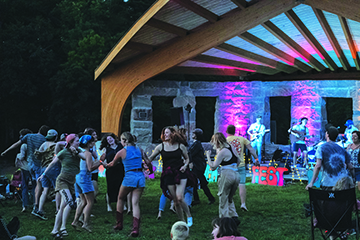
When Griff Comtois and two friends threw the first Wildflower Festival in 2023, it was three bands and a few dozen art vendors packed around the amphitheater at Milford’s Keyes Memorial Park. Four years later, the environmentally centered event is established enough that Comtois barely recalls the scramble of those early days.

“It feels a lot easier,” he said recently. “People know about us now, so that’s generally good.”

The fourth annual Wildflower Festival returns to Keyes Field Stage on Saturday, Aug. 22, running from noon to 9 p.m. This year brings a notable shift in sound, more art vendors and new education partners, and, for the first time, bands on the bill will be paid for their performances.

Every act this year hails from Massachusetts or New Hampshire, with a musical shift from the more folk- and jam-oriented acts of 2025, like headliner Nova One, toward punk, indie and shoegaze.

“There’s still some folk going on, but we switched styles a little bit,” Comtois said.

“We’ve all kind of just been really into this type of music lately, a lot more punk stuff,” he continued. “It kind of felt natural for us to gather all of our friends and the people we know within the area that play music, instead of trying to find a big name to get a draw.”

7-11 Jesus headlines, with Gollylagging, Tysk Tysk Tysk (replacing originally booked Main Era), Capo / Regime, Parachute Club, Cozy Throne, Thoughtsick, Time Eater, Milk Street, Five Feet and Star Family Singers. Returning for a third appearance is Darth Brandon; its frontman Andrew West, books much of the festival’s music.

The Wildflower Fest art market keeps growing as well. There are 60 vendors this year, up from roughly 50 in 2025. Comtois said organizers are intentionally keeping the number in that range. “It’s a good sweet spot for the amount of vendors to the amount of shoppers we have,” he said.

Expect the usual mix of stickers, prints, original paintings, brass sculptures, pottery, woodworking and crocheted items, plus what Comtois described as a strong showing of plant-inspired art and upcycled clothing this year.

“I always like to see them because I just feel like they fit the vibe of the festival,” he said.

New for 2026 is a slate of education-focused exhibitors. The Caterpillar Lab is bringing live caterpillars and butterflies for hands-on demonstrations, New Hampshire Audubon will have a table, and Queerlective is setting up a pressed-flower button-making station.

Partners underscore the festival’s growth as well, with Triangle Credit Union, Bangor Savings Bank and Fieldstone signing on this year.

“That’s a really nice part,” Comtois said. “Now that we’re more known as a running institution, it’s easier to get sponsors by showing them the things that we’ve done in the past.”

The festival’s original mission of funding pollinator habitat at Keyes Field keeps expanding. A bed of packed dirt in year one, the gazebo garden is now well established, though a few spots are still finding their footing. The meadow strip added last year has taken off: plugs once the size of a fist are now 5 to 6 feet tall and 2 to 3 feet wide.

This spring the group planted a redbud tree and a chokeberry, with more trees planned for fall. Groundbreaking for a planting area near the park’s volleyball courts also began recently.

“That will be cool,” Comtois said. “I think we’re going to get some plants that are 10 to 12 feet tall for that.”

Though national debates about sustainability are a concern, the festival’s ambitions will stay local for now — with an eye toward the future.

“My dream is for us to have more of a national impact,” Comtois said. “A lot of rhetoric and policies are going around now that are not good for us or the environment. I’d like to change that mindset.”

Wildflower Festival
When: Saturday, Aug. 22, noon to 9 p.m.
Where: Keyes Field Stage, Keyes Park, 45 Elm St., Milford
Tickets: Sliding scale (suggested donation $10), eventbrite.com

Featured photo: Courtesy photo.

The Music Roundup 26/08/20

Big aughts: Though best known for their early 2000s hits, The Fray, currently on tour with Dashboard Confessional, are still making music, with a new album that arrived earlier this year. A Light That Waits, according to a tour press release, “ushers in a renewed creative chapter defined by emotional clarity, cinematic songwriting” and the band’s “timeless sound.” Thursday, Aug. 20, 7 p.m., BankNH Pavilion, 30 Meadowbrook Lane, Gilford, $40 and up, ticketmaster.com.

Booty shake: A groove-packed triple bill is topped by Sophistafunk, who served as Guy Fieri’s house band on one of his Food Network shows. The upstate New York group is known for high-energy, genre-blending live shows that mix funk, hip-hop and jam-band elements. Joining the raw, soulful affair are one-man band Lee Ross and Broken Harmony Syndicate. Friday, Aug. 21, 8:30 p.m., Jewel Music Venue, 61 Canal St., Manchester, $18 and up, theticketing.co.

Vintage sound: Formed in 2004, Boston-based instrumental trio Otis Grove is known for a genre they coined, called Runk, a fusion of rock and organ funk played on old-school Hammond and Wurlitzer keyboards. They’ve logged more than 500 shows through the years, appearing with acts like John Medeski and Trombone Shorty. They perform at a Concord craft brewery. Saturday, Aug. 22, 6 p.m., Feathered Friend Brewing, 231 S. Main St., Concord, $5, featheredfriendbrewing.com.

Cult faves: In the early ’90s, a rocked up cover of “Cat’s in the Cradle” catapulted Ugly Kid Joe into the charts, along with the snarling “Everything About You.” In their heyday, the SoCal band toured with Ozzy Osbourne, Def Leppard and Van Halen. Their latest album is Rad Wings of Destiny. They’re joined by Wheatus, a one-hit-wonder with a wonderful hit, “Teenage Dirtbag.” Saturday, Aug. 22, 7 p.m., Tupelo Music Hall, 10 A St., Derry, $53 and up, tupelohall.com.

Community: Music, art and activism merge at the Rebel River Music Festival, a free event in a bucolic setting that includes performances by Woody & the Rebel Alliance, Sara Leketa & The Nasty Women, Megan From Work, Maizy Rae of Fox & the Flamingos, and Pat Lynch, along with speeches from Congressional candidates Karishma Manzur and Paige Beauchemin. Sunday, Aug. 23, noon, Suncook River Campground, 2 Fanny Drive, Allenstown, sucookrivercamp.com.

In praise of the under-two-hour movie

The End of Oak Street and more shorties

Here’s to the under-two-hour movie.

I hung in there with The Odyssey’s nearly three-hour run time, I can stick with and enjoy a longer movie.

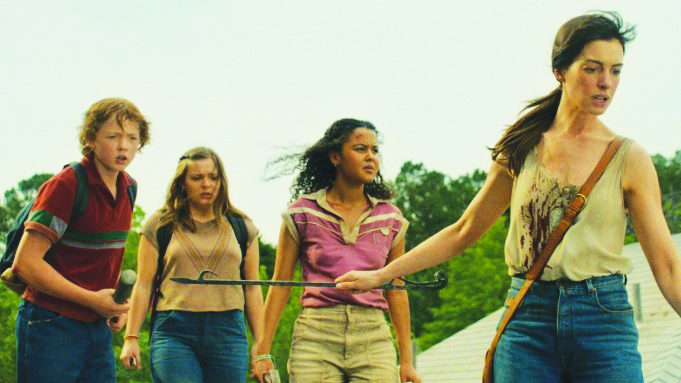
But I truly appreciate a movie that can get in and out in an economical 100 or so minutes, which is what Aug. 14 theatrical release The End of Oak Streetand many of the other movies mentioned here manage. Short, fun, occasionally funny, unapologetically goofy-action-packed, not an IP or a sequel — with that and its “kids on bikes” scenes, it has a real throwback feel.

It is also set in 1982 suburbia, so you get a lot of that faded late ’70s vibe. Denise (Anne Hathaway) and husband Greg (Ewan McGregor) also feel sort of faded as a couple. When they aren’t trying to fight quietly at a neighborhood block party, they are openly yelling in the family home, which Greg deals with by taking nips from a garage whiskey bottle and Denise handles by writing a book about a wife yearning to leave her family. The teenage Audrey (Maisy Stella) and tween Brian (Christian Convery) have definitely picked up on the couple’s problems.

After a night or two of seeing a bright light suddenly appear and vanish just outside the house, the family members see one bright light — maybe lightning, they wonder — that seems to cause the power and phones and water to go out. When the parents go outside the next day, they don’t see downed power lines but they do hear strange noises and see what at first Greg thinks might be the family dog and then realizes, when he gets a good look, is a large, feathery raptor of the dinosaur variety. The couple manages to make it back inside before getting eaten — not all of their neighbors are as lucky — and immediately start boarding up windows and trying to figure out how much food they have.

As we and they eventually figure out (and as the trailers give away), their neighborhood has been lifted out of our time and plopped back millions of years ago. How will they survive and is there a way back will be their chief questions — well and Brian will also keep looking for his dog and maybe Denise is wondering if she and Greg are still divorce-bound.

There is a fair amount of goofballery in this movie that the movie and the characters take absolutely seriously but that I think we are meant to laugh at. The southern California golden light and the bikes and the ancient-seeming station wagons gives this a very Steven Spielberg-lite feel but there is a B movie quality to some of the creature antics.

Hathaway is not “important movie Oscar contention” good here but she does a good job as the mom character in this sort of thing — think Dee Wallace in E.T. or JoBeth Williams in Poltergeist.

McGregor is equally enjoyable if a less steady member of Team Run Away From Dinosaurs in his role as Greg. McGregor has a way of playing this “regular” guy as just off kilter, with a sort-of-a-screw-up energy. Here, he ups the goofiness of any scene he’s in about 17 percent, even when he’s playing it dead seriously.

The audience in my screening included at least one group of movie goers who decided to have fun, give some “yay!”s to a scene where a dinosaur gets whacked with a sledgehammer and when the family dog shows up. I feel like this is the appropriate spirit in which to see and enjoy this movie, which feels like a throwaway “ha, nice” little August treat of a movie.

Also debuting last week was Don’t Say Good Luckon Netflix. “However much we as a culture appreciate Melanie Lynskey, we need to appreciate her much much more” and “Sunny Sandler has some serious acting chops” are two thoughts I had repeatedly throughout this dramady about a teenage girl dealing with both her role in the school play and the grave illness of her mother. Sandler, daughter of Manchester’s own Adam, plays Sophie, who learns that her mother’s cancer has returned via a butt-dial by her father, Ted (Max Greenfield, taking it to 11 with his decent-guy dad), right before she goes onstage to audition for a supporting role in her high school’s production of Waitress. Absorbing the news while she sings, she gives a performance that makes teacher-director Mrs. Parker (Stephanie Beatriz) consider her for the lead. Meanwhile, at home, mom Elizabeth (Lynskey) and Ted try to put on a good face for Sophie and her two younger brothers, even though Elizabeth seems to be getting sicker. Sophie is also dealing with standard but still heartbreaking teenage drama including a rupture with her longtime best friend Carolyn (Scarlett Estevez) and Sophie’s crush on her costar Jack (Jack Champion).

Steve Buscemi and Bebe Neuwirth show up as Elizabeth’s parents, doing good, heart-tugging work. Even Jon Lovitz impresses with a small role as a worker at Ted’s deli. Everybody here is note-perfect, down to the other kids theater-kid-ing it up on the production of the play.

Sandler is definitely a strong talent in her own right. I thought she did good work in teen comedy You Are So Not Invited to My Bat Mitzvah (also on Netflix, also worth a watch) and this movie proves that wasn’t a fluke and that she is growing into a compelling actress with range.

Lynskey, of course, adds fabulous to everything she’s in. Here, she reminds me a bit of Rachel McAdams in Are You There God? It’s Me, Margaret in how Lynskey, as McAdams did, is able to convey a lot of her character’s own emotions and inner struggles through interactions with the daughter who is really more the movie’s focus (that movie is currently streaming on Prime Video, and available via rent or purchase).

Don’t Say Good Luck is a top shelf coming-of-age + light comedy + weepiness cocktail. I almost feel like this movie is wasted as a streaming release but I’m not sure that a mother-daughter-focused film like this could make it in the current cinema-outside-your-house environment. Let’s just count ourselves lucky that we get it at all.

There are several earlier 2026 releases now available for a home watch.

Gail Daughtry and the Celebrity Sex Passwas a July theatrical release and is now on VOD for rent or purchase, which feels bad for the film industry but great for me because this movie is one of the dumbest things I’ve seen in a while, I say with the highest level of compliment and respect.

This endeavor comes from the The State and Wet Hot American Summer players (David Wain directed; he and Ken Marino cowrote; The State is streaming on Paramount+ and Wet Hot American Summer is available for rent or purchase). Kansas hairstylist Gail Daughtry (Zoey Deutch) and high school sweetheart fiance Tom (Michael Cassidy) are just a few weeks out from their wedding and, on the way to a cookbook reading by Jennifer Aniston, flirtily talk about their respective celebrity sex passes. Gail decides on Jon Hamm, Tom immediately says Tilda Swinton. After meeting Aniston and deciding that she’s swell, Tom changes his pass to her, which Gail laughs off while she waits for Tom to run back and get his coat from the signing. When he doesn’t return to the car, she goes to look for him and finds that he has, indeed, used his “pass.” Gail is horrified and not sure what to do or whether to go ahead with her wedding and decides to go with coworker Otto (Miles Gutierrez-Riley) to a convention headlined by “King of the Whip Curl Remy Fontaine” (Thomas Lennon) in Los Angeles. Gail and Otto also decide that, what with Jon Hamm living in Los Angeles, this is her opportunity to try to use her pass, level the infidelity playing field and maybe save her relationship. But due to an accidental suitcase swap with some gangsters (including Joe Lo Truglio) who stop to take a fan pic with Henry Winkler — Vinnie Barbarino himself, as one gangster later says, a blink-and-you’ll-miss-it example of why this is a movie to watch sans phone — Gail is soon being hunted by an international terrorist with perfect skin (Sabrina Impacciatore) even while on her own quest.

There are so many reasons to enjoy this excellent gleeful-stupid movie. There’s John Slattery playing a hard-up version of John Slattery. There’s an Old West bar fight. There are a zillion tiny throwaway lines, sight gags and facial expressions that have been calibrated just right. There are a fair amount of extremely game famous-es showing up to wink at the camera (in at least one case, literally). And throughout there’s a pretty fun, cleverly executed riff on a quest tale. This is the kind of brilliant-stupid that has made me always at least a little excited to show up for a project from these guys and Gail Daughtry and the Celebrity Sex Pass is a particularly well-crafted dumb good time.

Much as with Obsession, a horror movie I recently reviewed,Tuner (a May theatrical release available for rent or purchase) feels like a strong contender for a Best Sound Oscar nomination, one that makes excellent use of both sound design and sound editing. Niki (Leo Woodall) works as a piano tuner with his uncle-like mentor Harry (Dustin Hoffman). Once a talented piano player, Niki now has hyperacusis, which he describes as being allergic to sound and which you should definitely not look up if you’re a person who tends to freak out about any new medical thing you learn about. He wears ear plugs all the time and an extra pair of sound-dampening headphones most of the time, and is generally a rather keep-to-himself sort of guy. But then at a job at a music school he meets piano player and composer Ruthie (Havana Rose Liu) and even their mutual awkwardness — due to Niki’s condition and Ruthie’s upcoming deadline for impressing a composer she wants to intern for — can’t hold back their chemistry.

Their budding relationship comes at a stressful time for Niki. Harry is sick and his wife Marla (Tovah Feldshuh, excellent as always) tells him they are tens of thousands of dollars in medical debt. Shouldering the business alone and desperate to find more cash quickly, Niki decides to call Uri (Lior Raz), the owner of security company Niki met while tuning a piano at a fancy house. Well, “met” might not be as accurate as “caught trying to break into a safe.” Seems that while Uri and his guys install security systems, they also return to the odd house to steal, as one guy explains, the stuff (watches, jewelry and other items hidden in safes) their rich clients have so much of they won’t notice if it’s missing. Niki’s hypersensitivity to sound means that he can also hear things like the click of the metal tooth sliding into the correct numbered spot in a safe lock. So he opens the safe to stop Uri’s men from the loud drilling. Uri knows an excellent business opportunity when he sees it.

Tuner is sort of a combination heist movie, a romance between two prickly people and a character study of Niki in his attempt to eke out a new life for himself after suffering the medical setback that took away his music career. Each part of this movie is engaging and well drawn and flows together nicely. Woodall is good at showing the constant underlying tension of Niki as he moves through his day. He acts like he is always near a wince, like his pain level is perpetually at a 4 and he’s trying to muscle through the day, the conversation, the general noise of the city.

Havana Rose Liu is also in Power Ballad, another May release now available for rent or purchase. Her role here is much smaller, as the girlfriend of Danny Wilson (Nick Jonas), a one-time boy band star now trying to make it as a solo musician. Rick Power (Paul Rudd), the lead singer of a band that predominantly plays covers at weddings, meets Danny at his friend’s posh wedding and after Danny sings a song with the band, he and Rick end up hanging out that evening. They talk music, they play music and they drink a lot. At one point Rick plays Danny a song he’s been working on for years and Danny joins in playing it with him. And, like, if you didn’t know you were watching a John Carney movie (he directed and co-wrote this), you would know by this scene that so lovingly depicts the creation of a song. Carney also wrote and directed Once (RIP Glen Hansard), Begin Again, Sing Street and Flora and Son, all movies that I enjoy and that would be very handy if you ever had to explain “yeah, but like what is music really?” to an extraterrestrial.

Six months after this music-filled night, Rick hears that song, his song, while he’s walking through a mall. After looking it up, he learns that the song “How To Write a Song Without You” is a massive hit and has reenergized Danny’s career. Rick’s daughter Aja (Beth Fallon) asks if they’re rich now, presuming Rick has some sort of credit on the song. But of course he doesn’t and can’t prove to anyone, not his wife Rachel (Marcella Plunkett) nor his band mates nor a lawyer, that he wrote the song. Apparently, they’ve had to endure a lot of “Rick makes guitar face and sings at us” over the years. Rick sort of drives himself crazy over what to do about this unacknowledged creation of his and what exactly he’s looking for.

It’s very fitting that a John Carney movie centers itself on a song — what it means, what it means to make it, what it means to let it out in the world. It’s a specific kind of nerding out about music (and creation in general) that I find very enjoyable. Power Ballad is thinner, I think, than some of his other movies but still a solid story with good performances from Jonas and from Rudd, looking more beat up and even, gasp, a little more weathered than he usually does, which fits the role perfectly. If you’ve never seen a John Carney movie before, sure, this one is good, but definitely check out those others: Once (rent or purchase), Begin Again (streaming on Tubi and Amazon Prime Video and a few things that may or may not be real like Howdy and Lionsgate+, as well as rent or purchase), Sing Street (Starz, rent or purchase) and Flora and Son (Apple TV, rent or purchase).

Also streaming now is the May 29 release Pressure, which is on Peacock (as well as rent or purchase). This is a movie about the weather forecast for D-Day in 1944 — like, that’s it, that’s the movie. The overly confident American guy Irv Krick (Chris Messina) brags about predicting the weather for David O. Selznick and says the planned invasion day — June 5 — would be sunny and fair. The British guy, a Scot named James Stagg (Andrew Scott), direly predicts storms with massive waves and suggests putting off the invasion for a couple of weeks. Preposterous, says British Army General Bernard Montgomery (Damian Lewis). What am I supposed to do, yells a tense U.S. Army General Dwight Eisenhower (Brendan Fraser). There there, says Kay Summersby (Kerry Condon), a British Mechanised Transport Corps Lieutenant and Eisenhower’s private secretary, as Wikipedia says (Wikipedia says other things too, rabbit hole at your leisure).

We’re kind of shuffling through the remainders when it comes to finding new stories to tell about World War II, was my thinking while watching this movie — through really, it’s more like “new stories based on the people we know” because there are I’m sure tons of fascinating stories from parts of the war that aren’t just the tippy top of the military command in Europe. Here, we get a nice bit of “here’s the role the weather played in Allied landing in France” and my response was “huh, how about that.” I don’t know that it warrants a full movie and this movie isn’t doing anything particularly thrilling with its tale. I feel like Fraser, with Ike’s balding head and a perpetual look of indigestion, is doing the big performance and Scott is really trying to do a subtle-ish performance and we have the lady character who seems like she’s been elected mom-wife of everybody and we get a stirring rendition of a historical speech (Eisenhower’s address to the troops on D-Day). This isn’t that far, structurally, from a Darkest Hour or The King’s Speech. It’s not as well done as those movies but it’s not actively bad. It’s lightly fine, and probably OK-enough for a watch with your most history-loving parent.

Also based on a true story is March release Tow (available on Prime Video or rent or purchase). Amanda Ogle (Rose Byrne) got dealt some bad hands by life, made some mistakes, did some self-medicating and got on the wrong side of a tough economy, which is how she winds up sleeping in her 1991 Toyota Camry in present-ish day Seattle while trying to find a job with her veterinary assistant license. She gets a job at a fancy dog spa but it is quickly imperiled when, after the interview, she sees that her car has been stolen. After two calendar days, police find the car and it is towed to a lot where she can pick it up for the low cost of $270-some. Why do I have to pay to get my own stolen car back, she asks, not catching a break from the towing company and leaving with the knowledge that every day it sits in the lot, the car will cost her an extra $50 to spring. She files a lawsuit and gets a judge to order the release, without fine, of her car, but by this time some 20-ish days after it was impounded, the towing company has sold it. She turns to Kevin (Dominic Sessa), a lawyer at a nonprofit firm, to help her fight the company as she tries to keep herself safe and sober, eventually landing a semi-permanent spot at a shelter run by Barb (Octavia Spencer). There she meets others dealing with homelessness and other issues including the pregnant Nova (Demi Lovato) and Denise (Ariana DeBose), who, like Amanda, is struggling to keep up a relationship with her kids who live with their father. Amanda’s kid Avery (Elsie Fisher), who lives in Utah, is clearly desperate to have a relationship with Amanda but isn’t sure if Amanda, whose drinking and other problems have gotten in the way of her being a reliable parent, is truly able to be someone Avery can count on.

Bryne gives a strong performance of someone who, despite having taken many blows by life, is still actively fighting to improve her situation. She is able to show us the messy parts of Amanda along with her toughness and her deep love for Avery. It helps to pull the movie through some of the moments that feel a little “television movie about a Very Serious Issue,” making Amanda a person rather than the personification of an Issue. Likewise, the supporting characters help to ground the movie in something like human people. And you can enjoy your righteous anger at the whole concept of “$50 a day to get your stolen car back” with Corbin Bernsen playing the humanity-free personification of a predatory business in his role as the towing company’s lawyer.

Featured photo: The Last House.

Unseen, by David Lewis and Keelan Leyser

(Bloomsbury Sigma, 273 pages)

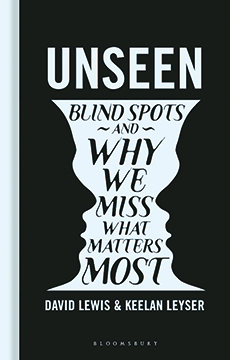
At first glance, Unseen looks like a typical make-your-life-better book, a compilation of research distilled for a general audience by a social scientist or academic. But early on, Keelan Leyser and the late Dr. David Lewis put readers on notice that Unseen is different, given that one of the authors describes himself as “magician, mentalist and pickpocket.”

OK, we’re in.

It’s not every day one has the chance to get life advice from a pickpocket.

Thankfully, Leyser’s light-fingeredness is in the interests of social science rather than a product of criminal intent. The success of both magicians and pickpockets depends on their ability to manipulate attention.

“Whether secretly removing a watch from someone’s wrist or making a pack of cards appear to turn into a block of glass in someone’s hands, the principles remain the same: the brain’s attention can be redirected through calculated psychological triggers,” Lewis and Leyser write.

In short, both magicians and pickpockets expose our cognitive blind spots, the ways in which we go through life “looking, not seeing.” In Unseen the authors convey these lessons leaving our wallets untouched. The everyday workings of the human body, especially the eye and brain, may seem miraculous, but we are largely unconscious of the way in which its processes fail us, sometimes catastrophically.

Researchers say that human error is responsible for 70 percent of vehicle accidents and 80 percent of aviation accidents, and cognitive blind spots play as much a role in this as inattention or exhaustion. In fact, we are most likely to suffer from blind spots when we are one of the “3 Fs” — fatigued, frightened or furious, Lewis and Leyser write. Even when not noticeably impaired by one of the 3Fs, human beings make three to six errors every hour, “regardless of the task or activity being conducted,” one safety expert tells the authors.

This is because there are so many ways in which our brains can fool us, as evidenced by the famous sketch “My Wife and My Mother-in-Law,” an illusion created in 1915 by a British cartoonist. When looking at the drawing (seen as sexist by today’s standards), some people see an old and unattractive woman, whereas others see a stylish young woman. Lewis and Leyser offer dozens of other examples that similarly show how our perception is altered by the shortcuts our brains take in processing information. They not only present photos and illustrations, but also provide QR codes throughout the book that take the reader to webpages where the concept is more fully explained. It’s an interesting approach, although I’m still not sure how I feel about having to have a smartphone on hand while reading a book.

Nor am I sure whether I’m happy to have learned about how accident prone all of us are because of these blind spots.

While most people believe we have five senses, Lewis and Leyser explain there are many more than that, and the shortcuts that the brain takes are necessary because of the millions of pieces of information it is constantly bombarded with. Blind spots basically are an adaptation that allows us to maintain our sanity, and there are varieties of them. There is, for example, “change blindness” in which we can be oblivious to a difference that becomes obvious when it is pointed out to us; this is particularly worrisome when applied to the work of those reading X-rays at a hospital and screening luggage at the airport.

There is “choice blindness,” in which people fail to notice a change in a choice they have previously made, which has had disturbing repercussions for those picking out suspects in a police lineup. And there is “expectation blindness,” in which people’s expectation of an outcome or act influences how we perceive what actually happens, which has resulted in wrongful police shootings and fatal medical mistakes, as when a nurse picked up a drug syringe and read the label as she expected to see it, rather than the way it was, resulting in the death of a patient.

In a chapter on visual illusions, Lewis and Leyser lay out why we are so easily fooled by what we think we see, such as the drawing known as “Shephard’s Tables,” which seems to depict two tables of varying sizes, but does not. Things get even weirder when they take up the intra-body communication that goes on between the brain and the gut, our so-called “alien brain” run by billions of microbes, and blind spots driven by other body parts, including the bladder. (“An empty stomach reduces our decision-making powers, while a full bladder increases them,” the authors write.

Unseen also delves into the complex machinations of why we remember faces and why we find some people attractive but not others, and how marketers exploit our blind spots to sell us things. The authors recall a famous psychology experiment from 1967 in which a person dressed from head to foot in a black cloth bag went to a college class every day for a semester. The “Bag Man,” who has never been identified, was at first mocked by other students, but as time went on they became protective of him. One researcher later said that Bag Man illustrated that “people will grow to like a thing they initially detest — even with no new information — if they are repeatedly exposed to it,” which is one reason brands bombard us with familiar products repeatedly.

In addition to showing us how certain popular magic tricks work, Lewis and Leyser offer some tips on banishing, or at least finding workarounds for, our blind spots. Cutting down on the fatigue in the 3Fs is an obvious one; when we’re tired we’re more likely to succumb to them. (It’s harder to stop being frightened or furious, although they have suggestions for that as well.) Perhaps the most helpful is being aware of all this social science research and how it applies to ordinary life.

Unfortunately, the authors spend 250 pages warning us about cognitive blind spots and only 22 telling us to banish them, with some suggestions that seem banal (tart cherry juice or milk to help you sleep, yawn). More helpful would have been 20 pages of warnings, 250 pages of solutions. B

Featured Photo: Unseen, by David Lewis and Keelan Leyser.

Album Reviews 26/08/20

Miguel Zenón & Luis Perdomo, El Arte del Bolero Vol. 3 (Miel Music)

Relevance check: The Hispanic and Latino community is a rapidly growing demographic in Manchester, N.H., making up approximately 13.5 to 14 percent of the city’s total population, or more than 15,000 residents, making it one of the largest and most vibrant multicultural communities in the state. Bolero and tango are two major components of the citizenry’s musical heritage, and this, the third full-length collection from sax player Zenón and pianist Perdomo, is, along with its unbridled romp into pure artistry, something of an archaeological expedition. These two have played together in Zenón’s quartet for 27 years, and the second volume in this series resulted in their winning a Grammy in 2024 for Best Latin Jazz Album; in other words there’s no questioning their qualifications, which here table sweeping, clever and above all romantic renderings of pieces like “El Día Que Me Quieras,” co-written by Argentinean music idol Carlos Gardel, renowned for defining the tango genre in the early 1900s. This wasn’t what I expected at all; it focuses on Latin music’s melodic patterning as opposed to its familiar percussion-driven vibe. A+

Anthony Moore with AKA & Friends, On Beacon Hill (Drag City Records)

There’s a renewed push for this November 2025-released album, so I leapt at the chance to get the vinyl version sent to me, not because I know Moore from SpongeBob SquarePants but because casual investigation showed that it was indeed unfairly overlooked and, in short, Something Important. At 77, Britisher Moore has a formidable CV, having collaborated with Pink Floyd (three co-writer credits on 1987’s A Momentary Lapse of Reason and “Wearing the Inside Out” on The Division Bell’) and Julian Lennon (on Help Yourself). The songs here are rerubs of tunes he’s recorded over the decades, including the single “World Service” from 1981 and other period pieces; thus it serves as both reminiscence and introduction, revealing the Floyd collaboratorship as logical: The songs are slow, saddish but not mawkish, i.e. there’s a psychedelic element at work, but fans of Nick Cave — especially his most morose records, like Ghosteen — will assuredly get a lot out of this. A-

PLAYLIST

A seriously abridged compendium of recent and future CD releases

• Friday, Aug. 21, what can you even say? Not only is it a day of new album releases for you, it marks many historic events in rock ’n’ roll history! For example, on Aug. 21, 1965, the Rolling Stones scored their first U.S. No. 1 album with Out of Our Heads, an album I’d never heard of until today, because I never cared! Let me look, OK, aside from “Heart Of Stone” and some other song I’m not familiar with, the album consisted of cover versions of old blues songs from people like Chuck Berry, Sam Cooke and waitwhat, Sonny Bono, from Sonny and Cher! Well, it actually makes sense, because back in those days, before the internet or cars or fire, Sonny Bono was a songwriter, not the sad television clown you all know him as, if you’re kind of old. OK, if you’re definitely old, but enough history filler, what you really want to know is what’s going on with Brandon Flowers, the singer from Killers, but there’s not much to tell, since he doesn’t get into beefs, because he is Mormon, who even knew. His third solo album is titled THRASHER, yes, in all caps, because whatever; it is a concept album serving as follow-up to the Killers’ 2021 album Pressure Machine. Like that one, this new one is a triptych of Flowers’ childhood growing up in Nephi, Utah, and is influenced by vintage artists like Johnny Cash, which explains the gospel-singalong-ish Grand Ole Opry vibe of leadoff single “Paradise.” He’ll be at Roadrunner in the snobby Brighton neighborhood of Boston on Sept. 23.
• Vermont native Grace Potter used to be in Grace Potter and the Nocturnals, but then she fell in love with her record producer, which caused her bandmate-husband Matt Burr to go “oh no you didn’t” and the band broke up, but before you start, she did end up marrying the producer guy. She is on her own these days, currently hawking her sixth album, Trespasser. The single “Love Me Not” is a rather interesting slow-rocker combining sounds remindful of both KT Tunstall (when she still had a few songwriting ideas) and Melissa Etheridge (because that’s who Potter usually sounds like, in other words half the songs you thought were Etheridge were actually done by this lady, and vice versa). Her 2026 tour will come very close to our state on Sept. 12 at River Ruckus in Haverhill, Mass.

• Ah yes, Weezer, the voice of an awkward, horribly mistreated generation, they are releasing their 20th album this week, once again titled Weezer, but this time everyone will refer to it as The Gold Album. If you’re one of the band’s fans, you’ve likely already heard the initial single, “Shine Again,” featuring a decent doomy-grungy guitar line that rips off Lit’s “My Own Worst Enemy,” which is of course itself a ripoff of most Weezer songs; the second single was “We Might as Well Be Strangers,” featuring a guest spot from shoegaze-slacker band Wednesday. That song is unbelievably lifeless and sounds completely phoned in, but for all I know you will relate to its message of suburban misery or whatever the guy who looks like Rick Moranis is singing about. These guys will play at TD Garden in Boston on Sept. 27.

• We’ll stick a fork in this exercise with Mystery Jets, an indie-pop/post-punk band from Eel Pie Island, situated in the River Thames in London; the people of that island are constantly bombarded with noise because the island is in the flight path of lots of flights coming in and out of Heathrow Airport, which is essentially how they invented their band name. A Hole To See The Sky Through, the band’s seventh LP, includes the title track, which is really cool, like Yes in rockout mode, or Supertramp if they didn’t suck.

Featured Photo: Miguel Zenón & Luis Perdomo, El Arte del Bolero Vol. 3 and Anthony Moore with AKA & Friends, On Beacon Hill

Peach Blintzes

We have a peach tree and are thus up to our noses in peaches right now. If your husband brought home too many blueberries, or you woke from a fugue state with a giant bowl of nectarines, those will work well for this, too.

Crepes

  • ½ cup (114 g) water
  • 1 cup (227 g) milk
  • 4 eggs
  • 4 Tablespoons (1/2 stick) butter, melted
  • 1 cup (120 g) all-purpose flour
  • 2 Tablespoons sugar
  • 1/8 teaspoon salt

Filling

  • 1¼ cups (284 g) ricotta cheese
  • 4 ounces (1/2 package) cream cheese
  • ¼ cup (28 g) powdered sugar
  • 1 teaspoon vanilla extract or paste
  • Zest of 1 lemon
  • ¼ cup (the other 1/2 stick) butter

Butter for frying

Topping

(The amounts for this stage of the recipe are maddeningly vague, because even you don’t know how sweet, or juicy, or whatever your fruit is. You’ll just have to taste as you go along.)

  • Zest of another lemon
  • Several large peaches, or a couple cups of berries, or other fruit you have too much of
  • A pinch of salt
  • An undetermined amount of honey – I like hot honey. Start with two or three tablespoons.

Put all the crepe ingredients, in the order they are listed in, in a blender. All crepe recipes are fairly insistent about this. I suspect that if you started with the flour on the bottom of the pile of ingredients, things would get gummy and you’d have a layer of glue, which might break up into glue nuggets when you blend it. Alternatively, it might open a portal allowing the ghost of Julia Child through to give you a thorough talking-to. I wouldn’t mind that so much, but it might be Auguste Escoffier or Anthony Bourdain, either of whom would probably be super-grumpy.

Blend the crepe batter until it is smooth. Leave it to rest for 20 minutes, or longer in the refrigerator.

Mix the ingredients for the filling with your electric mixer, one at a time. Unlike the crepe batter, this filling will not throw a princessy hissy fit about the order. I’d suggest starting with the hardest ingredient, which is probably the butter you forgot to take out of the refrigerator. Chill in the refrigerator for an hour.

Add the ingredients for your fruit topping to a saucepan. If you need to peel or pit the fruit, please do so. Cook over medium heat until the fruit softens and makes a syrup. Add honey a little bit at a time until the filling is as sweet as you want it.

Melt a tablespoon or so of butter in a non-stick pan, then make your crepes. You will only need to use melted butter for this first one. (If you haven’t made crepes before, take comfort from the fact that the first one is always wonky for everyone. You’ll figure this out.) Remember to flip the crepe and cook both sides.

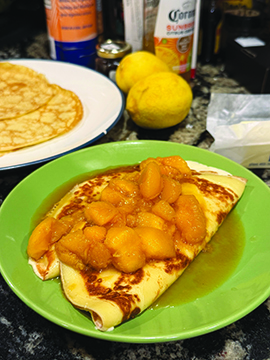
Fill each crepe with the cheese mixture, then roll them up and serve them warm, with the fruit topping. If you want to be extra fancy, they go well with sparkling wine.

Featured photo. Photo by John Fladd.

Stay in the loop!

Get FREE weekly briefs on local food, music,

arts, and more across southern New Hampshire!