It’s not too late to plant more lettuce

And other advice for September gardening

By Henry Homeyer

listings@hippopress.com

I’ve seen the big yellow buses meandering down the road, lines of impatient drivers behind them, noisy kids inside. That tells me, temperatures notwithstanding, that fall has arrived.

The most common question I am fielding is about lilacs: Why have so many had their leaves turn brown and fall off early? We had a wet spring, ideal conditions for fungal diseases to thrive, and many are affected. The ultra-dry conditions of August stressed the lilacs, making them even more susceptible. But fear not: They should recover next year.

I recently spoke to Kitty Werner, curator of lilacs at the UVM Horticulture Farm. She agreed that the problem is a blight and suggested that you rake up the dead leaves so spores don’t overwinter near your lilacs.

Give your lilacs a slow, deep watering now, and again every week until we get some serious rain. Bring your hose to the plant, and set the rate at very slow. Let it slowly sink in over a period of five minutes or more. If you have planted any new trees or shrubs this year, also give them a deep watering on a regular basis. This will allow roots to grow — scientists have determined that fall is when most root extension occurs.

Mulch can be useful for minimizing weeds, but it is also a liability. Even 2 inches of ground bark mulch on a flower bed can soak up all the water from a quick watering with your hose, or a nice 20-minute shower from the sky. If you are not sure if the water is getting to your soil, water, pull back the mulch and poke around in the soil with your finger.

My vegetables did well this summer, as they loved all the sunshine. My soil is very high in organic matter, so it holds water well. My spring-planted lettuces were cut-and-come again varieties, so I ate good lettuce all summer. Because I cut off heads instead of pulling them, the roots started up new plants, which produced well. Now everything has bolted and I will leave a few to set and drop seeds. Those will start new plants in April, even when the soil is too wet for me to work it.

When I was visiting a friend the other day, she pulled off a leaf from a lettuce plant that had bolted and ate it. Huh? I always worked on the idea that bolted lettuce is too bitter to eat. But I tried one, and it was good. So I have been tasting my lettuce that has bolted, and lettuce from other gardens. Most tasted fine to me, a few were worth making a face. Of course, I know that as we age our taste buds change, so to you younger folk, maybe all bolted lettuce is inedible. But it’s worth sampling your lettuce before pulling it out.

It is not too late to plant more lettuce. In late August I planted some Black Seeded Simpson. It is heat tolerant and frost tolerant, and matures in 21 to 40 days after it germinates. It’s a workhorse, and I should be able to start picking a few leaves later this month. Even if you plant in mid-September you will get some in October — and maybe into November. Because of the dryness, I did not seed the lettuce in the ground, but used potting soil and cells that I could monitor for moisture levels. When it is well established, I will transplant it into the ground.

Over the years I have created flower gardens that have something in bloom all three seasons. Right now monarch butterflies and migrating birds need lots of energy for their long journeys. Birds need seeds, which are high in calories, so I am not cutting back summer bloomers even if they have gone by.

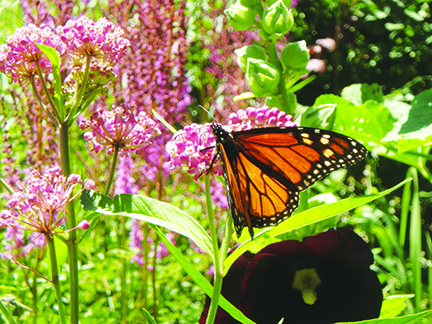
We all know that monarchs need milkweed — but that is so their larvae will feed on the leaves and become toxic to birds. Adult monarchs do not feed on milkweed leaves, but right now they are enjoying feeding on nectar from goldenrod, Joe Pye weed and fall asters, among others.

As the vegetable garden winds down, it is important to pick vegetables at peak ripeness if you intend to freeze, can or dehydrate them. Woody green beans picked huge will never get eaten even if you freeze them.

You know better than to let your zucchinis get too big, but did you know you can freeze them? Cut them into bite-sized pieces and blanch them very briefly in boiling water. Thirty seconds or so will kill the aging enzymes to keep them nice once frozen. Dump the blanched squash in a sink of cold water, let cool, drain and pat dry. Freeze in zipper bags and eat within six months.

If you haven’t got your seed garlic yet, buy some. We should plant garlic in October, but by then most seed garlic is gone. And harvest your potatoes soon — even if they haven’t blossomed (which is usually when we dig them). I got a great crop, due to all the sunshine.

Every year has its own challenges, but I try not to focus on the difficulties like lack of water. And who knows? Maybe next year it will rain some every week.

You may reach Henry at henry.homeyer@comcast.net

Featured photo: Lettuce bolts when it gets tall and produces seeds. Photo by Henry Homeyer.

Late summer in the garden

Arranging flowers, visiting a botanic garden and putting up tomatoes

By Henry Homeyer

listings@hippopress.com

Every year on the third weekend in August, my hometown of Cornish, N.H., sponsors a country fair. Not only does it have junk food and rides for the kids, it has ox and horse pulling competitions, woodsman’s events and more. The school is full of photography, art and crafts, 4-H and a chance to show off your best and biggest zucchini. Flower arrangements of all sorts fill a whole room.

If you want to compete in a flower competition, start a week ahead of time. Test out flowers to see if they will look good for the length of the fair. Will black-eyed Susans still look good? How about bee balm?

It’s best to pick flowers for an arrangement in the morning when they are fully hydrated and before the heat of the day has had a chance to dry them out. Watering your flowers the night before helps if you’re in a dry spell. Bring a picking bucket when you collect flowers. As soon as they’re cut, plunge them into deep water, but don’t submerge the blossoms. It’s best to pick flowers that are just opening up, not in full bloom.

When you actually make your arrangements, make sure no leaves go in the vase as they will decompose and invite bacteria that will clog up the stems. And re-cut the stems before using them, removing at least ¾ of an inch of stem. Some folks do this in a bowl of water, but I just cut them and quickly put them in a vase.

What kind of vases work best? That depends on the flowers to be used. I tend to like vases with relatively narrow openings, as they keep the flowers upright. Use heavy vases to keep tall arrangements from tipping over. Pick plenty of stems, and then choose the best to use.

How tall should an arrangement be? An 8-inch vase looks good with the tallest stems about 12 to 16 inches tall. You may want to start an arrangement with a low filler, something with stiff stems that will help keep taller stems upright. Boxwood branches are good for that. Place three, five or seven stems of a particular kind of flower in the vase. Use medium-height flowers, then add another variety with slightly taller flowers until the vase seems almost full. Some people obsess about making colors complementary, but I feel all flowers are beautiful, and look good together. You’ll know what looks good as you make the arrangement. White flowers add a nice counterpoint to the others.

This is a good time of year to visit a botanical garden — it can give you ideas about new plants and interesting designs for your garden. My wife, Cindy, and I recently visited the New England Botanic Garden at Tower Hill in Boylston, Massachusetts (near Worcester). It has acres of well-planned gardens on 200 acres with hundreds of perennials, trees and shrubs, all artistically placed.

One of the things I especially appreciated at Tower Hill was their effort to have readily visible labels for most things, with both English and Latin names. I came away with the desire to find two plants I had not seen before: a tree called hornbeam maple (Acer carpinifolium) and a perennial called rattlesnake master (Eryngium yuccafolium).

Within a week or so I found rattlesnake master at Rocky Dale Nursery in Bristol, Vermont. It is related to sea holly but has leaves like a yucca. At maturity it can get to be 4 to 6 feet tall with greenish-white, thistle-like blossoms and a basal rosette of yucca-like leaves. It is hardy to Zone 3 and is native to the Midwest. I had seen it once in Ohio in the wild. It likes hot, dry, sandy soil, preferably in full sun.

The hornbeam maple tree was intriguing. It is in the same genus as our maples, but its leaves look nothing like our maples. It is from Japan, and the leaves are like those of a hornbeam. It was growing as an understory tree in the shade garden area at Tower Hill. I loved the smooth gray bark, which is a little like that of our native beech trees. It can get to be 20 to 30 feet tall, is hardy to Zone 4, and does best in full sun to part shade. It’s a gorgeous small tree and I’m keeping an eye out for one.

For me, mid to late summer is a great time in the vegetable garden. I can eat fresh veggies every day and still have plenty left to put up for the winter. My favorites are the tomatoes. I often eat them three times a day — or more, if you count the cherry Sungolds I snack on in the garden.

I planted 37 tomato plants last spring and plan to freeze lots of tomatoes for winter use in soups and stews. The simplest method for this is to fit clean, dry tomatoes into zipper bags and put them in the freezer. To use, just run them briefly under hot water in the sink, wait 5 minutes, then rub off the skins (if you like) or just chop them up and cook with them. No canning work involved.

I also dry tomatoes in my Excalibur and Nesco American Harvester food dehydrators. Mainly I dry cherry tomatoes, cutting them in half and arranging on the trays. When dry, the tomatoes can be stored in the pantry, no need to freeze them. I put them in soups and stews, where they provide a burst of flavor.

The garden keeps me young: I get exercise, good food, and beauty. Who could ask for more?

Henry writes his column just once a month now. You may write him at PO Box 364, Cornish Flat, NH 03746 or email him at henry.homeyer@comcast.net.

Featured photo: Pick plenty of flowers so you have many to choose from when arranging them. Photo by Henry Homeyer.

July flowers worth growing

It’s a great month for blossoms

July is a great month for blossoms — on trees, shrubs and perennials. Here are a few of my favorite July plants.

The most dramatic of my July bloomers are my Itoh peonies. These are hybrids of herbaceous and tree peonies that were developed in the mid-20th century by a Japanese plant breeder named Toichi Itoh. Unlike their parents, the blossoms of the most commonly sold ones are yellow, not pink, red or white. In fact, I’ve never seen anything but yellow ones for sale.

I have a “Garden Treasure” Itoh, and counted 46 buds on it earlier this summer. The stems of Itoh peonies are stronger than on ordinary peonies, so I don’t feel the need to support them. The blossoms on mine are 5 to 7 inches in diameter. And instead of blooming all at once, they bloom over a period of several weeks. These perennials are very pricey, but worth every dollar. And they last well in a vase.

Another favorite July bloomer is a small tree called Stewartia. I only got mine four years ago as it is a Zone 5 plant, and I was previously in a cold Zone 4 location and unwilling to take a chance on it. I’m still here in Cornish Flat, N.H., but our winters “ain’t what they useta be,” so I got one four years ago. It has a plethora of 1-inch creamy-white flowers with yellow centers that are lightly fragrant, and exfoliating bark with patches of gray, orange, white and brown that is pleasing all year. I plan to prune mine to keep it around 12 feet tall, though it could go to 20 feet tall or more if I let it.

Then there is sea holly (Eryngium amethystinum). This was a challenge for me to grow. Not because it is delicate, but because it really only thrives in dreadful soil — sandy, infertile and dry. My soil is normally high in organic matter, moist and great for most plants. The flowers are blue, numerous and spiky — and great in dried arrangements. Florists love it. If you have crummy soil, this is for you. Never fertilize it!

This year my two wisteria vines started blooming on June 19, though they usually do not bloom until July 4. For decades gardeners in northern climates lamented they could grow wisteria but couldn’t get any blossoms. That is because those vines bloom on buds set the previous summer. But ‘Blue Moon’ and ‘Amethyst Falls’ bloom on new shoots that grow in the spring. Wisteria need trellises or supports and are vigorous growers. In southern climates some wisteria can be invasive, spreading out everywhere, but I have never had a problem with mine. They produce hundreds of blue flowers, though to me, the blossoms smell vaguely of cat pee. Blue Moon re-blooms again for me later in the summer, though not profusely.

By now we’re all aware that native trees and shrubs support our birds and pollinators. According to research done at the Mount Cuba Center, a botanic garden and research center for native plants in Delaware, the best of the hydrangeas is a native one called ‘Haas Halo’, a variety of Hydrangea arborescens, or smooth hydrangea. I have it, and love that caterpillars eat the leaves. After all, it takes 6,000 to 9,000 caterpillars to feed a clutch of chickadees from hatching to fledging. It blooms well in shade, and is fast growing.

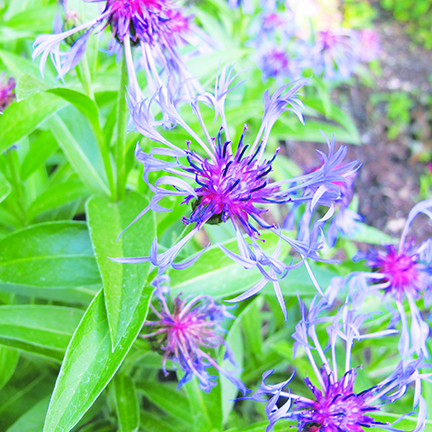
For exuberant perennials that spread, bloom well in July in sun or part sun, and serve as great cut flowers, it is hard to beat the clustered bellflower (Campanula glomerata). Yes, some people consider it a thug as it can spread by root or by seed, but I find it easy to remove if it oversteps its welcome. The clusters of small blue-violet blossoms form 2-inch balls on 24-inch stems and are a delight to grow.

I grew up in Connecticut, where the mountain laurel (Kalmia latifolia) is the state flower. There it grows in the wild under the high canopy of oaks and other deciduous trees. It has small, dark evergreen leaves that look good all winter. The small blossoms are usually pink to white with stripes of pink, though now growers have varieties that are deep pink or even red. It does best in acidic soil. It will grow in full sun to full shade, but flowers best with moderate amounts of sunshine. Mine get morning sun only.

Another flower I love is called Knautia macedonica, a perennial with no common name. Unlike most perennials, it blooms all summer, producing wine-red 1-inch flowers on thin stems. Each flower resembles a tiny dahlia or double peony. It loves sun and rich soil, but blooms in part shade, too. Not a great cut flower, but a worthy addition to any garden.

A great shade perennial I grow for its foliage is called ‘Sun King’ Aralia. This plant has bright yellow-green leaves that just pop in a full or part shade garden. Mine gets bigger every year. Now, five years old, it stands almost 5 feet tall and more than 5 feet across. It’s in rich, fairly dry soil and gets some morning sun.

So if July in your garden is just ho-hum, get thee to a garden center and try something new.

Henry can be reached by email at henry.homeyer@comcast.net. His articles appear near the beginning of each month.

Tough row to hoe

Gardening in difficult conditions

By Henry Homeyer
listings@hippopress.com

The very last day of May this year surprised me: We got three inches of rain in a little over 12 hours. Although not unheard of, it came after a month when we often got an inch or two of rain over a two- or three-day period. The ground is soggy, our brook is overflowing — and we have no way of knowing if the summer will continue wet or turn hot and dry. As gardeners in uncertain times, it helps to plan for the worst and celebrate when we have the best. Let’s look at what you can do to help your plants survive.

First, if you have a big rain, the best thing you can do is STAY OUT OF THE GARDEN. Wet soil compacts when you walk on it, making it less hospitable for plants because they get nutrients, water and oxygen through their roots. You already know better than to walk in your growing beds, both in the vegetable and flower gardens. But your lawn will suffer, too, if you walk on it while wet, and your footprints may make it lumpy.

We have lots of wide flower beds, wide enough that we cannot weed some of them while standing on the lawn. So we place flat stepping stones in the beds, strategically placed so we can step on them to weed or pick flowers for vases in the house. This being New Hampshire, we seem to have a good supply of relatively flat stones to use. If we dig one up, we save it for future use. If you don’t have stones, you can buy them from garden centers. Look for stones that are larger than your shoe, but get some bigger ones, too.

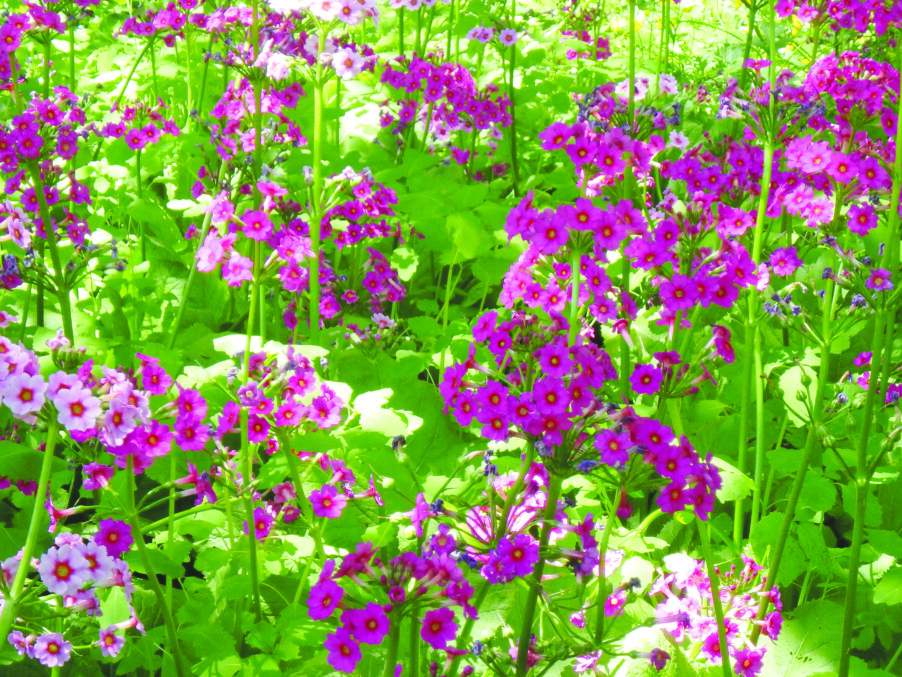
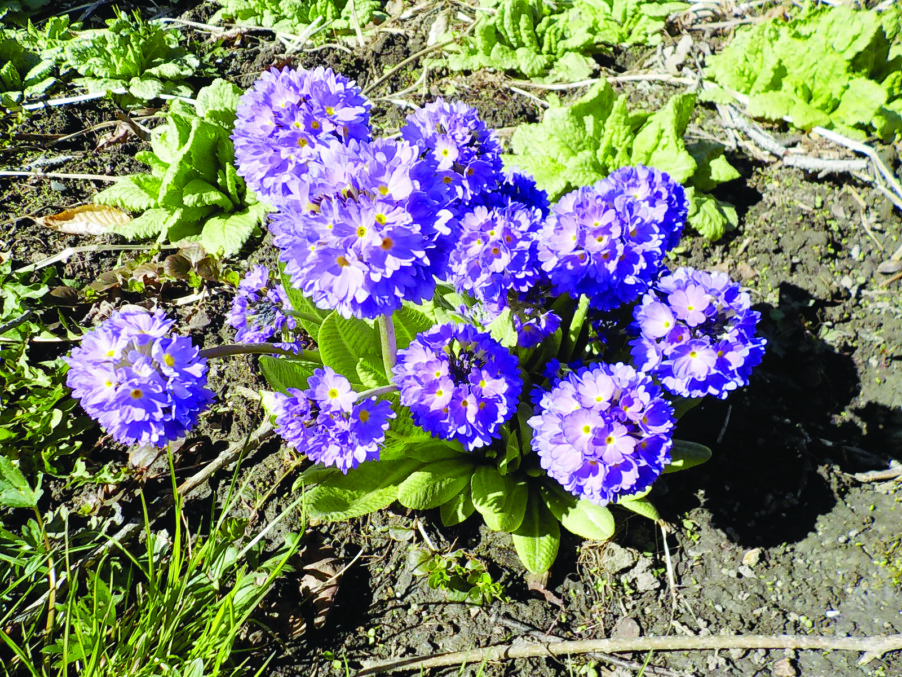
We also make pathways through large beds. We have a bed of candelabra primroses (Primula japonica) that is approximately 25 feet by 30 feet in size that contains hundreds of these beauties. We designed and built three pathways through and around it. And although we cannot access it all, it helps.

First we picked a route. Then we dug up and moved primroses and weeds to create a pathway about 18 inches wide. I find the CobraHead Weeder (cobrahead.com) can get under even mature plants and lift them, undamaged, for moving. This works best if the soil is moist — not a problem this summer. We got a nice rootball with each if we inserted the CobraHead in three or four places and loosened the soil a little before lifting the plant.

For our walkways we put down landscape fabric and pin it in place with landscape staples. We avoid woven landscape fabric, as weeds tend to grow through it. We use an almost see-through spun fabric, which does well by us. We cover the fabric with a 2-inch layer of quarter-inch washed pea stone that I buy at a gravel company and bring home in my trusty, rusty 2004 Toyota pickup truck. Lastly, we spread some finely ground bark mulch along the edges of the path to help keep weeds and soil from migrating into the walkway. Steel edging would be good, but it’s expensive.

Bark mulch is good in both wet times and dry times. Persistent weeds can grow through it, even a layer an inch-and-a-half thick. But it reduces weeding considerably. It helps to minimize evaporation in hot, dry weather, too. In wet times some weeds will grow in it — but they can’t hold on as well as in soil, so they pull easily.

Raised beds are great in wet times. I have a wooden one I built using rough sawn pine that is 16 inches tall. I filled it with a mixture of garden soil and compost I buy loose in bulk. You can buy both at good garden centers, and a 50-50-mix works well, though I sometimes add peat moss and perlite if the mix is too heavy. In these recent rains my raised bed stood happily above the water-filled walkway around it.

Mostly in the vegetable garden I make 30- to 36-inch-wide raised beds without wood sides. I just hoe up soil from the walkways into a bed that stands up 6 inches above the walkway. Our dog, Rowan, seems to instinctively know not to run through the beds. I work lots of compost into the soil to keep it light and fluffy.

The walkways I mulch with a layer of newspaper (three or four pages thick) covered with straw. I can use the same technique around big plants like tomatoes or Brussels sprouts. Onions and carrots? I just fit some straw in between the rows.

Peonies are a problem in wet times. Double peonies, those that have a blossom packed with petals, get heavy when wet. They flop over and sometimes the stems break. Metal peony rings are sold — they are like tomato cages but wider and lower. It is best to install them in April, before they get tall and bushy. Even so, I find they often don’t work — they are too short to protect tall stems.

What I prefer for peonies and other tall plants is to install three stakes around them, and then encircle the clump about two-thirds the way up with green garden string. For plants like peonies, I use bamboo stakes. For taller, heavier plants like New York ironweed or ‘Henry Eiler’ Rudbeckia, I use 4-foot-long 1-inch hardwood grade stakes that I paint green to disguise them. I drive them into the ground with a 3-pound sledge.

The bottom line is this: Despite all we do to prevent damage by storm or drought, not every plant is going to look its best all summer. So I focus on the beauty of the successful plants, and dream of sunny days punctuated with an occasional shower.

Reach Henry by e-mail at henry.homeyer@comcast.net or by mail at PO Box 364, Cornish Flat, NH 03746.

Annual flowers for summer blooms

Start slowly and save your back

By Henry Homeyer

listings@hippopress.com

It’s April, and spring has sprung. Or will soon. Winter always is a sneaky devil, coming back with hard frosts and even a foot of snow on occasion. There is much to do, but start slowly, not just for your back, which has been resting all winter, but because a week of warm sunny days doesn’t mean your soil is warm enough to plant. A soil thermometer pushed 3 inches into the soil should read 50 degrees before planting anything, even spinach and so-called cold-weather crops.

As you move around your garden you will probably notice that the soil is moist. If you are leaving footprints in the lawn or garden soil, stay off it until it dries out more. Otherwise you can ruin soil structure by compacting it.

You can put down 6-inch planks as walkways in flower beds if you are determined to weed or to remove leaves and debris while the soil is still a bit wet. But even then, be careful. There may be little green noses of perennials or bulbs lurking under the leaves and you won’t want to damage them by putting a plank on them.

I’ve had snowdrops up and blooming since March, as I do every year. By April I have lots of bulbs blooming: crocus, glory-of-the-snow, scilla or squill (a deep purple early bloomer), winter aconite (a bright yellow, short-stemmed beauty) and early daffodils. If you don’t have enough bulbs blooming, imagine where they might go, and put plant labels there for fall planting. A south-facing hillside bed will produce blossoms up to three weeks before a north-facing bed.

I plant 100 tulips as cut flowers every year. If you planted some last fall and have deer in the neighborhood, you may be disappointed to see them eaten just as they are starting to bloom. I prevent this by surrounding and covering my tulip bed with chicken wire before that happens. I plant my tulips in the vegetable garden each fall, and treat them as annuals.

Once your lawn has dried out, it will need a good raking to clean up the winter debris. I like to wait until the lawn has greened up a bit before raking. I don’t want to rake a dormant lawn as it would be easy to damage it with a brisk raking. Think of your lawn as individual plants growing very close together, not as one big green plant. They compete with each other and with crabgrass and weeds. A sprinkling of good compost will improve your soil, giving the lawn a better place to thrive.

I recommend reducing the size of most lawns. Think of a lawn as an area rug, not wall-to-wall carpeting. That will allow you to have a bigger vegetable garden and more places for native trees, shrubs and perennials that will support pollinators and birds. Do you know that caterpillars are essential food for baby birds? We need to provide flowers and trees that the butterflies and moths recognize and use — our natives.

I recommend raised beds for the vegetable garden, but you don’t have to build or buy wooden boxes for raised beds. When the soil has dried out, loosen it with a garden fork, and then use a short-tined rake to drag soil from walkways onto your designated beds to raise them up 6 inches or so. A 30-inch-wide bed is ideal — it’s wide enough for roots to spread far and wide, yet you will be able to reach all parts for weeding.

Adding compost to your soil every year will improve it greatly over time. An inch of compost works wonders if you do it every year. Buy it in bulk if you have access to a pickup truck, or buy bags if you don’t. And for my tomatoes? I always add a shovel of compost in every planting hole and stir it in well with my favorite weeding tool, the CobraHead weeder (cobrahead.com). Compost not only provides essential minerals in small quantities; it greatly improves soil texture and its ability to hold water in dry times.

Some people hate weeding, some love it. Either way, it has to be done. Start before the weeds get big. Perennial weeds like dandelions or thistles will already have deep roots. Annual weeds will be tiny but numerous. I believe the best tool for either is the CobraHead weeder. Its curved metal digging tip can loosen the soil around deep roots and help you pull from below with the tool while your other hand tugs on the top. Pull gently, slowly. You don’t want to snap off the root, as it will just start growing as soon as you walk away. Annual weeds you can loosen by scuffing the soil lightly.

As you plan your garden, think about buying organically certified starter plants and seeds. Why? Ordinary seed growers feed their plants with liquid fertilizer every day. That means that the plants don’t have to work as hard as organically raised plants to get the minerals they need. Organic practices promote longer roots to get the nutrition needed by the plants. If you are going to grow organic food, you will do best with organic starter plants.

Organic seed producers have to deliver seeds for plants that will not be protected from diseases and pests with chemicals. They have to be tough. Lastly, buying organic seeds and plants supports organic farmers. They are working hard to protect the environment by avoiding chemicals. Pay a little bit more if you can, and buy organic.

And remember: Gardening is supposed to be fun. Don’t work so hard you get blisters and a sore back. Garden a little every day.

Henry can be reached at henry.homeyer@comast.net or PO Box 364, Cornish Flat, NH 03746.

Featured photo: Lisianthus comes in several colors and lasts forever in a vase. Photo by Henry Homeyer.

The Kimchi Chronicles

The many uses for this Korean cuisine staple

For Susan Chung, owner of Sue’s Kimbap House, kimchi is as much a staple of everyday cooking as flour or butter.

“Kimchi is just a traditional Korean dish that was made with fermented vegetables,” said Chung, who is the Capitol Center for the Arts’ Culinary Artist in Residence and whose eatery is at Bank of NH Stage in Concord. “The most common type is made from napa cabbage. Another one is [made from] the Korean radish or daikon. Another one that probably isn’t as familiar is kimchi made with cucumbers. That’s one we’re planning to launch at our store coming up soon. But the main thing about kimchi is it’s so versatile that you can have it just as abanchan, or side dish, with just rice, a protein, or even just rice and egg. Traditionally, Korean people will eat kimchi sometimes three times a day for breakfast, lunch and dinner. I personally don’t, but it’s normal to do that, since even little kids start eating kimchi as early as 2 or 3 years old.”

Chung said she grew up in a non-Korean household and it was only after she married her husband that she began eating foods like kimchi on a regular basis.

“I wasn’t introduced to Korean food until I was in my 20s,” she said. “But the good thing is you can actually ease into kimchi. They have a non-spicy version, which is a watered-down one, which little kids will start off with. But also, if you’re new to the Korean palate, it’s something that you can do as well. Even if you were to try regular Korean kimchi, you can water it, rinse it with water, and then still eat it with a small amount of spice.”

jars of kimchi set on the back of a volkswagon with a license plate reading "kimchi"
Photo courtesy of Micro Mamas.

Because there are almost as many varieties of kimchi as there are Korean families, Chung said, finding a particular type that suits a particular eater is mostly a matter of shopping around and finding one that suits their palate.
“There’s different levels [of intensity] to it,” she said. “If it’s fresh kimchi that’s made that day, it’s not as fermented as the ones you would keep in the refrigerator for up to a month or even longer. And then there are the ones you use once they get super fermented to add to stews and kimchi fried rice. And so when I say it comes to being very versatile, I think kimchi fried rice would be something that most people would be willing to try as well because everyone loves fried rice. But if you make it mixed with the kimchi and then with the fried egg on top, it’s something that a lot of our customers have been waiting for.”

One of the reasons for kimchi’s surge in popularity over the past few years is its reported health benefits. Gloria Najecki, the produce manager at the Concord Food Co-op, said, “It has become increasingly popular because people know that it’s good for their gut and it can be made from a lot of different things so it’s varied so it’s not just cabbage. I think fermented anything is big right now. People like fermented foods because they hear it’s good for their digestive microbiome, you know, their belly and all the good gut bacteria that live there. There’s a whole ecosystem in our bellies so you want to eat varied foods to help keep them all in balance.”

For Najecki, part of eating a balanced diet centers around eating a large variety of foods.

“I’m always saying, ‘Eat the rainbow’” she said. “Eat a lot of different colors. Eat a lot of different textures. You want to have sour things, bitter things. You want to mix it all up because all of that together helps that flora in your belly. And kimchi has healthy microorganisms in it, different yeasts and positive bacteria, that sort of thing.”

Luke Mahoney is the owner of Brookford Farm in Canterbury. He grows many of the key ingredients for kimchi on his farm, and his staff makes small batches of kimchi to sell at his farm store.

“All the ingredients are grown on the farm except ginger,” he said. “The base is napa cabbage and we use leeks and carrots and daikon radish. We grow a Korean pepper, which is specifically for kimchi, and we use garlic and ginger. Daikon [radishes] grow awesome here in New England, but specifically on our farm.”

black and white image of a woman standing in room full of barrels, light streaming in from small windows
Stephanie Zydenbos, founder of Micro Mamas, Courtesy photo.

A member of Mahoney’s staff is a fermentation expert named Irina. “She moved here from Russia to be with her family about 10 years ago,” Mahoney said. “She’s been experimenting with different types of conserves and fermentations. She had a job in science in [Russia], but then when she moved here, she no longer worked in science. She didn’t have the language, so we offered her a position as our fermenter. It was kind of a dream we had, but it was still undeveloped. She dove in and got inspired and used her life experience and recipes and also whatever ingredients we had on the farm at the time. She created a wide variety of beautiful artisanal craft ferments. And the kimchi is her pride and joy.”

Stephanie Zydenbos is obsessed with fermentation, too. She is the founder of and facilitator for Micro Mamas in Henniker, a company that makes kimchi and other fermented vegetables.

“We were the very first commercial fermenters in the state,” Zydenbos said. “We learned a lot and continue to be marveled by the art of fermentation — because it is an art.”

Zydenbos said her fascination with fermentation grew from chronic health challenges.

“From adolescence through my early adulthood I had lots of different sinus problems and digestive problems,” she said. “I wasn’t an unhealthy child, but I think that the best way to say it is that I just had a less than optimal digestive system. I took a workshop on kimchi and sauerkraut and how to make our own probiotic foods. I wanted to treat my digestive symptoms naturally and I had been taking some pretty high-dollar high-quality probiotics — which I don’t recommend; anybody, stop doing that! — and I made my first batch of kimchi around the time I had my first child, because I wanted to get my children off to a good start with their digestive health. Around 2011 or 2012 I woke up in the middle of the night and I’m like, ‘Why am I not doing this for a living?’”

Zydenbos said the healthy microorganisms in fermented foods like kimchi start in the soil where the vegetables are grown.

“The microbiology of the soils are how vegetables and isolates of lactic acid bacteria are in the vegetables themselves,” she said. “We get those vegetables in their raw form right from the field.” As vegetables ferment, she explained, “the starches and the sugars break down from the vegetables. They are basically pre-digesting the starches and the sugars and [producing] lactic acid bacteria in addition to accelerating the vitamin and nutrient content of raw vegetables” As the fermentation grows more acidic, she said, it kills off most of any competing bacteria and microorganisms. “The pH becomes so low that the good microbes thrive and none of the harmful bacteria that might exist.”

Zydenbos likes to take a simple approach to eating kimchi.

“The No. 1 thing I like to do,” she said, “is to open some sour cream or hummus and throw 100 grams or so of kimchi in there. That’s it. Bam. Done. It takes chips and dip and brings it to an entirely different level.”

Because the flavor of kimchi covers a spectrum from “zesty” to “pungent” it has been welcomed by fine-dining chefs in recent years to add background flavor, texture, or even a “funky” quality to sauces and dishes. Nick Provencher is the executive chef at The Birch on Elm in Manchester. He said kimchi has found a place in his roster of ingredients.

“We have [a kimchi dish] on the menu currently,” he said, “and we always use a variety of different ferments, whether it be kimchi or to preserve seasonal vegetables, especially in the summer when there’s something like ramps we’ll ferment. We always have different kinds. Right now we have [kimchi] in a kind of a Korean-style barbecue sauce as a base that we cook down with onions, garlic, aromatics and ginger.”

“I think for the most part kimchi adds a lot of depth because it has a variety of different flavor profiles to it,” Provencher said. “It’s got a kind of bold, vinegary quality. It’s like, it’s kind of like blue cheese — it’s stinky but it’s like a good stink, you know? You have spice there, too, which can round a dish out. I think it really makes some dishes shine because of the depth [and pungency] it adds to the sauce. It’s nice too, because there’s also the level of acidity that comes from it, which cuts the fat of a pork belly, which is something we serve with it.”

Keith Sarasin is a chef, an author, and owner of The Farmer’s Dinner, a pop-up restaurant devoted to local, seasonal and sustainable dishes. He is a big fan of kimchi.

“I feel like kimchi is one of those unsung heroes that has existed in either progressive or fine dining scenes for a while,” Sarasin said. “The first thing that makes kimchi great is it’s very universal in what you can put in it. So, obviously cabbage, chilies and things of that nature. But since what we do at The Farmer’s Dinner is so rooted in farms, we’ll add a lot of different backbones to kimchi. Let’s say we have a bunch of arugula — we will gladly add some arugula into [a batch of kimchi]. Whenever we used to forage a lot back in the day, we would add dandelion greens and burdock root and all of these fun things, which give a different layer and complexity to kimchi, starting out with that bitterness. It’s a lot of fun and it reminds me a lot of balancing everything else that you have.”

Because Sarasin works so much with small, local farms, he has seen non-traditional foods like kimchi (non-traditional in New England, anyway) having an impact on what crops those farms grow.

“I feel like diversity has definitely been something that we’ve seen,” he said, “especially in the last five to 10 years. You can always find savoy cabbages and napa and all of these cabbages, but I think you’re seeing more daikons. You’re also seeing a lot more varieties of peppers that are being grown, which is really exciting for me because I love peppers. Part of the backbone of [kimchi] is you definitely need chili powder. It’s one of the really quintessential things. There’s the standard, traditional kimchi, which is out of this world, but then there’s a lot of ways to bring in food waste that typically would go in the bin, you can repurpose to really bring into a beautiful kimchi.”

“Kimchi’s not only about sustainability for us,” Sarasin said. “A lot of what we do is technique-driven, and we’ve used a lot of different techniques when it comes to utilizing kimchi. One of my favorite things to do with kimchi is instead of just serving it we do a lot of dehydration. So we dehydrate kimchi, either the whole kimchi or the brine, and spread it thin on a Silpat [a silicone baking mat] and then we let that dehydrate and grind it into a powder. We’ve used that to dust over dishes like a Wagyu tartare, a creamy soup, or even a savory custard because you get that salt, acidity and umami in one sprinkle. Kimchi lends itself to seafood unbelievably well, and we live in such a beautiful place for seafood. We’ve done kimchi sauces but we built them up with the intensity of aged kimchi. We love to ferment daikon and things of that nature and smear it over pork belly and foie gras.”

Chef Sarasin’s Kimchi Butter Sauce

Yields ~1 cup

Pairs well with seared scallops, roasted cauliflower, halibut, grilled chicken thigh, even a wild mushroom toast.

  • ½ cup (188 g) aged kimchi, finely chopped
  • 2 Tablespoons kimchi brine
  • ¼ cup (55 g) white wine or dry vermouth
  • 1 Tablespoon rice vinegar or white wine vinegar
  • 1 small shallot, finely minced
  • 1 teaspoon sugar (optional, balances acidity)
  • ½ cup (1 stick) cold unsalted butter, cubed
  • salt to taste
  • optional: a splash of cream if you want a silkier mouthfeel

1. Start the reduction

In a small saucepan, add the shallots, kimchi, brine, wine and vinegar. Bring to a gentle simmer over medium heat and reduce until almost dry; basically you want 2-3 tablespoons of liquid left. You want the acidity concentrated but not overpowering.

2. Strain (optional)

If you want a smoother sauce, strain out the solids. But I like leaving the finely chopped kimchi in there for texture and visual.

3. Mount with butter

Lower the heat to low. Whisk in the cold butter cubes one at a time, making sure each one emulsifies before adding the next. Don’t let it boil or it’ll break. If it’s too punchy, add a tiny splash of cream at the end.

4. Taste and adjust the seasoning. Depending on your kimchi, you might not need salt. Serve immediately.

Kimchi Fried Rice

Plate with fried rice covered in cooked green vegetables
Kimchi Fried Rice. Photo by John Fladd.

Fried Rice

  • 1 teaspoon vegetable oil
  • 1 cup (188 g) chopped kimchi
  • 3 cups (445 g) steamed rice
  • ¼ cup (55 g) kimchi juice
  • ¼ cup (55 g) water
  • 2-3 Tablespoons gochujang (Korean chili paste)
  • 1 teaspoon fish sauce or Maggi Seasoning
  • 3 teaspoons (1 Tablespoon) toasted sesame oil

Garnish

  • 2 teaspoons toasted sesame seeds
  • 1 mini cucumber or ⅓ normal cucumber, peeled, seeded and cut into slivers
  • 3 scallions, chopped
  • ¼ cup (57 g) prepared seaweed salad – you can find this at the sushi counter at many supermarkets

Heat the vegetable oil over medium-high heat, then add the chopped kimchi, and fry for about a minute.

Add rice, kimchi juice, water, gochujang and fish sauce. Stir all the ingredients together for seven or eight minutes with a wooden spoon.

According to master chef Roy Choi, the best part of any fried rice is the carmelized, crispy bits from the bottom of the pan. In a Facebook video he advises turning the heat all the way up and letting the rice cook for another minute or two to crisp up the rice. “The thing about this rice, as you see, is we take it to the edge. You feel like you’re going to fall off. You feel like this thing’s going to burn. You take it so far that you think that you can’t take it any farther, that you’re almost scared that it’s going to collapse and be ruined.” Be fearless, in other words.

After a minute or so of cooking at high heat, stir the rice to see if you’ve achieved any crusty bits. If your courage holds out, you might want to blast the rice for another minute or so to recrisp the stirred rice.

Plate the rocket-hot rice in a serving bowl, then drizzle it with sesame oil, and garnish it with the sesame seeds, cucumber slivers, scallions, and seaweed salad.

Kimchi Tacos (plant-based)

Chelsea Mackler is the cheese manager at Whole Foods Supermarket in Bedford. She is not vegan herself, but her wife is. She said that a year or two ago, when her wife was having a rough week, she made kimchi tacos for her, which were extremely well-received. This is a riff on those tacos:

  • ½ cup (114 g) vegan sour cream – I like one from Forager Project; it has a really good flavor
  • ¼ cup (64 g) tahini (sesame paste)
  • 1 Tablespoon toasted sesame oil
  • 4 to 6 ounces (100 to 175 g) shiitake mushrooms, cleaned, trimmed and cut into 1-inch pieces
  • 1 cup (164 g) canned chickpeas, rinsed and drained
  • ¼ teaspoon each salt and pepper
  • ¼ cup (55 g) water
  • 4 six-inch flour tortillas
  • 1 cup (164 g) kimchi
soft taco tortillas
Kimchi Tacos. Photo by John Fladd.

In a smallish bowl, combine the vegan sour cream and tahini. Set aside.

In a large skillet, heat the sesame oil over medium heat, then fry the chickpeas until lightly browned, seven minutes or so. Add the mushrooms and water, then cook, covered, until the shiitakes soften and take on a little color, maybe five minutes more. Season with salt and pepper, then transfer the mixture to a bowl and set aside.

Toast the tortillas in any sesame oil remaining in the pan, about a minute on each side. Keep an eye on them; you’re not looking to make them crispy, just to give them a little color and to cook off their floury taste.

Assemble the tacos. Put 1 to 1½ tablespoons of kimchi at the bottom of each taco, topped with ¼ of the shiitake/chickpea mixture. Top with a tablespoon or so of the tahini sauce.

These are extraordinarily good tacos — not just vegan tacos, but excellent tacos, period. The chickpeas give a little extra savoriness and texture to the mushrooms. The kimchi gives spiciness and flavor but also some essential crunch. Sesame and kimchi pair really well together, so the creamy tahini sauce is just about perfect.

This will make four tacos, which sounds like enough for two people, but the slower eater might end up having to fight to defend their second taco. Plan on four of these guys as a single serving, and adjust the recipe accordingly.

Korean Dirty Martini

  • Dry vermouth
  • 2 ounces botanical gin – I used Malfi Rosa, a grapefruit-forward gin, and I was very pleased with it
  • ½ ounce of kimchi juice – the flavor and assertiveness of this will depend on the kimchi you have on hand, so be prepared to embrace your first martini of the batch, then adjust how much takes you to where you want to be; half an ounce is a good starting point

Hardware:

  • A mixing glass – NOT a cocktail shaker. When making a for-real, actual martini, please stir it rather than shake it. It really does make a difference.
  • A long-handled spoon for stirring – not surprisingly, a bar spoon is perfect for this.
  • Ice
  • A stemmed martini glass – martinis are at their best skull-shrinkingly cold, and holding the glass by the stem keeps the heat of your hands from warming yours up.
  • A cocktail strainer.

Chill your martini glass by either filling it with crushed ice or putting it in your freezer for 10 minutes or so.

martini glass on counter filled with orange colored cocktail, surrounded by ingredients
Korean Dirty Martini. Photo by John Fladd.

Fill your mixing glass half full with ice and pour an ounce or so of vermouth over it. Stir to coat the ice cubes with the vermouth, then strain away any excess. This is what is called a “dry martini”; it retains just enough vermouth to subtly flavor the drink. There is a version called a “perfect” martini, which uses equal amounts of vermouth and gin. Because the kimchi element will probably be a new experience for you, start with a dry martini and adjust from there.

Pour the gin and kimchi juice into the mixing glass and stir gently but thoroughly, then strain the orange liquor into your chilled martini glass.

If you are a dirty martini enthusiast, this will be right up your alley. It is spicy and sour, with a stiff alcoholic backbone that lets you know you are drinking a grownup cocktail. If you haven’t been a fan of dirty martinis up till now, this might convert you.

Stay in the loop!

Get FREE weekly briefs on local food, music,

arts, and more across southern New Hampshire!