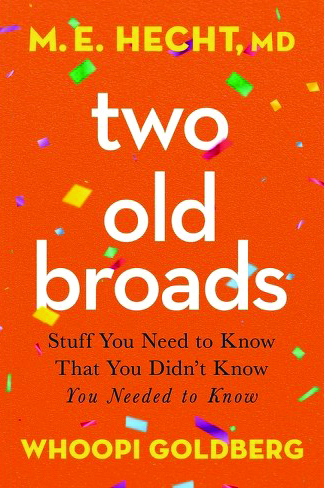
Two Old Broads, by M.E. Hecht and Whoopi Goldberg (Harper Horizon, 222 pages)
There is no topic so grim that it can’t be lightened by humor. And with America seeming to be graying at light speed, a wickedly funny book on the subject of aging by comedian Whoopi Goldberg (co-written with a physician friend) seemed just the prescription, promising to reveal “stuff you need to know that you didn’t know you needed to know.”
Unfortunately, Two Old Broads does not deliver on its promise and more realistically could have been titled “Two Old Broads Stating the Obvious in a Vanity Book.” It’s that bad.
It’s hard to see how this collection of platitudes and painfully useless advice made it through an agent, let alone a major publishing house. It’s the sort of book that is usually self-published and foisted onto friends, who have to invent creative ways to praise the book without selling their soul. Worse, this yawner comes from accomplished women who should have more interesting things to say.
Mary Ellen Hecht was an orthopedic surgeon with degrees from Columbia and Yale, who died at age 93 just before the book’s publication. She had been friends with Whoopi Goldberg since they met at a fashion show in 2010. Goldberg, of course, is a talented comedian and actress who has won a Grammy, an Oscar, an Emmy, a Tony and a Golden Globe award.
With Goldberg at the shallow end of the aging pool at age 64, and Hecht at the deep end, the friends decided to share their collective advice on various aspects of aging, from skin care to exercise, from medication to wills, from sex over 60 to being “crochety with charm.” All of this is done under the “old broad” rubric, (e.g., “dress like a broad’) which gets tired after the second page.
Here is a sampling of some of their advice:
“Arthritis is a killer when it comes to style, but lift up your head, look the world in the eye, and say internally, Ready or not, here I come — someone to notice and admire!”
“Believe it or not, sweaty feet are an invitation to medical problems including fungal infections.”
“Under normal circumstances, it’s a good idea to get a second opinion.”
“Try not to go through your day with anything that causes discomfort, like a dress or slacks being too tight or shoes that cause pinching.”
Lines like this are not only boring, but they are actually insulting to readers, as if Hecht and Goldberg are speaking to geriatric kindergarteners unable to comprehend basic aspects of life. Is there an 80-year-old alive today that doesn’t know they should get second opinions on serious medical matters? Is there a 70-year-old alive who doesn’t know that if pants or shoes hurt, they should take them off?
The book disappoints, not only because it’s not remotely funny or wise, but also because it skips lightly over things that aging people care a lot about — skin care, for example. For that matter, it’s hard to find a person over 40 who isn’t concerned about how their face will look as they age (hence the trend of people in their 20s getting Botox). Yet on the subject of “senior skin care,” Hecht and Goldberg offer a total of three pages. Three pages in which readers are told they should drink water, apply face cream and wax facial hair — and are given a mind-numbingly juvenile pep talk: “ … Remember you’re the CEO of your own body! So behave like one!’
To be fair, it is possible, not being in my 80s or 90s, that I’m bringing the jaundiced eye of (relative) youth to the book. Maybe our elderly relatives and friends who have been living in caves for the past 40 years will benefit from the simplistic style. And yes, there are a few takeaways that might be helpful for people struggling with the indignities of old age, such as the authors’ “three-look method” of avoiding falls and accidents (look low, look level, look up) and there’s surely a benefit (though this could be intuited) to their advice to thoroughly stretch before getting out bed at any age.
Moreover, Hecht, who wrote most of the book, with Goldberg chiming in, throws out the occasional charming tidbit in musings on her life. I will not soon forget her Aunt Grace, a gourmet cook who, late in life, always ate dessert before the main course. (“For her, all food led to dessert,” Hecht writes.) As a fellow dessert fiend, I grudgingly enjoyed that story.
But the rare paragraphs that weren’t insulting (“I’m sure you are familiar with a well-known saying: ‘You are what you eat.’”), aren’t good enough to justify this use of your time.
There are genuinely funny books about aging (Nora Ephron’s I Feel Bad About My Neck comes to mind) and inspirational books about old women (Two Old Women by Velma Wallace). Two Old Broads offers little to recommend it other than the fame of one of the authors. Don’t gift it to anyone that you like. D