With the Patriots done for the season weeks ago, New Hampshire football fans may not be all that excited for Sunday’s Super Bowl, but they can still celebrate the sport during the Super Sunday 4 Miler, an in-person or virtual run that features T-shirt jerseys as swag and beer at the post-race tailgate party. The race distance is also a nod to the theme: “There’s four downs [in football],” said Barry Lewandowski, the marketing director at Millennium Running, which is hosting the race. The in-person event takes place Sunday, Feb. 7, at 9:30 a.m. and starts and ends at the 1750 Taphouse in Bedford. The first Super Sunday 4 Miler took place in February 2020, and Lewandowski said it was a great success. “It went really well,” he said. “I think we had over 1,500 finishers.” A lot has changed since this time last year; there was no virtual option, for one thing, and social distancing wasn’t an everyday term. Now race organizers are implementing a time trial start, which they’ve done for every in-person run they’ve had since the pandemic began. “Two runners will start every 10 seconds to space them out on the course and to allow for social distancing,” Lewandowski said. While runners won’t have to wear masks while on the course, they are required before they start and after they finish, he said. Those who opt to participate virtually will run their four miles solo on Feb. 7. “We have a link for them to give us their result time,” Lewandowski said. “They’ll enter that time and then we calculate all the results on Monday.” Lewandowski sees the Super Sunday 4 Miler as an opportunity for individuals to get out of the house, do something “culturally relevant” and have fun with the theme. At the same time, participants will be supporting two good causes. This year Millennium Running has adopted the Mental Health Center of Greater Manchester as their official charity partner. The company has also teamed up with Bedford High School Athletic Boosters, who will receive some of the event’s proceeds.
Millennium Running’s Super Sunday 4 Miler When: Sunday, Feb. 7, 9:30 a.m. Where: 1750 Taphouse, Bedford, or virtual Tickets: $30 for virtual participants, $30 for in-person participants under 21, $35 for in-person participants over 21 More Info: Visit millenniumrunning.com/supersunday4miler
Featured Photo: The inaugural Super Sunday 4 Miler in 2020. Photo courtesy of Millennium Running.
Elopements and micro weddings are the next big, er, small thing
Dreams of elaborate weddings with hundreds of guests were dashed for many brides and grooms in 2020. As the pandemic took hold, social distancing restrictions made large gatherings impossible. And while some couples postponed their vows altogether, others reined in their plans and slashed their guest lists, opting for either an elopement, with no guests, or what has become known as a micro wedding, which usually includes about 15 people or fewer.
“Micro weddings definitely became a lot more popular [during the pandemic],” said Lauren Ingle, a wedding planner based in Manchester who ended up planning more than three dozen elopements and micro weddings last year and has 12 booked so far in 2021. “It’s definitely … the new norm at this point.”
“When Covid hit, a lot of people realized they didn’t want to postpone their wedding,” said Tatiana Cicuto, a justice of the peace and co-owner of Top of the Ridge Farm in New Durham, which just opened last spring and has since hosted several micro weddings and elopements. “Some decided, let’s get married now and have a [bigger] celebration later.”
For every wedding that was downsized that Ingle and Cicuto were part of, the end result was overwhelmingly positive.
“In my experience so far, [all of the couples] have been very happy to have something small and private,” Cicuto said.
“All of my micro weddings have been just as special and beautiful,” Ingle said. “Honestly, they seem even more intimate and beautiful.”
Elopement vs. micro wedding
“I think a lot of people have different ideas of what a micro wedding is,” Cicuto said.
To her, an elopement is two people and an officiant, and a micro wedding is, well, small.
“What that small means, the number, is really subject to interpretation,” she said.
She thinks of micro weddings as 10 or 15 people, though some venues in New Hampshire that offer micro weddings will include up to 25 people.
Ingle, who offers packages that range from elopement to extravagant, agrees that an elopement is typically just the couple and the officiant.
“It’s usually just exchanging of the vows and then the couple goes out for dinner, or goes up to a cabin up north [for the night],” Ingle said.
She said elopements can include elements like bouquets, a photographer, an arbor and Champagne so it “feels like something more than just going to town hall.”
Micro weddings, on the other hand, include almost all of the elements of a larger wedding but on a smaller scale — think sweetheart cake rather than a four-tier cake, appetizers rather than a four-course meal, and an amp that plays preloaded music rather than a live band.
Micro details
There are no hard and fast rules when it comes to micro wedding details, though — if the couple still wants a live band or a four-course meal for their small group, that can be arranged.
Cicuto likes to work closely with couples so their micro weddings are exactly what they want them to be.
“This couple who got engaged, they decided to get married three weeks later,” she said. “They came to us and said, ‘We know it’s crazy, but can we get married [in three weeks]?’ … They wanted it outside on a Tuesday in July. … We said, ‘Yes, of course we can get it done!’”
Cicuto said the couple was very flexible and understood that in three weeks they couldn’t get, say, blue tulips in the middle of July. She worked with them to plan their music and their flowers and set up vignettes around the property, like an antique tub filled with ice and drinks. The couple brought in their own caterer and photographer.
“It was a very collaborative approach,” Cicuto said. “There were some things they chose not to have … but otherwise it was a normal wedding. It wasn’t missing anything critical.”
Likewise, Ingle created exactly the wedding that Rachel and Steele Hudson wanted (that’s according to the bride herself — see her wedding story on p. 22), even though they had to downsize from a 100+-person wedding in Jackson to a micro wedding with 12 people.
“She ended up not getting many deposits back from some vendors, so it had to be pretty small and affordable,” Ingle said.
Ingle was able to take the elements of the Hudsons’ original wedding and scale it down.
“It was the most magical day,” Ingle said.
Less stress, less money
One of the benefits of a micro wedding (or an elopement, for that matter) is that it’s usually a lot easier to plan than a large wedding — for the couple who wanted to get married in three weeks, anything bigger than a micro wedding would have been next to impossible for Cicuto to plan in that amount of time.
Cicuto herself enjoyed a stress-free micro wedding last month, marrying Gino in December at their B&B with just an officiant and their two kids, who were holding up phones so friends and family around the world could watch.
“We had been together for such a long time, and my now husband said, ‘You know, 2020 has been such a crap year, let’s end it on a good note,’” Cicuto said.
They made sure the kids could come that Sunday and made a cake the day before.
Rachel Hudson wanted even less involvement in the planning of their micro wedding.
“She was sick of planning,” Ingle said. “She didn’t want to deal with the stress of re-planning a whole wedding.”
So Ingle and Hudson’s maid of honor took over and left her out of everything — including where the wedding was going to take place.
“She was actually blindfolded on her way up to the venue,” Ingle said. “She didn’t have to lift a finger.”
Aside from less planning, the day itself is less stressful too.
“It was seven minutes and done,” Cicuto said of her nuptials.
Hers may be an extreme example, but both Ingle and Cicuto have found that micro weddings have fewer high-blood-pressure moments.
“[The couple] can sit back and relax and enjoy their friends and family, as opposed to having to say hi to 150 people,” Ingle said. “[That] can be overwhelming. … With a smaller wedding, it’s just so laid back and relaxed.”
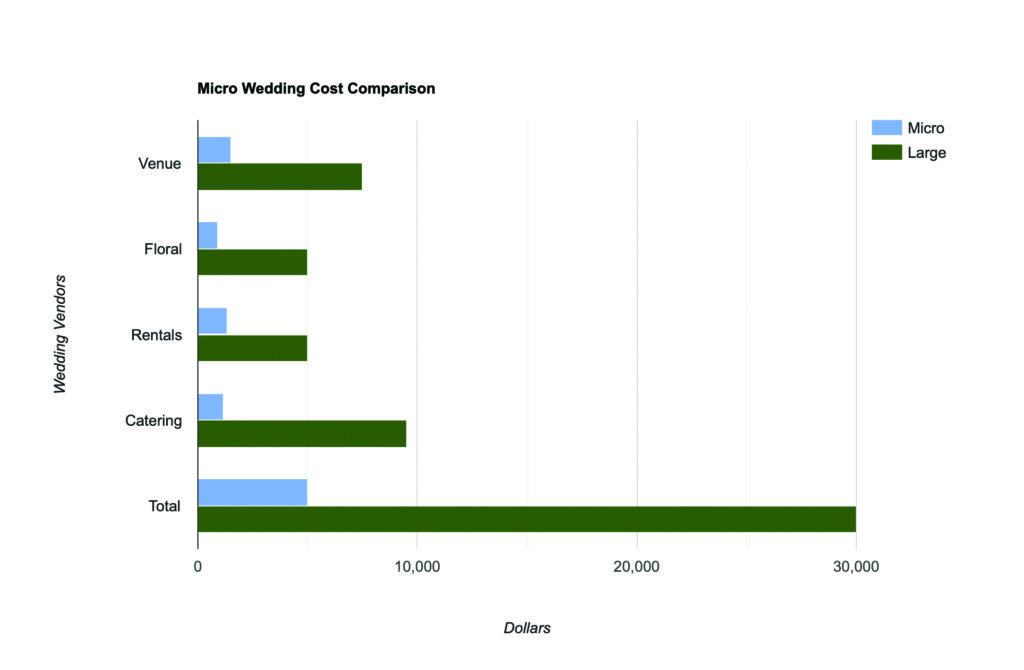
Perhaps one of the biggest benefits of eloping or having a micro wedding is how much less expensive it is, mainly because you’re not providing food and entertainment for a huge group of guests, but also because the fancy, costly details are less important when you’re not trying to impress that huge group.
“A lot of couples have come to terms with the fact that some things are not needed,” Cicuto said.
Ingle said a lot of the couples she worked with were relieved once they transitioned to an elopement or a micro wedding.
“I’m saving so much money now, and I’m not having to invite all these people and plus ones that I’ve never met,” Ingle said. “Moving forward, I think these smaller weddings are going to be more popular.”
Wedding Packages
Large wedding Average total cost: $30,000+ People: 50+ Usually includes: -Venue -Rentals -Floral -Band/DJ -Photo & video -Hair and makeup -Wedding planner -Officiant -Transportation -Lodging -Catering -Food & beverages -Cake -Attire -Stationary
Micro wedding Cost: $5,000-$12,000 People: Usually 15 to 25 Usually includes: -Venue -Rentals -Food & beverages -Floral -Hair and makeup -Music -Photo -Wedding planner -Stationary -Lodging -Transportation -Attire
Elopement package Cost: $500-$1200 People: The couple only with officiant, no guests Usually includes: -Location -Arbor -Bridal bouquet(s) / Boutonnière -Dinner for two at a local restaurant -Local lodging accommodations for the couple -Champagne for 2
A 2020 wedding story
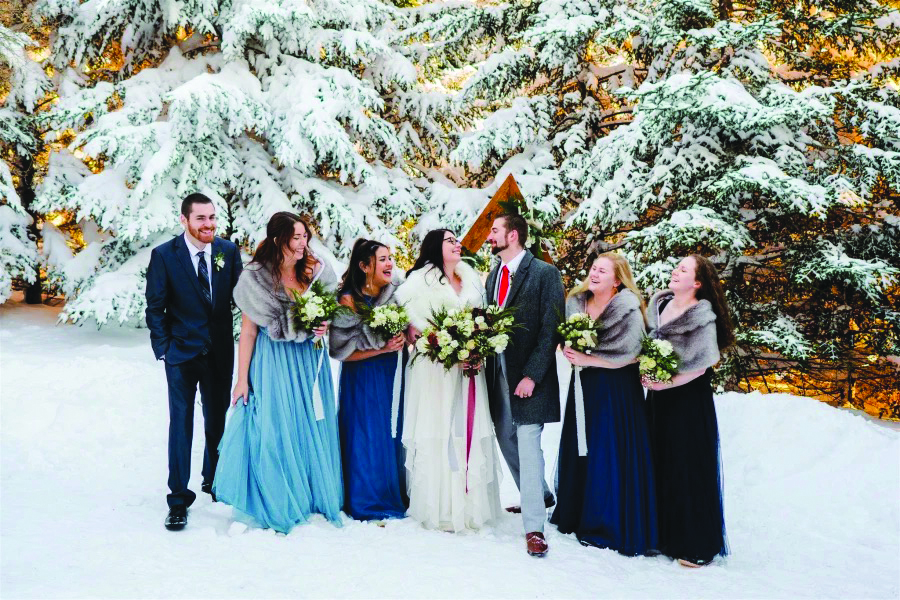
Rachel and Steele Hudson and their wedding party. Photo by Novae Film and Photo.
Rachel Hudson (formerly Prescott) shares her experience of being a bride in 2020. She and her husband, Steele, got married Dec. 18. I had always wanted a winter elopement, just the two of us, and then … a big party with friends and family after the fact. He wanted a summertime wedding with as many people … as possible. We ended up compromising and decided on a big winter wedding [at the] Mountain View Grand Resort in Whitefield. … Then Covid hit. Over the months more and more guests dropped out. … It got to the point where I started to dread the wedding. I had nightmares about an empty ballroom and an even more empty dance floor. … When we got down to about 25 guests — including the wedding party — we decided to cancel. The venue couldn’t lower the minimum guest count any further, [and] too many of our closest friends and family couldn’t be there. We were desperately holding on to the few shreds of the big fun wedding we wanted, and we knew no matter what happened we wouldn’t be able to save it. … We canceled it nine days before the wedding. [A day later] my maid of honor contacted Lauren and frantically put together a plan to save the wedding, without my knowledge. Lauren … found a venue that was willing to take us in on such short notice and made sure it was somewhere that was similar to what I had originally wanted. She worked … with my maid of honor and my photographer/videographer, Grace from Novae Film & Photo, to create a surprise wedding from scratch in a week. [Meanwhile], I was researching a sad courthouse wedding. I was eventually told that there was a rescue effort and that I should still plan on a wedding. My husband and I agreed to it on one condition: We wanted to be completely kept out of the loop. We had already spent so much time, effort [and] money … [on] our original wedding that we literally couldn’t bear to make another one. … I was blindfolded and brought to the location. My maid of honor dropped off some decorations and Lauren took off decorating while I was blindly escorted to a room to get ready. … I had never seen the spot; we never had a rehearsal. The first time seeing the area, the aisle, everything, was during the actual wedding. It was surreal. It was perfect, every detail. Everything was heartburstingly perfect. Lauren found the best ceremony spot I could ever hope for [I later found out it was Lakeview Inn in Wolfeboro] and decorated it exactly how I would have wanted. It was tucked into a wooded circle, surrounded by fresh snow-covered pine trees. … The arch was simple and rustic, decorated with evergreens, antlers and juniper berries. There were lanterns with real candles lining the aisle that wound through the woods. There were only 11 of us total, which ended up being better than expected — just our closest friends and family. The reception was inside the Inn, and it was decorated like a big family dinner on Christmas, with a large single-family table and intimate lighting. We all enjoyed ourselves immensely. The Inn is family-run and they cooked for us and served us, their dogs and cats coming in and out for some pets and scratches. It felt so warm and cozy, fireplace going, wine pouring and conversation that you could actually hear and participate in. It was better than anything I could have hoped or planned myself. Instead of compromising and making cuts and downgrading a big wedding repeatedly, they created a new micro wedding that wasn’t desperately trying to be something it wasn’t. … Being able to sit back and not plan or worry about the wedding took so much of a weight off my shoulders. … My husband and I will have a big party in a year or two so we can throw on the fancy clothes again, have a dance party like we wanted and invite everyone who missed out, but there is honestly nothing I regret about my mini wedding. My dream wedding was a small winter wedding elopement; I was lucky enough to get that. My husband’s dream was a big summer wedding party, and now we get to plan that too. We both get to have the elements of our weddings that we wanted without having to sacrifice anything.
Featured Photo: A previous Winter Fest in downtown Concord. Photo by Steven Lipofsky.
Winter fun is still on the schedule as The Hotel Concord and Intown Concord host their third annual Winter Fest on Friday, Jan. 29, and Saturday, Jan. 30, outside on the Statehouse lawn.
“The nature of the event — it being outdoors with people generally spread out — lent itself to having a safe version this year, so we thought it had some potential [to still take place],” said Jamie Simchik, a member of the Intown Concord board and Winter Fest committee and co-owner of The Hotel Concord. “Fortunately, Intown Concord and the city were interested and wanted to bring some activity back into downtown.”
The highlight of the event is its ice carvers, with ice carving demonstrations on Friday and a live ice carving competition on Saturday.
“People will be able to see the ice carvers in action as well as their final products,” Simchik said.
Five New England ice carvers — Eric Knoll, Dave Soha, Dennis Hickey, Michael Legassey and Alexander Bieniecki — will participate, which is the most Winter Fest has ever had.
“Many other ice carving competitions have decided not to move forward this year, which is unfortunate but kind of a blessing in disguise for us because as a result our ice carving competition got a lot more interest from ice carvers looking for an opportunity to compete,” Simchik said.
An award ceremony will close out the event on Saturday. The top four carvers will receive a one-night stay at The Hotel Concord, and the top three will additionally receive cash prizes — $100 for third place, $250 for second and $500 for first. After the event, Intown Concord will post a poll on its Facebook page, where members of the public can vote for their favorite carving to win the People’s Choice Award.
The sculptures will remain on display through at least Monday, Simchik said.
On both Friday and Saturday, Winter Fest will also feature games and activities like cornhole, warmup stations with s’mores and hot cocoa, music over a sound system and a Winter Shopping Stroll at downtown Concord’s restaurants and retail shops.
“It’s been rough, obviously, for the businesses affected by the pandemic, so helping them out is one of the goals for the event,” Simchik said. “Our vision is that we bring more people downtown in a safe fashion, and businesses take advantage of that.”
As for Covid safety precautions, mask-wearing and social distancing are required, and attendees are asked to register in advance, providing their contact information and the times they plan on being at the event.
“It allows us to get an idea of who is coming and who is there so that, if [a positive Covid case is reported], we can do contact tracing and notify people appropriately,” Simchik said.
Concord Winter Fest
Where: Downtown Concord. Winter Fest activities, the ice carving demonstration and the ice carving competition will be held at the Statehouse Lawn (107 N. Main St.). The Winter Shopping Stroll will include restaurants and retail shops on Main Street.
When: Friday, Jan. 29, from 3 to 9 p.m., and Saturday, Jan. 30, from 11 a.m. to 4 p.m. Ice carving demonstrations will take place all day Friday, and the ice carving competition will take place on Saturday from 11 a.m. to 3 p.m., with an awards ceremony at 4 p.m.
Cost: Free
Covid guidelines: Registration in advance is requested for contact-tracing purposes. Mask-wearing and social distancing as per state and city guidelines are mandatory.
More info: Visit intownconcord.org/index.php/winter-fest or call 226-2150. Registration for the event is through Eventbrite (search “3rd Annual Winter Fest & Ice Carving Competition”).
Featured Photo: A previous Winter Fest in downtown Concord. Photo by Steven Lipofsky.
A month into winter, outdoor ice skating rinks across the state are open for the season.
Local rinks
Local cities and towns like Manchester, Concord, Nashua, Bow, Merrimack and Hopkinton have outdoor rinks that are free and open to residents and non-residents.
The rinks may be open on and off, depending on the temperatures, so be sure to call or check your city’s or town’s website or social media before you go. Matthew Casparius, director of Merrimack Parks & Recreation, said temperatures must stay below 32 degrees consistently for the ice at Merrimack’s rink at Watson Park to freeze.
“Ice conditions can vary greatly with a temperature change as small as a few degrees,” he said. “If it doesn’t get cold or stay cold, then the rink season may be shortened.”
The rinks are skate-at-your-own-risk. Skaters are asked to stay off the ice if the rink is closed, and to practice common-sense Covid-19 safety measures while on the ice.
“We don’t really regulate it, but obviously people should maintain social distance, and masks are recommended,” said Janet Horvath, Manchester’s recreation and enterprise manager.
“Anyone that is showing symptoms of Covid-19 or has been exposed to Covid-19 should not visit the facility until they have been cleared by a medical professional,” Casparius added.
That’s especially important since skating so far this season seems to be a popular idea.
“This year, with a focus on outdoor activities as being safer for all, there has been more interest in skating than ever before,” said Veronica Lester, director of marketing for Strawbery Banke Museum in Portsmouth, home to Labrie Family Skate at Puddle Dock Pond.
Puddle Duck Pond is approximately 12,500 square feet, “75 percent of the size of a standard hockey rink,” she said. With an admission fee of $12, it features amenities like an outdoor patio and food truck on weekends; services including ice skate rentals and sharpening; rink rentals for private events; and skating lessons for kids and adults.
The perfect skates
Dave Palisi, owner of Capital Sporting Goods in Concord, which sells new and used pond or recreational skates and hockey skates, shared some tips for buying your first pair of skates.
If you plan on going ice skating on any kind of regular basis, Palisi said, it’s worth it to buy your own skates. Owning your own skates allows you to skate anywhere rather than being limited to rinks that offer skate rentals, and your skates are going to fit better and be more comfortable than rentals.
“You aren’t going to get a good fit with a pair of rented skates because you don’t get properly fitted when you’re renting. They just give you skates based on your shoe size,” he said. “That’s fine if all you’re looking to do is get into a pair of skates so you can spend a half hour skating, then take them off and be done.”
If you decide to buy your own skates, getting professionally fitted in person at a local shop that sells skates is the only way to ensure that you’re buying skates in the right size, Palisi said, adding that he would “recommend 110 percent not buying skates online.”
“I can’t emphasize enough the fitting process and how important it is,” he said. “If you put the time and effort into getting fitted correctly, you know it’s going to fit and that it’s going to perform the best for you.”
The biggest mistake people make when it comes to buying skates, Palisi said, is buying skates that are the same size as their regular shoe size.
“People think they know what size they need, but shoe sizes and skate sizes are totally different,” he said.
Another common misconception is that the best-fitting skates are the skates that are more expensive and higher-quality.
“You do not need to spend a lot of money,” Palisi said. “You’re better off buying a cheaper skate that is properly fit.”
A good-fitting skate should be tight against the foot. If the skates are “loose and floppy” and have enough space inside for your feet to move around, that will lead to soreness and discomfort, Palisi said.
For the best possible fit, you can get heat moldable skates. Palisi said Capital Sporting Goods and most specialty skate shops have a special “oven” that can “bake” the moldable skates. Once the skates are heated up, you wear them for 15 minutes or so, creating a custom mold around your feet.
If you’re trying to decide what type of skates to buy, Palisi recommends hockey skates for beginners, as opposed to figure skates. The blade on figure skates is fully exposed, with a squared-off tail on the end and a jagged “pick” at the toe. The blade on hockey skates is inset in a plastic holder and is smooth and slightly curved on both ends. To slow down or stop on hockey skates, the skater rotates their leg and scrapes the ice with the flat edge of the skate, whereas on figure skates, the skater uses the pick to push off and stop, which Palisi said is more challenging and takes some practice.
“If you don’t know what the toe pick on figure skates is or know anything about how to use it, just don’t even go there,” he said. “You don’t need to. Just go with a hockey skate.”
If you’re only skating outdoors, Palisi said, it’s futile to get your skates sharpened more than once a season.
“All the sand and grit on outdoor ice is going to ruin your sharpening, and there’s just nothing you can do about it,” he said, “but as long as you’re staying outdoors, [sharpening] is not a big need.”
Build a backyard rink
Building your own backyard rink is a great way to get in more skating time this winter while maintaining social distance.
“There are lots of backyard rinks right now,” Palisi said.
First, he said, find an area of level ground and decide how large you want your rink to be.
Then, go to a hardware or home improvement store and get a sheet of plastic for the base of the rink, and boards to enclose it.
“Just tell the people at the store that you’re looking for some liner to make a backyard rink, and they’ll know exactly what you’re talking about,” Palisi said, adding that some stores also sell complete backyard rink kits.
Another perk of building your own rink is that it doesn’t require as much freezing as public ponds do, so you can still skate even when the public ponds are closed.
“Ponds are deeper, so there needs to be several inches of ice,” Palisi said, “but if you make a backyard rink with just one or two inches of water, you don’t need it to be as cold for as long.”
To maintain your rink simply hose it down after each use at night when temperatures are freezing.
“It’ll smooth out overnight and be ready for the next day,” Palisi said.
Guided forest bathing walks Not all rinks may be open. The open/closed status of the rinks can change from week to week depending on the temperatures. Call or check the city’s or town’s website or social media for the most recent information. • Beaver Meadow Pond, at Beaver Meadow Golf Course, 1 Beaver Meadow Dr., Concord, 225-8690, concordnh.gov/1410/winter-activities. When open, hours are daily from dawn to dusk. • Bow Town Pond, next to the Bow Community Center, 3 Bow Center Road, Bow, 223-3920, bow-nh.com/256/Parks-Recreation. • Dorrs Pond, adjacent to Livingston Park, 56 Hooksett Road, Manchester, 624-6444, manchesternh.gov/departments/parks-and-recreation. When open, hours are daily from dawn to dusk. • Four Corners, behind Holman Stadium, Sargent Avenue, Nashua, 589-3370, nashuanh.gov/1464/ice-skating-rink–seasonal. When open, hours are daily from 11 a.m. to 4:30 p.m. and 6 to 10 p.m. for general skating, and before 11 a.m. and between 4:30 and 6 p.m. for hockey. • Ice Skating Rink at Watson Park, 441 Daniel Webster Hwy., Merrimack, 882-1046, merrimackparksandrec.org/watson-park. When open, hours are daily from dawn to 9 p.m. • Jeff Morin Fields at Roby Park, 126 Spit Brook Road, Nashua, 589-3370, nashuanh.gov. When open, hours are daily from 10 a.m. to 8 p.m. for general skating, and from 8 to 10 p.m. for hockey. • Kimball Lake, 47 Kimball Lake Road, Hopkinton, 746-8263, hopkintonrec.com/info/activities. When open, hours are daily from 8 a.m. to 10 p.m. • Labrie Family Skate at Puddle Dock Pond, at Strawbery Banke Museum, 14 Hancock St., Portsmouth, 422-0600, strawberybanke.org/skate.cfm. Open daily from 9 a.m. to 9 p.m. Admission costs $12 for skaters age 5 and up. Skate rentals are available for $6, and skate sharpening is available for $7. • Rollins Park, 116 Broadway St., Concord, 225-8690, concordnh.gov/1410/winter-activities. When open, hours are daily from dawn to dusk. • White Park Pond & Hockey Rink,1 White St., Concord, 225-8690, concordnh.gov/1410/winter-activities. When open, hours are daily from dawn to dusk.
Buy skates Here are some local shops selling ice skates. • Capital Sporting Goods, 276 N. State St., Concord, 224-6921, capitalsportinggoods.com • TSR Hockey, 5 Kelly Road, Salem, 898-7777, tsrhockey.com
Featured Photo: Labrie Family Skate at Strawbery Banke Museum’s Puddle Dock Pond in Portsmouth. Courtesy photo.
Milford resident leads forest bathing walks for wellness
For Laura Putnam, walking through the woods isn’t about burning calories or reaching a specific destination. It’s about sipping the air, watching a leaf twist in the wind or listening to water trickle downstream — and it’s all part of a practice called forest bathing.
“Forest bathing is a guided meditation to open the sense doors and bring people into the present moment, and it offers an opportunity for people to experience nature in a different way,” she said.
For the past several months, the Milford resident has been guiding small groups into the woods for forest bathing and meditation. It’s still a relatively new practice for Putnam — she had never even heard of forest bathing a year ago.
“Trees really do talk through chemicals, so there are physical benefits that are emitted from trees,” she said. “You’re being showered with all these chemicals. … Those chemicals help our immunity … [and the practice] naturally lowers blood pressure, increases focus … concentration is better [and there is] just an overall sense of well-being.”
According to Putnam, the chemicals, which are called phytoncides, can also increase creativity and decrease depression. Between the chemicals and the fact that scientists have found a correlation between increased depression and anxiety and lack of time spent outdoors, doctors in Japan now prescribe outdoor therapy as part of their patients’ health plan; there, it’s called shinrin yoku, which translates to forest bathing.
Putnam started forest bathing before she even knew what it was. Back in April she was furloughed from her job at the Visiting Nurse Association in Manchester, where she’d been working in an administrative position, helping transition patients to and from health care facilities.
“When Covid hit, I could no longer visit all those facilities because of the risk of infecting patients,” she said. “During this time … I should have been probably devastated, really worked up, anxious, crazy, thinking about being a single mom with a son in his senior year of college, like how [am I] going to make that all happen.”
And she was worked up, at first. But Putnam has forests and conservation land right outside her back door, and, trying to avoid showing her son that she was upset, she started to head outside when she felt stressed or needed to cry. Pretty quickly, both she and her son noticed that those walks outside changed her.
“He would say to me when I would come back, ‘Mom what happens to you out there? Because you’re so happy when you come back,’” she said.
It’s not as though Putnam hadn’t spent time in nature before. The avid hiker has completed all of New Hampshire’s 48 4,000-footers, and until the pandemic she had never considered making those hikes about the journey rather than the destination — or not having any destination at all.
“I’ve exercised in the woods for years, but never had I investigated fungus … or [looked closely at] tree bark,” she said.
Putnam started to do some research on the positive impact she was experiencing and eventually found an organization called the Association of Nature and Forest Therapists. She enrolled in the program, became a certified guide and started Biophilia Nature and Wellness, offering guided walks either privately or through local rec centers.
“This is what I feel most qualified to do, ever, in my life,” said Putnam, who is also a nurse and is wilderness first aid certified.
At the start of her forest walks Putnam leads participants through a guided meditation, inviting them to open up each of their senses — “feeling the wind on your face, sipping in the air as our sense of taste, listening to the sounds of birds.”
“Then you’ve sort of set the scene for, OK, now we’re all here together in this moment,” she said.
Throughout the session Putnam offers “invitations” to participants, sending them out to wander in the woods with specific prompts, like bringing back a small tactile object or focusing on some kind of movement, like ice going down the river. They then regroup and share what they found or the experiences they had.
“Then the day ends with tea [made with] what I have learned is safe and edible,” she said — a group last week had tea made with white pine and hemlock tree.
Putnam said that while most people around here have never heard of forest bathing, it is more popular out west, and she sees it becoming more prevalent here in the near future.
“I think right now the general population is just lacking connection and kind of looking for a way out of their heads,” she said. “I think there’s so much fear and stress and anxiety — I can’t think of anybody who [forest bathing] wouldn’t be good for.”
Guided forest bathing walks Laura Putnam has several upcoming guided walks through local recreation centers, or you can contact her directly if you’re interested in a private group session. Search for Biophilia Nature and Wellness on Facebook, or email her at biophiliawell@gmail.com. The Amherst Parks and Recreation Department is offering forest bathing guided walks with Putnam on Fridays, Jan. 15, Jan. 22 and Jan. 29, from 9 to 10 a.m. at the Peabody Mill Environmental Center (66 Brook Road). The cost is $40 for residents and $45 for non-residents. The walk is for adults ages 18 and older. Visit amherstnh.myrec.com. The Milford Recreation Department is offering a bathing guided walk with Putnam on Saturday, Feb. 6, from 1 to 2 p.m. and Saturday, March 6, at Kaley Field (448 Nashua St.). The cost is $15 per class. The walk is for adults ages 18 and older. Visit milford.nh.gov.
Featured Photo: A table set for tea to wrap up a guided forest bathing walk. Courtesy photo.
Two decades of revitalization in Manchester, Concord and Nashua’s downtowns
When the Hippo started in 2001 with the intention of highlighting Manchester’s culture, well, there wasn’t nearly as much going on then as there is now (or was, pre-pandemic, and will be again, soon…). In the first of a month-long series looking back at some of the subjects Hippo has covered over the years, former Mayor Bob Baines, real-estate developer Dick Anagnost and Mint Bistro owner Tim Baines look back at what they call the “renaissance” of downtown Manchester, while Tim Sink of the Concord Chamber of Commerce and Michael Herrmann, owner of Gibson’s Bookstore, talk about how downtown Concord has changed, and Dan O’Donnell of Nashua’s Great American Downtown shares his decades of experience in the Gate City’s downtown.
Bob Baines
Bob Baines was the principal of Manchester West High School for 20 years, then served as mayor of Manchester for six years starting in 2000. He’s worked at Southern New Hampshire University and was president of Chester College for six years, and he continues to do education reform work, most recently with a program called Steam Ahead at West High School and McLaughlin Middle School. He’s been on the board of the Palace Theatre for many years and is on the board of Manchester Public Television, and he recently joined the board of the Community College System of New Hampshire after serving eight years on the board of the University System of New Hampshire.
How would you describe downtown Manchester 20 years ago? What was it like as a destination, as a place to work and as a place to live?
During that time, when I became mayor there wasn’t much going on in Manchester at all. We had suffered through hard times in the ’90s and downtown was practically deserted. … The city was in tough shape, and I was fortunate enough to get the support of the aldermen to do a lot of things with economic development downtown. … When I was mayor there wasn’t even any place to go to lunch in downtown Manchester. … On Elm Street there were a lot of vacant buildings, a lot of rundown buildings, there wasn’t any housing. … Manchester is a totally different city than it was 20 years ago. … The Palace Theatre … had closed and went bankrupt. … Manchester was not a destination — there really was no place to go. There was one restaurant on Lowell Street called Richard’s Bistro, and that was about it.
Bob Baines on the Hippo I go back to when Hippo Press started … Jody [Reese] and Dan [Szczesny] came to see me about this idea of launching this paper and they said it was going to be called the Hippo. I was sort of puzzled about the name; I remember when they left my office I … called Jody and said, ‘Are you sure you want to call it the Hippo?’
What do you think the most significant changes were over the last 20 years?
The three key kingpins of the economic renaissance of the city were the Palace Theatre [reopening], the Verizon Wireless Arena [now the SNHU Arena]… and the [Fisher Cats] baseball stadium. … [Those three things] really put Manchester on the map. … During that time period there was a lot of excitement about the Manchester public schools [too]. The buildings hadn’t been touched in decades. … There were so many issues. When I was high school principal, I was one of the big complainers … saying we’ve got to spend some money to fix our schools. … At that time they were renovating City Hall and committed to building an arena and I said that’s all well and good that you’re doing that, but our students deserve better, and we got the support of the Board of Mayor and Aldermen to get a $1.5 million bond passed to renovate all the schools in the city of Manchester, so that was a really big deal. Unfortunately as the years have gone on, the proper amount of money has not been invested into teaching and learning and technology and professional development. … I’m very involved in an organization now called Manchester Proud … and we’ve raised over a million dollars to develop a strategic plan for the district, and we’re an active group still raising money to advance education in the city.
What do you think the downtown will be like 20 years from now? What will the biggest challenges be over the next 20 years?
I think good times are ahead despite the quagmire we’re in right now. … I hope [downtown is] still a vibrant part of the city. I think you’re going to get more and more people looking for opportunities to live in the downtown or live in the millyard. … They’re still creating housing units in the millyard. I think downtown still has a lot of possibilities for other development … to provide the kind of housing that people are looking for, especially young people. … Young people who work in all these tech companies, a lot of them want to live downtown because they don’t want cars. … I think the future looks bright in the next 20 years. … I think the biggest challenge is to get people to invest in the city, and I’ve always said you can’t have a great city without a great public education system, and I think that has been the challenge for decades in Manchester. … We should have the very best public schools in the state of New Hampshire. … I hope our city fathers recognize that we have to invest in our schools.
What has been the most surprising thing about the way downtown has developed?
The thing that surprised me when I was mayor was the willingness of local developers to get involved, people who grew up in Manchester, people like Dick Anagnost and [Arthur] Sullivan and his partners. A lot of the great things that happened in Manchester were the catalyst of people who grew up in Manchester and went to schools in Manchester. … It was certainly indicative of the Manchester spirit that people who grew up in Manchester and are now doing well helped revitalize our city, and they continue to do it.
What is your favorite spot to (eventually) hang out in downtown?
[Laughing] Mint Bistro! [Ed note: Mint Bistro is owned by Baines’ son, Tim Baines, who was also interviewed for this story.] … We really miss being able to go there. It’s like not being able to see family. … That’s our favorite place, and hopefully in the not so distant future we’ll be able to go back.
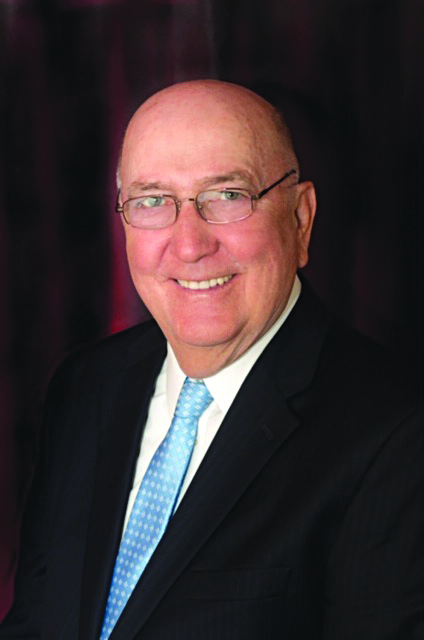
Dick Anagnost. Courtesy
Dick Anagnost
Dick Anagnost was born and raised in Manchester and has been involved in real estate development in Manchester for decades; in the past 20 years alone, he estimates that his company has renovated nearly 40 buildings, put up close to 600 units of housing and created approximately 400,000 square feet of new commercial office space.
How would you describe downtown Manchester 20 years ago? What was it like as a destination, as a place to work and as a place to live?
It was a raceway. Most of the commercial buildings were boarded up and abandoned, there was nobody living there. … The kids used to race up and down the streets and the police were tasked with trying to catch them. Downtown Manchester was pretty well abandoned. … That was about the time that the City decided that they needed to do something to bring back our downtown and millyard. … I received tons of cooperation from the City and actually joint ventured a number of buildings with the City. The first renovation downtown was a building called the Chase Block, where Margarita’s is. … That was actually a joint venture with Anagnost and the City of Manchester.
What do you think the most significant changes were over the last 20 years?
The City and I began moving down the street, so from [the Chase Block] we went to the next corner south, which is 1015 Elm, we went to 844 Elm, we participated with Paul Smith at the corner of Amherst and Elm. I took on parts of south Manchester, so I had Market Basket [brought in]. Murphy’s Tavern was another one of my deals. We started in the millyard with 33 S. Commercial St. … that whole development down there, Southern New Hampshire University is all me. We began marching through the rest of the city together and at about the same time Brady Sullivan started to see our success, and they started with the old gas company building and then they did a number of buildings downtown. … They have a huge stake in the renovation and renaissance of downtown as well. It all started with the Chase Block, and about parallel with the Chase Block was the Verizon civic center decision. The civic center was a key player, the construction of the ballpark, the southern side of the millyard was a key construction project.
Dick Anagnost on the Hippo Every time I needed help persuading the aldermen to do something, Jody and the guys, you know, Jeff [Rapsis] … and Dan [Szczesny], all jumped in and wrote things to get support and public opinion on my side. I have a long relationship with them; I was there when they went into business. … You could actually attribute the Hippo to a lot of Manchester downtown’s growth. They were the ones writing about the opening of Margarita’s and the opening of this restaurant and the Palace Theatre renovations and all those things. They were pointing out all of the good things that were going on in Manchester. … They were a break from reality. … They thought outside the box. … They brought forth the whole concept of, these are the things that are going on, these are the things you can do, that helped downtown particularly go through its renaissance. … You asked a question, what were the most significant changes? One of them was HippoPress.
What has been the most surprising thing about the way downtown has developed?
The upper stories are still underutilized. When I was growing up the upper stories were filled with offices and residential tenants and all kinds of things, so the buildings were all full. We still have not addressed the issue of trying to make buildings from the 1800s meet the codes of this millennium, and until that happens the upper stories will remain sparsely occupied. I mean, I was able in my buildings to renovate the upper stories by coming up with innovative methods to coordinate and … find different solutions to [meet] the codes. For instance, when we did Paul Smith’s building at Amherst Street, which [probably had] the best, most preserved original historic finishes from the 1800s, we … came up with a way to … [make] what was essentially a sprinkler system that created a safe corridor for people to get out of without having to tear out all of the historical things. At 1015 Elm St., which is where Baked is, we creatively put retail on the first floor, office on the second floor, residential units above it, but there was a fire egress issue … they allowed us to put a double-wide staircase in the rear and keep the smaller historic granite and marble staircase in the front. … It’s cost-prohibitive to renovate the upper floors, but we’re in such dire housing need, the upper floors of downtown would be the perfect opportunity to put in workforce type housing. We’ve now grown into a college town … and they’re always in a deficit for student housing. We could easily turn the upper floors … into student housing and workforce housing. That would be the key in my opinion to bringing back downtown 100 percent to its most vibrant point, because those people wouldn’t need vehicles, but … because downtown is such a walkable area, they would be able to service and support all the businesses located in downtown. Which is how downtown used to be in the ’60s and ’70s when I grew up.
What do you think the downtown will be like 20 years from now? What will the biggest challenges be over the next 20 years?
I think it’ll look a lot like it is now. You still have the traffic generators. When I started working in the millyard, it was 5 million feet with 90 percent vacancy and 10 percent occupancy. Your millyard today is probably 4.8 million feet and it’s 93 percent occupied, so the millyard is a significant generator. The Verizon is a significant traffic generator. The ballpark is a significant traffic generator. All of the new housing that’s coming in downtown, like the ones that are at the ballpark. The one finishing touch would be to [bring] the upper stories … back to their usefulness, to making them mostly residential. … There’s a huge demand. Vacancy in the city is about 1 percent. That would be an easy place to put a whole lot of housing. … [The biggest challenge will be] the codes. … In order to be code compliant, you need to spend too much money, more than [the] economic value of the property.
What is your favorite spot to (eventually) hang out in downtown?
My office, because I have to come here every day and I spend a significant amount of time here, so we’ve made it comfortable enough for us to hang out in for long periods of time. … I’ve always kind of put my money where my mouth is, so I was one of the first people to move my main offices, first into the millyard when we were redoing the millyard, and then into downtown when were redoing downtown, and this [1662 Elm St.] is one of the buildings I renovated.
Tim Baines
Tim Baines. Courtesy photo.
Tim Baines was born and raised in Manchester and is the owner of Mint Bistro on Elm Street, and he announced on Dec. 21 that he and two business partners will be opening Elm House of Pizza in January at 102 Elm St. Baines also served as alderman for Ward 3 for one term.
How would you describe downtown Manchester 20 years ago? What was it like as a destination, as a place to work and as a place to live?
Downtown Manchester 20 years ago was in a tough place (much of it abandoned) but there was hope on the horizon. The civic center, as it was referred to at the time, was a hotly contested issue in 1999 and 2000. It ultimately prevailed and was a part of a renaissance of sorts. There was probably one fine dining establishment and a few bars. There [were] a few solid anchor retail stores that brought people to the downtown on weekends, but it certainly was not a destination for most. Very few people were looking to live … downtown at this time.
What do you think the most significant changes were over the last 20 years?
Over the past 20 years there has been strong leadership that has realized what a thriving downtown can do for a city, the tax base and the quality of life. Whether it was ensuring that the Palace Theatre stayed alive through tough times or [because of] investments [that were supported by] the government but executed by the private sector, Manchester’s downtown grew and became a place that people wanted to be a part of. The condition of a downtown can truly make or break a city and we have had leadership over these 20 years that [has] fostered this and understood this. With good governance comes private citizens and investors believing in it, and we have seen amazing investments in our downtown.
What do you think the downtown will be like 20 years from now? What will the biggest challenges be over the next 20 years?
I believe in my heart that leaders in this community will step up and make sure that all of our progress continues. I hope it’s more walkable, I hope that businesses can control their sidewalks and I hope that we have more retail. It truly will come down to leadership and I am hopeful there are enough people out there that know that bringing people together is the way to make many of these things happen. Smart, common-sense and decisive leadership will go a long way. The biggest challenge will be how we handle the issues of the day that are squarely in front of us. No successful or thriving city has all of the resources available for those suffering in the downtown. We have an obligation to help people and we need to, but attracting those suffering to an area with the temptations that our downtown has to offer continues to send us down the wrong path. A facility away from the downtown that offers services, counseling, detox [and] hope, and one that is well-funded, will go a long way. This will take political courage.
What has been the most surprising thing about the way downtown has developed?
It’s a community. With a few glaring exceptions everyone cheers for each other and knows that the others’ success is part of their own success. It’s a beautiful thing. As far as surprising, I would have to say the lack of understanding by government officials as to what it takes to survive in the private sector. It has been discouraging to see leadership not understand the fundamentals of how A affects B and affects C. It has demoralized people.
What is your favorite spot to (eventually) hang out in downtown?
[They don’t exist yet, but I would like to see] a few things: a movie theater, a beer garden and a community event that rivals what Riverfest used to be.
Michael Herrmann
Michael Herrmann. Photo by Ryan Clark.
Michael Herrmann has been the owner of Gibson’s Bookstore in Concord since 1994, and he has served on the boards of Intown Concord and the Chamber of Commerce.
How would you describe downtown Concord 20 years ago? What was it like as a destination, as a place to work and as a place to live?
Concord has always been blessed to have a thriving downtown, and even 20 years ago it was an attractive place to visit, with many interesting shops. It was starting to look tired, but there was a real community of shop owners and regular visitors, and it was fun to be part of it.
What do you think the most significant changes were over the last 20 years?
For the downtown, certainly the Main Street redevelopment of 2016, and also the expansion of the downtown south of Pleasant Street.
What do you think the downtown will be like 20 years from now? What will the biggest challenges be over the next 20 years?
The rise of internet commerce has put all retail at risk, but I believe that people will continue to want to shop local and support institutions that make our city unique. The biggest challenge for downtown is to have businesses that are sufficiently capitalized so they can weather crises like the one we’ve seen this year.
What has been the most surprising thing about the way downtown has developed?
So many banks — some of my best friends are bankers, but these locations are like dead zones. The ground-floor spots on Main Street should be devoted to retail.
What is your favorite spot to (eventually) hang out in downtown?
I can’t wait to spend too much money at all the restaurants downtown. For now, I’ll just be buying gift cards and doing takeout.
Tim Sink. Courtesy photo.
Tim Sink
Tim Sink has been the president and CEO of the Greater Concord Chamber of Commerce since 1992; for the last 10 years he’s worked at its office on Main Street. He’s lived in Concord for about 35 years and raised his family there.
How would you describe downtown Concord 20 years ago? What was it like as a destination, as a place to work and as a place to live?
Twenty years ago downtown Concord was in the beginning of a renaissance. Capitol Center for the Arts had just opened, Capital Commons was going up with a much needed parking garage and downtown festivals like Market Days were growing more vibrant. The downtown was starting to wake up.
What do you think the most significant changes were over the last 20 years?
The redevelopment and redesign of Main Street, Red River Theatres, Capitol Center for the Arts, Bank of New Hampshire Stage, expansion and relocation of the League of New Hampshire Craftsmen and Gibson’s Bookstore, more public art and greater cultural diversity have all contributed to a much more vibrant, destination downtown.
What do you think the downtown will be like 20 years from now? What will the biggest challenges be over the next 20 years?
The boundaries of what we now consider downtown Concord will expand east [and] west and further south. The main gateway at Exit 14 will be vastly improved.
What has been the most surprising thing about the way downtown has developed?
The creativity and resilience of the retail, hospitality and dining sectors.
What is your favorite spot to (eventually) hang out in downtown?
Bicentennial Square
Dan O’Donnell. Courtesy photo.
Dan O’Donnell
Dan O’Donnell is the president of the Executive Board for Nashua’s Great American Downtown. He was born and raised in Nashua, spent 40 years as an educator in the Nashua School District before retiring in 2015, and is now a Realtor with Keller Williams Gateway Realty in Nashua. He has been a member of numerous organizations in Nashua, such as the Jaycees, Masons and Lions Club. Though he now physically resides in Hollis, he continues to tell people he “lives” in Nashua and always will.
How would you describe downtown Nashua 20 years ago? What was it like as a destination, as a place to work and as a place to live?
Nashua’s downtown has always been a great place to dine and shop. Back in the ’80s as more and more box stores and big malls opened on the outskirts of Nashua, people drifted away to experience that newfound convenience shopping, but it always lacked the character, charm and personal service that downtown offered. Since then the City of Nashua, Downtown Merchants Association, Great American Downtown and numerous volunteers have spent enormous amounts of time, energy and capital in revisioning, revitalizing and recreating what I would call the rebirth of downtown Nashua. Today’s downtown Nashua is a much more warm and inviting environment. It is once again the heart of the city and a special gathering place for residents and visitors … [and] has the highest-quality restaurants, unique and specialized shopping venues, art galleries, live music venues and an upcoming Performing Arts Center.
What do you think the most significant changes were over the last 20 years?
I believe that the most significant change is that people realized the most important part of any community is its people. We live in an unbelievably fast paced, instant gratification world. Malls and box stores are sterile environments and have no socially redeeming benefits. Downtowns provide far more social interactions, give us personalized service, which we have been missing, and they provide a connection with our friends and community.
What do you think the downtown will be like 20 years from now? What will the biggest challenges be over the next 20 years?
We are currently in a new phase in Nashua where we are experiencing significant growth in inner city housing starts. As this continues we will see further growth and opportunities in downtown Nashua.
What has been the most surprising thing about the way downtown has developed?
The most surprising thing about the development of downtown Nashua has been the pace of the growth and outstanding support from the community at large.
What is your favorite spot to (eventually) hang out in downtown?
My favorite future spot will be the new Performing Arts Center as it is a long overdue need for our community. I think it will be a huge draw in the further rebirth and revitalization of our Great American Downtown.
This story was possible with the generous financial support of Hippo readers. Hippo is very grateful to have the support of its readers. If you haven’t contributed yet, please consider a small contribution. Your contributions allow Hippo to write more stories and gets you access to additional stories and columns.