Making peace, and art, with AI
When Elsie Kagan talks about painting, it sounds like a jazz player’s memory of hearing a standard for the first time.
“I’m full of influences from other artists and from the history of the medium I work in,” she said by phone from Chicago, mid-residency with the artist collective Tiger Strikes Asteroid. “So I don’t feel like I take full ownership for whatever I’m making. There’s this kind of porous relationship I have to all of my resources and influences.”
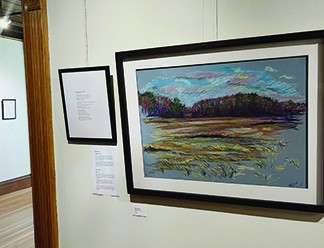
That porousness now includes a surprising collaborator: generative AI. Kagan’s solo exhibition, “the drop falls,” opens Aug. 7 at 3S Artspace in Portsmouth. The next day, she’ll demonstrate her process, which includes using an agent to transform her paintings, then join her husband, Carl Robichaud, for a public conversation about art and machine intelligence.
Robichaud has spent 25 years working on nuclear risk and now leads AI-related grantmaking at Longview Philanthropy, an organization Kagan describes as “concerned with the long-term protection of humanity.” Longview, she continued, considers AI “a real threat to our future.”
Paradoxically, this belief led Kagan to first engage with AI in her painting.
Such alarmism “was so difficult to wrap my imagination around,” she said. Then she realized there are visual AI models as well. “So I started to bring AI into the studio, thinking that it would be a very alien experience, but I actually had a kind of opposite reaction to them.”
Specifically, she found the models’ human-like characteristics soothing.
“The way that they operate visually seemed to kind of rhyme with what I’m interested in as a painter,” she said. “There are these visual cues they come up with as a response to prompts, but there are all these glitches, confusions and inventions … you’re sort of fighting between an experience of illusion and creating space and story and depth.”
Her method is simple to describe and harder to categorize. She paints, photographs the painting, feeds the image into an AI model, and lets whatever comes back seed the next canvas. Early on, she said, a model would take an unadorned photo of her canvas and abstract it, unprompted.
“It had kind of an innate understanding of my visual vocabulary as painting,” she said, calling the discovery “an absolute delight.” Crucially, she resists the idea that this is fundamentally different from how she’s always worked.
“It seemed very natural to kind of move from art historical references to AI,” she said, “because what is this AI? It’s just a kind of card catalog of all of our own making. It is us.” But she’s also watched the tool change under her, and not for the better, in her telling.
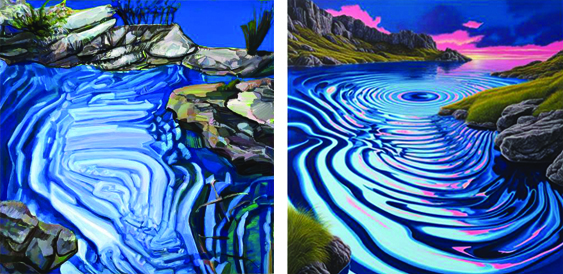
Outputs that once felt rough and painterly now come back “smoothed out,” closer to what she calls “faux reality” than to the glitchy abstraction she originally found useful. An early transformation of an impressionistic pool of water she called “long time gone” felt natural, while a later one seemed a bit Thomas Kinkade-y.
The model seemed to be correcting her, she said. “It’s decided that you’re a little too abstract here.”
The different systems she’s used have also converged in behavior: “They all used to kind of have their own characteristics and impulses, and they all behave more similarly now,” she believes. That convergence is a sign of where the technology’s heading. “Out into the stratosphere on its own, and kind of away from our own control and humanness.”
She’s aware this doesn’t square easily with the climate concerns running through some of her paintings, or the resource costs of massive data centers powering the models she uses.
“There’s no real good answers to any of this,” she said. “It’s coming for us, good and for bad. We should try to engage with it just as a human who’s experiencing the world as it is.”
That tension of engagement without illusion is likely to be present during the conversation with Robichaud, whom Kagan describes as her temperamental opposite on the subject. He evaluates AI risk “from a very high bird’s-eye point,” she said, mindful of its threat but having “an ability to sort of remove an anxious emotional reaction to the moment.”
Kagan calls herself granular and anxious by comparison. On stage, she plans to do something the gallery walls don’t: show her source material directly; “pull the curtain back” on which paintings prompted which AI responses, and introduce other artists grappling with the same tools — many of whom want nothing to do with it.
“A lot of my painter peers,” she said, “won’t touch this stuff with a 10-foot pole.
In the Meantime: Art Making Alongside Machine Intelligence – Artist Talk with Elsie Kagan + Carl Robichaud
When: Saturday, Aug. 8, 1 p.m. presentation, 2 p.m. conversation
Where: 3S Artspace, 319 Vaughan St., Portsmouth
Tickets: Free (Suggested donation $5), reserve spot at eventbrite.com
Elsie Kagan exhibit, ‘the drop falls,’ runs through Sept. 27 alongside Mina Kim’s exhibit, Between Lines and Breath
Featured photo: “long time gone” by Elsie Kagan (at left) and the AI interpretation of the work (at right). Courtesy images.