Class and consequences shape new Chris Bohjalian novel The Amateur
When Vermont author Chris Bohjalian began writing his new novel, The Amateur, he kept it a secret; the only person who knew about it was a lawyer. It wouldn’t be the last time attorney-client privilege would connect to the book, which, much to Bohjalian’s surprise, would turn into a courtroom thriller.
The Amateur follows Mira Winston, a teenage golf prodigy whose life is derailed when she smashes a golf ball through a practice net and accidentally kills a classmate, Kenny Foster, a caddy. In a first for Bohjalian, who’s written 24 novels, it has a table of contents, with section titles portending that she will ultimately stand trial.
Critically, the book explores Mira’s sexual exploitation by a middle-aged country club member that begins at age 15. Her experience leads to an irrational, magical thinking belief that the death was karmic punishment for being a homewrecker, when in fact she was a victim.
Bohjalian is an almost blank slate writer who starts with a premise and lets it lead him forward. The Amateur centers on the question of what a life-altering event does to someone who’s bound for greatness. As with previous novels, the future is often present, beginning with revealing that Mira will abandon golf and become a novelist.
“Dread is my jam, and that means I use a lot of foreshadowing in my work,” Bohjalian said in a recent Zoom interview. “So you know that at some point Mira is indeed going to be on trial, and that she’s not going to be an LPGA golfer. She’s going to be something else, and that will turn out to be a female version of me.”
It’s not Mira who best resembles Bohjalian, however, but the boy who dies at her hand. “I am Kenny Foster,” he said. Like Kenny, he moved frequently as a kid, attending six schools in five years across three states, the last particularly tough. “I parachuted in just before 11th grade,” he said. He also caddied at a country club that his family could never afford to join.
That class divide is deftly addressed in the book. Kenny’s parents spent most of their limited earnings to ensure that he had a good education and a brighter future. At the gilded country club, however, he met derision, getting the caddy equivalent of scut work, servicing meager tippers, and pathetic or inebriated duffers.
“F. Scott Fitzgerald said something along the lines of, ‘I grew up in the worst house on the best block’ … a lot of that was my childhood,” Bohjalian said, alluding to a The Great Gatsby character who described his house as “a small eyesore” in the “consoling proximity of millionaires.”
Confronting those inequities is one reason Bohjalian considers the novel his “most important” since 1997’s Midwives and The Sandcastle Girls, written in 2012, but it’s not the main one.
“We’re in the midst of enormous cultural transitions, a reckoning, so to speak,” he said. “I view The Amateur as important because it gets at all of those issues of how we look at young women, and the way we often give men of my generation a pass they do not deserve — Exhibit A, the man in the White House.”
This leaves the question of why Bohjalian kept The Amateur under wraps until he announced it with an email titled “How I Spent My Summer Vacation.” The answer isn’t nefarious, but practical.
Writing on the sly was less subterfuge than a reflection of a desire to work without pressure. Legal counsel provided plot guidance for Bohjalian when it became clear that The Amateur would not be solely about becoming a writer, but also about beating a murder charge. Still, he completed it in 90 days in what he described as “a frenzy.”
Given his prolific output, none of the people he normally confers with were concerned by his seeming radio silence at the time. “If anyone at Penguin Random House was wondering about my eerie quiet here in Vermont, all they assumed was I was giving myself a break and riding my bike and hanging out with my wife and my dog and having a lovely summer.”
Bohjalian will celebrate the book’s publication on Aug. 1 at BNH Stage in Concord, where he’ll have an onstage chat with Gibson’s Bookstore founder Michael Herrmann.
“I’ve known Michael since 1997, when I did my first event for Midwives at his bookstore; we’ve been friends ever since,” he said. Herrmann, he continued, “knows me better than almost any bookseller I know, and I think we will have a blast on stage, given our experiences together dating back 30 years.”
Gibson’s Bookstore presents Chris Bohjalian
When: Monday, Aug. 3, 7 p.m.
Where: BNH Stage, 16 S. Main St., Concord
Tickets: $45 includes copy of The Amateur, $15 admission only
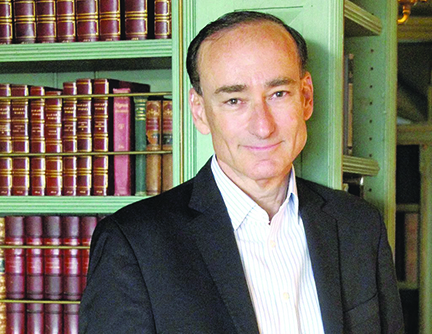
Featured photo: Chris Bohjalian. Photo by Victoria Blewer