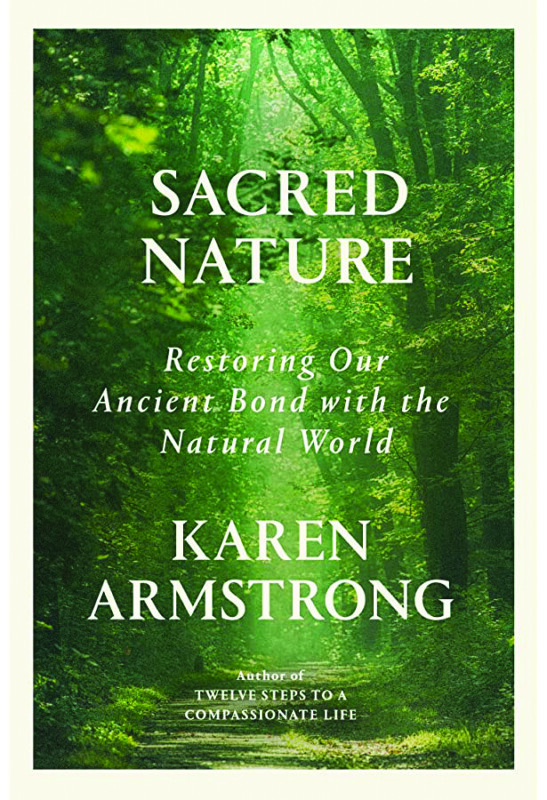
Sacred Nature, by Karen Armstrong

Sacred Nature, by Karen Armstrong (Knopf, 224 pages)

In the opening to Sacred Nature, Karen Armstrong tells a story of visiting a British library to look at original manuscripts of the poets William Wordsworth, Samuel Coleridge and John Keats. She was deeply moved by the visit, which she described as “a kind of communion.”

“I was looking at the moment that these poems, which were now part of myself, had come into being. I did not want to analyze the manuscripts. I simply wanted to be in their presence.”

Today, she is troubled by the people who walk through museums seeming more interested in taking photos and selfies than allowing themselves to become absorbed in the extraordinary things stored there. This tendency is also reflected in our relationship to the natural world, which Armstrong says has become an irrelevant backdrop in our busy lives. She quotes Wordsworth to describe this: “light and glory die away / and fade into the light of common day.”

It’s not all because of social media. In fact, the disconnect between humans and nature can’t be fully explained without also explaining the ways in which Western culture dissociated from nature when it embraced monotheistic religions.

The ancient Egyptians believed the annual flooding of the Nile was a “divine event,” as was the rising and setting of the sun; as such, it was near impossible to ignore Mother Nature, who could, at any moment, be ready to unleash divine wrath. As science and theology ran down separate paths that grew further apart, the thought of nature being somehow divine, or even vaguely important, was swept aside as dusty myth.

Armstrong wants to change that, by gleaning wisdom from the myths and practices of the Axial Age, 900 to 200 BCE, a time she says was “pivotal to the spiritual and intellectual development of our species.”

The religions of that time, including Confucianism, Daoism, Hinduism and Buddhism, had practices that can profoundly benefit us today if we can look beyond our modern view of a myth as being a fabrication, a “charming story,” and instead look at the meaning of the myth and allow it to be a guide. Yes, that is Oprah-level malarky, but hear her out. “A myth is true because it is effective,” she writes.

Armstrong begins by exploring the Confucian belief in “qi,” the energy that links all life, animal or plant, human or divine. Interestingly, Chinese religions are unlike others because they have no creation story, no God-creator, but the opposing forces of yin and yang. (They also were among the first to articulate what is known in Christianity as the Golden Rule.)

Early Buddhism, too, taught that enlightenment could be achieved in not just human beings but was “inherent in plants, rocks, trees and blades of grass.”

Armstrong walks through practices of other ancient modern religions, including the respectful rituals of animal sacrifice (many of the ancients who practiced it would be horrified by our mass slaughter of animals today, she says) and the practice of kenosis, or “anatta,” the “emptying” of the self required in many faiths. St. Paul, Armstrong notes, used the language when he wrote that Christ had “emptied himself” on the cross.

Although Armstrong makes clear the ways that Christianity dissuaded people from seeing nature as sacred, there have been exceptions. A disciple of St. Paul called Denys saw the natural world as revelatory of God, believing “We can only intuit God’s presence through the veils of natural objects, which conceal as much as they reveal. If we could see God clearly, it would not be God. But if we learn to contemplate nature correctly, we find that the tiniest particle of soil can yield a glimpse of the ineffable divine.”

At the end of each chapter, Armstrong offers what she sees as “the way forward.” Her recommended practices include altering our perception of “God” to be not a male dwelling apart from the Earth, but a “dynamic inner presence that flows through all things”; embracing not only stillness and silence, but images of suffering in order to develop compassion; developing our own “Five Great Sacrifices” similar to Hindu practice; the ritual practice of gratitude for the natural world that sustains us; and adopting the Indian rule of “ahimsa” or harmlessness that holds every creature deserves to live, or at least not to suffer. (The Jains took this to the extreme, believing that even stones were capable of pain.)

Regrettably, there is an overarching preachiness in Sacred Nature with regard to deepening “our spiritual commitment to the environment” that will repel some readers.

“Recycling and political commitments are not enough,” Armstrong says, later adding, “We must re-form our attitude to nature and that will entail sacrifice. We can no longer board airplanes, drive our cars or burn coal with our former insouciance.”

You can agree with her completely but still wish for a book that is more poetry, less sermon. Although it is an interesting compilation of major religious traditions’ teachings on the natural world, Sacred Nature will appeal mostly to those who already share Armstrong’s views. B-


Book Events

Author events

JOSH MALERMAN, a horror novelist, will be at Gibson’s Bookstore (45 S. Main St., Concord, 224-0562, gibsonsbookstore.com) to presentDaphne on Thursday, Oct. 13, at 6:30 p.m.

MELODY RUSSELL will sign and discuss her book Noni and Me: Caregiving, Memory Loss, Love at Toadstool Bookshop (12 Depot Square in Peterborough, toadbooks.com, 924-3543) on Saturday, Oct. 15, at 11 a.m.

RICHARD LEDERER will discuss and sign his books about language at Gibson’s Bookstore (45 S. Main St., Concord, 224-0562, gibsonsbookstore.com) on Monday, Oct. 17, at noon.

JOHN IRVING The Historic Music Hall Theater (28 Chestnut St., Portsmouth, 436-2400, themusichall.org) will host novelist and Exeter native John Irving to present The Last Chairlift, at the Music Hall on Tuesday, Oct. 18. Tickets are $49 and include a book voucher.

History, stories & lectures

BRET BAIER, the Fox News Chief Political Anchor and author of several books, will discuss his career in media and news journalism, followed by a book sale and signing, on Saturday, Oct. 15, at 7:30 p.m. at the Palace Theatre (80 Hanover St. in Manchester; palacetheatre.org). Tickets start at $59.

Poetry

GAIL DiMAGGIO and KAY MORGAN hosted by the Poetry Society of NH at Gibson’s Bookstore (45 S. Main St., Concord, 224-0562, gibsonsbookstore.com) on Wednesday, Oct. 19, from 4:30 to 6 p.m.

Writer events

THREE-MINUTE FICTION SLAM Monadnock Writers’ Group is hosting its regional Three-Minute Fiction Slam on Saturday, Oct. 15, at 9:45 a.m. at the Peterborough Town Library, 2 Concord St., Peterborough. Prizes will be awarded to the top three winners. The first-place winner will advance to the statewide finals and a chance to win $250. Everyone is invited to take part in the free competition by either participating or observing the fun. The competition challenges writers to perform original pieces of fiction in three minutes or less before an audience and a panel of judges. The regional event is part of an annual competition sponsored by the New Hampshire Writers’ Project. See monadnockwriters.org.

TENACITY PLYS and JULES PERLARSKI host a craft class on nonlinear storytelling for all at the Bookery (844 Elm St., Manchester, 836-6600, bookerymht.com) on Saturday, Oct. 22, at 4 p.m.

Babysitter, by Joyce Carol Oates

Babysitter, by Joyce Carol Oates (Knopf, 448 pages)

My desire to read books about abduction and murder of children was never strong even before I had children of my own. After becoming a parent, I wondered how anyone could.

As such, I wasn’t sure if I could get through even two chapters of the long-awaited novel from Joyce Carol Oates, which is built around a serial killer who specialized in children. Dubbed the “Babysitter,” because he abducted children between the ages of 11 and 14 who were neglected and unattended, the killer murdered five children near Detroit, Michigan, when the novel opens in 1977.

The victims speak collectively to reveal details: “When we died, our bodies were carefully bathed, the smallest bits of dirt removed from every crevice of our bodies and from beneath our (broken) fingernails, and the fingernails cut with cuticle scissors; rounded and even, as our hair was washed with a gentle shampoo, combed and neatly parted in such a way to suggest that whoever had so tenderly groomed us postmortem had not known us ‘in life’.”

Even as we may want to run screaming from what came before and what will surely come after, we cannot.

Joyce Carol Oates didn’t become one of America’s most celebrated writers for lack of talent, and with that horrific opening, she glides seamlessly into what at first seems an unconnected story: The budding affair between a wealthy housewife in Far Hills, Michigan, and a man she met only briefly at a fundraiser.

Hannah Jarrett is 39, beautiful, privileged, vapid, taught by her parents to prize elegance, simplicity and taste: “Never take a chance of appearing common” is a mantra to which she clings. Her life and her marriage somewhat resembles that of Don and Betty Draper in Mad Men — outwardly perfect, if vaguely hollow, with picture-perfect children, a girl and a boy. Unlike Betty Draper, Hannah Jarrett has a live-in housekeeper, who, despite Hannah’s belief that she is an attentive mother, seems to do a significant amount of the mothering in the household.

When Hannah is contacted by the man with whom she shared an electric moment at a charity event, she decides to meet him at an elegant downtown hotel, enabled by her husband’s business trip and the housekeeper, who will be with the children no matter how late Hannah returns.

On the drive to the hotel Hannah tells herself a reassuring story: she’s only going to satisfy her curiosity, to feel beautiful and desired for an afternoon; she won’t break any vows, but will have a satisfying and fulfilling conversation with the man in the hotel bar about their mutual and ultimately thwarted desires.

That, of course, is not what happens. In her skillful narrative, Oates makes Hannah’s drive to the hotel, and even the ride up the elevator to the man’s suite, suspenseful and chilling. It is a drama seemingly completely unconnected to the “babysitter” killings, but also, we know, somehow entwined. Moreover, there are hints of future — or are they past? — events that push their way into the telling, making it unclear if what happens on any given page is, as Ebenezer asked of the Ghost of Christmas Yet to Come, things that definitely happened or things that simply could happen.

The dynamic between Hannah and her Manila-born housekeeper, Ismelda, is polite, but fraught, as perhaps all housekeeper/employer relationships are. Hannah is both grateful and resentful of the help, and at times the similarities between “the Babysitter,” serial killer, and the babysitter/nanny/housekeeper are a bit heavy-handed. While Hannah’s children, we are led to believe, are not neglected in the way that the Babysitter’s victims are, their mother’s deficiencies are revealed in her interactions with her housekeeper.

Coming home distracted after a tryst, Hannah is so consumed by her fantasy life (“I have a lover!”) that she is unaware that her daughter is gravely ill until the housekeeper apologetically wakes her. While in no way evil or even deeply unlikeable — she is much too bland a person for that — Hannah is not a sympathetic character, even though her upbringing was in many ways troubled. Which is why it’s a shock to so quickly care so much about what happens to her and her family.

When Oates writes, “Despair of women, that men are unknown to them, essentially,” she speaks not only of the overt monsters but also of the hidden lives of husbands and friends. But women, too, have parts unknown to others and also to themselves, as Hannah learns as she is drawn deeper into a relationship despite the frantic screaming of conscience.

Babysitter is no cheap thriller but offers sharp cultural commentary on racism, class, religion and modern-day parenting. Give all the credit to Oates, who has crafted a finely tuned horror story that, like the film Fatal Attraction, is all the more horrific because of its placid suburban setting. A


Book Events

Author events

DONALD YACOVONE will discuss his new book Teaching White Supremacy: America’s Democratic Ordeal and the Forging of Our National Identity on Thursday, Sept. 29, at 7 p.m. at Gibson’s Bookstore (45 S. Main St., Concord, 224-0562, gibsonsbookstore.com).

STEPHEN PULEO visits the Nashua Public Library (2 Court St., 589-4600, nashualibrary.org) on Sunday, Oct. 2, at 2 p.m. to discuss his book Dark Tide: The Great Boston Molasses Flood of 1919. Registration is required.

RENEE PLODZIK, Concord author, visits Gibson’s Bookstore (45 S. Main St., Concord, 224-0562, gibsonsbookstore.com) on Thursday, Oct. 6, at 6:30 p.m. to present her cookbook Eat Well Move Often Stay Strong.

MARGARET PORTER presents The Myrtle Wand at Gibson’s Bookstore (45 S. Main St., Concord, 224-0562, gibsonsbookstore.com) on Wednesday, Oct. 12, at 6:30 p.m.

JOSH MALERMAN, horror novelist, will be at Gibson’s Bookstore (45 S. Main St., Concord, 224-0562, gibsonsbookstore.com) to present his newly released bookDaphne on Thursday, Oct. 13, at 6:30 p.m.

JOHN IRVING The Historic Music Hall Theater (28 Chestnut St., Portsmouth, 436-2400, themusichall.org) will host novelist and Exeter native John Irving to present his newest release, The Last Chairlift, at the Music Hall on Tuesday, Oct. 18. Tickets are $49 and include a book voucher.

LYNN LYONS, psychotherapist and anxiety expert, returns to Gibson’s Bookstore (45 S. Main St., Concord, 224-0562, gibsonsbookstore.com) on Wednesday, Nov. 16, at 4:30 p.m. with The Anxiety Audit: 7 Sneaky Ways Anxiety Takes Hold and How to Escape Them.

JOSH FUNK & KARI ALLEN Children’s authors Josh Funk and Kari Allen present their newest books, The Great Caper Caper: Lady Pancake & Sir French Toast Book No. 5 and Maddie and Mabel Take the Lead, atGibson’s Bookstore (45 S. Main St., Concord, 224-0562, gibsonsbookstore.com) on Saturday, Nov. 19, at 11 a.m.

The Milky Way: An Autobiography of our Galaxy, by Moiya McTier

The Milky Way: An Autobiography of our Galaxy, by Moiya McTier (Grand Central Publishing, 244 pages)

In college, I once signed up for an astronomy class. I dropped out after two weeks, having painfully discovered that astronomy isn’t so much about looking at celestial bodies in awe as it is about doing complex math. After that, other than a star-gazing class at a local community college, my knowledge of outer space hasn’t evolved much beyond watching Men in Black, which I maintain is a documentary.

So I was excited about the publication of Moiya McTier’s promised examination of the Milky Way in down-to-earth terms, billed as “an autobiography of our galaxy.” Finally, I could get the astronomy class of my dreams, on my couch, in a mere 244 pages, with an instructor who studied both astronomy and mythology at Harvard and went on to earn a Ph.D. in astrophysics at Columbia.

And I could have, and should have, except for the dumb gimmick that cripples the book: the Milky Way as narrator.

Maybe if this had been a kindly, wise Milky Way, a sort of cosmic Gandalf the Grey, the gimmick would have been easier to stomach. But we are instead given a haughty, snarky, disparaging galaxy, whose persona is made even worse by its perception that it is talking to puny, finite creatures not really worth its time. “I know it’s likely a lot for you to take in, and your brain is fully formed!” the narrator says at one point.

Another time, it says, “Sadly, your ignorance compels me to explain so much to you that I’m still not at the part about me yet.” And then there’s this: “A mayfly can live its entire life in one room of your homes. Isn’t that sad? Don’t you ever wonder why the mayfly even bothers to do anything at all? Because that’s how I feel about you.”

He seems nice, right? Or she. Who knows? This middle-school snark is hard enough to stomach for one chapter; it’s wearisome for the whole of a book. And this persona is so unnecessary; plenty of people write autobiographies without constantly addressing “dear reader.”

The implication of “Dumb reader,” over and again, is even worse.

To be fair, McTier is trying to convey the unconveyable: the vast chasm between small, finite creatures like human beings and the unknowable expanse of space and, if you’re into that sort of thing, a cosmic Intelligence, with a capital I. But Ed Yong did this without talking down to us in An Immense World, and for that matter, there are Twitter accounts that do as much without even using words, like ones that consist of nothing but photos of outer space or microscopic images.

Maybe this is just the kind of unintentional dumbing down that occurs when astrophysicists try to talk to regular people. There aren’t that many of them, after all, and they’ve got their own peculiar brand of humor. As McTier says while trying to explain red dwarf stars, the most common ones in the Milky Way, astronomers don’t all agree on the “initial mass function” of red dwarf stars: “If you ever want to cause an uproar among your astronomers, stand in a crowded planetarium and claim that the Kroupa IMF is better than the Salpeter. Most won’t be able to refrain from loudly asserting their opinion back at you.” Astronomers are clearly the life of the party.

McTier awkwardly hobbles from the Big Bang (“Don’t concern yourself with thoughts of what came before the Big Bang. That kind of knowledge is not for the likes of you — or even me, though I am fabulously worthy on nearly all other counts — to understand”) to the creation and destruction of other galaxies, to black holes, to the modern, mind-boggling telescopes to myths about space, to theories about when and how the world will end. It’s not all terrible, but it’s like eating pistachios with shells; at some point, you question the effort, particularly when she answers the question of extraterrestrial life, “Well, that’s for me to know, and hopefully for you and your scientists to find out.”

What’s most disappointing is that McTier does have a fascinating story to tell: her own.

In a much-too-short foreword written in her voice, McTier throws out a tantalizing morsel of her life story: how a girl who grew up in a cabin with no running water after her parents’ divorce fell in love with the universe and launched herself on an intellectual journey that found her, in her undergraduate studies at Harvard, having an internship that involved spending hours “analyzing five-dimensional data cubes to measure properties of a distant star-forming galaxy.” This from a girl who had to cross state lines to visit a bookstore when she was child.

It speaks to the power of imagination — she used to imagine the sun and the moon were her celestial parents — but also an incredible internal drive and intellect. I would gladly read 500 pages of McTier’s autobiography. But spare me her version of the galaxy’s in half that. D


Book Events

Author events

DONALD YACOVONE will discuss his new book Teaching White Supremacy: America’s Democratic Ordeal and the Forging of Our National Identity on Thursday, Sept. 29, at 7 p.m. at Gibson’s Bookstore (45 S. Main St., Concord, 224-0562, gibsonsbookstore.com).

STEPHEN PULEO visits the Nashua Public Library (2 Court St., 589-4600, nashualibrary.org) on Sunday, Oct. 2, at 2 p.m. to discuss his book Dark Tide: The Great Boston Molasses Flood of 1919. Registration is required.

RENEE PLODZIK, Concord author, visits Gibson’s Bookstore (45 S. Main St., Concord, 224-0562, gibsonsbookstore.com) on Thursday, Oct. 6, at 6:30 p.m. to present her cookbook Eat Well Move Often Stay Strong.

MARGARET PORTER presents The Myrtle Wand at Gibson’s Bookstore (45 S. Main St., Concord, 224-0562, gibsonsbookstore.com) on Wednesday, Oct. 12, at 6:30 p.m.

JOSH MALERMAN, horror novelist, will be at Gibson’s Bookstore (45 S. Main St., Concord, 224-0562, gibsonsbookstore.com) to present his newly released bookDaphne on Thursday, Oct. 13, at 6:30 p.m.

JOHN IRVING The Historic Music Hall Theater (28 Chestnut St., Portsmouth, 436-2400, themusichall.org) will host novelist and Exeter native John Irving to present his newest release, The Last Chairlift, at the Music Hall on Tuesday, Oct. 18. Tickets are $49 and include a book voucher.

LYNN LYONS, psychotherapist and anxiety expert, returns to Gibson’s Bookstore (45 S. Main St., Concord, 224-0562, gibsonsbookstore.com) on Wednesday, Nov. 16, at 4:30 p.m. with The Anxiety Audit: 7 Sneaky Ways Anxiety Takes Hold and How to Escape Them.

JOSH FUNK & KARI ALLEN Children’s authors Josh Funk and Kari Allen present their newest books, The Great Caper Caper: Lady Pancake & Sir French Toast Book No. 5 and Maddie and Mabel Take the Lead, atGibson’s Bookstore (45 S. Main St., Concord, 224-0562, gibsonsbookstore.com) on Saturday, Nov. 19, at 11 a.m.

The Book Eaters, by Sunyi Dean

The Book Eaters, by Sunyi Dean (Tor, 298 pages)

Does the world really need another story about mythical un-human creatures who hide in plain sight among us and need to destroy human beings in order to eat?

Why, yes, as it turns out, we do.

Despite its vague resemblance to Twilight, The Walking Dead and others in popular humans-as-foodstuff genre, Sunyi Dean has penned a marvelous, mind-bending novel about a class of creatures deposited on Earth as a science experiment of sorts. The majority of them don’t eat people, but instead eat books. Yes, that sounds ridiculous and would be garbage in the wrong hands, but Dean — an autistic American-born writer of fantasy novels who now lives in the U.K. — brings a sly wit to the enterprise and has produced a sophisticated fantasy world that will doubtless beget movies and sequels.

The story revolves around Devon, a young mother who is part of six family lines that hide among humans on Earth, their purpose being to absorb human knowledge through eating books and, for some of them, through consumption of human brains. You can’t tell them apart by looking at them; they all look like humans, but book eaters grow “bookteeth” at about age 3, and mind eaters have a mosquito-like proboscis and a serpent-like tongue.

Devon is a book eater. Her 5-year-old son, Cai, is not. And Devon has the choice of watching him starve to death, or bringing home some hapless human whose brain is suitable for consumption about once a month.

This is not a good way of living for either Devon or her son, so she is intent on finding a class of book eaters who possess an elixir called Redemption that can turn brain eaters into book eaters. (It’s not just a question of will, as it was for the Cullens in Twilight.) But there is more to her story than that.

Despite being fed a carefully planned diet of fairy tales as a child, designed to suppress her imagination and keep her from questioning the Family Rules, Devon grew up with a rebellious streak and would sometimes sneak a book she wasn’t supposed to consume. She would even do something that was forbidden — read the book. (Book eaters cannot write, and they are only supposed to consume books, not read them.)

Devon had a happy childhood, however, despite never knowing her mother. Among book eaters, women are precious and rare because of a genetic flaw that causes ovarian failure in their late 20s. Their marriages are both arranged and “enforced” — because of the dangers of inbreeding, the patriarchs of the families must place brides like chess pieces, and so at age 19, Devon had been sent to another family for the requisite term of three years to be a wife and bear a child, after which she is to return to her family of origin.

Book eaters, who drink “inktea” and large amounts of alcohol, are big on ceremony, and the lavish weddings give Dean’s fertile imagination room to run wild: The bountiful spread of food includes a “salad” — “shredded pages of Midsummer Night’s Dream that were dyed different shades of green” along with edible origami made of pages torn from books and made into the shape of swans, and a wedding “cake” in the shape of the biblical Tree of Knowledge, “printed pages carefully shaped into origami apples.” When Devon tastes wine for the first time, she reflects that it tastes a little bit like “a well-crafted romance novel. Complex, sweet, and a little stinging.”

The wedding cake is a metaphor for what is to come: Devon’s knowledge expands first with the consummation of her marriage and then with the birth of her first child. With that birth comes the first of several surprises that alter our perception of what is happening. The shrewd plotting switches constantly from present-day to the past but is easy to follow and reveals Devon’s back story and motivation in slow motion.

Another smart literary device is in the telling of the book eaters’ history in snippets of quotes from a book called Paper and Flesh: A Secret History, written by an unfortunate reporter who tried to infiltrate Devon’s family and paid a price for his interest.

To preserve their secrets, the families must keep distant from humans, whom they largely disdain. But Devon must navigate the human world — and learn the secrets of the other five book eater families — in order to get Redemption for her son, who, as he grows older, will need to eat not just once a month, but once a week.

Like baklava, The Book Eaters has complexity in its many layers: as a jacket blurb says, “Truth is found between the stories we’re fed and the stories we hunger for,” and readers can chew for days on the points the author is trying to make. But at the center of her sharp criticism of patriarchy and the cage of tradition and extended family, is a rollicking good story. Twilight had one, too, but the series was poorly written. The Book Eaters, in contrast,is sophisticated, thought-provoking and as immersive as a quality video game, whether or not you’re a fan of the fantasy genre.

And readers will become conversant with a wonderful, rarely used word: bibliosmia, which means the enjoyment derived from sniffing a good book. A+


Book Events

Author events

DAMIEN KANE RIGDEN will be at the Toadstool in Nashua on Saturday, Sept. 24, at 11 a.m. for his novella All Manor of Beast and Man.

SUSIE SPIKOL, a naturalist at the Harris Center for Conservation Education in Hancock, will come to Gibson’s Bookstore (45 S. Main St. in Concord; gibsonsbookstore.com, 224-0562) to “teach your kiddos how to find critters in their neighborhood” on Saturday, Sept. 24, at 11 a.m. with her book The Animal Adventurer’s Guide: How to Prowl for an Owl, Make Snail Slime, and Catch a Frog Bare-Handed, according to a press release. The book, which is slated for release Sept. 13, features “50 hands-on activities and adventures that bring you closer to wild animals than you’ve ever been,” the release said. Spikol will also bring supplies to do one of the crafts from the book.

BETSY THOMASON will discuss her book Just Breathe Out: Using Your Breath to Create a New, Healthier You at the Toadstool Bookshop in Peterborough (12 Depot Square; toadbooks.com, 924-3543) on Saturday, Sept. 24, at 2 p.m.

HUMA ABEDIN The Historic Music Hall Theater (28 Chestnut St., Portsmouth, 436-2400, themusichall.org) will host Huma Abedin, longtime political advisor and aide for Hillary Clinton, to discuss her bookBoth/Andat the Music Hall on Tuesday, Sept. 27, at 7 p.m.Tickets are $15 and include a book voucher.

DONALD YACOVONE will discuss his new book Teaching White Supremacy: America’s Democratic Ordeal and the Forging of Our National Identity on Thursday, Sept. 29, at 7 p.m. at Gibson’s Bookstore (45 S. Main St., Concord, 224-0562, gibsonsbookstore.com).

History & lectures

FRAN LEBOWITZ Author, humorist and social commentator Fran Lebowitz will appear at the Capitol Center for the Arts (44 S. Main St., Concord) on Friday, Sept. 30, at 8 p.m. Tickets range from $45 to $65, plus fees.

Poetry

KATHARINE GREGG & HOWARD FAERSTEIN will read from their collections of poetry (Mere Thread by Gregg and Googootz and Other Poems and Dreaming of the Rain in Brooklyn from Faerstein) at the Toadstool Bookshop in Peterborough (12 Depot Square; toadbooks.com, 924-3543) on Saturday, Sept. 24, at noon.

MARTHA COLLINS and L.R. BERGER hosted by the Poetry Society of NH at Gibson’s Bookstore (45 S. Main St., Concord, 224-0562, gibsonsbookstore.com) on Wednesday, Nov. 16, from 4:30 to 6 p.m.

Nona the Ninth, by Tamsyn Muir

Nona the Ninth, by Tamsyn Muir (Tordotcom, 480 pages)

When I first opened Gideon the Ninth, the first of Tamsyn Muir’s “Locked Tomb” series, all I knew was that the book was queer and in a science-fiction fantasy universe, and that was all I needed to soothe my lonely gay heart. And it had cool cover art. So I gave the book a shot.

And I was turned feral. I devoured Gideon the Ninth, then immediately stormed my local bookstore for the sequel, Harrow the Ninth. And after Harrow, I reread Gideon immediately. Then Harrow, again. Reader, you may not know me, but I assure you: This is unusual.

I delight in the writing; Muir selects delicious adjectives that had me re-reading sentences just to taste them again. The protagonists are lovable, equal parts endearing and heartbreaking, and the villains are conniving and charming. The unique genre is refreshing, a mix of dystopia, science fiction, fantasy and squicky horror. I am obsessed with the plot: characters navigating intense relationships within an epic adventure, reminiscent of the multimedia webcomic Homestuck (indeed, fans can find nods to it). The characters’ central struggles are captivating, including acceptance of duty, acceptance of grief, and acceptance that God is actually some guy named John who’s a bit of a jerk. And this is all in a universe that’s unapologetically gay. I think I’ve been transformed.

Now we’re at the third in the series, Nona the Ninth (and last will come Alecto the Ninth, planned for release in 2023). I paced myself through the nearly 500-page novel to try to savor it; I know there will be another long wait before Alecto comes around.

The central question here is: Who the heck is Nona? She’s a brand-new character. We know she’s a soul who has been hitching a ride in another person’s borrowed body for the past six months. She’s guileless, devastatingly cute, hilariously entitled, desperate for attention, and has an intractable case of pica. And she has no idea who she is. I was sucked into every thing Nona did, or said, or thought, trying to suss out who she might be. She is immediately endearing. She is brave and sweet and incredibly concerned for her friends. It was a joy to read about her. The tagline on the cover is true: “You will love Nona, and Nova loves you.”

At the same time that I was getting to know Nona, I was desperate to find out where my favorite protagonists’ souls (or bodies, or both) had ended up. In a similar structure to the last two books, revelations on their whereabouts and other mysteries are tantalizingly interspersed throughout the whole novel, providing rich reward for each chapter. Peppered in are moments of action, which are vibrant in their immediacy and urgency. The novel culminates in an explosive, breathtaking finale that will have you scrambling for the next installment, or to re-read the previous novel with fresh context.

I celebrated some of the reveals in Nona, while others were awful. I asked myself, “Is it possible to wail in delight and horror at the same time? This is probably not what they mean by ‘laughing until you cry.’” But Muir is aware of this emotional weight, and skillfully alternates between sweet tenderness, chilling doom, and irreverent humor.

There are intractable mysteries remaining, though: What do the pictographs at the start of each chapter represent? What clues can be found in the various bible passages that are quoted? Which memes went completely over my head? You can enjoy these novels with a surficial read, but even more can be extracted between the lines. It’s the perfect kind of book to discuss with your friends, whether by sharing your favorite lines or brainstorming the latest fan theories.

Readers used to heavy worldbuilding in science-fiction fantasy a la Brandon Sanderson may be thrown off by the sparsely described setting of this installment, the city (or planet?), which we eventually learn is New Rho. Only what we need to know is supplied. But this brevity does not bring down the story. The true focus in The Locked Tomb are the characters and their relationships. And indeed, Muir plies her trade to good effect. Nona the Ninth made me laugh out loud, cry, seethe with both cheer and horror, and put my heart through a meat grinder. To this I ask: more, please.

For much of Nona, I felt bittersweet pangs for my favorite characters. I wonder: What kind of ending will befall them in Alecto? Will they ever be at peace? At this point, it’s hard to see the light at the end of the tunnel, but I have trust that Muir will take them, and us, home. As many have already said: I’ve never read anything like Nona the Ninth. And I fear that when The Locked Tomb series is over, I’ll never read anything like it again. A+

— Alaina Tocci


Book Events

Author events

YANA TALLON-HICK, therapist, writer and educator, will be at Bookery Manchester (844 Elm St., Manchester, 836-6600, bookerymht.com) to discuss her book Hot and Unbotheredon Friday, Sept. 16, at 7 p.m.

SUSIE SPIKOL, a naturalist at the Harris Center for Conservation Education in Hancock, will discuss her book The Animal Adventurer’s Guide: How to Prowl for an Owl, Make Snail Slime, and Catch a Frog Bare-Handed, on Saturday, Sept. 17, at 11 a.m. at Toadstool Bookshop (12 Depot Square in Peterborough; toadbooks.com, 924-3543).

JOSEPH D. STEINFIELD presents Time for Everything: My Curious Life at Gibson’s Bookstore (45 S. Main St., Concord, 224-0562, gibsonsbookstore.com) on Tuesday, Sept. 20, at 6:30 p.m.

BOB BUDERI author of Where Futures Converge: Kendall Square and the Making of a Global Innovation Hub will beat the Bookery (844 Elm St., Manchester, 836-6600) on Wednesday, Sept. 21, at 5:30 p.m. for a discussion with special guests C.A. Webb and Liz Hitchcock. Free admission; register at bookerymht.com.

NINA TOTENBERG The Historic Music Hall Theater (28 Chestnut St., Portsmouth, 436-2400, themusichall.org) will host NPR legal affairs correspondent Nina Totenberg on Wednesday, Sept. 21, at 7 p.m. to present her newly released memoir Dinners With Ruth, which chronicles her lifelong friendship and conversations with the late Supreme Court Justice Ruth Bader Ginsburg. Tickets are $43 and include a book voucher.

SUSIE SPIKOL, a naturalist at the Harris Center for Conservation Education in Hancock, will come to Gibson’s Bookstore (45 S. Main St. in Concord; gibsonsbookstore.com, 224-0562) to “teach your kiddos how to find critters in their neighborhood” on Saturday, Sept. 24, at 11 a.m. with her book The Animal Adventurer’s Guide: How to Prowl for an Owl, Make Snail Slime, and Catch a Frog Bare-Handed, according to a press release. The book, which is slated for release Sept. 13, features “50 hands-on activities and adventures that bring you closer to wild animals than you’ve ever been,” the release said. Spikol will also bring supplies to do one of the crafts from the book.

HUMA ABEDIN The Historic Music Hall Theater (28 Chestnut St., Portsmouth, 436-2400, themusichall.org) will host Huma Abedin, longtime political advisor and aide for Hillary Clinton, to discuss her bookBoth/Andat the Music Hall on Tuesday, Sept. 27, at 7 p.m.Tickets are $15 and include a book voucher.

DONALD YACOVONE will discuss his new book Teaching White Supremacy: America’s Democratic Ordeal and the Forging of Our National Identity on Thursday, Sept. 29, at 7 p.m. at Gibson’s Bookstore (45 S. Main St., Concord, 224-0562, gibsonsbookstore.com).

STEPHEN PULEO visits the Nashua Public Library (2 Court St., 589-4600, nashualibrary.org) on Sunday, Oct. 2, at 2 p.m. to discuss his book Dark Tide: The Great Boston Molasses Flood of 1919. Registration is required.

Tomorrow, and Tomorrow, and Tomorrow by Gabrielle Zevin

Tomorrow, and Tomorrow, and Tomorrow by Gabrielle Zevin (Knopf, 416 pages)

If a great writer is someone who can take a subject like video games — loved by some, maligned by others, inconsequential to the rest — and use it to weave together a story that even the latter two categories of people can appreciate, then Gabrielle Zevin is a great writer.

Tomorrow, and Tomorrow, and Tomorrow is about love, friendship and, yes, video games. That might sound like the premise of a young adult novel written to entice middle school gamers to put down the controller and pick up a book, but no; this is a beautifully written, emotionally complex story that unravels over the span of 30 years through various characters’ points of view — though mainly protagonists Sam Masur and Sadie Green’s — and in settings that range from hospitals to living rooms that serve as creative epicenters and offices, to inside the world of a video game that Sam creates.

Sam and Sadie met as kids in a hospital, where Sam was recovering from a car accident that killed his mom and Sadie was visiting her sister, who had cancer. Their very first interaction drew me in, with some of the best dialogue I’ve ever read. Sadie walks into the hospital’s game room, where Sam is playing Super Mario Bros. She sits down next to him and watches him play.

“Without looking over at her, he said, ‘You want to play the rest of this life?’

Sadie shook her head. ‘No. You’re doing really well. I can wait until you’re dead.’

The boy nodded. He continued to play, and Sadie continued to watch.

‘Before. I shouldn’t have said that,’ Sadie apologized. ‘I mean, in case you are actually dying. This being a children’s hospital.’

The boy, piloting Mario, climbed up a vine that led to a cloudy, coin-filled area. ‘This being the world, everyone’s dying,’ he said.

‘True,’ Sadie said.

‘But I’m not currently dying.’

‘That’s good.’

‘Are you dying?’ the boy asked.

‘No,’ Sadie said. ‘Not currently.’

‘What’s wrong with you then?’

‘It’s my sister. She’s sick.’

‘What’s wrong with her?’

‘Dysentery.’ Sadie didn’t feel like invoking cancer, the destroyer of natural conversation.”

Thus begins their relationship, though it’s derailed after 14 months when Sam finds out that Sadie has been counting the time she spends with him at the hospital as a community service project: “Their friendship amounted to 609 hours, plus the four hours of the first day, which had not been part of the tally.”

Sam and Sadie reconnect in their college years after a chance meeting at the subway station. They end up collaborating on a video game, Ichigo, which is a huge success and propels them toward future collaborations. Over the years, though, that work is complicated by emotions and miscommunications, deep love and unrequited romantic love, outside forces and other people, like Sam’s roommate, Marx, and Sadie’s professor/lover, Dov. These characters are what make Tomorrow, and Tomorrow, and Tomorrow the compelling story that it is, and they’re a big part of the reason why people who don’t like video games can still appreciate this book. These are characters that readers can care about, and get mad at, and grieve with.

Zevin’s writing is exquisite; there are so many passages and sentences in the book that are worth reading more than once — an especially good thing when time jumps and perspective shifts get a little confusing and you need to stop for a moment and reread to make sure you know what’s going on.

There are some people who are not going to be able to get past all the video game references, because there are a lot. There are references to old-school games, and there are some technical aspects related to the behind-the-scenes work of creating a game, like design and programming and graphics engines (I’m still not quite clear on what such an engine does or why it can seemingly make or break the quality of a game, but those details don’t take away from the ability to understand what’s going on). There’s also a whole section that takes place in a video game called Pioneers, and while it wasn’t my favorite part, I can appreciate the depth that it adds to the storyline, as the game becomes an essential part of Sam and Sadie’s relationship.

I haven’t considered rereading a book in years — who has the time when there are so many new books waiting to be read — but this is one that I’m definitely going back to again, to savor the prose, spend more time with the characters and possibly get a better handle on what a graphics engine does — not that it really matters. A


Book Events

Author events

PHIL PRIMACK presents Put It Down On Paper: The Words and Life of Mary Folsom Blair in a Literary Lunchtime event at Gibson’s Bookstore (45 S. Main St., Concord, 224-0562, gibsonsbookstore.com) on Thursday, Sept. 8, at noon.

MINDY MESSMER presents Female Disruptors: Stories of Mighty Female Scientists at the Bookery (844 Elm St., Manchester, 836-6600, bookerymht.com) on Wednesday, Sept. 14, at 5:30 p.m. Free admission; register at bookerymht.com.

SUSIE SPIKOL, a naturalist at the Harris Center for Conservation Education in Hancock, will discuss her book The Animal Adventurer’s Guide: How to Prowl for an Owl, Make Snail Slime, and Catch a Frog Bare-Handed, on Saturday, Sept. 17, at 11 a.m. at Toadstool Bookshop (12 Depot Square in Peterborough; toadbooks.com, 924-3543).

JOSEPH D. STEINFIELD presents Time for Everything: My Curious Life at Gibson’s Bookstore (45 S. Main St., Concord, 224-0562, gibsonsbookstore.com) on Tuesday, Sept. 20, at 6:30 p.m.

BOB BUDERI author of Where Futures Converge: Kendall Square and the Making of a Global Innovation Hub will beat the Bookery (844 Elm St., Manchester, 836-6600) on Wednesday, Sept. 21, at 5:30 p.m. for a discussion with special guests C.A. Webb and Liz Hitchcock. Free admission; register at bookerymht.com.

SUSIE SPIKOL, a naturalist at the Harris Center for Conservation Education in Hancock, will come to Gibson’s Bookstore (45 S. Main St. in Concord; gibsonsbookstore.com, 224-0562) to “teach your kiddos how to find critters in their neighborhood” on Saturday, Sept. 24, at 11 a.m. with her book The Animal Adventurer’s Guide: How to Prowl for an Owl, Make Snail Slime, and Catch a Frog Bare-Handed, according to a press release. The book, which is slated for release Sept. 13, features “50 hands-on activities and adventures that bring you closer to wild animals than you’ve ever been,” the release said. Spikol will also bring supplies to do one of the crafts from the book.

MARGARET PORTER presents The Myrtle Wand at Gibson’s Bookstore (45 S. Main St., Concord, 224-0562, gibsonsbookstore.com) on Wednesday, Oct. 12, at 6:30 p.m.

Poetry

OPEN MIC POETRY hosted by the Poetry Society of NH at Gibson’s Bookstore (45 S. Main St., Concord, 224-0562, gibsonsbookstore.com), starting with a reading by poet Sam DeFlitch, on Wednesday, July 20, from 4:30 to 6 p.m. Newcomers encouraged. Free.

MARTHA COLLINS and L.R. BERGER hosted by the Poetry Society of NH at Gibson’s Bookstore (45 S. Main St., Concord, 224-0562, gibsonsbookstore.com) on Wednesday, Nov. 16, from 4:30 to 6 p.m.

Writers groups

MERRIMACK VALLEY WRITERS’ GROUP All published and unpublished local writers who are interested in sharing their work with other writers and giving and receiving constructive feedback are invited to join. The group meets regularly Email pembrokenhtownlibrary@gmail.com.

Book Clubs

BOOKERY Monthly. Third Thursday, 6 p.m. 844 Elm St., Manchester. Visit bookerymht.com/online-book-club or call 836-6600.

GIBSON’S BOOKSTORE Online, via Zoom. Monthly. First Monday, 5:30 p.m. Bookstore based in Concord. Visit gibsonsbookstore.com/gibsons-book-club-2020-2021 or call 224-0562.

TO SHARE BREWING CO. 720 Union St., Manchester. Monthly. Second Thursday, 6 p.m. RSVP required. Visit tosharebrewing.com or call 836-6947.

GOFFSTOWN PUBLIC LIBRARY 2 High St., Goffstown. Monthly. Third Wednesday, 1:30 p.m. Call 497-2102, email elizabethw@goffstownlibrary.com or visit goffstownlibrary.com

BELKNAP MILL Online. Monthly. Last Wednesday, 6 p.m. Based in Laconia. Email bookclub@belknapmill.org.

NASHUA PUBLIC LIBRARY Online. Monthly. Second Friday, 3 p.m. Call 589-4611, email information@nashualibrary.org or visit nashualibrary.org.

Language

FRENCH LANGUAGE AND LITERATURE CLASSES

Offered remotely by the Franco-American Centre. Six-week session with classes held Thursdays from 6:30 to 8:30 p.m. $225. Visit facnh.com/education or call 623-1093.

Stay in the loop!

Get FREE weekly briefs on local food, music,

arts, and more across southern New Hampshire!