When we think of summer drinking, cocktails usually aren’t the first thing to spring to mind.
We imagine a friend tossing a cold can of beer to someone at a clam bake, or sharing a bottle of chardonnay on ice on the deck of your summer house in the Hamptons. (I assume that you are a fancier person than me; it sort of goes without saying.) Mixed drinks fall somewhat farther down on the list.
But when we do get to actual cocktails, I, at least, find myself thinking about pitcher drinks. The idea of sharing extremely cold drinks with a group of friends seems really appealing. So let’s look at five summer drinks that lend themselves to pitcher-izing.
Because drinking cocktails by the pitcher is a generally social activity, let’s look at some potential parties that don’t require a huge amount of effort but complement those drinks. At the same time, that intensity of socializing can be stressful for some people, so let’s also include two summer drinks that lend themselves to drinking quietly and alone.
Getting Started – How to Scale Up a Cocktail Recipe
At first glance, making drinks by the pitcher seems pretty straightforward — just multiply each ingredient by the number of people you want to serve.
As soon as you start to do that, however, things get confusing.
“I want to make five of these, but will they fit in that pitcher? And what about the ice? Is there some sort of formula to calculate the volume of ice cubes? Does pi get involved somewhere in there? HONEY? DO YOU REMEMBER WHAT PI IS?”
As it turns out, math is involved, but it’s friendly Schoolhouse Rock-type math, not the “Two trains leave the station traveling in opposite directions” type.
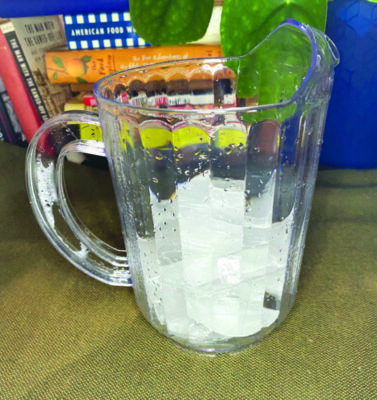
• First, get yourself a pitcher. I used a standard 60-ounce food service pitcher — the type you would get drinks in at most restaurants. I wanted to be authentic about all this, so I bought it at a restaurant supply store.
• Next, add ice. It doesn’t matter what type of ice you use at this point — the stuff your freezer makes for you, ice tray ice, novelty shaped ice from a silicone mold, block ice that you’ve attacked with an ice pick (and if you’ve never tried that before, I heartily recommend it) — any of it will work. Fill the pitcher up about 1/3 of the way with the ice of your choice.
• Just add water. Top your pitcher off with water. It doesn’t have to be to the extreme, worrying-about-spilling-it top — just fill it to the level that suits you. The amount of water you just added is the same volume as the drinks you will want to make in this pitcher.
• Measure the water. This is where the math comes in. Remain calm. Pour the water out into a separate container, so you can measure it. Use a kitchen strainer and another pitcher or a large bowl to hold the water. Now measure it.
I like to use a digital kitchen scale, because mine has an option to measure ingredients in milliliters. If you want to use a scale but it doesn’t have the milliliter option, grams will work just as well. (Important tip: If you are a pharmacist, grams and milliliters are not the same thing. If you’re cooking or mixing drinks at home, they pretty much are.)
Alternatively, measure the water with your largest measuring cup. If yours has measurements along one side in fluid ounces, you are golden. Just write down how many ounces of water you just poured out.
The rest of us will have to do some calculations.
For instance, according to my kitchen scale, the non-ice volume of my pitcher is 1,240 ml. A quick internet calculation — “Convert 1,240 ml to fluid ounces” — indicates that I’m looking at a final cocktail volume of around 42 fluid ounces.
Let’s say I’m making a pitcher of daiquiris. My recipe calls for two ounces of rum, an ounce of fresh-squeezed lime juice, and ¾ of an ounce of simple syrup. That works out to 3.75 ounces.
Now the math. Are you ready?
Divide the big number by the small number.
That’s it.
42 divided by 3.75 equals 11.2. Let’s round that out to 11. (You are welcome to round up or down freely; you can make up any difference with more or less ice.)
Now I know that for a pitcher of this particular drink I’ll need to multiply each ingredient by 11. I’ll make each round of drinks in the pitcher, adding the ice last, to bring the volume up to where I want it.
Which means that it’s time for a party.
Party #1: A Piñata Party
When my wife and I got married, we decided to have a backyard cookout for our rehearsal dinner. My wife planned the menu, chose the music, cooked five or six different side dishes, coordinated parking and got hotel rooms — in distantly separate hotels — for my parents.
I bought a piñata.
In my defense, the piñata was a solid call. My friends and family exist in a swamp of anxiety and social awkwardness that would intimidate the reed marshes of the Nile Delta. It was somewhat inevitable that at some point one of my friends would tell an off-color joke to a nun, or my mother would have a “just-being-honest” moment. If — OK, when — things got tense, I could shout out, “Hey, everybody! It’s piñata time!” We’d break open a piñata, people would be distracted, and we could quietly shuffle the conversation groups around.
I bought a piñata shaped like a large, red parrot. Because this was a special occasion, I went to a chocolate store and bought a couple hundred round, foil-wrapped truffles, and filled Polly pretty much to the top. I put her on the stairs leading up from the basement, where she would stay cool but we wouldn’t forget her.
On the day of the rehearsal, my soon-to-be father-in-law kept tripping over the parrot. He didn’t know what it was, but he knew it was in his way, so he relocated it to the kitchen counter, where he wouldn’t have to deal with it.
The piñata was now in my soon-to-be mother-in-law’s way, so she tasked my 6-year-old nephew with finding someplace to put it. He put it in the only empty space he could find — in the sun on the deck.
To make a long story short – several hours later, things did get awkward and tense at the dinner. I did announce “piñata time!” My new brother-in-law laid into the piñata with an awesome move he’d seen in a samurai movie. The piñata burst, splattering everyone at the party with melted chocolate. My wife’s maid of honor made a joke about “parrot blood” and a small child cried so hard that she did that dancing-in-place thing that only truly traumatized kids can do.
So, what I’m saying is that I’m a big fan of piñatas. And as such, I’d like to put in a word for making your own.
(1) Professionally made piñatas are built like dump trucks. They are almost impossible for casual, perhaps slightly inebriated, party-goers to break with a stick. This makes sense when you consider that they have to survive shipping from the piñata factory intact. If you make your own out of papier mâché, you can make it as fragile as you like.
(2) The hole in a standard piñata is about the size of a golf ball, which severely limits creative stuffing options. If you make your own piñata, you can leave a large access hole, fill it, then paper over the hole. In the reference photo to the right, I have filled my partially completed piñata with a copy of the Mr. Boston Bartending Guide, 10 pairs of socks and a can of chickpeas, with enough room left over for a live cat. [Editor’s note: This is just a fanciful amount-of-space descriptor. Do not attempt to put a live cat in a piñata. Don’t @ us, cats.]
What drink accompanies a piñata?
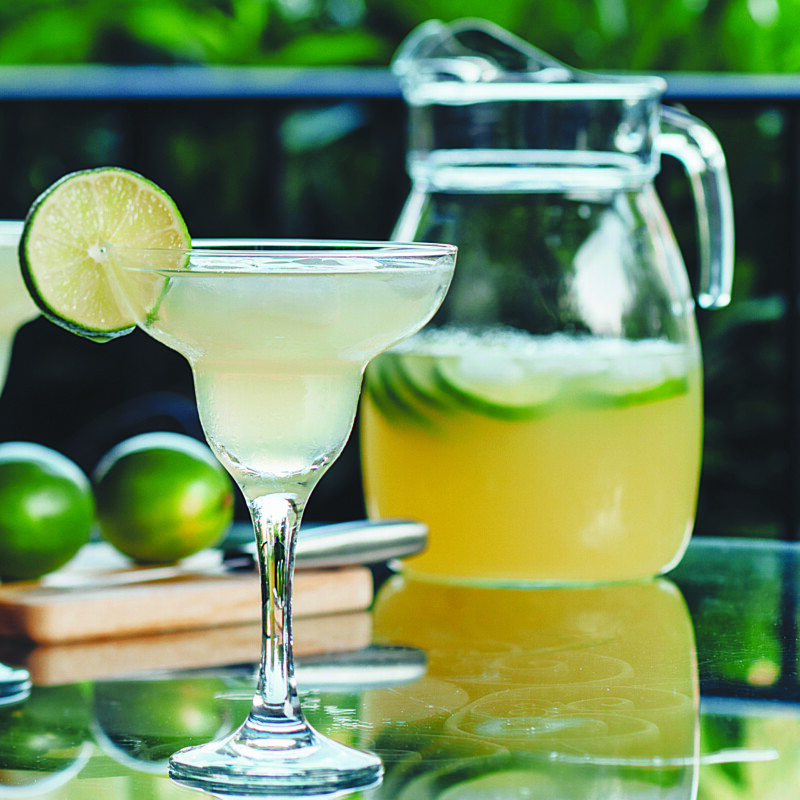
A margarita is a summertime classic; a cucumber one, doubly so. There are only three ingredients in this, so you will probably want to splurge on a decent tequila. The bar in Albuquerque where I first had this suggested Hornitos. Who am I to argue with them? This is a pitcher-drink natural.
One Cucumber Margarita
- 3 slices (~45 grams) cucumber with skin
- 2 ounces Blanco tequila – I prefer Hornitos
- 1 ounce fresh squeezed lime juice
- ¾ ounce cucumber syrup (see below)
Muddle the cucumber slices thoroughly in the bottom of a cocktail shaker.
Add ice, lime juice, syrup and tequila. Shake until very cold.
Strain into a chilled rocks or margarita glass.
A Pitcher of Cucumber Margarita
- 1 medium cucumber, unpeeled and sliced – about 300 grams.
- 22 ounces blanco tequila – roughly 3 cups
- 11 ounces fresh squeezed lime juice
- 7 ounces cucumber syrup – one scant cup
Muddle the cucumber slices in the bottom of your pitcher. I use the pestle from my largest mortar and pestle — it’s about the size of a billy club — but a potato masher would work well, too.
Add the lime juice, syrup and tequila. Stir gently but thoroughly. Top the pitcher off with ice, and stir again.
This pitcher recipe is deliberately a little intense. If you prepare it about 20 minutes before serving, the ice will dilute it just enough. It will be perfect.
Cucumber Syrup
Ingredients
- Equal amounts, by weight, of cucumbers and white sugar. Any type of cucumber — whatever makes you happy, or is threatening to take over your garden.
Wash, but don’t peel, the cucumber. Chop it to a medium dice.
Freeze the cucumber chunks for an hour or so. Ice crystals will form and perforate the cell walls inside the cucumber, making it more enthusiastic about giving up its juice.
Combine the frozen cucumber and sugar in a saucepan, over medium heat, stirring occasionally. As it thaws, the cucumber will start giving off a surprising amount of liquid. You really won’t need to add any water.
As more liquid appears, mash the cucumber with a potato masher, just to encourage the process along.
Bring the mixture to a boil, and let it boil for 15 or 20 more seconds, to make sure the sugar is completely dissolved into solution.
Remove the pan from heat, cover, and steep for 30 minutes.
Mash with the potato masher one more time, then strain and bottle.
This isn’t actually a step, but have some of this cucumber syrup on your yogurt. You will start smiling at people in traffic.
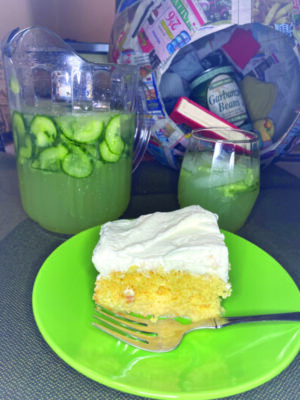
Julia Child once said that any party without cake is just a meeting. She was very wise.
If you aren’t familiar with Tres Leches Cake, you are in for the dessert ride of your life. It is the Prince of Cakes and a perfect accompaniment to our margarita and piñata.
Tres Leches Cake
Ingredients
- 1 boxed yellow cake mix + ingredients needed to bake it.
- 1 12-ounce can evaporated milk
- 1 14-ounce can sweetened condensed milk
- 1 cup (8 ounces) half & half
- 2 cups heavy cream
- simple syrup to taste
Prepare the boxed cake mix according to instructions, in a 9×13” pan.
Allow it to cool thoroughly.
Using skewers or sharp chopsticks, poke holes in the cake, every ½ inch or so.
Mix evaporated milk, condensed milk and half & half together in a large measuring cup.
Pour over the cake, still in its pan. It will puddle on top; do not panic. The cake will eventually absorb all three milks (todos de tres leches).
Cover and chill in the refrigerator for at least eight hours. This cake is at its best ice-cold. The extra time in the fridge will also allow the cake and milk mixture to meld at an almost philosophical level.
Just before serving, whip the heavy cream with just enough simple syrup to be lightly sweet. Cover the cake with the whipped cream.
“Wait a second!” you say. “That’s not tres leches! The whipped cream makes it cuatro leches!”
And you’re right, of course. Nevertheless, whether or not this cake is misnamed, you will become a convert after your first — then your inevitable second, third, etc. — bite.
Do you remember mushing birthday cake together with vanilla ice cream when you were a kid? The mixture of cake and ice cream was one of the best parts of going to a birthday party. This is like that — only thought out and designed to provide the perfect cake-to-dairy ratio. The slightly stodgy sweetness of the cake is balanced by the ice-cold milk glaze that you have soaked it with. If you use a light hand with sugar syrup in the whipped cream, you will balance the in-your-face nature of the dairy-soaked cake with something unexpected: subtlety.
Party #2: A Tomato Brunch
Burrata is the piñata of cheese.
Imagine a shiny, white, perfectly smooth ball of mozzarella, sitting modestly on a plate.
Now, imagine an Italian hand model — let’s call her Bianca — picking up a silver serving knife, and gently but firmly cutting into it, revealing an inside filled with cream and a fluffy über-cheese called stracciatella.
We might stand in a mild state of shocked wonder, and think vaguely about asking for some of this burrata — because that is what it is called, burrata — but we wait just a little too long and miss our window of opportunity. Bianca deftly transfers the burrata — mozzarella, stracciatella and all — to a serving platter and carries it out to the balcony, where a count in a tweed jacket waits for her.
Steven Freeman thinks about this sort of thing a lot. Freeman is the owner of Angela’s Pasta and Cheese Shop in Manchester, and he takes burrata very seriously. Even more so the stracciatella that it is filled with.
“If you love burrata, you will lust after stracciatella,” he assures me.
He is feeling extremely ardent about stracciatella at the moment, because after many, many months of trying to get his hands on some, he has finally tracked down a source and has started selling it in his store. He assures me that if I were to eat fresh stracciatella with perfectly ripe tomatoes and pink salt, I might reassess some of my priorities in life.
I buy some stracciatella and hunt down a really good tomato. I take the pair home, thank the tomato for the sacrifice it is about to make, then slice it up and spoon some of the cheese onto it.
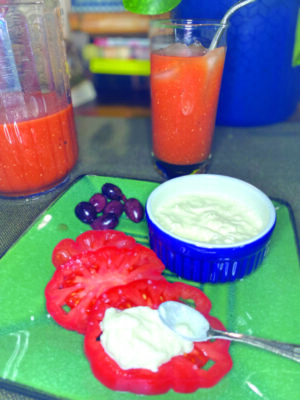
Freeman wasn’t lying.
I mean, I’m not going to quit my job and abandon my family to run off with a pint of Italian cheese or anything, but it is very, very good. It is intensely creamy and is perfectly set off by the acidity of the tomato.
Which reminds me that we are only a month or so away from tomato season and when the really good tomatoes hit the farmers markets, we should have a tomato party. Or in this case, a brunch.
For the food, I suggest tomatoes, olives and cheese. Perhaps some pumpernickel toast, if you are feeling especially adventurous.
For the beverage, there is really only one logical candidate, when you think about it: bloody marys, or bloody marias, in this case. Contrasting fresh, ripe tomatoes with a perfectly seasoned glass of tomato juice with a hint of tequila in the background will make for an excellent accompaniment to nice people and good conversation.
One Bloody Maria
- 2 ounces Blanco tequila – again, I prefer Hornitos
- 4 ounces freshly squeezed tomato juice (see below)
- ½ ounce fresh squeezed lemon juice
- 1½ teaspoon prepared horseradish
- ½ teaspoon miso paste
- 1 teaspoon of your favorite hot sauce
- A pinch of celery salt
- A pinch of freshly ground black pepper
Add all ingredients to a cocktail shaker with ice.
Shake vigorously, for longer than you normally would — at least one full minute — to make sure the miso dissolves completely.
Pour into a tall glass and for the sake of all that is good and decent in the Universe, please do not garnish the glass with 72 items. They would only distract from the tomato-ness of the situation.
If you have gotten a decent batch of tomatoes, sitting with pleasant company and actually paying attention to your bloody maria will be a bit of a revelation. A perfectly ripe tomato (see below) is a complex and beautiful fruit. Its natural sweetness and acidity will play off the savoriness of the miso and the bite of heat from your hot sauce.
A Pitcher of Bloody Marias
- 14 ounces Blanco tequila – 1¾ cups
- 28 ounces fresh squeezed tomato juice (see below)
- 3½ ounces fresh squeezed lemon juice
- 3½ Tablespoons prepared horseradish
- 3½ teaspoons miso paste
- 3½ teaspoons hot sauce of your choice
- ½ teaspoon freshly ground black pepper
- ½ teaspoon celery salt
If you have a very large jar with a tight-fitting lid, add all the ingredients to that, then seal and shake it vigorously. If you do not own such a jar, add all the ingredients to your pitcher, then blend briefly with an immersion blender. If you do not own a large jar or an immersion blender, add all the ingredients to your pitcher, then mix vigorously with a whisk.
If you have not done so yet, transfer the mixture to your pitcher, then top it off with ice.
Serve in tall glasses and drink while listening to Herb Alpert.
Homemade Tomato Juice
To make the really good stuff, you’re going to have to search through the farmers market for the right person. You can look over the tomatoes themselves, but ultimately you are going to have to put your fate in the hands of the person selling them.
Establish your credentials by telling them that you are making bloody marys — specifically, bloody marias. He or she will nod, unsmiling, at you. If they ask how many tomatoes you want, get six pounds. That sounds like a lot, but it is what you need.
The tomatoes you get will not be pretty, but like the person you chose to sell them to you, they have seen some things. These will be tomatoes with some mileage on them.
How to juice your tomatoes:
Wash your tomatoes, but don’t bother to core or peel them.
Working in batches if you have to, blitz them in your blender.
Strain them through a fine-mesh strainer.
In a large pot, bring the tomato juice and two teaspoons of salt to a boil.
Remove from heat and chill overnight in the refrigerator.
Tomatoes have a naturally occurring enzyme that kills off a lot of their flavor if they are exposed to cold temperatures. Bringing the juice to a boil neutralizes those enzymes and allows some of the more subtle flavors of the tomatoes to remain, even after chilling.
Party #3: A French Fry Party
Last year, we threw a french fry party.
It was supposed to celebrate a crop of really spectacular potatoes that I had raised over the summer, but the potatoes had other ideas and we ended up just buying potatoes and frying them ourselves. The party was extremely successful, but custom-frying that many potatoes turned out to be extremely labor-intensive.
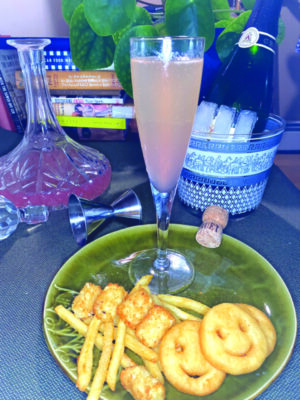
So I’ve had an idea: We invite extremely nice and cool people — more or less the same friends we had over last year — but each of them needs to bring a bag of their favorite frozen potatoes and an air fryer if they have one. We set up air fryers at strategic points around the kitchen and dining room, and each guest can make their own custom french fry mixture — hypothetically, a combination of shoelace fries, tater tots and smiley-face fries.
And to drink? A couple of years ago, a major Champagne producer announced that the perfect drink pairing with french fries is — surprise, surprise — Champagne.
I’ll buy that — I can see where a Champagne enthusiast would really like the contrast of the cold, dry bubbly and the hot, salty fries — but I think we can take things a step further, to a classic cocktail called a French 75. Champagne still plays a lead role, but it is backed up by gin, lemon juice and simple syrup. In this iteration I’ve subbed out the simple syrup for a slightly less simple rhubarb syrup, which adds an extra element of complexity to this drink and gives it a pretty, pink color.
One French 75
- 1 ounce dry gin – I like Wiggly Bridge for this
- ½ ounce fresh squeezed lemon juice
- ½ ounce rhubarb syrup (see below)
- 3 ounces Champagne
In a cocktail shaker, combine gin, lemon juice and rhubarb syrup, over ice. Shake vigorously.
Strain into a Champagne flute. Top with Champagne.
Feel very classy as you drink this, in between snarfing down your fries.
A Large-ish Batch of French 75s
It is totally possible to prepare this drink ahead of time, at least partially, but it requires some more math. A single French 75 calls for three ounces of Champagne. A standard bottle of sparkling wine contains 750 milliliters, or just over 25 fluid ounces. That means that we should prepare enough non-Champagne mixture for eight cocktails for every bottle of Champagne.
- 8 ounces dry gin
- 4 ounces fresh squeezed lemon juice
- 4 ounces rhubarb syrup (see below)
- 1 bottle Brut Champagne
Using a funnel, fill an empty bottle — a fancy decanter, if you have one — with the gin, lemon juice and rhubarb syrup. Cap and shake to combine.
Chill for several hours, or overnight.
To serve, pour two ounces of the mixture into each Champagne flute, then top with Champagne.
Rhubarb Syrup
Wash, then chop fresh rhubarb to a medium dice, then freeze overnight. Alternatively, buy pre-frozen, pre-chopped rhubarb.
In a saucepan, combine the frozen rhubarb and an equal amount (by weight) of white sugar and a pinch of salt.
Cook, stirring occasionally, over medium heat. Bring the mixture to a boil, to fully dissolve any sugar into solution.
Remove from heat, cover, and allow to steep for 30 minutes.
Strain and bottle. This should keep in your refrigerator for about a month.
Party #4: Scorpion Bowl for One
“This is all well and good,” you might say, “if I were a Party Person. I used to think I liked parties, but at this point in my life, after a long week at work, the only socializing I want to do is with my houseplants.”
That’s a fair point. Let’s see what we can do for you.
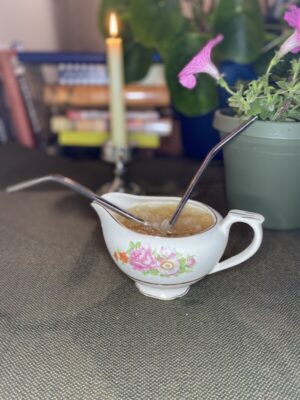
Many of us went through a phase in our youth of ordering absurd numbers of absurd drinks. Perhaps the most absurd of those drinks was the Scorpion Bowl.
Scorpion Bowls — a mixture of fruit juices and injudicious amounts of alcohol — were always served in elaborate bowls with several straws. The conceit of the cocktail is that it was supposed to be shared with a group of friends. In point of fact, I don’t think I’ve ever actually seen anyone sharing one.
But can we re-engineer a Scorpion Bowl to bring that same sense of adventure to an evening with the houseplants, without the dread of danger that accompanied it in our youth?
A Traditional Scorpion Bowl
- 2 ounces fresh squeezed lime juice
- 4 ounces fresh squeezed orange juice
- 1½ ounces simple syrup, or better yet, rhubarb syrup (see above)
- 2 ounces orgeat (almond syrup)
- 2 ounces brandy
- 4 ounces dry gin
- 4 ounces golden rum
Divide the amount of ice that you would normally put in your pitcher in half. Put one half in your pitcher.
Add all the ingredients to the ice in your pitcher.
Wrap your remaining ice in a tea towel. Beat it mercilessly with a blunt object, until the ice is shattered into several different-sized pieces.
Add the brutalized ice to your pitcher and stir to combine all ingredients together.
Pour into a large bowl or flower vase and garnish with several oversized straws to help sell the lie that this will be shared.
A Scorpion Bowl for One
- ⅔ ounce fresh squeezed lime juice
- 1⅓ ounces fresh squeezed orange juice
- ½ ounce simple or rhubarb syrup (see above)
- ⅔ ounce orgeat (almond syrup)
- ⅔ ounce brandy
- 1⅓ ounces dry gin
- 1⅓ ounces golden rum
Combine all ingredients in a cocktail shaker.
Wrap 15 or so ice cubes in a tea towel and shatter them with a blunt object.
Add the shattered ice to the shaker and shake your cocktail thoroughly.
Pour unstrained into a tiki glass or other whimsical container. Drink with one straw.
The genius of a Scorpion Bowl is that someone very carefully made a list of classic Tiki drink ingredients and chose seven that complement each other beautifully. The limes are sour and acidic. The oranges are sweet and acidic. The syrups smooth out the acidity, which in turn keeps the syrups from making things sickly sweet. Almond is a classic, get-along-with-everybody ingredient and serves as a bridge between the different liquors, which might not get along with each other otherwise.
Party #5: Just You and Jackie O’
“Alas,” I hear you sigh. “Even that is a little more intense than I was looking for. I want something I can enjoy with a good book in the hours after I load the kids on the bus to summer camp. Do you have anything like that?”
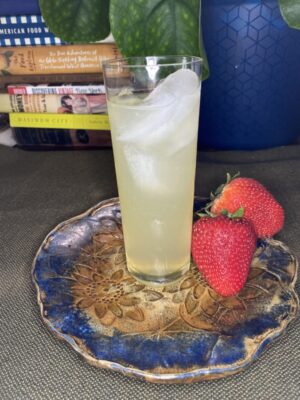
As it happens, I do. Let’s set you up with a Jackie O’s Rose.
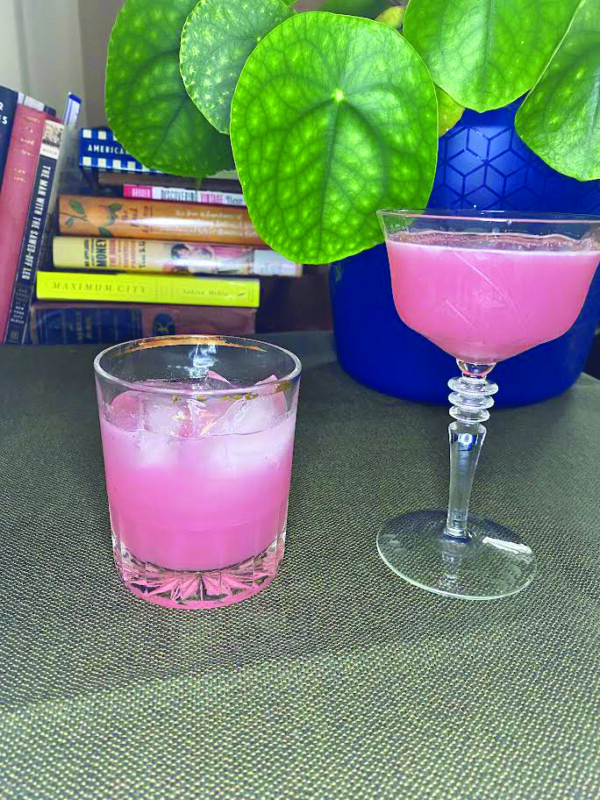
Think of this as a rose-kissed daiquiri. It’s a combination of standard daiquiri ingredients — white rum, simple syrup and lime juice — with a drop or two of orange curacao and a hint of rose water. The lime and the rum are extremely refreshing, and the rose water makes it a tiny bit exotic. It’s a very good sitting-by-yourself cocktail. It asks nothing of you. It just sits with you and enjoys your company.
Jackie O’s Rose
- 2 ounces white rum
- ½ ounce orange curacao
- 1 ounce fresh squeezed lime juice
- ½ ounce simple syrup
- ½ teaspoon rose water
Combine all ingredients in a cocktail shaker, and shake with ice.
Pour into any glass you choose. Strain the ice out if you want to, or leave it in. This is a very undemanding drink.
Drink in calm and silence.
A Pitcher of Jackie O’s Rose
- 20 ounces white rum
- 5 ounces orange curacao
- 10 ounces fresh squeezed lime juice
- 5 ounces simple syrup
- 1 ounce rose water
Combine all ingredients in a pitcher.
Top with ice.
Stir.
Serve in a variety of glasses and teacups.
Yes, I know. You wanted to be alone. But what if you’ve got four friends who want to sit quietly with you?
It pays to be prepared.
Featured photo: Courtesy photo.