
Get inspired at public gardens and garden tours
For gardening nerds and the occasional gardener alike, a trip to a top-notch “professional” garden is more fun than a week at Disney. Seeing what is really possible if you have enough experience and put in the hard work can be truly inspirational.
A really good resource for this is the reference book The Garden Tourist’s New England: A Guide to 140 Outstanding Gardens and Nurseries by Jana Milbocker, who views these visits as a good way to see gardening from somebody else’s perspective. She recommends paying close attention to the combination of plants that a master gardener has put together.
“People really give a lot of thought to how they use the forms of the garden design,” Milbocker said in a telephone interview. “I think it’s really helpful for me to go through a garden in that direction, to experience it the way that the garden owner wants you to experience it.” Thinking about the question “Why is this here?” can help reframe a home gardener’s outlook, she said.
But then, she advised, take a second look.
“You’re going to see things that you missed the first time. It’s possible also, for instance, a garden conservancy will have a garden open in the early summer and that same garden open later in the season, like late summer or early fall. It’s great to see any garden in different months because it can be vastly different. Different plants have beautiful colorful foliage in the fall. So to see a garden [over time] is really a great experience.”
A good way to find gardens to be inspired by is to take part in a sponsored garden tour.
Amy Murray is the Open Days Program Manager for the Garden Conservancy (gardenconservancy.org), an organization dedicated to garden preservation.
“We assist public gardens that are either damaged or are in need of preservation services,” Murray said. “We also give small grants to a variety of horticultural organizations that are bringing gardening to people and making significant impacts within their communities.” Murray’s particular job is working with gardens, public and private, in a given area, to help them participate in “Open Garden Days” — one or more days per season when the public can visit them.
“Unless you have a very explicit program or invitation through something like the Open Days program, there’s really not a ton of opportunities to see these spaces,” Murray said. “Open Days are absolutely wonderful because if you are interested in a garden and you want to see it, you have to go to that Open Day. There are no guarantees that a given garden will be open in a subsequent year or even ever again. We have a variety of gardens. Some love the practice of opening every single year. Some will take a few years off in between and then open once and then stay closed for several seasons. And then some will open once and never again. And so if you want to see it you have to see it on that day.”
Michael Gordon is in charge of working out the details for the Open Garden Days in New Hampshire. He said each garden in the program brings something different to each visitor.
“On one level, it’s just fun to have a nice day and you get to see pretty places. And then if you’re a more serious gardener like I am, you get ideas and see plants. It’s a good way if you live in the area to go to a garden and find out what they’re able to grow because you will be able to grow it too because it’s local to you. You can make a day of it and go from garden to garden. And people are generally really excited to share their garden,” Gordon said.
Another popular garden tour each year is put on by the Palace Theatre in Manchester. It is one of the Palace’s biggest fundraising events each year, said Box Office Manager Cherie Prior.
“The garden tour is a self-guided tour we’re running on June 20 this year,” she said. “In the morning, participants register at Demers Garden Center and they’re given a program, which lists the individual gardens. We have a combination of private and public gardens and [people on the tour] have the rest of the day to travel to the gardens and take their time at each one. Our host gardeners are there to talk about the garden and we have write-ups about each garden and its history and sort of the plants and the things that the host gardener wants to talk about.”
“We work with the Manchester Garden Club,” Prior said. “They help a lot about picking the gardens because they’re the ones out there looking at other people’s gardens and letting us know. We [the Palace Theatre] are invested in art in the community. And we consider gardens to be a part of that as well; a beautiful garden is just as valuable as a beautiful stage production. And we like to be able to promote beauty in any form within our community.”
Elinor Terrell of the Manchester Garden Club described the Palace Theatre Garden Tour as a way of giving area gardeners inspiration and a jumping-off point for their own garden projects.
“The Garden Tour is about showing the lovely hidden treasures of Manchester,” Terrell said. “We have little pocket gardens that are just tiny little things. We also have some of the nice big homes down on River Road. So it’s a wonderful way to show the treasures of the city and also to promote the love of gardening and inspiration. People will see them and go, ‘OK, I’ve got something like this. I could do this.’”
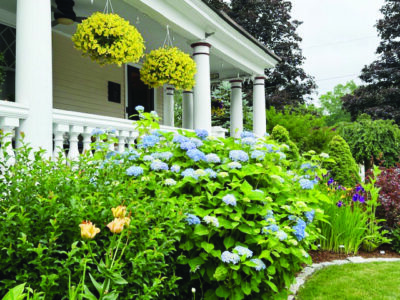
The Garden Club of Deerfield will host a garden tour in June called “Heritage in Bloom” that will showcase gardens and plants tied to Deerfield’s almost 300-year history.
“One of the stops,” said Robin McKinnon, the President of the Garden Club, “is a fourth-generation property. It comes from the 1830s. And there are plantings of lilacs that were taken from the Governor Wentworth mansion in Portsmouth. And those were the original lilacs that came to the New World. We have one farm that lies within the region historically inhabited by the Algonquin-speaking peoples, including the Seneca and related groups of the Wabanaki Confederacy. And there’s a small family cemetery on site, including the grave of a young man who served and died in the Civil War. Another [stop on the tour] is a farm from 1742 that chooses plants for their beauty but also their sustainability and healing qualities — perennial herbs, fruits, trees, vegetables selected for their dependability and heirloom varieties long valued by earlier generations.”
There are a variety of garden tours throughout the growing season, but there are also public and private gardens throughout the state that welcome visitors but are not part of organized tours. Each appeals to a different type of gardener and embraces a different gardening philosophy.
For 17 years, Petals in the Pines in Canterbury has been a go-to choice for families to spend a day outdoors, hiking along trails and enjoying gardens. According to owner Donna Miller, if you haven’t ever visited, you probably should do so this summer.
“This year will be our last year of being open to the public full-time,” she said. “Four years ago, my husband Jim and I drew a line in the sand. We said, ‘Let’s do this for five more years.’ And this is Year Number 5.”
In addition to pollinator gardens and gardens where visitors can pick their own flowers, “we have 2 miles of outdoor trails,” Miller said. “We have two labyrinths that some people use to get in touch with their thoughts, almost like meditation. We have an outdoor classroom, and a Tale Trail, with laminated pages from four different nature books that parents can read to young children as they walk, and older children can read themselves. There’s something for everyone.”
For families who want to visit throughout the season, season passes are available.
The Canterbury Shaker Village (288 Shaker Road, Canterbury, 783-9511, shakers.org), on the other hand, probably not surprisingly, takes a more historical approach. The Shakers took growing plants very seriously, said Garrett Bethmann, the museum’s Manager of Communications and Engagement, and that is reflected in the gardens on the grounds today. “There are basically three main agricultural or garden spots that people can walk through and check out,” Bethmann said. “There are the granite beds, kind of that smaller plot of what people I think would traditionally see as gardens or botanical gardens. Then we have our farm fields, and those have a lasting imprint on the site. And then we have our orchards.”
“The orchard is filled with different versions of apple trees,” Bethmann said. “The Shakers used to grow apple trees in different locations throughout their close to 200 years of active living here. The orchards in the space, where they are now, first got placed there in about 1917, and a lot of those trees are from that time period.”
“The thing that I think has always been true about when people come and visit our spaces here,” Bethmann continued, “is that as best as we can, we try to use our gardens and our agricultural spaces as ways to showcase the Canterbury Shaker legacy and, as best we can, tie the things that we have going on now to elements and aspects of what they were doing in the past when the Shakers were here. So, for instance, over in our herb gardens where the granite beds are it’s a nice show of preservation in action. Typically we try to use the granite beds to kind of showcase some of the plants and herbs and perennials that were grown there in the past.”
Other gardens focus on plants that grow under very specific conditions.
The Evergreen Woodland Garden in Goffstown, for instance, features plants that thrive in the limited light found on the floor of a forest.
“It’s a one-acre woodland garden heavy on pines,” said Robert Gillmore, the garden’s creator. “There’s a total of around 400 rhododendrons. It’s probably one of the largest rhodi gardens in Northern New England. Of course, there are other ericaceous plants like mountain laurel and Lakota weed and so forth. It’s an extremely low-maintenance garden and it was designed that way. One of the problems, if you want to have a large garden, unless you’re rich with 20 gardeners on your payroll, it’s got to be low-maintenance. So with a woodland garden, one of the reasons it’s low-maintenance is that there’s no grass. There are no high-maintenance plantings, like trees and shrubs and ground covers. Another thing that makes it low-maintenance, of course, is that it’s in the shade. A woodland garden is a shade garden. And a shade garden is a slow ecosystem. Things happen slowly. Weeds happen slowly or not at all.”
“In gardening,” Gillmore said, “there is a quote by the poet Alexander Pope: ‘Consult the genius of a place,’ and by that he meant consult the special character of the site and use what’s on the site. The special character of Evergreen is a pine woods. The most expensive plants in a garden — the plants that are unavailable in any nursery at any price — were already there, planted, growing: the trees, free of charge. There are also some lovely large granite glacial erratics. It’s a wonderful topography,”
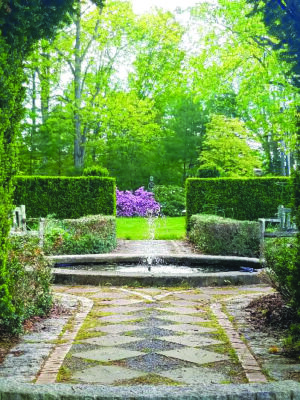
Another approach to gardening is aligned with the Palace Theatre’s philosophy of gardening as an art form. This is the perspective of Bedrock Gardens in Lee. John Forti is the Executive Director there.
“Bedrock Gardens opened to the public formally as a public garden nine years ago,” Forti said, “and we just reopened for the season a week or so ago. It’s a 37-acre old farm that has been here for centuries. The founders of the garden, Jill Nooney and Bob Munger, worked for over 30 years to create a really fascinating garden infused with art and rare botanicals that has become an oasis of art and horticulture. It’s become a public garden where people can take garden tours, art tours, special educational programs and events for all age levels that really help people connect to nature and art and find just a really unique, beautiful green space. Unlike a lot of public gardens, this is really designed to just take you on journeys so that it can be a serene step away from the world, but a place where you can really find some sanctuary and some peace. Gardeners or art enthusiasts are drawn into every corner, because there are dozens of outdoor rooms, one after the next, each with its own mood and emotion and color palette and seasonal specializations and rare plants that just tell stories and pull you away from your daily life into experiences all throughout that 30 plus acres. [The art] is largely sculptural art that really is found in every nook and cranny.”
At NH Audubon’s McLane Center in Concord, the focus is immersing visitors into native species. The Center’s Diane DeLuca said that an aim has been to restore an entire ecosystem. “Four years ago or so,” she said, “we restored an old field area that was full of invasives to an acre of pollinator meadow. It hasn’t been possible to clear out all the invasives, as you might imagine, but now there is at least an acre of native pollinator plants out there. We also have native plant pollinator gardens that go all the way around the building. And also up on the hill there’s some space that we call our butterfly garden, which is meant to be more attractive to some of the species of butterflies that move through here — monarch butterflies specifically — and the pollinators that use areas late in the fall, including migrating butterflies.”
“Our gardens here,” DeLuca said, “are meant to be as diverse as possible in order to attract all kinds of wildlife. They have a lot of different structural diversity, meaning we have some attractive trees for pollinators, which would include our birds, some of which are actually nesting in and around the garden. It’s definitely an area that’s attractive for hummingbirds, because there are a lot of plants that are in here that specifically hummingbirds enjoy and will be pollinators of those particular plants as well. The structural diversity in the garden allows for different wildlife species.”
A decision was made early on when planning the Audubon’s gardens, DeLuca said, to fill it with plant species that would peak throughout the entire growing season.
“We have blooms that start in the early part of the spring … and are available for pollinators to come out early, like queen bumblebees and some of the other bees which tend to emerge pretty early in the season and need plants that they can both nectar on and get pollen from. We think about blooms across the season, into mid-summer, and then as late as possible into the fall. We also think about diversity of the flower structures for those plants, because some of the pollinators need plants where they don’t have to get their tongues deep into the plants, because they don’t have that ability. Some of them can reach far in. So you want plants that are tubular, that hummingbirds might be attracted to. You want plants that are flat-topped, that are much easier for some of the bees and butterflies to get into. We want a diversity of structure. so that we can attract many different forms of wildlife into the garden.”
Public gardens
Here are some area public gardens.
- Bedrock Gardens (19 High Road, Lee, 659-2993, bedrockgardens.org) A nonprofit public garden that integrates unusual botanical specimens, unique sculptures, and interesting landscape design and features into an inspiring journey. This 30-acre site has recently transitioned from a historic farm and private garden to a self-described “public oasis of horticulture, art, and inspiration.” Adults $15. Children 12 and under free.
- Brigit’s Garden in Livingston Park (156 Hooksett Road, Manchester) A public garden within Livingston Park, created by the Brigit A. Feeney Foundation for Hope and Healing, in memory of Brigit A. Feeney, a victim and witness advocate with the NH Department of Justice, who died in a motorcycle accident in 2021.
- Canterbury Shaker Village (288 Shaker Road, Canterbury, 783-9511, shakers.org)Canterbury Shaker Village describes its mission as “preserving and sharing the legacy of the Canterbury Shakers, promoting learning, connection, and rejuvenation for people from down the street and around the world.” There are three main gardens on site: an herb and culinary garden, apple orchards, and farm fields. Throughout the summer the Village will be open seven days a week from 10 a.m. to 4:30 p.m. Nature trails are free to explore daily from dawn to dusk. Adult admission is $25.
- Kimball Jenkins Estate (266 N. Main St., Concord, 225-3932, kimballjenkins.com) A historic mansion in Concord, now the site of the Kimball Jenkins Art School. The campus grounds have gardens that are currently under renovation.
- Maple Hill Gardens at the Beaver Brook Association (117 Ridge Road, Hollis, 465-7787, beaverbrook.org/visit-us/maple-hill-gardens) “There are 13 themed gardens, a natural play area, a demonstration compost court, picnic areas and even a wildflower trail to explore,” according to the website.
- New Hampshire Audubon Society NH Audubon has two visitor centers in the region with gardens: The Susan N. McLane Audubon Center (84 Silk Farm Road, Concord, 224-9909, nhaudubon.org/center-and-events/mclane-center-concord) is open Wednesdays-Saturdays from 11 a.m. to 5 p.m., with trails and pollinator gardens open from dawn to dusk daily; Massabesic Center (26 Audubon Way, Auburn, nhaudubon.org/center-and-events/massabesic-center-auburn) is open Wednesdays-Saturdays from 11 a.m. to 5 p.m., with trails and pollinator gardens open from dawn to dusk daily.
- Petals in the Pines (126 Baptist Road, Canterbury, 783-0220, petalsinthepines.com) A family-friendly farm with hiking trails, pollinator gardens, PYO flower bouquets and a farm stand. The summer of 2026 will be its final year open to the public. Open Wednesday through Sunday; closed Monday and Tuesday. Season passes are available for $25.
- Pickety Place (248 Nutting Hill Road, Mason, 878-1151, pickityplace.com) An 18th-century Cape surrounded by vast, well-established garden beds, mainly perennials and herbs. The herbs are served in the restaurant’s five-course lunches.
Garden tours
Here are some upcoming garden tours. Know of any tours not mentioned here? Let us know at adiaz@hippopress.com.
- 37th Annual Pocket Gardens of Portsmouth Tour
What: The tour features 10 private gardens in the historic South End neighborhood of Portsmouth, the Goodwin Garden at Strawbery Banke Museum, and the garden at South Church. When: Friday, June 19, Saturday, June 20. Admission: Early bird tickets $25 (until June 13), general admission tickets $30 (June 14, until day of tour). More info: Visit portsmouthnhtickets.com/e/37th-pocket-gardens-of-portsmouth - 7th Annual Palace Theatres Garden Tour
What: A self-guided, self-paced tour of both private and public gardens throughout Manchester. When: Saturday, June 20. Admission: Tickets are $20. Registration is from 9:30 a.m. to noon at Demers Garden Center in Manchester. More info: Visit palacetheatre.org/events/2026-garden-tour. - 4th Annual Lilac City Garden Tour
What: Organized by Lilac City Gardeners (formerly Rochester NH Garden Club). Local gardeners will showcase their gardens, share knowledge, and inspire others in the community. When: Saturday, June 20. More info: Visit Lilac City Gardeners’ Facebook page. - Heritage in Bloom
What: A tour of six historic gardens in Deerfield. When: Saturday, June 27. Admission: senior/student $8, general admission $10, carload $30. More info: Visit givebutter.com/heritage-in-bloom - Jaffrey Artist and Garden Tour
What: Features local private gardens, each hosting a local artist at work. You’ll have the chance to see artists create in real time — painting, sketching, and capturing the beauty of each setting. When: Saturday, July 11. Admission: $15. More info: Visit jaffreyciviccenter.com/event/event-artist-garden-tour. - Hospice Home and Garden Tour
What: A tour of four residential properties on or near Lake Winnipesaukee, benefiting Granite VNA. When: Wednesday, July 15. Admission: $55
Visit granitevna.org/ways-to-give/hospice-home-garden-tour. - Garden Conservancy’s Open Garden Day
What: A self-guided tour of some of the area’s best public and private gardens in Manchester, Nashua, Milford, Pelham, Hollis, Hudson and Hooksett. When: July 18. Admission: $10, by pre-registration only. More info: Visit gardenconservancy.org/open-days/ticket-release-dates - The Second Annual Five Senses Tour at Tiffany Gardens
What: Use your five senses while exploring the private gardens hidden in a quiet Londonderry neighbor. Enjoy food, drink, music, art and nature. When: Saturday, July 25, and Sunday, July 26. Admission: $20. More info: visit comcaregivers.org/garden-tour.