After a shooting in Lewiston, Maine, which resulted in 18 fatalities, New Hampshire’s Department of Safety actively monitored the situation and provided significant assistance, according to a press release. The state dispatched its SWAT team, shuttled blood donations and offered other critical resources. Maine authorities led a manhunt for the suspect, who was later found deceased in a trailer at a former workplace. Gov. Chris Sununu issued the following statement: “Grateful for the efforts of Maine State Police who led the manhunt to bring closure to this challenging search. Thanks to the men and women of our own New Hampshire State Police for their tireless assistance. It is time for the communities in Maine to heal and I hope the families of this tragic situation can heal in peace.”
Biden write-in
In an unprecedented move, New Hampshire Democrats, including numerous state lawmakers and prominent figures like filmmaker Ken Burns, have initiated a write-in campaign supporting President Joe Biden for the state’s presidential primary, NHPR reported. This comes after Biden opted not to list his name on the New Hampshire ballot, following the Democratic National Committee’s decision to prioritize South Carolina as the first primary state. The “Write-In Biden” website guides voters on the write-in process and critiques the DNC’s decision as “misguided.” Despite Biden’s notable lead in local Democratic polls, Minnesota Congressman Dean Phillips has entered the fray, emphasizing the younger generation’s desire for alternative nominees. The write-in initiative marks a historic moment, as campaigns of this nature targeting a sitting president during the New Hampshire primary have never occurred before, according to the article.
New AUSA
U.S. Attorney Jane E. Young has announced the appointment of Tiffany Scanlon as an Assistant U.S. Attorney (AUSA) to handle domestic terrorism and violent crimes in the District of New Hampshire. AUSA Scanlon brings with her a wealth of experience from her tenure since 2012 at the Worcester County District Attorney’s Office, where she worked in various units, including the Major Felony and Gang Units. Throughout her career she has prosecuted numerous severe criminal cases, such as homicides and armed robberies. In May 2023 the U.S. Attorney’s Office in New Hampshire was allocated two new attorney positions, with one focused on Civil Rights yet to be filled.
School security
The New Hampshire Department of Education has opened its third round of applications for the Security Action for Education (SAFE) grants program, according to a press release. This program will allocate $10 million to district and public charter schools to bolster school security, with a focus on enhancing access control, emergency alerting, and surveillance. Although $13.9 million has been awarded in previous rounds, schools that haven’t received grants before will be given priority in this round. Applications can be submitted to the Public School Infrastructure Commission, and the maximum award for any school will not surpass $100,000. Award decisions will likely be made in the first quarter of 2024.
Honorees
U.S. Sen. Maggie Hassan honored Dr. Reiko Johnson of Newfields and Dr. Nathan Swanson of Durham as October’s Granite Staters of the Month for their contributions to the community, according to a press release. Dr. Johnson founded Volunteers in Medicine of New Hampshire (VIM-NH) to cater to uninsured and underinsured patients. Recognizing a need for dental care among these patients, she collaborated with Dr. Swanson to organize VIM-NH’s inaugural Dental Day of Caring. The event witnessed volunteer dentists providing 19 extractions, 10 fillings and one root canal, donating services worth $11,531. Sen. Hassan’s “Granite Stater of the Month” initiative acknowledges remarkable New Hampshire residents for their community contributions.
FEMA funds
The Federal Emergency Management Agency (FEMA) has awarded New Hampshire more than $26 million in reimbursements for Covid-19-related costs, according to a press release. Of this, a grant of $24,410,106 will be directed to the New Hampshire Department of Health and Human Services for staffing vaccination sites, having facilitated the vaccination of around 36,727 vulnerable individuals. Mary Hitchcock Memorial Hospital will receive $1,770,931 to cover expenses tied to a Covid-19 testing system and related public service announcements. In addition, the state will receive nearly $1.4 million for renting and operating warehouse space from April 2020 to July 2022, which stored and distributed essential Covid-19 supplies. To date, FEMA’s Public Assistance program has reimbursed New Hampshire more than $286 million for pandemic expenses.
In Pembroke, more than 50 “No Coal No Gas” activists rallied by the Merrimack River, urging Granite Shore Power to transition from coal to solar energy at the Merrimack Station. Several were arrested after clashing with Bow Police on trespassing claims.
The Greater Manchester Chamber (GMC) reports that more than 20 nonprofits will participate in the “Find Your Cause” event organized by the Manchester Young Professionals (MYP). Presented by Southern New Hampshire University, this event, scheduled for Wednesday, Nov. 29, at the Rex Theatre, aims to connect young professionals in Manchester with nonprofit leaders and opportunities. Attendees will have the chance to interact directly with each organization before the nonprofits present their two-minute pitches. Registration is available on Eventbrite, and nonprofits interested in joining can contact the GMC for more information.
The Nashua Public Library will host a Veterans Day celebration on Saturday, Nov. 4, from 2 to 3:30 p.m. in the Chandler Wing, according to a press release. Inspired by a previous Salute to Service display, this year’s event will feature live music, miniature military vehicle displays and a preview of a WWII oral history project. Attendees can engage in crafting buttons and cards for veterans. Veteran organizations will be present to provide resources. Visit nashualibrary.org.
If not for his tight New England bonds, things might have been different for Steve Bjork. In the late 1990s he was approached for the role of a young Fred Flintstone in the prequel The Flintstones in Viva Rock Vegas. Problem was he’d have to audition in Los Angeles. Bjork politely declined; he’d left his native Massachusetts to try the West Coast for a while, and decided it wasn’t for him.
“It occurred to me seeing some people that were struggling in L.A. for decades that I could potentially be one of those,” he said in a recent phone interview. “Or I could go home, have comedy and my family and everything I wanted.” He was married, with a stepson and a day job, spending his weekends doing standup. Bjork wasn’t looking to change any of that.
However, the eager casting agent was undeterred and called back two days later.
“She goes, ‘Listen, I keep hearing your name, I’ve seen your headshot, I’ve seen a clip, and we really want to see you. How about we move the audition to New York City?’ I said, ‘No, I appreciate it, but I’m not chasing that anymore.’”
The movie got made, with British actor Mark Addy in the lead. Addy went on to star opposite Jamie Gertz in the sitcom Still Standing, which ran for four seasons, and later played Robert Baratheon on Game of Thrones.
“Hypothetically speaking, I could have been on TV, married to Jamie Gertz and then King Robert Baratheon,” Bjork said with a laugh.
It turned out OK for Bjork, who regularly headlines throughout the region, including an upcoming show at Murphy’s Taproom in Manchester on Oct. 28. His family grew when he and his then wife fostered and later adopted four kids from a troubled background. They’re now in their teens and the source of some great material, including a memorable bit about getting them all off to school on time.
The experience of turning down a role weighed on him, though, to the point where he would leave comedy.
“I was working full-time,” he said, “and Friday afternoon, I’d be like, ‘I don’t feel like doing my show tonight.’ It occurred to me: who the hell am I? People want to pay me to tell jokes and I’m not that interested in it? I should get out of the way for somebody who has more passion.”
He left the business for 10 years, returning, he said, “because I couldn’t stay away anymore. Now, every single time I get on stage I’m thankful. If there’s five people, if there’s 15 hundred, it’s the highlight of my day. My goal is to connect with the audience, not just make them laugh … after the show, I want them to be compelled to come up and talk to me. Hopefully, I brighten their day.”
Inspired to become a comic by listening to Bill Cosby as a kid, Bjork always works clean — comedy parlance for no profanity or adult content in his set. “Unless he’s dating you, there’s nobody cleaner than Cosby,” he said. When Eddie Murphy put out his first record, his mom bought it for their family to hear together, an experience that steeled his resolve.
There were no lovable Saturday Night Live characters on Murphy’s album. “It was standup, and everybody knows at this point, it’s filthy,” Bjork said. “It’s hysterical by the way — but it’s filthy.” He watched his mother squirm for about eight minutes until she ended the ordeal. The aspiring comic then vowed he’d never make anyone feel that uncomfortable if he could.
While studying at Salem State College, he got a kitchen job at a nearby comedy club and studied the craft. “The boom was huge,” he said. “This club in the middle of nowhere was selling out every night. There was this big dirt parking lot, and the line was stretched out to the street.” By the time he started working, things had cooled a bit, and it’s ebbed and flowed since.
These days Bjork likes what he’s seeing in New England comedy.
“Since I started, it’s gone through peaks and valleys as far as interest from the public,” he said. “Right now there’s a lot of shows going on; people are coming out. We’ve got a younger generation that’s working at it, and working hard. It’s a great scene.”
There’s another trend that Bjork finds encouraging: “People are a lot more personal on stage,” he said. “Showing vulnerabilities, talking about their real lives as opposed to, ‘What happened to peanuts on the airplane?’ Gary Gulman a couple of years ago did this entire special about his battles with depression. It was really empowering, and I think so helpful to so many people who struggle with that. It was very brave of him.”
One reason Bjork likes this comes from his other work as a speaker.
“My phrase is ‘mental health is contagious,’” he said of the talks he gives to corporate audiences. “Look, life is crap wall to wall. Moments of laughter … you really need to embrace those, cradle them, and hold on to them as well as you can; even think back to them when you’re struggling again. That’s what gets you through.”
Steve Bjork w/ Mona Forgione, Emily Mame Ford and TBA When: Saturday, Oct. 28, 8 p.m. Where: Murphy’s Taproom, 494 Elm St., Manchester Tickets: $20 at humantix.com
On Friday, Sept. 22, a VIP launch party was held for the opening of Jals Cuisine Bantu, Nashua’s first African restaurant. Jals Cuisine Bantu is an extension of Mola Foods, a food production company offering the flavors of Africa through spices, sauces, seasonings, teas, marinades and more.
“Mola Foods is a food production manufacturing company, and Jals Cuisine plays the role of showcasing our product with traditional cuisine of Africa,” said LaFortune Djabea, the founder of Mola Foods and Jals Cuisine Bantu. “Mola Foods creates products, and people want to know how to use these products in their cooking. That’s where Jals Cuisine comes into play [by] showcasing how you can utilize Mola Food products in your own cuisine.”
Born and raised in Cameroon, Djabea describes her native country as a melting pot of culture and cuisine from other African countries, such as Zambia, Congo, Nigeria and Ghana. Her grandmother was able to cook in a variety of styles. When a friend of Djabea’s asked her to create a hot sauce using her grandmother’s recipe, she was at first reluctant but eventually decided to accept the challenge, which led to the creation of Mola Foods and, in turn, Jals Cuisine Bantu.
“The flavor is completely traditional of African cuisine, so basically we are introducing a fusion cuisine with the bold flavors of Africa,” Djabea said. “People think African cuisine is spicy but it’s actually not. … If you want to make your food spicy then you add the sauce, but the food itself isn’t spicy, it just has a bunch of spices that people don’t use traditionally on their food here in America. In Africa we use a bunch of spices to bring out those flavors, bring out the boldness [and] the smell. … Whether you want it spicy or not is really based on what you’re looking for. At Jals Cuisine we don’t make food spicy, we give it a kick, and if you want it a little spicier then you’re welcome to utilize one of our hot sauces.”
Menu items include jollof, or thieboudienne, a traditional Senegalese dish consisting of rice, okra, yucca, assorted vegetables and your choice of meat; West African key lime pie; yassa, made with cauliflower or chicken, rice, onions, olives and lime; and fried plantains. Each meal can be made into a vegan option as well. You can dine in at the restaurant or order to take out, with pickup and delivery options available. Meal plan services are also offered.
“African cuisine, and Africa in general, is extremely not represented in Nashua whatsoever,” Djabea said. “It’s a wonderful cuisine [and] the world does not do it justice, and the reason the world doesn’t do African cuisine justice is because of the stigma surrounding Africa itself [and] African people … and that’s unfortunate. … I have made it my mission at Mola Foods and through Jals Cuisine to … repel the stigma … and make people understand that African cuisine is very approachable, delicious and is something that should be acclaimed with the rest of the cuisine.”
Jals Cuisine Bantu 9 Simon St., Nashua When: Wednesday, Thursday and Friday, 11:30 a.m. to 7 p.m.; Saturday, 4 to 8 p.m.; closed Sunday, Monday and Tuesday More info: 820-2543; jalscuisinebantu.molafoods.com
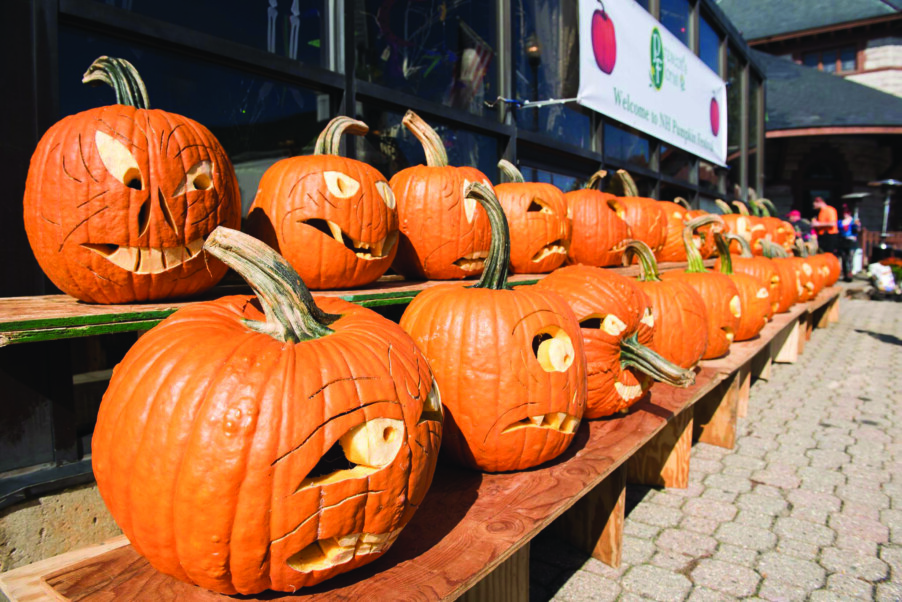
The New Hampshire Pumpkin Festival will feature a zombie walk, a road race, a costume parade, street performers, a beer garden and more, running Friday, Oct. 27, and Saturday, Oct. 28, in downtown Laconia.
On Friday, Oct. 27, events run from 4 to 8 p.m. and include KidsZones (featuring a climbing wall, bungy jump and inflatables), the Great New England Craft and Artisan Show (at City Hall), beer gardens at Hectors Fine Food & Spirits and the 405 Beer Garden on Beacon Street West in the City Hall parking lot and food trucks, vendors and street performers.
A zombie walk starts in Veterans Square at 6 p.m. and a Spook’N Grove Halloween Dance Party takes place at the CAKE Theatre (12 Veterans Square in Laconia; thecaketheatre.com — tickets cost $10 for 13+, 12 and under are free) from 7 to 10 p.m.
On Saturday, Oct. 28, events run from 11 a.m. to 8 p.m. and include the Runaway Pumpkin 5K/10k Run/Walk in Opechee Park ( 9 a.m.); Hobo Pumpkin Express Train Rides (every hour starting at 11 a.m.; see website for tickets); a Wicked Pumpkin Cornhole Tournament at noon; a pie eating contest (every hour from 11 to 4 p.m. in Veterans Square); a scavenger hunt; the beer gardens; the craft & artisan show; thousands of pumpkins on display; a children’s costume parade (1 p.m.); Recycled Percussion at the Cake Theatre (see thecaketheatre.com for tickets); Amy Grant at the Colonial Theatre (609 Main St. in Laconia ;see coloniallaconia.com for tickets), live music and more, according to nhpumpkinfestival.com, where you can find a complete schedule.
Karmen Gifford, president of the Lakes Region Chamber of Commerce, which is one of the event’s organizers, said that the festival has in previous years drawn more than 40,000 people from different parts of New England, and even as far away as California and Canada. She said the event is an opportunity to celebrate, but also a way for the Chamber to support and promote other organizations and businesses local to New Hampshire.
“We try to blend it all together. Come out and spend the day, ” Gifford said.
The CAKE Theatre — Chaos and Kindness Experience Theatre — will host the zombie walk and will be putting on a pumpkin display with the help of their many volunteers. Melissa Aupperle, brand director at CAKE, says this is only their second year since the pandemic in being involved with the pumpkin festival. Aupperle said Recycled Percussions shows at the CAKE are all-ages-friendly.
“We want to curate some good things for everyone,” Aupperle said.
Jody Donohue is the organizer behind the Great New England Craft and Artisan Show, which will run across the two days. The event will have more 100 exhibitors, consisting of artisan local
designers and blacksmiths who create handmade products of all kinds, as well as specialty food vendors showing off their unique pastries and desserts. Visitors can expect to see anything from old clarinet parts turned into household lamps to ghost and goblin decor sets made from driftwood to welcome in the spooky season, Donohue said.
New Hampshire Pumpkin Festival When: Friday, Oct. 27, from 4 to 8 p.m., and Saturday, Oct. 28, 11 a.m. to 8 p.m. (with the road race beginning at 8 p.m.) Where: Downtown Laconia on Main Street and Beacon Street East as well as Beacon Street West, Veterans Park and streets in between. More info: nhpumpkinfestival.com for a schedule, map and links to ticketed items
Featured image: Jodi Picoult. Photo by Rainer Hosch.
Currier program helps those experiencing memory loss and their care partners
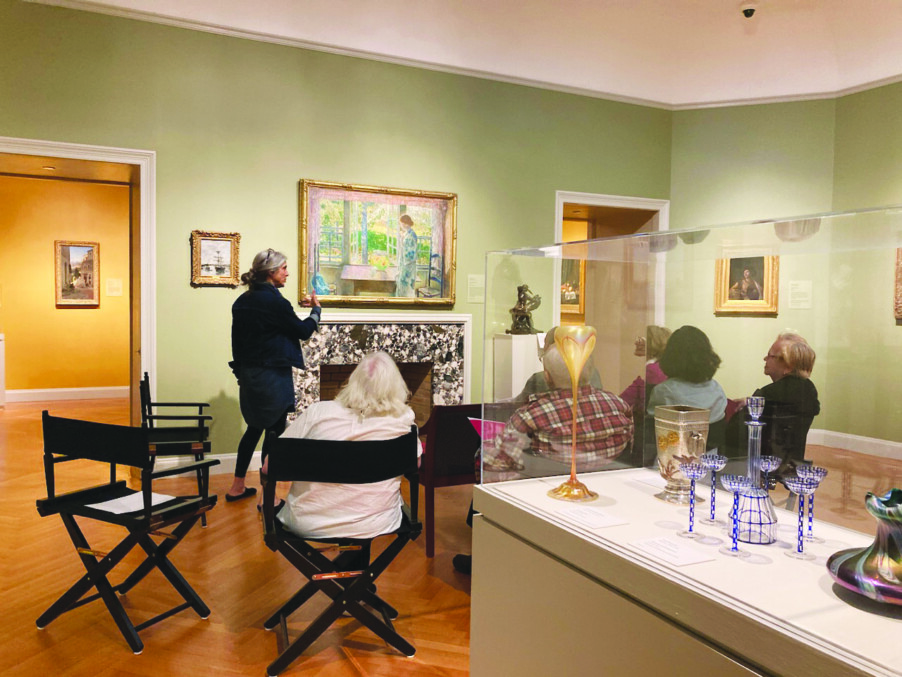
On the first Wednesday of every month, Currier Museum of Art in Manchester holds Memory Café, a program for individuals experiencing memory loss along with their care partners.
“The Memory Café is something that the Currier has done for quite some time, but we stopped doing it during the pandemic,” said Corey Lyford, who administers and designs the program. “We were only able to relaunch the program this past June. It’s designed to be a really joyful art looking experience for people in early stages of memory loss along with their care partners. A care partner could be a spouse, an adult child [or] a friend. … Any and all are welcome.”
Each session starts in one of the studio spaces at the museum, where attendees gather for light refreshments and socialization to get to know each other before heading to the gallery.
Before Covid, the entirety of the session would take place in the studio, where the art would be presented on slides. While this approach made it possible to look at multiple pieces, including ones that were not in the Currier collection, the team felt it was important to offer the true gallery experience.
While looking at the art, program facilitator Lucie Chmura likes to encourage people to use the method of “slow looking.”
“People get to really take time and relax into looking at a piece of artwork, much longer in front of it than one normally would when moving through the gallery spaces,” Lyford said. “Folks get to think about engaging their different senses, such as looking at a painting and thinking about what [they] hear when looking at this painting. Are there any sounds that come to mind? Everything is very open-ended. There are no wrong answers. People don’t have to draw on memory. This is really about what we’re all experiencing together in the moment.”
When deciding what art to select for the program, Lyford said she and Chmura think about the conversations the pieces may inspire, going for ones that are likely common to everyone in the group, to create an enjoyable, positive experience for both those experiencing memory loss and those who are not. Prompts are used to help viewers engage with the piece and to enliven conversation.
“We’re trying to blur that line between a care partner and someone with memory loss,” Lyford said. “We’re trying to help people not feel stigmatized and not feel like they’re standing out [or] like the attention of the program is on the fact that they have memory loss.”
She says the purpose of Memory Café is to create a support system and build connections while enjoying a creative experience.
“We hope for people to find respite and to find the museum as a resource for them and to keep engaging with these creative opportunities even if they are in a place in their life where they may have felt like that wasn’t possible anymore,” Lyford said. “We want people to feel safe and that applies to the person with memory loss and also for their care partners. They can be going through some pretty difficult times, so we’re hoping that this provides a creative space for them and one that they’ll want to come back to and see familiar faces from month to month.”
Memory Café When: The first Wednesday of every month. The next session is Wednesday, Nov. 2, from 1 to 2 p.m. Where: Currier Museum of Art, 150 Ash St., Manchester
Featured photo: Memory Cafe. Photo Courtesy of the Currier Museum of Art.
Exciting new adventures in graham cracker, marshmallow and chocolate
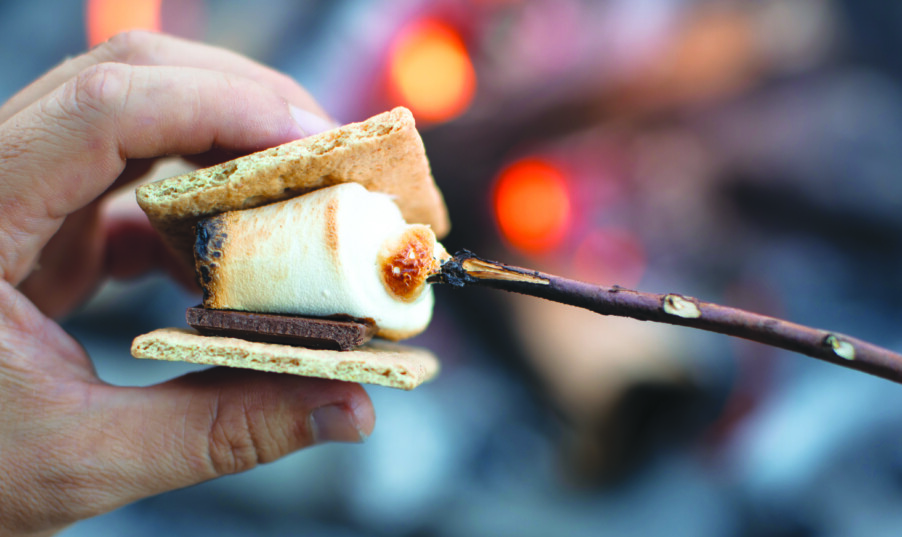
S’mores seem like a good bet.
They only have three ingredients. You have access to sticks. And even though the leaves have turned and the nights are cold, s’mores, with their accompanying campfire, give you a good reason to keep the deck furniture out a few more weeks. What could possibly go wrong?
Aw, jeez, I just jinxed it, didn’t I? Now even roasting marshmallows seems like too much to wrap your head around. OK, let’s break this down to its essential components: graham crackers, marshmallows, chocolate and fire. We’ll ease into it.
The Graham Crackers
Graham crackers are a good place to start. They were designed to be non-threatening. They were invented by the followers of Sylvester Graham, a 19th-century preacher and nutritionist, who was convinced that white flour, sugar and meat of any kind led to poor health and impure thoughts. If you think that you wouldn’t have been likely to get along with him, an angry mob of bakers and butchers in 1837 Boston would agree with you. They laid siege to his hotel while he was on a speaking tour, and were only dispersed when Graham and his followers dropped bags of cement on them from the hotel roof.
Commercial graham crackers, the ones we remember from kindergarten, are delicious, inexpensive and easily available, so who would make them from scratch?
You would. As long as you don’t expect perfection.
Lindsey Bangs, the baker of I Whisked It, a homestead bakery in Raymond, says that the secret is rolling the dough to a consistent thickness.
“If you don’t get the dough completely even, the edges will be a little crispy while the center isn’t done yet.”
This isn’t a huge problem for home bakers but would be a logistical headache for a commercial baker, which is why you don’t see house-baked graham crackers in bakeries very often, she says. But making them yourself also allows you to take some liberties in how you flavor them — adding cardamom, or even a little black pepper.
“Adding more cinnamon would really bump the flavor profile up,” Bangs says.
She likes her marshmallows gently toasted and golden brown.
Homemade Graham Crackers
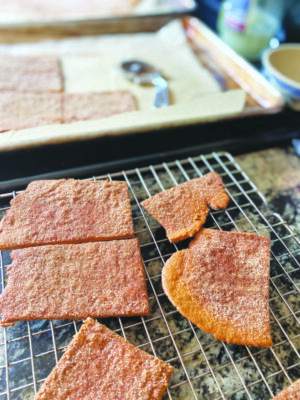
Homemade graham crackers. Photo by John Fladd.
Lindsey isn’t kidding about how fiddly graham crackers can be. They are straightforward enough to make at home, but making them professionally would be like juggling ice cubes. If you follow each step, though, you will be very pleased with the result.
A note on substitutions:
When making comfort foods, it is very tempting to jazz up a recipe. By their nature, comfort foods are basic; they are there to comfort, not to inspire or excite or intrigue the eater. This is why there are so many recipes and articles about mashed potatoes. Everyone wants to mess with them, but when someone is burned out from work or nursing a broken heart or feeling homesick, they do not want blue cheese in their mashed potatoes.
Most of the ingredients in this recipe lend themselves to intriguing substitutions. I would recommend restraint; feel free to change one ingredient. More than that will muddle the flavor of your graham crackers. Even one substitution will probably get you a pointed comment from a graham cracker purist.
1 cup (113 g) Whole wheat flour – You could use stone-ground whole wheat flour for this, but that would be your one substitution.
1 cup (120 g) all-purpose flour – Don’t experiment with this; you don’t want to toughen or soften the texture of your graham crackers by using bread or pastry flour.
¼ cup (50 g) white sugar – or brown sugar, or maple syrup, but that would be your one substitution.
½ teaspoon salt – I like kosher salt, but again, well, you know.
1 teaspoon ground cinnamon – I like smoked cinnamon.
1 teaspoon baking powder – There isn’t really a substitution here, but did you know that you should replace your baking powder every six months? Weird.
1 large egg
¼ cup (50 g) vegetable oil – or hazelnut oil
¼ cup (85 g) honey – or hot honey
2-3 Tablespoons (28-43 g) milk
more milk to make cinnamon sugar cling to the top of your crackers
cinnamon sugar for topping (optional)
In a large bowl, whisk together the dry ingredients – the flours, salt, cinnamon, and baking powder.
In a separate bowl, whisk together the wet ingredients – the sugar, egg, oil, honey, and milk. I don’t know why sugar is considered a wet ingredient, but it is, and it works better when you treat it that way. Chemistry is weird.
Add the wet ingredients to the dry ones, then stir to combine. You might have to knead the dough a little to bring it together.
Wrap the dough, and chill it for at least an hour.
Preheat your oven to 300º (150º C).
Divide the graham cracker dough in half.
Roll each batch of dough to 1/16 inch thick. It is important that the dough is consistently thick. Is there an easy way to do that? And how thick is 1/16 inch, anyway?
Here’s how you’re going to preserve your sanity. Lay down a sheet of parchment paper, and weigh it down with half your dough. Flatten it out a little with the heels of your hands. It turns out that the wire in most clothes hangers is made of 12-gauge steel, 1/16 of an inch thick. Place a clothes hanger on either side of your dough, then cover everything with another layer of parchment paper.
Using the wire as a guide, roll the dough out as thick as the hangers. As you get your dough thinner and thinner, each end of your rolling pin will rest on one of the hangers.
Peel the top layer of parchment paper from each batch, then slide the bottom layer onto a baking sheet, then repeat the whole process with the other half of the dough.
If you are going the cinnamon-sugar route, brush each sheet of dough with milk, and sprinkle it with the cinnamon-sugar.
Bake the sheets of dough for five minutes, rotate them, then bake them for another five minutes.
Remove each sheet from the oven and cut to shape with a bench scraper or a pizza cutter.
Return the dough to the oven, and bake for another 20 minutes or so.
This is the part that seems really fiddly, but it’s important if you want your graham crackers to be crisp and not bendy:
Turn off the heat, and open the oven door all the way. Let it cool for five minutes, then close the door again, and let the crackers cool in the oven for another 20 minutes.
Transfer the graham crackers to a cooling rack. At this point they are exquisitely crispy. They should stay crispy, though not crunchy, for a couple of days, depending on how humid the air is. If you have any of those “Do Not Eat” dehydration packets saved, put those with the crackers in an air-tight container, and maybe store them in your refrigerator, which is the driest place in your kitchen.
So, the natural question: Is making your own graham crackers worth the trouble?
First of all, the number of steps involved is misleading. Tying your shoes or organizing your sock drawer would probably involve 72 separate steps if you broke it down. None of these graham cracker steps is very complicated. I know that there are days when you feel like opening an oven door is at the outer limit of your ability, but you can totally do this.
Secondly, these are delicious. Most of us have never had a thoroughly crisp graham cracker, warm from the oven. It is warm, but crunchy, gently sweet, but with tiny bursts of salt, and — depending on how well you were able to restrain yourself — with a little something extra.
This recipe is based on one from King Arthur Flour, my first stop when looking for any baking recipe. Their recipes are pretty much bullet-proof, but here’s something that even they won’t tell you: Flip a warm-from-the-oven graham cracker upside-down, and smear the bottom with butter. It is the most decadent legal experience you are ever likely to have.
The Marshmallows
When it comes to marshmallows, Sherrie Paltrineri knows what she’s talking about. She runs Sweet & Sassy, a small candy company specializing in pre-made s’mores. It’s fair to say that she’s not a s’more purist.
“Right now we’re making s’mores with up to 12 flavor profiles per week,” she says. “As we get into the fall season, we have pumpkin spice, of course, but we play around with Dark Chocolate with Raspberries, Orange Cranberry, and even Mochaccino.” According to Paltrineri, the surprise sleeper hit of this past summer was made with root beer flavored marshmallows.
She likes her marshmallows completely torched. “I love them burned; I want them to go up in flames,” she says.
Cooking with Marshmallows
There are a lot of people who will assure you that making your own marshmallows from scratch is relatively easy and very rewarding. I am not saying that those people are wrong, but my most recent attempt at home marshmallowing went badly. The term “fiasco” is too kind to describe it accurately.
I am not saying not to try it. There are many very nice instructors who can walk you step-by-step through the process — Martha Stewart springs to mind — but they could speak to this much more authoritatively than I can.
But is there a marshmallow-forward recipe that we can tackle that will help guide you toward s’morehood?
As it turns out, there is:
Toasted Marshmallow Ice Cream
1 10-ounce bag of mini marshmallows
4 egg yolks
pinch of kosher salt
½ cup (99 g) white sugar
3 cups (735 ml) half and half
2 teaspoons vanilla
Toast the marshmallows under the broiler in your oven, or with a blowtorch, either one of the tiny kitchen ones or a regular no-pretense plumber’s blowtorch from a home center. (I like the one with a pistol grip; it has a great sound. Hissssssss, click, WHUMP!) The torch will allow you to get a little more variety in how dark you toast the marshmallows, but in any case, if you prefer them toasted a gentle golden brown, cook them a little darker than you might otherwise do. The ice cream base will dilute the flavor slightly, and a darker marshmallow will bring more marshmallow flavor.
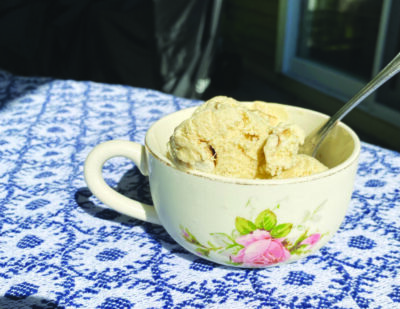
Toasted Marshmallow Ice Cream. Photo by John Fladd.
Combine egg yolks, salt, sugar and cream in a small saucepan.
Heat, whisking, until the mixture reaches 175ºF/80ºC.
Strain the hot mixture over 2/3 of the toasted marshmallows. Add the vanilla, and whisk the mixture until it is as smooth as it’s going to get. Do not let this step worry you; clumps of semi-melted marshmallows in this ice cream is not a bad thing.
Chill the mixture for at least three hours or overnight, then churn according to your ice cream maker’s manufacturer’s instructions.
When spooning the soft-serve-textured ice cream into containers, layer with the remaining toasted marshmallows, before hardening it off in the freezer.
Even die-hard marshmallow fans will admit that they can be a little (unrelentingly) sweet. This ice cream carries the toasted marshmallow flavor gently, in a just-sweet-enough base. The flavor is delicate enough that you will probably not want to eat this with any topping that might overpower it.
This is a definite winner.
The Chocolate
Let’s face it: It’s the chocolate that makes or breaks a s’more. The graham cracker provides texture, and the marshmallow provides sweet stickiness, but it is the chocolate that sets the tone for the whole enterprise.
Should you go with a classic milk chocolate, or something darker? Should you let it melt completely, or let your marshmallow cool a little so you still have some resistance to your teeth? Should you use a classic American candy bar or something a little shmancy?
According to Jeffrey Bart, the owner of the Granite State Candy Shoppe in Concord and Manchester, most people don’t put enough thought into this.
“Many times, someone will just break up a chocolate bar and hope for the best,” he says. His suggestion is to either use two types of chocolate or to finely chop some, but not all, of the chocolate, and use both in a s’more. The little pieces, having more surface area, will melt easily. “That hits the perfect ratio of totally melted and fused with the graham cracker,” he says, “and something to still bite into.”
He prefers his marshmallow gently toasted.
“I’m of the Low and Slow camp,” Bart says.
Rob Delaney and Maggie Pritty of Worldwide Chocolate in Brentwood agree that texture is important but stress the importance of picking the right flavor profile.
“Personally I’d go with a dark milk chocolate,” Delaney says, “which is not a thing that a lot of people are even aware exists.” He says that some dark milk chocolate can have as high a cocoa percentage as 55 to 70 percent, as opposed to the usual 35 percent or so for a typical grocery store chocolate bar. “That would have that milky, caramelly character, without being so sweet.”
Pritty stresses the importance of reading the label on a bar of chocolate. “Make sure to look at the ingredients,” she says. “You want to see that it’s made with cocoa butter and sugar, not hydrogenated palm oil or anything like that.”
She likes her marshmallows dark brown but not quite burnt.
So is there something chocolate-forward and s’moresy that will build your confidence back up?
Yes. Yes, there is.
Dark Chocolate Cheesecake with Graham Cracker Crust and Toasted Marshmallow
Crust
403 g graham cracker crumbs – this is almost exactly equal to one box of graham crackers
4 Tablespoons (56 g) butter, melted – this is half a stick
Cheesecake Filling
24 ounces (678 g) cream cheese, room temperature – this is three 8-ounce packages
1 cup (207 g) sugar
6 Tablespoons (43 g) dark cocoa powder
1 cup (230 g) sour cream, room temperature
1 teaspoon vanilla extract
8 ounces (227 g) dark chocolate, melted and slightly cooled
4 eggs, room temperature
Marshmallow Topping
1 7.5-ounce jar of marshmallow cream
Preheat oven to 325°F (163°C). Line a 9-inch (23 cm) springform pan with parchment paper in the bottom and grease the sides.
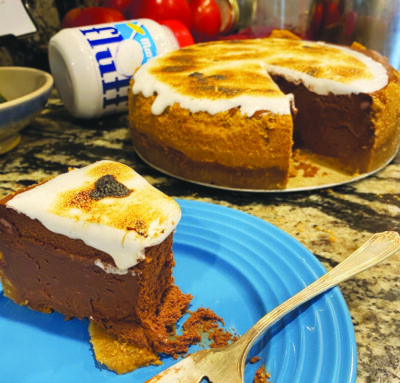
Dark Chocolate Cheesecake with Graham Cracker Crust and Toasted Marshmallow. Photo by John Fladd.
Combine the graham cracker crumbs and melted butter in a small bowl. Press the mixture into the bottom and up the sides of the springform pan. It will seem like too much crust, until it doesn’t.
Bake the crust for 10 minutes, then set aside to cool
Put your chocolate in a microwave-safe bowl, and heat, 15 seconds at a time, to melt it. Stop when it still has a few lumps. If you stir it at that point, everything will melt without getting too hot.
Cover the outside of the pan with aluminum foil. This is to more-or-less waterproof it, when it goes into a water bath. (Yes, there will be a water bath. Don’t panic. As the Winter Warlock® once put it, put one foot in front of the other.)
Reduce the oven temperature to 300°F (148°C).
In a large bowl, beat the cream cheese, sugar and cocoa until completely combined. If you use an electric mixer, use your lowest speed for this. Because Reasons.
Add the sour cream and vanilla, then mix to incorporate them.
Add the melted chocolate in three parts, stirring to combine each time.
Add the eggs, one at a time, mixing after each addition.
When everything is completely combined, pour the cheesecake batter into your foiled-up springform pan.
This is where the water bath comes in. In old recipes, it will be called a bain marie. Put your foiled-up pan inside a larger pan, maybe a turkey-roasting pan. (If, like me, you don’t have a pan that big, use your largest non-melty mixing bowl.) Gently fill the larger pan or bowl with hot water that reaches about halfway up the side of your springform pan.
Bake for about 70 minutes. Don’t panic and open the door too much. The whole reason for the water bath is to provide gentle steady heat to your cheesecake. It will have your back for one or two viewings, but try to exercise some restraint. Set a timer, and go clean out your refrigerator. You will not believe what there is in there.
After your timer goes off, check on your cheesecake. It shouldn’t be ready yet, but it will have a nice skin on top of it and be a little wiggly in the middle. Turn the oven off, but leave the cheesecake inside with the door closed, to finish cooking gently. Leave it for another hour.
When the oven is much cooler and your cheesecake has an internal temperature of 150º-175º F (65º-80º C), remove it from the oven, and let it cool on your countertop, then refrigerate for three to five hours or overnight.
When your cheesecake is completely cooled and firm, take it out of the refrigerator and de-pan it. You will rightfully feel proud.
But you’re not done yet.
Coat the top of the cheesecake with marshmallow cream. Use your own judgment as to how much you want to use.
Toast the marshmallow layer. Yes, you could do this under your broiler, but I prefer to use a blowtorch, either one of the mini ones designed for kitchen use or a plumber’s torch from the hardware store.
Serve immediately. If you aren’t serving a dozen people — though if you aren’t, why aren’t you? — wait until service before topping each slice with Fluff individually, then torch it in front of your guests, which is probably more dramatic anyway.
Much like a s’more, this is a very rich, deeply chocolatey treat. Even if you are a “more is more”-type person, you might want to start with a small slice of this. Its intense chocolateness is balanced by the sour tang of the cream cheese and sour cream, but it is still very, very rich. If you wanted to freeze this (and why wouldn’t you?) small slices might be even better.
The Fire
The only element left to discuss is the fire.
Yes, you could toast your marshmallow over the last coals in a charcoal grill, or even a gas one. In an emergency, you could toast it over one of the front burners in your kitchen, especially if you have a gas stove.
But half the experience of making s’mores is navigating actual flames — flirting with disaster, if you are a gently-toasted-golden-brown person, or plunging your marshmallow into the heart of the flame if you belong to the go-for-broke, fully-torched school of marshmallow toasting.
The key to a good marshmallow fire, according to 15-year-old Eagle Scout candidate Hailey Hansen, is starting small: “When I make a fire, I like to make a log-cabin fire, with sticks stacked like walls to a house, but you have to start from the bottom first, with tinder, then kindling, and larger and larger sticks, before you get to that stage.”
She says that coals are better for any campfire cooking, as they provide a steady, dependable heat, which lets a marshmallow roaster confidently choose how done they want to roast their marshmallow, but it’s not a binary situation:
“Your fire doesn’t have to be all coals. You can have half with flames, but let the other half burn down to safer” — by this, she clearly means “old person” — “coals,” she says.
Hailey likes her marshmallows golden brown and crispy but thoroughly melted inside.
At this point you must be feeling pretty confident s’mores-wise. If you can handle that cheesecake, you can host a s’mores party with one hand tied behind your back. But maybe you would like one more easy recipe to keep you bucked up until then. Is there an easy recipe that you can make to keep everyone on a short leash until it’s actually S’mores Time?
As a matter of fact, yes, there is.
S’mores Candy
Some marshmallows — the big ones, the mini ones, whatever you have around
Some graham crackers — you know you’re going to have to buy a new box, anyway, so you might as well use up what you have handy at the moment
Some peanut butter — all natural, or the kind that children actually like, it’s up to you.
Some chocolate — any chocolate: white, milk, dark, whatever you have stashed away in that cupboard that the kids can’t reach.
Crush the graham crackers into crumbs. A food processor is good for this.
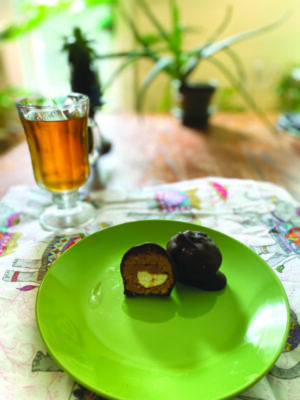
S’mores Candy. Photo by John Fladd.
Mix the crumbs with peanut butter — however much it takes to make a nice, stiff dough. You will almost certainly start doing this with a spoon, but almost as certainly end up mushing it altogether with your hands. You decide when it is the right consistency; this is one final exercise to get in touch with your s’mores instincts.
Melt the chocolate in your microwave. (See cheesecake recipe, above)
If you are using large marshmallows, cut them into quarters or eighths. If you are using mini-marshmallows, just let them be themselves.
Coat the marshmallows with the peanut butter dough you just made. You will probably need to play with it in your hands a little, before it reaches the consistency you want, and more-or-less covers the marshmallow. This doesn’t have to be perfect (because of the next step).
Drop the marshmallow/graham cracker/peanut butter ball into the melted chocolate, and then roll it around with a fork, until it is completely coated.
Remove the candy from the melted chocolate with your fork, then gently place it on a plate covered with a piece of waxed or parchment paper.
Repeat this until you run out of an ingredient. Don’t worry if you have some left over; any extra will mysteriously disappear.
Refrigerate the candies for at least 20 minutes. They are very good with tea.
Putting It All Together
At this point you might expect step-by-step instructions on how to make s’mores, but that would be silly. You have known how to make a s’more since you were 5 years old. It was probably the first food you learned to cook. It is less complicated to put together than toast.
Step 1: Toast a marshmallow
Step 2: Put a piece of chocolate on half a graham cracker, then sandwich the marshmallow between the two cracker halves.
(I do have a preference for Mexican chocolate — the gritty stone-ground kind — but when I mentioned this to our three chocolate experts, they stared at me in shock, then started to speak to me in very small words, so use whatever kind suits you personally.)
However, I do have one final recipe:
S’mores Martini
Graham Cracker Vodka
1 sleeve (135 g) graham crackers
3 cups 80-proof inexpensive vodka
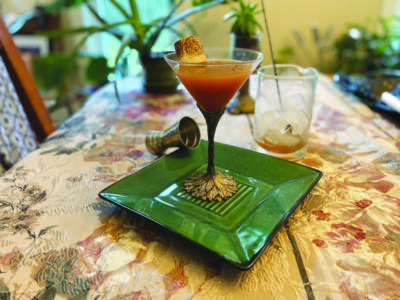
S’mores Martini. Photo by John Fladd.
Combine graham crackers and vodka in a blender. Blend at whatever speed pleases you for about one minute. Feel free to chuckle evilly as the graham crackers meet their fate.
Pour into a wide-mouthed, air-tight jar.
Store in a warm, dark place for a week, shaking twice daily.
This is really important: On Day 7, DO NOT SHAKE THE JAR.
Gently pour the clear liquid through a fine-meshed strainer, let it settle, then pour it through a coffee filter, into a labeled bottle.
Chocolate Vodka
This is very similar to the previous recipe.
¼ cup/1 ounce/30 g cocoa nibs. Cocoa nibs are the raw ingredient for chocolate-making. You can find them in an upmarket grocery store or online. I like ones from Guittard. They come with this warning: “May contain shell, kernel, plant material or other material from the growing process. Inspect or re-clean before using. This is not a Ready-to-eat food.” In other words, just exactly what we’re looking for in this application.
2 cups middle-shelf vodka
Combine the cocoa nibs and vodka in a large wide-mouthed jar, seal, shake vigorously, then place in the basement or under the sink, with the graham cracker vodka.
Shake twice per day for four days.
Strain, filter, and bottle, as above.
S’mores Martini
1 ounces crème de cacao
2 ounces chocolate vodka
2 ounces graham cracker vodka
a toasted marshmallow, for garnish
In a mixing glass, rinse several ice cubes with crème de cacao, then pour it off.
Pour equal amounts of chocolate and graham cracker vodka over the liqueur-rinsed ice.
Stir gently but thoroughly.
Pour off, into a chilled martini glass.
Garnish with toasted marshmallow, much like you would a conventional martini, with an olive.
The surprising thing about this martini is how well the flavor of graham crackers comes through. Make no mistake; this is a strong, fully adult cocktail. It is not nearly as sweet as you might be tempted to think. This is a s’more to drink in small sips.