Dancing, music and the iconic red boots will take the stage for The Palace Theatre’s production of Kinky Boots from Friday, Oct. 13, through Sunday, Nov. 5.
“Ever since the Kinky Boots musical was on Broadway [in 2013], it has just been one of those big, splashy, exciting musicals that many people would go see,” said Shane Hurst, the assistant director of the production at the Palace. “Time and time again it has proven to be, first of all, very entertaining and just a good musical, but then it also brings in a lot of different types of audience members. … It is a story of friendship, perseverance [and] about celebrating who you are and accepting other people.”
On the brink of bankruptcy, things don’t look great for Charlie Price and his men’s shoe factory. He fears he will have to close his doors, until he meets a drag queen named Lola.
“Through a series of circumstances they begin a friendship, and Lola tells Charlie that there is not a big retailer of drag queen professionally made boots,” Hurst said. “Charlie kind of has a spark in his brain and takes that back to the factory and says, ‘We can save the factory if we just pivot a little bit.’ Instead of making men’s shoes, which isn’t going so well for them, they rebrand and Charlie and Lola come up with the name ‘Kinky Boots’ and start manufacturing professionally made, sturdy, danceable drag queen boots.”
The musical, the book written by Harvey Fierstein and the music and lyrics by Cyndi Lauper, has won six Tony Awards and a Grammy. The Palace Theatre is pulling out all the stops with a video wall on the back wall of the theater, and a bigger-than-ever costume budget allowing for multiple costume changes, sequins, glitter, wigs and makeup, Hurst says.
“No matter who you are, you are going to find yourself on stage and relate to one of the characters in the show. I think it’s a show that very carefully changes an audience’s mind,” he said. “I think a lot of people are going to go in with the word ‘kinky’ and think it’s going to be a sexy, bold, brassy show — which it is — but behind all of that glitter is a lot of heart and a beautiful story about love and loving your neighbor.”
Kinky Boots Where: Palace Theatre, 80 Hanover St., Manchester When: Friday, Oct. 13, through Sunday, Nov. 5; showtimes on Fridays are 7:30 p.m., Saturdays at 2 and 7:30 p.m., Sundays at 2 p.m., plus Thursday, Nov. 2, at 7:30 p.m. Cost: Tickets range from $28 to $49
Featured photo: Kinky Boots dress rehearsal. Courtesy photos.
The state of NH’s bat population and what people can do to help
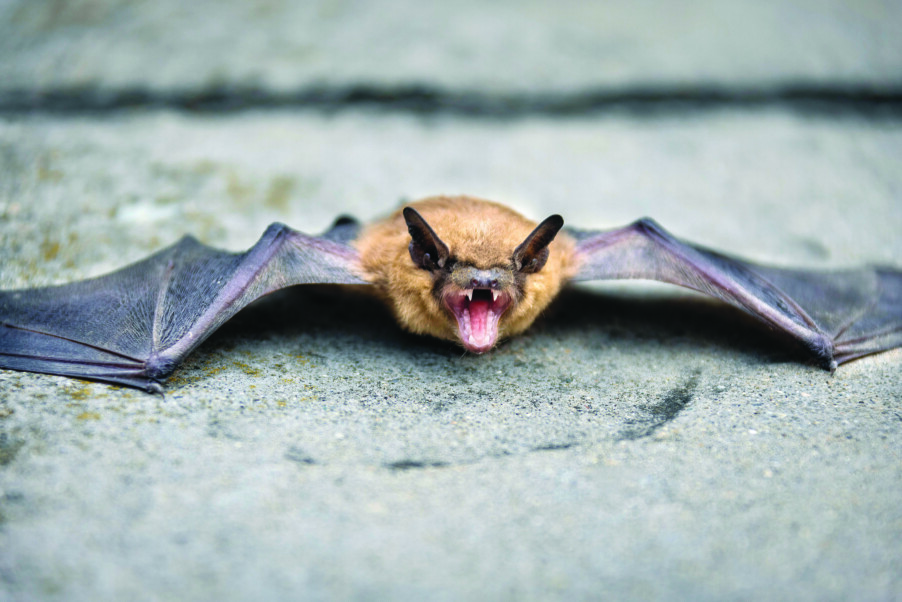
Bat Week, an international celebration and week of awareness for bats, runs from Tuesday, Oct. 24 through Halloween. While bats are a standard of Halloween scene-setting, many species of bats spend this time of year through mid-April hibernating in caves and mines. There, they face a threat — a fungal disease called white-nose syndrome that has, in addition to habitat loss and fragmentation, nearly obliterated the bat population in New Hampshire.
Bats in peril
“I wouldn’t call any of our bat species common because they all have threats to their population that result in population decline over the last 15 years or so,” said Haley Andreozzi, a wildlife conservation state specialist with the University of New Hampshire Cooperative Extension. “We have eight species of bats in the state of New Hampshire and all of them are what we consider species of greatest conservation need, which means they’ve been identified in the state wildlife action plan as species that warrant special concern.”
Half of these species, the little brown bat, eastern-small footed bat, tricolored bat and the northern long-eared bat, are all state endangered, the last of which is also federally threatened. The other species in the state include the big brown bat, the hoary bat, the silver-haired bat and the eastern red bat.
According to Sandra Houghton, wildlife diversity biologist with the New Hampshire Fish and Game Department, maternity colonies begin to disperse and head to their winter locations in mid-to-late August. Andreozzi says that the hoary bat, eastern red bat and the silver hair bat head south while the rest hibernate in the New England area, mostly Vermont and New York, in caves and mines, where they face the threat of acquiring white-nose syndrome.
“White-nose syndrome was first found in New Hampshire in 2009 and it really has decimated bat populations in the state for those species that spend the winter hibernating in caves and mines,” Andreozzi said. “Their populations have seen declines of [around] 99 percent … in the last 14 years since the occurrence of white-nose syndrome in the state.”
The conditions that are ideal for this fungus to spread are the same that are ideal for bats to hibernate: damp, 40-degree cave environments. The white fungus can be on an affected bat’s ears, wings, tail or nose, and while the fungus itself doesn’t directly result in a bat’s death, it leads to abnormal behaviors that do.
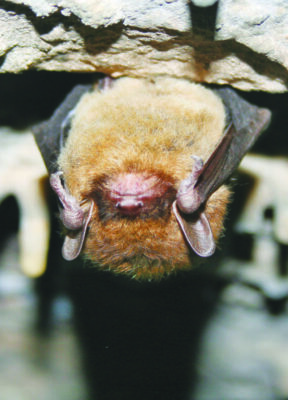
Little Brown Bat. Photo by Ann Froschauer.
“Bats are typically what we consider true hibernators; they’re really doing everything they can to expend very little to no energy in the winter months,” Andreozzi said. “They’re really kind of shutting down their bodies to make it through the winter so they don’t require any fuel, because their major food source, which is insects, isn’t available in winter. This fungus causes them to become more active and is really forcing them to use up fat stores that they otherwise really rely on to get through those winter months.”
Impacted bats will sometimes fly out of their hibernation sites into the cold to look for food and water and face the risk of freezing or starving to death. As with many wildlife species, Andreozzi notes, habitat loss and fragmentation pose further threats to bat populations.
“As development and human population has increased, we’ve seen an increase in habitat loss and fragmentation that’s had negative consequences for those species and populations,” she said.
Bats in the ecosystem
Losing the bat population could have negative impacts ecologically and economically.
In tropical areas, bats are very important pollinators for flowering plants, according to Andreozzi. Here, in more northern parts, their primary role is different.
“They eat a ton of insects and here in New Hampshire bats are actually the greatest predator of night flying insects that we have, and that’s because they have extremely high energy,” she said. “It takes a ton of energy for them to fly and so they’re typically eating half their body weight every night in insects, but even more if they’re a female who’s nursing pups.”
According to the New Hampshire Fish and Game Department, this can equate to 1,500 mosquitoes per bat per night. They also feed on agricultural pests, providing a pest control service valued at $3.7 billion annually according to an analysis mentioned on the New Hampshire Fish and Game Department website. One of the best things people can do to help bats combat the effects of white-nose, according to Andreozzi, is simply let them be and help maintain their habitat. Disturbing them during hibernation and rousing them can threaten their survival during the winter. During the summer, bats’ roosting sites vary depending on the species, eastern small-footed bats preferring hillside or cliffs and northern long-eared bats roosting in cracks in trees or crevices under tree bark. Others, like the big brown bat and the little brown bat, have adapted to using human structures.
“We encourage people to let bats exists where they have for centuries, which is in their barn or other outbuilding, so if someone has bats in their barn, shed or even their attic [if] it’s in a place where it’s not bothering them and there’s no human health concern,” Andreozzi said. “It’s really become an important, valuable bat habitat … and there is a way that bats and people can coexist if there’s no chance of direct contact with humans.”
If you meet a bat…
If you do come in contact with a bat, it’s important to take the right measures. While bats have a reputation for carrying rabies, they don’t carry rabies at a higher rate than any other mammal. Andreozzi says the issue with bat bites versus another animal, like a raccoon, is that their bites are so small you might not even notice you were bitten.
“Any case where a bat is found in a living space, like with a sleeping child [or] some other considerations, it needs to be treated as if the bat does have rabies regardless, and then you should get in touch with the department of health and human services through the state,” Andreozzi said.
If there is no chance of contact and you just wish to remove a bat from your house, she recommends turning off all the lights and opening a window and allowing the bat to fly out on its own. If that doesn’t work or the circumstances are more complicated, you can hire a licensed wildlife control professional for help.
Bat hospitality
Instead of sharing yours, there’s also the option of making bats a home of their own.
“People can install a bat house, which is basically an artificial roost structure,” Andreozzi said.
It’s not as simple as putting up a wooden box and hoping for the best, she says. There are specific features that make a bat house successful.
“You want them to be large, you want them to be dark in color, ideally facing south or southeast so they get really hot, because that’s what the bats are looking for,” Andreozzi said.
According to Bat Conservation International’s “The Bat House Builder’s Handbook,” the chambers of a bat house should be a minimum of 20 inches tall and 14 inches wide to be successful with at least one chamber. The bigger the house, and the more chambers it has, the better. While it’s important for the houses to be hot, ventilation slots are needed to prevent overheating when the average temperature in July is 85 degrees or higher. Having at least three chambers will likely be better at providing appropriate temperature ranges and will be more suitable for a larger number of bats and nursing colonies, according to the guide.
“You want them pretty high off the ground, typically more than 12 feet high or so,” Andreozzi said.
The guide says that bats are better able to find bat houses when they are mounted on poles or buildings as opposed to trees. This is also a more attractive location, as bat houses on trees will likely receive less sun and be more vulnerable to predation. Positioning them under an eave is a way to protect them from both predators and rain.
“With proper specifications and installation practices, those bat houses can be successful,” Andreozzi said. “They’re not always, but they do get occupied by bats pretty regularly when installed around the state.”
Bat Conservation International has further information on building and installing successful bat houses.
If building your own doesn’t sound like your thing, you can always purchase one and install it. In addition, there are other measures you can take when caring for your property.
“People can maintain or enhance bat habitat on their property or in their communities,” Andreozzi said. “Bats are using forested areas for roosting [and are] really interested in some of these dead trees we call ‘snags,’ these dead standing trees or cavity trees, so leaving some of those on the landscape can be beneficial.”
Other ways to be more “bat friendly,” according to Bat Conservation International, include opting for organic practices in your garden instead of using pesticides and remedial timber treatment agents, both of which can poison bats, and planting native plants and moth hosting plants that will attract native insects, noting that white and light-colored flowers are especially attractive to nighttime pollinators. On a larger scale, Andreozzi adds that conserving large areas of land that are ideal for foraging near ponds and streams is also helpful.
Another way people can help is by participating in UNH Cooperative Extension and New Hampshire Fish and Game’s Bat Counts program.
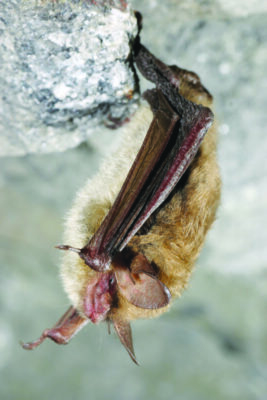
Northern Long-eared Bat. Photo by Al Hicks.
“Bat counts take about an hour and a half in an evening, starting a half hour before dusk, and volunteers are asked to conduct at least one count in June and one count in July, though they can count more frequently than that if desired,” Andreozzi said in an email. “The data collected helps us understand where bats currently live in New Hampshire and in what numbers, as well as help us learn more about the site characteristics where bats exist and are maybe even thriving.” In the 2022 Bat Count, 3,777 bats were counted, according to data provided by Andreozzi.
Training for the counts take place in May or June every year both virtually and in person. If interested, you can visit wildlife.nh.gov. For more information on upcoming sessions and training opportunities, as well as summer bat count results, you can sign up for the NH Bat Counts newsletter.
Bats of New Hampshire
The following information comes from the New Hampshire Wildlife Action Plan.
Big brown bat Big brown bats have three habitat types: forests, buildings and caves or mines. They can be found statewide in all forests, but are unlikely to be found in forests at high elevations. Forests with wetland, streams or other openings offer sites for foraging. During their active season, they use trees for day and night roosting and buildings for night and maternity roosting. During hibernation, they will use insulated buildings, caves, mines and artificial subterranean structures. Their habitat is highly threatened due to habitat conversion and the evicting bats out of buildings. Their bigger size and ability to hibernate in buildings means they are not quite as affected by white-nose syndrome as other hibernating bat species.
Little brown bat Like big brown bats, little brown bats live in forests, buildings and caves or mines and can be found anywhere in the state in different kinds of forests, but likely not in ones of high elevation. Their population has been greatly affected by white-nose syndrome, and they also have a high risk rating for human disturbances in their hibernation habitats.
Tricolored bat Tricolored bats hibernate in caves and mines, and occasionally in other structures, but there is no data available about where they roost during the summer in New Hampshire. Data from the Midwest shows that they are generally a foliage-roosting species, with females from maternity colonies living in the dead foliage of deciduous trees, particularly oak and maple.
Silver-haired bat The biggest threat to silver-haired bats is not white-nose syndrome — they migrate south in the fall — but wind turbines and habitat loss. Findings in their habitat studies have varied but it seems they typically roost in tree hollows and deep cavities in early to moderately decayed tall trees.
Northern long-eared bat Northern long-eared bats rely on caves and mines for hibernation — often in crevices or on the surface of walls and ceilings — and also use them year-round. They also roost in trees, both alive and dead. High-ranking threats for them are disturbance from humans as well as white-nose syndrome.
Eastern red bat Eastern red bats are another species that head south for the winter. They spend their New Hampshire summers roosting in tree foliage high off the ground in a variety of large deciduous trees near permanent water sources. They may roost closer to the ground when roosting in fragmented habitats like urban areas and farmland. Their biggest threats are habitat loss and wind turbines.
Hoary bat As with many other migrating bat species, the biggest threat facing hoary bats are wind turbines and habitat loss. While in New Hampshire for the summer, they roost in tree foliage, often woodpecker holes or squirrel nests and in branches sheltered by foliage about 12.7 meters off the ground.
Eastern small-footed bat Eastern small-footed bats live in rocky outcrops in the summer and in caves or mines in the winter. Their species status is not well known, but they have been caught in southern parts of the state during the summer months. They prefer colder hibernation temperatures and seem to arrive at their hibernation spot later and leave earlier than most other bat species, where the threat rank is high for disturbance from humans. One known winter site is the abandoned Mascot Lead Mine, which has stability concerns and accumulation debris, putting it at risk of collapsing.
Paul Brogan, author of The Concord Theatre, and author Margaret Porter present a gala at Bank of NH Stage — formerly the Concord Theatre — on Wednesday, Oct. 18, at 7 p.m., celebrating the 90th anniversary of the theater’s opening. NHPR’s Laura Knoy hosts the free event, which includes a screening of one of the theater’s most successful films, Moonstruck (1987). Brogan talked about his history with the theater and the impact it has had on him and on the Concord community.
What has been your personal journey with the Concord Theatre? Everyone in Concord would, at some point, come to watch a movie there. This was especially true in the late ‘60s and ‘70s before the prevalence of cable TV. Movies were an affordable entertainment choice. … I started working there in June of 1967. I was a teenager, a student at Bishop Brady High School in Concord. I was looking for an after-school job, and loving movies the way I did, it was the perfect job. I began working there in June of ‘67 and remained associated with the theater until it closed in September of ‘94. I didn’t work there every night, as I had been, but I was there two or three nights a week. I helped Theresa Cantin, who owned and ran the theater, to book films. She’d send me to screenings of upcoming films and would take into account my feedback. As a teenager, having someone much older value your opinion about movies was flattering. That’s partly why I stayed connected until the theater closed. Working there felt almost wrong to get paid because it was such a positive experience.
Tell us more about Theresa. Theresa was remarkable. She started there at 19 years old in 1933 and stayed until 1994. For 61 years this woman ran a first-run movie theater. Back in those days, while women might sell tickets or work the concession stand, the actual running of the theater and booking films was seen as a man’s job. She took care of everything from creating ads to selling tickets. Watching Theresa was truly inspiring.
How did the idea for an event come about? I wrote a book that was about the Concord Theatre and sort of a tribute to Theresa. … I was talking with my good friend Margaret Porter about it. We realized the date of the theater’s opening in 1933, Oct. 18, falls on a Wednesday this year, just as it did the year that the theater opened. … Laura Knoy [of NHPR] had also read the book and said she was just mesmerized by it. … So the three of us got together and decided we should do something special and give this gift to the community of a free evening in the theater.
You’ll be showing Moonstruck. Why that film? Well, the biggest hit at the theater was Valley of the Dolls, so we said, OK, what was the second biggest? [laughs] It was Moonstruck. It drew a little over 14,000 people, and Concord had [a population of] 30,000 at the time, so almost half the city came to see it. It was one of those movies where people walked out smiling and holding each other. It made everyone feel good, and it was one of those movies that Theresa was proud to play, so we thought that would be the perfect movie to celebrate the theater.
Have you heard from others who have memories of the theater? Yes. There’s a [Facebook page], ‘I’m from Concord, NH & remember when …’ and many people have shared their memories on there of when they went to see movies like The Breakfast Club and Pretty in Pink, Die Hard, the first Star Trek film. All those were shown at the theater. For a lot of people walking in there now, it’s going to be like a piece of history.
Featured photo: Paul Brogan with Margaret Porter, left, and Laura Knoy, right. Courtesy photo.
In September 2023, the Boys & Girls Club of Manchester (BGCM) announced its “Free Food Friday” initiative, offering club families complimentary groceries every week at its Union Street Clubhouse. According to a press release, this effort, in partnership with Hannaford and the New Hampshire Food Bank, aims to combat food insecurity in New Hampshire by providing essentials like produce, eggs, dairy and meats. With food laid out in the clubhouse lobby every Friday, families can easily collect supplies, ensuring they have ample food for the forthcoming week. During the summer of 2023, 353 families benefited from this program. For more information or to support BGCM’s endeavors, visit mbgcnh.org.
Nashua candidates
The Nashua Public Library (2 Court St. in Nashua; nashualibrary.org) and League of Women Voters NH — Greater Nashua will hold candidate forums at the library for the city’s alderman-at-large, ward aldermen and board of education positions. Meet alderman-at-large candidates on Thursday, Oct. 12, at 6:30 p.m.; ward 1, 2 and 6 alderman candidates on Thursday, Oct. 19, at 6:30 p.m. followed by wards 7, 8 and 9 at 7:45 p.m., and board of education candidates on Thursday, Oct. 26, at 6:30 p.m., according to a press release. At the forums, candidates will read opening statements and then take audience questions, via the moderator, the release said. Forums will also air on Nashua Public Television Channel 6, the release said.
New hire
Rebecca Fredrickson, a nonprofit veteran with over 15 years of experience, has joined Catholic Charities NH as a Major Gifts Officer, according to a press release. In her new role, Fredrickson will work on connecting supporters with their charitable passions, focusing on critical issues such as poverty, homelessness, mental health, and the aging population in New Hampshire. She will also contribute to the development of the organization’s major gifts strategy as Catholic Charities NH expands its presence in the state.
Sustainability studies
Plymouth State University (PSU) has initiated a series of courses and lectures as a part of its sustainability studies program, introduced in fall 2022, funded by a $56,867 grant from the National Endowment for the Humanities (NEH). According to a press release, a foundational course, Conversations in Sustainability, offers a multidisciplinary approach to sustainability, currently led by Associate Professor Laura Tilghman, Ph.D. This course, among others, is interwoven with the NEH Spotlight on the Humanities in Sustainability Lecture Series, which includes multiple events through December 2024. Additionally, the program will introduce an experiential class in fall 2024 and another centered on sustainability’s link to public health and humanities in spring 2025. The initiative aligns with Plymouth State’s interdisciplinary Cluster Learning Model and its focus on environmental education.
Pet paintings
The Salem Animal Rescue League, in collaboration with the Arts Academy of New Hampshire, is bringing back its unique fundraiser for its third year: custom pet portraits crafted by students of the Academy. From realistic renditions to imaginative interpretations, each portrait captures the essence of your pet in a distinct style, according to a press release. A donation of $25 gets you a digital portrait, while $50 provides both a digital and the original piece (with options for pick-up or mail delivery for an added cost). Orders are open until Oct. 17. Visit sarlnh.org.
Funds for breast cancer
Merrimack County Savings Bank sponsors the Making Strides Against Breast Cancer event on Sunday, Oct. 15, at Memorial Field in Concord. For the 8th consecutive year, The Merrimack will act as the Survivorship Sponsor of Survivor Place, having donated over $80,000 during this period, according to a press release. Survivor Place is a dedicated zone at the event where cancer survivors and thrivers can connect and share experiences. This year also sees the introduction of the Tribute Garden, which will display pink pinwheels purchased in homage to those who have battled breast cancer. The event, which annually raises about $500,000 for the American Cancer Society, is an avenue to fund research and provide cancer patients with necessary care and support.
Conservation awards
During its annual meeting on Sept. 16, NH Audubon announced its 2023 conservation award recipients. According to a press release, Karen Bennett of Antrim received the Tudor Richards Award for her impactful conservation efforts and work with Good Forestry in the Granite State. George W. Gavutis Jr. of Kensington secured the Goodhue-Elkins Award for his extensive contributions to bird knowledge and conservation in New Hampshire. The John Thalheimer Volunteer Award was given to Sandra Bowles of Bow for her dedicated gardening contributions at the McLane Center, especially her work on the pollinator gardens since 2018.
The Pembroke Town Library, in collaboration with the Pembroke Historical Society, is hosting a virtual Zoom presentation titled “Family Stories: How and Why to Remember and Tell Them” on Thursday, Oct.19, at 7 p.m. Jo Radner, a storyteller and oral historian, will lead the interactive session and guide participants on effective techniques to recall, develop and narrate personal stories. The event, sponsored by the NH Humanities Council, is free to the public. Register at pembroke-library.org.
Flag Hill Distillery & Winery in Lee is hosting a 10 Year Bourbon Release Party on Saturday, Nov. 4, to mark the launch of its 10-year-aged bourbon. According to a press release, the Prohibition era-themed event will start at 4 p.m., with a cocktail hour followed by a bourbon-inspired dinner, with opportunities to taste the bourbon, interact with the distillers and enjoy live music, campfire stories and line dancing. An after-party by candlelight will follow. Tickets cost $85. Visit flaghill.com.
SEE Science Center will host a Fall Fusion Festival on Saturday, Oct. 14, from noon to 3 p.m. at Arms Park in Manchester. The event focuses on art, science and inclusion and will feature the 2nd annual Disability Justice Parade, according to a newsletter. Attendees can view a partial solar eclipse at the designated SEE Science Center viewing area and witness the unveiling of Manchester’s newest murals. The Ooch Experience will provide music, and food trucks will be onsite. The festival is free and open to the public. Visit see-sciencecenter.org.
Raised in New York City, with a father who watched Dick Gregory perform in Village comedy clubs in the early 1960s, Steve Hofstetter grew up to be a smart comic. Don’t interrupt his set; Hofstetter’s retorts draw blood before an offender even knows there’s a knife in the scene. He has a YouTube page dedicated to heckler management.
Professional comedy wasn’t his destiny — until love leapt up. “I always enjoyed watching stand-up. I never thought I’d become one,” Hofstetter said by phone in July. “When I was 13 … the girl I had a crush on told me she thought I should join the improv club in school. I was so enamored with the idea that someone I was impressed by thought I was funny enough to do that.”
Over a 20-plu-year career, Hofstetter’s made eight albums and specials; the latest is The Recipe, which debuted on YouTube earlier this year. He has a knack for thought-provoking jokes, like one with a Rorschach test punchline, “I hope you get from life exactly what you deserve.” Broadly, he specializes in observational comedy, drawing inspiration from keeping his eyes open.
“Whenever people say, ‘Where do you get your material?’ I always think, ‘How come you don’t have yours?’ — we all live in the same world and see the same things,” he said. “It’s just about paying attention and processing what’s going on around you … if I see something that’s anachronistic, I can’t not notice it.” Improv still plays a role in Hofstetter’s comedy, in the form of a Q&A session after every show. He began doing them 10 years ago, mainly to produce content without having to give away new material online.
“I was OK posting bits I wasn’t doing anymore, but I didn’t want to post any of the current stuff,” he said, and the segments resonated, “because, partially they were watching comedy happen on the fly, and isn’t it more interesting to see something getting painted than just see the finished product?”
The sessions became good-natured roasts when he began bringing in fellow comics, the first time after he learned that his dog was dying and would need to be put down at tour’s end. “I was in no shape to think on my feet,” so Hofstetter asked two friends to lend emotional support. “They said yes, and it was great. It was so much fun to be able to bounce back and forth off each other.”
Hofstetter’s work extends beyond comedy. He’s written books and, a tireless baseball nerd, has worked in sports radio as well as writing a column for Sports Illustrated. He runs the nonprofit Steel City AF, a live/work/play environment for comedians based in Pittsburgh, where he’s lived for the past few years.
“It was always a dream of mine to have some sort of comedy-based charity, and when my dad passed, I had this realization of, if you keep waiting for stuff, you might never get there, so I decided to start it,” he said. He moved to Pittsburgh from Los Angeles, finding it was an ideal home base city with a great civic spirit. “The thing I like about it most is just how passionate about the city residents are; people are really, really proud of it, and want to make it better. There’s this amazing camaraderie that I just really like.” The foundation has given away some scholarships, and opened a performance space in a renovated building, inspired by an experience Hofstetter had at the Edinburgh Fringe Festival. Beyond that, Hofstetter received a Nobel Peace Prize nomination (really) for a digital comedy club launched during the pandemic. It led to over $1.5 million worth of work for comics that had no other options. “I was also still running my foundation where I was giving out grants to comedians that didn’t have any way to make any money,” he added.
What set the effort apart was that it extended beyond the constraints of livestreaming.
“We let the audience be unmuted, which was very different than most other places, because without an audience a comedian doesn’t have timing, and it feels awful,” he said. They also limited tickets and thus audience size to make the virtual events more manageable.
An upcoming show at Nashua’s Center for the Arts will be Hofstetter’s first ticketed event in the Granite State.
“I’ve done some college shows there early on in my career, and I did some bar shows here and there,” he said. “But that was when people had no idea who they were going to see; this is the first time since anyone has heard of me that I’ll be doing a show in New Hampshire.”
Steve Hofstetter When: Saturday, Oct. 7, 8 p.m. Where: Nashua Center for the Arts, 201 Main St., Nashua Tickets: $29 and up at etix.com
Featured photo: Amythyst Kiah. Photo by Sandlin Gaither
Once Kate MacKenzie left Manchester in 2004, she didn’t think she would ever come back. When she ultimately returned to the Granite State in 2015, she returned with inspiration that would manifest eight years later into South of the 6, a nontoxic nail bar and espresso bar opening on Saturday, Oct. 7, on Dow Street in Manchester, offering espresso, teas, kombucha and other beverages as well as pastries provided by the Bearded Baking Co. There will be a ribbon-cutting on Friday, Oct. 6, at 10:15 a.m.
Having grown up in Manchester after moving from Canada at just six weeks old, MacKenzie left for Nova Scotia to study psychology at Dalhousie University, where she met her future husband.
“In 2009 we said, ‘OK, we’re done with school, what’s next?’ and so we moved to Toronto and those were some wonderful, electric years in the big city,” MacKenzie said. “It’s a really unique, awesome place to be and it was a great time in my life because I was in my mid to late twenties, early thirties. Those were really kind of the golden years.”
While living there, MacKenzie and a friend would get manicures every other week, so when a new place opened they decided to check it out. What they discovered was a part cafe, part nail bar, where people could stop in, order a drink and enjoy it at the bar, or turn the corner to get a manicure while sipping on a cafe beverage.
“The concept was just mind-blowing to me because it really was the definition of self-indulgence,” MacKenzie said. “You’re sitting there, you’re getting a manicure for yourself and then you have a drink to sip on to really bring yourself into that moment and be there and take that for what it is.”
MacKenzie and her husband moved back to New Hampshire in late 2013 to be closer to her family. The concept had stayed in the back of her mind and was reawakened one spring morning in 2021.
“I wanted to make something inspiring [and] bring that sense of community, that sense of innovation to little old New Hampshire,” she said. “In that moment, that was not when my journey really started, but that was when I realized that it was going to turn into something real.”
A few months later she started working to bring it to life. She met the owner of Humble Warrior Power Yoga, who had offered for her to look at the space she had available for lease, informing her that, oddly enough, the yogis at her studio had been asking for coffee and for nontoxic nails. After taking a look, MacKenzie decided it was the perfect location.
“The space is divided so when you enter you can clearly see this is a coffee bar, this is where I order coffee, this is cafe seating,” MacKenzie said. “The nail bar is divided by a hedge wall so there is no confusion about where you’re sitting or where you’re supposed to be. … They’re more or less two separate entities, but they’re operating together so the only true overlap is that if you’re a client at the nail bar … you have access to that full cafe menu.”
The self-serve, full-service coffee shop will offer a variety of beverages including cortados, lattes, teas, kombucha and affogato, an Italian-inspired drink consisting of spiked ice cream from PopScoops with espresso poured over top. While food will not be made in-house, treats from the Bearded Baking Co., like muffins and croissants, will be available.
“This for me is really full circle because I never imagined coming back to Manchester because I didn’t really have the greatest memories of Manchetser,” MacKenzie said. “It was not a place that I felt connected to, so me coming back here and starting this business is more than just starting a business. This is me claiming my childhood and putting a different mark on it.”
South of the 6 Where: 155 Dow St., Manchester Cafe hours: Monday through Friday, 7 a.m. to 2 p.m.; Saturday, 8 a.m. to 1 p.m.; closed on Sundays. Salon hours: Tuesday through Friday, 10 a.m. to 6 p.m.; Saturday, 9 a.m. to 5 p.m.; closed on Sunday