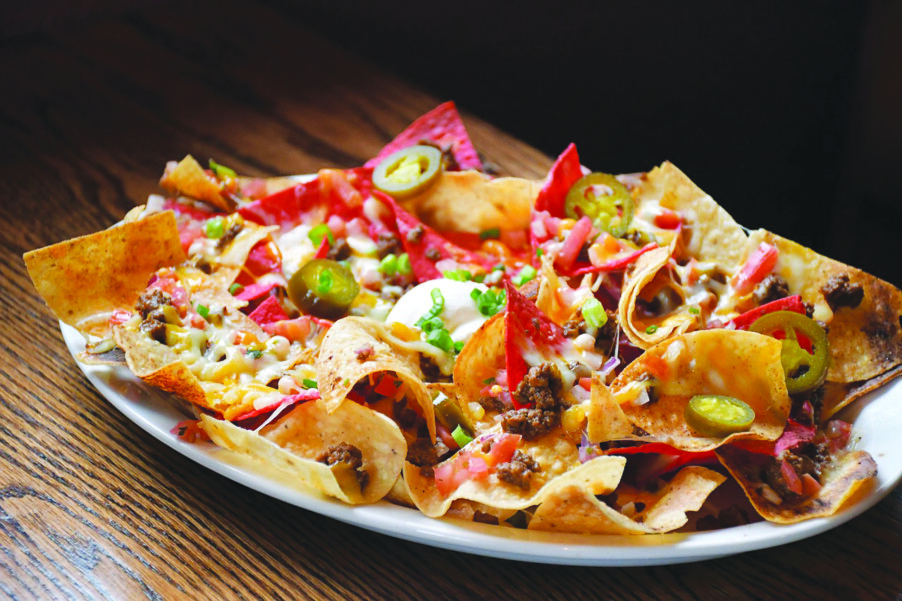
There is a skill to taking pictures of food. It’s a specialty of its own, very different from shooting portraits or action shots of children at an amusement park. According to Raquel Wojceshonek and Emma Fraser, a mistake many people make when they shoot food is forgetting to think of it as food.
“In a lot of cases for food photography there are a lot of tricks,” Wojceshonek said. “You can fake the height, you can put glue on things — there’s a bunch of things you can do to make it look better. We don’t have that luxury with what we’re doing.”
Wojceshonek and Fraser both work for Great New Hampshire Restaurants, the parent company for T-Bones, Cactus Jack’s, and the Copper Door restaurants. Some of their responsibilities involve photographing dishes that are being considered as new menu items.
For both photographers, it is important that the food in the pictures looks like it would if a customer ordered it.
“For us,” Wojceshonek said, “it’s a little bit different than some bigger-brand food photography, because … people are trying it right before a menu demo.” The demo is when restaurant executives try new dishes before adding them to the menu. “So everything you’re seeing is exactly how it comes out of the kitchen. Because we’re actually shooting at a live menu demo, the dishes that we’re photographing are actually going to the team to be tried and decided on if they’re going to end up on a menu. So it hits our table and we have about two minutes to take the pictures before the food gets taken away. We have to be quick with it. It’s kind of like fashion photography in that you’ve got that instant and then they’re down the catwalk somewhere else.”
For Fraser, the most important element of a food photograph is getting the light right.
“For me,” Fraser said, “it’s always about finding the correct lighting. It can’t be too harsh, but it can’t be too little. I actually prefer taking pictures on a cloudy day when the light isn’t super bright. Things don’t get too shadowy. It can be awkward, but I feel like every food is different.”
“I look at it with how a guest would see it,” Wojceshonek said. “What would make it the sexiest? I’m looking for a contrast of colors in the plate. I come in and edit how a guest would see it if they were about to pick it up and eat it. So if they were coming into the restaurant and they’re looking at their dish like this, this is what I want them to see. I want to see every part of it in the photo. So it’s not just a high up over. I want a guest looking at a picture of a dish to see every component they possibly can of that dish and picture it in their mouth.”
Fraser used a dessert as an example. “One of my favorites actually was the strawberry cheesecake creme brulee. We posted pictures of it on social media, and you just want to eat it. I got low and I got super close and the way the light hit the strawberry right there, it just looked juicy and appetizing, like fresh strawberries that actually have that shine.”
Wojceshonek said Fraser has one particular talent that serves them well when they shoot food. “She has tiny fingers,” she said. “So when we use her as a hand model, everything looks bigger.”
Nashville’s Celts bring Christmas show to New Hampshire
Unlike many purveyors of his genre, Ric Blair, who leads The Celts, wasn’t born in Ireland, though he has family roots there and in Scotland. Rather, the music found him, while he was studying jazz and classical at Conservatory of Music at the University of Cincinnati, and it took hold.
A friend persuaded Blair to take a day off from the rigors of studying and check out a traditional Irish band playing a show downtown.
“We walked in the door, and people were literally dancing on the tables,” he recalled by phone recently. “And immediately every cell in my body was like, ‘This is what I’m supposed to do.’”
Celtic music would weave its way into the Christian music albums Blair released starting in the mid-1990s. Around 20 years ago he launched an early iteration of Christmas With The Celts in churches around the country. The shows were a unique blend of ancient carols, traditional holiday songs, and modern tunes given an Irish twist.
In 2011 PBS broadcast a Celts performance filmed at Nashville’s Ryman Auditorium, and their holiday show became a national phenomenon. Since then the group’s name has changed a few times. First it was the Ric Blair Band, then The Celts, then the Nashville Celts. A few years ago they finally switched back to The Celts.
“We don’t know who we are; we like to keep the customers on their toes,” Blair said with a laugh. “Upon the advice of our booking agency, we made it official. They were like, ‘People are easily confused — is it country or is it Irish music with the Nashville Celts?’ We said, ‘Well, it’s a little bit of both. Just tell them the Celts.’”
These days the show offers a bit of everything, like traditional Irish dancers, some of whom are recruited locally. An area youth choir is usually at every tour stop, and there are plenty of jokes. “The quick Irish wit is a big thing in Irish culture,” Blair said, along with “the ability to laugh and not be so overly sensitive that we can’t laugh at ourselves.”
The music, of course, remains front and center, and it’s the most eclectic element of a Celts performance. For the holiday show there are songs not normally associated with the traditional Irish canon, like John Lennon and Yoko Ono’s “Happy Christmas (War Is Over)” done with a reel.
“I’ve always been a Beatles fan, like millions and billions around the world, and it just seemed to me to be a good song to kind of unify everybody,” he said. “The people that were around when The Beatles first started, and the children that don’t know who they are.”
Every year, Blair and his band strive to add new touches and fresh numbers to a show that for many fans is now a holiday tradition. He hinted at a new addition that doesn’t come from anyone’s Christmas carol book but seemed to him to be ripe for the Irish touch and a seasonal role. It’s a well-known hit from an English rocker popularized in a late 1980s movie and an accompanying music video.
“There was just a moment that hit me, where I was like, ‘Oh, my gosh, this is a perfect Christmas song,’” Blair said. “Just because of the lyrics, as far as getting to the message of Christ’s birth. It’s so fun to perform.”
Some of the best moments come when The Celts perform carols that are hundreds of years old. Even those are done in a decidedly untraditional manner.
“We have a song called ‘Wexford Carol’ that goes back to the 1600s, or 1500, even earlier than that. We’ve composed almost an EDM version of that.”
The band coming to New Hampshire for two shows, the first Dec. 19 at Derry’s Stockbridge Theatre and the second Dec. 23 at the Colonial in Laconia, consists of Blair, bassist Jimmy Sullivan, David Rollins on drums, and two fiddlers, each doing double duty. Grace Broadhead also sings, and Kira Doppel is a dancer.
Finally, multi-instrumentalist Patrick D’Arcy was a founding member of Flogging Molly and is a longtime collaborator of Blair’s, who called him “one of the best pipers in the world.” D’Arcy was lurking during the interview, and Blair deferred to the native Dubliner when asked why Irish music is so popular with American audiences.
“Because it’s so brilliant,” D’Arcy exclaimed, and continued. “They love it, and it’s not anything to do with their culture or family history. It’s way more an international thing now [even if] it will always be from Ireland. And it represents a return to simpler things as well. I think people like that at Christmas.”
Christmas With The Celts When: Friday, Dec. 19, at 7 p.m. Where: Stockbridge Theatre, 5 Pinkerton St., Derry Tickets: $33 and up at pinkertonacademy.org Also appearing Tuesday, Dec. 23, at 7:30 p.m., Colonial Theatre, 609 Main St., Laconia, $43 and up at etix.com
You got inspired by a cookie recipe you saw online, but you thought it would taste even better without the coconut. And maybe with butterscotch. And Sheila at your book group is gluten-free. So you adapted the recipe and baked it three times before you dialed in the ingredients and baking time. You’ve made so many of these cookies that your family is ready to ask for a salad. But you finally nailed it. Your cookies taste great.
But they look like they were made by a blindfolded orangutan.
How do some people make their cookies look like works of art?
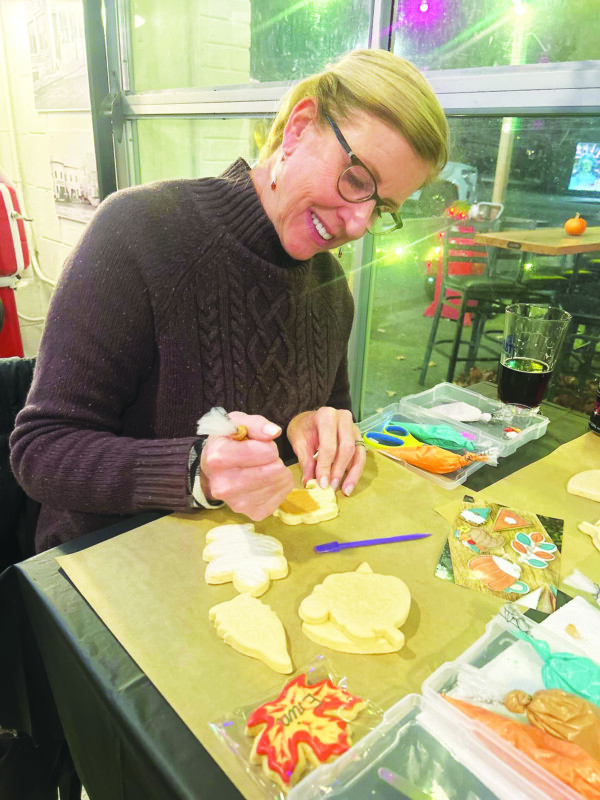
According to Kelli Wright, the secret is royal icing. Wright designs and produces custom cookies for customers, and teaches classes and workshops in cookie decorating through her business, Just Wright by Kelli (494-8472, justwrightbykelli.com). She said that unlike buttercream frosting, which tastes great but doesn’t lend itself to fine details, royal icing gives a baker more control.
“Buttercream is made from butter and sugar,” Wright said. “Royal icing is an icing. It hardens and there’s no butter in it. You can do more without it melting, so you have more capability with royal icing than you do with, say, decorating buttercream on your cookie. I think you have far more capability to create details and have them remain longer. It’s also more shelf-stable than a buttercream. When you make it correctly, the taste is just as good. It’s just a harder texture on the outside.” If you’ve watched cookie-decorating competitions on television, it is likely that the competitors used royal icing. When a contestant uses buttercream, they usually go out of their way to make a big deal about it.
Cookie Hack: Freeze the dough The cookie dough for all three of these recipes can be saved in the refrigerator for a week or so, or for much longer in the freezer, so you don’t have to use all of it at one time. You can also make and freeze logs of cookie dough to have on hand in case of a cookie emergency.
One of the techniques that experienced cookie decorators use is something called “flooding.” They will pipe an outline on a cookie with a slightly stiff icing, then pipe looser icing inside that outline, which spreads out, or “floods” the space. When it dries, the icing provides a smooth, glossy surface that looks good on its own or provides a base to pipe more details on top of.
“It’s basically coloring in,” Wright said. “Flooding is basically coloring and filling in whatever section it is that you are doing. There are multiple consistencies in royal icing. It’s basically a really thick one when you’re doing detailed work. But there’s multiple consistencies that you use for different effects. I like to use a medium consistency, which is a little bit thicker, but I can flood with it in smaller sections. And then I use a looser consistency. to fill in, or flood. Other bakers might use a thicker consistency for both.”
Wright said different consistencies of royal icing allow a decorator to add fine details to a design. “There are multiple techniques to do any design,” she said. “One way is to outline flood and then do your details on top of that. But there is a technique called wet-on-wet where you’re using a loose consistency the entire time and the design is actually falling into your flood icing and you’re creating it all in one layer at one time.”
In Wright’s classes and workshops she has seen a spectrum of attitudes toward decorating.
Photo courtesy of Kelli Wright.
“On one hand,” she said, “you just have a mix of people who just want to have fun and learn the basics, and then you have people who really want to learn. They are intent on getting the technique down right away and really intent on learning everything they absolutely can in every single class. And it can be hard in the beginning. It’s a lot harder than what you see on TV. I mean, I try to make it easier because I’ve gone through the … tribulations. I’ve learned on my own. Some people just have a natural ability to do it, and I think that’s amazing. But it took me some time to get the hang of it and adjust the consistencies to make it work for me and my style. There was a steep learning curve, but I was able to learn it on my own.”
“The best part about cookie decorating or cake decorating … and custom work like I do,” she said, “is the free form of it all. Letting it be art and realizing art, nature, everything is not about perfection.”
Royal Icing 4 2/3 cups (530 g) powdered sugar 1/3 cup milk 2 Tablespoons light corn syrup 1 teaspoon vanilla or almond extract
Mix these ingredients together, gently and slowly at first, until they come together as a thick, pipable liquid. Add more milk, a spoonful at a time, as needed, to thin it out. Split the icing up into separate bowls depending on how many colors you will need to decorate your cookies. Stir in food coloring a few drops at a time to color each bowlful. Kelli Wright and Kate Soleau both prefer gel food coloring. Use a piping bag or a plastic sandwich bag with the very tiniest tip of a corner cut off to pipe lines on your cookies. You can pipe or spoon more icing to “flood” it.
Wright likes to use all-natural gel-based food coloring.
“I don’t use a water-based [color] because it can alter my consistency. And then I have to remix and change my consistency. There are powdered colors out there, too. Prism, I think, is the company, or now it’s SugarArt, has beautiful powdered colors and a natural color base that people use. But there’s a whole other learning curve to go through … using the natural products because they don’t work the same as our current gel food coloring. They work very differently.”
Because Wright makes some very specific custom designs of cookies, she rarely buys cookie cutters “off the shelf” anymore.
“Etsy is kind of the place to go. I buy the STL files [from artists] on there and print them myself on my 3D printer. If you don’t have access to a 3D printer, your library might be able to print them for free, so if you find something that you really like you can always get the file and see if your local library will print it out for you.”
Kate Soleau is another custom baker, decorator and instructor. Her business is Posy Cottage Cookies (801-7590, posycottagecookies.com). She is in the process of developing online instructional content to teach elements of cookie decorating. She is a big fan of royal icing but takes a slightly different approach to adding details.
“I like to use stencils,” Soleau said. “I’ll flood the background [of a cookie], let it dry, and then come back the next day with a stencil and scrape thicker royal icing over it. When I remove it, it looks like a very cool textured look on the cookies, but it is still just using the royal icing. I’d say 90 percent of my additives on decorating are royal icing but used in different ways. So for instance I make a lot of floral transfers where I take really thick royal icing and pipe it with a piping bag with little metal tips, make flowers, and then let them dry. Later I can come back and actually pick them up and use them as homemade sprinkles or transfers to put onto cookies to enhance the look.” Soleau also uses a 3D printer to make custom stencils.
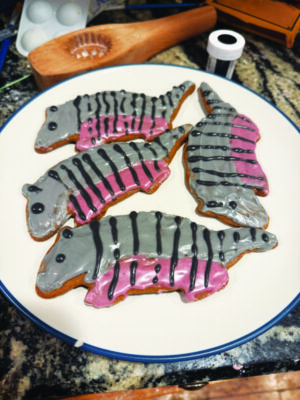
Decorated gingerbread armadillos by John Fladd. Photo by John Fladd.
For the highly detailed work Soleau does, she rarely uses candies or sprinkles.
“But there’s a gold dust,” she said, “where you mix a powder that’s gold or silver with a little bit of vodka or Everclear [an extremely high-proof grain spirit] and then you paint it on.” She explained that the high-proof alcohol evaporates quickly and doesn’t change the flavor of the cookie.“ I do a lot of painting techniques on my cookies and I’ll use edible gold but also just use food-grade gels and do the same thing — mix them with water or Everclear, then paint the cookies. I generally use transfers and use what I have to create the decor.”
Soleau said many of the techniques she uses to decorate cookies have unexpected quirks that she only learned about with experience.
White Cutout Sugar Cookies 2 1/2 cups (300 g) all-purpose flour 1/2 teaspoon salt 1/2 teaspoon baking powder 1 cup (2 sticks) butter 1 cup (198 g) sugar 1 egg 1 teaspoon almond extract – Yes, you could use vanilla. It’s kind of boring a classic. But the almond gives this cookie a slightly fruity background flavor.
In a medium bowl whisk together the flour, salt and baking powder. Set it aside. Its time will come. In your stand mixer — A quick aside: If you like to bake, or think you might like to if it were less of a hassle, it would be worth your time and money to invest in a good stand mixer. Yes, the really good ones (cough, cough, KitchenAid) can be pricey, but you can buy a reconditioned one from most manufacturers for about 30 percent less than a new one. There’s a lady at one of the flea markets I go to who has a couple of tables full of kitchen appliances. With some hard haggling and a gift doughnut, you might get a stand mixer for $100 or so. Alternatively, you can go the conventional route and get married. A good stand mixer will last longer than most marriages. — anyway, in your stand mixer, beat the butter until it has softened slightly, then add the sugar, and beat until it is creamy, about three minutes. This is, appropriately enough, known as “creaming” the butter. Beat in the egg and almond extract. Turn the mixer to its lowest setting, and spoon the flour mixture in, a little at a time. This is to prevent a comical poofing of flour into your face. Mix everything very briefly, just until it all comes together. Split the dough into two lumps and wrap each with plastic wrap. Chill the dough in your refrigerator for an hour or two. When the time comes to bake, preheat your oven to 350°F. Flour your counter, then unwrap one of the doughballs and flatten it with the heel of your hand. You will want to flip it a couple of times and swish it around in the flour, to keep it from sticking. Use a rolling pin to roll it out to about ¼ inch thick. If you have a large offset spatula — the kind fancy people use to frost cakes — swipe under your rolled-out cookie dough to make sure it hasn’t bonded to your counter. Use whimsical cookie cutters to cut shapes from your sheet of dough. Transfer the cutout cookies to a baking sheet covered with parchment paper, or a silicone baking sheet. These particular cookies won’t spread too much as they bake, so you won’t need to space them out too much. Bake each batch of cookies for 10 minutes, and let them cool on the baking sheet.
“For instance,” she said, “I’ve been dabbling in natural food-grade gels. It’s kind of like a whole science project because the pH and everything actually changes the color. So if you try to make black, sometimes it’ll come out a little purple and you add a little baking soda and it’ll change the color. So the natural gels have been challenging, but I’d really like to work more with natural colors in the future.”
Where sprinkles, miniature candies and dragees (colored sugar balls) come into their own is in decorating with children. Kristen Chinosi is the owner and chief instructor at The Culinary Playground in Derry (339-1664, culinary-playground.com), where she teaches cooking and food techniques to adults, children and mixed groups. She said that for very young children a good strategy is for an adult to bake cookies ahead of time, frost them with buttercream, and provide the kids with decorations they can press into the frosting.
“For the younger kids, you definitely want to go with just a buttercream as a base and use it as sort of a glue to hold on whatever other candies, sprinkles you’re supplying for the decorating,” she said. It’s a good idea to take a child’s age and ability into account to keep them — not to mention their parents — from getting frustrated.
“Probably not younger than 8 — more like 10 — is a really good age to start with royal icing,” Chinosi said, “because those need to be bagged. You need quite a steady hand; it’s pretty detailed work. I mean, younger kids can try it, but the frustration level can get high. If you’re doing soup-to-nuts with your Christmas cookies — meaning if you’re making your own sugar cookies, rolling it out, cutting them and frosting it — plan to make it a two-day event, because the kids will lose interest and you will be by yourself decorating cookies. So on one day you could have them help make up the dough, maybe later that day you roll it out, cut the cookies, set them aside. The next day, make up your frosting, or if you’re using a canned frosting that’s fine too. They’re littles, right? And then have like a decorating party. And what we like to do is use muffin tins and we’ll line them with like the paper liners and put different types of candies or sprinkles so the children have kind of like a whole little array.”
Old-fashioned gingerbread cutout cookies 1 Tablespoon ground ginger 1 Tablespoon ground cinnamon 1/2 teaspoon ground cloves 1/2 teaspoon ground black pepper – after you’ve made this recipe once or twice, you might want to use more black pepper, or even, if you’re feeling adventurous, ground Szechuan pepper. 5 cups (600 g) whole wheat flour 1 teaspoon baking soda – If you were wondering why this recipe uses baking soda instead of baking powder (and let’s face it; you probably weren’t), it’s because the molasses is slightly acidic, so the slightly alkaline baking soda will work better in this particular application. 1 teaspoon salt 1 cup (2 sticks) butter 1 cup (198 g) brown sugar 1 egg 1 cup (340 g) molasses
See if this seems familiar: Whisk the spices, flour, baking soda and salt together in a medium bowl and set it aside. Cream the butter and brown sugar together, then beat in the egg and molasses. Add the flour mixture, a couple of spoonfuls at a time, and mix everything until the dough just barely comes together. Divide the dough, wrap it, and chill it. Roll the dough out, and cut out shapes with cookie cutters, then bake at 350°F for 10 minutes, and let them cool on the baking sheet. If you own an old-fashioned, wooden cookie mold, this dough works extremely well using that. Just remember to brush the inside of the mold with vegetable oil before you start, and with flour Every Single Time thereafter. These are, as promised by their name, classic, old-fashioned gingerbread cookies, spicy and not too sweet, perfect for decorating in full color or with traditional minimalist white icing.
The Nature Conservancy (nature.org) will celebrate the longest night of the year with a Winter Solstice Soirée this evening from 5 to 9 p.m. at the McAuliffe-Shepard Discovery Center (2 Institute Drive, Concord, 271-7827, starhop.com). Celebrate the season and mingle with other nature lovers with drinks, light appetizers and holiday cheer. Register at preserve.nature.org/page/180114/event/1.
Thursday, Dec. 18
Pop-rock band the Jonas Brothers perform at the SNHU Arena (555 Elm St., Manchester, 644-5000, snhuarena.com) tonight beginning at 7:30 p.m. as part of their Greetings From Your Hometown tour. Tickets start at $196 through ticketmaster.com.
Friday, Dec. 19
The Canadian Brass will perform at the Nashua Center for the Arts (201 Main St., Nashua, (800) 657-8774, nashuacenterforthearts.com) tonight at 7:30 p.m. as part of their Making Spirits Bright tour, which includes original arrangements and signature takes on beloved holiday classics. Tickets start at $54.
Friday, Dec. 19
Etz Hayim Synagogue (1 1/2 Hood Road, Derry, 432-0004, etzhayim.org) continues its annual tradition of lighting its giant outdoor electric menorah tonight from 7:15 to 8:30 p.m. to celebrate the sixth night of Hanukkah. Jelly doughnuts will be served.
Saturday, Dec. 20
Red River Theatres, 11 S. Main St. in Concord, redrivertheatres.org, has fam-ily-friendly holiday screenings on the schedule this weekend. Catch Elf (PG, 2003) on Saturday, Dec. 20, at 10 a.m. andThe Grinch (PG, 2018), the animated movie, on Sunday, Dec. 21, at 10 a.m. Both screenings feature complimentary hot cocoa. Tickets can be purchased on the website.
Saturday, Dec. 20
Enjoy a festive holiday tradition at The Stockbridge Theatre (22-98 Bypass 28, Derry, 437-5210, pinkertonacademy.org/stockbridge-theatre) at 7 p.m. with the Safe Haven Ballet’s production of The Nutcracker. Tickets start at $33 through the Theatre’s website.
Saturday, Dec. 20
New Hampshire Philharmonic Orchestra (647-6476. nhphil.org) will perform its Annual Holiday Pops concert this afternoon and tomorrow, Sunday, Dec. 21, at 2 p.m. at the Seifert Performing Arts Center (Salem High School, 44 Geremonty Drive, Salem, 893-7069, ext. 5601, sau57.org/pac). An audience favorite returns with seasonal classics, sing-alongs and more. General admission tickets are $35.
Saturday, Dec. 20
’80s glam metal band Warrant will take the stage at the Tupelo Music Hall (10 A St., Derry, 437-5100, tupelomusichall.com) at 8 p.m. tonight as part of its Let The Good Times Rock tour. Tickets start at $84.
Save the Date! Sunday, Dec. 28 Experience the thrills of slam dunks, trick shots and moments you’ll never forget as The Harlem Globetrotters dazzle, dunk and hype the stands as part of their 100 Year Tour. They will take on their long-time rivals the Washington Generals, who are due for a win. Performances will take place at 2 and 7 p.m. Tickets start at $90 through ticketmaster.com.
Featured Photo: The Harlem Globetrotters. Courtesy photo.
The Anheuser-Busch facility in Merrimack will close in early 2026, as reported in a Dec. 11 report on WMUR.com and by several other media outlets. A press release from New Hampshire Senate President Sharon Carson (R-Londonderry) said the plant represented nearly 120 jobs. “The State of New Hampshire will provide the necessary resources and support to help them navigate this challenging transition,” Carson’s press release said. Sen. Tim McGough (R-Merrimack) also put out a release on the closure saying, “Anheuser-Busch has been a long-time supporter of Merrimack, contributing to local schools, charities, and civic organizations. It has been a driving force behind our economy providing jobs and supporting vital community projects.”
LCHIP
On Dec. 9, Gov. Kelly Ayotte joined “New Hampshire Land and Community Heritage Investment Program (LCHIP) Board Chair Richard Lewis in announcing 31 LCHIP grants totaling more than $3.5 million awarded to municipalities and nonprofit organizations in support of land conservation and historic preservation initiatives across the state,” according to a press release from the program. Grant recipients include Canterbury Shaker Village ($250,000) for its East House, Kimball Jenkins Estate ($18,450) for a comprehensive building assessment of its five historic structures, Goffstown Public Library ($19,272) for preservation of its wood windows, Hudson Historical Society ($72,875) for Hills House, Grace Episcopal Church in Manchester ($22,000) for Riddle House, and the Town of Milford ($12,500) for the Milford Town Hall assessment, according to the program’s website lchip.org, where you can find descriptions of all of this year’s recipients, see a map of LCHIP projects and find information about applying for the grants.
Delta Dog
Red Arrow Diner raised more than $8,000 to benefit Operation Delta Dog, an organization that rescues and trains “shelter dogs as specialized service companions for veterans experiencing PTSD, TBI, and MST,” according to a Red Arrow press release. The diner held a Breakfast for a Year raffle, selling tickets for $1 each, to raise the funds, which it presented to the Hollis-based Operation Delta Dog on Dec. 12, the release said. See operationdeltadog.org.
Big stuffies
The D’Amante family continued an annual tradition of gifting “more than 20 oversized stuffed animals” to the Concord Hospital pediatric unit for pediatric patients “who are invited to choose their own stuffed companion to snuggle with and then take home,” according to a Dec. 8 hospital release. “The tradition began when Cinda D’Amante visited the unit decades ago and decided to make a positive impact on hospitalized children during the holiday season,” the release said. See concordhospital.org.
The Flying Monkey in Plymouth will screen 1946’s It’s A Wonderful Life on Saturday, Dec. 20, at 2 p.m. Doors open at 1 p.m. for this free screening; reserve tickets at flyingmonkeynh.com.
Rick Santos has resigned as head football coach at the University of New Hampshire in Durham to accept the same position at the University of Pennsylvania, according to a Dec. 13 UNH press release. “Associate head coach and defensive coordinator Scott James has been named interim head coach, and UNH will launch a national search for the next program leaders,” the release said.
Day’s Jewelers, “an employee-owned New England fine jeweler” that has eight locations in New Hampshire and Maine, held a grand opening in November for a location at Tuscan Village in Salem, according to a press release. See daysjewelers.com.
Spyglass Brewing Co., 306 Innovative Way in Nashua, will hold a Puzzle Competition on Sunday, Dec. 21, starting at noon, according to spyglassbrewing.com. Teams of up to four people each will compete at putting together a 500-piece puzzle, the website said.
Some of the most sophisticated and mature music in New England is coming from Slim Volume, a Manchester quartet that in four years has grown into a solid presence on the scene. Fans of lush harmonies, layered guitars and songs that suggest many influences but stand out as unique have a chance to see for themselves at an upcoming Pembroke City Limits show.
“Slim Volume is one of the most cohesive bands around,” Pembroke City Limits owner and regional music authority Rob Azevedo commented recently. “It’s as if the band members were all meshed together, sharing in melody and sound. Just a tight, tight band.”
Two EPs released over the course of 2024, Back To You and Big Plans, were both the result of Trent Larrabee and Jake DeSchuiteneer, who respectively play guitar and bass, coming to guitarist Mike Morgan and drummer Jonny Lawrence with mostly completed songs. Early this year, that began to change.
“We took a deliberate approach … to pull back on Jake and I bringing material into the band that’s already written and fleshed out, and we’re going to go toward just organic creation,” Trent said in a recent joint Zoom interview with Jake.
“It’s easier, especially when you have bandmates who are very eager to contribute something unique.”
Jake agreed. The old way, he said, “can deny the other members of the band a little bit of flexibility, and the ability to kind of put in some of their own creativity. Like if someone suggests in a bridge, ‘Hey, what if we went to this change instead?’ and I say, ‘Well, I’m kind of married to this thing that I’ve had since I wrote it.’”
Trent and Jake have a Lennon and McCartney thing going as a songwriting team — the first song they learned together was a Beatles song — but composing as a band lifted their overall sound to another level. Jake credits a big part of it to Mike’s contributions on guitar and the textured, atmospheric sounds that result.
“He’s a very prolific writer of guitar parts that lend themselves really quickly to becoming songs,” Jake said. “The kinds of things he writes tend to be of a different flavor than something Trent would come up with, or something I would come up with. It allows us to kind of run a little wild on it lyrically and melodically.”
This all happened as Trent switched from acoustic to electric guitar and Slim Volume started to move away from the folk rock sound of its early records.
“Electric is just different, it opens up so much more potential,” he said, especially with a second guitarist. “Mike and I are both very careful about overplaying … I think that comes through.”
One consequence of this new “all for one, one for all” approach is that the band is writing a lot of new music. Ten songs recorded from January to April should have been released but for what Trent termed “a series of setbacks with the mixing” that are now resolved. In the interim, they’ve written another ten.
The band’s name definitely doesn’t refer to the number of musicians that inform their sound. There’s a vast river of music packed into their songs. One of the best, “Talk It Over” came after Trent heard “a random boygenius” track Jake sent him, “and it blended with the Vance Joy that I was listening to at the time.”
Another, “Big Plans,” echoes a Beatles song, though not deliberately. “I didn’t instantly think of ‘Dear Prudence.’ Once we were recording it, I was like, ‘Oh, wait,’” Jake recalled. Heck, George Harrison cribbed “Something” from James Taylor, so it’s all good. “A lot of our primary influences are classic rock guys … it’s a pretty big stew between the four of us.”
The show in Suncook is the band’s last scheduled one for a while. They are booked at Concord’s BNH Stage next April. “That’ll be our first time there as a headlining band,” Trent said. “We opened for Modern Fools in January and Golden Oak from Maine the prior year. So we’re really excited for that.”
They also are looking forward to their third show at Pembroke City Limits. Trent encourages people to come out for it.
“If you haven’t seen Slim Volume in a while, this would be a great place,” he said. “You’ll hear a bunch of new stuff and hear how the songs have evolved.”
Slim Volume When: Saturday, Dec. 13, at 7 p.m. Where: Pembroke City Limits, 134 Main St., Suncook More: slimvolume.band