Most art exhibitions focus on already completed works, but the City of Nashua is unique in hosting an event that’s about watching art come to life, from raw materials to finished pieces. The Nashua International Sculpture Symposium (NISS) happens for three weeks in May in and around a converted mill building.
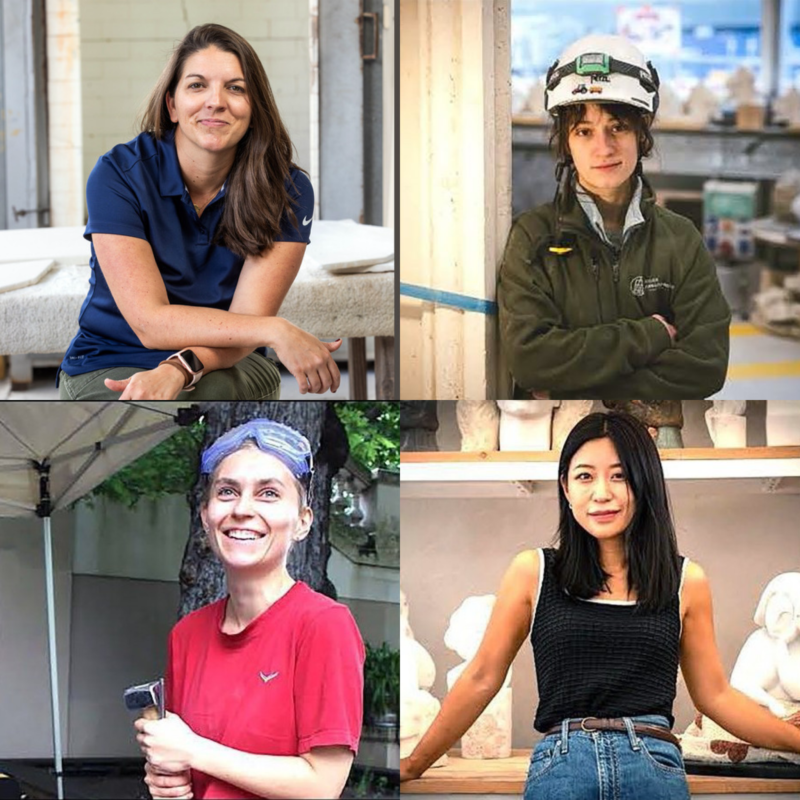
Every spring, four sculptors from around the world are invited to participate. This year’s include Valerie Funk, who lives and works in Berlin, Germany, Danaë LeBlond-Joris from France, South Korean native Yunmi Lee, who’s exhibited in Italy as well as her home country, and U.S.-born Casey Schachner, who teaches art at Georgia Southern University.
Now in its 18th year, the event hews to a motto of “art as everyday living,” with a legacy of 52 different public art works in Nashua’s downtown, schools, parks, neighborhoods and walking trails. And it’s truly community-wide; the visiting artists are housed by area families and supported by local businesses and organizations.
NISS President Gail Moriarty is a metalsmith who first got involved by hosting the symposium in a building next to the Picker. In 2016 she and her partner purchased the Pine Street location and launched Picker Artists’ and Design Studio. Moving the symposium there made sense, both practically and aesthetically.
The location and layout of the studio lent it to showcasing the evolution of public art, Moriarty said by phone recently.
“It’s a busy street, and we have sculptors working. It’s a long mill building, so they work on the side of the building right next to the streets; everybody can see them,” she said, adding, “It’s a public, community-driven event.”
While there are only four host families, others get involved by hosting meals with the sculptors. People sign up for lunch or dinner, and bring enough for themselves and the artists. Their reward is a lot of one-on-one time to learn about the work and where the creators come from.
“You sit and enjoy your meal with them, which is private time that you get to spend with these international sculptors; it’s pretty popular,” Moriarty continued. “We love it because we show them the room, we set them up, we close the door, and they have that whole time with the sculptors. No one else is bugging them.”
While the people of Nashua love the event, Moriarty said it’s the sculptors themselves who are the biggest fans. “These are professionals, who travel the world doing sculpture symposiums,” who are more than happy to receive living expenses and a stipend at NISS. “I get requests all year long — when’s it happening, can I apply?”
Moriarty recalled going to breakfast with a sculptor after an installation. Upon learning what most at her level in the art world regularly earn for their work, she asked her why she wanted to come to NISS.
“‘Because of the people, because of your respect for us guys and the way everybody talks about you; all we hear is great things, how much fun it is and how the people are so cool … we just needed to be a part of it,’” Moriarty recalled being told. “They come from Israel and Ukraine and Iran, all these places, and then they go back home to what is going on in their country. But here they had three weeks of fun, and tons of food and lots of people and hugs.”
This year’s theme is “In The Making,” chosen for the unfolding nature of NISS.
“You never know what you’re going to get,” Moriarty said. “The sculptors … can do whatever they want, and it’s different every single day, different every single year. It’s very unique. To watch these people take these big pieces of stone and cull them into something that’s beautiful in just three weeks is just extraordinary.”
18th Annual Nashua International Sculpture Symposium When: May 8 through May 31 Where: The Picker Artists’ Studios, 3 Pine St., Nashua Opening ceremony May 8 at 5:30 p.m., closing ceremony May 31 at 1 p.m. (begins at Picker and moves around the city)
Featured photo: Clockwise from top left, sculptors Casey Schachner, Danaë LeBlond-Joris, Yunmi Lee and Valerie Funk (Courtesy photos).
For Susan Chung, owner of Sue’s Kimbap House, kimchi is as much a staple of everyday cooking as flour or butter.
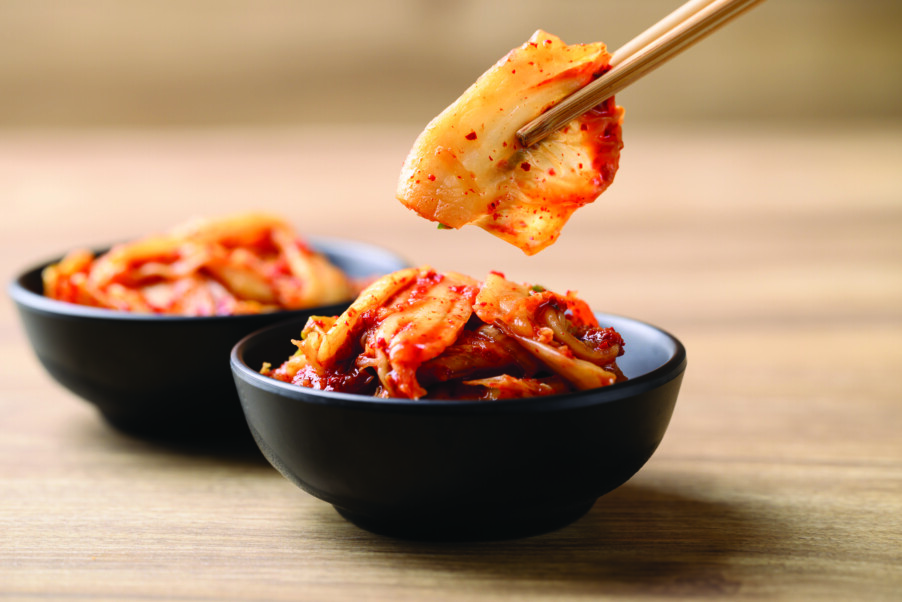
“Kimchi is just a traditional Korean dish that was made with fermented vegetables,” said Chung, who is the Capitol Center for the Arts’ Culinary Artist in Residence and whose eatery is at Bank of NH Stage in Concord. “The most common type is made from napa cabbage. Another one is [made from] the Korean radish or daikon. Another one that probably isn’t as familiar is kimchi made with cucumbers. That’s one we’re planning to launch at our store coming up soon. But the main thing about kimchi is it’s so versatile that you can have it just as abanchan, or side dish, with just rice, a protein, or even just rice and egg. Traditionally, Korean people will eat kimchi sometimes three times a day for breakfast, lunch and dinner. I personally don’t, but it’s normal to do that, since even little kids start eating kimchi as early as 2 or 3 years old.”
Chung said she grew up in a non-Korean household and it was only after she married her husband that she began eating foods like kimchi on a regular basis.
“I wasn’t introduced to Korean food until I was in my 20s,” she said. “But the good thing is you can actually ease into kimchi. They have a non-spicy version, which is a watered-down one, which little kids will start off with. But also, if you’re new to the Korean palate, it’s something that you can do as well. Even if you were to try regular Korean kimchi, you can water it, rinse it with water, and then still eat it with a small amount of spice.”
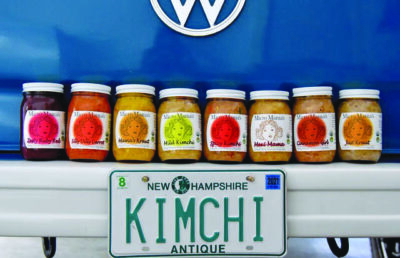
Photo courtesy of Micro Mamas.
Because there are almost as many varieties of kimchi as there are Korean families, Chung said, finding a particular type that suits a particular eater is mostly a matter of shopping around and finding one that suits their palate. “There’s different levels [of intensity] to it,” she said. “If it’s fresh kimchi that’s made that day, it’s not as fermented as the ones you would keep in the refrigerator for up to a month or even longer. And then there are the ones you use once they get super fermented to add to stews and kimchi fried rice. And so when I say it comes to being very versatile, I think kimchi fried rice would be something that most people would be willing to try as well because everyone loves fried rice. But if you make it mixed with the kimchi and then with the fried egg on top, it’s something that a lot of our customers have been waiting for.”
One of the reasons for kimchi’s surge in popularity over the past few years is its reported health benefits. Gloria Najecki, the produce manager at the Concord Food Co-op, said, “It has become increasingly popular because people know that it’s good for their gut and it can be made from a lot of different things so it’s varied so it’s not just cabbage. I think fermented anything is big right now. People like fermented foods because they hear it’s good for their digestive microbiome, you know, their belly and all the good gut bacteria that live there. There’s a whole ecosystem in our bellies so you want to eat varied foods to help keep them all in balance.”
For Najecki, part of eating a balanced diet centers around eating a large variety of foods.
“I’m always saying, ‘Eat the rainbow’” she said. “Eat a lot of different colors. Eat a lot of different textures. You want to have sour things, bitter things. You want to mix it all up because all of that together helps that flora in your belly. And kimchi has healthy microorganisms in it, different yeasts and positive bacteria, that sort of thing.”
Luke Mahoney is the owner of Brookford Farm in Canterbury. He grows many of the key ingredients for kimchi on his farm, and his staff makes small batches of kimchi to sell at his farm store.
“All the ingredients are grown on the farm except ginger,” he said. “The base is napa cabbage and we use leeks and carrots and daikon radish. We grow a Korean pepper, which is specifically for kimchi, and we use garlic and ginger. Daikon [radishes] grow awesome here in New England, but specifically on our farm.”
Stephanie Zydenbos, founder of Micro Mamas, Courtesy photo.
A member of Mahoney’s staff is a fermentation expert named Irina. “She moved here from Russia to be with her family about 10 years ago,” Mahoney said. “She’s been experimenting with different types of conserves and fermentations. She had a job in science in [Russia], but then when she moved here, she no longer worked in science. She didn’t have the language, so we offered her a position as our fermenter. It was kind of a dream we had, but it was still undeveloped. She dove in and got inspired and used her life experience and recipes and also whatever ingredients we had on the farm at the time. She created a wide variety of beautiful artisanal craft ferments. And the kimchi is her pride and joy.”
Stephanie Zydenbos is obsessed with fermentation, too. She is the founder of and facilitator for Micro Mamas in Henniker, a company that makes kimchi and other fermented vegetables.
“We were the very first commercial fermenters in the state,” Zydenbos said. “We learned a lot and continue to be marveled by the art of fermentation — because it is an art.”
Zydenbos said her fascination with fermentation grew from chronic health challenges.
“From adolescence through my early adulthood I had lots of different sinus problems and digestive problems,” she said. “I wasn’t an unhealthy child, but I think that the best way to say it is that I just had a less than optimal digestive system. I took a workshop on kimchi and sauerkraut and how to make our own probiotic foods. I wanted to treat my digestive symptoms naturally and I had been taking some pretty high-dollar high-quality probiotics — which I don’t recommend; anybody, stop doing that! — and I made my first batch of kimchi around the time I had my first child, because I wanted to get my children off to a good start with their digestive health. Around 2011 or 2012 I woke up in the middle of the night and I’m like, ‘Why am I not doing this for a living?’”
Zydenbos said the healthy microorganisms in fermented foods like kimchi start in the soil where the vegetables are grown.
“The microbiology of the soils are how vegetables and isolates of lactic acid bacteria are in the vegetables themselves,” she said. “We get those vegetables in their raw form right from the field.” As vegetables ferment, she explained, “the starches and the sugars break down from the vegetables. They are basically pre-digesting the starches and the sugars and [producing] lactic acid bacteria in addition to accelerating the vitamin and nutrient content of raw vegetables” As the fermentation grows more acidic, she said, it kills off most of any competing bacteria and microorganisms. “The pH becomes so low that the good microbes thrive and none of the harmful bacteria that might exist.”
Zydenbos likes to take a simple approach to eating kimchi.
“The No. 1 thing I like to do,” she said, “is to open some sour cream or hummus and throw 100 grams or so of kimchi in there. That’s it. Bam. Done. It takes chips and dip and brings it to an entirely different level.”
Because the flavor of kimchi covers a spectrum from “zesty” to “pungent” it has been welcomed by fine-dining chefs in recent years to add background flavor, texture, or even a “funky” quality to sauces and dishes. Nick Provencher is the executive chef at The Birch on Elm in Manchester. He said kimchi has found a place in his roster of ingredients.
“We have [a kimchi dish] on the menu currently,” he said, “and we always use a variety of different ferments, whether it be kimchi or to preserve seasonal vegetables, especially in the summer when there’s something like ramps we’ll ferment. We always have different kinds. Right now we have [kimchi] in a kind of a Korean-style barbecue sauce as a base that we cook down with onions, garlic, aromatics and ginger.”
“I think for the most part kimchi adds a lot of depth because it has a variety of different flavor profiles to it,” Provencher said. “It’s got a kind of bold, vinegary quality. It’s like, it’s kind of like blue cheese — it’s stinky but it’s like a good stink, you know? You have spice there, too, which can round a dish out. I think it really makes some dishes shine because of the depth [and pungency] it adds to the sauce. It’s nice too, because there’s also the level of acidity that comes from it, which cuts the fat of a pork belly, which is something we serve with it.”
Keith Sarasin is a chef, an author, and owner of The Farmer’s Dinner, a pop-up restaurant devoted to local, seasonal and sustainable dishes. He is a big fan of kimchi.
“I feel like kimchi is one of those unsung heroes that has existed in either progressive or fine dining scenes for a while,” Sarasin said. “The first thing that makes kimchi great is it’s very universal in what you can put in it. So, obviously cabbage, chilies and things of that nature. But since what we do at The Farmer’s Dinner is so rooted in farms, we’ll add a lot of different backbones to kimchi. Let’s say we have a bunch of arugula — we will gladly add some arugula into [a batch of kimchi]. Whenever we used to forage a lot back in the day, we would add dandelion greens and burdock root and all of these fun things, which give a different layer and complexity to kimchi, starting out with that bitterness. It’s a lot of fun and it reminds me a lot of balancing everything else that you have.”
Because Sarasin works so much with small, local farms, he has seen non-traditional foods like kimchi (non-traditional in New England, anyway) having an impact on what crops those farms grow.
“I feel like diversity has definitely been something that we’ve seen,” he said, “especially in the last five to 10 years. You can always find savoy cabbages and napa and all of these cabbages, but I think you’re seeing more daikons. You’re also seeing a lot more varieties of peppers that are being grown, which is really exciting for me because I love peppers. Part of the backbone of [kimchi] is you definitely need chili powder. It’s one of the really quintessential things. There’s the standard, traditional kimchi, which is out of this world, but then there’s a lot of ways to bring in food waste that typically would go in the bin, you can repurpose to really bring into a beautiful kimchi.”
“Kimchi’s not only about sustainability for us,” Sarasin said. “A lot of what we do is technique-driven, and we’ve used a lot of different techniques when it comes to utilizing kimchi. One of my favorite things to do with kimchi is instead of just serving it we do a lot of dehydration. So we dehydrate kimchi, either the whole kimchi or the brine, and spread it thin on a Silpat [a silicone baking mat] and then we let that dehydrate and grind it into a powder. We’ve used that to dust over dishes like a Wagyu tartare, a creamy soup, or even a savory custard because you get that salt, acidity and umami in one sprinkle. Kimchi lends itself to seafood unbelievably well, and we live in such a beautiful place for seafood. We’ve done kimchi sauces but we built them up with the intensity of aged kimchi. We love to ferment daikon and things of that nature and smear it over pork belly and foie gras.”
Chef Sarasin’s Kimchi Butter Sauce
Yields ~1 cup
Pairs well with seared scallops, roasted cauliflower, halibut, grilled chicken thigh, even a wild mushroom toast.
½ cup (188 g) aged kimchi, finely chopped
2 Tablespoons kimchi brine
¼ cup (55 g) white wine or dry vermouth
1 Tablespoon rice vinegar or white wine vinegar
1 small shallot, finely minced
1 teaspoon sugar (optional, balances acidity)
½ cup (1 stick) cold unsalted butter, cubed
salt to taste
optional: a splash of cream if you want a silkier mouthfeel
1. Start the reduction
In a small saucepan, add the shallots, kimchi, brine, wine and vinegar. Bring to a gentle simmer over medium heat and reduce until almost dry; basically you want 2-3 tablespoons of liquid left. You want the acidity concentrated but not overpowering.
2. Strain (optional)
If you want a smoother sauce, strain out the solids. But I like leaving the finely chopped kimchi in there for texture and visual.
3. Mount with butter
Lower the heat to low. Whisk in the cold butter cubes one at a time, making sure each one emulsifies before adding the next. Don’t let it boil or it’ll break. If it’s too punchy, add a tiny splash of cream at the end.
4. Taste and adjust the seasoning. Depending on your kimchi, you might not need salt. Serve immediately.
Kimchi Fried Rice
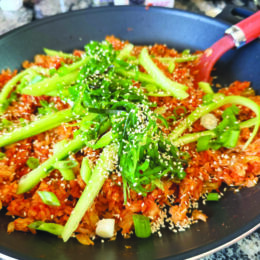
Kimchi Fried Rice. Photo by John Fladd.
Fried Rice
1 teaspoon vegetable oil
1 cup (188 g) chopped kimchi
3 cups (445 g) steamed rice
¼ cup (55 g) kimchi juice
¼ cup (55 g) water
2-3 Tablespoons gochujang (Korean chili paste)
1 teaspoon fish sauce or Maggi Seasoning
3 teaspoons (1 Tablespoon) toasted sesame oil
Garnish
2 teaspoons toasted sesame seeds
1 mini cucumber or ⅓ normal cucumber, peeled, seeded and cut into slivers
3 scallions, chopped
¼ cup (57 g) prepared seaweed salad – you can find this at the sushi counter at many supermarkets
Heat the vegetable oil over medium-high heat, then add the chopped kimchi, and fry for about a minute.
Add rice, kimchi juice, water, gochujang and fish sauce. Stir all the ingredients together for seven or eight minutes with a wooden spoon.
According to master chef Roy Choi, the best part of any fried rice is the carmelized, crispy bits from the bottom of the pan. In a Facebook video he advises turning the heat all the way up and letting the rice cook for another minute or two to crisp up the rice. “The thing about this rice, as you see, is we take it to the edge. You feel like you’re going to fall off. You feel like this thing’s going to burn. You take it so far that you think that you can’t take it any farther, that you’re almost scared that it’s going to collapse and be ruined.” Be fearless, in other words.
After a minute or so of cooking at high heat, stir the rice to see if you’ve achieved any crusty bits. If your courage holds out, you might want to blast the rice for another minute or so to recrisp the stirred rice.
Plate the rocket-hot rice in a serving bowl, then drizzle it with sesame oil, and garnish it with the sesame seeds, cucumber slivers, scallions, and seaweed salad.
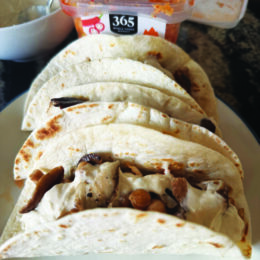
Kimchi Tacos (plant-based)
Chelsea Mackler is the cheese manager at Whole Foods Supermarket in Bedford. She is not vegan herself, but her wife is. She said that a year or two ago, when her wife was having a rough week, she made kimchi tacos for her, which were extremely well-received. This is a riff on those tacos:
½ cup (114 g) vegan sour cream – I like one from Forager Project; it has a really good flavor
¼ cup (64 g) tahini (sesame paste)
1 Tablespoon toasted sesame oil
4 to 6 ounces (100 to 175 g) shiitake mushrooms, cleaned, trimmed and cut into 1-inch pieces
1 cup (164 g) canned chickpeas, rinsed and drained
¼ teaspoon each salt and pepper
¼ cup (55 g) water
4 six-inch flour tortillas
1 cup (164 g) kimchi
Kimchi Tacos. Photo by John Fladd.
In a smallish bowl, combine the vegan sour cream and tahini. Set aside.
In a large skillet, heat the sesame oil over medium heat, then fry the chickpeas until lightly browned, seven minutes or so. Add the mushrooms and water, then cook, covered, until the shiitakes soften and take on a little color, maybe five minutes more. Season with salt and pepper, then transfer the mixture to a bowl and set aside.
Toast the tortillas in any sesame oil remaining in the pan, about a minute on each side. Keep an eye on them; you’re not looking to make them crispy, just to give them a little color and to cook off their floury taste.
Assemble the tacos. Put 1 to 1½ tablespoons of kimchi at the bottom of each taco, topped with ¼ of the shiitake/chickpea mixture. Top with a tablespoon or so of the tahini sauce.
These are extraordinarily good tacos — not just vegan tacos, but excellent tacos, period. The chickpeas give a little extra savoriness and texture to the mushrooms. The kimchi gives spiciness and flavor but also some essential crunch. Sesame and kimchi pair really well together, so the creamy tahini sauce is just about perfect.
This will make four tacos, which sounds like enough for two people, but the slower eater might end up having to fight to defend their second taco. Plan on four of these guys as a single serving, and adjust the recipe accordingly.
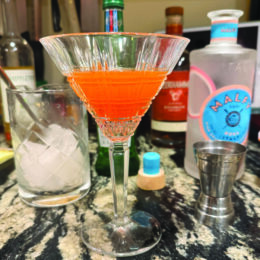
Korean Dirty Martini
Dry vermouth
2 ounces botanical gin – I used Malfi Rosa, a grapefruit-forward gin, and I was very pleased with it
½ ounce of kimchi juice – the flavor and assertiveness of this will depend on the kimchi you have on hand, so be prepared to embrace your first martini of the batch, then adjust how much takes you to where you want to be; half an ounce is a good starting point
Hardware:
A mixing glass – NOT a cocktail shaker. When making a for-real, actual martini, please stir it rather than shake it. It really does make a difference.
A long-handled spoon for stirring – not surprisingly, a bar spoon is perfect for this.
Ice
A stemmed martini glass – martinis are at their best skull-shrinkingly cold, and holding the glass by the stem keeps the heat of your hands from warming yours up.
A cocktail strainer.
Chill your martini glass by either filling it with crushed ice or putting it in your freezer for 10 minutes or so.
Korean Dirty Martini. Photo by John Fladd.
Fill your mixing glass half full with ice and pour an ounce or so of vermouth over it. Stir to coat the ice cubes with the vermouth, then strain away any excess. This is what is called a “dry martini”; it retains just enough vermouth to subtly flavor the drink. There is a version called a “perfect” martini, which uses equal amounts of vermouth and gin. Because the kimchi element will probably be a new experience for you, start with a dry martini and adjust from there.
Pour the gin and kimchi juice into the mixing glass and stir gently but thoroughly, then strain the orange liquor into your chilled martini glass.
If you are a dirty martini enthusiast, this will be right up your alley. It is spicy and sour, with a stiff alcoholic backbone that lets you know you are drinking a grownup cocktail. If you haven’t been a fan of dirty martinis up till now, this might convert you.
The South Manchester Rail Trail has been selected as an American Public Works Associations 2025 Public Works Historical Restoration/Preservation Project of the Year, according to the city’s Department of Public Works. The project finished in May 2024 and extended the city’s rail trail network and repurposed the historic wooden railroad trestle over Cohas Brook into a pedestrian bridge, the press release said.
Forever chemicals
Mariah Blake, author of They Poisoned the World: Life and Death in the Age of Forever Chemicals, will take part in a community conversations about her book on Thursday, May 8, from 7 to 8:30 p.m. online and in person at the Merrimack Historical Society (10 Depot St. in Merrimack), according to a press release. The event is sponsored by New Hampshire Network for Environment, Energy and Climate along with the CItizens for Clean Water, League of Conservation Voters and the Sierra Club New Hampshire Chapter. See mobilize.us/lcvnh/event/781201 to RSVP.
Miss NH
A new Miss New Hampshire and Miss New Hampshire’s Teen were crowded last weekend and both will go on to compete in the national competitions, Miss America and Miss America’s Teen, according to a press release. Xanthi Russell, who is slated to graduate from NHTI in Concord this month with an associate degree in Paralegal Studies, was named Miss New Hampshire and Megan Plaza, a sophomore at Londonderry High, was crowned Miss New Hampshire’s Teen, the release said. Both won scholarships and will begin a year of service, the release said.
Egg update
Two of the five eggs have hatched in the peregrine falcon nest at Brady Sullivan Tower in downtown Manchester, according to the daily log available in the comments of one of the three livestreaming feeds. The two eyasses — unfledged falcon chicks — are Una, short for Sunapee, hatched on May 2, and Alpy, short for Walpole, hatched on May 6, the log said. The names of five New Hampshire towns were picked by two fifth-grade classes in Hooksett to serve as names for this year’s hatchlings, the log said. The eggs were laid between March 22 and April 7. Find the links to the three live views of the nest via nhaudubon.org/education/birds-and-birding/peregrine-cam, where the New Hampshire Audubon offers the nest cams with support of Peregrine Networks and Brady Sullivan Properties, the website said. The log also has a link to a document with basic information about the nest, the falcons and previous seasons of peregrine falcons that have occupied it and the chicks that hatched there.
Henniker Handmade & Homegrown, a festival of music, arts and food trucks, will run Saturday, May 10, and Sunday, May 11, from 10 a.m. to 4 p.m., at the community center and park at 57 Main St. in Henniker, according to a press release. The event will feature nearly 90 local artists, crafters, farmers and food makers, the release said.
Red Arrow Diners in Concord, Londonderry, Manchester and Nashua will offer teachers and nurses 50 percent off their individual meal, including cocktails and desserts, through Sunday, May 11, according to a press release. See redarrowdiner.com/appreciation.
The Great Bay Food Truck Festival will run Saturday, May 10, from noon to 4 p.m. at Stratham Hill Park in Stratham. General admission tickets cost $10 in advance, $15 on the day. See greatbayfoodtruckfestival.com.
The Rodney Marsalis Philadelphia Big Brass will perform, with special guests the Pinkerton Academy Jazz Ensemble, at the Stockbridge Theatre (44 N. Main St. in Derry; stockbridgetheatre.showare.com) on Tuesday, May 14, at 7 p.m. Tickets cost $30.
One of many tribute acts to form in the aftermath of Ronnie James Dio’s death in 2010, Seattle band Rising moved from imitation to emulation six years ago. Renamed RivetSkull, with singer Chad McMurray, Mark Plog on guitar, bass player Michael Robson and Mark Hopkins on drums, began playing out, and released an album of original songs in 2022.
Trail of Souls: Samsara and 2024’s follow-up Absence of Time hewed musically to the spirit of Dio’s career, which ranged from Rainbow to Black Sabbath and finally the eponymous group he led until stomach cancer claimed him. For example, the roiling, frenetic “Hellbound,” which opens their most recent LP, has clear Sabbath and Dio influences.
While they enjoy playing original material, in the time since switching over, RivetSkull has considered returning to Dio’s music. Recently they found a solution that works on both fronts: opening with their own songs, then doing an extended set of tribute music. On May 3, they’ll appear at Rock n Roll Meatballs in Manchester.
As Chad McMurray explained in a recent phone interview, “basically [we] open for ourselves, let people experience what RivetSkull is as an original band, and then also treat them to something that we did pretty well at,” he said, “which was the music of Ronnie James Dio.”
The decision was both artistic and practical, McMurray continued. “We were joking occasionally about doing a Dio show again. We started running through some of the songs again, and it was like, man, this feels pretty good, you know? And so we said, hey, well, what if we do a thing where we go out and basically try to do two things?”
They did a couple of test market shows, “and people showed up,” he continued. “So we’re like, ‘hey, OK, this could be fun.’ We can actually kill two birds with one stone, and keep Dio’s music and legacy out there live a little bit for people that never got to ever experience that, and turn people on to what we’re doing.”
The business part made even more sense for the indie metal band.
“It’s tougher to make a splash these days … get attention, get publicity, get people to show up at a show even, especially if you’re not on a label or being promoted,” he said. “But tribute acts have always managed to do fairly well. I’ve done a fair amount of those over the years.”
In addition to Rising, McMurray, who studied Bel Canto opera with the maestro who trained Ann Wilson, Geoff Tate and Layne Staley, played Bruce Dickinson in a band called Maiden Seattle. He began in the tribute world singing and playing bass as Geddy Lee in a Rush-centric band.
He also spent two decades playing bass, keyboards and mandolin in a Led Zeppelin tribute act. “John Paul Jones, as most people know, is the unsung hero of the band. So it was always fun to chill out and do the role that he did,” he said. But the multi-instrumentalist enjoys the spotlight.
“I love being out front as well,” he said. “When I got back into the singing as more of a full-time gig of what I do, then it was like, OK, the bug came back and I’m fine. I love interacting with the crowd, and I love keeping my vocal chops up.”
The upcoming show isn’t a complete revival — the pivot from RivetSkull to Dio is different from their Rising days. “Back when we were doing the tribute, we were trying for a reenactment of the stage show … we built sets,” he said. “This time, it’s just us doing our thing, and then giving a kick-ass night of music.”
Asked for the story behind the band’s moniker, McMurray said guitarist Plog chose RivetSkull. “That was his baby,” he said. “To him, it was … synonymous with metalhead; he always wanted to have a band called that. When we decided to branch off and do the original thing, he said, ‘Hey, what do you think about this name?’ and I’m like, ‘Yeah, let’s go for it.’”
Dio Celebration: RivetSkull Performs Ronnie James Dio Classics When: Saturday, May 3, 8 p.m. Where: Rock n Roll Meatballs, 179 Elm St., Manchester (formerly Angel City Music Hall) Tickets: $20 at eventbrite.com
Featured photo. RivetSkull. Photo by Savoia Photography Live.
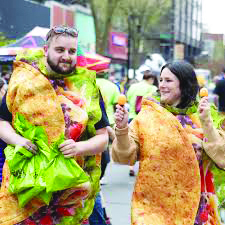
It’s time for Taco Tour, one of the high points of Manchester’s food calendar and the unofficial opening of the food festival season. For four hours on Thursday, May 8, downtown Manchester will host thousands of taco enthusiasts. More than 100 Manchester restaurants, food trucks and businesses will serve their own spins on tacos for $3 each.
Cole Riel from the Greater Manchester Chamber is the organizer of this year’s Taco Tour.
“This is one of the larger food festivals,” Riel said. “When I look at other taco events, it’s funny. Sometimes they’ll be like, ‘Yeah, we have 10 different taco vendors!’ And I’m like, ‘Oh, that’s cute. Yeah, we’ll have over 100 different options for folks to choose from.”
The tour even has its own Grand Marshall. Max Clayton, born and raised in Manchester and now a performer in several Broadway musicals, will help kick off this year’s event, according to a Chamber press release.
Riel said that as the Taco Tour has grown it has come to represent a good cross-section of Manchester’s restaurants.
“When we took the event over after the first year,” he said, “we just knew, OK, if this many people are going to come, there needs to be enough options to keep the line moving, to keep everyone happy. For the most part, that growth is just in more and more downtown businesses supporting the event. I was really happy to get the call from the Crown Tavern and Hanover Street Chop House, who are participating this year for the first time since Covid. Then we have some new friends like Dishon Bakery and Moka Pot. It’s a good mix of folks who’ve been here and now their business is just a little bit more stable and they’re able to participate in the event, and folks who have moved into downtown are just really excited to be involved.”
Riel said the fact that Taco Tour takes place in a limited area for a limited amount of time sets it apart from other big food events.
“A lot of times, [food businesses] will go to a food expo or something like that,” he said. “They’re driving to Boston and then they’re paying for the table, they’re sampling product, and then they’re hoping to get some sort of clients out of that. Here, we’re taking the vast majority of attendees right to the door of each restaurant. They’re paying $3 to have the taco that night. A restaurant will see a thousand, two thousand, sometimes three thousand customers eating their food in a four-hour period. And that’s kind of hard to replicate anywhere.”
Chyna Potts is an internet food influencer known as Auntie Eats First on Instagram and TikTok. She is a diehard Taco Tour enthusiast. She is looking forward to all the tacos this year, but especially ones with an Italian twist.
“I love a good Italian rendition,” she said. “So, Piccola [Italia] was one of my favorites from last year; they did a chicken Parm and a chicken Caesar taco, and those were next level.”
For Potts, one of the make-or-break features of any type of taco is the shell. For instance, “Piccola Italia just used a typical tortilla last year,” she said. “They didn’t switch up anything. A lot of [Taco Tour restaurants] pay homage to a typical taco, but if we’re talking maybe one of the sushi joints, they might do it on a wonton wrapper or something of that nature. They do sushi tacos, but almost everybody pretty much pays homage to a typical taco. Sometimes they’ll feature chicken tikka masala, or something like that, but it’s still going to always be wrapped in that typical taco form.”
Given her choice of crunchy taco shells, corn tortillas or flour tortillas, Potts said there is very little contest. “I’m a soft-shell chalupa girl,” she said. “The only time I eat anything like a hard shell is when I’m eating nachos. I love a good soft shell. I love a good all-American taco. I mean that’s just always going to be me.”
Taco Tour 2025 This year’s Taco Tour will take place on Thursday, May 8, from 4 to 8 p.m. on Elm Street in Manchester. Elm Street will be blocked off for pedestrian traffic from Bridge Street to Granite Street (near the SNHU Arena). Some businesses will also serve tacos on side streets off Elm Street. Visit tacotourmanchester.com/info.
Here is a sampling of what you will find at this year’s Taco Tour: Annapurna Curry and Sekuwa House will serve a vegetable and chicken taco Alley Cat Pizza plans to offer slices of pizza “with taco stuff on it.” Boards & Brews is tentatively planning on serving pork tacos with apple and pineapple salsas. Firefly Bistro, perennial winner of the Tour’s Best Taco award, will serve its proven winner cheesy chicken tacos on flour tortillas topped with crema and crispy tortilla strips. Republic Brewing will serve falafel tacos, which will be vegan-friendly. The Hop Knot will offer “walking tacos” with cowboy caviar, beer cheese and jalapeño honey. The Potato Concept will serve “mashed po-tacos” and vegan taco chili. The Terracotta Room will have taco-themed merchandise on hand. The Sleazy Vegan will offer a Jamaican jerked taco with mango/jalapeño salsa.]
Featured photo: Previous Taco Tours. Photos courtesy of the Manchester Chamber of Commerce.
On May 4, 2002, Free Comic Book Day was launched to coincide with the premiere of the initial movie in Sam Raimi’s Spider-Man trilogy. The choice seemed fated when the play on words “May the Fourth be with you” gained popularity a few years later among Star Wars fans, around the time Disney acquired the franchise.
At the inaugural event, more than two million Spider-man, Star Wars, Tomb Raider and Justice League comics were given away. This year, there are 38 official titles, including Post Malone’s debut comic book and one based on the hit Netflix series Black Mirror. Ten different New Hampshire locations are participating.
Jetpack Comics
When Ralph DiBernardo opened his Rochester store in the late 2000s, he was quick to participate. First, he set up a small tent in the parking lot and a few hundred people showed up. It grew to a circus tent the next year, drawing a crowd of over 1,000. These days, DiBernardo said by phone recently, it’s city-wide.
“It takes place across 2 square miles; there are 20-plus businesses, a convention hall,” he said. “It’s a mini comic-con.”
However, after last year, he decided to scale back, worn down by months of planning and out of pocket costs. Fortunately, the Rochester Opera House stepped up. They offered support through activities like a Star Wars-themed spoof of Annie, which opens the same weekend as Free Comic Book Day, and an outdoor show by Kiss tribute band Hotter Than Hell. Anthony Ejarque, Executive Producer of the Opera House, led the handoff effort. “This event has such strong community support,” he said by phone recently, adding that there are literacy events at the library, and that The DaVinci Code author Dan Brown is donating some of his children’s literature. “He’s not able to attend, but we’re excited to get him on board.”
Double Midnight Comics
Two comic book fan brothers and their best friend from high school launched Double Midnight Comics in Manchester a few months after the first Free Comic Book Day in 2002. Originally located in Maple Valley Plaza, the store moved in 2023 to The Factory on Willow Street. It has a second store in Concord, which opened in 2013.
Double Midnight always goes big on Free Comic Book Day. The store launched Granite State Comicon in 2003, and Free Comic Book Day is a smaller version of that fall event. There are movie cars, a cosplay contest, food trucks, and the event space behind the store has vendor booths, including several local creators.
“You get to see people from the region that are making comics; it’s basically a chance to meet and discover some new talents,” Chris Proulx, Double Midnight co-owner, said by phone recently. There’s also live music from The Clemenzi Crusaders, a father and son nerd rock duo. “They do things like rock up the theme from Star Wars or The Simpsons.”
Proulx boasts that everyone who attends can count on going home with a big stack of comics, and he enjoys seeing fans, both new and old, experience Free Comic Book Day.
“It’s always fun to introduce people to comic books for the first time or have somebody that might be a past reader come back and rediscover comics,” he said. “And there are people that bring their friends and family and kind of introduce them to comics. So it’s a great, fun day.”
Merrymac Games & Comics
The Merrimack store will welcome a few creator guests to this year’s event, including Perhapanauts author Craig Rousseau, who’s worked on titles such as Young Hellboy, Harley Quinn and Batman Beyond. Also appearing is Joseph Schmalke, a comics creator, writer and illustrator. Schmalke is the publisher of the Midnight Factory comic line and author of Murder Hobo, One Last Trick and Prophets of Doom.
Stairway to Heaven Comics
Also hosting local creators is Stairway to Heaven Comics in Newington. The panel includes illustrator and graphic artist Jesse Lundberg, Jake Allen, who worked on Kings and Canvas, and Jeff Lorentz, whose credits include Skin of My Teeth and My Coworker is a Vampire.
Stairway to Heaven owner Brad Gile’s favorite thing about the annual event is seeing a well-blended crowd take in the creative pulse, the excitement of graphic art and storytelling.
“We get so many different types of people in here,” he said. “Folks that typically are not as interested in comics will come in and get excited meeting talented local creators. And there are a lot of really great comics for kids. It’s exciting to see all the happy kids come in and walk away with some really cool free comics.”
Free Comic Book Day When: Saturday, May 3 Where: Various locations More: List of free comics at freecomicbookday.com