The Gate City BrewFest, slated for Saturday, Aug. 24, at Nashua’s Holman Stadium, is Chelsea Davis’ brainchild.
Davis, the marketing manager for Bellavance Beverage Co. in Londonderry, used to travel to other beer festivals and discovered that it was a lot of work.
“What we realized,” Davis said, “is when we attended brewfests, it felt like we did a lot of the work with them — getting our different breweries there and just really trying to go above and beyond. So we thought to ourselves, ‘Why don’t we do our own?,’ which is how this came about, really. It’s really a showcase of all the Bellevance beverage products, plus some out-of-state breweries, some other breweries that are local that maybe self-distribute.”
“This is like my baby,” Davis said. ”The idea I had was 12 years ago, and now that it’s Year 10, it’s crazy — it’s older than all of my actual babies.”
“Each brewery needs to submit special paperwork, Davis said. “If you are a vendor and you want to sell food, there’s different paperwork to submit. … There are definitely a lot of moving parts, a lot of paperwork, and just making sure that everything is done by the book so that we can have a successful event and follow all the rules.”
Which is why she was so happy to turn that side of the BrewFest over to PAL. The Nashua Police Athletic League, or PAL, is the organization that benefits from the BrewFest. According to Jen Miller from the Nashua PAL, it is worth some work to be part of the festival.
“The Gate City Brewfest is in its 10th year,” Miller said. “We’re very excited, bringing out some special things specifically to help us celebrate this event. We have just close to 100 breweries, serving several brews each. So there will be lots of different samples available. The majority of the brewers are all from New Hampshire, so they are all locally sourced. And we have a lot of other really interesting beverages. We have hard cider, spirit-based seltzer, as well as a good selection of our non-alcoholic drinks for our DDs [designated drivers] and to stay hydrated on the field.”
603 Brewery of Londonderry is one of the local breweries. Parker Wheeler is the Director of Distribution and Sales for 603. He said the BrewFest is a good time for the brewers who attend.
“When they [Bellavance Beverages] come to us every year, we frequently say around the brewery that it’s one of the best beer festivals that’s put on every year,” Wheeler said.
He is looking forward to taking a variety of drinks to GateCity.
“We’ll bring two of our flagship beers,” he said, “which is the 603 IPA and the 603 double IPA. We’ll also be featuring our new non-alcoholic hop water, which is called Fizzy Hop. It’s essentially a sparkling water infused with hops and just a good opportunity for people to try out something if they’re looking to stay away from some alcohol and just get some refreshing hydration. We will also have a couple of our hard seltzer flavors. And then we have a VIP beer as well. That’s actually going to be one of our strawberry wheat beers that we just released recently.”
The Brewfest, which runs from 1 to 5 p.m., will also feature music (Bradley Copper Kettle and Friends, Slack Tide and Sippin’ Whiskey), kid-friendly activities (the Nashua PAL Kid Zone, face-painting, bounce houses and games), food and other vendors. The scheduled food line up includes Creative Cones, Crumbl Cookie, Donali’s Food Truck, Poor House BBQ and more, according to the website.
Folks only there for the food can get designated driver tickets for $15; children 12 and under get in for free. A VIP ticket, which runs $70, allows for a noon admission, a special seating area and light snacks.
Gate City BrewFest Saturday, Aug. 24, from 1 to 5 p.m. Holman Stadium, 67 Amherst St, Nashua, 718-8883 General admission tickets are $35 in advance or $50 at the gate. Designated Driver and Teen tickets are $15. Children under 12 are free. Proceeds support the Nashua Police Athletic League. Visit gatecitybrewfestnh.com.
Strange creatures are lurking in Manchester and the hunt is on. Studio 550 Arts Center founder and programs manager Monica Leap — “that’s Leap, like to jump” — spoke about the scavenger hunt for wild clay treasures.
“It’s a free community event that we do every year that we’ve been open…. It’s all about getting people out to enjoy the city and find some art in the process,” she said. “The real treat is discovering your downtown and seeing what there is out there, getting art into the streets so people can find it.”
The Monster Hunt started 12 years ago. This year it will be on Saturday, Aug. 24.
“We usually do it one of the last Saturdays in August,” Leap said. “The youth-only hunt is going to be at 10:30 [a.m.] in the green space in front of the Center of New Hampshire, which is a building on the corner right next to the DoubleTree Hotel.”
The public hunt is at 11 a.m., “starting at City Hall and people will break from there,” Leap said. The Studio 550 website advises participants to meet at 10:50 a.m. for a “Monster Hunters Meeting.”
How many monsters are hiding in Manchester?
“We sculpt 100 unique clay monsters,” Leap said, “and the past couple years we’ve actually been making 125 because we started a youth hunt for kids 5 and under.” Leap made 50 of the monsters.
Originally the monsters themselves were hidden, but some monsters would wander off, “so we started hiding medallions that you can trade in for the actual monster,” Leap said. “The past year or two we’ve done medallions, and people have really enjoyed that because you kind of get two surprises during the day. One is finding the medallion out there in the streets, and that’s also very exciting because they’re all unique and different as well, and then you bring it back and then you get the second surprise of actually unveiling the monster that you get, which is associated with the number to the medallion that you found,” Leap said.
How did it start? “We just did it for fun, honestly … it’s evolved, for sure, over the years,” Leap said. “We always put them out in public places so you don’t have to buy anything, you don’t have to do anything to get one, you just have to find one, so it’s just about the art of surprise and art in daily life versus having to go to a museum or a gallery to experience it, just something that is there.”
Medallions or monsters can get you some tasty treats in the city. One monster partner is Dancing Lion Chocolate on Elm Street. “You can show it to them and they will give you a free chocolate coin which is a very artful chocolate coin,” Leap said. “Everything they make is beautiful.”
Queen City Cupcakes has a monster cupcake for any medallion finders as well, and the Bookmobile from the Manchester City Library will be at City Hall for the duration of the hunt.
The Monster Hunt is not the only way to have fun with Studio 550 Arts on Saturday, Aug. 24. “We have a whole art activities open house at our studio during the time that we’re doing the exchange of the medallions for the monsters,” Leap said, “and people can try the pottery wheel, they can sculpt their own monster out of clay, they can do some tie dye, which is also a fun activity that most people won’t do at their house because it’s so incredibly messy,” she said.
Speaking of messy, bringing a monster into the home is no small task. Where is it going to live?
“They can also create a little monster habitat where they get to pick a small piece of pottery, get some soil in there, and then put a succulent in there so that your monster has a little habitat to live in when you take it home,” Leap said.
There will be other free crafts at the Studio, like “painting a rock or creating a paper bag puppet monster and then a few other things that we put out that day,” Leap said. “It’s a whole community event.” Clean-up begins at 1 p.m. at the Studio.
Leap has an idea on why people arrive to track down the hidden clay critters: “It’s a game, it’s a hunt, you feel special when you find one.”
Participants can head over to Studio 550 Arts to make their own creation if the monsters are successful in eluding their capture. “Even if you don’t find one you can come to the studio and make your own or just experience some hands-on art activities,” Leap said.
Monster Hunt and Studio 550 Open House Saturday, Aug. 24, youth hunt (age 5 and younger) at 10:30 a.m. in the green space in front of the Center of New Hampshire by the DoubleTree Hotel (700 Elm St.), Manchester; public hunt at 11 a.m. (meet at 10:50 a.m.) starts at City Hall (908 Elm St.) Monster Medallions will be hidden in public places on Elm Street from Studio 550 north to Bridge Street. Studio 550 Arts open house is 10:45 a.m. to 1 p.m. 550arts.com
Featured image: Monsters. Photos by Zachary Lewis.
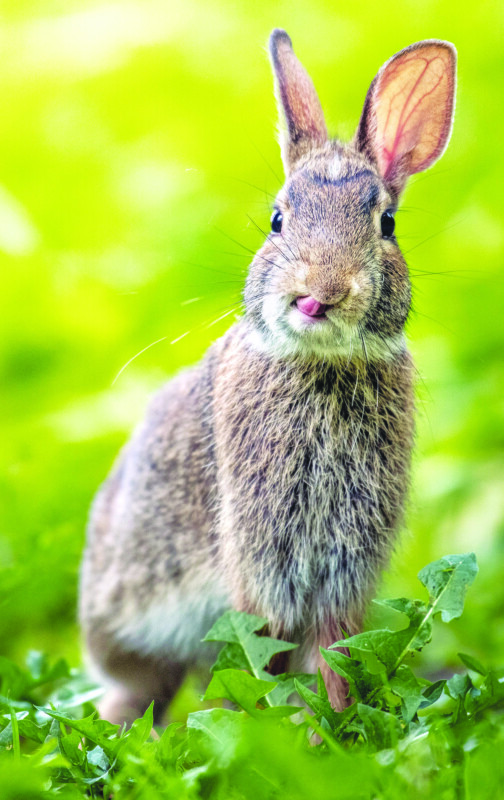
Specifically, the eastern cottontails “have been increasing in New Hampshire because of, likely, the milder winters, and some of our development,” said Heidi Holman, Wildlife Diversity Biologist from New Hampshire Fish and Game.
They like the suburbs.
“The eastern cottontails do really well in our suburban neighborhoods. They take cover from us from some of their predators,” Holman said.
Eastern cottontails are on an upward trajectory.
“I think the populations are just growing so it seems like every year we keep seeing more rabbits … so we’re just seeing the populations continue to increase year over year, so every year [it’s] like we’re seeing the most rabbits we’ve ever seen right now, that’s the trend,” she said.
The Hippo spoke with several biologists from New Hampshire Fish and Game about the different bunnies in the state, along with some fellow mammals that call the Granite State their home.
BUNNIES
Species: New England cottontail
Eastern cottontail
Snowshoe hare
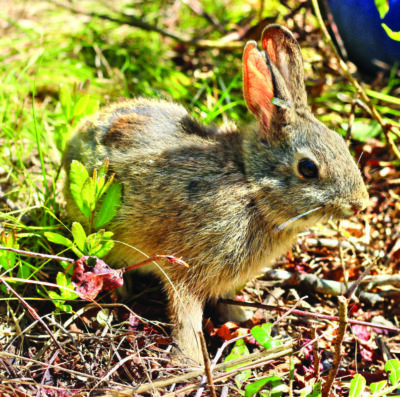
There are three types of what would typically be considered bunnies in the Granite State, according to Holman. The first is the New England cottontail.
New England Cottontail. Photo by Meagan Racey of USFWS.
“It’s also nicknamed the coney or a wood rabbit and that is in reference to the fact that it typically lived in interspersed thickets,” Holman said.
The next one is the eastern cottontail.
“This species is actually from the Midwest, so areas west of the Hudson River Valley, and they were brought to New England for release in the 1800s, early 1900s. At the time I don’t think they recognized them as two distinct species. They look incredibly similar, very similar in size, although if you get familiar with them you’ll notice eastern cottontails are bigger.”
Finally, the snowshoe hare.
”The third species of what we might link to rabbits would be the snowshoe hare,” Holman said. “It’s different than a cottontail rabbit. Its young are born with fur and can actually move around early on. They become more independent from their parents.”
Cottontails are not ready to go out on their own right away.
“Rabbits are born without fur and are blind and are in a nest … for a pretty long time, a couple weeks,” she said.
How are they doing? “Snowshoe hare are doing well,” Holman said. “They are being researched for the impacts of climate change, so that concept of them changing color and snow being on the ground, if they still change color but there is no snow, all of a sudden there’s this big white rabbit on a brown landscape so that could lead to higher predation rates, so the exact opposite of what keeps cottontails south, traditionally.”
The recently arrived eastern cottontail, relatively speaking, is faring fairly well.
“The eastern cottontail populations have been growing in New Hampshire pretty substantially, especially in the past five to 10 years, we’ve noticed them in many towns that we hadn’t detected them [in] for a long time,” Holman said.
When they first arrived, “we have documentation from literature that shows they were pretty much everywhere, ” she said. But as forests grew back, their numbers “retreated from this historic anomaly that had been created by people.”
Holman is from southwest New Hampshire and is noticing them there now too: “I grew up out there, I never saw a cottontail rabbit growing up and now I see them pretty regularly in the town I grew up in.”
The native rabbit species is not doing as well. “The New England cottontail has been declining for several decades and is listed as state endangered,” she said.
New Hampshire Fish and Game workers are studying their numbers.
“We have two different focus areas that we’ve been working on conservation,” Holman said. “One is in the Merrimack River corridor. There, it just has continued to decline, there’s just so much development along that corridor between Nashua, Londonderry and Manchester. Where we had the largest remnant population, we’ve slowly lost it to industrial buildings. We’re having a hard time creating a viable landscape with enough habitat for them to maintain a viable population.”
There is a different story on the Seacoast, where there is “a lot more agriculture, and you have larger parcels, maybe more historic farms … and more wooded areas too, which we’re finding might be critical for them…. The landscape In the Seacoast region is OK and we’ve been able to find a lot of landowners that are willing to work with us so we have been able to expand the population in that area, modestly, but we’re still working on it,” Holman said. The added wooded cover could be helping New England cottontails dodge predators while they find thickets of solitude. As mentioned above, the New England cottontail is listed as endangered on the state level as well.
How do the New England and eastern cottontail fit together?
“We don’t really know much at the moment about the interaction between cottontails and snowshoe hare,” Holman said. “If cottontails move north and snowshoe hare are all living in somewhat similar locations, would there be enough room, is there a competition issue, etc.”
Where to find them: The eastern cottontail “are from a more open landscape,” Holman said. “So there’s a lot more fields and native prairies in the Midwest. They live pretty much all the way to the West Coast as well. So they adapted to using more hedgerows and stone walls, less cover, they tend to be out in the open more…. They also tend to be more southern.”
As snow dwindles, certain bunny populations expand.
“One of the things that determines how far north they’re found is how many days of snow cover there is in a year.The longer winters make the brown rabbits more susceptible to predation, but as winters get shorter there’s a higher likelihood any individual will survive, so populations will continue to grow, and then they have the opportunity to disperse and move north,” she said.
Snowshoe hares are actually all over the place.
“We detect them across the entire state of New Hampshire because we do still get snow over most of the state,” Holman said.
The original bunnies have a smaller area. “Native New England cottontails were only really found in the southern part of the state, and they seem to have been more of a coastal species, again, where you’re going to get a lot more hurricanes, probably creation of coastal thicket, but they tend to be more southern,” she said.
Their place in the ecosystem: Rabbits like to multiply.
“They’re known for rapid reproduction, right, ‘breeds like bunnies,’ so they have multiple litters with lots of young, and that’s part of their role in the ecosystem because they are so plentiful only a small portion of them survive to make it to their first winter, anywhere, I think it’s 30 to 40 percent, and that may fluctuate somewhat but it’s less than half,” Holman said.
The change in seasons is an obstacle. “Survival over the course of winter is challenging,” she said.
Eastern cottontails have a unique advantage.
“UNH did some research and they determined that they had the ability to detect predators from a further distance, better peripheral vision, and they just happen to go out in the openings more regularly than our native rabbits,” Holman said.
Snowshoe hares have a helpful ability, she noted. They “change their fur color as the days get longer and shorter, so they turn to a white coat in the winter and that allows them to be less detectable to predators as they’re moving around. Then in the summer they tend to be a similar color to cottontail rabbits.”
The future: How are things looking for the eastern cottontail? “As of right now,” Holman said, “I see them continuing to potentially expand in the state. Similarly to how we’ve seen deer move north….”
They are doing better than the New England cottontail, which “don’t seem to do well sharing the habitat” with the eastern cottontail, she said, but “that’s some research we need to do. That is a huge concern for us over time.”
Brett Ferry, a colleague of Holman’s who specializes in small game spoke on the future of the snowshoe hare.
“There is some concern with less snow during the winter [that] they’ll be mismatched,” Ferry said. “Instead of being white to blend in with the snow. Some concern there for them but for now they remain a common species that is statewide.”
Bunnies at Millstone
The Millstone Wildlife Center in Widham (16 Millstone Road, millstonewildlife.com) rehabilitates mammals in the Granite State and has first-hand knowledge of how they are doing. When people find bunnies in their yard that need help, they typically reach out to Millstone and those bunnies are typically eastern cottontails.
“Most everyone that comes in here is the eastern cottontail.” said Frannie Greenberg, Executive Director.
Markings can help differentiate between eastern and New England cottontail, though a DNA test would be needed to be conclusive, but location is also a helpful indicator.
“Because of where they are found, we are going by habitat…,” Greenberg said. “We can surmise, because the amount of eastern cottontails in the state are much, much higher, that most all of the ones that come in here are eastern cottontails.”
Greenberg has noticed the increase of eastern cottontails in the state. “We are seeing that rabbit babies start coming earlier and earlier,” she said. “This year we had rabbits in March, and people aren’t usually thinking the rabbits are out with babies because there may be snow on the ground — they don’t care about that. If it’s a warm stretch they may start having their litters.”
These warm stretches are being utilized by the eastern cottontail.
“The rabbit population is on the rise in southern New Hampshire,” Greenberg said.
Again, warmer winters are fueling the surge. “If they start in March and they go all the way through October, there is plenty of time to have six or seven litters…,” Greenberg said. “That’s a lot of rabbits. It’s natural that not every rabbit makes it to adulthood, which is why rabbits are prolific, why they have more.”
The bunnies continue to do well, and although it remains to be seen how the eastern and New England cottontail cohabitate, the rise in eastern cottontails is good for larger predators.
“Enough of them have made it so that we see a notable difference over the last few years of the rabbit population in southern New Hampshire…,” Greenberg said. “The better rabbits do in the state, the more food sources there are for the other animals. They are the bottom of the food chain, so when there are more rabbits, they can support more predators so there can be more bobcats or foxes or other animals that would eat the rabbits.”
There is an issue for these larger predators that the MWC has noticed and that echoes the sentiments of NH Fish and Game, and that issue is rodenticide poisoning.
“Rodenticide poisoning is a concern,” Greenberg said. “We are seeing more and more that animals come in here with secondary rodenticide poisoning. That means they’re not necessarily the ones that get into the bait box that gets sick…. Even if it’s a few animals past that mouse. It can be that an animal eats the mouse and then something else eats that animal, that poisoning stays in their system.”
For foxes, rodenticide can exacerbate the effects of mange and make it harder to recover. “That, in turn, presents itself very often with mange. Mange in red foxes is something that the fox themselves have a harder time if they’re immunocompromised, if their systems just are struggling because of the rodenticide poisoning, mange seems to take a hold a whole lot quicker and be a more devastating problem for them in the state of New Hampshire,” Greenberg said.
The health of mammals in the state should be a concern for all. “If it’s a problem for them then it’s a problem for all of us if we want to maintain our red fox population.”
BOBCATS
Species: Lynx rufus (not to be confused with the Canada Lynx)
How are they doing? Oodles of bobcats live in the Granite State, according to Patrick Tate, a Fish and Game biologist.
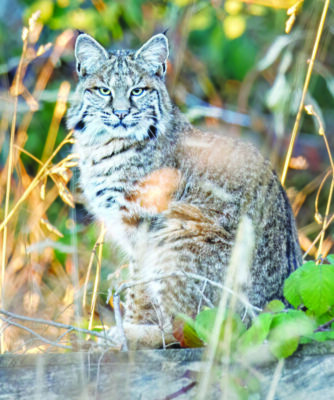
Bobcat. Photo by Micheal McGarry.
“Bobcats are very abundant in New Hampshire and are doing great statewide,” Tate said. “Their densities do decline, and by density I mean number of animals per square mile, as one goes north, particularly in the White Mountain area and the very extreme northern parts of New Hampshire, and that is because of snow depth. They have small feet and don’t do exceptionally well with snow during the winter.”
We’re not talking about a small amount of snow.
“Not 4 or 5 inches, but 12 inches or more of snow. They don’t do well because their body weight pushes their feet through the snow and moving around becomes difficult,” Tate said.
The winters do appear to be changing, Tate noted: “Our winters are a little more mild than they’ve been in decades past. With milder winters, animals do better, predators do better.”
“There’s been various work done where predators of bobcat have altered in their number which allows bobcats to do greater, meaning reproduce more. Some of those predators, one in particular, are argued to be fisher, and there’s various work there, but at the same time where our bobcats are doing so well now our fisher may not be doing as well because in part of our bobcat population doing so well,” Tate said.
Where to find them: Bobcats can be found all over the state.
“Seeing a bobcat during daylight hours is not anything to be alarmed about,” Tate said. “The species will be active 24 hours a day, they will hunt during the day, that’s a normal behavior.”
They are not skittish.
“Seeing a bobcat walk away, rather than run away, from a person is a normal behavior. They tend to be tolerant of human presence.”
But chicken owners should be aware.
“Make sure they have a properly constructed chicken coop with a chicken run. Don’t rely on having chickens out during the day because there’s a lower number of predators. Bobcats learn to key in on human behavior and timing and will learn to hunt chickens during the day,” Tate said.
Their place in the ecosystem: Besides occasional chickens, what does a bobcat eat?
“Bobcats are capable of taking down anything from smaller than a mouse to whitetail deer-sized animal, any species between there: rabbits, raccoons, there’ve been situations where they’ve gone after foxes, deer fawns, gray squirrels, bird, beaver, muskrat, and adult whitetail deer,” Tate said. They like to eat and move on to their next errand.
“They are a strict carnivore species,” Tate said. “They will scavenge in the winter…. They tend not to cache animals unless it is the winter months, and during winter months they will cache whitetail deer because they can’t consume one entirely at one sitting.”
As to rivals, “fisher and bobcat are predators of one another,” he said.
The future: The outlook for the bobcat is unclear.
“The future all depends on what time scale we are talking about and how much habitat continues to be fragmented and the impact of those roads,” Tate said.
There is an issue with rodenticide. “Rodenticide use and how we use rodenticides has potential of impacting various wildlife species and indirectly bobcat. Where I stand now, the future does not look awful. I don’t want to put rose-colored glasses on and say it looks the best it’ll ever be,” he said.
“Predator species key on prey that are a little bit off and not acting correctly and they’ll kill those prey. That is called secondary poisoning. By killing mice and in situations where other animals are poisoned, the predator is then poisoned themselves…,” Tate said.
How many bobcats are affected by rodenticide? “The exact numbers on bobcats, I don’t know,” he said, “but I can say for sure with fox and fisher, it happens a lot.”
The UNH Veterinary Diagnostic Lab has done work with New Hampshire Fish and Game on fox and fisher and “it showed that over 90 percent had been exposed to rodenticide, of the animals we submitted,” he said.
Overall though, “bobcats are doing well and as long as our wildlife habitat, our unforced habitat, remains where it is, bobcats will continue to do well.”
BATS
Species: There are eight species of bats, three of them migratory, according to Sandra Houghton, a Wildlife Diversity Biologist in the Nongame and Endangered Wildlife Program through the New Hampshire Fish and Game Department. These include the hoary bat, silver-haired bat and eastern red bat.
The five that winter here are the little brown bat, the northern long-eared bat, the tricolored bat, the eastern small-footed bat and the big brown bat.
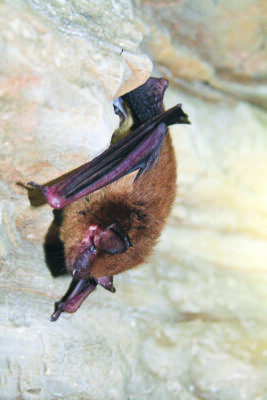
“The big brown bat is now much more common. It used to be the little brown bat prior to white-nose syndrome,” Houghton said.
Big Brown Bat. Courtesy photo from NH Fish & Game.
How are they doing? Unfortunately, bats are not doing well and the main culprit is white-nose syndrome (WNS). “White-nose syndrome, it’s caused by a fungus that basically decimated bat populations, originally in the Northeast but now it’s kind of spread across the nation,” Houghton said. “It’s causing them to arouse more frequently during the winter and we just saw massive die-offs. A 90 percent decline in many of our wintering bat species.”
When and where did this come from? “It was first documented in New Hampshire in 2009 and most of that decline occurred generally by 2014, 2015, our numbers were low and have stabilized at that low number. It’s a little bit different for every species. Some have been impacted more severely…. It was first documented in New York…. It’s a little bit unknown … it may have come from Europe or Asia. It was a new fungus to the environment,” she said.
Some bats can carry the fungus and be asymptomatic but still pass on spores.
Will they get better? “Any recovery is going to be slow and uncertain. They’re generally only having one young each year and the likelihood of survival for that young is also more tenuous now than it was. That’s about how they are doing,” Houghton said.
Many bats are considered threatened or endangered both on a state and federal level.
“The northern long-eared bat was listed as federally threatened … it just became federally endangered…. The tricolor is proposed for listing as federally endangered and four out of the five of those species are state endangered,” Houghton said. These include the little brown bat, the northern long-eared bat, the tricolored bat and the eastern small-footed bat.
Where to find them: “The wintering locations are more confined,” Houghton said. “It might be an old mine or cave that has a suitable environment. That’s high humidity, generally over 80 percent humidity. The temperature is stable so it’s staying like 34 to 40 degrees. It’s inground.”
When the weather warms up, it’s a different story.
“During the summer, it’s really statewide. Different species use a variety of habitats,” she said. “Some of them live in trees. We have one bat, the eastern small-footed bat, that lives in more of a rock crevice, like a talus slope….”
Bats utilize snug spaces in trees too.
“Others will roost in different parts of a tree. some use the cracks and crevices, some will be among the leaves, and then some might be underneath the bark, and both the little brown bat and big brown bat will utilize man-made structure,” Houghton said.
Their place in the ecosystem: Bats will eat a lot of insects.
“They are our largest predator of night flying insects. They’re eating half their body weight, and when they’re pregnant or nursing they may be eating all of their body weight in insects and they’re eating a whole diversity, agricultural pests, forest pests, a mosquito that people find to be pesky,” Houghton said.
As for what eats bats, “predators could include owls or cats,” though that’s not an exhaustive list, she said.
The future: Not without hope, but having the joy of watching bats flutter about at twilight is an ongoing struggle.
“We see little glimmers of potential signs of recovery but any recovery is going to be slow and uncertain. Any glimmers we’re taking with caution,” Houghton said.
Some other good news include a certain longevity and the ability to have their offspring survive. “We’ve seen little brown bats who we’ve documented surviving over a decade,” she said. “Also, successfully having young and having the young return. Little signs of encouragement. Little things like that.”
CHIPMUNKS & SQUIRRELS
Species: Eastern gray squirrel
Red squirrel
Eastern chipmunk
How are they doing? According to Brett Ferry, the New Hampshire Fish and Game small game project leader, squirrels are doing fine.
“They are doing quite well,” Ferry said. “Their population is based on available food sources, mostly oak acorns, pine seeds and cones. If it’s a good pine cone year then there are a lot of pine seeds for them to eat over the winter.”
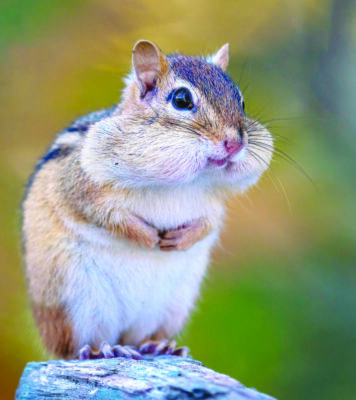
Chipmunk. Photo courtesy NH Fish and Game.
The chipmunks, “they’re doing fine as well,” he said, and they are on “the same track as squirrels…. Sometimes people call in because they occasionally see an albino squirrel or sometimes they’re black, but they’re all the same eastern gray squirrel; they just have some different color variations once in a while.”
Where to find them: “They’re pretty common, found statewide,” Ferry said. “The gray squirrels will be more in the southern part of the state. Red squirrels are more common in the north. But they’re both statewide…. There’s a hunting season on gray squirrels.” This starts on Sept. 1.
Their place in the ecosystem: Chipmunks and squirrels provide similar ecosystem services.
“They spread the seeds and nuts of the trees they eat. They spread acorns around, keeping those species going. Then, they’re also prey for predators such as hawks and owls, weasels…,” Ferry said.
The future: Squirrels do not seem to be going anywhere.
“They’re able to exist with humans pretty well, and good stands of oak trees to maintain acorns and future food sources so they should do well,” Ferry said. Chipmunks are “pretty much the same.”
COYOTES
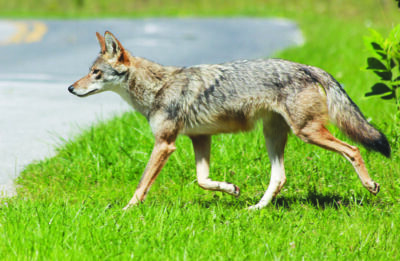
Species: The eastern coyote, canis latrans variant, is what’s found in New Hampshire, as Patrick Tate explains. “They are a mix of western coyote DNA, a small amount of wolf DNA, and I’m going to use rough terms, call it 10 percent or so, and approximately 10 percent domestic dog,” Tate said.
These coyotes are found all the way from Ohio to the tip of Maine and from there down to the Carolinas and back up to Ohio.
It is interesting to note that “eastern coyotes in New Hampshire, which are pretty similar to all those occupying New England, would be extremely different from an eastern coyote on the edge of Ohio or New York.”
Coyote. Photo courtesy NH Fish and Game.
How are they doing? Coyotes are doing great. “Eastern coyotes are doing very well in New Hampshire,” Tate said. “They arrived in the state in the late ’30s, early 1940’s. The first documented one in New Hampshire was in 1944 and that was up in the Lakes Region…. Animals are generally present for a few years before they are officially documented.”
Where to find them: Coyotes are pretty much everywhere.
“By the 1970’s they [were] found statewide and they continue to remain statewide,” Tate said. “They are highly adaptable to all habitats and have the ability to do well in all the places they adapt to, so our cities have eastern coyotes in them and certainly every town in the state.”
Their place in the ecosystem: Coyotes eat lots of different types of food.
“They’re an omnivore species,” Tate said, “so they eat fruits, berries, and take prey up to the size of whitetail deer. They do very well at taking whitetail deer … If there is good snow depth or snow conditions they’ll do better.”
These animals excel at what they do, Tate said. “As predators, they are a consistent force through the year to remove sick and weak prey animals, which strengthens the prey species because the stronger ones survive. It’s that predator-prey relationship game that all the species that we discussed play, that they’re a part of…. They have the ability to help the natural ecological function of being a predator and capturing animals.”
The future: Tate does not have information on coyotes with rodenticide, but said “they do extremely well in all habitats and seem to be more resistant to human changes in the landscape. As a wildlife biologist, my projection is that they’ll continue to do well as they are….”
FOXES
Species: Red fox, Gray fox
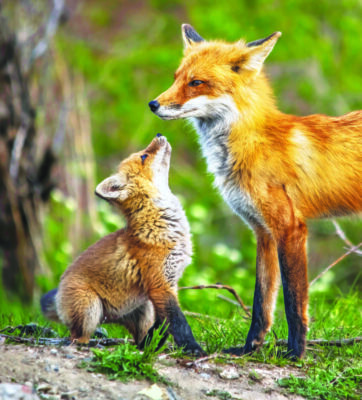
These two types of foxes are “completely separate species. They have a different chromosome number and they do not have any ability to interbreed,” Tate said.
Foxes. Photo courtesy NH Fish and Game.
How are they doing? Tate and New Hampshire Fish and Game “are doing some trail camera work to determine densities” of fox populations, Tate said. Numbers for both species are down, he said. “Their numbers are down from the historic high; however, we have no reason to believe that foxes are about to leave this state and not be present.”
Where to find them: Both can be found statewide, and especially for “red fox, the density per square mile does not vary greatly throughout the entire state,” Tate said.
It is different for the gray fox.
“Gray foxes are near the northern limit of their range in New England. Because of that, as a person goes north, the density per square mile of gray fox declines,” he said.
Their place in the ecosystem: Foxes have a varied palate.
“They’re an omnivore species, both red and gray; interestingly their diets overlap,” Tate said. “So they’ll eat berries, they’ll eat fruits. Then mice, squirrels, rabbits … waterfowl, turkeys, wild turkeys, that’s all in their realm.”
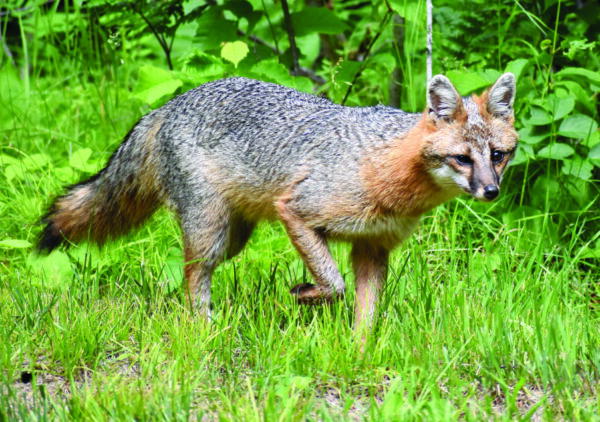
Gray fox. Photo courtesy NH Fish and Game.
Unlike the bobcat and coyote, foxes leave deer alone, he said. “They have less capabilities than bobcats.”
It is fun to note that gray foxes have retractable front claws. “They have the ability to climb trees,” Tate said. “When I say climb, they hold on with the front claws and with their rear claws, push themselves up the tree. So they’re not using limbs to climb; they’re actually using their claws to grip and climb the tree.”
Red foxes lack this trait. “Red foxes do not have that ability,” Tate said. “However, red foxes will climb ornamental trees that they’re able to jump limb to limb to get to fruit such as crab apples or apples…. It’s not the same type of climbing technique and one could argue that one does not climb at all. Whereas gray foxes can certainly climb trees.”
The future: The outlook is similar to that for the bobcat, although “based on exposure rates, I would argue that rodenticides are more impactful to the population because of the fox’s willingness to occupy residential settings at a greater level,” Tate said.
Foxes do not travel as far as bobcats either.
“They have smaller home ranges than bobcat, smaller area, and can expose themselves a little more because of that,” he said. This makes rodenticide exposure a greater concern. But it is important not to lose hope. “There’s work at the federal level regarding rodenticide … that continues to be ongoing,” Tate said, “so my hope is that the rodenticide issue gets cleared up over time and the population is less impacted by human presence.”
According to a press release, Lindsey Stepp of Holderness was re-nominated by Gov. Chris Sununu and was confirmed by the New Hampshire Executive Council on Wednesday, Aug. 7, to continue serving as Commissioner of the New Hampshire Department of Revenue Administration (NHDRA).
Stepp is the NHDRA’s first female Commissioner and she began her tenure as Commissioner in December 2017 after previously serving as Assistant Commissioner for nearly two years. Her new four-year term runs through Sept. 1, 2028.
In her role as Commissioner, Stepp leads the state’s tax agency, which is responsible for collecting in excess of $2.7 billion in annual revenue and ensuring equity in the $4.5 billion of property taxes collected by New Hampshire’s 234 municipalities; and directs a staff of more than 150 professionals that are charged with fairly and efficiently collecting taxes from the state’s citizens, businesses, utilities and hospitals, according to the release.
The marquee achievement under Stepp’s leadership to date has been the implementation of the Revenue Information Management System (RIMS) and the Granite Tax Connect (GTC) online user portal, which together modernized NHDRA’s entire information system and transformed the way New Hampshire taxpayers and tax preparers file and pay taxes through automation, integration and electronic filing.
Fire foam retrieval
According to a press release, the New Hampshire Department of Environmental Services (NHDES) in partnership with the New Hampshire State Fire Marshal has launched a statewide initiative to destroy hazardous per- and polyfluoroalkyl substances (PFAS) in firefighting foam.
During an event at the New Hampshire Fire Academy’s Aircraft Rescue Training Facility in Concord, NHDES Commissioner Bob Scott announced details of the new Aqueous Film-Forming Foam (AFFF) Take Back Program. AFFF is primarily used by fire departments to smother flammable liquid fires. Its high concentrations of PFAS compounds resist typical environmental degradation processes and cause long-term contamination of water, soil and air, according to the release.
The ban on the use of these “legacy foams” is possible because there are now PFAS-free foam alternatives available.
NHDES has contracted with Revive Environmental Technology to administer the collection and destruction of AFFF in the state. Following collection of the foam, Revive will consolidate the containers and ship them to its facility in Columbus, Ohio, where the foam will be treated with Revive’s PFAS Annihilator technology, originally developed by Battelle, which uses supercritical water oxidation (SCWO) to destroy the PFAS chemicals without generating harmful PFAS byproducts or transferring the PFAS elsewhere in the process.
The FAA doesn’t currently require airports like Manchester-Boston Regional Airport to transition to the new foam, but the airport is taking the initiative to switch over now in order to be a more sustainable and environmentally-friendly airport, according to the release.
New Hampshire’s AFFF Take Back Program is open to all New Hampshire fire departments, local governments, and government-owned airports. See des.nh.gov.
Ocean of hot sauce
According to a press release, the third annual New England Hot Sauce Fest, presented by The Spicy Shark on Saturday, July 27, at Smuttynose Brewery in Hampton, raised $17,942 for two Seacoast organizations dedicated to preserving ocean ecosystems, the Blue Ocean Society for Marine Conservation and Seacoast Science Center.
In a statement, Jen Kennedy, Executive Director of Blue Ocean Society for Marine Conservation, a Portsmouth-based nonprofit, said, “We’re so grateful to have been a part of this hugely successful event. We look forward to using the funds to expand our research on marine life and ensure a healthier ocean.”
RIP Bald Eagle
The New Hampshire Audubon Society (26 Audubon Way, Auburn, 224-9909, nhaudubon.org) announced on its website on Aug. 6 that its long-time ambassador bald eagle has died. “It is with heavy hearts that we announce the passing of our cherished ambassador Bald Eagle,” the post read. “He was 36 years old and had been a vital part of our conservation and education programs for 25 years.” The bald eagle came to NH Audubon in 1999. He was found injured in upstate New York, which led to his left wing being amputated at the elbow. A metal band on his left leg “identified him as a nestling from Ontario, Canada, in 1988,” NH Audubon wrote. According to the U.S. Fish and Wildlife Service website (fws.gov), bald eagles generally live 15 to 25 years in the wild.
Correction
In the Aug. 15 issue of the Hippo, a Q&A on page 6 with Kyle Dimick incorrectly described the injuries he suffered during a ski trip that led him to his invention. He had a concussion, as well as other injuries listed in the story, but not, as was initially stated in a press release about Dimick, a traumatic brain injury.
Go for a beginner wild mushroom walk at Prescott Farm Environmental Education Center in Laconia (928 White Oaks Road) on Saturday, Aug. 24, from 10 a.m. to noon. Led by experts from the New Hampshire Mushroom Co., this walk will take you along the farm’s scenic trails to search for, collect, identify and become familiar with different mushrooms. This event is for foragers 16 and older. $20 for members and $35 for nonmembers. Visit prescottfarm.org.
Tickets are on sale now for the NH Highland Games & Festival Sept. 20 through Sept. 22 at Loon Mountain in Lincoln. Special ticketed events at the festival include a whiskey tasting, a Cape Breton dinner and concert, Highland Brews & Bites and a Scotch Ale competition. See nhscot.org.
Talking Heads tribute act Start Making Sense will perform at The Range Live Music and Concert Venue in Mason (96 Old Turnpike Road, 878-1324, therangemason.com) on Saturday, Aug. 24, at 7 p.m. Tickets cost $39 in advance, or $45 on the day of the show.
Music fans scanning upcoming shows recently did a double take when Tom Dixon’s name popped up.
The country rocker and his band were ubiquitous from the mid-2000s on, but in 2013 he moved to Nashville. For a few years he’d come back for an occasional mini tour. However, by 2018 he’d hung up his guitar and pen to become a dog trainer.
Dixon has been dipping his toes back in musical waters of late. A show with his band at a campground in Hohenwald, Tennessee, in June, a couple more at a Virginia brewery and a winery in Lewisburg. He even dusted off an old song of his, “Truckin’” — not the one by the Dead — and made a dozen ballcaps to celebrate.
He’s excited, he said by phone in early August, because now playing is a choice, not a job. Dixon is also stoked to finally be back in New England for a few shows with his old band mates.
“That’s what’s fun about this part of my career; I’m not rushing to have something new and stay fresh,” he said. “When I make music, it’s what I want, or what my friends want.”
He’s headed back, for the first time in two years, to play some shows in his old stomping grounds. There’s a sentimental trip to Salisbury Beach, Mass., where he introduced line dancing to a bar called Surfside over a decade ago, and a couple of shows at the Caledonia Fair in Northern Vermont, one with his band and another with Saving Abel’s Jared Weeks and Big Vinny of Trailer Choir.
In New Hampshire, he’ll do a full band show Aug. 17 at Stumble Inn in Londonderry, a roadhouse where Dixon spent a lot of time before heading south.
“We used to play Slammers out in Bedford, that was our place,” he said. “It disappeared, and Stumble Inn became the place … as many venues as I’ve played anywhere, that’s always kind of home. I go back, and I always go there.”
When his clients asked about him taking time off, Dixon joked with them.
“They’re like, ‘what are you doing, going on vacation?’ I said, ‘No, I’m going to go pretend to be a rock star again, get back on the road and play some music.’ We’ll see how it goes. I’m looking forward to seeing so many people. That’s the best part.”
Even if Dixon isn’t quitting his day job, he’s more focused on making music. Along with updating “Truckin’” he recorded a song called “We Used to Be Rock Stars” with Ben Kirsch. “It’s not about being a musician, but about getting older,” he said. It continues an effort that began with “The Weekend,” released in early 2020 — no, you don’t need to remind him of the timing. The song was an affirmation and actually got a decent amount of pandemic streams.
“Nashville kept telling me who I needed to be; I was trying to reinvent who Tom Dixon was for so long, but things slowed down, and I wasn’t listening to Nashville anymore,” he said. “I took a break from things … I decided to look at the history of streams and online downloads and stuff over the years and the top ones were all songs that were my style from before moving to Nashville. It was so crazy.”
Chastened, he wrote the new tune.
Now, with songs like “Rock Stars” and the voice memos on his phone that he’s spending more time with, “I can do this my way now,” he said. “I came from Manchester; it always was a rock town. I remember having to go into rock venues to get gigs, that’s where I had to be years ago. I should have just stuck with that melding of rock and country … versus trying to reinvent what Nashville was telling me I was supposed to be. Now, I get to be me.”
Tom Dixon Band When: Saturday, Aug. 17, 8 p.m. Where: Stumble Inn, 20 Rockingham Road, Londonderry More: tomdixonmusic.com Tom Dixon also appears solo at Stumble Inn on Wednesday, Aug. 21, 7 p.m.
Fest features African-Caribbean and Latin communities
The We Are One Festival is something of a legacy for Sudi Lett, and like all legacies it comes at a cost.
“I’m excited to do it, “ he said. “It’s one of those things that I feel good about doing, but it is work and it takes a lot of time. We’ve been going at this since April. So I’m excited.”
The We Are One Festival got its start more than 20 years ago by Lett’s parents.
“My folks organized the first African Caribbean celebration back in 2001,” he said. “We initially started [the Festival] with this Haitian woman named Marcy Boucher. She was talking about that there wasn’t really anything for Caribbean people in terms of cuisine or entertainment or anything. And so they really went out of their way to kind of create this space for people in Manchester and in New Hampshire.”
Since then, the Festival has grown. Fifteen years ago, it joined with Manchester’s Latino Festival, making it the oldest Latino-and-African-centered cultural festival in New Hampshire, with the goal of reducing feelings of social isolation among Manchester’s Black and Spanish-speaking communities. A big part of that is the food.
“There’s a lot of overlap between African-Caribbean and Latin cuisine.” Lett said. “I think the common thread is that these cuisines, even though they overlap with each other, are really new food for this area of New England. A lot of the cultures here are not as familiar with things like goat meat and oxtail and even things like sweet plantains for that matter.”
Working with Manchester Caribbean restaurants, like La Fierra (521 Wilson St., 518-5644) and Don Quijote (362 Union St., 622-2246, donquijoteunion.com), Lett hopes to present new foods to some of the city’s residents, and give a taste of home to others.
“We have oxtail, African rice, [Caribbean] curry chicken and fried chicken,” he said. Other restaurants will serve chicharron — crispy, fried pork skin — stewed chicken, rice and beans, empanadas and pastelitos. “Every year so many people I see in the park, they always come out and say, ‘Hey, Sudi, we’re here for the food!’ I think that’s awesome.”
In addition to the food, We Are One will feature music, dancing and other expressions of Caribbean and Latin American culture. Master percussionist Theo Martley of the Akwaaba Ensemble (akwaabaensemble.com) will perform, as will the band Tuca del Norte.
After all these years, Lett is still excited about We Are One.
“The festival combines obviously African, as well as African American culture, music, food, as well as Latino and Latino American culture, music and food,” he said. “It’s a great opportunity. We’re hoping to get some really good weather because we go rain or shine. Some years, we’ve had unbelievably great weather. And I mean unbelievably great, like 71 to 75. But also weather, where it’s rained or it’s been 92 and it’s just so hot outside. It’s a great thing for me because it really just kind of shows a little bit about life, like the years come and go. Some years are better than others, some years are great.”
Lett says that regardless of the weather, the food will be spectacular.
”You can’t argue taste, man. You can’t argue taste.”
We Are One Festival Saturday, Aug. 17, from 11 a.m. to 6 p.m. Veterans Memorial Park, 723 Elm St., Manchester Admission is free. Visit manchesterproud.org/the-event/we-are-one-festival.