
Black Adam (PG-13)

Black Adam (PG-13)

Dwayne Johnson is the magnetic core of the “too many items on the menu” comic book adaptation Black Adam, an entry in DC’s Extended Universe.

We meet Black Adam (Johnson) — who is, to oversimplify, a “Shazam”-type — as well as the Justice Society, presented as a good guy Suicide Squad (also directed by Viola Davis’ Amanda Waller). The team is led by Hawkman (Aldis Hodge), who is sorta cool and rich, and includes Dr. Fate (Pierce Brosnan), Cyclone (Quintessa Swindell) and Atom Smasher (Noah Centino), a new-guy superhero whose funnest attribute is that his uncle, the previous Atom, is played by Henry Winkler. We also learn about Intergang, a group of criminal mercenaries occupying Kahndaq, a country presented as the vaguely Middle Eastern. And, rounding out the DCEU business, there is a mid-credits scene that is, in my opinion, some complete nonsense.

The movie also talks vaguely about colonizers, oppression, freedom, the idea of being a hero versus being protector and why it is bad to murder people. And, it seems like the movie can’t decide whether it’s deadly serious or quippy and so it does both.

In the movie’s present, Adrianna Tomaz (Sarah Shahi), a professor in the oft-invaded and oppressed Kahndaq, is desperate to find an ancient Kahndaq artifact, a blue-ish iron-y crown that can give its wearer godlike powers (of demonic origin). She wants to rehide it so Intergang and other baddies will never find it. But one of her shifty compatriots, Ishamel (Marwan Kenzari), has other plans. Adrianna finds the crown in an ancient tomb just as Intergang arrives and demands it at gunpoint.

Certain she is going to die, she does some on-the-fly translating to call on Kahndaq’s ancient protector, and the muscle-y Adam (Johnson) appears. He lays waste to nearly all of the Intergang group and allows Adrianna and her comic relief brother, Karim (comedian Mohammad Amer), to get away. Later, Adrianna introduces Adam to her young son, Amon (Bodhi Sabongui), a big fan of superheroes who has some advice for Adam on how to improve and capitalize on his image in this modern world.

Amanda sends in the Justice Society to neutralize Adam because of some secret ancient texts that suggest he isn’t the public-protecting superhero that legend paints him as. When the Justice Society arrives in Kahndaq, they discover that “international stability!” isn’t exactly an electrifying rallying cry and maybe oppressed people aren’t so concerned with what happens to their oppressors.

Or, I mean, that’s an element that is mentioned and that I found kind of interesting — justice and prioritizing the global peace vs. more direct protecting of one’s people. But for all that the movie throws it out there, the Big Ideas are kept kinda vague.

Like a kid sprinkling Fruit Loops and M&Ms on top of a Nutella and potato chips Eggo sandwich, the movie drops those nuggets of “saying something” on top of an overstuffed pile of comic book lore: this character and their relationship to that character and the magical this thing, created by the wizard-y those guys. We don’t get a whole lot of time with any one element and most of it is just told directly to us in flashback or exposition dump. While I’ve often wanted superhero movies to skip the origin stories and get right to the superheroing (not unlike how the MCU handled Spider-Man), Black Adam skips any kind of context about these people or groups. Watching Black Adam isn’t a whole lot different, experience-wise, from reading the character’s Wikipedia page. You get plenty of raw data but not a lot of emotional connection to characters or their quests.

Dwayne Johnson is a top-notch action movie player — he is one of my favorite parts of the whole Fast & Furious experience at this point. Black Adam doesn’t use his talents nearly enough and doesn’t give him a solid story. It never really settles on who it wants Black Adam, the man or the movie, to be. C

Rated PG-13 for sequences of strong violence, intense action and language, according to the MPA on filmratings.com. Directed by Jaume Collet-Serra and written by Adam Sztykiel and Rory Haines & Sohrab Noshirvani, Black Adam is two hours and four minutes long and distributed in theaters by New Line Cinema.

Ticket to Paradise (PG-13)

The charms of and genuine good will between George Clooney and Julia Roberts do most of the work in the rom-com Ticket to Paradise.

Long-divorced couple David (Clooney) and Georgia (Roberts) have a deeply antagonistic relationship, bickering all the time — including throughout the college graduation ceremony of their daughter Lily (Kaitlyn Dever). They seem delighted to walk swiftly away from each other at the airport after saying goodbye to Lily, who is vacationing in Bali with her buddy Wren (Billie Lourd). After the post-college pre-life trip, Lily is slated to start work at a prestigious law firm.

But is law really Lily’s dream, or something her parents have talked her into? When she meets Gede (Maxime Bouttier), a local seaweed farmer, she starts to doubt her whole life plan. Thus, some two months later, do David and Georgia find themselves on a plane to Bali to stop their daughter from marrying Gede and derailing her big career.

There is, of course, all kinds of baggage. A similar post-college engagement between David and Georgia, followed quickly by the birth of Lily, derailed Georgia’s career plans. Though divorced more than a decade, David and Georgia are clearly still angry about how their relationship ended — and maybe even that it ended. David is currently unattached and Georgia is maybe not looking for forever with her boyfriend Paul (Lucas Bravo), an airline pilot.

Roberts and Clooney are good separately — clunky exposition scenes where they tell various stories of their relationships to other people work because they are such watchable actors. Together they crackle and spark — they’re great scene partners whether their characters are fighting or flirting. Their plan to break up Lily and Gede allows for a fair amount of charmingly executed scheming and gentle capers.

The rest of the movie is a flat fountain soda, watered down in flavor and generally lacking in effervescence. Everything that isn’t based on Roberts’ and Clooney’s star power and chemistry is tepid at best. The story feels like so much warmed over “haven’t we seen this before” and the romance between the youngs is fairly spark-free. Lourd, whose oddball neglected-rich-kid character is interesting, doesn’t get nearly enough to do to really bring anything to the movie.

Clooney and Roberts and the beauty of Bali carry this movie further than it has any right to go, but it ultimately underwhelms. C+

Rated PG-13 for some strong language and brief suggestive material, according to the MPA at filmratings.com. Directed by Ol Parker with a screenplay by Daniel Pipski, Ticket to Paradise is an hour and 44 minutes long and is distributed in theaters by Universal Studios.

Featured photo: Dwayne Johnson in Black Adam.
Halloween Ends (R)

The infectious nature of violence is the real boogeyman in Halloween Ends, the allegedly final installment in the Laurie Strode/Michael Myers rebooted-ish Halloween series.

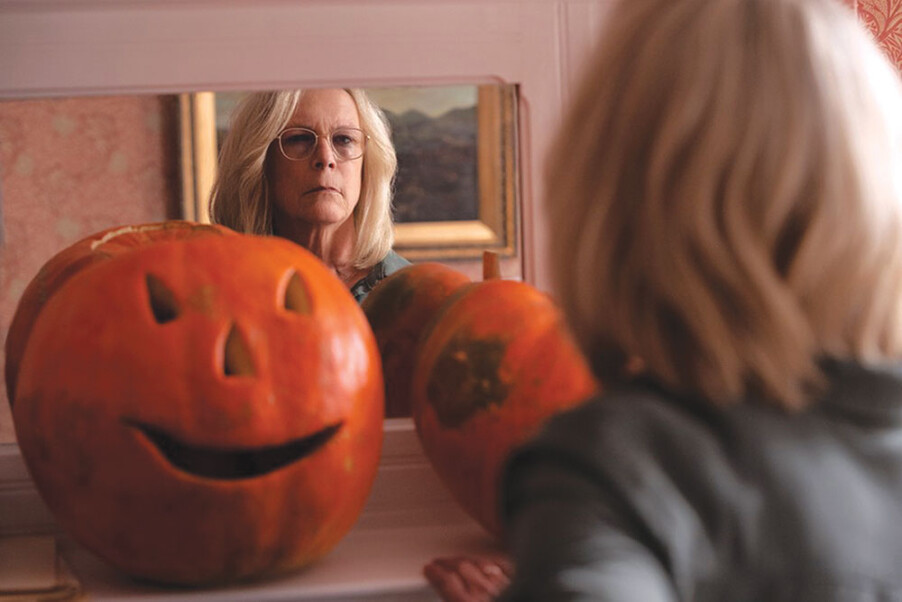
This movie is also about the awesome recent career of Jamie Lee Curtis. She served up Laurie in the last movie, 2021’s Halloween Kills, largely from a hospital bed, which feels like a pretty rad way to collect your franchise check. Since restarting the Halloween franchise with Halloween in 2018, where she got to play a gun-toting revenge-seeking prepper, she’s been in Knives Out and played Deidre Beaubeidre in Everything Everywhere All At Once. Curtis is, at 63, living the life and even though these Halloween movies aren’t setting the world on fire for me they have, in total, given me a new appreciation for Curtis for being able to get fun work in movies past the age when Hollywood usually allows women to have that. (Also, for what it’s worth, they’ve made some good money at the box office.) “Good on ya, Jamie Lee Curtis” might actually be my strongest takeaway from this trilogy as a whole.
We’ve had a little time jump since Halloween Kills, which I guess took place in 2018 (the same in-universe night, I think, as 2018’s Halloween). It’s now four years later. Laurie Strode (Curtis) is still dealing with the death of her daughter (Judy Greer) at the hands of Myers at the end of the last movie. She lives with her granddaughter Allyson (Andi Matichak) still in the same death-town of Haddonfield, Illinois, but now in a proper house in a regular neighborhood. She’s decorating for Halloween, writing about surviving all the Michael Myers violence and even awkwardly flirting with Frank (Will Patton), longtime friend and police officer. But even in happy moments she finds herself buried in the grief of the Myers killings. People blame her for all the death and destruction and she feels that the evil and violence of those actions have spread, not just to the Halloween Kills vigilante mob but to crimes perpetrated through the town over the last four years. One of the most gruesome, which we see in the movie’s opening scenes, happens in 2019 and features college-ish-aged Corey (Rohan Campbell), called in to babysit for a boy when his parents go to a Halloween party. The kid tries to scare Corey by locking him in the attic, but what happens next leaves Corey pegged as a new town boogeyman.
In the present day, Laurie sees Corey getting picked on by some high school kids and feels sorry for him. She takes him to the hospital to be treated by Allyson, who takes an instant liking to Corey. It is once again Halloween time and the tentative new couple goes to a party, where there are masks and angry townsfolk and instances of casual violence. Michael Myers (James Jude Courtney as “The Shape”), not seen since 2018, lurks in the corners but does he see in Corey prey or something else?
Look, I’m not going to pretend that this movie is super deep. It is still mostly stabbing and screaming and masked figures doing a power walk after running-in-terror victims. But there’s some “what is the nature of evil” and “how does hate spread” musings, often delivered by Curtis, between all of that, which gives the movie at least the veneer of thoughtfulness. We also get fountains of stage blood and some pretty gleeful squish noises, so I don’t feel fans of the seasonal classics will be disappointed. I did also appreciate the overall lo-fi quality of the movie, with its out-of-time setting (from clothes to hair to the fact that the whole town is glued to the rock radio station, there is still a general late-1970s/early 1980s vibe) and its quip-free, linear-plot-development no-nonsense approach to the story. There is almost something wistful about the whole endeavor, like you can feel a bittersweetly smiling Curtis saying “aw, I’m going to miss all this knife-welding.”
Halloween Ends ultimately feels like it’s delivering vibes more than a scary story, but if you’re in the mood for Halloween-season fare, I feel like you could do worse. C+
Rated R for bloody horror violence and gore, language throughout and some sexual references, according to the MPA on filmratings.com. Directed by David Gordon Green and written by Paul Brad Logan & Chris Bernier & Danny McBride & David Gordon Green, Halloween Ends (sure it does) is an hour and 51 minutes long and is distributed by Universal Studios in theaters and via Peacock.

Featured photo: Jamie Lee Curtis in Halloween Kills.

Amsterdam (R)

Amsterdam (R)

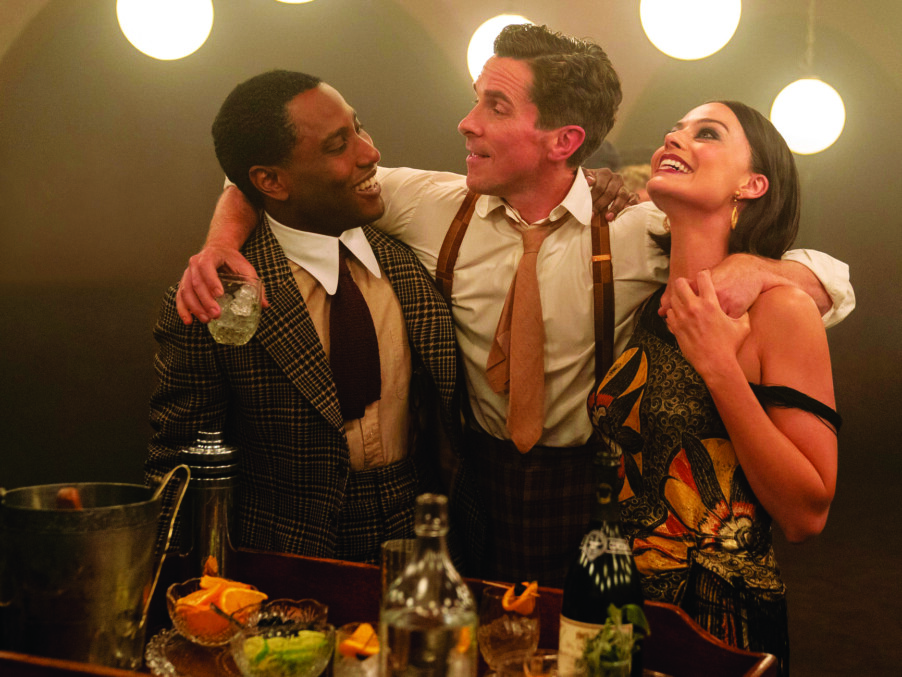
John David Washington, Margot Robbie and Christian Bale are Americans who enjoy liberation in post-WWI Europe but find themselves tangled up in intrigue in pre-WWII New York in Amsterdam, a movie written and directed by David O. Russell that backs into a piece of history called the “Business Plot.”

Spoiler alert if you decide to dive down the Wikipedia rabbit hole of the nutty incident that is the Business Plot before seeing this movie.

In World War I, medical doctor Burt Berendsen (Bale) joins a mostly African-American Army regiment that has suffered from dangerously hostile and disrespectful leadership by white officers. Aspiring lawyer Harold Woodman (Washington) makes a deal with Burt that if Burt actually works to help the troops and keep them alive Woodman will try to keep Burt alive. When most of the regiment, Burt and Harold included, end up in a French hospital with injuries, the friendship deepens and grows to include Valerie (Robbie), an American working as a nurse.

Valerie takes the men with her to Amsterdam, where two “businessmen”— Henry Norcross (Michael Shannon), in US Naval intelligence as a chyron tells us, and Paul Canterbury (Mike Myers), really MI6 — offer to help the men receive medical treatment for their wounds and in Burt’s case an unlimited supply of glass eyes to replace the eye he lost. In exchange, Norcross and Canterbury might one day need some kind of favor from Burt and Harold, maybe a favor similar to the kind of information-passing favors Valerie did during the war. In Amsterdam the men get a rest — not just from war but from all of the constraints they suffer from at home, such as the antisemitism lobbed at Burt (including from his tony in-laws) and the deadly racism that plagues Harold and would make his romance with Valerie impossible.

Eventually Burt returns home to his wife Beatrice (Andrea Risenborough). He’s kicked out of his fancy Park Avenue medical practice because he brings veterans in for treatment — all veterans regardless of race. Eventually, Burt and Harold join forces to help veterans try to get the care and the benefits they deserve.

Which brings us to the now of the movie: 1933. Burt and Harold agree to perform an autopsy of their beloved former general when his daughter (Taylor Swift) suspects that he’s been murdered. But then she is murdered, pushed into the street by a man who points the finger at Burt and Harold. They must find out who killed the general and his daughter in order to clear their name.

A story of interwar hopefulness and romance is folded into a crime caper and it all comes together in a tale of the international political storm of the 1930s. And it’s long. And feels it.

Amsterdam meanders around, spending some time being a comedy about the buddyship of Burt and Harold, with characters played by Chris Rock and Zoe Saldana, then spending some time in a whirl of crime and early spycraft, in storylines filled with shady people with shady motives. The movie doesn’t have time to settle into any one groove. I have liked John David Washington in everything I’ve seen him in but here, like most of the people in this movie, he’s so busy ferrying the story from this moment to the next that he doesn’t really get to do much with his character. Bale goes big with his character and Robbie is, I dunno, fine, but with the vast list of movie chores for everybody to tick off it almost doesn’t even matter who we think they really are. Everybody gets a few nice moments but nobody really gets to build layers.

I appreciate the goodness that this movie seems to want to advocate for — one of its messages is “you know what’s better than war? Love and mutual respect,” which is, you know, accurate and laudable and even kind of sweet in its earnestness. But the buffet of styles and tones and everything made it too easy for whatever was the point of all this to get lost along with any really standout work from the actors. Amsterdam needed to get where it was going quicker, with more bounce and with a lot less of everything else. C+

Rated R for brief violence and bloody images, according to the MPA on filmratings.com. Written and directed by David O. Russell, Amsterdam is two hours and 14 minutes long and is distributed in theaters by 20th Century Studios.

Lyle, Lyle, Crocodile (PG)

A family moves to New York City and finds a singing crocodile living in their brownstone in Lyle, Lyle, Crocodile, a live-action musical whose songwriters include The Greatest Showman’s Benj Pasek and Justin Paul.

I mention this because the songs here had the same unremarkable-to-me feel that the Greatest Showman songs did. But now every kid who has ever dipped a toe in a theater class can bust out “This Is Me,” so my personal tastes don’t necessarily serve as a gauge of wider success. I still wouldn’t listen to that movie’s album but I do own it thanks to my kids — the same kids whom I can see wanting the album of original songs for this movie. The songs, sung by Shawn Mendes, who is Lyle’s singing voice, were half of what my kids seemed to enjoy most about the movie.

The other half was the action scenes, and with a series of people unexpectedly discovering a crocodile, there’s plenty of the wacky, chase-y, adults-screeching action that seems to resonate with kid audiences.

When we first meet Lyle, he is a gecko-sized crocodile living — and singing — in a cage in the back of a pet store. Not-so-great showman Hector P. Valenti (Javier Bardem), desperate for a new act, takes Lyle home and teaches him the movie’s first original song in hopes that they can take the performance on the road. By the time Lyle is a preschooler-sized crocodile, Hector thinks he’s ready and sets up a show, backing the expenses with the inherited brownstone he and Lyle have been living in. But when the curtain rises, Lyle can’t make a sound, and Hector loses his house. He goes on the road to earn cash and leaves Lyle, telling him to pretend he’s stuffed if anybody visits his attic home.

When the Prim family — mom (Constance Wu), dad (Scoot McNairy) and lonely eighth-grader Josh (Winslow Fegley) — moves in, they have no idea that anyone lives in the building other than themselves and the downstairs apartment dweller, Mr. Grumps (Brett Gelman). Then Josh pokes around the attic and discovers Lyle. The two become friends and Josh learns that Lyle can sing. Later Josh’s parents each discover Lyle and, after some screaming, realize the crocodile is not just friendly and tuneful but has the ability to help them work through their various adult existential stuff.

That stuff includes the father’s difficulties with his new class of chatty private-school kids and the mom’s sadness about Josh growing up plus a whole lotta baggage about her marrying Josh’s dad after the death of Josh’s mom and her, I guess, continued uneasiness with her stepmother status? Whatever the exact source of her troubles, it’s something that required just enough talking between adults that kids — mine and others in the theater where I saw the movie — were moving around, chatting, going to the bathroom, all the standard behaviors of a young audience that has lost interest in a movie. The movie comes in at around an hour and 45 minutes and I feel like the adult chatty parts could have been tightened to the “fireworks factory” faster, which in this case is a great escape from the city zoo. The hijinks of that did seem to reel younger audience members back in and leave my kids with an overall positive opinion of the movie.

And “overall positive” would probably be my judgment as well. It’s fine, with a few cute lines and some campy business from Bardem, who is not Hugh Grant in Paddington 2 but seems to be enjoying himself. The physicality of the animated Lyle in an otherwise real world is good enough; a scene of him dancing with Constance Wu is cute and well-executed. The movie doesn’t dazzle but nor does the animation get in the way. Lyle, Lyle, Crocodile is a serviceable, pleasant-enough family viewing experience. B-

Rated PG for mild peril and thematic elements, according to the MPA on filmratings.com. Directed by Josh Gordon and Will Speck with a screenplay by Will Davies (based on the book by Bernard Warber), Lyle, Lyle, Crocodile is an hour and 46 minutes long and is distributed in theaters by Columbia Pictures.

Featured photo: Amsterdam.

Bros (R)

Bros (R)

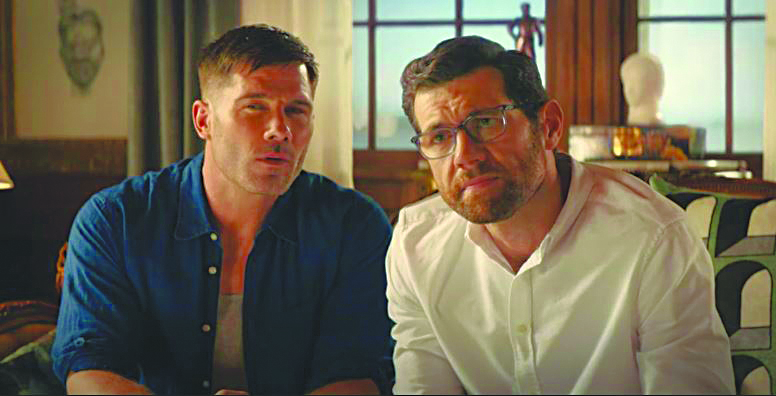
Billy Eichner plays a man who is perfectly happy by himself, absolutely doesn’t want a relationship but uncertainly navigates a possible romance with the very handsome Aaron in Bros, a sweet, genuinely laugh-out-loud funny rom-com co-written by Eichner.

I feel like I’ve seen a run of movies lately where I think “ha, funny” but don’t actually have the spontaneous reaction of laughing. That I actually out-loud laughed is one of the delights of this movie.

And Eichner, of course, gives his character Bobby the mix of clever dialogue and solid delivery that allows for plenty of comedy. Bobby is working to open a museum of LGBTQ+ history in New York City; he has a popular podcast, a solid group of friends and all the casual hookups he wants. He has no need for some conventional-style coupledom, he emphatically explains. But when he sees Aaron (Luke Macfarlane) at a club, he finds himself not just awkwardly flirting but interested enough to be hurt when Aaron seems to walk away from him. He is excited when he and Aaron go on a date but seems sort of pre-angry at the rejection that he thinks is coming from Aaron. Bobby keeps setting Aaron up to tell him that Bobby is not Aaron’s type, but Aaron, who is also wrestling with an unfulfilling career choice, is intrigued by and attracted to the confident Bobby.

This is not your standard Hollywood romance, Billy and Bobby (both Eichner and his character) argue, because gay relationships and the relationship dynamics are different from straight relationships. The movie works to examine that, while also, with a bit of a wink at the Hallmark movie conventions, hitting a lot of the classic romance beats. (Macfarlane has a baker’s dozen of Hallmark movie credits on his filmography, with names like The Mistletoe Promise and Sense, Sensibility and Snowmen.) We get real — or real enough — people navigating relatable emotional stuff with specifics to the community Eichner is portraying, which is always a solid recipe for creating an appealing story.

Even the slightly stilted moments — including some of Eichner’s performance, which at times reminded me of Jerry Seinfeld’s Seinfeld Jerry — work because the movie is able to root itself in believable characters who give some dimension to their rom-com-trope-ier elements. Guy Branum is a standout in the movie’s supporting cast but there are lots of note-perfect smaller roles and cameos, including the always excellent Bowen Yang.

And then surrounding all of that are just pleasurable moments of fun — from your Debra Messing cameos to your jabs at online culture. The office politics of Bobby’s museum, Aaron’s skill at dealing with what he calls weird rich people — it all makes for some highly enjoyable silliness.

Bros mixes just enough tartness and broad comedy, plus some moments of honest introspection, to balance the sweetness of its swoony romance. B+

Rated R for strong sexual content, language throughout and some drug use, according to the MPA on filmratings.com. Directed by Nicholas Stoller and written by Billy Eichner & Nicholas Stoller, Bros is an hour and 55 minutes long and distributed in theaters by Universal Studios.

Featured photo: Bros.

Don’t Worry Darling (R)

Don’t Worry Darling (R)

A sunny mid-20th-century suburb has a dark side, obviously, in Don’t Worry Darling.

Alice (Florence Pugh) and Jack Chambers (Harry Styles) are a blissful-seeming young couple living in a Palm Springs-like desert town full of beautiful mid-century ranches, palm trees and other blissful-seeming couples, including Alice’s neighbor and best friend Bunny (Olivia Wilde, who also directed) and her husband Dean (Nick Kroll), that they regularly hang out with for cocktails and cigarettes. When Alice rushes to greet Jack at the door after his day working for the secretive Victory Project, he is delighted to see her and not just because she has a drink for him in her hand and a steak on the table.

But there is some fraying in the pastel fabric of this company town. What is the Victory Project, the place the husbands leave for in a herd of Cadillacs driving into the desert every morning? Is it top-secret weaponry, as one wife speculates? And why is big boss Frank (Chris Pine) such a creepy cult leader about not just whatever they’re doing out there but the town itself? Alice starts to really consider these questions after her friend Margaret (Kiki Lane) cracks up and loses her young son out in the desert — with Alice’s questioning much to the dismay of Jack, who seems to be on the cusp of big advancement.

Don’t Worry Darling is both better and worse than you probably think it is. You may have heard about this movie’s behind-the-scenes drama (Vulture has a whole roundup if you want to spare yourself the Googling; the Olivia Wilde/Harry Styles stuff, the various actor kerfuffles). All that and the intense coverage of it prepared me for a mess, which this movie isn’t. But, as a fan of Booksmart, Wilde’s first directorial outing, I was also hoping for something with that movie’s charm and cleverness, which this movie doesn’t have. So let go of all your expectations, is I guess what I’m saying.

Pugh does a good job of giving us both the around-the-edges wariness of living in a too-perfect paradise and the increasing anxiety of a person afraid that they’ve been caught in a really dangerous trap but can’t convince anyone else of that. She is highly watchable even when the story doesn’t exactly hold together or seems to be fluffing up the demonstrations of dread because it doesn’t have a lot else to do. It’s clear early on that there’s going to be a “Thing” about this desert oasis. But the movie takes a while to reveal the Thing and then doesn’t do much beyond deliver that (kinda predictable) revelation. Even if you can just go with what’s happening and don’t ask questions about the mechanics (though I couldn’t help but nitpick the mechanics), the delivery of the Thing isn’t sleek enough to smooth out all the bumps, from “wait, what?” plot elements to the performances (Styles doesn’t give much until the movie’s final moments, Wilde feels a notch out of phase with the rest of the movie but Pine seems to be digging into his weirdo character with two spoons). Don’t Worry Darling feels like it’s stalling more than building tension and then hurries through what feels like the important bits, perhaps because it wants us to focus on the message and themes about this woman in a very stylish cage more than some precisely constructed story. I feel like this movie would have been stronger if it could have delivered both. C+

Rated R for sexuality, violent content and language, according to the MPA on filmratings.com. Directed by Olivia Wilde with a screenplay by Katie Silberman, Don’t Worry Darling is two hours and two minutes long and is distributed in theaters by New Line Cinema.

Featured photo: Don’t Worry Darling.

The Woman King (R)

The Woman King (R)

Viola Davis makes a serious play for a second Oscar win in the action-drama The Woman King, which is set in early 1800s West Africa and based on the real Dahomey army of female warriors called the Agojie.

Nanisca (Viola Davis) is the general of the Agojie and a member of Dahomey King Ghezo’s (John Boyega) council. Ghezo being a relatively new king, Nanisca seems hopeful that he can be persuaded to end the country’s participation in the slave trade with the Europeans. She is also helping the king to fight a war with the Oyo empire, which has demanded tribute from Dahomey for many years. She becomes particularly intent on bringing down the Oyo when she sees that their new general is Oba Ade (Jimmy Odukoya), one of the men who had captured and raped Nanisca decades earlier.

Meanwhile, young woman Nawi (Thuso Mbedu) does not want to wind up in the abusive marriage her father arranges for her. Always somewhat in awe of the passing Agojie, Nawi is dumped at Ghezo’s palace by her father and the Agojie take her in to join a class of new recruits. The recruits are from a mix of backgrounds, including some who were taken prisoner during a recent raid to free Dahomey people held by Oyo and their allies Mahi. If you make it through the training, mentor types like the bad-ass Izogie (Lashana Lynch) and Nanisca’s second in command Amenza (Sheila Atim) reinforce to the recruits, your background won’t matter and you’ll be Agojie. Nawi isn’t exactly a “fall in line” type but she badly wants to be part of this powerful group of women.

One could argue that some of the twists of the personal stories of Nanisca, trying to navigate court politics, and Nawi, who meets and has a sort of flirtation with half-Dahomey Brazilian Malik (Jordan Bolger), can border on the soapy. And one might feel tempted to get all “well, actually” about some of the historical elements and the gratifying but wish-fullfill-y turns the story takes. But I am not that one. To borrow one of critic Joe Reid’s oft-used terms of affection, this movie is rad: Davis with her blend of weariness and determination is rad, Mbedu is rad, all the ladies of the Agojie are rad but particularly Lynch and Atim (Lynch is having a rad career that includes playing Carol Danvers’ friend and colleague Maria Rambeau in the Marvel Cinematic Universe and Nomi, a 007, in No Time to Die). This world isn’t some made-up utopia; the women here all deal with various patriarchal restraints. But the Agojie also get to be confident and self-assured, and not in some girl-boss-y way but like the battlefield tested warriors they are. Instead of male gaze of these strong women, the movie (directed by Gina Prince-Bythewood) shows them in a kind of sisterly appreciation light and we get to be dazzled by their relationship with each other and their Wonder Woman-likeathleticism (there are some real Themyscira moves in their fighting style, which, along with Black Panther’s whole Dora Milaje, suggests that comic books owe a lot to this slice of history). I know I should scrape together some kind of intellectual read on this movie but where I’m at: The Woman King is rad and you should see it. For my part, I can’t wait to see it again. A

Rated PG-13 for sequences of strong violence, some disturbing material, thematic content, brief language and partial nudity, according to the MPA on filmratings.com. Directed by Gina Prince-Bythewood with a screenplay by Dana Stevens and Maria Bello, The Woman King is two hours and 15 minutes long and distributed in theaters by Tristar.

Confess, Fletch (R)

The frequently barefoot, occasionally overconfident but basically capable detective-ish Fletch investigates the theft of paintings and gets himself tangled in a murder in Confess, Fletch.

Irwin M. Fletcher— Fletch (Jon Hamm) to his friends, enemies and frenemies — has been hired by an Italian count, the father of Angela (Lorenza Izzo), to find some paintings (Picassos and the like) stolen from him. As Fletch meets with Angela to give her an update on his progress, he learns that the Count has also been kidnapped, with his kidnappers demanding the Picasso for his safe return. Angela fears that her father is already dead and tells Fletch that her stepmother, the Countess (Marcia Gay Harden), is probably behind it. Fletch has information that two of the stolen paintings have already been sold and travels to Boston to follow up. But when he arrives at the posh apartment Angela has rented for them, he finds a woman dead in the living room and himself the most obvious suspect. Though police detectives Monroe (Roy Wood Jr.) and Griz (Ayden Mayeri) try to dissuade him, Fletch investigates the murder and the art theft, which he comes to believe are related.

“Goofy Bond” is how something I read described this movie — which I took as a selling point — but for me the goofiness frequently felt off. Or maybe it was a specific temperature of goofiness that I just had a hard time acclimating to. Hamm is good at goofy comedy and good at straight-faced comedy (which is what I choose to believe he’s doing in Top Gun: Maverick) but Fletch is an oddball mix of the two that I didn’t really warm to until about halfway through the movie. It’s fine, but not strikingly silly or delightfully weird. There are bits of comedy business where I thought “ha, nice” but didn’t actually laugh out loud. I like many of this film’s characters — Wood and Mayeri have nice comedy-crime-solver chemistry with each other and with Hamm; John Slattery shows up at Hamm’s one-time newspaper editor and adds a note of tartness — but even with solid actors doing solid work this movie never heats up past a simmer.

I don’t know that “Confess, Fletch: You’ll grow to appreciate its slightly-better-than-average-ness!” is the review you’ll see on any movie posters, but here we are. B-

Rated R for language, some sexual content and drug use, according to the MPA on filmratings.com. Directed by Greg Mottola with a screenplay by Zev Borrow and Greg Mottola, Confess, Fletch is an hour and 38 minutes long and distributed by Paramount Pictures in theaters and via VOD.

Featured photo: The Woman King.

Stay in the loop!

Get FREE weekly briefs on local food, music,

arts, and more across southern New Hampshire!