
Mank (R)

Mank (R)

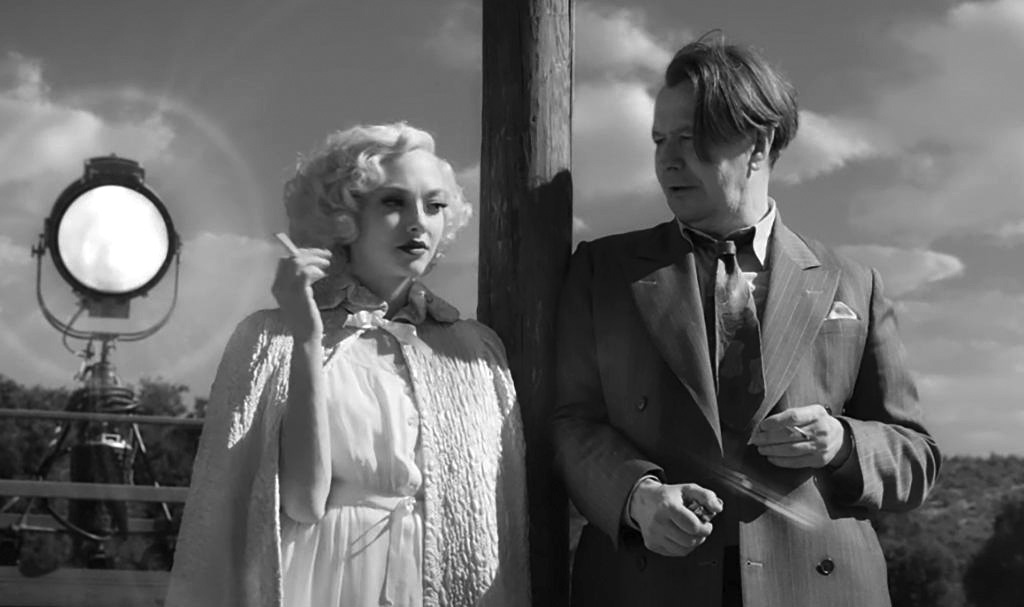
Screenwriter Herman Mankiewicz writes Citizen Kane while recuperating from injury and Citizen Kane-ily reflecting on his career in Hollywood in Mank, the most made-for-Oscar-nominations movie I have ever seen.

It is a movie about the movies featuring a character whose name is on one of the Academy Awards’ prizes (that being the Irving G. Thalberg Memorial Award; the Irving Thalberg played by Ferdinand Kingsley here is worth his own biopic). Many of the towering figures of 1930s Hollywood appear in this movie set in southern California that somehow captures, despite being in black and white, the sunny California-ness. And you get the intersection of California politics and Hollywood (and the conservative politics of corporate Hollywood clashing with the liberal politics of creative Hollywood) and a testament/cautionary tale about the power of movie magic storytelling in a real political world. There’s a “fake newsreel”! This movie has everything!

When we meet Herman Mankiewicz (Gary Oldman) in 1940, he has recently been in a car accident and has been given a place out toward the southern California desert to recuperate, a nurse (Monika Gossman) to care for him and an assistant, Rita Alexander (Lily Collins), for him to dictate his screenplay to. All of this comes courtesy Orson Welles (Tom Burke), who has hired him to write a screenplay (or begin the writing that the two would complete; look, the authorship of Citizen Kane is a whole thing — what I’m talking about here is what this movie tells us about a screenplay that would ultimately have both Mankiewicz’s and Welles’ names). John Houseman (Sam Troughton) is to work as editor on the project and it seems understood by everybody, immediately, that what Mank is doing is a potentially dangerous undertaking.Even Alexander, a British lady who is more concerned about her RAF pilot husband’s survival than Mank’s career woes, immediately knows that the great man in decline that Mank is writing about is a thinly veiled riff on media magnate William Randolph Hearst (Charles Dance), which would make his ditzy showgirl wife a take on Marion Davies (Amanda Seyfried), even though Mank insists he doesn’t mean it to be her.

In flashbacks we see how Mank used to be a writer at MGM for Louis B. Mayer (Arliss Howard) and used to be a friend of Hearst and his mistress Marion Davies, having met her through her nephew, the writer Charles Lederer (Joseph Cross). The witty Mank was, for a while, a regular at gatherings at Hearst’s house in San Simeon, where he hung out with the likes of Mayer and Thalberg and saw their influence beyond media and into the world of state and national politics. Mank seems to want to appear above politics, playing the sarcastic wiseguy role, but the 1934 governor’s race and Mayer’s and Hearst’s opposition to the Democratic candidate Upton Sinclair seems to make it increasingly hard for Mank to follow his wife Sara’s (Tuppence Middleton) “if you don’t have anything nice to say” advice. And then there’s his own self-destructive behavior — drinking and gambling and a fair amount of what seems like self-loathing.

This feels like such a movie-nerd’s movie I’m not even sure how to judge it. I mean, do I love it? Sure, it checks all the boxes for a movie geek, with movie nostalgia (or not nostalgia, really, because I’m not 110 years old but, like, reveling in the fantasy, mostly built by movies, of the early days of Hollywood) that packs an extra punch both because I haven’t been seeing big Hollywood movies in theaters and because the industry and its future are suddenly, here in 2020, so much in flux. I like all the technical elements of this movie, how in look and sound and scene transitions it looks like a 1940s film. Specifically, it uses a lot of Citizen Kane visual and storytelling elements and, sure, it does so very self-consciously, but it doesn’t make me like it any less.

Oldman’s performance feels, well, Oscar-bait-y in the extreme but captivating nonetheless. He’s not just Herman Mankiewicz; he’s a Herman Mankiewicz-y version of the Herman Mankiewicz character in highly stylized movie. It is not a natural performance, I guess is what I’m saying, nor is anybody else’s, but I bought it.

Look, this is 2020 and for those of us out in the movie fan universe (i.e. not going to virtual film festivals or working for film studios) this glossy Netflix bit of concession stand candy is probably as Hollywood as it’s going to get for us. This was probably always going to be an enjoyable movie to me, but under these circumstances it felt like an extra special bit of movie magic. A-

Rated R for some language. Directed by David Fincher with a screenplay by Jack Fincher, Mank is two hours and 11 minutes long and distributed by Netflix.

Hillbilly Elegy
Ron Howard directed this adaptation of J.D. Vance’s 2016 memoir and it’s streaming on Netflix now. It stars Glenn Close and Amy Adams — both of whom seem to be trying hard for their elusive Oscar wins. Find Amy Diaz’s thoughts on Hillbilly Elegy at hippopress.com, available for free thanks to our members and contributors.

Featured Photo: Mank

Happiest Season (PG-13) & Superintelligence (PG)

Happiest Season (PG-13)

Hulu offers a solid bit of Christmas content in the streaming-service-holiday-movie competition with Happiest Season, a sweet, genuinely fun and ultimately emotionally rich holiday love story.

Abby (Kristen Stewart) hasn’t gotten too jazzed about Christmas since losing her parents at age 19 but when her girlfriend Harper (Mackenzie Davis) invites her home to her parents’ house for Christmas, Abby is genuinely excited. She even buys an engagement ring and plans to ask Harper to marry her, possibly Christmas morning, possibly even going real old-school and asking Harper’s dad for his blessing.

This would come as a surprise to Ted (Victor Garber), Harper’s dad, who doesn’t know Harper and Abby are together or even that Harper is gay. Harper has told her family, including mom Tipper (Mary Steenburgen), that Abby is her (straight) roommate who just needs a place to go for the holidays. Abby is horrified to hear all of this, particularly as she hears it in the car when the couple is practically at the parents’ house, but she decides to go along with it for Harper’s sake.

She quickly realizes that Harper’s fear of coming out to her parents is only part of the family tension. Harper is hyper-competitive with her oldest sister, Sloane (Alison Brie), a mom of two kids who runs a business with her husband, Eric (Burl Moseley), but who is constantly catching shade from her parents about giving up a career as a lawyer. Harper’s middle sister, Jane (Mary Holland), is perpetually overlooked and underestimated. Tipper is freaking out about her extremely fancy and involved Christmas Eve party — even more so this year because Ted is running for mayor and hoping to impress a big donor (Ana Gasteyer). What exactly Tipper’s and Ted’s damage is that has caused them to pit their children against each other and make them feel like big life issues are better kept quiet (even before Ted started running for mayor) the movie never says. But basically, this family is high-strung.

I usually do not love this kind of movie, the The Family Stone-ish type family-gets-together-for-holidays story, because they usually push the limits of how normal humans act to such a degree that I find it somewhat unwatchable. I always find myself thinking “hey, grown adults, you can leave this horrible situation, or not come at all, or get a hotel room and come for the meals but leave in between.” Here, the movie makes most of the crazy behavior make sense, at least within the logic of the movie — the secrets the sisters keep from each other, Harper’s paralyzing fear of her parents, Abby’s hurt reaction to Harper’s behavior but reluctance to give up on Harper. (Maybe not the parents. I’ve read some criticism of this movie which is essentially “what is with these parents?” and there really is no sense-making reason for people who end up where these people end up to act this way in 2020 but I guess you just have to accept certain elements of extreme character stasis followed by sudden growth for this kind of story, just as you have just sort of go with the idea that Harper deeply loves Abby but would put her through all this.) There are very “holiday movie” moments — these movies seem to always feature a fight involving a Christmas tree — but there is some very recognizable human emotion happening, particularly with Abby. The movie doesn’t turn Abby into a doormat or let Harper off the hook (at least not entirely) for the way she treats her, while still giving us the happy beats you need in a movie like this.

I realize I am very late to this party but Kristen Stewart is great — she’s good with the emotional stuff and even better in the comedy moments (a scene where she briefly has to interact with Sloane’s kids called to mind her excellent “Duolingo for Talking to Kids” Saturday Night Live commercial skit). She and Davis have solid chemistry (though not quite as good as Stewart and Aubrey Plaza, who shows up as Harper’s first girlfriend and is a delight). Steenburgen, Garber, Brie and Holland are good supporting players, offering their own moments that fill in whole sides of their characters with just a look or a line reading. Other standout supporting actors include Daniel Levy as a friend of Abby’s and even a brief scene with Timothy Simons as a security guard.

With genuine romance, actual humor and a lot of solid family stuff, Happiest Season is a holiday treat. B

Rated PG-13 for some language, according to the MPA on filmratings.com. Directed by Clea DuVall with a screenplay by Clea DuVall & Mary Holland, Happiest Season is an hour and 42 minutes long and distributed by TriStar. It is available on Hulu.

Superintelligence (PG)

An A.I. picks an average human to teach it about humanity so it can decide whether or not to “Clorox wipe the entire planet and let it start over” in Superintelligence, the best of these Ben Falcone-directed, Melissa McCarthy-starring comedies.

And that’s not a backhanded dig. While not quite as sharp or as bold as McCarthy’s best work, Superintelligence is light and fun and with just the right amount of smart.

What started as a Teddy Ruxpin-ish stuffed animal thing that taught kids to read has somehow morphed into a sentient intelligence that is in, as Carol Peters (McCarthy) quickly learns, everything from computers and phones to her rice cooker and alarm clock. Super Intelligence, as it calls itself, sounds like James Corden to Carol, because of her James Corden fandom (and because Corden does most of its vocal work here), and briefly Octavia Spencer to Dennis (Brian Tyree Henry), her best friend who works at Microsoft and is the person Carol tells after she “meets” the Super Intelligence. It tells her about its recent sudden sentience and its “meh” take on humans. Its dilemma: Should it help humans fix our problems or enslave us or just get rid of us altogether. It has decided to watch Carol to try to figure out what makes humans tick and, to see her response to a variety of situations, it gives her things — a fancy car (that it controls), a fancy new house, a bunch of money and a foundation that she can use to give money to good causes.

Perhaps most importantly, it gives her a push to find George (Bobby Cannavale), her ex-boyfriend, and try to put things right with him. They were apparently very much in love but Carol had what sounds like a career/life crisis and decided to change everything — focusing on doing good in the world and leaving George in the process. We quickly see that he hasn’t ever gotten over her and she very much still loves him but George happens to be just days away from moving to Ireland as part of a year-long teaching fellowship. Super Intelligence nevertheless pushes her to ask him out on a date and patch things up — whatever that means for their future, if there even is A Future.

Meanwhile, Dennis contacts the government even though Super Intelligence told his Microsoft team to back off (but with a “lighthearted” reference to War Games, so you can see why Dennis may not want to listen). The U.S. and the international community work together to find a way to “trap” Super Intelligence before it can “play a game” with the world. Thusly do we also meet the FBI agents (Ben Falcone, Sam Richardson) who spend time tracking Carol’s interaction with Super Intelligence and the U.S. president (Jean Smart), who feels like one of those Shmillary Shminton movie presidents that showed up in films in, like, 2017 and 2018.

This movie plays to all McCarthy’s strengths: believably conveying empathy, physical comedy, doing “regular person in a crazy situation” (as in Spy), being believably awkward and charming at the same time. She is generally someone I just enjoy watching, almost regardless of the quality of the material she’s given, but here she’s got good material — good, if maybe not the “great” of Spy or The Heat.

The movie is also just a solid comedy overall — broad but with strong bits (a job interview scene early in the movie featuring Jessica St. Clair and Karan Soni is almost completely irrelevant to the movie but is also just goofy fun). I also like what the movie does with George. He isn’t a tough guy or a pushover or a performative do-gooder or a fantasy boyfriend. He seems like, at least for a broad comedy, something approaching a normal human — one who has certain life ambitions, who still loves his ex but who was hurt by her and yet still hasn’t let that make him a jerk. He seems like, I don’t know, an adult. Carol also seems like an adult. I mention that because maturity often feels like a goal and not a pre-existing condition in a movie like this and it was just nice to see.

Superintelligence probably isn’t the smartest comedy I’ll watch all year but, as a bit of fun entertainment during a holiday weekend, it was absolutely satisfying. B

Rated PG for some suggestive material, language and thematic elements, according to the MPA on filmratings.com. Directed by Ben Falcone and written by Steven Mallory, Superintellegence is an hour and 46 minutes long and distributed by New Line Cinema. It is available on HBO Max.

Featured Photo: The Lego Star Wars Holiday Special

The Lego Star Wars Holiday Special (TV-G)

Rey learns a valuable lesson about friendship on Life Day in The Lego Star Wars Holiday Special, a gleefully goofy Lego tour through the Star Wars universe.

It’s also 47 minutes long, which is the perfect “movie” length for something that I think is fairly kindergarten-and-up appropriate. (Even the scariest moments are cut with levity.)

In what I’m pretty sure is a post-Rise of Skywalker world, Rey (voice of Helen Sadler) is trying to teach Finn (voice of Omar Miller) the ways of the Force, all shield helmets and drone lasers in the Millennium Falcon, just like Luke and Obi-Wan. Despite reading all the Jedi texts (nice callback!), she can’t seem to get the teaching right and decides to set off to an ancient cave on the Whatever planet where it is prophesied that Jedi can find answers to their questions once a year on Life Day — and, luckily, it happens to be Life Day.

A brief “Life Day” aside: So this is a Wookiee holiday that originated in the infamous 1978 Star Wars Holiday Special, a TV thing that featured the likes of Bea Arthur and Harvey Korman as well as many of the original Star Wars movie actors and was so notoriously bad that it never saw the light of day after its initial airing. I have never seen the whole thing, though the full special and clips are available on the internet. A few years back, David T. Cole of the Extra Hot Great podcast did a delightful short-run podcast series called Now That’s What We’re Tarkin About that examined in depth this thoroughly bizarre-sounding special, which is where most of my knowledge about the special comes from. (In a brief search, I couldn’t figure out if the podcast was still available anywhere; there is an Honest Trailer about some early Star Wars spinoffs, including the holiday special, and that also gives you the gist of what this cultural artifact was like.) This 2020 special seems to offer a general acknowledgment of the place in pop culture that “Star Wars holiday special” as a concept holds without winking too hard about it or requiring you to have deep canonical knowledge to get it. Just for tone and how it deals with this element of its subject, I give this movie points.

Back to the plot: Finn, Poe (voice of Jake Green) and Rose Tico (voice of Kelly Marie Tran, who also played Rose in the most recent trilogy) are bummed that Rey is leaving on Life Day. The plan was for the whole gang to be together to help Chewbacca celebrate and welcome his family. Scenes of them preparing, with varying degrees of success, for a big party are intercut with scenes of Rey finding the special Jedi cave and stumbling upon a crystal that opens portals through time. Since she is looking for help training Finn, she specifically goes back to previous scenes of teachers and students: Luke (voice of Eric Bauza) and Yoda (voice of Tom Kane), Luke and Obi-Wan (voice of James Arnold Taylor), Anakin (voice of Matt Lanter) and Obi-Wan, Obi-Wan and Qui-Gon Jinn (also Kane) — a particularly delightful scene because it highlights how boring trade talks are.

But, of course, there is another master-and-apprentice duo in the Star Wars universe: Emperor Palpatine (voice of Trevor Devall) and Darth Vadar (voice of Matt Sloan). When this pair catches a glimpse of Rey portaling through time, they decide that maybe her time-travel-enabling crystal would be a good thing to have.

As Rey jumps through the Star Wars timeline, occasionally pulling a character or two along with her, we get some fun sight gags — young and old Han Solo both shooting first, a Darth Maul sighting, a shirtless Kylo Ren, a moment of The Mandalorian’s The Child. This element of the movie has a very Avengers: Endgame feel, with a kind of affectionate and playfully ribbing reference to characters and situations across a franchise. It’s all done with enough general silliness that you don’t have to know every corner of every entry to enjoy it. And we also get nice Lego-physicality gags — my favorite is one involving the Return of the Jedi-era Death Star. Through it all, there is even some nice messaging about friendship and believing in yourself — but don’t worry, the bits of sentiment don’t get in the way of a good blue milk mustache.

This holiday special really does seem made for the whole family — with Lego people doing lightsaber battles for the kids and Empire Strikes Back callbacks for the adult fans. A

Rated TV-G. Directed by Ken Cunningham with a screenplay by David Shayne, Lego Star Wars Holiday Special is 47 minutes long and available on Disney+.

Featured Photo: The Lego Star Wars Holiday Special

Stay in the loop!

Get FREE weekly briefs on local food, music,

arts, and more across southern New Hampshire!