A few chores for the early fall garden

We’ve already had some chilly nights here in Cornish Flat, New Hampshire. Frost is still a long way off, but a few leaves are already turning and I’m thinking about my fall chores and getting a few done now. Let’s take a look at some chores you might wish to add to your list.

First, have a good look at your lawn. If you have bare spots or areas where your grass is thin, this is a good time to “over-seed” those places. You’ll be helped by temperatures that are cooler and rain that is usually more frequent.

I recently called Paul Sachs, a lawn expert and the owner of North Country Organics, a Vermont-based organic fertilizer producer. Paul suggested scratching up the area that needs help with a rake, sprinkling some seed over the area and tamping it down to ensure good contact with the soil. I use a metal tamper that does this well: it is a thick metal plate 8 inches square on a 4-foot handle. Lift it a few inches, drop it. Thud. Done.

Lawn seed needs light to germinate, so don’t cover your seed with soil. You can mulch lightly with straw to shade it and reduce evaporation. Seed needs to be kept lightly moist in order to germinate. In hot dry times, water daily. I generally use a “conservation mix” for the seed — it’s a good mixture of grass types. Paul Sachs told me you can over-seed through the end of October. I say do it sooner rather than later, preferably right after a rain.

If you haven’t harvested your potatoes yet, do so soon. If they have bloomed or if the leaves are yellowing and dying back it is time to do so. Try to avoid damaging your potatoes when digging. If your soil is loose and fluffy, you can tug gently on the main stem while loosening soil from around the plant with your other hand. If your soil is heavy, push your shovel into the ground at a 45-degree angle to get well under the plant, and pry upward. Potatoes store best unwashed and cured in the shade for a couple of days before going in a storage fridge or a cool, dark basement. Mice love potatoes, so make sure they can’t get to them.

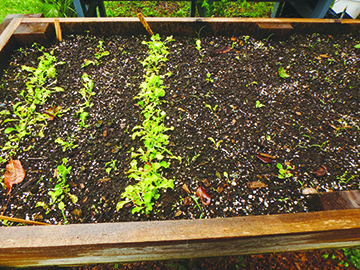
Recently I planted another batch of lettuce, and I recommend you do, too. Lettuce seeds need sunlight to germinate, so you shouldn’t cover them with too much soil. A sprinkling of agricultural vermiculite (instead of soil) works fine. But if you plant seeds directly in the ground and you press down the seeds, it can form a little gully that fills up with soil when watering. I did that once this year and got only three seeds to germinate in a double 4-foot row. (Shame on me, I know better.) When I planted seeds in my waist-tall raised growing bed I was able to water gently and had germination in five days! I thinned out some seedlings and replanted, but I need to thin the rows some more.

Fall is a good time to move things around in the garden, including trees and shrubs. Scientists have determined that woody plants extend their roots after leaf drop in the fall. If you transplant now, be sure to water daily for the first week or so, and at least weekly after that, or more often if it’s hot and dry.

I recently dug a mature honeyberry shrub (Lonicera caerulea) and gave it to some new friends. It was about 5 feet wide and 30 inches tall. It had provided birds with nice snacks in early summer, but I got only a few berries since birds eat them earlier than I do, and I refuse to use netting.

I pushed a long shovel (sold as The Root Slayer) into the soil and pried up the soil all the way around. I tried to get the shovel under the middle of the plant from all four sides before gently lifting it and placing it on a tarp we used for moving it to my friend’s truck. Fortunately honeyberry has no tap root, which would have made the digging more difficult. Oaks (and most nut trees) grow deep tap roots making transplanting difficult after their first year and requiring severing the tap root.

This is a good time to do a little planning: If you plan to plant spring-blooming bulbs or garlic, buy or order them soon. Seed garlic often sells out long before planting time in October. Visit your local farmers market or gardening center to buy garlic now unless you plan to sacrifice some of this year’s harvest for planting.

Lastly, take a walk around your property and ask yourself, “Do I really like this plant? Should I pull it and replace it with something else?” I’ve run out of space in my garden, so I am doing that now and sharing plants with friends to make space for new plants.

Henry has been gardening in Cornish Flat since he bought his home in 1970. You can reach him at henry.homeyer@comcast.net or PO Box 364, Cornish Flat, NH 03746.

Ride rides, cheer contests

Hopkinton State Fair offers fair season excitement

The Hopkinton State Fair kicks off this year’s fall fair season. It begins Thursday, Sept. 3, and runs through Monday, Sept. 7. Agricultural fairs like Hopkinton’s bring very different experiences to different fair-goers.

Yes, there are rides, and vendors, and people selling fair food that most of us only eat once per year — fried dough, fried Oreos, giant bowls of french fries, and every type of doughnut or apple product one can imagine. There are neon-colored T-shirts, and replica swords, and just about any handcrafted item made of wood, leather, or 3-D printed plastic that the mind can conceive. And this year, according to the Fair’s website, hsfair.org, there will be more than 25 rides, with names like Vertigo, Viper and Crazy Bus.

But for some fair-goers the State Fair represents the culmination of a year’s worth of effort. It is an agricultural fair. Professionals and hobbyists spend months preparing to show their prize sheep or blueberry pie or giant pumpkin and compete against their peers to see who really has game. According to the Fair website, this year’s livestock shows will include competitors of different ages and in different categories showing, among other farm animals, beef cattle, dairy cattle, dairy goats, draft horses, oxen, sheep, swine and working steers.

Presumably these contests will judge individual animals’ physical characteristics, calmness and show-worthiness. But there will be pulling competitions for horses, oxen and, most intriguingly, ponies. Some of the horse and oxen teams will pull more than 3,000 pounds at the top levels.

The Farmers Market Building will show off ribbon-winning agricultural products, including flowers, vegetables, maple products, honey, dairy products and even Christmas trees and wreaths. And in the Grange Hall are the giant pumpkins.

For more action-oriented fair-goers, the real action is at the Grand State Events — traditional events like tractor pulls and demolition derbies, and less traditional competitions, like a Battle of the Bands, and Lawn Mower Racing.

Tom Sheehan is the Vice President of the New England Lawn Mower Racing Association, which has organized this weekend’s lawn mower races. In a phone interview with the Hippo, he stressed that all competitors race actual riding lawn mowers: “We race lawnmowers that you drive, that you’d mow your lawn with. We take off the blades and we race them at fairgrounds. There are seven to eight different classes depending on engine size.” He said that although there are categories for stock and modified mowers “they have to have the appearance of a lawn mower. You cannot modify the whole thing; it cannot be a go-kart, nothing like that, just a regular lawn mower.”

Lower octane but just as exciting will be the Infield Events. According to the Fair’s website, these include dog frisbee, the Axe Women Loggers of Maine, dock-diving dogs, live chainsaw art, animal adoption, and the Bay State Bandits, a live show featuring gunfighting on horseback.

For families, a high point of the State Fair is the petting zoo run by Charmingfare Farm. The Fair’s website says to expect the usual sheep, goats and rabbits but also cows, llamas, alpacas, pigs, ducks and chickens.

John Pyteraf from Charmingfare Farm told the Hippo that the animals in the petting zoo are professionals.

“The animals are very friendly,” he said. “They’re used to it because it’s similar to the setup we have at the farm itself. We duplicate it here at the fairgrounds. We are USDA licensed under the Animal Welfare Act, and there is a rest area for the animals where they can move away from the public if they want to hang out and chill and not be bothered.”

The Hopkinton State Fair
When: Thursday, Sept. 3, from 5 to 10 p.m., Friday, Saturday, and Sunday from 8 a.m. to 11 p.m., and Monday, Sept. 7, from 8 a.m. to 5 p.m.
More: Visit hsfair.org. Ticket information is available at hsfair.org/buy-tickets.

The Exeter files

The aliens come marching in at UFO Festival

By Chelsea Spear
listings@hippopress.com

In the summer of 1965 Norman Muscarello saw a UFO in a field just outside of Exeter, New Hampshire. This was the second UFO sighting in four years and made the Seacoast area an unlikely tourist destination for ufologists and those interested in alien communications. More than six decades later, UFO enthusiasts from around the world descend upon Exeter for the annual Exeter UFO Festival, which takes place over Labor Day weekend.

Dean Merchant, a UFO researcher, founded the Exeter UFO Festival in the late aughts with “a few speakers and a very small group of people who wanted to hear the speakers,” Connie Cox said in a recent Zoom interview. “That’s actually how it got started.” As the festival grew, Merchant brought the event to Exeter Kiwanis as a fundraiser for their scholarships and programs, and Connie and her husband, Bob, took over as organizers in 2013.

While the festival was an immediate success with attendees, Exeter businesses took a while longer to join the fun. “On Sunday the stores would not open, and sometimes Saturday they closed as well,” Cox said, citing parking as an issue for businesses in Exeter Square. ”As it has become more popular over the years … this fact that it’s growing helps bring so many people into town. And they walk up and down Water Street and they enjoy going into the shops if they haven’t lived around here and they don’t know about things there.” Among the prominent sponsors are Aroma Joe’s Coffee, which has “an alien green drink” available for purchase over the weekend, and Top Shelf Boutique, which puts “blow up aliens with bikinis and bras on” in the store windows, “stretched out kind of like they’re lying out there watching all the people look in the windows.”

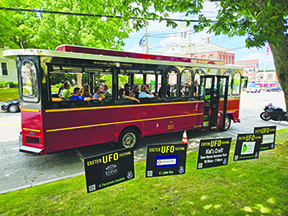
This year marks the 65th anniversary of Betty and Barney Hill’s report of UFO abduction, and the main attraction for the festival will be a keynote presentation by the Hills’ niece, Kathleen Marden. Speaker presentations will take place in the town hall on Saturday and Sunday; a two-day speaker series pass is $40. Trolleys will offer half-hour rides to the site of the 1965 Exeter Incident in Kensington; tickets are sold at the Trolley Station on Front Street.

The UFO Festival also hosts a block party, which Cox says is for “families and anybody else that just wants to come down and have a fun time.” Kids can make tinfoil hats, pie plate flying saucers and jet packs at an arts and crafts table. A group of belly dancers will be performing and leading kids in hula hoop lessons on Saturday at 10 a.m. Attendees on Saturday can also participate in an Alien Costume Contest and Parade, or take their pets to an Alien Pet Contest. Those with a burgeoning interest in ufology can also view historic videos about the Exeter Incident at Exeter Town Hall. Admission for all these events is free.

While most of the attendees are usually from New England, the festival has attracted interest from around the world.

“We have had people come from all over the United States, Canada, as well as Europe, the U.K. and Japan,” Connie Cox said in a follow-up email. “We are even known on Easter Island in the middle of the Pacific Ocean. Imagine that!”

For Bob and Connie Cox, the annual UFO Festival not only represents a celebration of Exeter’s extraterrestrial past; it’s also a reflection on the future of Exeter Kiwanis and the children they support.

“Our mission is to provide funds for kids in need in our area,” Cox said. “We feel pretty proud that we’re helping to support Exeter as a town as well as the kids.”

2026 Exeter UFO Festival
When: Saturday, Sept. 5, and Sunday, Sept. 6,
Where: Exeter downtown and town hall, with trolley rides to Kensington available
More: See exeterufofestival.org for a detailed schedule and ticket information.

Classic!

Manchester sends off summer with Cruising Downtown

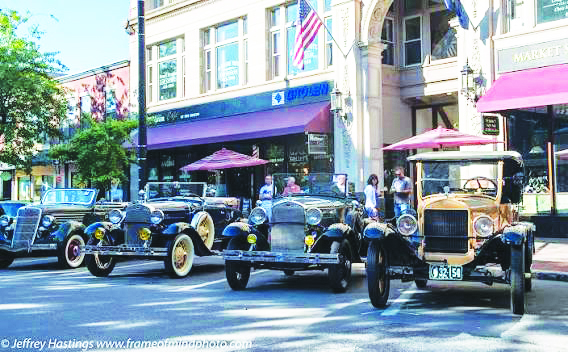
According to Brad Fournier, this weekend’s Cruising Downtown event is New England’s biggest classic car show.

“It really is,” he said. “It’s just one big, huge car show with vendors and food trucks and music and families.”

The Manchester Rotary Club is the main sponsor of Cruising Downtown, and Fournier is the organizer.

“There will be classic cars,” he said, “muscle cars, import cars — sometimes even exotic cars; you get a handful of those.” It’s an opportunity, he said, for car people to spend the day surrounded by what they love and talking with other car people about their passion for old cars.

“That’s what makes it pretty awesome,” Bournier said. “It’s a pretty rare occurrence where you get a certain ambience, and you put a bunch of cars in the street, and you shut the streets down, and you allow everybody to be very passionate about their cars. They always have a story whether it be about their first car or the car that their father left behind and, you know, they restored it. There was one gentleman who had a car that he was doing like a father-son project and then unfortunately his wife passed away and before she passed she made them promise that they would get the car finished and enjoy it. So [when they were done] he had an airbrushed mural of her on the inside of the hood. And so that way it’s a tribute to her. When he pops the hood, you can see her painting on the inside of the car.”

“You’d be surprised how many different stories there are,” Bournier continued. “People say money isn’t everything, and this is one of those rare occurrences where that’s true. Because people will put thousands and thousands of dollars into these cars just because of what they mean to them.”

Cruising Downtown starts early, Bournier said. “For me, it goes all day, but the actual show cars registration starts sometime around 6 a.m., but cars will start showing up hours before that. We don’t let the show cars onto Elm Street until probably about 7:30-ish in the morning, and then that’s that, and that’s as the vendors are getting finished setting up before the actual show for spectators, but then it goes from 8 or 9 in the morning until 4 in the afternoon when it kind of wraps up.”

The goal, Bournier said, is to bring people together to raise money for area charities. “Mostly what we [at Manchester Rotary] target is the charities for families. We used to target just the youth, the children, but now we look to help any charity that benefits families … there’s Friends of Aine — that’s kids that have lost a parent or grieving children who have lost a sibling and don’t know how to process their feelings. They have a great program that helps families. We [Manchester Rotary] donate money back to them. Any charity that reaches out to us,if they are ones that help families in the surrounding areas, odds are we’re going to donate to them; we’re going to put this money back in.”

25th Annual Cruising Downtown
Where: Elm Street in Manchester
When: Saturday, Sept. 5. Car registration begins at 6:30 a.m.
More: cruisingdowntownnh.com.

Plants to look out for — and remove

By mid-August many of us have sighed with relief and settled into a comfy chair in the shade. Planting is done. Weeds? Either under control or not going to be controlled until Jack Frost comes along. We pick our tomatoes, fill a few vases with late bloomers and generally relax. But this is a good time to work on controlling invasive plants. Let’s look at a few of the culprits and what we might do. Three shrubs or small trees I have been working on are buckthorn, multiflora rose and bush honeysuckle.

Buckthorn is difficult to eradicate because if you just cut it down, the roots send up dozens of new plants. If you are patient, you can double girdle a trunk with a small folding saw, cutting through the bark and green layer beneath it but not cutting into the core wood beneath that. This prevents the leaves from feeding the roots, starving them. I’ve done this, but generally it takes three years to kill the tree. No new shoots come from it. But I’m 80 now and don’t want to wait three years.

So what have I been doing? Digging out the plants, roots and all. It’s slow but generally doable. I shall see next spring if the inevitable fragments of roots left in the soil send up new shoots. But if they do, they should be easier to get out. I am working on plants no more than an inch and a half in diameter at the base.

I start with my CobraHead weeder, raking through the soil, exposing roots and teasing them out. I then rock the main stem to loosen up the roots some more, and I try to get roots exposed on one side and pull them out of the ground, then tip the small tree over the other way. I then get a long shovel under the center of the tree and try to pry it up. If there are deep roots going straight down, I slice them off and try to dig them out after I have removed the tree and the surface roots.

Buckthorns are showing ripe fruit in my neighborhood right now — dark shiny berries that have a pit like a small cherry in the middle. Birds eat them and excrete the seeds, starting new plants. Common buckthorn has male and female plants, and only the females have berries. Glossy buckthorn is self-pollinating, so all produce fruit. I have a male common buckthorn and although it has not made fruit it has sent up about three dozen root sprouts in a radius of 6 feet or so, all interconnected.

Most trees have either alternate or opposite branching of leaves and branches. Not the buckthorns; they have “sub-opposite” branching. Twigs are not quite opposite on the branches, one just a little below the other. That’s a good way to help identify buckthorns.

Multiflora roses (Rosa multiflora) were introduced by the USDA in the 1930s for use in erosion control and as living fences. They were used by highway departments in the 1960s in divided highways as crash barriers and a way to screen headlight glare. Unfortunately, they escaped and became a dreadful noxious invasive. They can strangle trees and make it impossible to walk through areas where they have taken over.

Birds introduced multiflora roses to my property just a few years ago. I had seen it elsewhere and knew it, so I began digging it out before it became a serious problem. But it will be on my “to do” list, I fear, till the day I die. I have found its roots spread far and wide, and the thorns are dreadful. This is a job to hire out if you can find someone willing to take it on, and must be done every year.

I try to at least cut it back before animals spread the seeds found in the rose hips. Digging it out is a “later in the fall” project for me so I can wear heavy canvas jeans, jacket and gloves. The roots, in my experience, are not particularly deep. However, that may vary according to the type of soil you have. Digging out roots is always easiest when the soil is moist, not dry.

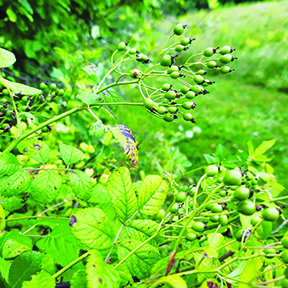
There are many species of honeysuckle, both native and foreign invasive that grow in New England; of these, four bush honeysuckle are invasive. If you have honeysuckle and didn’t plant it, it probably is one of the invasive ones. I have honeysuckle as a problem plant at the edges of my property. Right now it is displaying juicy red berries that have three small hard seeds inside. If you cut the stem, it has a hollow center, or a dark area at the center.

In my experience digging up a honeysuckle is much easier than getting out a buckthorn or multiflora rose. This is due, in part, to the fact that the roots seem to stay closer to the surface and can be exposed by digging with my CobraHead weeder. Sometimes they break when I pull on them, and I don’t really know if those bits will create new plants. I will mark where the honeysuckles were pulled, and revisit the sites where they were growing next spring to see if new plants are growing.

The list of invasives is long but most gardens have some of them. Both New Hampshire and Vermont have good websites with complete lists. New Hampshire will identify invasives for you from photos you send in. The most important things to do are to learn about your invasives, and to work every year to remove some.

Removing invasives is hard work but very satisfying. I recommend getting rid of root systems and fruit in household trash or in your fireplace — never in your compost pile, where they may survive and thrive.

Henry’s column appears twice monthly. Reach him at henry.homeyer@comcast.net.

Kiddie Pool 26/08/27

Family fun for whenever

Music and fun

• Concord Community Music School, 23 Wall St. in Concord, will hold a Family Music Festival on Saturday, Aug. 29, from noon to 4 p.m. with an instrument petting zoo, demo classes, jams, activities, live entertainment, food trucks, face painting and more, according to a press release. The day is geared to people of all ages and musical experience, the release said. The instrument petting zoo will run from noon to 3 p.m. to allow guests to try out instruments with the help of school faculty, the release said. The Krimson Krewe will perform on the Fletcher Murphy Park Stage at the back of the school at 3 p.m., and food trucks slated to attend include Sunfox Farm and Savvy Sweets and Treats, the press release said. See ccmusicschool.org.

And save the date for other music school open houses: The Nashua Community Music School, 2 Lock St. in Nashua, will hold an open house with instrument petting zoo on Friday, Sept. 18, from 3 to 6 p.m. See nashuacms.org. The Manchester Community Music School, 2291 Elm St. in Manchester, will hold an instrument petting zoo on Monday, Sept. 21, from 4:30 to 6:30 p.m., according to mcmusicschool.org.

Summer magic

• The Palace Theatre’s 2026 Bank of New Hampshire Children’s Summer Series at the Palace Theatre, 80 Hanover St., Manchester, wraps up its season with magician BJ Hickman, whose final shows are Thursday, Aug. 27, at 10 a.m. and 6 p.m., according to palacetheatre.org, where you can purchase tickets.

• The Girl Scouts will host a Fairy Garden Party for girls in pre-kindergarten and up on Saturday, Aug. 29, from 10 to 11:30 a.m. at the Epsom Public Library, 1606 Dover Road in Epsom, according to a press release. The event will feature activities (making fairy wands, flower crowns and a fairy friend) as well as information about Girl Scouts, the release said. “RSVP to 888-474-9686 or customercare@girlscoutsgwm.org — or just drop in. See more at bit.ly/44JFef1,” the release said. See girlscoutsgwm.org for more on other Girl Scouts happenings.

For the littles

• The Upper Room in Derry is offering a new initiative, Little Explorers, with the SEE Science Center, 200 Bedford St. in Manchester, starting Friday, Sept. 4, and running the first Friday of each month from 10 to 11:30 a.m. for ages 0 to 6 years, according to a press release. This free program will offer hands-on science exhibits and interactive demonstrations, according to the release. Space is limited and registration is required; see forms.office.com/r/UbjuWJF8K3. For more on The Upper Room, see urteachers.org.

Save the date

• The annual AerospaceFest at the McAuliffe-Shepard Discovery Center in Concord will take place Saturday, Sept. 19, from 10:30 a.m. to 4 p.m. and feature STEM and aerospace organizations from across New England, the debut of the new planetarium show “Encounters in the Milky Way” and more, according to starhop.com.

Stay in the loop!

Get FREE weekly briefs on local food, music,

arts, and more across southern New Hampshire!