
A look at the bakeries turning out gluten-free breads and treats
Lisa Withrow had pretty much run out of patience with reading food labels.
“We have eight grandchildren,” Withrow said. “One of our granddaughters was diagnosed with celiac disease when she was 5. And at that point there was significant damage to her intestine. And they suggested the whole family go gluten-free because they did not want her to be around gluten. So learning that — I’m a health care provider and yes, we learned about that in med school but … experience was very humbling. You go through the initial overwhelm of ‘They can’t have the food,’ ‘What can they have?,’ reading the label, trying to figure it out.”
“In this country,” Withrow said, “it’s challenging. There were labeling laws, but it was a pretty humbling process as a health care provider to go through that anticipatory anxiety over buying things that are safe for someone with celiac disease.” She quickly became frustrated with how little of the specific information she was looking for was included in many labels. “Sometimes we’d have to go to three and four and five or more stores, just to get our weekly groceries.”
For Withrow and her husband Paul, the answer was to open their own business, Gluten-Free Express, in Bedford.
“It’s an independent store,” Withrow said. “Gluten-Free Express is a completely gluten-free, celiac-safe food market. It’s a mini-mart with some groceries, but it also has take-out [prepared food]. Everything in the store is going to say “gluten-free” on it or “certified gluten-free,” including what we use to cook the grill items. And, because there are a lot of people who like to know exactly … we have a notebook that has the ingredients of everything in the store.”
Figuring out gluten
Gluten is a term given to a family of proteins found in some grains — especially wheat, barley and rye — that gives a stretchy quality to bread doughs, which bakers love but which can cause havoc in some people who eat it.
According to Dr. Vincent Aguirre, executive director of digestive health with the Elliot Health System, gluten sensitivity is fairly common. The most well known gluten sensitivity is called celiac disease, which he described as “an autoimmune condition, where immune cells called lymphocytes are activated by gluten and attack the interior of the intestines.” This prevents celiac sufferers from being able to metabolize nutrients. In the United States, he said, an estimated one percent of the population suffers from some degree of celiac sensitivity. It can cause a myriad of symptoms, he said, “which is what can make it so difficult to diagnose.” Different people can be more or less sensitive to gluten, Dr. Aguirre said, and their symptoms can be just as individual.
For the Withrows, ensuring their business was completely gluten-free meant they had to consider factors that casual label-readers rarely have to think about.
“That includes anything we cook on the grill,” Lisa Withrow said, meaning the oil that foods are fried in, and even the breading and coating that prepared foods have. “We have takeout items,” she said. “We’re not a restaurant, but [customers] can come for takeout items, so chicken tenders and fries and that sort of food. We have a fryer and we have a grill and we have soup and we have an oven that we cook things in. … And none of those can come in contact with ingredients that might have even trace amounts of gluten in them.”
Withrow said the terminology can be tricky.
“We’ve gone through the certification to be gluten-free,” she said, “and that was an education. There are different labels and levels of ‘gluten-free’ and one of them means there can be no more than five parts per million [of gluten]. One means no more than 10, and the rest are no more than 20. And so it’s just confusing that people don’t know that if they have to stay within certain parameters. And then many people think [gluten-free is] like a dietary fad. You’ll be at a restaurant and the attitude is, ‘OK, you want something gluten-free. Does it HAVE TO be gluten-free, or are you just doing it because you want to?’”
Meant to share
Matt Berry is the chef and owner of Lovejoy Restaurant in Milford. When he put together the menu for Lovejoy, he said, it turned out almost entirely gluten-free accidentally. Everything is either gluten-free already or can be made that way.
“It kind of non-intentionally became a big part of our menu,” Berry said. “At previous establishments, I’ve had a lot of staff members who were gluten-free, so I just kind of got used to preparing our staff meals and stuff toward their restrictions. And as I was writing a menu [for Lovejoy], where I could fit in a gluten-free substitute or having more dishes be naturally gluten-free, I did.”
“I’ve been using a one-to-one flour substitute that works really well for all of my baking stuff,” Berry said. “We came up with a really good gluten-free dredge for [frying] all of our chicken and stuff. Dredge, specifically for something like fried chicken, you can jump down like a deep, deep rabbit hole. People take their fried chicken very seriously. And growing up, this friend that I had in high school, I stayed at his house a lot, and his mom used to make this like fried chicken, but the breading she used was made from instant potato flakes. And I really, really loved it, it was so good! So a couple of years ago, when I was a line cook, I wanted to, like, kind of mess around with that. I started using a lot of potato starch for many things, but specifically for dredge and … tempura batter and stuff, utilizing more starches and less flour with gluten, I found that I enjoyed that crispiness a little bit more, anyway. I felt that it stayed crispy for longer and it just achieved like my ideal fried chicken batter.”
Many of the dishes at Lovejoy are appetizers designed to be shared, Berry said, and they are also fried. As he pulled the menu together, it made sense to stick with gluten-free dredge, similar to the one on his favorite fried chicken, tempura for example.
“The usual recipe for a classic tempura batter is something like tonic water or seltzer water, flour, and egg,” he said. “It’s usually pretty straightforward and simple, but we don’t use egg in ours. We use soda water, flour, and some spices and salt — obviously the gluten-free flour. It’s for our tempura oyster mushrooms, which are a heavy eater here.”
“But yeah,” Berry said, “I didn’t go into it intentionally, trying to hunt down gluten or to write a gluten-free menu. It just kind of like naturally became that.” He said a commitment to focusing on fresh and locally grown ingredients has also steered him away from gluten.
“We get our breads from a local bakery, Sunflower Bakery in Nashua, but for everything else? We’re not in a big grain-producing part of the country. What I get from local farms is produce and stuff, not necessarily grain.”
Baking without gluten
Bonne Richards, on the other hand, was very deliberate in her decision to open a gluten-free bakery.
“I own a gluten-free, vegan bakery and market in Nashua [Bonne the Baker Bakery and Market, 2 Cellu Drive, Nashua],” she said. “It’s doing fabulous. I’ve only been open three months, but everyone that comes in the door has the biggest smile on their face and is so happy and relieved that they can come in here and buy anything — and I mean anything in my store — and it has no gluten and is vegan, no dairy, no eggs, no animal products. They know they’re safe if they have celiac or an allergy, and I think southern New Hampshire is becoming the place to come now to find treats and food, if you have a specialized diet.”
Richards said that she has noticed a growing awareness in the general public that food allergies and sensitivities are a medical reality. It wasn’t too long ago, she said, that people who couldn’t eat gluten were viewed as “picky eaters.”
“I don’t think that even now everyone thinks about that,” Richards said. “Gluten-free people can get sick; they’ll get really sick.” Additionally, she said, there is a growing number of people who are trying to cut down on gluten as part of a healthy lifestyle. “I know myself,” she said, “even though I don’t have celiac disease, if I eat gluten, I swell up and my hips start hurting and my knees start hurting — the joints start hurting. So I choose not to eat it for that reason. I am seeing more of that kind of thing. I think a lot of people are worried about what’s in their food more than ever.”
Taking such a non-traditional path in her baking has let Richards reinterpret some classics, she said.
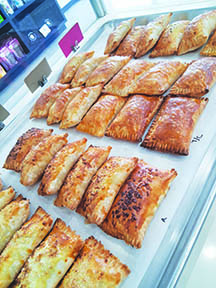
“I make these savory turnovers, and people are all over that. A lot of people are like, ‘I haven’t had an apple pie in forever’ or ‘I haven’t had a breakfast pastry in so long!’ and they’re just so happy. I can’t keep those items in stock. They could go buy that savory pastry somewhere else that says it’s gluten-free. But if it’s in a regular bakery, they have to really seriously think about cross-contamination.” It’s almost impossible for a traditional bakery to not have flour in the air, she said.
Richards is looking forward to finding out the rhythms of the business cycle of a gluten-free bakery.
“I think it’s going to get really busy real soon,” she said, “because we’re coming into apple cider doughnut season, with the fall flavors that everybody loves, apples, pumpkins, that kind of stuff. And then it will be the holidays, and we’ll see a lot more people coming in.” What she’s really interested in, Richard said, is the period right after the holidays, when so many people commit to a healthier diet, even if only briefly.
“It’s the same thing every year, after Christmas into New Year’s, everyone goes on a diet. Nobody’s eating any treats and then all of a sudden Valentine’s Day comes around and everybody’s eating again and it starts all over again.” She wonders how that will translate into gluten-free and vegan baking, she said.
Richards said baking without wheat flour or other ingredients with gluten requires finding substitutes, which might be different for any given recipe. Gluten, she said, creates long strands of protein that form a mesh that traps gas bubbles, which help baked goods rise.
“There’s almost always some xanthan gum involved,” in gluten-free baking, she said. “A lot of times, for breads [which require extra-stretchy dough] people use psyllium husk, which is a binder — a fiber. Some recipes use different types of eggs, or flax seeds, applesauce or bananas. I like aquafaba, which is the liquid from a can of chickpeas.”
Another challenge of baking without gluten, Richards said, is browning.
“That’s one of the things that can make gluten-free bread so tricky,” she said. “Gluten-free flour does not like to brown up.”
According to baker/owner Evan Lang of Dishon Gluten-Free Bakery in Manchester, baking gluten-free bread requires a different mindset than making muffins or brownies.
“We work with an actual dough that proofs,” he said. “It’s not a batter.” To that end, he uses psyllium husk as a binding ingredient.
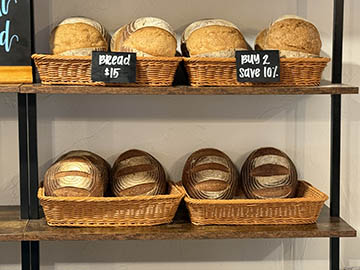
“It’s the fiber that’s in Metamucil,” he said. “It absorbs water and allows us to create a dough that is workable. In terms of browning, we do add a little bit of sugar to our dough to help with that. [Browning] also has to do with the fermentation process and time. And lastly, it’s about oven temperature. We bake everything pretty hot — between 480 and 525 [degrees], which is pretty hot for bread. But that’s what allows us to get kind of the color that you see here on these breads that comes from baking hot and long.”
Pizza for all
But what if your entire business is built around gluten?
Tyler Carmilia is the kitchen manager at 900 Degrees Neapolitan Pizzeria in Manchester. The key to a good pizza is its crust. For 900 Degrees, the secret of serving a high-quality pizza crust that is safe for someone on a gluten-free diet, Carmilia said, has been to outsource it.
“We use a [pre-made] brand called Gillian’s,” he said, “which is available through a number of our vendors. It is a gluten-free crust, but given all the flour in the restaurant, we can’t guarantee that anything we make in-house is 100 percent gluten-free.”
“We use a 12-inch crust,” Carmilia continued. “It’s made with a potato starch, tapioca starch and a little bit of rice flour. We bake it in our oven. It comes on aluminum trays to help kind of prevent the cross-contamination.” Regular pizza made with a wheat crust is baked on the floor of the oven, which means that the non-gluten crust needs to be separated from the bricks.
Carmilia said that even though pizzas with non-wheat crusts are still in the minority of pizzas sold at 900 Degrees, customers order them almost every day.
“We probably sell anywhere from 20 to 40 a week,” he said. “We do add an upcharge [for non-wheat crusts] just because it costs more, because we do get it from a vendor.” It’s a fairly crisp crust, he said, “but we get people that’ll order it like well-done as well, just to ensure that it’s a little bit more familiar. With us not cooking it directly on the fire brick in the oven and it being on that aluminum, it doesn’t get that char per se, but it will get a nice crispy crust. We’ve always had a lot of repeat customers coming back in, telling us it’s one of the best ones that they’ve had, especially with the quality of toppings that we use.”
Cupcake fun
When discussing gluten-free diets, a classic conundrum that comes to mind is a child’s birthday party, or cupcakes to celebrate something special at school. Bite Me Kupcakez in Merrimack specializes in that sort of sweet treat.
“Our baked goods are exclusively gluten-, dairy- and nut -free,” said baker Addisen Tilley. “All of our baked goods are made with an all-purpose gluten-free flour, and we replace the milk with other milk alternatives in order to separate the dairy from it. We do also have a vegan section that uses egg replacements instead of egg.”
Because Bite Me doesn’t use any traditional wheat flour, Tilley said, there is little to no chance of cross-contamination.
“There’s absolutely no gluten in the air at all,” she said. “We don’t allow any gluten in our area. Even if employees come in with lunch, they can’t bring anything into the building that is not gluten-free.”
“Cupcakes are our specialization,” Tilley said. “We have a variety of baked goods every day, depending on the supply and demand. But aside from the cupcakes our specialties are whoopie pies, we have muffins, we have brownies that we have pretty often, we have doughnuts, any [sweet] baked goods that you can think of we will likely have.”
Tilley said some groups will place orders for gluten-free items to make sure nobody is accidentally exposed to gluten.
“Some schools will come in knowing that they have kids who are gluten-free. And then other times it’s a safety precaution because in a big population like that, you are likely to have allergies sometimes.”
The cupcakes children like best are pretty much the traditional ones you would assume, Tilley said. “Funfetti is a very popular one. And then our basic chocolate and vanilla is usually the go-to for parties, because that guarantees that every kid gets something that they like. We have some fun sprinkles. One of our favorite decorations is edible glitter, and that always works very well.” She said inclusion is an important principle for Bite Me Kupcakez. “Our doors are open to absolutely everyone. We care a lot about our customers, and especially on last-minute orders we do our best to include them. Everyone is welcome in. Everyone should be able to get some sort of treat, because no one should be left out on a big day.”
Gluten-free expo
Jody Donohue, president of Great New England Events, has taken the gluten-free concept to a new level. Her company will hold the first ever Gluten Never Ever festival Saturday, Sept. 5, and Sunday, Sept. 6, at the Hampshire Dome in Milford.
“I’ve actually been wanting to do this for years,” Donohue said. “I’m a celiac. My two daughters have to eat gluten-free. So this is something my family lives with and has lived with for years. So for this particular event I’m also a customer. I wanted to bring this together for the community of people who have to eat gluten-free. It’s an event where people walk through the door, and they don’t have to worry about labels or if it’s safe for them or if [food] is gluten-free or certified or friendly. I want them to walk in and just be able to eat.”
The Gluten Never Ever Festival will feature craftsmen and vendors dedicated exclusively to gluten-free products, according to the event’s website (glutennevereverexpo.com). There will be “nearly 100 vendors, live music, cocktails and beer, food trucks, workshops, and plenty of food samples.”
“New Hampshire has some incredible gluten-free businesses,” Donohue said, “and not just New Hampshire; New England. There are products throughout New England, but they’re scattered. So I thought let’s bring them all together under one roof.”
“There will be a recipe wall,” Donohue said. “We’re doing a 75-foot recipe wall, and we have a template online. You fill out the recipe of your favorite gluten-free recipe, and we’re going to tape it to the wall. And people can go with their phones and take photos of the recipes. We want everybody to be able to share.”
The inventor of a gluten-tax-calculation app will be on hand. “She will be doing a seminar explaining this new app that she created for people to use to be able to track [gluten-specific] tax deductions for them. So there will be not just food but resources. People will pay $10 for the whole weekend, so if they can come back Sunday to eat off the other trucks they haven’t eaten off of or bring their coolers and stock up again on some of the products that they really like.”
The gluten-free
Gluten Free Express (9 Triangle Lane, Manchester, 782-8386, glutenfreeexpress.com) is open 8 a.m. to 6 p.m., Monday through Saturday.
Lovejoy Restaurant (40 Nashua St., Milford, 554-8430, lovejoynh.com)
Bonne the Baker Bakery and Market (2 Cellu Drive, Nashua, 669-4200, bonniethebaker.com) is open Tuesday through Friday, 7 a.m. to 3 p.m., and Saturday, 8 a.m. to 2 p.m.
Dishon Bakery (915 Elm St., Manchester, 600-1773, dishonbakery.com) is open Thursday and Friday, 10 a.m. to 5 p.m., and Saturday and Sunday, 10 a.m. to 3 p.m.
900 Degrees Neapolitan Pizzeria (50 Dow St., Manchester, 641-0900, 900degrees.com) is open from 11:30 a.m. to 9 p.m. Sunday through Thursday, and until 10 p.m. on Friday and Saturday.
Bite me Kupcakez Cafe and Bakery (4 Mound Court, Merrimack, 674-4459, bitemekupcakez.com) is open Tuesday through Friday, from 7 a.m. to 7 p.m., 9:30 a.m. to 5:30 p.m. on Saturday, and 9:30 a.m. to 3:30 p.m. on Sunday.
The First Gluten Never Ever Festival will take place Saturday, Sept. 5, and Sunday, Sept. 6, from 10 a.m. to 4 p.m. at the Huge Hampshire Dome (34 Emerson Road, Milford). Tickets are $10 in advance or $15 at the gate. Visit glutennevereverexpo.com.
Featured photo: Gluten-free loaves at Dishon Bakery. Photo by John Fladd.