
Hope follows action

Singer-songwriter John Gorka performs in Manchester

Even if he’s performed since the late 1970s, winning the prestigious Kerrville New Folk Award in 1984 and coming up in the Greenwich Village Fast Folk Scene during that decade, John Gorka still feels a touch of nervousness every time he walks on stage.

“The only time I don’t … is if I’ve done a bunch of shows in a row and I’m too tired to be nervous,” Gorka said in a Zoom interview from his home in Minnesota. It means it still matters, he added. “Frank Sinatra said something about having nerves, he said that’s just a sign that you care.”

He’s still working the muscle he began to hone when the late Jack Hardy told him in 1979 that success comes from a schedule. “I told him, ‘I basically wait for inspiration to strike,’ and he said, ‘that’s a copout — you’ll come up with more songs quicker if you put the time in, even if you throw out three quarters of what you come up with.’”

On “Favorite Place,” a song that leads off his most recent album unentitled, Gorka mused on a process that’s “still mysterious and still calls me.” It’s about the joy he finds in the middle of writing, when he knows it’s going to be a song and it’s just a matter of getting all the details right. Throughout, Hardy’s admonition echoes.

“Hope follows action … you start out with showing up and going to work,” he said. “Hopefully, during the working on stuff, a spark of inspiration will come along that’ll fuel you for the rest of the time. These days, despair is not an option, so I’ve got to do something … then the hope will come.”

Gorka deftly manifests that feeling on a standout track from unentitled called “Particle & Wave.”

The song came in response to the 2018 March for Our Lives in Washington, D.C.

“Watching the coverage on CNN, a still small voice in my head said, ‘never stop believing there’s goodness in the world,’” Gorka recalled. “It was like, ‘OK, that sounds like the language of a song.’”

With lines like “Though justice seems to hesitate / It’s not too late,” he introduces it at concerts with a background story. More often, though, Gorka prefers to let audiences infer the meaning of his songs. Sometimes he’s surprised, like the time a woman told him “I Saw a Stranger With Your Hair” reminded her of a son she’d lost.

“I’d thought of it mainly as a romantic song, but that’s the way it hit her, and that’s why it meant something to her,” he said. “People will figure out what the song is about to them … you don’t want to put blinders on the listener by describing what it’s about too much or where it came from.”

The new record, his 10th for Red House Records, is Gorka’s first release in seven years, with some songs that date even further back.

“There were some things from a while ago that I started to record but never finished, some were new and some were old,” he said. “It was over a fairly long period of time.”

He hosts virtual songwriting workshops multiple times a year with Eliza Gilkyson — the next is in October — and one piece of advice he shares is that modest ambitions are best. “So you’re not trying to write a song for all mankind,” he said. “Set some limits and then work within those limits — and there’s an infinity even within those.”

Hardy and the habit of writing as a bedrock guide him.

“Clear a physical space, as well as your mind, then monitor the thoughts and images coming through,” he said. “For me, morning brain is the most productive. Before going to bed, that’s also a good time — because the song will keep playing through the day.”

As he sings on another great song from unentitled, “Stay until the night’s gone / Stay till you can dream again.”

John Gorka
When: Saturday, Aug. 29, 7:30 p.m.
Where: Rex Theatre, 23 Amherst St., Manchester
Tickets: $40 at palacetheatre.org

Featured photo: John Gorka. Photo by Robert Hakalski.

The Music Roundup 26/08/27

Hip-harp: The penultimate Levitt AMP Manchester Music Series event has Küf Knotz & Christine Elise melding hip-hop and classical harp music. The unique duo formed almost accidentally, after Elise saw Knotz perform in a Philadelphia club, met him in a grocery store a few months later and offered her services. They fully improvised their first performance together. Thursday, Aug. 27, 6 p.m., Veterans Memorial Park, 723 Elm St., Manchester, facebook.com/ManchMusicNH.

Song man: Indiana-born and now New York-based Benjamin Louis performs in one of the region’s most music-friendly venues. Louis’s November 2025 single “Yesterday Is Good” is a soulful slow burner that fans of Leon Bridges will love, and he just released Music, an EP described as focused “on the passage of time, the weight of age, the pursuit of passion, and the depths of desire.” Friday, Aug. 28, 7 p.m., Pembroke City Limits, 134 Main St., Suncook, linktr.ee/benjaminlouis.

Double play: The Juggalo and horrorcore scene has a two-day moment as Leathal Weekend returns for the ninth time. This year’s lineup has Onyx, Bizarre of D12, Lil Eazy-E, and Fury on Day 1, followed on Day 2 by Esham, King Gordy, First Jason (a metal project led by Ari Lehman, the young Jason Voorhees in the original 1980 Friday the 13th) and Lyte. Friday, Aug. 28, and Saturday, Aug. 29, 7 p.m., Jewel Music Venue, 61 Canal St., Manchester, $50 and up, eventbrite.com.

Lady laughs: Known for full-on charisma and zero filter from her tenure as a Daily Show correspondent, Dulcé Sloan is a powerhouse standup comic, as well as the author of Hello, Friends! Her 2024 memoir turns dating disasters and day-job chaos into entertaining reading (and listening — Sloan also narrates the audiobook). The brash, unapologetic comedian also hosted CW’s Great American Joke-Off. Saturday, Aug. 29, 8 p.m., BNH Stage, 16 S. Main St., Concord, $45, ccanh.com.

Sunday best: The Shaker Village Music on the Green series continues with Caitlin Piper & Damian Bernardini. Piper is a Seacoast singer-songwriter who offers “sweet Jackson Browne swagger and Lake Street Dive sentimentality” on songs about love, resilience and connection. Bernardini is a stunningly talented guitarist who complements Piper with delicate yet complex lead riffs. Sunday, Aug. 30, 4 p.m., Canterbury Shaker Village,288 Shaker Road, Canterbury, shakers.org.

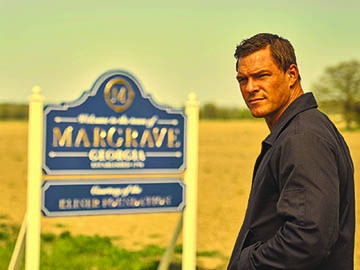
Reacher vibes

Capturing the fun of a big man and his fists

By the time you read this the TV show Reacher, streaming on Amazon Prime Video and starring Alan Ritchson, will have released the fifth episode (out of eight total) of its fourth season.

If you haven’t been watching, you are so lucky because you have three and a half seasons of this excellent-fun show, based on the Lee Child books, to fill your TV watching time. Reacher (Ritchson) is a former military investigative whatever who travels the country being a massive slab of a man. Reacher doesn’t suffer fools and isn’t looking for trouble, but when he comes across injustice he is compelled to Get Involved and Make Wrongdoers Suffer. And sometimes he romances a lady. It’s a perfect show. In an early episode this season, he holds a fluffy white baby kitten. Also in an early episode, it takes a group of like five dudes plus two animal tranquilizers to bring Reacher down. Perfect!

The show dropped three episodes in early August and has been releasing the rest weekly, which means that you get a delicious punch-kick treat and then have to wait a whole week until the next one. Which sent me in search of some movies that can offer some of the same sense of ridiculous fun.

So far,Deep Water (a May theatrical release now streaming on MGM+ and available for rent or purchase) comes the closest to both the tone and the action I’m seeking. Ben (Aaron Eckhart) is the pilot on a passenger flight from Los Angeles to Shanghai. After we watch the world’s biggest jerk (Angus Sampson) carelessly stuff a sparking power charger into his luggage, we meet a variety of passengers and learn just enough about them to help us make guesses about who will die, in what order and how horribly. Eventually jerk’s suitcase explodes and the plane is forced down on open water. The landing executed by Ben and Captain Ben Kingsley (Wikipedia says his character’s name is Rich; I love this Oscar winner’s continued willingness to show up for whatever) would have been great but for the coral reef that shreds the plane into chunks, leaving the passengers with a variety of “how do I not die” problems to solve. And then the sharks show up.

I feel like the best review I can give of this movie is “somebody shoots a shark in the mouth with a flare gun!” If that sounds like the right kind of dumb for you, then this is your movie. It is definitely the right kind of dumb for me and it is a nice end-of-summer light-lift action watch.

Cold Storage (a February theatrical release also streaming on MGM+ and available for rent or purchase) is also goofy fun action, though even gorier than Deep Water and its many scenes of sharks eating people. Here, Naomi (Georgina Campbell) and Teacake (Joe Keery) are the overnight guards at a U-storage that has been built in and over a supersecret decommissioned military lab. Unbeknownst to them, decades earlier, government scientist types Robert (Liam Neeson) and Trini (Lesley Manville, which is rad) stored a hybrid, fast-spreading, mind-controlling fungus brought from space in one of the rooms deep underground. Robert warned — though no one listened — that changing weather patterns could allow the containment of that room to eventually fail. When it does, Naomi and Teacake find themselves fighting assorted fungus-zombie creatures while they wait for the Army, which turns out just to be Robert, to come and save them. Campbell and Keery have great bored-coworkers chemistry, which turns into great normies-fighting-alien-whatevers chemistry, and Neeson, Manville and Vanessa freakin’ Redgrave add just the right amount of, like, I wouldn’t go as far as “gravitas” exactly but straightfaced adult goofiness?

I also reached back to 2024 to watch the Netflix release Atlas, hoping for some goofball action. Alas, this movie starring Jennifer Lopez as an AI-hating scientist who must make peace with a robot-mech-suit buddy (voice of Gregory James Cohan) to fight the robot terrorist Simu Liu is not as goofy as that description suggests, despite having a “game for it” Sterling K. Brown in a supporting role as a military dude. Lopez, whose character’s name is Atlas, can be goofy fun, as this year’s Netflix release Office Romance reminded us all. She gets some moments to shine here, to be sassy to or with her robot buddy, named Smith, but not enough. This movie needed to take itself less seriously and unleash Lopez to be both sillier and badassier. Atlas is an OK thing to have on while scrolling back-to-school sales or napping.

Back at MGM+, I’ve found that a nice comedown after an episode of Reacher is an episode of The Westies, an eight-episode show in its first season about warring criminal interests in 1970s New York City. J.K. Simmons seems to be having fun as the beleaguered boss of the Westies criminal gang, trying to keep in line his own guys and deal with assorted law enforcement and the Gambino family, including up-and-comer John Gotti (Hamish Allan-Headley). Also, the Troubles of Northern Ireland are spilling over into New York City in the form of characters played by Sarah Bolger (who I probably know best from her Mary Tudor days in The Tudors) and Allen Leech (one-time chauffeur Tom Branson from Downton Abbey). Titus Welliver also appears as a dirty cop tasked by the FBI with keeping an eye on Simmons’ character and his gang.

This is a grittier show, with violence that is grimmer and more downbeat the giddy “yippee!” of Reacher. But I enjoy the little window on an era and I miss watching Welliver in Bosch (all seven seasons of that, plus the three seasons of Bosch Legacy, are on Prime Video). The Westies is a compelling enough show to stick with — no Reacher, but then what is.

Featured photo: Reacher, from season one of Reacher. He is possibly even larger now.

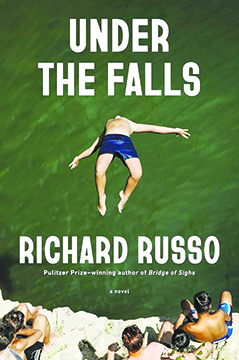
Under the Falls, by Richard Russo

(Alfred A. Knopf, 234 pages)

Richard Russo labors in the shadow of another Maine novelist who shall go unnamed. He’s the only one of the two who has won a Pulitzer Prize, which Russo was awarded in 2002 for Empire Falls, a story about people caught in the grip of an economically struggling town in Maine.

Russo’s latest, Under the Falls, has a similar theme, but with a different origin story. He began writing with the intention of its being a TV series, but the project fell apart during the 2023 Writers Guild of America strike, and so he recast it as a novel — lucky for us. The book, as they say, is a page turner, a sophisticated one that explores the limits and obligations of childhood friendships, and the hold that a home town can have on a person even after they leave it.

The main character, Tyler Sinclair, left his home town, Stone Mountain, when he turned 18, taking nothing with him but clothes, a guitar and a little money he’d swiped from his dad. He left behind a dysfunctional home — his father had been physically abusive to Tyler’s mother and verbally abusive to the both of them — and also a circle of close friends. When Tyler left, he didn’t say goodbye to anyone, and he didn’t respond when those friends tried to reach him later.

Eighteen years later Tyler is a celebrity, the lead singer of a band named after his home town. Some of his most famous songs are about things that had happened at Stone Mountain, including one called “The Long Fall” that is evocative of a tragedy that befell one of Tyler’s childhood friends. That friend, nicknamed Doc, became paraplegic after an accident that Tyler was involved with. Doc still lives in Stone Mountain, as does Tyler’s long-ago best friend, Curt, and as Under the Falls opens, Tyler is reluctantly headed to Stone Mountain with his band, having been booked to play a fundraising concert for Doc, without his consent or knowledge.

As unhappy as he is about going back to Stone Mountain, Tyler sees it as a one-and-done. He’ll have an uncomfortable, on-camera reunion with Doc — the band’s manager had contacted a local TV station seeking publicity for the band’s first show after the pandemic — and then play a concert at his old high school and return to his comfortable post-Stone Mountain life. Tyler’s parents have passed, so there’s no family drama to navigate, just the awkwardness of seeing former friends who had not escaped the town and did not enjoy his success.

The conversation with Doc goes better than Tyler expected — his old friend has made the most of his post-accident circumstances and is able to drive, using a tricked-out hearse modified for his use. But after the camera and lights are turned off, the conversation takes a serious turn, with the topic of blame for Doc’s accident coming up. Doc assures Tyler that he doesn’t blame him, but says not everyone in the town feels that way. And the bad feelings aren’t just about the accident, but about Tyler’s success. “It’s not just that you made all that money. It’s that you made it writing songs about us. About our lives,” Doc tells Tyler.

The sense of dread that Tyler had about returning to Stone Mountain turns out to be prescient. There’s a huge turnout for the event, and at first it’s like every other concert — an exuberant, appreciative crowd. But then there is a shocking announcement and the tone drastically changes, setting into motion a series of events that will upend Tyler’s life and those of his friends.

The trajectory is dark, and as it unfolds we vault from one perspective to another, including those of Curt, Tyler’s closest childhood friend who is now Stone Mountain’s chief of police, and Deb, a young officer whose good heart and honest questions about what happened that day threatens to unravel lives. The story moves fast and packs an emotional punch.

Tyler and the people of Stone Mountain aren’t necessarily likeable; Russo didn’t develop his characters deeply enough for us to feel comfortable picking sides. We get information about the characters’ back stories on a “need to know” basis. His decision to give one lesser character a MAGA hat and a presence at the Jan. 6 Capitol riot is curious, as these details aren’t relevant to what transpires at Stone Mountain and could alienate some readers. In fact, I’m not sure that dating the story in any way was a good choice — the Covid-19 pandemic keeps coming up in this and other recent novels, in a soon-to-be wearisome way.

Russo’s latest resonates not because of its modern touchpoints and questions but because of old ones: How do dynamics change between childhood friends over time? What do we owe our friends and family members if we achieve financial success and they don’t? Is it ethical to walk away from a bad situation, leaving others in it, without explanation? And Under the Falls is an exploration of how small missteps over the course of a lifetime can lead to enormous regret. As one of Tyler’s friends muses, the circle of friends were all “good people” decades earlier, and yet what happens the day of the benefit concert, and its aftermath, suggests that at least some of them aren’t now.

“No way to uneat the apple,” Russo writes, positing a double meaning for the titular falls. Stone Mountain was never Eden, not for Tyler or for his friends, but like every small town and large city, it was a breeding ground for the best and worst of human impulses. Their struggles are our own, writ large. And the 2023 writers’ strike notwithstanding, they’d still make for a great TV series. B+

Featured Photo: Unseen, by David Lewis and Keelan Leyser.

Album Reviews 26/08/27

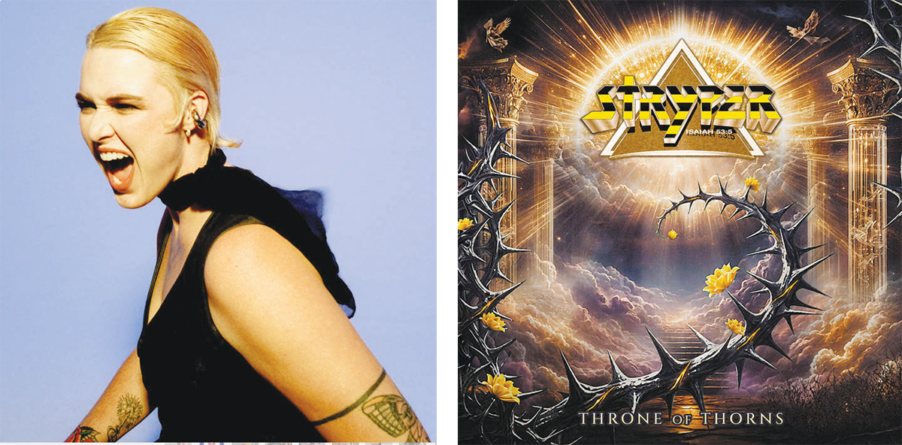
Stryper, Throne Of Thorns (Frontiers Music s.r.l.)

Oh, sure, I remember these guys from their hair-metal heyday in the ’80s. I never believed a word of their claiming to be a “Christian metal” band, given that when I was in the business myself I almost got trolled into co-creating such an act myself: A demented, incorrigible heathen in the Manchvegas hard rock scene wanted to get some backing for us to do a record, and we both agreed that the fastest way to get things going would be to get a rich Christian fundamentalist to throw us a bucket of money to “rock out for the Lord” and we could be as derivative as we wanted, which Stryper was at their peak. I remember listening to them once and noting that they sounded like low-rent Iron Maiden wannabes, which brings us to now, and voila, the title track opens the record up with a thinly disguised ripoff of Mayyy-den’s “Where Eagles Dare,” Michael Sweet’s amateurish vocals leading the charge. “Here In Your Heart” follows, re-establishing their masterful way with uninspiring mid-tempo Accept-ish schlock rock. Absolutely nothing new here; these guys still couldn’t write an interesting riff if Satan himself were threatening to boil them alive. C

Brennan Wedl, Brennan Wedl (ANTI- Records)

Sure, this self-described “Nashville wench rocker” is fine for what she is, in case you can’t bear another minute without a new Sheryl Crow album. Because that’s who this Minnesota native sounds like, although she does try to emphasize the sassy side of country-tinged jangle-rock (lots of nasty mugging with her tongue out and such), a habit she developed while co-piloting the queercore outfit Dazey & The Scouts in the mid-2010s. Her eventual failure will be that she sounds way too much like Crow, which is too bad, given that her songwriting is actually quite good, as demonstrated in “Let’s Be Models,” and she does have a rockout side, which we hear in “Pretty Little Fantasy,” its blocky guitar line recalling scratchy old Mountain records from the 1960s. Actually, “Two Dollar Pistol” is decent, too, for a strummy rocker that sounds like, you know, Sheryl Crow; in the end what’s missing is more dobro and pedal steel, which is tendered in a few Bonnaroo-worthy spots from journeyman Colin Croom, but not enough to distract from the 30,000-pound elephant in the room. B

PLAYLIST

A seriously abridged compendium of recent and future CD releases

• The new CD releases of Friday, Aug. 28, are here, the summer is over, can I get a do-over on the whole thing before we’re back to freezing water pipes and polar bears going through the trash again? OK, now think back, remember when Alabama Shakes first appeared on the scene and the mainstream press wouldn’t shut up about them for five seconds? I mean, there was good reason for it, given that singer-guitarist Brittany Howard is a world-class frontperson and the band’s music is like an alternative-universe Dave Matthews in which songs are mildly interesting, but I still don’t get what the fuss was/is; the press made it sound like the band was a slovenly, deeply rootsy DIY act a la Cigar Box Serenaders, which they are not. At any rate, their new LP I Must Be Dreaming includes the ’70s-soul-tinted single “I Feel Hope Coming,” a cross between Roberta Flack and Sadé. On Sept. 5 they’ll be playing at Koussevitzky Music Shed in Lenox, Mass.

• Interesting character, this Ty Segall guy, no relation to Steven Segal, given that his last name is spelled differently. He’s a garage/stoner-rocker from Laguna Beach, California, and is on record complaining that MTV’s stupid-brained mid-Aughts reality TV series Laguna Beach: The Real Orange County drove out all the interesting hippies and surfers and whatnot who made the place awesome, because suddenly it was too expensive to live there. Learning that reminded me of a newspaper article I wrote in my Portsmouth Herald weekly column in 2003 about the sudden inexplicable appearance of horrible greed-monsters in the Port City buying up apartment buildings where one used to be able to rent a 400-square-foot place for $450 a month and then partitioning them into hilariously cramped little “condos” and selling them to tedious yuppie families from Boston, which drove every last cool person in the city north to Ogunquit, Maine, such a terrible timeline. So recently Segall had a burst of creativity, which is usually a bad thing, but in this case it isn’t, as his trip is no-wave-adjacent and quite loud; he’s releasing two things this Friday, an EP titled Love Fuzzz and an album called Chrome. The reason for this mini-flood of music product is that he’s very happy with his new band, as he should be; the guitar sound on the latter release’s doomy “Running To Nowhere” is so filthy and groovy it would make Queens Of The Stone Age run for the hills. I approve of its message.

• If you’re cool, or you unironically read music magazines like Nylon, a vice that lowers your coolness level significantly, I’m sure you’ve heard of LA Priest, real name Sam Eastgate, of the British dance-glam-prog band Late Of The Pier, which broke up in 2010. Oh what am I even doing, none of this will be on the test, most Americans haven’t taken a British band seriously since Oasis, let me just go listen to the title track from Eastgate’s new album, Into The Sky. Well isn’t this special, zoomy 16-bit-video-game music fit for Gran Turismo or whatnot, something Daft Punk might have thrown together in three minutes to soundtrack the unveiling of the iPhone Pro Max 18 at whatever insufferable Apple conference, where they’ll also mention that the upgrade price will be going up again even though Apple got two billion dollars as a “tariff rebate” that should have gone to their customers. Big whoop.

• And finally we have Aughts-indie darlings Interpol with their newest LP, This Mirror Weighs A Ton. If you’re a fan of theirs, you’ve probably already heard the first single, “See Out Loud,” a dark, tuneless, ’80s-jangling trifle; the album opens with “Iron City,” a tune that sounds like Coldplay after listening to too much Depeche Mode.

Featured Photo: Stryper, Throne Of Thorns and Brennan Wedl, Brennan Wedl

Peach Ranch Water

Ingredients

  • 1 small peach
  • 3 ounces jalapeño-infused tequila – I like Tanteo
  • 1 lime
  • Ice
  • Plain seltzer or club soda

Equipment

  • Long-handled bar spoon
  • Needle-nosed plyers
  • A tall glass – You might not actually own a Foghorn Leghorn commemorative glass, but if you do, this is the time to break it out.
  • A strainer
  • Straw – the kind you drink through, not the type you line a manger with.
  • A sense of righteous anger

Examine your peach. Along the top you will find a crease. Open your needle-nosed pliers and position the prongs on either side of it. Thank the peach for its sacrifice, then stab your pliers into the flesh and seize the pit. Grasp it firmly, and pull it through the top of the peach.

This will make you feel very clever. Well done, you.

This is where your sense of righteous anger comes in: Crush the peach in your fist, until the peach glop runs through your fingers and into your cocktail shaker or mixing glass. Feel free to make a fierce face while you do this. Add the tequila, and stir with your long-handled bar spoon. Warning: You will get peach guts all over everything. That’s the price you pay when emotions run high.

Go wash the evidence of your peachy crime of passion from your hands, leaving time for the alcohol to strip away the not-water-soluble compounds from the fruit.

Slice the lime in half, and squeeze it into the peach-tequila mixture. You can use your fist for this again, or a more conventional juice-squeezer; it’s a judgment call. Stir everything again.

Fill your tall glass with ice, and strain the peach mixture into it. Top with club soda and stir with your straw.

This is a perfect thirst-quencher. It is barely sweet; it depends on the peach you just violated. It is bubbly and perfect for a post-yardwork hammock nap. Remember that the end of the napping season is almost here, and if you want to make the nationals this year, you’re going to have to put in some training.

Featured photo. Photo by John Fladd.

Stay in the loop!

Get FREE weekly briefs on local food, music,

arts, and more across southern New Hampshire!