Plane (R)
Plane go crash in Plane — a movie that will never be criticized for being too complex.
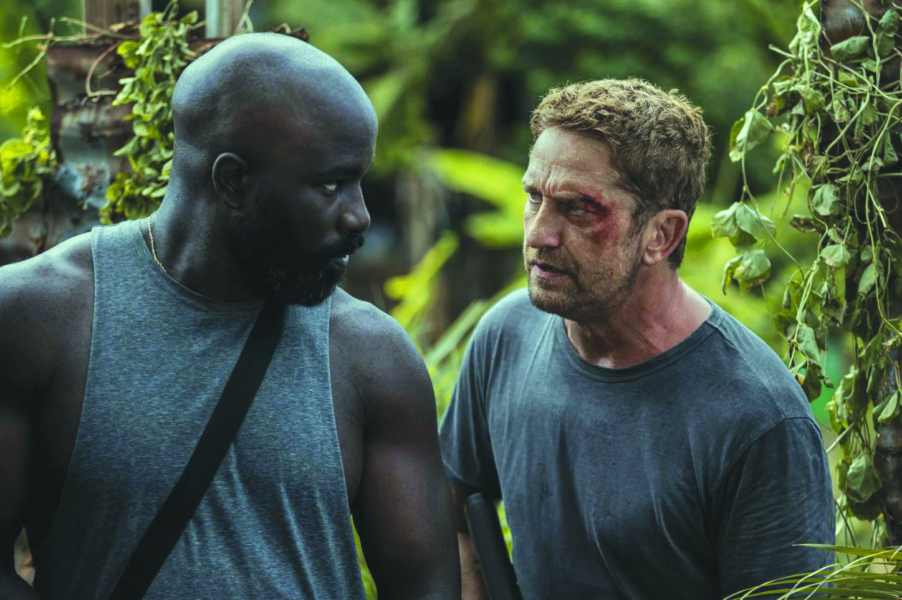
Right from the jump, this movie won me over by letting Gerard Butler, who plays Trailblazer Airline pilot Brodie Torrance (I mean, HA! with that name), just be Scottish and not try to hide his accent. That always weighs these goofy action movies of his down; Plane keeps the story relatively light so we can focus on what really matters — an airplane doing crashy things.
Brodie and co-pilot Dele (Yoson An) are flying from Singapore to wherever, I forget, not important, with a small flight crew and 14 passengers, including Gaspare (Mike Colter), who is being returned to the U.S. in handcuffs. He was wanted for a homicide — something that happened when he was in his teens — and was finally caught after a decade and a half in the French Foreign Legion. Also, some corporate jerk tells the pilots not to worry about the big storm in their path, they should just fly above it — not around it, though, because that would cost slightly more in fuel.
The storm will not let itself be flown over and even at 40,000 feet the airplane gets tossed about and eventually struck by lightning. The electrical stuff goes out, the plane has to make an emergency landing and the Captain-Sully-esque Brodie manages to sort of crash-land it (with lots of sheared off trees and bumps and skids) onto an unknown island. Though, as Dele explains, probably not an uninhabited island — he’s pretty sure they’ve crashed down on a lawless island run by let’s just say Bad Guys.
With no way to radio out, Brodie decides to go in search of someplace with a telephone — and he takes Gaspare with him as a way to keep an eye on him. Thus are the rest of the crew and the complainy passengers left with the titular Plane to be found by the Bad Guys, who know ransom potential when they see it.
Meanwhile, in New York City, a room full of corporate people who I don’t think get names take direction from Scarsdale (Tony Goldwyn), a guy whose whole deal is handling crises by talking tough and having mercenaries on speed dial.
I won’t say this movie has no unnecessary details. We learn that Brodie has a daughter, we learn some details from his past, it’s New Year’s Eve — none of this matters at all. The movie could slice these bits out and it would be fine and might improve some of the draggy moments when the plane isn’t crashing or Brodie and Gaspare aren’t fighting the Bad Guys. I did enjoy the moments when this movie called Plane is basically doing Plane — Brodie and Dele say words like “thrust” and “landing gear” and “radar” to each other and we see the plane take off or climb in altitude. These moments don’t really get us any closer to the fireworks factory of airplane-centric action or Gerard Butler-centric violence, but they do underline the theme of this movie, which is, to be clear, “plane” and nothing more.
This movie is so just “plane” that it almost defies ranking. You absolutely get “plane” and absolutely nothing else. Do I wish it were maybe a little more fun, a little more self-aware about how it is a Gerard Butler movie called just “Plane”? Sure, but nevertheless this nonstop service to “movie your eyes can watch while your brain takes a rest” gets you where you need to go. B-
Rated R for violence and language, according to the MPA on filmratings.com. Directed by Jean-Francois Richet, Plane is an hour and 47 minutes long and distributed by Lionsgate in theaters.
A Man Called Otto (PG-13)
Tom Hanks plays the neighborhood grump in A Man Called Otto, a movie about a man lost in grief and depression.
But, like, whimsically!
After being forcibly retired from his decades-long job, Otto (Tom Hanks) now has more time to police neighborhood rules about parking and recycling and to grow increasingly despondent over the recent death of his wife, Sonya. (We see her in flashbacks as a young woman played by Rachel Keller; young Otto is played by Truman Hanks, son of Tom and Rita Wilson). He decides to “join you,” as he says, speaking to Sonya’s headstone, turning off the electricity and phone service to his tidy townhouse. But new neighbors, the very pregnant Marisol (Mariana Treviño) and her husband Tommy (Manuel Garcia-Rulfo), distract Otto from his plans with their terrible attempts at parking a trailer. He fusses at them and then grumps that he’ll do it himself, getting in their car and parallel parking it — which is how he meets their young daughters, Luna (Christiana Montoya) and Abbie (Alessandra Perez), who are strapped in the back and instantly amused by grumpy Otto. Marisol also seems to find Otto and his prickliness kind of amusing and she barges past it to give him food by way of saying thank you and asking for more neighborly favors — an allen wrench, a ladder, a ride to the hospital when Tommy falls off the ladder. Against Otto’s will at first, Marisol and her family befriend Otto and, because Marisol is a naturally outgoing person, she pulls Otto back into the life of his neighborhood. She makes him part of a cat rescue, and thus does Otto end up with a cat. She seems to inspire his reaching out to Malcolm (Mack Bayda), a neighborhood teen who turns out to have been a student of Sonya’s. And even though Otto seems to continue seeking ways to “join Sonya” he also seems, little by little, more tethered to the wider world.
Whimsical suicidal ideation and performative grumpiness — sounds fun, right? There are moments when this movie feels right on the edge of “yikes, really?” and I think it’s only the American Treasure Tom Hanks-iness of Tom Hanks that keeps it from sliding over. Even so, there’s a lack of nuance and a flatness to the characters that really gets in the way of this movie reaching the emotional depths it’s shooting for. Hanks (actually, Hankses, because I’d include Truman’s portrayal) never really seems to calibrate Otto exactly right. There is often a collection of quirks and brow furrows standing in for a multi-dimensional person.
So, on the one hand, there’s a really too-sweet, too-greasy overall uneasy quality to this. But there are still some genuine moments and some nice scenes of relationships — Otto and Marisol, particularly the way he helps to build her up at the right moments but also Otto and Malcolm (those scenes do a better job filling in one of Otto’s big life disappointments than the eventual exposition about it do), Otto and the cat, and Otto and Reuben (Peter Lawson Jones) and Anita (Juanita Jennings), a neighborhood couple that had been longtime friends but from whom he had been estranged.
I’ve never seen the Oscar-nominated 2012 Swedish original A Man Called Ove on which this movie is based so I can’t offer a comparison. I think this variation is probably fine, offering some emotionally satisfying moments even, if you don’t think too hard about what’s actually going on. B-
Rated PG-13 for mature thematic material involving suicide attempts, and language, according to the MPA on filmratings.com. Directed by Marc Forester with a screenplay by David Magee (based on the screenplay of A Man Called Ove by Hannes Holmes, which was based on the book by Fredrik Backman), A Man Called Otto is two hours and six minutes long and distributed by Sony in theaters.
The Whale (R)
Brendan Fraser gives a legitimately very good performance — for which he has received awards nods including Golden Globe and SAG nominations — in the very frustrating The Whale, a Darren Aronofsky movie based on a play.
Charlie (Fraser) teaches English remotely to college students. Because his laptop camera is “broken” they hear his voice but don’t see him in his apartment, where he is nearly immobile on his couch, breaking out in sweats and suffering from wheezing and sudden pains in his chest. As Liz (Hong Chau), his friend and a nurse who regularly checks on him, explains, Charlie has dangerously high blood pressure and congestive heart failure and will likely not live beyond the week. He has gotten to this state from extreme weight gain, which we learn has happened since the death of Charlie’s longtime boyfriend. Realizing he’s at the end of his life, Charlie reaches out to Ellie (Sadie Sink), his teenage daughter whom he hasn’t really seen since the breakup of his marriage to her mom, Mary (Samantha Morton). He basically bribes Ellie, with money and the promise of doing her English homework, to hang out with him so he can get to know her.
As the days tick down, Thomas (Ty Simpkins), an eager little missionary with connections to a church Liz’s family belongs to, regularly stops by Charlie’s house, hoping to “save” him, even if Thomas doesn’t seem entirely sure what that would mean. Liz meanwhile seems to both hope she can convince Charlie to go to a hospital and be somewhat resigned to the fact that Charlie isn’t going to stop his rapid decline.
If you’ve heard about this movie at all, it’s probably because Fraser is sort of wrapped in prosthetics to make himself appear extremely obese and there has been, you know, discourse about that whole thing. This movie’s approach to Charlie and his weight does not, as Roxanne Gay in her New York Times article and others have pointed out, exactly radiate respect for Charlie as a fully worthy human. Fraser will have some moment of heartbreaking sweetness where Charlie talks about his love for his daughter, but then the movie lingers on Charlie in the shower in a way that made me want to tell the movie to knock it off.
And yet, this, the sort of body horror aspect infused into the story, is not the movie’s only, or even its biggest, problem. Fraser’s performance really does come through but it occasionally gets crowded out by the stageyness of the movie. There are times when you can all but hear someone reading a stage direction as a character unnaturally walks to a door or stares out a window. Samantha Morton’s lines are so play-ish, so not-how-people-talk that it frequently pulled me out of her scenes. Because Fraser and Chau (who also got a SAG nod) are pretty capable at sounding like humans, it is even more noticeable when Simpkins’ Thomas sounds like he’s doing a chunk of dialogue as part of an audition. The religion aspect of the story and the way he fits into it is just not smoothly integrated and sticks out as nuggets of “bigger meaning” — much in the way the news reports about the 2016 presidential primaries do (just no, movies, to using 2016 as thematic shorthand).
And then there’s Sink, making Ellie a teenager sort of vibrating with rage — at the father who left her, at the mother with whom she’s in constant struggle, at the school where she’s not thriving. It can be good and get to the part of Charlie’s choices that he hasn’t really dealt with. But it can also be “angry Rory Gilmore,” which just pulls the whole man’s-struggle-with-depression into a place of thin melodrama.
Fraser and Chau deserve their accolades from this movie. They did good work, but The Whale is exhausting. C+
Rated R for language, some drug use and sexual content, according to the MPA on filmratings.com. Directed by Darren Aronofsky with a screenplay by Samuel D. Hunter, The Whale is an hour and 57 minutes long and is distributed by A24 in theaters.
Featured photo: Plane