New York Times reporters Megan Twohey and Jodi Kantor investigate reports of sexual harassment and assault by Harvey Weinstein in She Said, a movie based on the real-life investigation and the subsequent book by the same name.
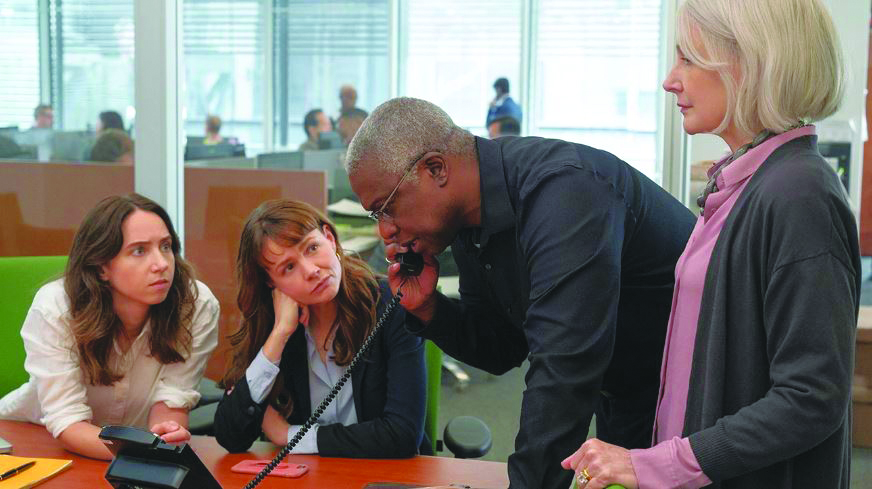
When we first meet Twohey (Carey Mulligan) she’s investigating allegations against then candidate Donald Trump — while also going to OB appointments as her pregnancy progresses. Kantor (Zoe Kazan) is covering refugees, while also juggling her two girls’ schedules with her husband, who is also a reporter. Kantor gets a tip about allegations of sexual misconduct, possibly years of misconduct, by Weinstein and starts looking into it, making calls and finding women with stories who can’t talk or won’t talk on the record out of fear of damaging their careers or because of non-disclosure agreements signed years ago. Twohey joins her on the investigation when she returns to work from maternity leave, still sort of reeling from what the movie depicts as postpartum depression.
The paper’s editors — including Rebecca Corbett (Patricia Clarkson) and Dean Baquet (Andre Braugher) — believe in the story but know that hefty on-the-record corroboration is needed. Twohey and Kantor chip away at the process of finding documents to back up the stories about settlements, charges that are dropped, HR complaints and the many non-disclosures. They also search for women with a story to tell about Weinstein, hoping they can find at least one who will go on the record, talking to the likes of Gwyneth Paltrow and Rose McGowan and Ashely Judd (who appears in the movie as herself). They also talk to former assistants who have spent years carrying the trauma of their interactions with Weinstein. The more they investigate, the more Twohey and Kantor are told that Weinstein himself will be coming for them, having shut down all previous attempts to tell these stories.
I almost feel like She Said isn’t quite about what it seems to be about. The trailer sells the idea that the movie is some John Grisham-meets-All the President’s Men high-pressure race to get Weinstein and go after the “whole system” or something — the trailer sort of feels like it’s just one explosion short of a Michael Bay movie. And there are moments in the movie itself where we get some real TV-exposition-style lines of the “what? Sexual harassers getting away with it?” variety that feel kind of silly coming from fully grown women in 2016 and 2017 who work in national media.
But the actual story, the meat of the movie, is more about the unglamorous work of investigating — a lot of phone calls and searching for documents and showing up at the doors of people who don’t want to talk — paired with the pushing-a-boulder-up-a-mountain quality of trying to work while parenting. Specifically, I think, of trying to work while being the mother of in Megan’s case a new baby and in Jodi’s case two young kids. The limitations, the constant sense of being behind and running late and keeping it all together with tape. At one point Jodi gets a pivotal call and, to get the time and quiet to have the conversation, she essentially bribes her daughter with Netflix time. That moment felt incredibly well done and true to life, as do scenes where Megan tries to find her work self again while swimming through her postpartum struggles. It captures the “backwards and in heels” aspect of what was involved for these two specific reporters to work this investigation and goes to the movie’s larger themes about women, the situations they have to deal with and the choices they make.
When the movie just lets itself be about this, about the work and Jodi and Megan and the way they try to honestly foster relationships with the women hurt by Weinstein without over-promising or being false about their motivations, She Said is absolutely riveting. The core duo of Mulligan and Kazan bring a lot that is unsaid to their characters, with facial expressions and little moments that fill their characters out and make them people. Mulligan even gets one really good explosion, a “had it with All Of This” moment, that is just a chef’s kiss. Clarkson is also solid; I wish she’d had even more to do.
She Said occasionally seems to get tangled up in the needs of a conventional movie versus the still-developing story that its characters are enmeshed in. But when it works, when its elements all come together, it’s thoroughly captivating.
Featured photo: She Said.