Reimagining art

How the Currier used the pandemic pause to revamp its galleries and make art more accessible

With a new focus on global art and a stronger emphasis on immersive experiences and community outreach, the Currier Museum of Art in Manchester has spent the past couple years revamping its galleries, enhancing its programming and planning for the future.

“Our new goal is to make sure that people know we have more than just art on the wall,” Currier Director Alan Chong said. “We have two Frank Lloyd Wright houses which are worth visiting, we have art classes … [along with] the permanent collections and exhibitions.”

The museum was able to continue running in some capacity even in the beginning of the pandemic, Chong said, and has continued to add back old programs and start new ones since then.

“We’ve had very strong support from the community,” Chong said. “The government has kept us going [with funding]. … We really depend on a whole network of support.”

PPE funds meant the Currier staff could keep working, and other grants helped support online programming and expanded museum offerings.

“Our audience has responded well,” Chong said. “Our numbers are pretty much recovered. We’ve been close to full capacity for a couple of months.”

Here’s a look at the Currier’s new mission, latest exhibitions and current efforts to make art more accessible to the entire community.

Going global

Though the Currier Museum of Art had to shut down during the pandemic, museum staff solved the immediate problem of accessing the community with online programming. The museum’s curators, in the meantime, saw their scope of work change a bit — instead of traveling the globe to acquire work, they looked inward at what they already had.

“In some ways when we were closed it gave us a lot of time to focus on the collection and reimagine [what it could look like],” Senior Curator of Collections Kurt Sundstrom said. “We all sat around on a Zoom call and talked about how we could use this opportunity.”

The Currier’s mission, he said, is to become more global, to visually show the connections between America and Asia, Europe and other parts of the world. For the Currier, that meant shifting around some of its collections. The second floor of the museum was reinstalled and looks completely different, Sundstrom said, with works from around the world paired together.

“We broke down those walls,” he said. “You can come to the museum now and see American art in the European gallery. … You look at things differently depending on where they’re hanging.”

For example, a Dutch painting that features a rug now hangs with Persian rugs from the museum’s collection, allowing for a new perspective.

“It was interesting to reinterpret how the collection could [work together],” Sundstrom said.

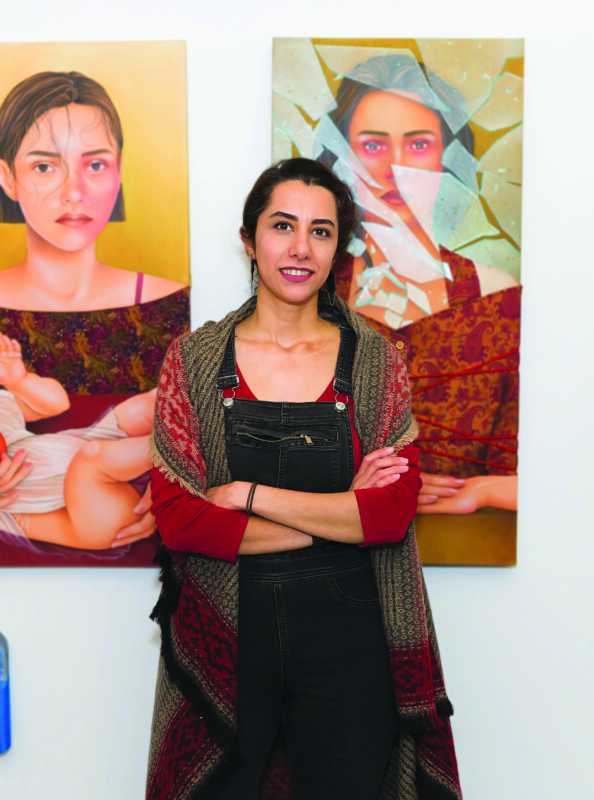
The Currier is also acquiring new pieces and planning exhibitions that will help it tell more of a story of global art, Sundstrom said, like an Islamic rug show, and the current exhibition that features the work of Iranian artist Arghavan Khosravi.

“When I first came here 25 years ago, there wasn’t any work here from African American artists, and there was very little from women,” Sundstrom said. “I think audiences, when they come in now, they’ll see themselves represented. You’ll have Asian art and Mexican art and works by women and everything that you would expect in a multicultural community.”
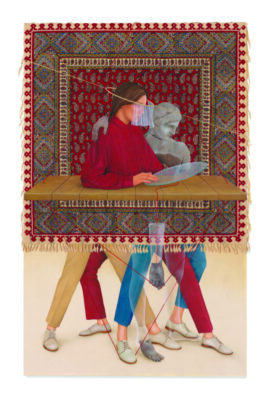
mixed media artwork by Argahavan Khosravi.
The Uncertainty, by Arghavan Khosravi (2020, acrylic on found textile and cotton canvas over wood panel, leather cord) Courtesy of the artist, © Arghavan Khosravi, 2022, photo by Julia Featheringill.

You can visit a museum many times and still never see the extent of its collection. Sundstrom said that museums typically have 2 to 7 percent of their collections on view at any given time. Paintings and sculptures can stay out longer, but photographs and watercolors will deteriorate over time when exposed to light. Because of this, a visit to the museum one year could be an entirely different experience than a visit the next. And with the pandemic giving the Currier time to make more significant changes, the overall vibe is different too.

“I think it’s much more fun,” Sundstrom said. “It’s not so static anymore. It’s not what you would expect — it’s not stuffy.”

Community connections

Programming at the Currier made strides during the pandemic too, with strong efforts to make art more accessible to the community — something it had been doing in recent years anyway.

“We do a lot more online,” Chong said. “We were already moving in that direction. … We had designed a new website in late 2019, so we were ready to launch a more user-friendly experience.”

Chong said that government grants were key in helping the Currier stay connected to the community and provide an online museum experience when it had shut down, and even after, when its hours and programs were limited.

The Currier already had its entire collection online — most museums had been looking at the digital world very intently, Chong said — but a National Endowment for the Humanities grant allowed the museum to put its two Frank Lloyd Wright homes online, including photo galleries, drawings and plans, 3D tours and historic documents.
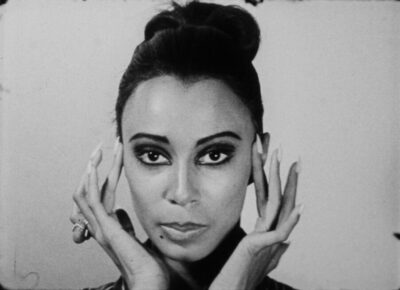
Donyale Luna in a film still from an Andy Warhol screen test.
Screen Test: Donyale Luna [ST 195], by Andy Warhol (1965, 16mm film, black-and-white, silent, 4.5 minutes at 16 frames per second) © The Andy Warhol Museum, Pittsburgh, PA, a museum of Carnegie Institute. All rights reserved.

Grants also allowed the museum to pass out kits to do art projects and enhance some of its supportive arts programs.

“Our curators and educators really worked hard on how we can respond to [the pandemic] and the racial tension,” Chong said. “[For example], a lot of people were feeling that hybrid learning wasn’t a very good way of going to school, so we formed a teen anxiety group.”

Sundstrom runs that group, using art to initiate conversations, like looking at a painting made after World War II, another difficult time in history.

“We talked about how to get through those anxious moments,” Sundstrom said.

Those groups started back in person last semester, which Sundstrom said has been an even better experience.

Chong said the museum was also able to hire an art therapist.

“I think we’ve been able to develop core strengths to support the community,” he said, noting that the Currier was the first museum in the country to offer an art therapy group for families of people suffering from opioid use disorder.

The Currier also launched a new veterans program during the pandemic, expanding what had been a small program with war photography to supportive art groups in new classrooms.

Diverse exhibitions

The Currier’s newest exhibition, Arghavan Khosravi, opened April 15 and will be on view through Sept. 5. The show features more than 20 works from Iranian artist Arghavan Khosravi, whose techniques range from using printed textiles from Iran as a canvas to creating three-dimensional components on painted surfaces, with a focus on depth and texture.

“We’re really committed to showing global contemporary artists, artwork that is innovative and interesting and sparks conversations,” said Samantha Cataldo, senior curator of contemporary art. “Her work is surrealism. … There’s almost always a woman at the center of the work and then the images themselves kind of capture memories or dreams. … She paints in a way that when you’re looking at it you can’t really tell if something is real.”

The images explore themes like exile, suppression and empowerment, which Cataldo said is drawn from the duality that Khosravi has experienced in her life, having lived in both Iran and the United States.

“The culture where she grew up, you were allowed to be a little more free with your family, but in public [you were] more restricted,” Cataldo said. “A lot of the themes [in the exhibition] are a form of restriction, [like] people being boxed in or existing on two different planes of reality. … The works don’t have a specific narrative, but there’s a symbolism and there’s clues and ideas. … [They] are really approachable and acceptable.”

A duality also exists between the works’ first impressions and their more closely scrutinized images.

“At first glance, things are colorful [and] and really inviting because they feel warm and happy,” Cataldo said. “But [what’s happening] in the scene is not so bright and cheery.”

She said the exhibition so far has been well-received, both in its themes and in its visual appeal.

“[The paintings] are exquisitely made,” she said. “They’re also quite poetic in terms of how they look and how they’re composed.”

Also on view now (through July 3) is Warhol Screen Tests, which features 20 of Andy Warhol’s black-and-white short films that he made in the mid-’60s of his friends — some famous, like Bob Dylan and Salvador Dali, and others who came to his studio in New York City.

“He filmed essentially a moving portrait,” Cataldo said. “A single subject would sit in a chair and he would run the camera on them until the film ran out, [about] 4 minutes. … You have people who are extremely aware of the camera, some who try to be totally still, some [who act] playful.”

The films are unscripted and played in a loop in slow motion, and they’re projected large-scale, which Cataldo said can be a bit unsettling.

“It feels too close to a Zoom meeting,” she said,” watching people feel like they have to present themselves in a certain way.”

Warhol’s prediction that “everyone will be world-famous for 15 minutes” seems to have come to fruition to some degree, with regular people becoming TikTok or YouTube famous. And his repetitive screen prints that feature the same face over and over are reminiscent of today’s selfies.

“Everything he was doing was so far ahead of his time, so the idea of a selfie wasn’t a thing,” Cataldo said. “But the exhaustion of looking at a screen and looking at yourself — people can [now understand] that scrutiny.”

Looking ahead

While the Currier is mostly back to its pre-pandemic level of offerings, Chong said they’re proceeding with caution.
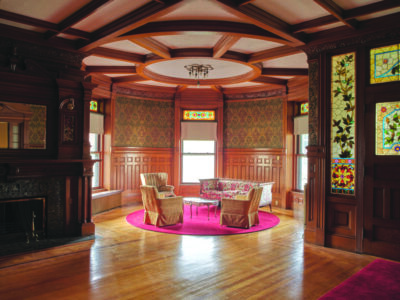
The first floor of the Chandler house. Photo courtesy of Currier Director Alan Chong.

“We feel a responsibility to the public, so we’re cautious,” he said. “History has taught us that it’s not over. We need to be flexible; we’re not going to pretend it doesn’t exist. There’s been a recent surge, so we follow all that.”

One of the upcoming projects that Chong is looking forward to is the renovation of a “new” old building.

“We took over the Chandler House during the pandemic,” he said. “It was a historic house … and it has the most beautiful interior in Manchester.”

Chong said the Currier had been looking to buy the building from the Catholic Diocese for years but hadn’t been able to make a deal because it was too expensive.

“I suspect that the pandemic pushed along that whole process,” he said.

Now the Currier will be working on finding funding to turn the building into a community center that will include offices for museum staff as well as classrooms for public programming, with the hopes of having it open by the fall of 2023.

In the more immediate future, the museum is planning to bring back its annual block party on a to-be-determined Saturday in July after a two-year absence. Chong called the day of free fun the museum’s signature event.

ARTSY OPPORTUNITIES

The Currier offers all kinds of classes and programs, both in person and online. Here are some of the offerings, according to currier.org. Visit the website for more details and the latest classes and events.

Ongoing programs

Making Art Accessible

This program is for teens and adults with developmental disabilities. The multimedia studio art class allows students to make works of art inspired by the Currier’s collections, and to visit the Currier’s galleries. The Currier regularly holds Making Art Accessible classes, and it is open to the public. Email CLyford@currier.org for more information.

Creative Connections for Teens

This program supports students suffering with anxieties related to the pandemic and related stressors. Each session provides students opportunities to connect through art-viewing, art-making and social time, and they’re led by Currier educators and curators with the support of a school counselor.

The Art of Awareness

Strangers from different backgrounds gather for a 30-minute awareness exercise and discussion to build connections with each other and art. Each week features one piece of art, chosen based on a theme. General admission is free on Thursdays from 5 to 8 p.m., and this program starts at 6:30 p.m. Upcoming classes are May 5, with the discussion centered on Arghavan Khosravi’s “The Black Pool,” and May 19, featuring John Marin’s “Movement in Red.” Register online.

Art of Hope

An in-person support group for loved ones whose family members suffer from substance use disorder. It takes place on Mondays from 6 to 8 p.m., with the next groups meeting May 9, May 16, May 23, June 20 and July 18.

Art for Vets

This art-focused program offers free opportunities for veterans, active service members and their families to enjoy the Currier. Veteran Creative Cohorts allows veterans to connect through art-viewing, activities and guided conversations, with an emphasis on personal development, respite and mindfulness. Studio Art Tutorials has professional teaching artists launching online or in person art tutorials for veterans and active service members, including drawing, watercolor painting and bookmaking. The classes are for all skill levels and focus on the therapeutic nature of art. Art for Vets Family Days are offered on the third Saturday of the month, with free access to the galleries, art activities and a complimentary lunch. Veterans, active service members and their families get free admission every day, and the Currier also offers all of its art classes and vacation camps free of charge.

Immigrant and refugee programs

The Currier provides after-school art instruction for children of immigrant and refugee families during the school year and extends their learning into vacation weeks by offering free enrollment in art camps. During camps, children are given 30 hours of instruction each week and are provided free breakfast and lunch each day.

Looking Together

Explore one work of art in detail for 15 minutes with a Currier docent. Sessions are informal, interactive and focused on a different object each day. It’s offered every Saturday and Sunday at 11 a.m. and noon.

Art After Work Tours

Every Thursday, enjoy free admission, live music and drink specials in the Winter Garden Café (open until 8 p.m.). The 30-minute adult tour is free of charge. Participants meet in the lobby.

Art Conversations from Home

Join the Currier Museum of Art’s education team for a live facilitated conversation over Zoom about the Currier’s collection and exhibitions. Sessions are informal, interactive and focused on a different work each week. Open to all, these free 30-minute adult programs run every Wednesday at 1 p.m. Register online.

Frank Lloyd Wright house tours

The Currier is the only art museum in the world with two Frank Lloyd Wright homes, and the only Wright buildings open to the public in New England. The Usonian Automatic and the Zimmerman House were both built in the 1950s. The two-bedroom Zimmerman House showcases Wright’s Usonian architectural concepts, with a compact design that contrasts narrow passages with dramatic, open spaces. It includes its original furniture and garden, both designed by Wright. The Kalil House, which was acquired by the Currier in 2019, is one of only seven Usonian Automatics constructed, dubbed “automatics” by Wright because they were easily and quickly built. Public tours of the Wright houses last two hours and are offered Thursdays through Sundays at 10:30 a.m., 1 p.m. and 3:30 p.m., as well as an evening tour on Thursdays at 6 p.m. (spring and summer only). To schedule a private tour, email tours@currier.org or call 603-518-4956.

Classes

The Currier regularly offers art classes for all ages and abilities. Here are some of the museum’s upcoming offerings.

Drawing from Presence with Norma Hendrix (Adult)

Online five-week class, Tuesdays, May 10 through June 7, 1 to 3 p.m.

Painting with Pastels: Finding Beauty in the Urban World with Janet Schwartz (Adult)

Online five-week class, Fridays, May 13, through June 10, 2 to 4 p.m.

Learn to Draw: Structure and Volume with Shading with Martin Geiger (Adult)

Online five-week class, Thursdays, May 26 through June 23, 6:30 to 8:30 p.m.

Earn and Learn Teen Program

Teen volunteers will be involved in classroom assistance, art-making activities, mentoring younger students, facilitating museum visits and other organizational tasks, and they will receive tuition remission for classes at the Currier. Admission to the program is based on a review process. Each applicant must be willing to commit to two weeks minimum of summer camp. Camps run Monday through Friday from 8:45 a.m. to 4 p.m. Apply by May 14; for more information, email Lauren Steele at lsteele@currier.org.

Vacation camps

The Currier offers camps throughout the summer: Art Camp for ages 6 to 10 and Art Ventures for ages 11 to 14. The camps include classes in drawing, painting, collage, printmaking and sculpture. Every Wednesday, an inspirational tour of the museum is conducted to discover the works of art in the galleries. Weekly full-day programs run Monday through Friday from 9:30 a.m. to 4 p.m. All art-making materials are provided. Camps have a maximum capacity of eight to 10 students, and students, instructors and camp assistants are required to wear masks. The schedule is as follows; see currier.org for prices, updates and other information.

June 27 to July 1

Art Camp: Down the Rabbit Hole (ages 6 to 10)

Art Ventures: Fun with Fibers (ages 11 to 14)

July 11 to July 15

Art Camp: Music Makers (ages 6 to 10)

Art Ventures: Drawing Outside the Box (ages 11 to 14)

July 25 to July 29

Art Camp: The Moody Currier School of Magic (ages 6 to 10)

Art Ventures: Drawing and Painting exploration (ages 11 to 14)

Aug. 8 to Aug. 12

Art Camp: Space is the Place (ages 6 to 10)

Art Ventures: Mixed Media Painting & Printmaking (ages 11 to 14)

Aug. 15 to Aug. 19

Creatures Large and Small (ages 6 to 10)

Art Ventures: The Moving Picture (ages 11 to 14)

Events

Gregory Pierce, curator of the Warhol Museum, will be at the Currier for an ARTalk to complement the “Warhol Screen Tests” exhibition. He will discuss the impetus for Screen Tests and how they’re relevant almost 60 years later and take a deeper dive into Warhol’s creative process. The talk will be held Sunday, May 8, from 2 to 2:45 p.m. in the auditorium. The cost is $20 and includes museum admission.

Featured photo: Arghavan Khosravi. Photo by Andrew T. White
Book it

Celebrate Indie Bookstore Day

If you love your local bookstore, this Saturday, April 30, is your chance to support it — and get some good deals, exclusive merchandise and prizes — during national Independent Bookstore Day.

“Independent bookstores are the hearts of the communities they serve,” Michael Herrmann of Gibson’s Bookstore in Concord said. “We’re glad for this opportunity to thank everyone who makes it possible for us to be here.”

At Gibson’s, thank-yous will come in the form of raffle prizes and the chance to earn discounts and a tote bag of Advanced Reader Copies.

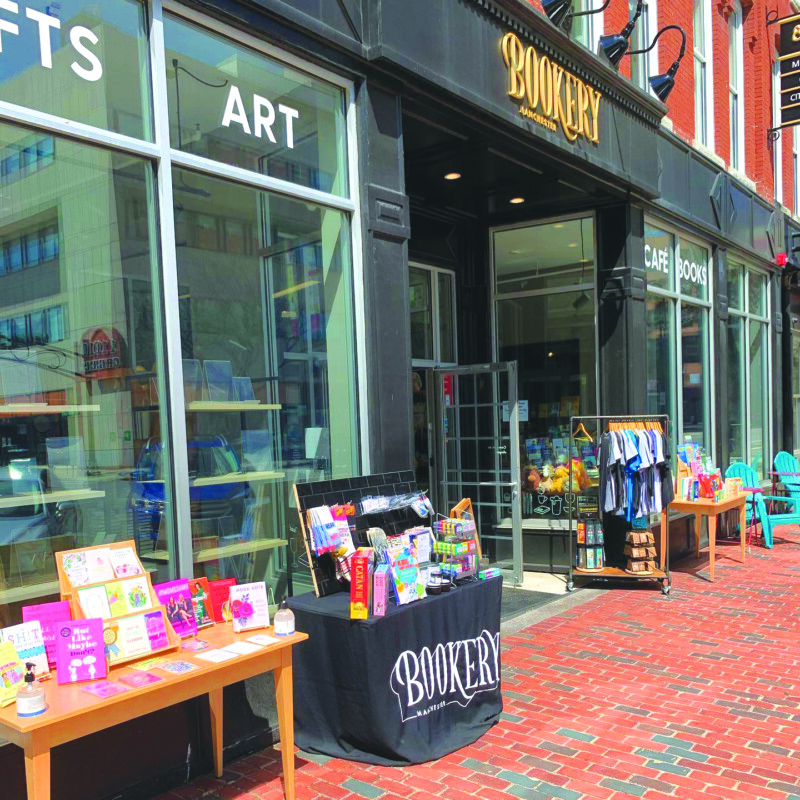
The Bookery in Manchester is celebrating the day with games, contests and giveaways.

“I think there’s been more of an awareness even in the past few years about the importance of local businesses,” Bookery events coordinator Lily Foss said. “People think we’re a dying breed but we’re still very much vibrant. … We have the pleasure of bringing in authors and [hosting] other special events.”

Saturday will bring a performance from magician DaSean Greene at 11:30 a.m., and Foss said they’re thrilled that he’s coming back.

“The kids absolutely loved him,” she said. “They were all crowded around him.”

The Bookery will also have a special Indie Bookstore Day tote bag and special merchandise for sale, and they’ll be giving away small prizes with the “very popular prize wheel,” which people can spin if they purchase a certain amount, Foss said.

“People get so excited,” she laughed. “No one has ever refused to spin.”

Toward the end of the day, Foss — a former Jeopardy! contestant — will be hosting a literary trivia event that she said is a combination of Jeopardy! and pub trivia, with people playing on teams. She said she went through the online “J-Archive” and compiled an entire game’s worth of literary trivia from various shows throughout the years.

“It has been tested by customers and booksellers to make sure the questions aren’t too hard or too easy,” she said.

Foss is also including one question from her own stint on Jeopardy!. She said she was the youngest contestant that night by at least 10 years, and she was at a disadvantage with categories like “90s Pop Culture.” But it was worth the experience: “It was my 15 minutes. … And I got $1,000.”

“I’ve been wanting to bring trivia here for a while,” she said, “so I’m really looking forward to that. And we do serve libations … coffee, tea, beer, wine and canned cocktails, so it will have that pub trivia [atmosphere].”

Independent Bookstore Day is one of the biggest days of the year for local booksellers, as they thank their customers and their customers thank them for offering a bookstore experience that you can’t get at chain stores.

“As we struggle to return to something that looks like normalcy, it’s more important than ever to celebrate community,” Herrmann said.

“It’s such a fun day,” Foss said. “It’s just a big party, celebrating our customers [and] thanking them for choosing us.”

Celebrate Independent Bookstore Day

The Bookery, 844 Elm St. in Manchester, will be open from 9 a.m. to 7 p.m. with prizes, games and exclusive Independent Bookstore Day merchandise. Magician DeSean Greene will perform at 11:30 a.m., and Literary Trivia will be held at the end of the day.

Gibson’s Bookstore, 45 S. Main St., Concord, will be open from 10 a.m. to 6 p.m. It will be doing double stamps all day (two stamps for every $10 on your Frequent Buyer Stamp Card), a tote bag of Advanced Reader Copies for every $100 spent, and a raffle ticket for every book purchased, with raffle items that include a Gibson’s Bookstore merchandise bundle, a Personalized Shopping Experience and an Indie Bookstore Day merchandise bundle. Bonus: If you wear any Gibson’s Bookstore merch (shirts, hats, pins, etc.) now through April 30, you will get a full stamp card, good for 20 percent off an entire transaction.

Toadstool Bookshop, 375 Amherst St., Nashua, will be open from 9 a.m. to 7 p.m. and will be celebrating with cake and refreshments, according to the store’s Facebook page. There will also be an Advanced Reader Book Table set up for people to browse and select books for $1 each, which will be donated to the Nashua Soup Kitchen and Shelter.

Featured photo: This aluminum shovel is lightweight and good for cleanup. Courtesy photo.

Illustrations on auction

Bedford artist donates old works to support FIT

When Tracey Dahle Carrier of Bedford created her first illustrations for a kids’ booklet for Bedford Presbyterian Church, it never occurred to her that two decades later those illustrations would be back at the church for a whole different purpose — raising money for Families in Transition via an art auction.

The auction is being held online and in person now through April 30, featuring nearly 50 of Carrier’s original illustrations and artist proofs from her children’s books — she’s illustrated five, including Digby in Disguise.

But the project that started it all was the small booklet she created for the church at the request of her friend and co-author, Ruth Boling.

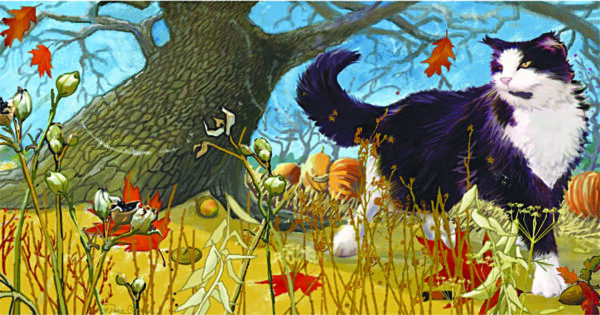
Illustration of cat in autumn woods
Copyright and courtesy of Tracey Dahle Carrier.

“The Bedford Presbyterian Church was merging their church service to include children [and the church wanted to create] a booklet to help kids understand the service and what to expect,” said Carrier, who at the time was working from home doing freelance work, illustrating for different companies. “I ended up donating the illustrations and the design.”

Carrier said she wanted to make the booklet attractive to kids, and relatable.

“Kids are squirmy and they’re wiggling around in their seats and making noises,” she said. “I wanted to take the child’s perspective into account.”

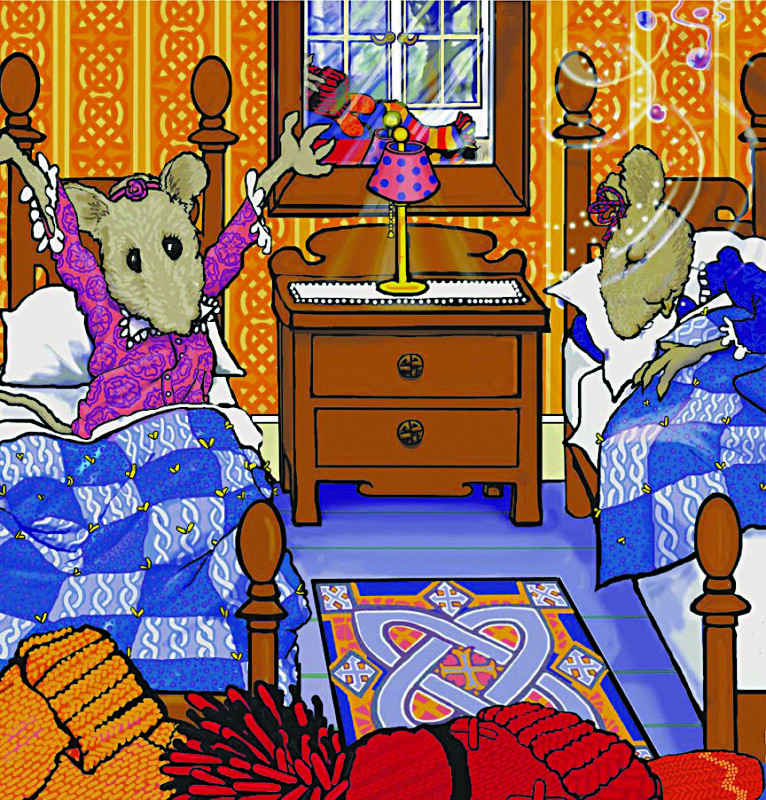
So she created characters that have similar qualities: mice.

“Mice are seldom welcome and are squirmy and hard to manage,” Carrier said. “They were the perfect spokespeople for this job.”

The booklet was picked up by Geneva Press, and after it was published, John Knox Press asked for more, similar children’s books from Carrier and Boling.

“It was quite a successful little venture,” Carrier said.

The pair decided that when the first JKP book was released, all proceeds would go to Families in Transition, an organization that the church as well as Carrier and her husband support.

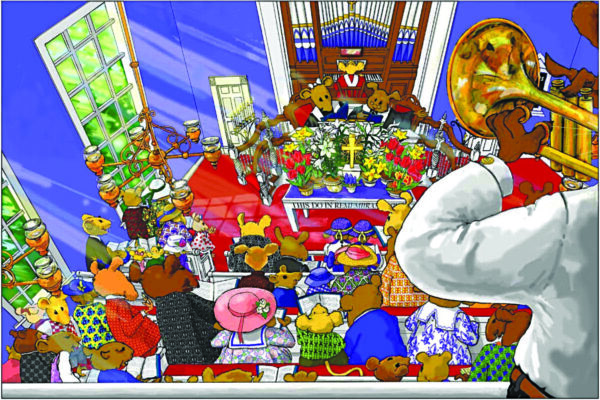
illustration of mice in mouse church
Copyright and courtesy of Tracey Dahle Carrier.

Fast forward 20 years to when Covid hit. Carrier — who is the membership manager at the Currier Museum of Art in Manchester — started working from home.

“We had to work extra hard to stay connected to the art-loving community,” she said.

During her lunch breaks, she and her husband would talk about how there were so many in the community who were devastated by Covid, some even unable to pay their rent.

“When I was thinking about what to do [to help], it was hard to know because I couldn’t really get out and about,” she said.

But then she thought back to the donations that she and Boling had made to Families in Transition so many years ago and figured it wouldn’t hurt to approach the church to see if there was a way to help FIT with support from Bedford Presbyterian.

“There are people who might still have some feelings for these mice,” Carrier thought.

The church agreed and suggested they include some of Carrier’s other pieces that she’s illustrated over the years. There’s a poster that she created for the NH Reading Program when its theme was “treasure reading,” so it features mice scrambling off a pirate ship to find books. There are also pieces from Digby in Disguise and Digby Finds a Friend; those books feature a little bear.

There are other animal illustrations too: “There’s a lot of fur in these drawings,” she laughed.

One is a drawing of a black lab, and as with all of her animals, Carrier said she tried to capture its personality and spirit.

“I had a Bernese mountain dog for 12 years, and I was asked by Silent Moon Press to illustrate a book about Bernese mountain dogs,” Carrier said. “I knew [my dog] wasn’t going to be around much longer, so it was a tribute to her.”

Carrier stopped illustrating in 2012, as she was juggling work at the Currier — part-time, at that point — and doing commissioned work for McGowan Fine Arts Gallery in Concord, and teaching at the New Hampshire Institute of Art. When the Currier offered her a full-time position, she took it, and she has been there ever since. She’s thinking about retiring soon, though, and might go back to doing some artwork.

For now, the best chance to see Carrier’s work is at the church or online. One hundred percent of the proceeds of the auction will go to Families in Transition.

“If anyone wants to take a look at the art and see if there’s anything that appeals to them … or if they don’t have a lot of wall space and just want to make a donation, that would be great,” Carrier said.

Art Auction
Bidding for Tracey Dahle Carrier’s artwork runs through April 30. All items are on display and can be viewed in person at Bedford Presbyterian Church (4 Church Road in Bedford) during regular office hours Monday through Friday, or find the auction link online at bedfordpresbyterian.org. Call ahead at 472-5841 to arrange viewing times. There is a “Buy Now” option for all pieces to bypass the bidding process, and 100 percent of proceeds will benefit Families in Transition.

Featured photo: Copyright and courtesy of Tracey Dahle Carrier. Courtesy photo.

Bold and beautiful

Powerful works on display at ‘Impact! Abstract’ exhibition

Twiggs Gallery in Boscawen has opened its 2022 season with “Impact! Abstract!” featuring the work of six local artists and on display through May 28.

“It showcases artists boldly approaching abstraction in completely different ways with a wide variety of media,” Twiggs Gallery Director Laura Morrison said. “Most of the artwork in this exhibit is on the smaller side, yet each piece really stands out on its own. It’s very powerful work.”

Each of the six artists answered a few questions via email about their inspiration and techniques.

Ann Saunderson

Acrylic, mixed media, oil & cold wax, monotype

What draws you to abstract art?

At first abstraction was just a challenge after having been a landscape and narrative painter all my life.

What was your artistic process in creating pieces for this exhibition?

It was surprisingly difficult to switch over and loosen up enough to enjoy the process. Once I accepted that I could paint over layers it was easier. And oil and cold wax helped and added the possibility of texture. Most of my work is really quite accidental. I may start with a theme, a concept, and then halfway through there’s a moment where the paint and I change directions and truly I’m just along for the ride.

How does your work in this exhibition make an impact?

My work is pretty dynamic. It doesn’t have answers and leaves a great deal up to the viewer. I love color and texture and I think those factors also give my paintings impact.

Daniela Wenzel

Oil painting, assemblage, ink drawing, driftwood pyrography and improvised quilt making

What draws you to abstract art?

What excites me about abstraction are the endless possibilities to depict facets of everyday life and the environment, without portraying clearly recognizable subject matter. An abstract work of art can mean many things to different viewers. I am specifically drawn to the emotional capacity in abstract art and its utter unpredictability. I rarely have a definite vision in mind when I start a new piece.

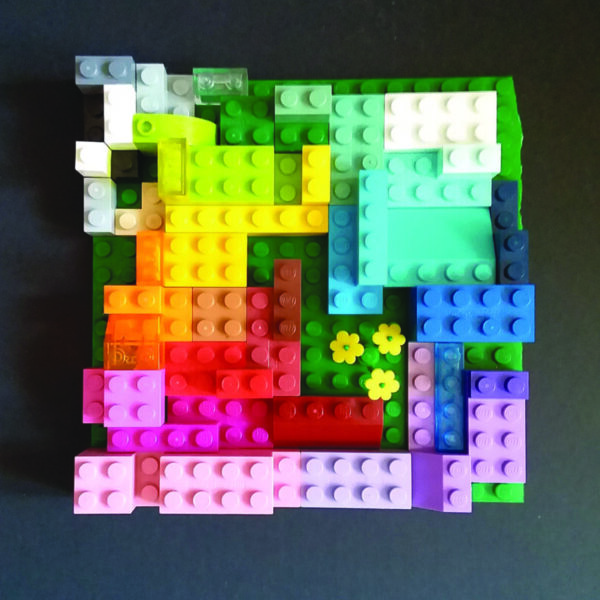
A low relief abstract sculptures by Daniela Wenzel.

What inspired your choice of materials?

I enjoy free experimentation with color and techniques, pushing boundaries and being resourceful with my materials.

What was your artistic process in creating pieces for this exhibition?

While time stood still at the height of Covid-19 in the spring of 2020, I found myself home with my kids on the days I wasn’t working at Elliot Hospital. My three Lego assemblages were created due to lack of time to paint in the studio. A lover of any kind of colorful visual vocabulary, I improvised my art making and created simple color abstractions. I specifically enjoyed playing with color theory and depth by layering different shapes and hues. Legos are an incredibly fun and abundant art supply and after repeatedly stepping on them I realized they could be more than nagging booby traps. For the two oil paintings included in the ‘Impact! Abstract’ exhibition I also used pigment sticks, which are basically solidified oil paint in the shape of a thumb-sized crayon. The use of these is more immediate and less deliberate and the marks noticeably different than from a paint brush.

How does your work in this exhibition make an impact?

The paintings both reflect and resonate the same playfulness and positivity as the Lego assemblages. They contain colorful pattern work, evocative shapes and a variety of paint application techniques to carry a sense of spontaneity.

Kate Higley

Printmaking

What draws you to abstract art?

I was a painting major as an undergrad, discovered printmaking in my early 30s, and fell in love with the way it has to be done step by step. The focus on process slows me down in a good way.

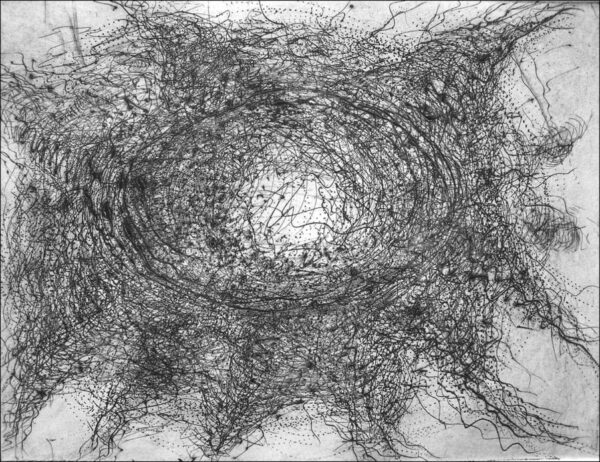
Printmaker Kate Higley’s “Spinning World.”

What inspired your choice of materials?

These particular prints are intaglio drypoints. This means that the ink is snagged inside the lines rather than flowing across the surface. I use an expanded plastic material for the plate and all kinds of sharp objects to make an image. It is then inked, wiped, and put through a press onto dampened paper.

What was your artistic process in creating pieces for this exhibition?

The gallery inquired if I could submit some black and white images. With three older plates on hand, I printed those, became engrossed and created four more plates specifically for this exhibit. The incentive was the invitation and I think Laura Morrison, the curator, used the absence of color to break up the other more vibrant work in a lovely installation.

How does your work in this exhibition make an impact?

My interest is inventing small organisms swimming or tangled in imagined aquatic or marine environments. The concerns are ecological and environmental. As an abstract artist, my aims are quite different from those who work toward realism. Texture, movement and repetition are all used to create a mysterious and engaging space where the viewer can consider not just what is present, but what might be happening outside the picture place.

Ethel Hills

Acrylic

What draws you to abstract art?

I started in abstract art almost accidentally. I was working in watercolor and started using a wet in wet technique to drop unusual colors into my landscapes. That led me to being more experimental and more colorful, letting go of realism in favor of design and color. The bottom line is that I’d much rather have a luscious crazy colorful painting than one that looks like a photograph.

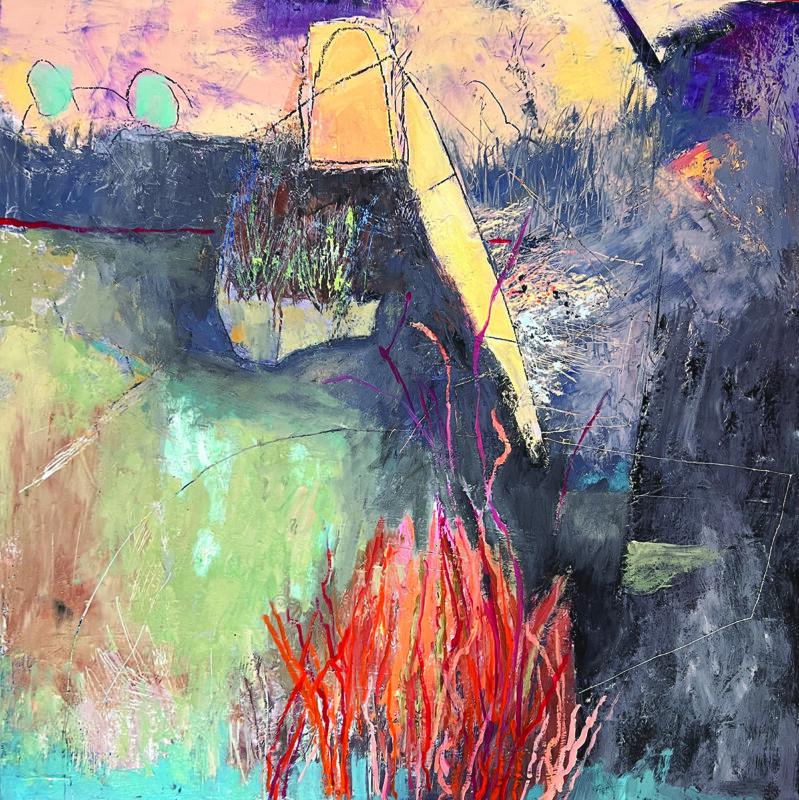
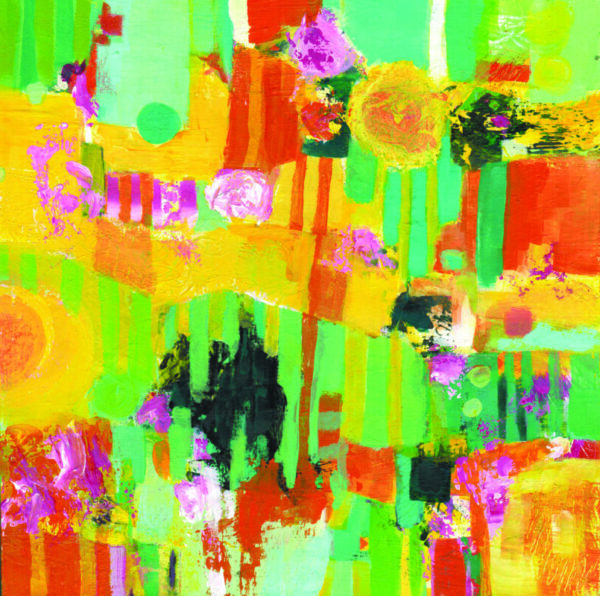
Ethel Hills – Signs of Spring – Acrylic on Panel – 8″ x 8″

What was your artistic process in creating pieces for this exhibition?

The pieces in this exhibit were painted with lots of play and experimentation. I put shapes and marks on the panel or canvas and then keep playing and experimenting, looking for surprises, and looking for what speaks to me. At some point in the process I start to see what the painting is about. At that point the refining, rearranging and adjusting are a bit easier, because I have an emotional direction for the painting.

What inspired your choice of materials?

Acrylic is a great medium for this type of playing around, trying things out and changing things.

How does your work in this exhibition make an impact?

Hopefully these paintings make people think and make them smile. In general, I think that abstract art asks more of the viewer. The artwork isn’t always a quick read. It’s an invitation to look and think and feel. My paintings are kind of two sides of a coin. The ‘Mud Season’ ones are dark and rich, but with strong lights. They’re the contrast between the dark and messy parts of life and the brighter things, such as hope and joy. The brightly colored ones, from the ‘Early Spring’ series, are joyful and reminiscent of the contrast between snow and the coming spring. But that’s just my read on them. Everyone gets to bring their experience to the work and make their own judgments and their own stories.

Grace Mattern

Mixed media collage

What draws you to abstract art?

I’ve been a writer since I was young and have published two books of poetry. … Poetry is an abstraction of sorts, using as few words as possible to express the meaning of moments and events in our lives. Ten years ago I began to make image-based collages, layering figures and backgrounds to reflect multiple dimensions. That led me to an interest in combining image and text to create an additional layer of meaning. From there I began to make abstract collages because I was intrigued by the process of creating meaning without representational images. I enrolled in an online course in abstract collage in the spring of 2021. Through that class I learned different techniques for mark-making and printing collage papers and committed to a regular practice of collage-making. I’ve been regularly making abstract collages since.

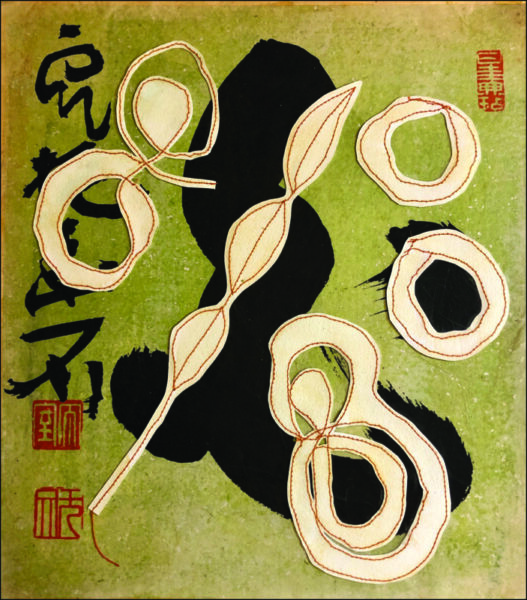
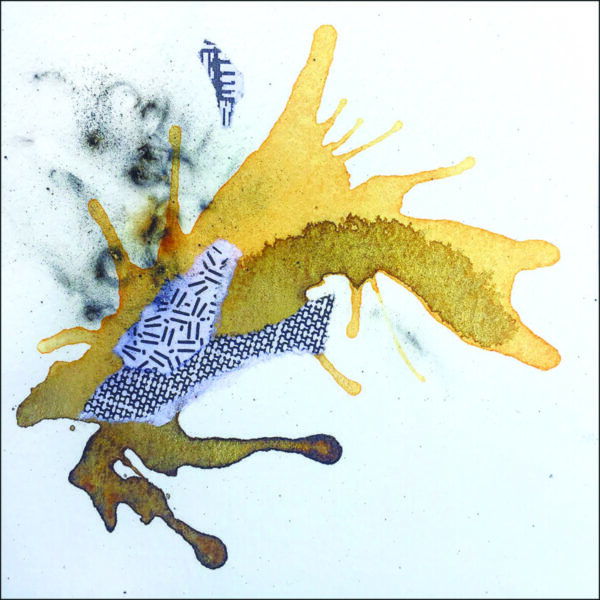
Grace Mattern’s “Mending.”

What was your artistic process in creating pieces for this exhibition?

The pieces in the exhibit were created using techniques I’ve learned over the past year. The pieces arose from experimentation with techniques and materials and building trust in my instincts regarding composition and how to create meaning through abstraction.

What inspired your choice of materials?

I’m intrigued by meaning that can arise from unexpected combinations of materials. Sewing on paper, then painting the paper and cutting out shapes is included in three of the collages in the exhibit. I’m also drawn to the effects of layering transparent paper with varied prints, and what can emerge from that process. That’s reflected in the pieces in the show also.

How does your work in this exhibition make an impact?

As a longtime writer and somewhat beginner visual artist, I’ve always struggled with the question of how art has an impact in the world. I’m a lifelong social justice advocate, and worked for the New Hampshire Coalition Against Domestic and Sexual Violence for 30 years. The current focus of my activism is racial justice and land conservation, which overlaps with recognizing the ongoing contributions of indigenous peoples who have stewarded this land for thousands of years. I believe that the act of creation itself is activism, as it’s a gift to the world to express ourselves through art, music, poetry, etc. I hope the impact of my work in the exhibition is to create excitement in people to find whatever creative expression is meaningful to them and put it out into the world.

Becky Barsi (Artsy Barsi)

Interdisciplinary with a focus on mixed media assemblage

What draws you to abstract art?

The element of experimentation, chance, and the unknown draw me to create abstract compositions.

From Becky Barsi’s “Texture in Motion” series.

What was your artistic process in creating pieces for this exhibition?

It all started by deconstructing a bullet and playing with the gunpowder inside. After a few singed fingertips I learned how to safely control this mild explosive. Following these experiments I considered the broader significance of this media and how it could be juxtaposed with traditional art media.

What inspired your choice of materials?

So much of my life is lived in motion. Going, going, going. I often forget to stop and observe the subtle details of the life around me. … ‘Texture in Motion’ is a response to the chaos of a life that had intended to be more reflective and aware. Developed over the past year, this mixed media work was created as a meditative process and bridges three unique media. The work plays with the physical properties of a fluid medium, bending and twisting, sometimes colliding with colors (acrylic ink). It is balanced by the varied, yet structured, textures that are interacted with on a daily basis (security envelopes) and are tied together by the contrasting unpredictability of a volatile explosive (black powder). This work is a reflection and metaphor of a life.

How does your work in this exhibition make an impact?

There is a visceral reaction to working with gunpowder that can’t be avoided. The anticipation of the ignition, when the flame touches the volatile grain, adds an extra beat to the rhythm of my heart. The chance, the unknown result of this material instantly impacting the surface and surrounding materials, adds to the anticipation and impact of this process.

A poet’s perspective
New Hampshire poet laureate Alice B. Fogel (2014-2019) will be at Twiggs Gallery On Saturday, April 16, from 1 to 3 p.m. She will be reading from her new book of poems inspired by abstract expressionist art, Nothing But: a series of indirect considerations on art & consciousness. There will be a book signing opportunity after. The event is free but seating is limited; reserve a ticket at twiggsgallery.wordpress.com.

How did you use abstract art to inspire your writing?
What I wanted to do was to start with abstract expressionist artworks — without describing or explaining them — and bring to language those same disruptions to our stream of consciousness that occur when we encounter the unexplainable. … I’m so grateful for the opportunity to transcend mundane logic by means of nonrepresentational material — mineral, color, form, texture, light, shadow — I hoped the poems would create a conversation about reality, illusion, embodiment, perception and thought itself.

Was there any piece in particular that originally made you think, ‘This could be the basis for a poem’?
The very first poem I think I wrote for this series was based on my response to a painting called ‘Field Notes, No. 59,’ by Andrew Moore, that I saw in a gallery in Asheville, North Carolina, Blue Spiral. (The poem is ‘Notes for 59,’ which opens the book.) I was so taken with it that I began to contemplate how abstract art, while not representing recognizable, ordered figures from our daily lives, can still represent a great and necessary part of our primal or archetypal human experience. I wondered if language could confound and re-orient us the same way.I took off from there.

How did you find the artwork that you drew your inspiration from? Local galleries? Online?
Some of it was from galleries, and a very few from artists whose work I already knew. But because I was injured and immobile at the time, I found most of it online through websites. Not the best way to view art, but it was a life-saver that I could view it at all.

Why abstract as opposed to representational art?
If I saw a painting and I could say, ‘That looks like a tree/house/river/anything!’ then I wouldn’t use it for this project. I didn’t even like using a totally abstract painting if it had a title that was too directive, like ‘Loneliness’ or ‘Rain in Winter.’ … I wanted to be affected in my heart or my gut or my skin while being clueless in my mind. I’m basically examining consciousness itself, building up a first-person plural, collective conversation, poem by poem, about reality and illusion, embodiment and spirit, perception and thought, as well as about art itself. Whether my response was infused with humor or wonder or ache, the art became … akin to a religion — a way to access the transcendent by means of pure material.

Explain the subtitle of your new book.
Thank you for asking about this.The book starts with an epigraph from William James’s The Stream of Consciousness, written in 1892: ‘Consciousness is in constant change … a series of indirect considerations…. The only breaches that can well be conceived to occur within the limits of a single mind would … be interruptions, time-gaps during which the consciousness went out….’ The book’s subtitle reflects that concept. … It’s probably no surprise … that these poems are not narratives or linear lyrics. So I also hoped that by providing a pretty concrete hint of what the poems are after, the subtitle would help people know what they were getting themselves into.

Twiggs is calling this exhibition “bold and powerful.” Do your poems fit that description as well?
That’s not for me to say, but that’s definitely how I think of the art that inspired the poems in this collection.

Featured photo: “If only…” by Ann Saunderson. Courtesy photo.

Multicultural watercolors

Nashua exhibition represents faces from around the globe

Kavitha Chandrasekaran has painted every single day since she moved to Nashua three years ago, and now she’s sharing the products of that devotion in a solo exhibition at the Nashua Public Library.

“This is my first [show],” Chandrasekaran said. “I can’t believe I’ve created so many paintings.”

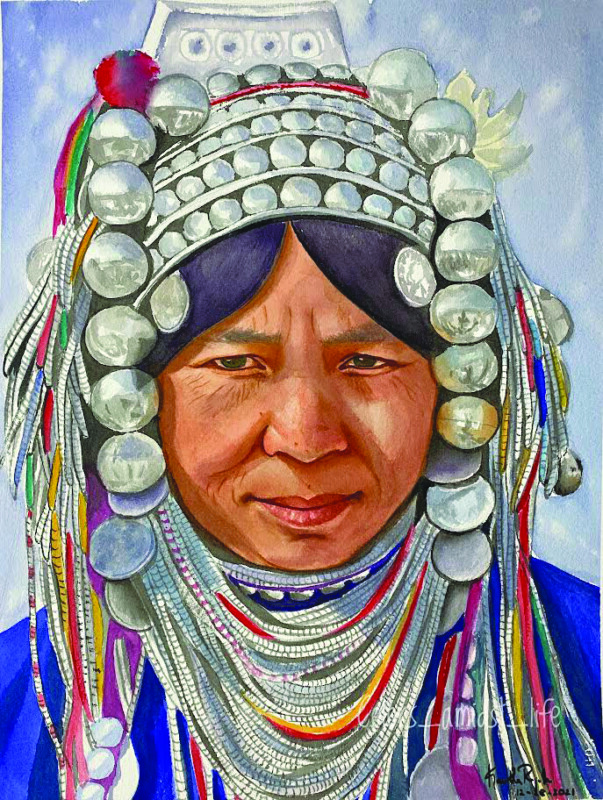
“Faces in Watercolors,” on display through April 30, features portraits of people from Africa, Vietnam, Thailand and India; the latter is Chandrasekaran’s homeland. She moved to the U.S. in 2013, first to Atlanta, then New York, finally landing in Nashua due to her husband’s job change.

Chandrasekaran said it was boredom that prompted her to pick up a paintbrush.

“When I came to Nashua my kids were very small, so I couldn’t get a full-time job,” said Chandrasekaran, who has a master’s in human physiology. “But when they napped I had some time.”

painting of three young boys, smiling
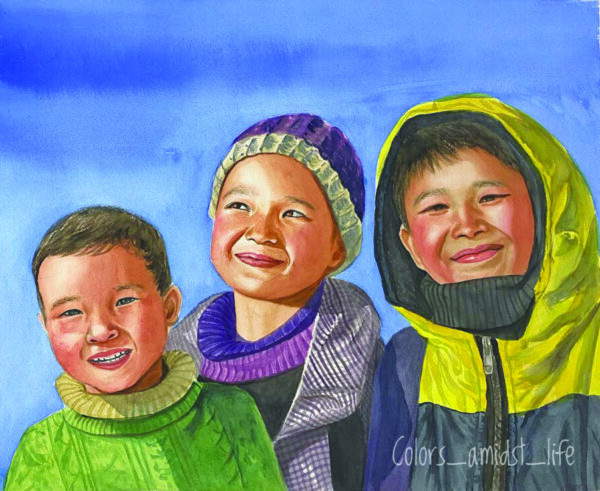
“Those Eyes.” Watercolor by Kavitha Chandrasekaran.

It was the first time Chandrasekaran had tried painting; previously the only art she’d done was drawing back in her early school days. She started by teaching herself how to paint with acrylics.

“[Then] I started exploring watercolor [and spent] hours scrolling on Instagram — Instagram made me try watercolor,” she laughed.

Chandrasekaran said she loves the way you can’t predict exactly how the watercolor effect is going to look when she’s working on the backgrounds for her portraits, but there’s a more practical reason why she’s stuck with watercolors.

“I don’t need lots of supplies, so when my kids wake up I can just pack up and put things away,” she laughed.

People’s faces resonate with Chandrasekaran in a way that landscape painting hasn’t; she’s tried the latter, but she said that after 10 or 15 paintings, she still didn’t like how they turned out.

Her desire to create a custom calendar with images of her children drew her into portraiture. She didn’t know how to draw figures, so she studied and taught herself the basics, then started to learn how to tell a story through the faces she paints.

“The eyes are very important to me because that is the most expressive part of a face,” she said.

For this exhibition, some of the portraits are based on photos she found on Instagram and was given permission to paint. Some she picks as a reference to start with and changes a little bit so they have their own unique look. The photos of Indigenous people in particular caught her eye.

“These photos were very expressive, and I got very attracted to their jewelry and [accessories],” Chandrasekaran said.

During this time when she hasn’t been able to travel to India, or anywhere really, for a couple of years, Chandrasekaran said immersing herself in the faces of people from around the globe has been a comfort. She is hoping, though, that she will be able to introduce her kids, who are 6 and 4, to India this summer. But for now, she’s embracing the cultures of Nashua.

“This is a foreign land to me, but I made it my home,” she said.

Chandrasekaran plans to keep painting and wants to try to submit some of her work to more galleries and become more familiar with the local art scene.

“The painting is what now keeps me going every day,” she said. “This is something that I enjoy and want to [continue to] explore.”

“Faces in Watercolors”
Where: The gallery at Nashua Public Library, 2 Court St.
When: Now through April 30 any time the library is open
Meet the artist: There will be an artist’s reception on Thursday, April 14, from 6:30 to 8 p.m.
Visit: nashualibrary.org

Featured photo: “Akha.” Watercolor by Kavitha Chandrasekaran. Courtesy photo.

Capital authors

Meet four Concord-area writers at “An Evening to Remember”

Concord author Paul Brogan is on a mission to show locals that the Capital City area is home to talented writers of all genres — in fact, he’s using all of the royalties from his recently published book, The Concord Theatre, to pay for what he hopes will be an ongoing free series of talks that spotlight these local authors.

The first event will bring four of those writers — Brogan included — to the Bank of NH Stage for “An Evening to Remember: Conversations with Concord Area Authors” on Wednesday, April 6, at 7:30 p.m.

“There are lots of people in this area who write, who love to write, who express themselves beautifully in all genres,” Brogan said. “I want to do something that makes the people of the area understand that we have some really talented people who are writers. We know we have really talented performers [like] Seth Meyers, Adam Sandler, Sarah Silverman, and there are [well-known] writers like Dan Brown and Jodi Picoult, but I want to showcase some of the people who aren’t selling books at that same level but who are writing passionately … [and] writing because they have something they want to say.”

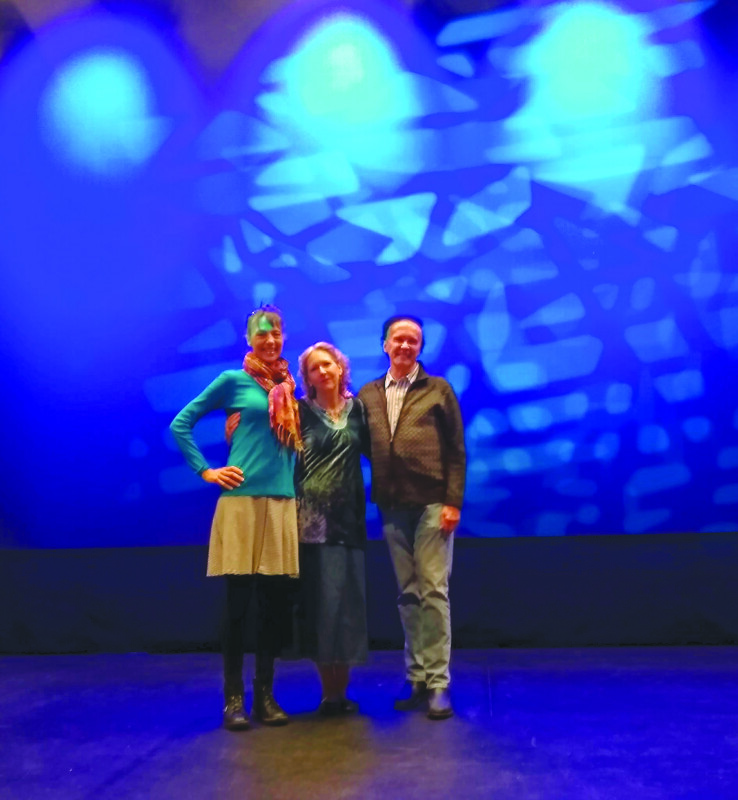
“An Evening to Remember” will be led by former longtime NHPR host Laura Knoy and feature Brogan as well as authors Margaret Porter, Virginia Macgregor (who writes as Nina Monroe) and Mark Okrant.

“Laura will talk with each of us and let us tell a little bit of our story, ask questions and encourage people in the audience to ask questions [about things like] why do we do it, how we get inspired,” Brogan said.

Brogan’s writing story began relatively recently.

“I went to Catholic schools and writing was one of those things nuns instilled in you … but I never did anything with my writing for a long, long time,” Brogan said. “I was past 50 when I finally sat down and wrote my first book.”

That book, Was That A Name I Dropped?, was published in 2011, and Brogan didn’t get the writing bug again until several years later, when he was inspired by the old Concord Theatre being converted into the Bank of NH Stage. He had worked at the Concord Theatre for 27 years, starting when he was 14.

“I had such affection for the [Concord Theatre], so I wrote a book three years ago about the theater’s history and Concord’s history with movies,” he said.

The feedback he got after his latest book came out showed him how few people are aware of what New Hampshire authors have to offer, with people saying things like, “I didn’t know anyone around here could write,” and assuming that you have to be in a more metropolitan area “to have the muse hit you,” Brogan said. But that’s because most people aren’t taking advantage of local resources; Brogan calls Gibson’s Bookstore in Concord, for example, “a writer’s best friend,” with owner Michael Herrmann hosting book launches for local writers and displaying their books in a special section. He also said the NH Writers’ Project is a great resource, but “would wager that a lot of people don’t click on that website.”

So Brogan started thinking about putting on an event to spotlight local authors and spoke with fellow author Margaret Porter at Gibson’s one day, asking her what she thought about it. She was all in, and the two approached Monroe and Okrant to see if they’d be interested as well. They were on board, and Porter suggested they ask Knoy to moderate the discussion.

“I said, ‘If you can get her, she would be amazing.’ … And she jumped at it,” Brogan said.

Knoy met with Brogan and Porter recently to check out the venue.

“Within an hour I felt like we’d been friends for years, and I think she’s the perfect person to put us all on stage at ease, and put the audience at ease,” Brogan said.

They want to make sure the whole atmosphere is comfortable too.

“We want it to be [like] the audience is looking at people in a living room having a conversation and then have the audience become involved and then stay around and mingle,” Brogan said.

Porter said she’s looking forward to sharing a small sample of the creativity within the Concord region, as well as their experiences of writing and publication.

“We hope to provide helpful information, maybe even some inspiration, to anyone aspiring to write fiction or nonfiction, or has questions about pursuing a writing career,” she said.

Brogan said he wanted to make the event free so that people can check it out without making any kind of financial commitment.

“They can come see the Bank of NH Stage — now there’s no excuse not to check the place out — and meet Laura in real life. … There’s a number of reasons for someone to give it a try,” he said.

Both Porter and Brogan hope the audience will come away with new notions and ideas and a curiosity to read one of their books or to check out the section of local authors at Gibson’s.

“New Hampshire has long been noted for its literary associations, a legacy that we’re privileged and excited to continue,” Porter said.

“We hope, if it really goes nicely, we’ll do a second one next year with different area authors,” Brogan said.

“An Evening to Remember: Conversations with Concord Area Authors”
When: Wednesday, April 6, 7:30 p.m.
Where: Bank of NH Stage, 16 S. Main St., Concord
Cost: visit ccanh.com to register

Featured photo: Laura Knoy, Margaret Porter, Paul E Brogan. Courtesy photo.

Stay in the loop!

Get FREE weekly briefs on local food, music,

arts, and more across southern New Hampshire!