
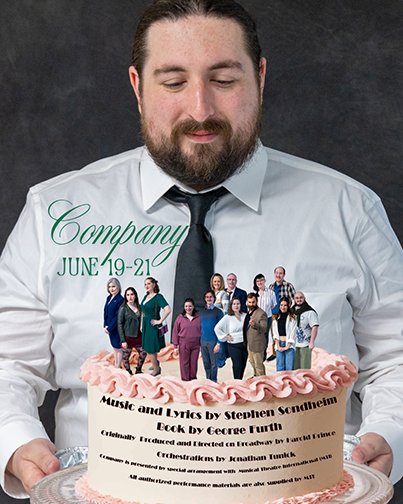
Cue Zero stages Sondheim’s Company
In 1970, Stephen Sondheim and George Furth’s Company seismically shifted the theater world. One of the first concept musicals, it was also groundbreaking for lacking a linear plot, and for being one of Broadway’s first productions to deal candidly with modern relationships, dating, marriage and divorce.
The play follows Bobby, a bachelor turning 35, as he visits the marriages of his closest friends, observing, deflecting, then gradually confronting what he actually wants from life. It won six Tony Awards, including Best Musical and Best Score, while receiving a record 14 nominations.
Company contains several Sondheim classics, including “Ladies Who Lunch,” “Someone Is Waiting” and “Being Alive.” One song in particular is a favorite of Dan Pelletier, founder of Cue Zero Theatre Company. He’s directing a three-show run of the musical opening June 19 in Salem.
“Sorry-Grateful” is a song built on contradiction — the idea that love is both burden and gift, and neither cancels the other out. For Pelletier, it lands differently at 35, both his age and Bobby’s at the surprise birthday party thrown by his friends that opens the show, than it did in his early 20s.
In a recent phone interview he talked about seeing the show in college.
“This doesn’t make sense,” he recalled thinking at the time. “One of my professors told me, ‘This is a show you’ll want to come back to in 10 or 15 years’ … and now, it all makes so much more sense.”
Pelletier is no stranger to Sondheim. This is his third time directing the composer’s work; he’s also helmed productions of Into the Woods and Assassins at Cue Zero. However, Company is probably the most personally resonant for him.
“I got married this past October,” he said. “So, kind of very relevant to me.”
Pelletier takes a minimalist approach to set design for the Cue Zero production, with the stage and its furnishings all black and white.
“This represents Bobby’s perception of relationships and marriage at the beginning of the play,” he said. “Then the characters have a lot more color and nuance to them. It shows what he needs to realize, that it’s not that simple.”
Cue Zero’s three-quarter thrust floor configuration at the Arts Academy of New Hampshire is a key production element. It’s an intimate black-box-style space seating 115, with no audience member more than 20 feet from the performers. Thus, the crowd isn’t just watching the main character’s interior life; they’re part of it.
“We want the audience to be treated as an extension of Bobby’s mind,” Pelletier explained. “So when the actors are saying certain things, they can convince all of the other people in the room of whatever it is they’re trying to get across.” By using them as co-conspirators, he continued, the audience believes it’s helping Bobby come into agreement.
As for whether Bobby’s problem is simple commitment aversion, Pelletier sees something more layered.
“A lot of it has to do with a misunderstanding of what it really means to be in an adult committed relationship,” he said, “and what it means to be open and vulnerable with another human being.”
Matt Brides, who plays Bobby, and Pelletier have worked through the vignettes carefully, treating each not as scenes in chronological order but as the moments that hit Bobby hardest on his inward journey.
“Who he thinks he is and who he actually is,” Pelletier said, “are not perfectly in alignment.”
More than once, Company was tweaked to reflect changing times, first by Sondheim and Furth in the early 2000s. Recent Broadway revivals have swapped Robert for a female character named Bobbie in the lead role. Pelletier also had thoughts about modernizing it, but changed his mind.
“I had this vision of the opening number as a Zoom call, like Bobby trying to FaceTime 13 different people all at the same time,” he said. “But I just don’t think we’ve got the resources and the time to do that. Maybe in another five to 10 years I’ll come back to it. Who knows what social media will look like then?”
Company by Stephen Sondheim & George Furth
When: Friday, June 19, and Saturday, June 20, at 7:30 p.m., and Sunday, June 21, at 2 p.m.
Where: Arts Academy of New Hampshire, 19 Keewaydin Drive, No. 4, Salem
Tickets: $20, cztheatre.com
Featured photo: Company. Courtesy photo.