A sunny mid-20th-century suburb has a dark side, obviously, in Don’t Worry Darling.
Alice (Florence Pugh) and Jack Chambers (Harry Styles) are a blissful-seeming young couple living in a Palm Springs-like desert town full of beautiful mid-century ranches, palm trees and other blissful-seeming couples, including Alice’s neighbor and best friend Bunny (Olivia Wilde, who also directed) and her husband Dean (Nick Kroll), that they regularly hang out with for cocktails and cigarettes. When Alice rushes to greet Jack at the door after his day working for the secretive Victory Project, he is delighted to see her and not just because she has a drink for him in her hand and a steak on the table.
But there is some fraying in the pastel fabric of this company town. What is the Victory Project, the place the husbands leave for in a herd of Cadillacs driving into the desert every morning? Is it top-secret weaponry, as one wife speculates? And why is big boss Frank (Chris Pine) such a creepy cult leader about not just whatever they’re doing out there but the town itself? Alice starts to really consider these questions after her friend Margaret (Kiki Lane) cracks up and loses her young son out in the desert — with Alice’s questioning much to the dismay of Jack, who seems to be on the cusp of big advancement.
Don’t Worry Darling is both better and worse than you probably think it is. You may have heard about this movie’s behind-the-scenes drama (Vulture has a whole roundup if you want to spare yourself the Googling; the Olivia Wilde/Harry Styles stuff, the various actor kerfuffles). All that and the intense coverage of it prepared me for a mess, which this movie isn’t. But, as a fan of Booksmart, Wilde’s first directorial outing, I was also hoping for something with that movie’s charm and cleverness, which this movie doesn’t have. So let go of all your expectations, is I guess what I’m saying.
Pugh does a good job of giving us both the around-the-edges wariness of living in a too-perfect paradise and the increasing anxiety of a person afraid that they’ve been caught in a really dangerous trap but can’t convince anyone else of that. She is highly watchable even when the story doesn’t exactly hold together or seems to be fluffing up the demonstrations of dread because it doesn’t have a lot else to do. It’s clear early on that there’s going to be a “Thing” about this desert oasis. But the movie takes a while to reveal the Thing and then doesn’t do much beyond deliver that (kinda predictable) revelation. Even if you can just go with what’s happening and don’t ask questions about the mechanics (though I couldn’t help but nitpick the mechanics), the delivery of the Thing isn’t sleek enough to smooth out all the bumps, from “wait, what?” plot elements to the performances (Styles doesn’t give much until the movie’s final moments, Wilde feels a notch out of phase with the rest of the movie but Pine seems to be digging into his weirdo character with two spoons). Don’t Worry Darling feels like it’s stalling more than building tension and then hurries through what feels like the important bits, perhaps because it wants us to focus on the message and themes about this woman in a very stylish cage more than some precisely constructed story. I feel like this movie would have been stronger if it could have delivered both. C+
Rated R for sexuality, violent content and language, according to the MPA on filmratings.com. Directed by Olivia Wilde with a screenplay by Katie Silberman, Don’t Worry Darling is two hours and two minutes long and is distributed in theaters by New Line Cinema.
Everybody needs food to survive — this commonality connects all of us as human beings, and is a sentiment at the core of local chef Dawn Hunt’s new book Kitchen Witchcraft for Beginners: Spells, Recipes, and Rituals to Bring Your Practice Into the Kitchen.
Released Sept. 27, the book chronicles various methods of harvesting and cultivating love, connection and relationships through food. It’s the latest project for Hunt, the owner and founder of Cucina Aurora Kitchen Witchery, which offers a line of products like infused olive oils and risotto mixes.
Originally from New York, Hunt grew up in a traditional Italian family where, she said, “food is our religion.” As she has food allergies, Hunt began to look for ways to cook for herself that didn’t compromise flavor. Eventually her cooking spread beyond her own personal table, as she started selling at farmers markets and teaching classes about the principles of cooking with good intentions. This, she said, is what it means to be a self-proclaimed “kitchen witch.”
“For me, it’s about cooking with love, putting positive energy into the food and doing my cooking, my shopping, [using] my resources and purchasing foods intentionally,” she said, adding that it is this focus on intention that is at the core of witchcraft.
During her days of traveling to various farmers markets, Hunt found support in New England.
Kitchen Witchcraft for Beginners is out now.
“My experience was that in New England people really got what I was doing, [and] they understood,” she said.
She found that she was embraced by the people in New Hampshire, a place where she had always wanted to live.
“The way the community … embraced this idea of cooking with love and [being] really intentional with what you’re eating and creating in the kitchen … was really unique for me to find,” Hunt said. “It wasn’t that experience in New York.”
A year after moving to New Hampshire in 2010, Hunt quit her job and decided to work on Cucina Aurora full-time. The company has been in Salem since 2012.
Hunt started working on her new book after being scouted out by the publisher, who was looking for someone to write about the basics of putting love and intention into one’s food. Unlike her previous book, 2020’s A Kitchen Witch’s Guide to Recipes for Love & Romance, which focuses on aphrodisiac food, this book provides more basic knowledge about the ingredients and tools used to make the recipes. It also includes recipes that don’t involve food, something she was challenged to do by the publisher, who asked Hunt if she could come up with blends for everything from teas to cleaning solutions and soaps. In addition, the book contains “seasonally synchronized” recipes.
“I try to stay connected to the rhythm of the seasons by eating and cooking seasonally,” Hunt said. “That’s a big part of what I consider kitchen witchcraft.”
To Hunt, “food is the connective tissue between human beings.” This notion is at the core of Hunt’s company and her book. Hunt said she believes “there is magic in the connectivity of food,” which the recipes and rituals in the book will help readers unlock.
Kitchen Witchcraft for Beginners Kitchen Witchcraft for Beginners: Spells, Recipes, and Rituals to Bring Your Practice Into the Kitchen, by Dawn Hunt Available now wherever books are sold. Visit cucinaaurora.com to order a signed copy.
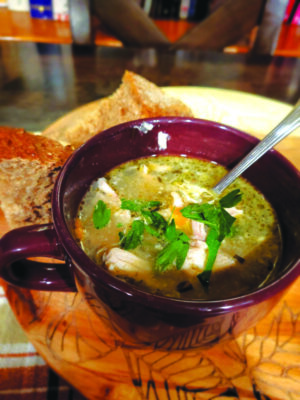
A Kitchen Witch’s cure-all chicken soup Courtesy of Dawn Hunt, as seen in her book Kitchen Witchcraft for Beginners: Spells, Recipes, and Rituals to Bring Your Practice Into the Kitchen (serves 6 to 8)
2 32-ounce cartons chicken broth (organic is preferable) 2 cups cubed cooked chicken 2 Tablespoons olive oil 1 cup chopped celery 1 yellow onion, chopped 1 cup chopped carrots 3 garlic cloves, minced Salt Freshly ground black pepper Rosemary sprigs
In a large (5-quart) sauce pot, warm the oil over medium heat. Add the celery, onion, carrots and garlic. Cook, sauteeing on medium heat until the onions are soft and translucent. Add the chicken broth and the chicken. Bring to a boil. Once boiling, add the salt and the pepper to taste and stir three times, clockwise, to infuse the soup with positive intentions for health and healing. Reduce the heat to a simmer. Add the rosemary on top of the liquid and cover the pot. Let the soup simmer on low heat for at least one hour. Serve hot with noodles or crusty bread for dipping.
Featured photo: Dawn Hunt of Cucina Aurora. Courtesy photo.
Manchester’s Red Arrow Diner serves up 100 years of history
PLUS A peek at other area diners
A full century after David Lamontagne opened a lunch cart at 61 Lowell St. in Manchester, his legacy as the founder and original owner of the Red Arrow Diner continues to live on. A free outdoor community celebration will take place on Saturday, Oct. 15, commemorating the 100th anniversary of the original Red Arrow — the event will feature samples of a variety of the diner’s most iconic dishes for a small fee that will benefit Waypoint New Hampshire, along with raffle prizes, games, music, family-friendly activities and an onsite radio broadcast with DJs Nazzy and Marissa of Frank FM.
All year long, to celebrate its 100th year in business, the Red Arrow has been featuring monthly “Diner Dish of the Decade” promotions at each of its four locations, offering special discounts that have corresponded to various menu items that were or became popular during that time. There has also been an ongoing social media campaign highlighting notable moments in the history of Manchester — and the Granite State as a whole — over the past century.
During the block party-style event, Lowell Street between Kosciuszko and Chestnut streets will be closed to traffic. Diner fare is expected to include everything from the Red Arrow’s original “No. 1” hot hamburg sandwich to other eats of yesteryear, like fig squares and coffee Jell-O. American chop suey, tuna rolls and mashed potatoes with gravy will also all be available for sampling.
“The Lamontagne family is coming,” said Carol Lawrence, president and owner of the Red Arrow Diner since 1987. “The quality and the consistency that the Lamontagnes started way back when [is] what we keep striving for. If it wasn’t for them, we wouldn’t be here. … They are just so happy that it’s still going and still going strong, and I’m very proud of that.”
Throughout the years, the Red Arrow opened and closed multiple locations across the Queen City and other neighboring towns, and has endured everything from devastating fires and wars to, of course, a global pandemic. Here’s a look back on some highlights of the Red Arrow’s rich history that helped shape its now-celebrated status, along with a bonus list of even more southern New Hampshire diners where you can go to satisfy your next comfort food craving.
Humble beginnings
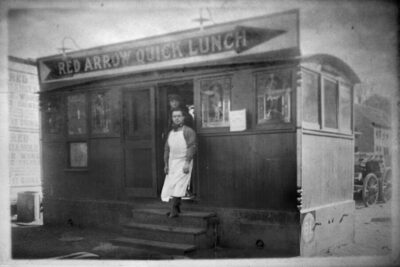
The year was 1922 — the United States was just four years out of World War I, Prohibition was still in effect nationwide and the stock market crash triggering the Great Depression was still seven years away. David Lamontagne — a French-Canadian immigrant who also happened to have a brief three-year run from 1919 to 1921 as a professional boxer — purchased a small shack at 61 Lowell St. and opened it for business on Oct. 9 as a lunch cart. According to a 2020 Yale University research paper the Red Arrow ownership team provided to the Hippo, student Daniel C. Lu writes that this shack would become the foundation for the Red Arrow Diner.
Lu writes that Lamontagne, who came to Manchester to work for the Amoskeag Manufacturing Co. when he was just 12 years old, eventually quit his job and retired as a boxer to work at the shack full-time, becoming the primary caretaker of his family.
“How he got the name Red Arrow, we think, was because at the time there was a Red Arrow Garage next door to the diner,” said Amanda Wihby, co-owner and chief operating officer since 2020. “That’s … as far as we can date back to where the name originated from.”
Lamontagne’s lunch cart proved to be a success, as additional locations would quickly follow. A second lunch cart opened at 39 Lake Ave. in 1925, with a third location arriving at 223 Main St. in Nashua by early 1929 — the latter, Lu writes, was home to the first electronic dishwasher that was installed in the city. A fourth spot, then known as Red Arrow Cafe, soon opened at 1195 Elm St. in Manchester, followed by a fifth restaurant, at 16 W. Merrimack St.
Even back then, the Red Arrow was known for being “always open” and “never closed,” an old advertisement dated March 30, 1929, boasts. An old menu from the 1195 Elm St. location that is now framed at the Red Arrow’s corporate office likely dates back to the 1930s, Lawrence said.
Lu writes that, in its very early years, the Red Arrow was best known for its basic American comfort food with a French-Canadian flair. Most of the sandwiches ranged from 10 to 40 cents a la carte, while the higher-end cost for some of the full-service meals — take, for instance, an “evening special” of grilled filet mignon with a fresh mushroom sauce, complete with sides, a vegetable salad and one’s choice of a drink and a dessert — was $1.25.
“It has always been a pretty big menu, but definitely not as big as it is now,” Lawrence said.
An early photo of the Red Arrow Diner on Lowell Street in Manchester, which originally opened on Oct. 9, 1922, as a lunch cart. Courtesy photo.
On Nov. 27, 1941, the first of two fires struck the Elm Street restaurant. Lu writes that Lamontagne ended up rebuilding it as a cafeteria, just in time for the United States’ entry into World War II. But a second three-alarm fire on Feb. 15, 1946 — dubbed the “city’s worst accident,” according to the City of Manchester’s website — ultimately destroyed that location.
Instead of rebuilding a second time, Lamontagne decided to open Red Arrow Bakery, which operated at 126 Amory St. on the West Side from 1953 to 1958. Also in the 1950s, Lamontagne was even known to establish and briefly operate his own milk distribution business.
According to a Manchester Union Leader newspaper clipping dated Oct. 2, 1963, Lamontagne sold his successful restaurant chain to University of New Hampshire graduate Kennard H. Lang — just three Red Arrow locations were still open by then, including the one in the original spot at 61 Lowell St. The sale ushered in a new era for the Red Arrow, which would change ownership three more times over the following two decades leading up to Lawrence’s tenure.
Levi’s Red Arrow
Just as David Lamontagne is cemented in Red Arrow Diner history, so is Levi Letendre, who worked at the restaurant for decades before eventually becoming the third overall owner.
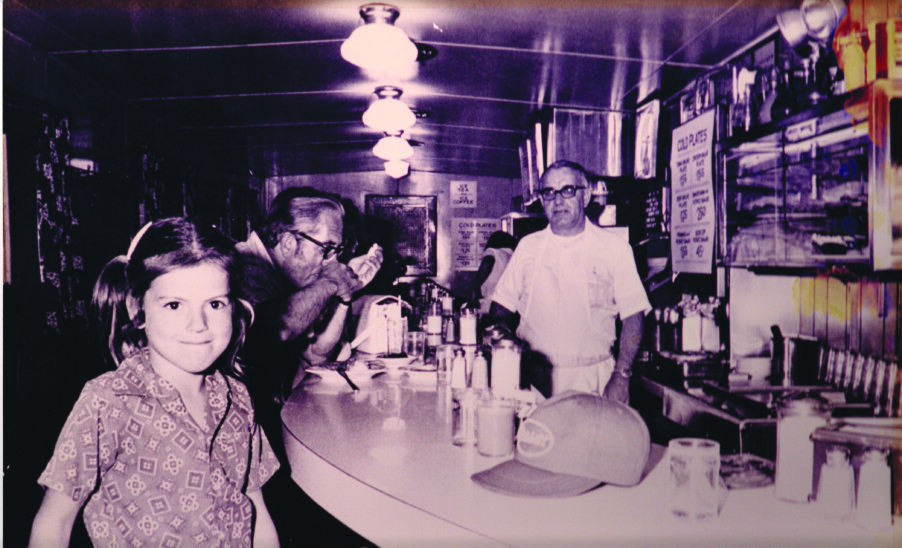
At the very end of 1969, following extensive renovation of the 61 Lowell St. space, Letendre and his son, Mark, purchased and re-opened the restaurant as Levi’s Red Arrow, a newspaper clipping from December of that year shows.
Letendre, who was very well-known and connected across the Queen City, was also a longtime familiar face at the Red Arrow. He originally started working there as a cook in 1945, just after the end of the second World War. He then became a counter man at the diner for many years leading up to his ownership status. By 1978, not long after opening the short-lived Red Arrow Restaurant at 197 Wilson St. in Manchester, Letendre retired, but his son Mark would carry on the diner’s tradition as owner for a few more years. After his father’s death in February 1985, Mark decided to sell — Manchester city directory records and newspaper clippings show that Borrome “Bob” Paquet and Didi Harvey became the Red Arrow’s new owners that year.
But this next span of ownership — the fourth overall, and just the third change of hands for the diner in more than six decades up until that point — would prove to be by far the shortest. Even a Union Leaderstory dated Oct. 6, 1986, ran with the ominous headline “Is the Red Arrow Diner history?” after the establishment was allegedly “closed for renovations” for nearly two months. The fifth — and current — leadership team that was established that following year would later prove that, in many ways, the Red Arrow’s lasting legacy was still only just beginning.
National status
Carol Lawrence was just 23 years old when she bought the Red Arrow Diner in September 1987. Growing up in the restaurant business, Lawrence got her start in the industry as a teenager working at Belmont Hall on Grove Street, at the time owned by her father, George.
“I wish that I would’ve known more about the Red Arrow. … We even lived way up on the top of Lowell Street, but I never, ever went in there,” she said. “But then, when I was working there, I realized pretty early on how special the Red Arrow was.”
Lawrence recalls primarily working in the kitchen when she first took over. In her earliest days, the Red Arrow wasn’t yet back to being open 24 hours a day, either.
“We only opened until 2 [p.m.]. I’d get there at 5 in the morning,” she said. “On the specials board, we would put up these crazy things. Like, we had the hash brown special, which is something we just kind of made up and now it’s a staple on the menu. … Anything on the specials board would sell, and I was just amazed by that. That was how our menu got bigger.”
A pivotal point in Lawrence’s career — and consequently in the overall history of the Red Arrow — came in May 1998 when she decided she was going to go “smoke-free,” an action virtually unheard of in New Hampshire restaurants at the time. Lawrence recalls that everyone, even her own father, a local restaurateur in his own right, thought she was crazy for doing so.
“The smoke in there was horrible,” she said. “We had put in two smoke eaters: one where you first walk in the door right up on the ceiling, and then one toward the back. And I mean, it was yellow in there. I would question certain times taking my own kids in there because the smoke was so bad, and I’m not even a smoker. I never have been.”
Her decision to go smokeless stemmed from a 1998 visit from Randy Garbin, writer for Roadside Online and dubbed by Lawrence as a “diner guru.”
“I kind of idolized Randy Garbin … and next thing you know, I get an email from him saying that he visited the diner. He says, ‘I loved the atmosphere, I loved the staff, the food was great … but I will tell you I’ll never be back.’” Lawrence said. “And I go, ‘Well, what the heck does that mean?’ And he said, ‘Because the smoke was just too bad.’ And, he was kind of promoting smoke-free diners, and then he started sharing statistics with me, we talked a lot and I just thought that all of this totally made sense.”
The move turned out to be the right one — but not without immediate repercussions.
“People were so mad, like, it wasn’t even funny,” she said. “I had threats … [and] people were picketing in the early hours out front. So many people swore that they would never come back. It was ridiculous. … But the funny thing was that we started to notice an increase in sales. After a year, I think it was like 19 or 20 percent.”
By September of that year, USA Today, referencing the Red Arrow’s recent switch to going smokeless, named it one of “Top Ten Diners in the Country,” marking one of the first times it was propelled to national prominence. Two years later, in 2000, it was officially named a Manchester city landmark.
As for the Red Arrow’s reputation as a must-visit for political candidates on the campaign trail, Lawrence said that also came into its own during her tenure. This has always been in part due to New Hampshire’s first-in-the-nation primary status, but Lawrence estimates it especially took off around the time of the Merrimack Restaurant’s closure in 2008.
“[The Merrimack Restaurant] was right on the corner of Merrimack and Elm streets,” she said. “All of the political people were going there … and then when they closed, they just started coming to the Red Arrow, and they’ve been coming ever since.”
Today, patrons at the 61 Lowell St. Red Arrow have included everyone from Presidents Obama, Trump and Biden to various celebrities with local ties, including Sarah Silverman, Seth Meyers and, of course, Adam Sandler, who used to frequent the diner with his dad.
The tradition continues
By the mid-2000s, George Lawrence retired as owner of Belmont Hall, selling it to his daughter — and Carol’s sister — Cathy, and dividing his time between New Hampshire and Florida.
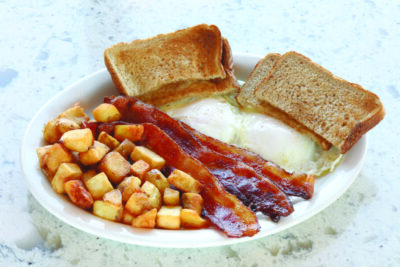
The Red Arrow Diner’s “Stan the Man’s favorite,” featuring two eggs with bacon, toast and pan fries, is named after Adam Sandler’s father. (On page 14: the Red Arrow’s famous “Mug O’ Bacon”). Courtesy photos.
“He says, ‘I’m sick and tired of riding a golf cart down in Florida. Let’s open another Red Arrow,’” Carol Lawrence said, “and that was how we bought Milford.”
On the Milford Oval, the Red Arrow operated from October 2008 to its closure in late 2019. A third location would open in February 2015 in Londonderry — Wihby noted that’s where all of the diner’s scratch-made desserts are now prepared — followed by a fourth, in Concord, in the summer of 2017. In early May 2020, at the height of the Covid-19 pandemic, the Red Arrow opened its largest spot in Nashua in the site of a former Friendly’s restaurant. Taking advantage of the onsite drive-thru window, this location started operating on a takeout-only model. Even today, all four Red Arrow Diners continue to utilize online ordering, a revenue stream Lawrence never thought they would have or benefit from.
One hundred years strong, the original site of the Red Arrow Diner at 61 Lowell St. may have undergone numerous changes, but Lawrence said there’s one important factor that has remained the same. It has not only kept the Red Arrow alive and kicking, but remains a staple for diners both across New Hampshire and the United States.
“Anywhere you go, the diner is the focal point of the community,” she said. “You get all walks of life that come in. You can sit there and be next to a city worker or a lawyer, and then there’s a doctor over there. … You just get to talk to such a variety of people.”
Mya Blanchard contributed to this story.
More nostalgic eats at NH’s diners
In addition to the iconic Red Arrow Diner, New Hampshire offers diner fans several places to stop for a cup of coffee and a classic meal. Here are some of the diners across southern New Hampshire, focusing on the establishments with the word “diner” in their name. Do you know of a diner in the Manchester, Nashua or Concord areas that isn’t on this list? Let us know at food@hippopress.com.
Airport Diner 2280 Brown Ave., Manchester, 623-5040, thecman.com/airport-diner Hours: Daily, 6 a.m. to 10 p.m. Established in 2005, the Airport Diner gets its name for its close proximity to Manchester-Boston Regional Airport. It’s one of several eateries owned by The Common Man Family. Specialty of The House: The Airport Diner’s acclaimed tuna melt features Albacore tuna, tomatoes and Swiss cheese all on grilled Parmesan bread. Most Decadent Dessert: Try the diner’s house peanut butter pie, featuring a graham cracker crust, creamy peanut butter, hot fudge and whipped cream.
Allenstown Country Diner 85 Allenstown Road, Suncook, 210-2191, find them on Facebook @allenstowncountrydiner Hours: Monday, and Wednesday through Friday, 6 a.m. to 2 p.m.; Saturday, 6 a.m. to 1 p.m., and Sunday 7 a.m. to 1 p.m. Theresa Gelinas opened the Allenstown Country Diner in May 2015 with the help of several friends, her two daughters Sonya and Kristy and her son-in-law Josh. The diner is currently open six days a week for breakfast and lunch, featuring a menu of omelets, waffles, pancakes and French toast, plus drinks like pineapple orange or cranberry orange mimosas, and several flavors of house bloody marys. Specialty of The House: House specials include the steak and eggs, featuring 10-ounce grilled sirloin steak with two eggs and toast; and the country breakfast, featuring two eggs and sausage on a buttermilk biscuit, topped with house sausage gravy.
Casey’s Diner 13 Plaistow Road, Plaistow, 382-3663, caseysdinernh.com Hours: Monday through Saturday, 5:45 a.m. to 1:30 p.m., and Sunday, 5:45 a.m. to 1 p.m. Casey’s Diner has been in business for more than two decades, serving home-cooked breakfasts and lunches seven days a week, along with daily specials. Specialty of The House: Try the changeup scrambler, featuring three eggs scrambled with your choice of an omelet filling, melted cheese, toast and your choice of home fries, baked beans, hash browns or fruit.
Charlie’s Homestyle Diner 598 Daniel Webster Hwy., Merrimack, 262-5693, charlieshomestylediner.com Hours: Monday through Wednesday, 6 a.m. to 2 p.m.; Thursday through Saturday, 6 a.m. to 8 p.m., and Sunday, 7 a.m. to 2 p.m. Known for its home-cooked breakfasts and lunches, Charlie’s Homestyle Diner also offers customized catering. On Fridays they’ll serve fresh haddock, while on Sundays they’ll serve breakfast only. Specialty of The House: Try their poutine, made with hand-cut french fries, Canadian curd cheese and brown gravy on top. Most Decadent Dessert: Charlie’s Homestyle Diner serves a baklava sundae, featuring their own homemade baklava with vanilla ice cream and chocolate sauce.
The Derry Diner 29 Crystal Ave., Derry, 434-6499, find them on Facebook @thederrydiner Hours: Monday, Tuesday, Friday and Saturday, 6 a.m. to 2 p.m., and Sunday, 6 a.m. to 1 p.m. Breakfast and lunch are served five days a week at this neighborhood diner in Derry. Specialty of The House: Comfort meal specials are served from 11 a.m. to 2 p.m. — recent options have included open-faced meatloaf sandwiches, hot veggie and cheese wraps with fries, and chicken Parm with garlic toast and a cup of soup. Most Decadent Dessert: Homestyle pumpkin pie has been a recent featured dessert.
The D.W. Diner 416 Daniel Webster Hwy., Merrimack, 424-1116, thedwdinertogo.com Hours: Daily, 6 a.m. to 1:30 p.m. This Merrimack diner is known for serving up home-cooked breakfasts and lunches seven days a week. Specialty of The House: Diner favorites include the hash and eggs, served with toast; the biscuits and sausage gravy, served with home fries, hash browns and homemade baked beans; and a specialty quiche of the day. Most Decadent Dessert: Try the Belgian waffle sundae, topped with whipped cream and your choice of strawberry or chocolate sauce.
Frankie’s Diner 63 Union Square, Milford, 554-1359, find them on Facebook @frankiesdinermilford Hours: Wednesday through Friday, 11 a.m. to 9 p.m.; Saturday, 9 a.m. to 9 p.m., and Sunday, 9 a.m. to 3 p.m. This Union Square diner is named in tribute to the late Frankie Bobola, a lifelong restaurateur who got his start in the industry in 1962 and whose career spanned decades before his death in 2018. His family also continues to run Bobola’s Family Restaurant, which has locations in Nashua and Dracut, Mass., as well as Stonecutters Pub, also in Milford. Specialty of The House: House favorites at Frankie’s Diner include the roasted stuffed turkey dinners, the shepherd’s pie and the marinated steak tips.
Hanna’s Diner 83 Henniker St., Hillsborough, 464-3575, find them on Facebook @hannasdinernh Hours: Monday, 6 a.m. to noon, Wednesday through Saturday, 6 a.m. to 1 p.m., and Sunday, 7 a.m. to 1 p.m. Formerly known as the Hillsborough Diner, Hanna’s is a classic spot known in town for serving freshly home-cooked breakfasts and lunches. Specialty of The House: Try the Hillbilly, featuring two biscuits topped with Hanna’s sausage gravy, two patties, two hash browns, two eggs and cheese. Most Decadent Dessert: A special pie of the day is always available, served with whipped cream.
Joey’s Diner 1 Craftsman Lane, Amherst, 577-8955, joeysdiner.com Hours: Sunday through Thursday, 7 a.m. to 3 p.m., and Friday and Saturday, 7 a.m. to 8 p.m. Joey’s Diner serves breakfast all day as well as lunch and dinner options in a retro, 1950s setting. Specialty of The House: Sticking with the 1950s theme, on the menu is the “Elvis Presley Breakfast,” featuring two eggs made any style with corned beef hash, home fries, toast and your choice of bacon, ham or sausage. Most Decadent Dessert: Among their variety of desserts are xangos, or fried cheesecake chimichangas.
Margie’s Dream Diner 172 Hayward St., Manchester, 627-7777, margiesdreamdiner.com Hours: Monday through Friday, 6 a.m. to 2 p.m.; Saturday, 6 a.m. to 1 p.m., and Sunday, 7 a.m. to 1 p.m. Calling itself “Manchester’s Best Kept Secret,” Margie’s Dream Diner is a great place to stop for breakfast or lunch and to enjoy Greek specialties. Specialty of The House: At Margie’s Dream Diner you’re sure to find something you like. Their wide array of omelets and eggs Benedicts include the Southern Benedict, featuring poached eggs on freshly baked golden biscuits topped with a homemade sausage gravy.
Market Place Diner 4 Market Place, Hollis, 465-3209, marketplacediner.com Hours: Daily, 6 a.m. to 2 p.m. Located in the village of Market Place in Hollis, this family-friendly diner serves up home-cooked breakfasts and lunches seven days a week. Specialty of The House: Recent fall specials have included pumpkin nut pancakes and caramel apple waffles. Other menu specialties include omelets, pancakes, French toast, crepes, burgers and sandwiches.
MaryAnn’s Diner 29 E. Broadway, Derry, 434-5785; 4 Cobbetts Pond Road, Windham, 965-3066; 3 Veterans Memorial Parkway, Salem, 893-9877; maryannsdiner.com Hours: Derry’s location is open Monday through Saturday, 6 a.m. to 2 p.m., and Sunday, 7 a.m. to 2 p.m. Windham’s location is open daily, 7 a.m. to 2 p.m. Salem’s location is open Monday through Wednesday, 6 a.m. to 3 p.m.; Thursday, 7 a.m. to 3 p.m.; Friday, 6 a.m. to 8 p.m.; Saturday, 7 a.m. to 8 p.m., and Sunday, 7 a.m. to 2 p.m., according to the website. Originally opened in Derry in 1989, MaryAnn’s Diner now has two additional locations in Windham and Salem — all three are known for their home-cooked meals in a cozy, nostalgic setting. Specialty of The House: MaryAnn’s Diner’s top hits include their marinated black raspberry barbecue steak tips, served with two eggs, toast and home fries. Most Decadent Dessert: The dessert menu includes grapenut custard, a slightly sweetened egg custard laced with nutmeg and cinnamon with Grape Nuts cereal.
Moe Joe’s Country Diner 649 E. Industrial Park Drive, Manchester, 641-2993, eatatmoejoe.com Hours: Monday through Friday, 6 a.m. to 2 p.m.; Saturday, 6 a.m. to 1 p.m., and Sunday 7 a.m. to 1 p.m. Diner favorites at Moe Joe’s include a meatloaf dinner and macaroni and cheese, with garlic bread and your choice of Buffalo chicken, diced ham or chourico (Portuguese pork sausage). Specialty of The House: Moe Joe’s offers a Portuguese burger that’s topped with linguica, onions and peppers, all on a Portuguese muffin. Most Decadent Dessert: Sweet items include frappes in a variety of flavors, including vanilla, chocolate, strawberry, coffee or mocha.
Murphy’s Diner 516 Elm St., Manchester, 792-4004, find them on Facebook @murphysdinernh Hours: The diner is currently open Friday through Sunday, 7 a.m. to 1 p.m. Founded by local restaurateur Keith Murphy of Murphy’s Taproom, this diner is directly adjacent to the eatery’s Manchester location on Elm Street. A sister establishment, known as Murphy’s Taproom & Carriage House, opened in Bedford in 2017. Specialty of The House: Try the Captain Crunch French toast, the signature French toast dish at Murphy’s Diner that’s rolled in Captain Crunch cereal and topped with powdered sugar.
Northwood Diner 1335 First New Hampshire Turnpike, Northwood, 942-5018, find them on Facebook @northwooddinernh Hours: Monday through Saturday, 5 a.m. to 2 p.m., and Sunday, 5 a.m. to noon Breakfast is served all day at the Northwood Diner, with a menu that includes Benedicts, waffles, eggs, pancakes and more. Specialty of The House: Try the steak and eggs, featuring six ounces of freshly cut Delmonico steak cooked to order, with home fries, toast and two eggs cooked any style. Most Decadent Dessert: Pies, cakes and assorted pastries are baked fresh daily, with a rotating offering of selections.
Ober Easy Diner 416 Emerson Ave., Hampstead, 329-3430, obereasy.com Hours: Monday through Friday, 7 a.m. to 2 p.m.; Saturday, 6 a.m. to 2 p.m., and Sunday, 6 a.m. to 1 p.m. (breakfast only on Sundays) Formerly known as Christina’s Country Cafe, this eatery assumed new ownership in January 2019 and was later renamed Ober Easy Diner after owners Susan and Tim Ober. Breakfast is served all day, including exclusively on Sundays, with a menu featuring Benedicts, omelets, sandwiches and more. For lunch, there are salads, sandwiches, burgers and soups. Specialty of The House: Try the Western scrambler, featuring two eggs scrambled with peppers, onions, ham and cheddar cheese, served with toast on the side. Most Decadent Dessert: Try the Belgian waffle banana split, featuring a house Belgian waffle topped with one scoop of vanilla ice cream, bananas, strawberries, chocolate syrup and whipped cream.
Poor Boy’s Diner 136 Rockingham Road, Londonderry, 432-8990, poorboysdiner.com Hours: Monday through Saturday, 7 a.m. to 8 p.m., and Sunday, 7 a.m. to 3 p.m. Stop in to Poor Boy’s Diner for a home-cooked breakfast, lunch, or dinner in a welcoming environment. Specialty of The House: Grilled pork chops with applesauce on the side are among the menu staples. Most Decadent Dessert: Dessert specials vary at Poor Boy’s Diner, the most recent being a sweet pumpkin pie just in time for fall.
The Red Arrow Diner 61 Lowell St., Manchester, 626-1118; 137 Rockingham Road, Londonderry, 552-3091; 112 Loudon Road, Concord, 415-0444; 149 Daniel Webster Hwy., Nashua, 204-5088; redarrowdiner.com Hours: According to its website, the Manchester location is open 24 hours a day, seven days a week. The Londonderry and Nashua locations are open daily, 5:30 a.m. to 10 p.m. The Concord location is open Sunday, Tuesday, Wednesday and Thursday, 5:30 a.m. to 10 p.m., and Friday and Saturday, 5:30 a.m. to midnight (temporarily closed on Mondays). Established in Manchester in October 1922, The Red Arrow Diner is now an institution that reaches visitors far beyond the Granite State. For decades, it’s been known as a popular campaign stop for presidential candidates and other politicians. In 2000 it was named a city landmark. Specialty of The House: The Red Arrow is known for its weekly Blue Plate specials, featuring home-cooked items like pork pie, lasagna, meat loaf, haddock and more. Most Decadent Dessert: Freshly baked desserts are available all day long. Options include whoopie pies, cheesecakes, fruit pies, double layer cakes and Dinah fingers (think Twinkies).
The Red Barn Diner 113 Elm St., Manchester, 623-9065, redbarndinernh.com Hours: Daily, 5 a.m. to 3 p.m., according to its website. The Red Barn is a small nostalgic diner in an old train car, serving items like Angus beef, handcrafted original burgers and handcrafted desserts since 1930. Specialty of The House: One of their original burgers is the Barn Burger, a cheeseburger topped with bacon, lettuce, tomato, grilled onions and the diner’s special Red Barn sauce. Most Decadent Dessert: The Red Barn has all kinds of decadent homemade desserts, ranging from chewy brownie sundaes to fluffy strawberry shortcake.
Route 104 Diner 752 Route 104, New Hampton, 744-0120, thecman.com/route-104-diner Hours: Sunday through Thursday, 7 a.m. to 8 p.m., and Friday and Saturday, 7 a.m. to 9 p.m. Like its sister establishments, the Airport Diner and the Tilt’n Diner, the Route 104 Diner is owned by The Common Man Family, serving traditional home-cooked meals in a nostalgic 1950s-style setting. Specialty of The House: Homestyle classics include the fried chicken and waffles, featuring a house-made Belgian waffle that’s topped with golden-fried, hand-breaded chicken tenders and served with your choice of New Hampshire maple syrup or white country gravy. Most Decadent Dessert: Sweeter indulgences include cakes, pies, grapenut custard, bread pudding and The Common Man’s own ice cream available in five flavors.
Stubby’s Diner 26 Old Manchester Road, Candia, 483-5581, find them on Facebook Hours: Monday through Saturday, 6 a.m. to 1 p.m. Breakfast is served all day at Stubby’s, with a menu that includes Benedicts, omelets, sandwiches and more. For lunch, there are several burgers, sandwiches, soups and sides to choose from. Specialty of The House: Try the Humongous Trashcan, a ham and cheese omelet with onions, peppers, chili, mushrooms and tomatoes. It’s served with toast, home fries or beans.
Suzie’s Diner 76 Lowell Road, Hudson, 883-2741, suziesdiner.com Hours: Monday through Sunday, 5:30 a.m. to 2 p.m. Suzie’s Diner, established in 1999, serves breakfast every day of the week, in addition to lunch starting at 11 a.m. Specialty of The House: Each weekday, Suzie’s features a different lunch special, like fried clam strips, roast beef, steak quesadillas, meatloaf and jumbo shrimp scampi. Most Decadent Dessert: Sweeter indulgences include an Oreo-filled waffle, topped with whipped cream, Oreo cookies and an Eclair ice cream bar.
Temple Street Diner 200 Temple St., Nashua, 521-7133, find them on Facebook Hours: Daily, 6 a.m. to 3 p.m., according to its Facebook page Temple Street Diner is known for serving breakfast and lunch seven days a week. A sister food truck known as The Roadside Diner is operating on Fridays and Saturdays, from 3:30 to 8 p.m., throughout October. Specialty of The House: Favorites include lobster rolls, fried seafoods, chowders and other homemade specials.
Tilt’n Diner 61 Laconia Road, Tilton, 286-2204, thecman.com/tilt-n-diner Hours: Daily, 6 a.m. to 9 p.m. Tilt’n Diner, which opened in 1992, is one of three nostalgic diner establishments owned and operated by The Common Man Family. It has been called a “must stop” on the New Hampshire presidential primary campaign trail by The Associated Press, according to its website, and is also a popular stop for visitors of the annual Laconia Motorcycle Week or the next NASCAR race at New Hampshire Motor Speedway in Loudon. Specialty of The House: The diner offers several classic comfort food favorites, like baked shepherd’s pie, meatloaf, frappes and house-made pies. Most Decadent Dessert: Try the classic bread pudding, which features a maple syrup glaze, or the chocolate, peanut butter or coconut cream pies.
Featured photo: Levi Letendre (right) owned the diner during the 1970s, then known as Levi’s Red Arrow. Photo by Patrick “P.J.” Audley, likely taken around 1976 (with added color on the cover).
The New Hampshire Attorney General’s office issued a cease-and-desist order against the New Hampshire Democratic Party on Sept. 23 in regard to a case of “voter confusion” caused by absentee ballot application mailers for the November 2022 general election that the Party published and mailed that contained erroneous information. According to the order, the mailers, which affected 926 voters in 39 communities, had postage pre-paid, pre-addressed return envelopes with wrong return addresses for the appropriate town and city clerks. Voters also reported receiving mailers with return envelopes addressed to “[County Name] Board of Elections,” entities which do not exist; mailers that said, “You have a history of requesting absentee ballots” when the voter had not voted by absentee ballot in the past; and mailers that listed the voter’s domicile address as being in a city or town in which the voter does not reside. “The NHDP’s mailer … is causing voter confusion and frustration,” New Hampshire Attorney General John Formella said in the order. “The [incorrect] return mail addresses on the mailer are likely to mislead voters into unintentionally violating [the absentee ballot application procedure]. It could also disenfranchise some voters in that voters may complete the absentee ballot applications, believing they will receive absentee ballots for the State General Election, only to discover that their applications were never delivered to their Town or City Clerks. This discovery could be made at a time when the voters are not able to file follow-up applications for absentee ballots.” The order closed with remediation steps that the NHDP is required to take, including contacting each recipient of the mailers and personally assisting them with the absentee ballot application process to ensure that it’s done correctly so that they will be able to obtain an absentee ballot in time for it to count as a valid vote in the upcoming General Election.
Federal funds to fight opioid epidemic
State Opioid Response grants in the total amount of $28,507,046 for fiscal year 2022 are being made available to the State of New Hampshire to fund resources and efforts addressing the substance use disorder crisis in the state. According to a press release, the federal funding was approved through legislation bolstered by U.S. Sen. Jeanne Shaheen, a senior appropriator on the Labor-Health and Human Services Appropriations Subcommittee, and U.S. Sen. Maggie Hassan, a member of the Health, Education, Labor, and Pensions Committee, and is nearly $400,000 more than the annual opioid response funding New Hampshire received last year. “We need to continue an all-hands-on deck approach to combating the opioid epidemic, and I will stay laser focused on getting New Hampshire communities and law enforcement the tools that they need to combat this crisis,” Hassan said in the release.
Making monkeypox vaccines accessible
The New Hampshire Department of Health and Human Services has updated and expanded the eligibility criteria to receive the two-dose monkeypox vaccine series known as JYNNEOS. According to a press release, people for whom the vaccine is recommended include “any person who identifies as gay, bisexual, queer, or is a man who has sex with men and believes they are at risk for monkeypox virus infection; a person of any gender or sexual orientation whom a medical provider thinks is at increased risk for monekypox virus infection; [and] persons who report in the prior 14 days a known exposure to the monkeypox virus.” “JYNNEOS vaccine uptake has been low in NH, and with increasing supply we want to make it as easy as possible for people who may be at risk to get vaccinated to protect themselves from infection,” New Hampshire State Epidemiologist Dr. Benjamin Chan said in the release. The vaccine is currently being distributed through city health departments and participating provider clinics throughout the state. If you believe you are eligible to receive the vaccine, contact your primary health care provider for a referral to a participating clinic. If you do not have a primary health care provider from whom you can get a referral, you can still receive the vaccine at a participating New Hampshire Convenient MD location as long as you live, work or have a primary health care provider in the state. Anyone who is experiencing symptoms or has been exposed or possibly exposed to the virus should isolate at home and consult their health care provider. Visit dhhs.nh.gov/programs-services/disease-prevention/infectious-disease-control/monkeypox for monkeypox vaccination locations and the latest updates on the monkeypox outbreak in New Hampshire.
New NH Liquor & Wine Outlets
Two new NH Liquor & Wine Outlets are now open, at 850 Gold St. in Manchester and in the Concord Crossing Plaza at 11 Merchants Way in Concord. According to a press release from the NH Liquor Commission, the Outlets feature more than 4,000 sizes and varieties of wines and spirits and have special sections showcasing premium and ultra-premium spirits, high-end wines and Outlet Price Busters and Wine Power Buys. The buildings include high-efficiency materials and LED fixtures, oversized aisles and enhanced accessibility for curbside pickup service. The NH Liquor Commission also announced that construction has begun on a new NH Liquor & Wine Outlet in the Westside Plaza in Nashua, to which the existing Outlet on Northwest Boulevard in Nashua will relocate. It is expected to open in May 2023. “These new Outlet locations represent the latest step in our ongoing effort to enhance the customer shopping experience, strengthen our brand, and continue to generate critical revenue for the New Hampshire General Fund,” NHLC Chairman Joseph Mollica said in the release.
The New Hampshire Department of Natural & Cultural Resources, along with state and local dignitaries, local community members and project partners, gathered atop Pack Monadnock in Peterborough on Sept. 23 to celebrate the revitalization of Miller State Park. According to a press release, the Miller State Park Revitalization Project included upgrades such as improving views, improving parking, painting buildings, removing old conduit and restructuring the poles and wires that run up to the summit and across the access road. The celebration included a ribbon cutting, comments from project partners and dignitaries and the unveiling of a new historical highway marker commemorating Miller State Park as “New Hampshire’s First State Park.”
The Nashua School District has become the first New Hampshire school district, and one of only four school districts in New England, to be accepted as a member of the League of Innovative Schools. According to a press release, the national network was created by Digital Promise, an organization devoted to accelerating innovation in education, and currently includes 150 schools across 38 states. “Being a member of the league offers us access to a network of similar, forward-thinking schools to share best practices in teaching and learning,” Mario Andrade, Superintendent of the Nashua School District, said in the release.
Road work to resurface Route 101 resumed this week in Milford and Amherst, according to a press release from the New Hampshire Department of Transportation. The work, which is estimated to take one week to complete if the weather permits, is concentrated at all on and off ramps at Route 13, Route 101A and Route 122. Daytime lane shifts are being used between 9 a.m. and 3:30 p.m. to accommodate the placement of ramp traffic markings.
Over lunch a few years ago, a friend asked me a simple, but very direct question: “Steve: when you think of the Holocaust, what image comes to mind?” It caught me off guard as we had been talking about politics prior to the upcoming election. I paused, thought for a moment — my mind flashing through a series of recalled images — and replied: “The picture of an emancipated Elie Wiesel, in a prison suit, standing in a bunk room with similarly starved inmates. The other is the open pits with thousands of bones uncovered in the course of liberating the Nazi concentration camps.”
“Yes,” he said, but a fuller picture — an important additional facet — is an image of the German neighbors who peered from behind their lace curtains, watching, as the Gestapo dragged away their Jewish neighbors. Their silence, their inaction, to what was being done, while understandable given their concern for their own safety, over time, had allowed a totalitarian regime to take such measures without opposition.
That lunch conversation and its insights have stayed with me, deeply impressing on my conscience.
This month marks the appearance of Ken Burns’ new documentary, The Holocaust. While some of Ken’s films give us reason to celebrate the beauty, places and people of our country, this has a very different intention and impact. It is a historical documentary but also a cautionary tale.
A cautionary tale sets out a story, the roots of an event, the impact of an event, and the lessons to be drawn from it. It invites — nay, challenges us — to look around at our present situation and ask, “Could that happen here?” His film does and the answer is “yes.” But with a qualifier: “It is happening now.”
Institutions and movements have arisen since the Holocaust to amplify and instruct regarding the horrors and the lessons of that tragic time, but despite those, bigotry, racism, intolerance, extreme nationalism and supremacy have mushroomed in countries around the world. “Ethnic cleansing” — the term itself proclaiming that only one “pure race” can/should inhabit a country, has set tribalism against multiculturalism. “Difference” has become the criterion of choice, its impact felt in the political ads that blanket our state now in the days leading up to the midterm elections and likely to follow into the voting booths as well.
But we are a country of indigenous people and immigrants. Of the latter, no matter how long we have lived here, we came from someplace else, and we have made our way and enriched this country, this noble experiment in multicultural democracy. To honor our forebears and their epic journey — regardless of race, religion or culture — we must not wait till we can look out our windows to see what is happening. The time to resist is now. Otherwise, the option is complicity. And by now we should know where that can lead.
Paula Poundstone can find something to talk about with just about any audience, anywhere; her act has a handful of jokes and a whole lot of back and forth. The reason for this becomes clear during a 20-minute interview, as the comedian easily moves from topic to topic like a Beetle at a car rally.
She begins with a quick disquisition on her Sisyphean cat litter box duties (“I’m usually sifting”). Next up is her newly found passion for hydroponic gardening, and what it says about her at a certain age. “I eat collard greens, and I’ve been diagnosed with bursitis,” she said. “I’ve become Granny from The Beverly Hillbillies.”
Poundstone lives in Santa Monica “for no good reason” and the recent California heat wave seems to have made her PA a bit mouthy, which prompts her to proclaim, “it’s assistant-firing season.” This boss/underling dynamic’s similarity to the plot of Hacks somehow leads to a discussion about why she’s not ready for binge watching in television’s new golden age.
It’s partly technology, and the rest would definitely take longer than a phone call to enumerate.
“Streaming? That’s stuff they say on Lost in Space; I don’t know how to do any of that, and I’m glad,” she said. “I have 10 cats, two big dogs, and a couple of jobs. How would I ever get anything done with something compelling me to sit down and watch it all the time?”
It’s not hypothetical. When Poundstone was starting out in comedy, she spent a lot of time on buses, rolling from town to town, finding her voice at open mics. It was the late 1970s, and an addiction to M*A*S*H reruns threatened to bankrupt her every time the Greyhound had a layover.
“Back then, bus stations had these little chairs with coin-operated televisions attached to them. I didn’t even have enough money for food, but I’d put my quarters in so I could watch M*A*S*H.” She quit when she realized it was also emotionally draining; a gut punch episode would leave her so bereft she could barely work.
So she missed Seinfeld, avoided Downton Abbey and skipped This Is Us. One exception is Breaking Bad, which she has on DVD. “I’ve watched it probably the whole way through maybe 50 times. So I don’t transition well.” She did watch The Mentalist, but as for the rest? “People look at me like I have two heads, but it’s just too much for me…. I really try to limit my engagement, because I get too upset.”
In her 2017 book, The Totally Unscientific Study of the Search for Human Happiness, Poundstone used a made-up metric of “heps and balous” to rate experiences that varied from driving a rented Lamborghini to getting tidy and taking dancing lessons. Asked about her current supply of the units — a bunch of heps adds up to one balou — she admitted she hadn’t been counting lately.
“Like many of us, I feel like I’m just putting one foot in front of the other these days,” she said. “But this last year, I’ve been able to work steadily, and I’ll tell you that really lifts your spirits, being with audiences. I tell my little jokes and … people come up to me and say, ‘Oh, thank you for coming, I haven’t laughed this hard in’ … whatever span of time. It’s funny, because they thank me, and the truth is they were the ones who paid to be there. So the thanks go the other way.”
Growing up in Massachusetts, Poundstone began as a standup in Boston before moving to California and finding success. “I had a feeling that life could be different in a different place,” she said, adding, “In Boston I did a substantial amount of bombing, because everyone does, because that’s how you learn.”
She still thinks of New England as home, and is hoping that her upcoming run there will coincide with the autumn colors, though she’s unwilling to refer to that experience as many New Englanders often do. “The phrase ‘leaf peeping’ has come in my absence, and it makes it sound sort of sinister.”
Poundstone will be in the region as September ends and October begins; she hopes this helps her luck. “Every year it looks like I’m going to be [there] during peak foliage,” she said. “Then I show up, and it turns out it happened earlier, or it wasn’t really that good. … I’m always seeing brown molding leaves. So I’m very much looking forward to getting there at the right time.”
Paula Poundstone When: Saturday, Sept. 24, 7:30 p.m. Where: Capitol Center for the Arts, 44 S. Main St., Concord Tickets: $19 to $39 at ccanh.com Also Saturday, Oct. 1, 8 p.m., The Music Hall, 28 Chestnut St., Portsmouth, $32 to $45 at themusichall.com
Featured photo: Paula Poundstone. Photo by Shannon Greer.