Every year for more than two decades, students from Colby-Sawyer College in New London head to Italy for a semester at the Florence School of Fine Arts. The city serves as the study abroad program’s laboratory and studio. For the first time, an upcoming exhibition will show some of their works, along with those of the artists who run the school.
“Florence is filled with antiquities, art objects, museums and cathedrals; it’s very inspiring,” Jon Keenan, a professor who also runs the Davidow Fine Art Gallery at Colby-Sawyer, said in a recent phone interview. “These students are translating their experience of their studies there, and we’re able to exhibit it.”
Keenan got the idea during a visit last year with Florence School of Fine Arts founder Melania Lanzini, and photographer Charles Loverme, Lanzini’s husband, who runs the school with her. “I’ve been working with them pretty much since they started up,” he said. “We were saying, ‘We should have an exhibition, to highlight and celebrate our relationship.’”
Lanzini and Loverme will both display works.
Art by Colby-Sawyer students. Courtesy photo.
“Melania does a lot of lithography and collage work,” Keenan said. “She’s combining both traditional and contemporary approaches, working with some found objects, as well as depicting scenes in and around Florence and the area that they live in.”
In an artist statement, Loverme described the work he’ll bring to the exhibit: “For the past two decades, Italy has been both my home and my muse. Living in the historic center of Florence for 20 years, and now amidst the rolling hills of Chianti, I’ve found inspiration in the juxtaposition of city and countryside. This series explores these contrasting worlds.”
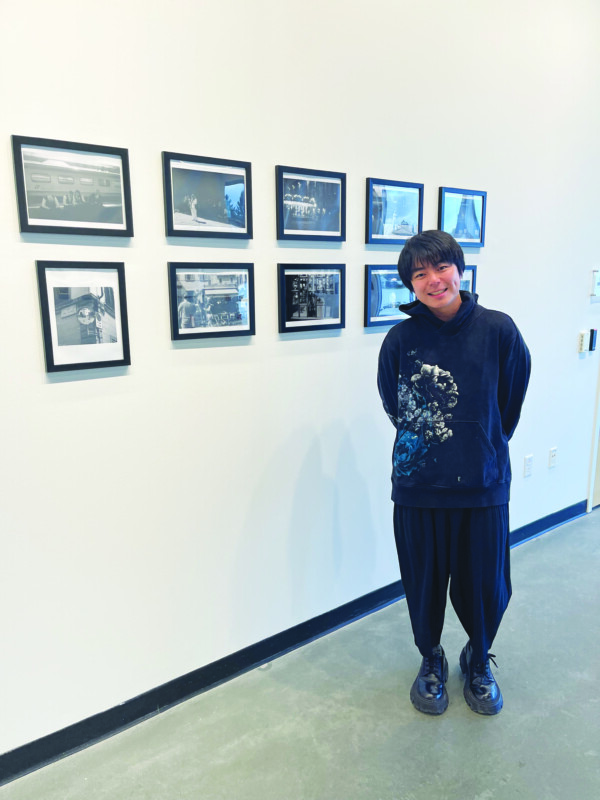
His black and white images primarily capture what Loverme calls “the timeless geometry of urban life, the interplay of light and shadow [that] highlights the city’s elegance,” while his color work focuses on rural subjects that “draw the eye to the small, overlooked details of the natural world — fallen leaves, scattered fruit, and the quiet poetry of decay.”
Representing Colby-Sawyer are Brian Cal-Mallo, who’s both a painter and photographer, printmaker Alex Jenkins, and Sota Morishita, a photographer. All are studio art and graphic design majors who studied in Florence during the summer program in 2024.
“Though varied in their chosen media, each artist shares common ground in finding inspiration in the contrasts of beauty in Florence, the birthplace of the Italian Renaissance, and the Tuscan region,” Keenan said. “This exhibition reminds us not only that art is a joy to experience but also a universal language and a vibrant expression of our shared humanity.”
The exhibit will open on Jan. 30 with the three student artists in attendance.
“We always do a nice reception to celebrate the audience and create community through the arts,” Keenan said. “We’re going to have lots of great food and beverages.”
It runs through April 2, and Loverme will visit on the final day for a meet and greet, and to discuss his work.
Funded by William H. and Sonja Carlson Davidow, the latter a 1956 Colby-Sawyer graduate, the gallery opened six years ago. Keenan was involved in the conception and execution of the state-of-the-art facility where it resides, which also has a black box theater and multiple facilities for students to create in.
It sits amidst natural beauty, with Mt. Kearsarge in view, and Keenan hosts six events a year in the gallery.
“My goal is to create community, bring people together through the arts,” he said. “This venue is the ideal place to do that — to provide learning for the public, and to support the arts. Whatever we can do to keep it happening is our privilege.”
Opening Reception: The Florence School of Fine Arts & Colby-Sawyer College Art Project
When: Thursday, Jan. 30, 4-6 p.m. Where: Davidow Fine Art Gallery, 541 Main St., New London More: colby-sawyer.edu
On Jan. 23, JetBlue launched service from Manchester-Boston Regional Airport with flights to Orlando International Airport as well as seasonal flights to other Florida airports. The Orlando flights will be year-round and daily, according to a press release on the airport’s website. Flights to Southwest Florida International Airport in Fort Myers (three times weekly) and Fort Lauderdale-Hollywood International Airport (four times weekly) will be seasonal, the release said.
Math & science teachers
Five New Hampshire teachers received the Presidential Awards for Excellence in Mathematics and Science Teaching, according to a Jan. 22 press release from the New Hampshire Department of Education. The awards were announced the previous week by former President Joe Biden and honor teachers from the 2021, 2022 and 2023 award application cycles, the release said. The teachers are John Tietjen from Lebanon HIgh School (for 2021); John Blackwell from Phillips Exeter Academy (for 2021); Susan Leifer from Mast Way School in Lee (2022); Joanne Goelzer from Coe-Brown Northwood Academy (2023) and Sandra Swiechowicz from Raymond High School (2023). For more information on the awards, see paemst.org.
Lotto scam
The office of New Hampshire Attorney General John M. Formella issued a Consumer Alert for New Hampshire residents regarding a rise in reports of scammers perpetrating lottery and sweepstakes scams, according to a press release. “In these scams, a scammer contacts the victim and falsely claims that the victim has won a lottery or sweepstakes, such as the Publishers Clearing House (PCH) sweepstakes. The scammer tells the victim that before the prize money can be issued, the victim must pay certain fees upfront, such as taxes, legal fees, or processing fees. In many cases, the scammer instructs the victim to pay these fees by wire transfer, Bitcoin ATM, or prepaid gift or debit cards. In two recent reports, the scammers demanded fees in increments of $8,500,” the release said. The release said the Publishers Clearing House sweepstakes never calls in advance to tell you that you’ve won and if you receive a call claiming to be from the sweepstakes, hang up and call Publishers Clearing House at 800-392-4190. Also, generally, “You will never have to pay a fee to claim a prize from any legitimate sweepstakes or lottery,” the release said. Report the scam to your local police department, the Consumer Protection and Antitrust Bureau of the Attorney General’s Office at 271-3641, and the Department of Health and Human Services, Bureau of Adult and Aging Services at 1-800-949-0470 or to doj.nh.gov/consumer/complaints/index.htm, the release said.
The Last Ice, a short documentary by New Hampshire science teacher Greg Stott and Vermont filmmaker Nick Natale, will screen Friday, Feb. 7, at the McAuliffe-Shepard Discovery Center in Concord (starhop.com) as part of this month’s Super Stellar Friday programing, which begins at 6:30 p.m. Stott, the 2023 NH Charitable Foundation recipient of the Christa McAuliffe Sabbatical award, used his sabbatical to make a film about the last ice age and its effect on the Connecticut River Valley, according to the website. Admission costs $13 for adults, $12 for 62+ and ages 13 through college, and $10 for ages 3 to 12.
The Center for the Arts in New London will host master fly fisher Scott Biron on Monday, Feb. 17, at 6:30 p.m. to discuss the art of fly tying, according to a press release. See centerfortheartsnh.org.
Sunday, Feb. 2, is the final day to view the exhibit “Dan Dailey: Impressions of the Human Spirit,” featuring the works of the “New Hampshire artist whose creative ideas and innovations in glass have expanded the canon of art,” at the Currier Museum of Art (150 Ash St., Manchester; currier.org). The show will feature more than 75 of Dailey’s pieces, according to a Currier press release. The Currier is open Wednesdays through Sundays, 10 a.m. to 5 p.m.
Recycled Percussion will perform four shows this weekend at the Nashua Center for the Arts — Saturday, Feb. 1, at 2 and 7 p.m. and Sunday, Feb. 2, at 1 and 5 p.m. See nashuacenterforthearts.com.
Advice on hiking during the coldest season PLUS Winter birds and where to find them
By Zachary Lewis
zlewis@hippopress.com
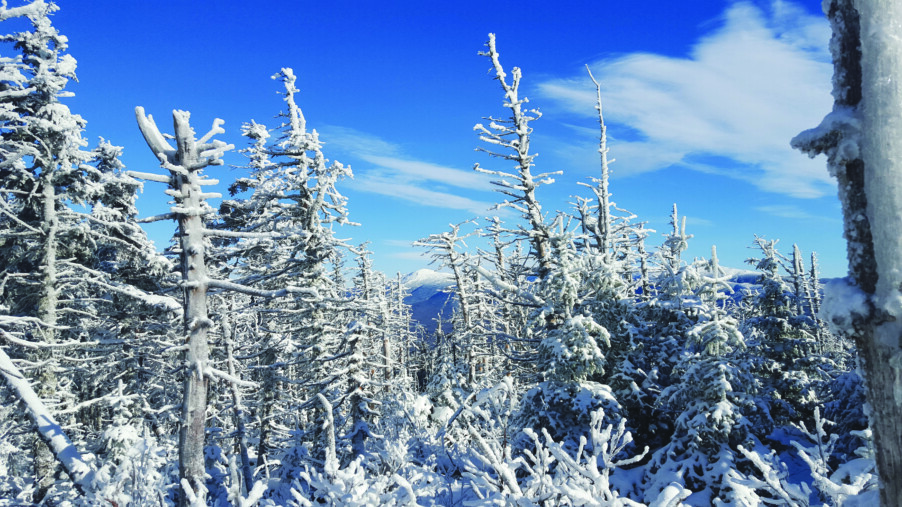
Outdoor enthusiasts don’t let snow or single-digit temperatures stop them from getting out there. Looking to hike (or take a woodland walk) in the winter? Here is some advice from the experts.
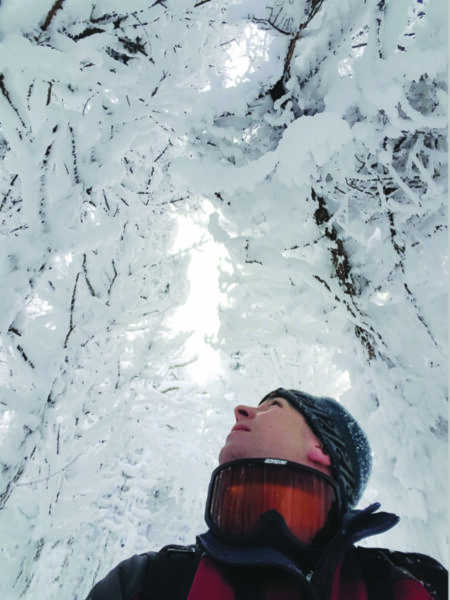
Photo by Matt Larson.
Hitting the snowy trail
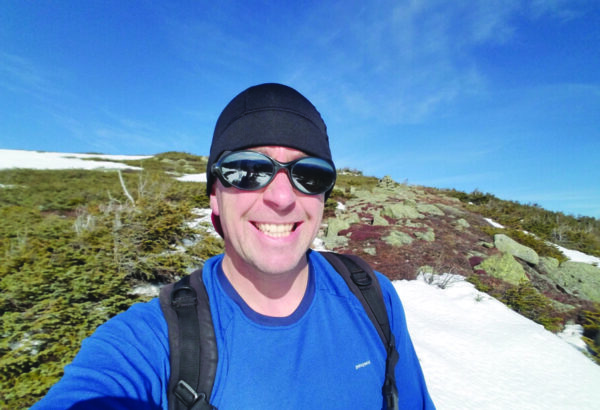
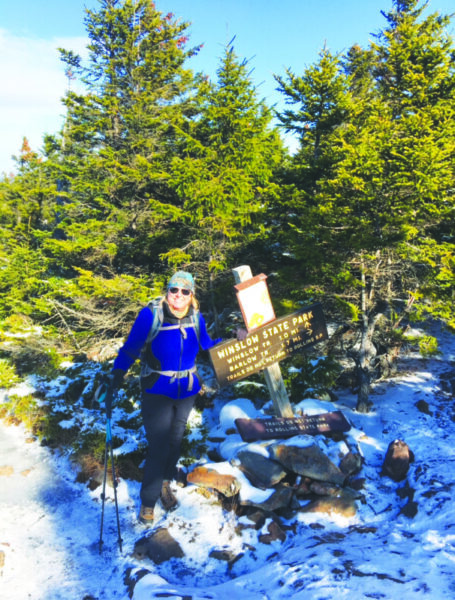
Matt Larson has hiked all 48 and wrote a book about it called 4000s by 40, which came out in September.
“I had this mission before I turned 40 to climb all the 4,000-footers,” he said. His book can be found on wanderingmattlarson.com. These mountains loomed before Larson.
“I grew up in Massachusetts and I always loved it when we came over to New Hampshire and went skiing in the North Country or were in the Lakes region. I was always very aware of the mountains. They earned a spot in my heart from a very young age,” he said.
As a Granite Stater Larson had the perfect opportunity to accomplish his goal.
“I live in the southern part of the state now. I was so excited when that happened because I finally got to be close to all these mountains that I always loved as a kid. When I was coming close to turning 40, I realized that I really hadn’t explored all of the mountains that I wanted to. I climbed a few of them, but I just felt like this deep connection with the 4,000-footers. It just felt a shame to me that I hadn’t really fully explored them yet. That was my first call to arms, so to speak, for getting out on the trail,” he said. He started in the winter because his birthday is in February and gave himself a timeline for the year.
“I started off hiking in the snow and quickly learned that I needed microspikes the first time I went climbing in the winter. I did not have them and had to learn about the proper gear that was really necessary to take on the mountains during the wintertime and learned a lot fast. I’ve been doing it for quite a while now,” Larson said.
Photo by Matt Larson.
Larson was persistent even as his dream met with reality.
“I had big visions when I first started off, and so I thought I was going to be able to climb two mountains in one day in the middle of winter without microspikes. I went up East Osceola and I was hoping to climb over what’s called the chimney from there to Mount Osceola. About halfway up, I thought I had something called Yaktrax in my bag so I thought I had something to help me with the ice. I didn’t have spikes yet, but I at least thought I had my Yaktrax with me. I went into my bag to take them out and realized I had left them in the car. So without anything to help me, I really was contemplating turning around. I ended up actually finding a way through. Along the sides of the trail, there’s a bunch of thickets and narrowly spaced pines that you can grab onto so I was able to actually get to the top of East Osceola by navigating my way through the trees off the side of the trail, but I wasn’t going to shoot for the other peak of Mount Osceola, because it just was way too treacherous-looking.”
This close call led Larson to gear up.
“Shortly after that climb I went right out to my local EMS store … and I grabbed myself some microspikes,” he said
Most of his journeys were solo missions.
“That’s not to say I was alone out there. I mean, I was always really surprised. Even that first day in Osceola, I think I got to the parking lot at 6 in the morning and started climbing, and there was already somebody there who beat me to the lot,” he recalled. “It’s really amazing. I think as time has gone on more and more people are getting into this and getting outdoors. When I completed the 4,000-footers, I think it was sort of a banner year for the AMC in terms of people that were submitting a claim for having finished the 4,000-footers.”
Larson is excited that more people are embracing hiking in the cold.
“It’s been really nice to see how many people are taking on the adventure but being sensible about it too. The most impressive climbers to me are the ones that are doing it in the winter because they really are a much more thoughtful bunch about how to prepare for it and be safe. There’s plenty of stories of people who have taken on unnecessary risk during the winter, but it’s all very doable if people take the sensible approach and mitigate the risk through proper gear and awareness of the terrain and the weather. You do see a lot of people out there, which is great,” he said.
As with a river, no hiker steps onto the same mountain twice.
“It definitely changes week to week too. Even this winter. We went up around the Mount Tom and Mount Willey area and there was a little bit of snow on the ground. Then the next week I went out with a buddy to Cannon and it felt like a blizzard had hit the place. Very quickly it went from not needing any spikes or anything really on our feet, or just needing spikes for like a little portion of the trail up Mount Willey, to needing spikes the entire time up Mount Cannon and us contemplating if we even needed snowshoes,” Larson said.
The snowy terrain has the possibility for change after change and it is important to be cautious while enjoying the spectacular beauty of nature.
“There’ll be times that you’re out there and you’re using snowshoes for 50 percent of the climb up and then you have to switch back and forth between spikes and snowshoes because it gets really icy in some sections and then it can get really deep in others,” he said. “Then there’s other times where it doesn’t look like it’s that icy or that snowy but the rock is so slick. There’s sort of a form of black ice on some of the granite. People slip. I slipped a couple of times even with spikes on. You can have some moments where your feet can get pulled out from under you. It’s definitely important not to rush, especially on the descent. It’s always more dangerous on the descent.”
One perk of winter hiking is the chance encounter with wildlife.
“When I’m in the 4,000-footers … I’ve seen some minks. I’ve seen plenty of gray jays out of Mount Tom, Mount Willey and Mount Field in particular. … and of course everything from chipmunks to squirrels, all the usual suspects.”
There’s always a chance some critter will dart right out toward you. “I think the funniest encounter I had with any animals was one time I was on the trail and it was super quiet. It was kind of spooky how quiet it was. I was kind of thinking there might be a bear around, and I started inching my way up the trail, looking every single direction I could. Just as I started getting comfortable, all of a sudden, all of these pheasants just emerged out of this bush in front of me. There were probably 30 or 40 of them, or quail, I guess. You’ll see them out there too. Then there’s some turkeys along the way and mostly birds, birds and squirrels,” he said.
Regardless of the locale, hiking a mountain trail in the winter is a joy that Larson hopes others in the Granite State can experience for themselves.
“I love winter hiking. I love hiking at any time … but winter hiking is very peaceful. There really is a serenity to winter hiking that I think is unique. I definitely encourage people to try it if they’re thinking about it. One of the reasons why I wanted to write 4,000s by 40 was because I feel like there’s a lot of stories out there about the dangers of the mountains. I think there is inherent risk in climbing, but I do think that it’s something that’s a venture that everybody can enjoy if they just take sensible steps, there’s no reason they shouldn’t be able to enjoy winter hiking, too,” Larson said.
Snowshoes and postholing
Sometimes using snowshoes is not just for your own benefit but for keeping the trail in good shape. They’re mainly used for traversing powdery or deep snow, to keep you from sinking.
The City of Concord’s online guide to local trails (concordnh.gov/1033/Trails) includes this note: “On fresh snow, please use showshoes. Bare-booting can cause post-holing, which is a potential hazard for trail users.” Post-holing is trail-speak for when your boot sinks deep into the snow and leaves a hole. Not only is post-holing no fun, but later, someone else’s boot, ski or snowshoe can get tripped up by that hole.
Even with snowshoes, you shouldn’t hike on top of ski tracks. In a Feb. 28, 2022, blog post on Sharing Winter Trails (nhrtc.org/sharing-winter-trails), Ellen Kolb wrote, “Where cross-country ski tracks are present, showshoers and hikers will walk next to rather than on top of them. Slower traffic always stays to the right.”
On gearing up
Renee Robertie works at REI in Bedford. She is a committee member of the New Boston Rail Trail and an avid hiker. She gives quarterly free talks on all things hiking-related, such as waterproofing and the 10 essentials to bring on every hike (her next talk will be on Saturday, April 26; email nbrailtrail@gmail.com for more information).
According to Robertie, rail trails are a great introduction to the world of winter hiking.
“It gives people an opportunity to get outside, get some exercise, do some hiking, ride the trail maybe, and these are folks that may or may not necessarily be in a physical condition or have the desire to do something more strenuous such as something in the White Mountains. So it’s a glade in between. It’s a beautiful path that’s an old railroad bed of course, and there are benches along the way and you can sit and just kind of watch the river because it follows the flow of the river. It’s just a nice time to be out in the woods,” she said.
Robertie laid out the basics of hitting the trail in winter.
“The first area [is] the clothing. Layering your clothing so that you can have flexibility to regulate your heat and any moisture if you’re aggressively walking or even running the trail,” she said.
Wool is an excellent choice for the first layer. “A typical base layer would be something that is wool or a wool blend or a synthetic type of clothing. There are pros and cons to either one, wool being a little bit more expensive than synthetic but it’s a really good insulator so even when it gets wet it still insulates and can keep you warm. Wool comes in various densities. It might be a light, a medium or a heavy type of wool,” Robertie said.
“The next layer is an insulating layer. Typically that’s fleece or it could be even like a down jacket or something thicker that’s going to insulate your heat and keep it in because you’re the one that’s generating the heat,” she said. Layering allows you to adjust the thermostat of your own body.
“Then the third layer is a shell layer and that keeps out moisture. So say if it’s raining or snowing or even if snow is dropping from the tree branches or something like that. You keep your base layer and then you can regulate your heat by adding or removing the other two layers or even just opening up, so unzipping if you’ve got a quarter zip, the zip that is from the neck down to above your chest, or even fully unzipping if you’re that warm,” she said.
The human head is like a chimney where a good amount of heat escapes. “Not having a hat can account for losing about 10 percent of your body heat, so if you’re getting too warm you can take your hat off, if you need a little more warmth you can put your hat on,” she said.
Leg gaiters are also an option to consider. “A gaiter is simply a waterproof fabric that has a strap that goes under your boot and then either zips or more typically these days Velcros around your leg. It’s made of a rugged material so if you are wearing something like microspikes and you happen to get it caught on your ankle or shin it’s not going to damage a good pair of pants.”
Foot covering is an obvious necessity in the winter too. “There are different insulation types for boots and you can get very warm … but the insulation in the boots can help keep your feet warm. Certainly things like hand warmers or toe warmers are a good idea too if you’re not quite sure what you’re going to encounter,” she said.
Renee Robertie. Courtesy photo.
After clothing, Robertie will speak on staying secure in your footing.
“Traction is what keeps you from slipping. Some boots have deep lugs, so kind of the bumps on the bottom … But sometimes you need a little bit more, so I talked about things like microspikes, which are quarter-inch spikes on chains that are attached to a … rubber-type thing that you put on the toe of your boot and then draw it back and up around your heel. That holds the spikes in place underneath your foot. So the microspikes are good when there’s definitely ice and they are very grippy.”
Bigger spikes are needed for the mountains. “I didn’t go into crampons or anything like that because that’s more of a steeper mountain, mountaineering kind of traction…. That’s a big spike that’s maybe a 3- or 4-inch spike that, it’s not just one spike, it’s a series of spikes underneath your boot that provides a lot of traction and is meant for very steep and very icy trails.”
And sometimes a wide, flat surface is what is called for in the winter.
“I spoke about snowshoes as well, which typically don’t come into play too much on a rail trail because there’s so much foot traffic, but if you’re breaking ground in snow a snowshoe is going to help you stay buoyant on the snow instead of possibly falling in…. The rail trails are typically packed down, but after a snowstorm, if you’re the first one out, there’s definitely a possibility that you could be running into some deep snow.”
Trekking poles can help you stay upright. “Trekking poles are great for stability. If you’re older or even young people nowadays, it’s really great for staying stable on your trail. It helps you walk a little more briskly. And if you’re doing a water crossing, which typically you don’t do on a rail trail but you might do on one of the town trails. It’s great for descent and especially if you’ve got bad knees because it takes some of the pressure off your knees.”
Robertie also mentioned the benefits of the New Hampshire Fish and Game Hike Safe Card. “The Hike Safe, which is through the New Hampshire Fish and Game, is something that you can purchase to help support the Hampshire Fish and Game. It’s $25 for an individual, $35 for a family, and if you have that and have not been irresponsible, if it happens that you do need to be rescued, then you won’t be charged the rescue costs.”
She hopes to spread her enthusiasm about winter hiking to others.
“It’s all about getting outdoors. The fresh air, the health benefits of being in a forest are well documented and studied. We want people to do that and we want them to do it safely and more than anything to have fun and enjoy it. It’s a great resource. The more people out there, the better,” Robertie said.
Birds in winter
Grace McCulloch works for the New Hampshire Aubudon is excited to get more Granite Staters interested in a winter activity that pairs well with winter walks and hikes: birding.
“One of our favorite projects here at New Hampshire Audubon is the Backyard Winter Bird Survey, which this year is taking place on February 8th and 9th. It’s a weekend out of the year where we encourage people to report the birds that they see in their backyards to us at New Hampshire Audubon. The reporting form will be open for a few days after just so that everyone can get their results in,” McCulloch said.
The Survey has been going strong for decades. “This will be our 38th year doing the Backyard Winter Bird Survey,” she said, “and so over that time we’ve gathered a huge amount of data to really get an understanding of bird trends throughout the state. Being able to look through that kind of year-to-year variation and noise and see what bird species are increasing in number and what species might also be declining in the state.”
The process is simple. “The survey is really easy. We have a simple online survey form on our website where people report what they see over the weekend. They can watch for as little as 15 minutes, or if they’re really dedicated they can watch the entire weekend as well.”
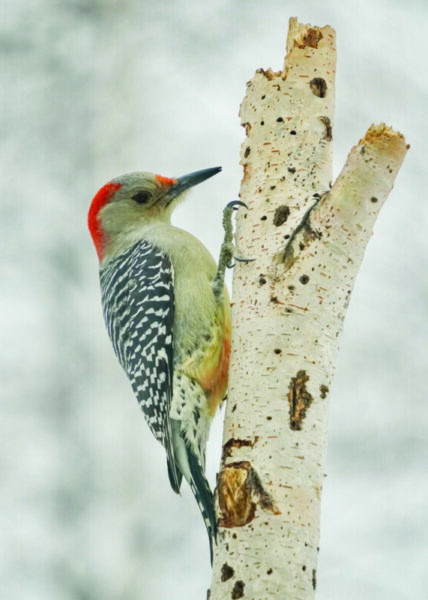
Red-bellied woodpecker. Photo by Grace McCulloch.
Birders do not need to be experts.
“We know that not everyone is out there birding every day, and that’s one of the things I love about the survey, is that it really is supposed to be easy for people who maybe this is the first time that they’re taking time to notice the birds in their backyard.”
The NH Audubon has plenty of helpful information on birds.
“We have a ton of resources on our websites, including a guide to the most common winter birds that people can check out, as well as a guide to commonly confused birds. Because there are species that can look quite similar. You can know that you have a woodpecker, but which woodpecker is it?”
The landscape of birds has changed in the state over the years. “You’d be surprised how dramatically the bird communities have shifted,” McCulloch said. “One example that I like to talk about a lot are American robins and eastern bluebirds. These are species that were once thought of as signs of spring. They arrived just in time for the beginning of spring. When we first started the survey in 1987 they were almost unheard of in February in the state. But today they’re frequently seen by people on the Backyard Winter Bird Survey in February. So just in 35 years, a huge shift.”
“We’re also seeing new species appear on the survey, species that are typically found further south. And … our work is even more important as we look to understand how bird species range and how long they’re staying in the winter might shift over time. We’re … seeing new species arrive, like red-bellied woodpeckers and Carolina wrens.”
Fan favorites will be making a return as well. “Our most common bird last year was the American goldfinch. We actually had about 10,000 of those reported on the survey. Then other favorite birds like black-capped chickadees, northern cardinals, those are always very distinct birds, easy to identify. We had a lot of blue jays on the survey last year, and also things like mourning doves.”
McCulloch said residents can take steps to entice birds to their homes. “I always encourage people if they want to put up a suet feeder. It’s kind of like a block of suet that you can put up and that really will help attract the woodpeckers. You can see several different woodpeckers just within one weekend. Things like downy woodpeckers, hairy woodpeckers and red-bellied woodpeckers, you can see all three in your backyard. The amazing thing is most of our feeder birds, multiple species, are all feeding together at once, so you have a good chance of seeing more than one species at a time.”
Now is the time to make your guesses on which birds will be showing up.
Tufted titmouse. Photo by Grace McCulloch.
“Our senior biologist, Pam Hunt, always likes to make predictions for the survey. … this year, based on some food availability up north, we’re predicting a higher number of red-breasted nuthatches. … We’re also expecting a fairly good showing of species like red-bellied woodpeckers and Carolina wrens as our winters get warmer over time,” she said.
The Carolina wren has been drawing attention here, she said. “They’re a species that 10 years ago people weren’t seeing in the state, so when you see a brand new bird at your bird feeder, you’re like, ‘What is this bird?’”
“If you’re talking about hiking the 48 4,000-footers in winter, a bird you could always mention is the Canada jay or the gray jay,” McCulloch said. “That’s a bird that you typically only find on the top of mountains in New Hampshire, and you find it in the winter, and they love peanuts and other food that hikers bring them up. They’re known to eat out of hikers’ hands on the top of the snowy mountains,” she said.
Where to hike
Here are some ideas for finding winter (and all-season) hiking spots that match your skill level and interest.
• Renee Robertie suggested checking out rail trails. See nbrailtrail.com for information on the New Boston Rail Trails, including maps and a link to the group’s social media for updates on conditions. For information about rail trails throughout the state, check out the New Hampshire Rail Trails Coalition at nhrtc.org, which offers links to rail trail groups around the state and brief descriptions of the trails.
• The Society for the Protection of New Hampshire Forests offers a visitor’s guide that lets you filter through its properties for location, difficulty of trail and specific activity like snowshoeing or bird-watching. See forestsociety.org/visitor-guide.
• On the New Hampshire State Parks website, a specific guide to winter parks includes popular hiking parks as well as spots for snowshoeing, fat biking, ice fishing and mushing. See nhstateparks.org/things-to-do/winter-recreation.
• The New Hampshire Audubon (nhaudubon.org) will hold its annual Backyard Birding Survey Saturday, Feb. 8, and Sunday, Feb. 9. See the website for details. While you’re there, check out the information about their trails at sanctuaries near the Audubon’s centers including the Susan N. McLane Center in Concord and the Massabesic Audubon Center in Auburn as well as wildlife sanctuaries across the state. The sanctuaries page offers maps and guides to each property.
• Beaver Brook Association (117 Ridge Road in Hollis; beaverbrook.org) has 35+ miles of trails, according to the website, as well as ongoing fitness hikes that can get you started by letting you hike with a crowd.
• The state Division of Travel and Tourism Development describes 10 winter hike options including Mount Major, with its views of Lake Winnipesaukee; the ever-popular Mount Monadnock; and hiker favorite Mount Cardigan, “a very popular area for hiking and snowshoeing,” at visitnh.gov/blog/10-popular-winter-hikes.
• Picturesque local parks with trails are good places for winter strolls, usually not too hilly, such as Mine Falls Park in Nashua (nashuanh.gov/491/Mine-Falls-Park), Livingston Park and other city trails in Manchester (manchesternh.gov/Departments/Parks-and-Recreation/Parks-Trails-and-Facilities/Recreational-Trails), and several park trails in Concord (concordnh.gov/1033/Trails). According to the Concord trails website, there are three group hikes currently scheduled: On Saturday, Feb. 22, at 9:30 a.m., Bob Lyon will lead a 3-mile hike on Broken Ground trails; on Saturday, March 29, Peter Bartlett will lead a Morono Park trails hike, and on Saturday, April 26, at 9:30 a.m., Wendy Olson will lead a hike of the Winant Park trails.
An upcoming show at Exeter’s Word Barn features a pair of unique performers both collaborating and performing their own music. Nate Sabat is an upright bass player who transforms his rhythm instrument into something all-encompassing. Rakish, the duo of Conor Hearn and Maura Shawn Scanlin, weds traditional Celtic music to modernity for a fresh sound.
The show is part of a four-date mini tour. “We’re really excited about it,” Hearn said, along with Scanlin, in a recent Zoom interview. “Nate’s going to play, and then we’ll play with Nate on his music, and Nate will play with us on our music…. it’s sort of this integrated thing that we’re trying to pull off.”
Rakish released their second-full length album, Now, O Now, in October. It’s a rich and varied work that kicks off with “Lonely Hotel Room,” a buoyant yet bittersweet ode to road weariness. The title track follows, one of two James Joyce poems set to music by Hearn, something he also did with W.B. Yeats’ “The Stolen Child” on their eponymous debut EP.
Hearn, a literature major at Tufts, delights in detecting song patterns in poetry. “Joyce was very interested in music, but we don’t necessarily hear the music that they had going on in their head when we read their poems except to the extent that we have their rhyme schemes and their meters and such,” he said. “To take a text like that and infer what a new melody could be lets us use some of our compositional muscles.”
The two took artistic risks on the new disc, like the Jamie Oshima-produced “765,” which echoes Natalie MacMaster’s 1999 crossover hit “In My Hands” with its fiddle electronica dance beat. It’s also the only track not helmed by Hearn and Scanlin, who elected to self-produce after working with Solas’s Seamus Egan on 2022’s Counting Down the Hours.
In addition to being lyrically compelling, with standout songs like “Island in the Sea” and “Lightly Come or Lightly Go,” Now, O Now stands out for another reason, Scanlin pointed out.
“The entirety of the album is all original musically, even excluding those two James Joyce poetry pieces,” she said, adding that she’s pleased to have it as a unifier, “instead of trying to come up with a thread about how JS Bach relates to this other old Irish tune relates to a tune that I wrote yesterday or something, which was the case on the previous album.”
Scanlin hails from Boone, North Carolina. Despite growing up in the Appalachian region, she initially studied classical music, but repeated trips to folk festivals with her parents got her interested in fiddlers like MacMaster, Hanneke Cassel and Liz Carroll. Hearn grew up in Washington, D.C., and got into Celtic music at summer camps and other places.
The pair met while both were attending different colleges, Hearn at Tufts and Scanlin at the New England Conservatory. Mutual friends and shared interests brought them together. They’d jam at Irish sessions at clubs like The Burren and The Druid; later they were in a band called Pumpkin Bread, before pairing up to focus on their shared favorite music.
One of the duo’s earliest supporters was Brian O’Donovan, a major force in New England’s Celtic music community and beyond before his death in 2023. “Brian was definitely the first to really elevate us and what we were doing and give us a platform and throw gigs at us,” Hearn said. Scanlin concurred, saying, “in a more tangible sense Brian literally did give us our very first gig together as Rakish, so our relationship as a band goes back all the way.”
Recently Rakish was named as the inaugural Brian O’Donovan Legacy Artist, part of an effort to memorialize the man who, here in New Hampshire, regularly hosted events like Celtic Christmas at Derry’s Pinkerton Academy. The weekend after this interview they served as resident artists at the Boston Celtic Music Festival, which featured a musical tribute to O’Donovan along with the awarding of six $2,500 grants in his name, with Rakish being among the recipients.
“Brian brought so much to Celtic music,” Scanlin said, from connecting people Stateside to folks back in Ireland as well as bringing the Northeast community and the rest of the U.S. together. “We’re really grateful to him, and also honored … to be stepping foot into this Brian O’Donovan Legacy role for its very first year. We’re so excited to see where that fund goes, and just totally excited to be the first in that role.”
Rakish and Nate Sabat
When: Thursday, Jan. 23, 7 p.m. Where: Word Barn, 66 Newfields Road, Exeter Tickets: $16 and up at portsmouthnhtickets.com
Chili Cook-Off offers demonstrations of creativity
By John Fladd
jfladd@hippopress.com
For the past nine years the Amherst Lions Club has raised money for its community-based projects with a Fire and Ice Chili Cook-Off. Joan Ferguson is one of its coordinators.
“This is our ninth annual chili event,” she said, “and the idea has been to provide a community event in the middle of winter when everybody is asking when spring will come. There’s the chili, which is the fire, and the ice is making your own ice cream sundae.”
Ferguson said the cook-off has become something of an Amherst institution.
“We think we have it down in terms of planning, at this point,” she said, “but, you know, there’s always something we can do better. For example, during Covid we did something radically different. We videotaped competitors going before judges and making their presentation. And then we filled the recipes online. And that year we were able to get really prestigious judges because the restaurants weren’t open.”
The 2025 Fire & Ice event will take place Friday, Feb. 7, in the Souhegan High School Cafeteria. Competitors submit crockpots of their chili to be judged. Judges will circulate around the room, to each table, and judge the submissions on taste, smell, heat, creativity and presentation. Attendees will pay to sample and eat the different chilis.
Amherst Chief of Police Anthony Ciamoli will be one of this year’s judges. He said he loves chili but really looks forward to judging entrants’ creativity and patience.
“Being a layman, I was really excited [last year] to see some of the work that people put into their presentation and different kinds of chili,” he said. “Some were sweet, some were hot, and some of the people truly prepared their little stations. They had turned their areas into small vignettes. One was a dinosaur scene. It was really cool. They take a lot of pride in it. That’s a reason to make sure that we take each [submission] seriously.”
Dan DeCourcey, owner of the Up in Your Grill Food Truck (493-3191, upinyourgrill.com), is another chili judge. He thinks first impressions are important.
“You’re always going to start off with how it looks,” he said, “so the presentation, right? Then you’re looking at the product itself. In a contest like this one, the presentation is important. When you walk up [to a station] there could be a little story written on the side or, you know, they have garnishes out or, you know, different things and you’re kind of getting the first impression. If there’s a really interesting story, like … I don’t know, it’s great-grandma’s secret recipe from, you know, Mississippi that is now a family guarded secret and sought after by everyone. It just adds to the fun.”
Joan Ferguson said the chili submissions themselves have been extremely creative in past years. “We’ve had venison entries,” she said. “We’ve had beef, we’ve had chicken, and of course we’ve had vegetarian. We have very hot chili recipes and we have pleasant chili recipes. One [chili] will take the top of your head off and will be one that everybody finds savory. Don’t ask me what people prefer because the pots usually go home empty.”
Chief Ciamoli agreed. “Everyone has had different bases,” he remembered. “There was one table that I remember last year that actually had a vegetarian chili. Then there was your standard ground beef and some that had brisket. So it’s really neat to be able to try all the different styles. Some have some fruit in it to soften things. There’s work that goes into it.”
Ciamoli has a double involvement in this year’s cookoff. In addition to judging, the Amherst Police Department will be submitting a chili (which he will not be allowed to judge). He said his officers feel surprisingly motivated. “I was shocked because when I brought it up with them I said, ‘I think we should do something brisket-based,’ and then all of a sudden one of our officers I never hear from is like, ‘Whoa, whoa, whoa! Hold the phones! I want in, man!’”
Amherst Lions Club 2025 Fire and Ice Chili Cookoff
When: Friday, Feb.7, from 5 to 7 p.m. Where: Souhegan High School Cafeteria, 412 Boston Post Road, Amherst. Tickets: To purchase tickets, contact any Amherst Lion or purchase online. Tickets are $12 for adults, $6 for students ages 7-12, free for children ages 6 and under, $40 for a family of four or more. There is no fee to enter a chili. Competitors must register by Feb. 4. Visit the Amherst Lions Club website at e-clubhouse.org/sites/amherstnh.
An evening devoted to a centuries-long American folk music tradition will launch a series of public events from Concord Community Music School dubbed New England Roots & Branches. Contradance Music: The New England Contradance Repertoire will include a community jam session followed by a contradance called by a veteran and scholar of the style.
David Millstone began attending contradances soon after moving to New Hampshire’s Upper Valley in the early 1970s. Within a couple of years he was regularly attending dances led by Dudley Laufman. Millstone called Laufman the most influential figure in spreading contradancing across America and especially in New England.
“People would refer to Dudley dances,” Millstone said by phone recently. “He was a charismatic individual, and he was calling essentially every night from Maine to Connecticut back in the day. Other callers got interested, other musicians started playing, and the whole scene … really took off.”
Millstone was one of those inspired by Laufman; he began calling in the mid-’70s, and 50 years on he’s doing it still, in addition to writing books and album liner notes and making movies about contradance. As a caller he becomes an integral part of the band, and at the Jan. 25 event he’ll be working with four leading lights of New England acoustic music.
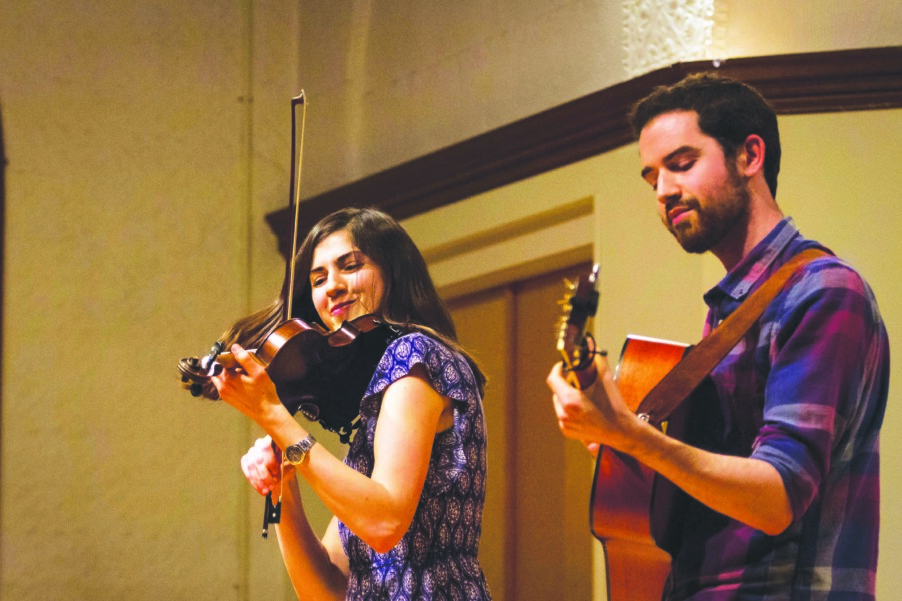
Guitarist Dan Faiella will accompany fiddlers Jordan Tirrell-Wysocki, Audrey Budington and Liz Faiella, who organized the series. She’s excited to have Millstone calling.
“My brother and I’ve worked with him through the years, and I used to go to his country dances,” Liz Faiella recalled in a recent phone interview. “He’s great at working with absolute beginners and really advanced dancers, getting everyone on the floor dancing comfortably and enjoying themselves.”
In 2015 Liz received a New Hampshire Arts Council grant to explore contradancing across the state. “I got to bop around, visit all of these different contradances, talk to the people who organized them and get a sense of the history,” she said. “I came away with a sense of how central it was to people’s lives here.”
As a musician she’s also impressed by the many tributaries joined together to make New England’s contradancing scene unique. “There’s stuff from Ireland, England, coming from Cape Breton, and we’ve got Quebecois music coming down here,” she said. “We’ve also got music from Appalachia, that sort of thing, and it’s all been integrated into this really rich contradance music tradition.”
All the band members are part of Concord Community Music School’s folk department.
“It really is a dream team; I can’t believe I get to work with these guys,” Liz said. “We all have been immersed in this scene and yet have our own takes on it. So it was kind of an opportunity to do some of what we do best, in sort of disentangling some of the genres.”
Beginning with a dance was the logical way to kick off the series, she continued. “We’re sort of starting out with ‘OK, here’s what we experience … this convergence of all of these different styles.’ Then, let’s pick that apart a little bit, and in the next few concerts, we’re going to celebrate different places that that music comes from.”
On Saturday, April 5, Transatlantic Tunes: Celtic & British Isles Folk Tunes celebrates music from the United Kingdom that became part of New England’s folk repertoire, and Music From North & South: Canadian & Appalachian Folk Tunes finishes the series on Friday, June 13.
Don’t fret about fitting in at the upcoming event, cautions David Millstone.
“If you can walk, you can do these dances,” he said, and welcoming newbies is a hallmark. “Experienced dancers will go up, say hello and invite people to dance, because that’s how we all learned how to do this. You don’t go to class for eight or 10 weeks … you learn it on the fly.”
Contradance Music: The New England Contradance Repertoire When: Saturday, Jan. 25, 6 p.m. Where: City Wide Community Center, 14 Canterbury Road, Concord More: ccmusicschool.org/event/ne-roots-and-branches-1
Featured photo: Liz & Dan Faiella. Photo by Elizabeth Frantz.