Pop of flavor

The perfect buttery, sweet and savory popcorn treats for your movie nights and TV binges

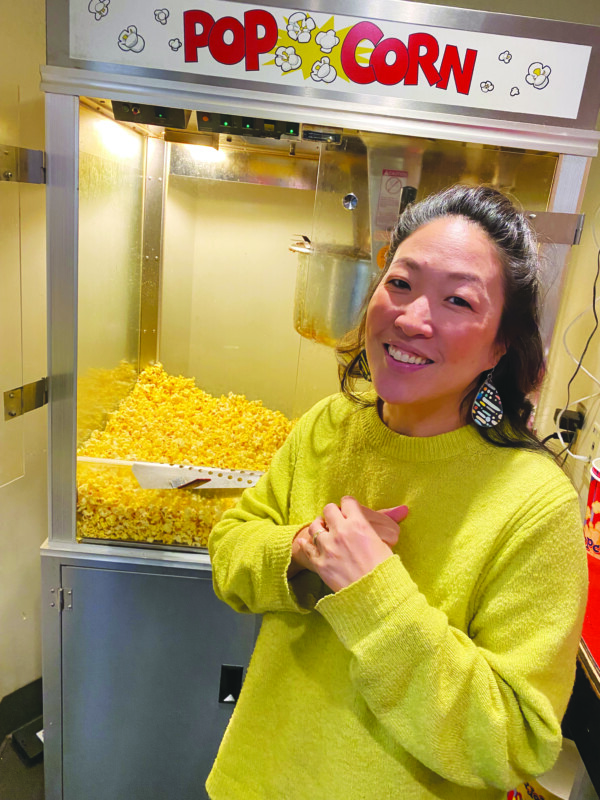
Angie Lane spends a lot of time thinking about popcorn.

Lane is the Director of Red River Theatres in Concord. It’s not an overstatement to say that popcorn is the lifeblood of any movie theater, and Lane takes it very seriously. Right now, during the busy holiday season, Red River uses up a 50-pound bag of unpopped popcorn seed every day and a half or so. For Lane, the secret to really good popcorn is real butter.

“We use anhydrous butter; the water has been removed,” she said, “so it’s shelf-stable, but it’s real, actual butter.”

(Sadly, one of the cold, harsh realities of life is that the “butter” on most theaters’ popcorn is actually mostly partially-hydrogenated soybean oil, an industry salt called “Flavacol,” beta carotene — the same vitamin that makes carrots orange — for color, tertiary butylhydroquinone — a preservative — and polydimethylsiloxane, an anti-foaming agent.)

While it is real butter (minus the water), Red River’s butter isn’t something you can buy off the shelf. “One time we ran out of butter during like Barbenheimer,” Lane said, “and actually during Wicked we’ve run out of butter because there was some supply chain issue, and somebody said, ‘Oh, we can just get butter from the supermarket!’ I had to tell them that I didn’t want to kill anybody, because [supermarket butter] is not shelf-stable once you heat it up and everything. But I love it when we run out of butter. It’s an indicator that business is good.”

According to Lane, only amateurs dump the butter on the top of a tub of popcorn. “We personally layer the butter because we’re professionals,” she said. “But I love it when people ask for extra butter, because people come to the theater for the movies but they also come for the popcorn.”

“Historically speaking,” Lane said, “there’s just something about when you smell popcorn in the movie theater, like it just goes together, and I think … if you ask someone to think about a concession item at a movie theater, the first thing they would say is popcorn.” She remembers the classic intermission cartoon that used to encourage movie-goers to buy concessions. “With the little marching concession people, it’s always led by a little popcorn guy,” she said. “When you were a kid, wasn’t popcorn magical?”

Meredith Thomas spends most of her day thinking about popcorn, too. She and her husband, Ken, are the owners of Ken’s Corn in Derry, a family business that sells popcorn at farmers markets, fairs and events and through a few small retail stores. Like many small food businesses, theirs started with a face-to-face relationship with customers. ”We started at farmers markets and fairs and events,” she said. “And that’s still primarily where we meet our customers.”

The business has expanded over the past two years. “It is a year-round business,” Thomas said. “We are primarily busy from about April through Jan. 1. And then we kind of take a few months to regroup. This year we’re going to be focusing on looking at more storefronts to get into just to keep expanding.”

One of the things Thomas likes about popcorn is how versatile it is.

“We started in 2022 just making buttered [popcorn] and kettle corn as our base,” she said. “Now we have seasonal ones, like in the fall. One of those is Caramel Choco — it tastes like a Twix bar! Now, we have a Cookie Explosion, which is like cookies and cream. And one of our savory flavors is a white cheddar.”

Thomas said that coming up with new flavors comes easy to her. “I am ADD, so my brain is constantly running. But just going into a store and looking around — at even just candies or potato chips [is inspiring]. Sometimes our customers give us really great options. We’ve had a lot of requests lately for a dill pickle [flavor], so that’s on our winter menu.”

Home cooks have a natural knack for personalizing popcorn, she said.

“Before we started this business, one of my favorite snacks was to pop popcorn, either on the stove top or just the microwave bags. And then I always added pretzels and M&M’s to it, so you get that sweet and salty flavor.”

It’s easy to understand why people love popcorn so much, Thomas said. “It is a quick, easy, on-the-go snack. Young, middle-class America is constantly on the go. So they’re looking for a healthy, consumable snack that they can either eat where they are or take it on the go, running to sporting events or going to work. It also is an allergy-friendly snack, which can be hard to find. It’s gluten-free, and depending on the flavor, dairy-free and nut-free.”

Popcorn experts
Red River Theatres (11 S Main St., Concord, 224-4600, redrivertheatres.org) shows movies seven days a week. Visit the website for listings.

Ken’s Corn (68 Chester Road, Derry, 208-661-0282, kenscorn.com) is available through small stores, including East Derry General Store (50 E. Derry Road, Derry, 432-5302, eastderrygeneralstore.com) and Prime Butcher 201 Route 111, Hampstead, 329-7355, primebutcher.com).

Popzup Popcorn (Canal Street Mill, 22 Canal St., Suite 358, Somersworth, 314-8314, popzup.com) sells five flavors of popcorn, poppers, seasonings and more online and in grocery stores nationwide.

The Burstin’ Kernel (facebook.com/theburstinkernel) makes hot, fresh kettle corn on the spot at farmers markets and events throughout southern New Hampshire. The Hallinans also have a new food truck, Chew ‘N’ Screw. Check for availability and more at facebook.com/chwnscw.

Julie Lapham has been in the popcorn game even longer. She is the CEO and co-founder of Popzup Popcorn in Somersworth. She and her husband started their company in 2015. For them, making popcorn is an expression of some deeply-felt values.

“Our facility is located in an old, refurbished mill on the river,” Lapham said. “That sort of reflects who we are in terms of our mission to be local and just to do the right thing, which basically is really fresh, farm fresh, pure and simple local ingredients, make it all ourselves, be sustainable, take good care of our employees, and give back to the community.”

PopzUp produces five flavors of popcorn for retail sales online and through supermarkets, but for the Laphams, selling popcorn and making it are intertwined.

“We also sell locally grown, non-GMO popcorn kernels in a microwave popcorn popper that we actually invented ourselves,” she said. “It’s called the PopzUp Popper, which is where we came up with our name. And basically it’s a reusable microwave popping box. It’s made from virgin paperboard and it’s printed with vegetable inks. It’s, you know, totally chemical-free and … reusable and sustainable.”

Like Angie Lane, Lapham is a big believer in real butter and dairy products. “What really differentiates us from other popcorn brands,” she said, “is that we use a lot of real butter, real cheddar. There really aren’t any other commercially available brands that use pure dairy. A lot of them have butter or cheddar or whatever, but for the most part they’re ultra-processed foods, which [are referred to as] UPF. It’s an actual term; all it means is that they are not real farm fresh dairy products. [Fresh dairy] is very much more difficult to work with and to protect because it goes bad quickly. Real butter and real cheddar and real truffles are very sensitive to light and heat and air. So we have to spend more to protect them and so those are more expensive.”

Using sensitive ingredients involves putting a lot of thought into PopzUp’s packaging. The bags, for instance, are completely light-proof. “It’s actually a foil-lined bag,” Lapham said, “We really need to have that foil liner to protect the popcorn. We also do something called a nitrogen flush, which basically is right before we close the bag up and seal it, we flush it with nitrogen, which is just an inert gas. It’s heavier than oxygen, and oxygen will cause popcorn to go bad and dairy to go bad, so we have to get that out of the bag, and seal it up tight. That’s just an extra effort that we go through to make sure that our popcorn is delicious when somebody buys it. “

For a family business, PopzUp produces a lot of product.

“We go through about 10,000 pounds [of popcorn] every three weeks,” Lapham said, “which is basically four full pallets at this point. But every year it’s more and more.” Early on, the Laphams decided to take a hands-on approach with their popcorn. Instead of using automated air poppers, which is the standard in the industry, “Ours is made the old-fashioned way,” she said, “but basically on a commercial level. We have giant, real kettles that pop it, and then we take that and then we put it in giant tumblers where people put the seasoning on it and tumble that, and then we take that out and put that in a machine that helps us to ensure that the right amount goes in every bag.”

In the beginning, Lapham said, their focus wasn’t on producing seasoned popcorn.

“What we did is we let our customers tell us what the fan favorites were. We took those seasonings and that’s what we used to season the popcorn that we started selling already seasoned. The first year was really spent deciding what flavors were the best flavors, what flavors the customers liked. We started with four flavors: butter, cheddar, and then two vegan flavors, Cheesy Herby, which is made with nutritional yeast and herbs and spices, and then Maple Cinnamon Toast, which has like a kettle corn flavor but it’s not candy coated, so it’s nice and snackable — it’s got this light sweet and salty mapley flavor that you can eat a whole bag of and it’s not like you’ve eaten badly. Last year we added a fifth. We added the truffle butter flavor; we buy real Italian black truffles and mix them with our butter and then put that on.”

Given how many varieties of popcorn are available, one or two types are perennial favorites. Kettle Corn enthusiasts are especially enthusiastic. Sean and Samantha Hallinan devote themselves to it. The Hallinans own and run The Burstin’ Kernel. For the past two years they have made and sold kettle corn at farmers markets and events throughout southern New Hampshire. “We pretty much operate from springtime all the way through until December, when it just gets too cold,” Sean Hallinan said.

The Hallinans are particular about the variety of corn they use. “Basically you have different types of kernels,” Sean said, “”and some kettle corn companies use one type versus another. We use a popcorn kernel that creates a very large pop; it’s called a ‘mushroom’ style.”

Hallinan said the actual popping process is pretty straightforward.

“Basically, you throw [the kernels] in a kettle with some oil. The kettle we use is 160 quarts. It is a pretty large commercial unit. Then you throw sugar in, and stir it. We stir it by hand usually; we use a big wooden paddle to stir it, or for larger events we stir it with an automatic stirrer. When it’s done, you dump it out of the kettle and you sift it through a sifting bin and salt it or put whatever flavorings on it. The sifting removes all the kernels and small bits. We try our best to get rid of them. You don’t want people breaking their teeth on hard kernels that didn’t pop.”

Kettle corn satisfies several cravings at once, Hallinan said. “I think people like the sweet and salty mix. We try our best to get the best recipes so that way it’s not too much one way or the other. There’s also a little bit of crunch to it as well, but not too sticky, so it doesn’t get stuck in your teeth like caramel corn.”

According to Hallinan, making good kettle corn didn’t have a steep learning curve.

“I saw someone doing it and got interested in it,” he said. “and then we worked on our own recipe over and over again for, I don’t know, it probably took us maybe a week or so of trying different things until we got it just right.”

Given how much care and technique the Hallinans put into making popcorn during the day, their own popcorn consumption is pretty basic. “We kind of grew up on microwave popcorn,” he said, “so that’s our default — easy, throw it in the microwave.”

Making good popcorn at home

Kristen Chinosi is the owner of and an instructor at The Culinary Playground in Derry. According to her, a good batch of popcorn starts with the oil it’s cooked in.

“I always pick a heavy-bottomed pot, and I like to use coconut oil,” she said. “It gives it a little bit of different flavor, though, so you can really use an oil that you prefer the flavor of, whether it’s a vegetable oil or an olive oil. You just have to watch how hot you have it because some of those oils have a lower smoke point.” (This means that different oils burn at different temperatures. Refined peanut or canola oils, for instance, have a high smoke point, which means they can be heated to a high temperature before they start to break down. Extra virgin olive oil and butter have low smoke points; they burn easily.)

Chinosi heats her oil before adding popcorn kernels to it.

“I like to get my oil nice and warmed in the bottom, and I’ll put a couple pieces of popcorn in until I hear it pop. I have a lid kind of halfway, you know, maybe like a quarter of it exposed when the lid is on. And once I hear it pop, I know the oil is hot enough, and then I go ahead and add the rest of my popcorn. Honestly, I just eyeball it. I put maybe an eighth of an inch of oil on the bottom of the pan or pot, and then I cover the bottom of the pot with the raw kernels; that ratio seems to work pretty well. I do like to put salt on at that time. So I’ll go ahead and salt the kernels before they’ve popped. After that, I let them do all their popping. I shake the pot. I keep it over medium heat. I’d rather it go a little slower than burn, so I shake the pot often. And then when it’s done, I either salt it additionally, and add some melted butter. You could put cinnamon butter on there. You could add some different flavorings if you wanted a spicier popcorn — some red pepper flakes or cayenne pepper. You could add a little bit of lemon zest on there for kind of a different twist that plays well with the salt and the acidity of the lemon.”

Spicy Popcorn Granola Clusters

These are sweet, peanut snacks, with a generous amount of spice on the back end. Adapted from a recipe on the Bob’s Red Mill website, this version has a reduced amount of chili oil.

  • 8 cups (80 to 90 g) popped popcorn – I like to use pre-popped, movie theater-style popcorn that I buy in large bags from the supermarket
  • 1 package (about 300 g) peanut butter granola – I like Bare Naked or Trader Joe’s brand
  • 1 cup (235 g) light corn syrup
  • ⅓ cup (78 g) Chinese chili oil
  • ¼ cup (65 g) smooth peanut butter
Spicy Popcorn Granola Clusters. Photo by John Fladd.

Preheat oven to 250°F. Mix granola and popcorn together in a large bowl, and set aside. Lightly oil a large wooden spoon or a silicone spatula.

Over medium heat, bring corn syrup, chili oil and peanut butter to 235°F; if you are using a candy thermometer, this is the “soft ball” stage, stirring often.

Pour the hot syrup over the popcorn mixture, stirring to coat thoroughly. Turn the sticky mixture out onto a baking sheet with parchment paper or a silicone baking mat.

Bake for one hour, stirring every 15 minutes. Remove the pan from the oven, and set aside until the pan is cool to the touch. Break the popcorn mix into clusters, and store in an airtight container.

Variation: Before baking, you can pack the mixture into parchment-lined baking pans, and bake for the full hour without stirring. Before it has cooled completely, use a sharp knife to cut into bars.

Raised Eyebrows Popcorn Balls

Offer one of these excellent popcorn balls to a friend, they will take a bite, pause, take a second bite, then look thoughtfully at you with raised eyebrows, completely reassessing your potential. These popcorn balls offer a nearly perfect ratio of sugar, salt, butter, peanuts, and of course corn. I adapted a recipe from the Food and Wine website with changes in some of the ingredients.

  • 20 cups (around 200 g) movie-style popcorn
  • 4 cups (124 g) Corn Chex cereal
  • 1½ cups (225 g) dry roasted peanuts
  • 3 cups (595 g) sugar
  • 1½ cups (468 g) light corn syrup
  • ½ cup (1 stick) butter
  • ½ cup (120 g) water
  • 1 glug (1 to 1 1/2 teaspoons) vanilla
  • 1 Tablespoon sea salt
  • 1 teaspoon chipotle chili powder

In a very large, lightly oiled bowl, combine the popcorn, peanuts and cereal. Set aside.
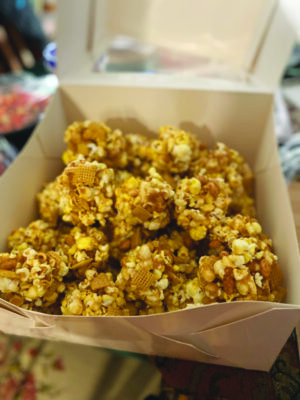
Popcorn balls. Photo by John Fladd.

In a saucepan, combine sugar, corn syrup, butter, and water, and cook over medium-low heat until it reaches 295°F (“hard crack” stage), stirring occasionally. When the sugar syrup has come to temperature, stir in the vanilla, salt and chili powder.

Pour the hot sugar mixture over the popcorn, cereal and peanuts, and mix to combine with a lightly oiled wooden spoon or silicone spatula. Most of the peanuts will have fallen to the bottom of the bowl, so take care to flip the caramel corn over once or twice while you stir, to make sure they are incorporated.

With lightly oiled hands, or lightly oiled gloved hands, break off 2- to 3-inch blobs of the popcorn mixture, gently shape them into balls, and place them on a baking sheet covered with parchment paper or a silicone mat. You will have to work fast — the caramel will be very hot, so you’ll have to let it cool a little, but will also be in a race to form the balls before the mixture sets up too much. You will end up with 30 or so balls.

Store these in an airtight container for three or four days, but they are best on the first day, when the popcorn is still crisp.

Popcorn Vodka

Popcorn has a distinct flavor that lends itself to infusing into alcohol. Vodka is a good choice for this, because it is generally neutral in flavor and will let the taste of the popcorn shine through.

popcorn – either freshly popped or movie-style from the supermarket or even from a movie theater

1 bottle of vodka – because you will be infusing it with a flavor that would overwhelm any subtleties in the vodka, a mid-range vodka will be best for this; I like Gordon’s or Mr. Boston. Avoid the very cheapest vodka, which might have off-flavors and taste chemically.

You know that hole in the lid to your blender that you’ve always wondered about? You finally get to use it. Pour the vodka into the jar of your blender, and add about an equal amount — by volume — of popcorn. Put the lid on the blender, and blend the popcorn and vodka together on the lowest setting. Once the initial popcorn has been pulverized, go ahead and add more through the hole in the lid, a handful at a time. Stop from time to time, to check on your progress.

Popcorn Vodka. Photo by John Fladd.

When the popcorn fragments and the vodka seem to take up the same amount of space, pour the mixture off into an airtight container, and put it somewhere cool and dark for two to three days, shaking it occasionally.

After the vodka and popcorn have had time to get to know each other, pour the mixture through a fine mesh strainer, then through a coffee filter in a funnel, into an empty bottle — maybe the original one that the vodka came in, labeled with the date and a short description, so in a couple of weeks, when you find a faintly yellow bottle of alcohol, you’ll remember what’s in it.

Variation: If you’re an impatient sort of person, you can speed the infusion process up by putting your airtight container in a hot water bath. Let it soak at 150°F for two hours, then strain and filter, as above. This is an excellent use for a sous vide, if you have one. Be aware that if you use actual movie theater popcorn for this hot water bath technique, your final product will be a golden yellow color, from the artificial color the theater or supermarket uses in its “butter.”

A cocktail for your Popcorn Vodka: A Caramel Corn Daisy

  • 3 ounces popcorn vodka (see above)
  • 1 ounces fresh squeezed lemon juice
  • 1/2 ounce maple syrup, the darkest you can find – the darker the syrup, the more mapley it will taste

Combine all ingredients over ice in a cocktail shaker. Shake thoroughly, and strain over fresh ice in a rocks glass.

Maple and lemon are the dominant flavors in this drink, with the popcorn bringing up the rear, leaving you with a subtle popcorn flavor between sips.

Cinnamon Caramel Corn

This fire truck red corn gets its flavor and color from hot cinnamon candies. This is another recipe adapted from Bob’s Red Mill with the addition of some Szechuan pepper.

  • 8 cups (around 200 g) freshly popped or movie theater-style popcorn
  • A 9-ounce (255 g) box of “hot” cinnamon candy (like Hot Tamales or Atomic Fireballs)
  • 2 cups (237 g) light corn syrup
  • 2 teaspoons Szechuan peppercorns, crushed

Preheat oven to 250°F. Cover a baking sheet with parchment paper or a silicone baking mat.

Measure the popcorn into a large bowl, and set aside.

In a medium saucepan, cook the cinnamon candies, corn syrup, and Szechuan pepper to 235°F; stirring often. When it has come to temperature, pour the mixture over the popcorn, and stir to combine with a lightly oiled silicone spatula. The candy will set up quickly, so this requires haste.

Spread the cinnamon corn on your baking sheet, and bake for an hour, stirring every 15 minutes. Remove from the oven to cool, then break into small pieces.

The flavor of this popcorn is much as you’d expect. It tastes like cinnamon candies. The surprise is in its texture. Baking it has made the popcorn crispy, which contrasts with the toffee-like chewiness of the candy coating. Milk and cookies are a classic to leave for Santa; this, paired with a caramel corn cocktail, could be an alternative.

Miso Caramel Popcorn

Miso is a fermented soybean paste. Its salty, funky nature provides a good counterpoint to the sweetness of caramel. The original recipe is adapted from a recipe on the Food and Wine website.

  • 9 cups (90 to 95 g) freshly popped or movie-style popcorn
  • 6 Tablespoons (1½ sticks) butter
  • ½ cup (99 g) packed brown sugar
  • ¼ cup (4 Tablespoons or 60 g) white miso
  • 2 Tablespoons light corn syrup
  • 1 teaspoon toasted sesame oil
  • sea salt
  • ½ teaspoon baking soda
  • 3 Tablespoons sesame seeds

Measure popcorn into a large plastic or glass bowl, and set aside.

Toast the sesame seeds in a dry pan over medium-low heat, stirring or tossing continuously. They will deepen in color and release a nutty flavor. As soon as the seeds have darkened to a tawny color, like a lion, transfer them immediately to a plate to cool. If you keep them in the pan, they will continue to cook and might burn.
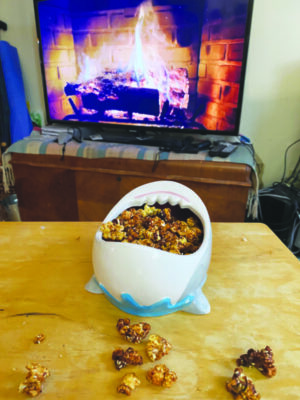
Miso Caramel Popcorn. Photo by John Fladd.

In a small saucepan, combine the butter, brown sugar, miso, corn syrup, sesame oil, and ½ teaspoon of salt. Cook over medium-low heat until the butter has melted and the mixture is bubbling. Whisk in the baking soda. This will make the caramel foam up; it’s supposed to.

Pour the miso caramel over the popcorn, and stir to combine with a lightly oiled silicone spatula. Add the sesame seeds you toasted earlier, and stir it again.

Place the bowl in your microwave, and cover it with a paper towel, to keep any splatter contained. Any drops of caramel that splash onto the sides or ceiling of your microwave will bond there like industrial concrete.

Cook the popcorn in your microwave for 1½ minutes.

Turn the popcorn out onto a baking sheet covered with parchment paper or a silicone mat, and sprinkle with more salt. Allow it to cool for 15 minutes before breaking it into pieces and serving.

French Onion Popcorn

This combines the best of two classic snacks, popcorn and chips and dip.

  • 8 cups (80 to 90 g) freshly popped or movie-style popcorn
  • 6 Tablespoons (¾ stick) butter, melted and cooled
  • 1 ounce dry onion soup mix (about half a standard 2-ounce packet)

This is about as simple as it gets. It hardly seems fair to call this a “recipe.”

Measure the popcorn into a large bowl.

Pour the melted butter over it, stirring to combine.

Sprinkle half the soup mix over the popcorn and stir to combine, then repeat with the remaining soup mix. Serve with beer, or better yet, Champagne.

News & Notes 24/12/19

18+ only

According to a press release, The New Hampshire Lottery and the National Council on Problem Gambling collaborated for a Gift Responsibly Campaign to remind the public that holiday-themed scratch tickets and other lottery games are not appropriate for children under the age of 18.

In a statement, Executive Director of the New Hampshire Lottery Charlie McIntyre said, “we want to share a critical reminder for gift givers that all lottery games, including holiday-themed games, are only for those 18 years of age and older. While lottery games and scratch tickets are great gifts, they should not be gifted to minors. There are many risks to gifting underage people lottery tickets and it is critically important the New Hampshire Lottery and the National Council on Problem Gambling work together to keep lottery games in the appropriate hands.”

According to the same release, the New Hampshire Lottery restricts underage lottery play by including a printed reminder on each product showing all players must be 18 to play, and New Hampshire Lottery retailers are trained to verify lottery game customers’ ages with a photo ID prior to finalizing a sale.

Funding for families

According to a press release, Concord Hospital Health System (CHHS) has received more than $353,000 in grants and donations to enhance maternity, prenatal and postnatal ob/gyn patient care across central New Hampshire, and these gifts contribute to a $2.8 million campaign supporting major renovations at The Family Place at Concord Hospital, innovative pilot programs and critical resources for families.

In a statement, Melissa Devine, the director of women and children’s value stream at The Family Place at Concord Hospital, said that “a unique aspect of The Family Place at Concord Hospital is patients remain in the same room through every stage of labor, delivery, and recovery. The upgrades will enhance that unique experience, ensuring families thrive in a safe and inviting environment during their stay.”

Some specifics of the funding include The Family Place Renovations: $250,000 from an anonymous donor, $40,000 from The Abbie F. Mosely Charitable Trust, Citizens Bank, N.A., Trustee, $17,445 from The Jessie Gould Fund of the New Hampshire Charitable Foundation, and $2,500 from Bruce Dyke, according to the release.

In a statement, Mario Rosario, practice manager, said, “we established a Maternity Comfort Closet at Concord Hospital Obstetrics and Gynecology in Laconia to support parents. It provides newborn clothing and other essentials to help families prepare for their baby’s arrival and address the need for basic necessities in a meaningful way.”

Lorax tax

According to a press release, the New Hampshire Department of Revenue Administration (NHDRA) is increasing education efforts for landowners, municipalities and loggers to help them understand and follow New Hampshire’s laws and regulations regarding logging and timber harvesting.

The NHDRA recently developed and introduced a guide on New Hampshire’s Timber Tax, which is accessible on the NHDRA website and provides an overview of the tax and how it is assessed, while also providing links and directions to forms, resources and additional information, according to the release.

New Hampshire’s forest products industry generates more than $1.6 billion annually in direct economic impact and sustains more than 7,000 jobs according to the University of New Hampshire Cooperative Extension’s most recent Forest Products Industries’ Economic Contribution report, and with more than 80 percent of the Granite State covered by trees, the total economic output from our forests from direct, indirect and induced economic impact and from forest-based recreation exceeds $2.5 billion, according to the press release.

Logging occurs year-round but winter is traditionally when loggers are most active, and forestry is New Hampshire’s oldest land-based industry, dating back to the 1600s.

New Hampshire legislators enacted a Timber Tax in 1949 “for the purpose of encouraging conservation of the forest resources of the state”and each municipality is responsible for assessing the Timber Tax on the landowner of the property from which the lumber is harvested, according to the release.

The Timber Tax is set at 10 percent of the “stumpage value” — the value of wood, measured per thousand board feet of saw logs or tons of pulpwood — at the time of cutting, according to the same release.

One penalty known as “doomage” provides that the municipality may assess two times what the tax would have been if the report of wood cut had been filed accurately and on time, according to the release.

DRA has several resources for landowners, municipalities and loggers on its website, revenue.nh.gov/taxes-glance/timber-tax, such as details on how the Timber Tax is assessed, necessary forms, a series of Frequently Asked Questions, and links to partner organizations, including the New Hampshire Timber Owners Association and the New Hampshire Department of Natural and Cultural Resources, according to the release.

Those interested can also call 230-5950 or email timber@dra.nh.gov for assistance.

“Coming Home” is an art exhibit at the Community Art Gallery in the Feed Loft at the Canterbury Country Store (3 Center Road, Canterbury) where artists explore the meaning of home. It’s free to view. Visit canterburycountrystore.com or call 783-9933.

Capitol Center for the Arts in Concord (225-1111, ccanh.com) will be hosting The Heather Pierson Trio as they play a Charlie Brown Jazz Christmas on Saturday, Dec. 21, at 2 and 7 p.m. at the BNH stage.

Lucy’s Voice, a mystery novel by J. Dennis Robinson, will have its launch at the Woodman Museum (182 Central Ave., Dover) on Friday, Dec. 20, from 6 to 7:30 p.m. with remarks from the author as well as book signing in the Museum’s Thom Hindle Gallery. Call 742-1038 or visit jdennisrobinson.com.

Gifts for music fans

Cool stuff to light up the season

From vinyl to attire, books and trinkets, there are many ways to make a music fan happy with the perfect holiday gift. Here are some ideas crossing genres and eras, including a few for local music aficionados.

musical note shaped gadget with cat face painted on
Otamatone

Making music is fun, especially when it’s easy. One option is the Otamatone, which is shaped like an eighth note and sounds like the spawn of a synthesizer and a slide guitar. The emotively adorned Aggretsuko Rage version is $44.99 at hamee.com.

Or spring for the $159 Orba 3, Artiphon’s latest iteration of its music-in-the-palm-of-your-hand synthesizer, which starts with a massive library of drum sounds and adds sampling for miniature magic. Artiphon also makes the keyboard-shaped Chorda, both a standalone synthesizer and MIDI controller ($249.99 at artiphon.com).

For listening to music, headphones are a great gift that can range in price from the reasonable and well-regarded Status Audio 3ANC, the first in-ears with a dedicated bass speaker ($179, status.co). Audiophile legends Bang & Olufsen just introduced its high-end Beoplay H100 cans ($1,549, bang-olufsen.com) for the truly nice person on your list.

Affordable tabletop surround sound is available with the Ultimate Ears Wonderboom 4 portable Bluetooth speaker, a compact yet powerful unit costing $80 at most stores. For heavier listening, the 6-pound Marshall Acton III is a boomer that will evoke the giant amp it’s named after ($227.99 at amazon.com).

rectangular speaker
Marshall Acton III

For something completely different in the portable speaker category, Uncommon Goods has a combination water bottle and Bluetooth unit that’s perfect for pop-up parties. It’s quite popular, though, and as of this writing it was sold out on the store’s website. Check for restocking at uncommongoods.com, a great stop for other gifts.

Speaking of one-stop shopping, it’s axiomatic that the best way to support local music is buying direct from your favorite artists. For those who can’t attend every show, the best alternative is the Bandcamp website (bandcamp.com). There, area bands make most of the money, unlike Spotify, where the CEO is richer than any musician on his site.

If your list includes a dedicated collector of vinyl albums, consider gifting them a Spin-Clean cleaning kit. Its $125 price tag may be too lofty; if so, there are some cheaper options available. The Discwasher D4+ Record Care System is the granddaddy of the bunch, dating back to the ’60s. It’s $25.

Of course, your giftee will need records to clean with their new gear. 2024 doesn’t disappoint. For the Swiftie on your list, Target offers a bunch of exclusives, including a double album of songs from The Tortured Poets Department with a bonus track (“The Manuscript”) on clear vinyl for $32.99. Give it with a copy of the massive Official Taylor Swift The Eras Tour book ($39.99) and you’ll be a hero.

For fans of an earlier era, the debut LP from an influential New Wave band recently received a deluxe treatment. Talking Heads: 77 introduced songs like “Psycho Killer” and “Uh-Oh, Love Comes to Town” while hinting at adventurous music to come. The four-CD set has goodies including outtakes, Atmos mixes and a full-length CBGB show from October 1977.

Elvis Costello was another artist who evolved from that period, moving from angry young man to reverent roots-music adherent. The six-CD King Of America & Other Realms Super Deluxe begins with the 1986 album and includes new songs, along with beauties like a Grand Ole Opry performance of “The Scarlet Tide” from the Cold Mountain soundtrack accompanied by Emmylou Harris, Gillian Welch and Dave Rawlings, and duets with Ralph Stanley and Larkin Poe.

Playing cards

While physical tickets have mostly been displaced by cell phone barcodes, dedicated concertgoers usually have a big collection of stubs. For those, consider a Ticket Stub Diary for preserving those memories. It will give them something to share with their children and grandkids one day ($29, uncommongoods.com).

Finally, let’s not forget stocking stuffers. Uncommon Goods is a great source for things like music playing cards with drawings of David Bowie, Jimi Hendrix and other rock stars. Mistaken Lyrics Coasters are fun if you’ve ever misheard this U2 song: “It’s alright, it’s alright, it’s alright / Shamu, the mysterious whale.” Or get a mahogany thumb piano for your favorite fan.

Featured photo: Courtesy photo.

Books to give

Looking to gift a book? Here are some of the books our reviewers loved this year:

William, by Mason Coile I don’t like horror, but I loved this absorbing, disturbing little book. —Jennifer Graham

Funny Story, by Emily Henry This isn’t all fluff and love, and I don’t think I rolled my eyes once. It is definitely funny, but it’s so much more than that, too: It’s a story of human relationships and all of the messiness and intensity that come along with them, how they can start and end in the most unpredictable ways, and how we all have the capacity to overcome heartbreak and learn to love again. —Meghan Siegler

Playground, by Richard Powers This novel wants us to to think deeply about the unintended consequences of the development of AI and human dominance of the planet as we wade through the events of each character’s life, laid out in constantly changing points of view. For those willing to rise to the challenge Playground is a wholly immersive experience [that] gives the reader a mental workout. —JG

The Women, by Kristin Hannah Hannah superbly blends the heaviness of war with the frailty of humans at their most vulnerable — and often at their best. —MS

Bird Milk and Mosquito Bones, by Priyanka Mattoo Mattoo’s writing is exquisite …. It’s been a while since I enjoyed a collection of essays so much. —JG

The Demon of Unrest, by Erik Larson Larson tells stories that explain the onset of the Civil War better than any AP history course ever could. Nobody does it better when it comes to putting readers in the trenches of history, in this case with cannonballs whizzing over our heads. —JG

And here are a few more recent releases that may make good gifts.

What the Chicken Knows: A New Appreciation of the World’s Most Famous Bird, by Sy Montgomery (96 pages) Montgomery is also the author of The Soul of an Octopus and other books about animals. She lives in New Hampshire.

Heartbreak is the National Anthem: How Taylor Swift Reinvented Pop Music, by Rob Sheffield “An impassioned dissertation on (almost) all things Swiftian,” says the Washington Post of this book by a veteran Rolling Stone writer.

Atlas Obscura: Wild Life, by Cara Ciaimo and Joshua Foer A guide to giant Gippsland earthworms, hot springs snow monkeys, vampire finches and other amazing creatures of the world. “The perfect tome to get lost in on a rainy day,” said Taste of Home. Check out AtlasObscura.com.

Webb’s Universe, by Dr. Maggie Aderin-Pocock A catalog of images from the James Webb Space Telescope along with backstory on the science behind them, from a British space scientist.

Kitchen toys

Gifts for all budgets and levels of culinary nerdery

If you’ve been trying to think of a holiday gift for the cook, baker or mad scientist in your life, here are a few suggestions that you might not have thought of.

Anova Sous Vide starting at $69.99 at anovaculinary.com. A sous vide is a fun toy for a kitchen gadget enthusiast. Originally designed for use in science labs, it keeps a water bath at a constant temperature, allowing a cook to bring a food to an exact temperature. If, for instance, you want to have a boiled egg with a yolk at just the right level of runniness, this will help you do it. If you want to pasteurize a particular food at an exact temperature, boom! Anova sous vides clamp onto the side of any deep vessel, like a soup pot, and are controlled via an app on your smartphone. Search for “sous vide” on YouTube, and you will be hooked.

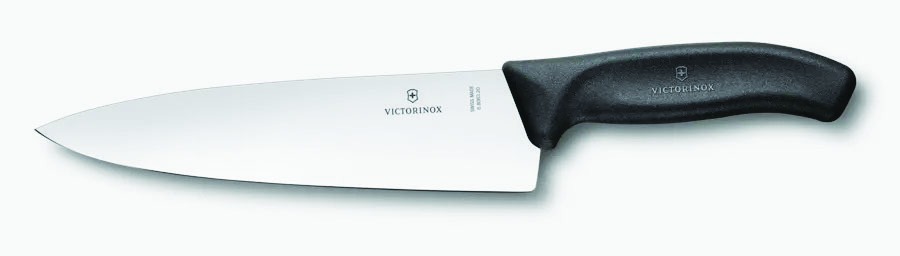
Victorinox Swiss Classic 8-Inch Chef’s Knife with Straight-Edge Blade and Black Handle $61 at victorinox.com.The best, most useful tool in any kitchen is a sharp, high-quality chef’s knife. Watch any non-baking cooking competition, and most of the contestants will make a bit of a production of unrolling their canvas knife carrier. Victorinox is the company that makes Swiss Army Knives, and this is their beginner’s kitchen knife that is perfect for culinary students and 98 percent of the rest of us. It is comfortable in the hand, holds an edge well, and chops, cuts and slices like a dream. Send it out to be sharpened two or three times per year, and the cook on your list will be 15 to 18 percent happier in the kitchen.

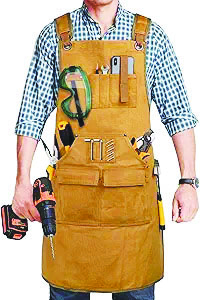
product photo of man wearing toolshop apron filled with woodworking and  repair tools
Shop apron

Apron. A good apron is a necessity in any kitchen and probably gives a cook the most latitude for self-expression. There are classics, like a solid or pinstriped professional apron available from any restaurant supply store, or the iconic “Kiss the Cook” apron. You can easily find aprons designed to reflect any personality, from the NRA to NPR, from a favorite sports team to obscure anime characters. Personally, I love my shop apron, originally designed for woodworkers; it is made from sturdy canvas and has more pockets than any one cook is likely to need.

Bar tools about $25 online or from a restaurant supply store. Almost any chef will tell you to buy your pots and pans or knives individually, rather than in a set, so you get exactly the tools you need and very few of the ones that will sit around cluttering up your cabinet. If you are shopping for someone looking to learn how to mix drinks, there are four basic tools that will allow them to make virtually any cocktail: a Boston shaker (a two-part big cup and little cup for shaking drinks with ice), a long-handled bar spoon for drinks like martinis that shouldn’t be shaken, a small strainer (I like a simple $3 mesh drain strainer; it fits well over almost any glass) and a hand-held citrus juicer. Any of these will make good stocking stuffers, or as a set, with a bottle of liquor, they will be an excellent wrapped present.

The Flavor Bible: The Essential Guide to Culinary Creativity, Based on the Wisdom of America’s Most Imaginative Chefs by Karen Page and Andrew Dornenburg (2008, Little, Brown and Co.) hardcover $45. This reference book is the authoritative guide to pairing flavors with each other. It is perfect for the cook in your life who enjoys developing their own recipes.

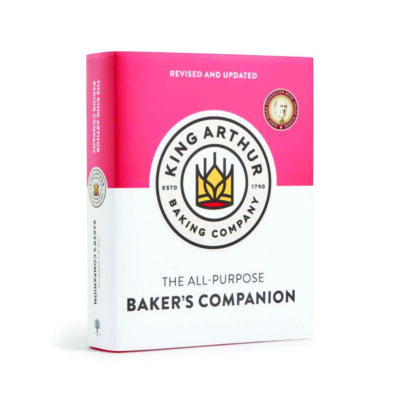
product image of King Arthur Baking Company book, titled All purpose baker's companion

The All-Purpose Baker’s Companion by King Arthur Baking Co. (2021, Countryman Press) hardcover $40. Cooking is fun, because most of the time you can throw things together on a whim and see how they work together (especially if you own a copy of The Flavor Bible). Baking can be intimidating, because recipes need to be exact to achieve the chemical reactions needed to produce proper cookies, cakes and breads. Every recipe in this book has been rigorously tested by the staff at King Arthur. There are chapters devoted to technique, and the science of baking, and useful, easy to understand charts and descriptions of tools and ingredients.

Cast-iron Dutch oven starting at $34.95 at lodgecastiron.com. A cast-iron Dutch oven is the Swiss army knife of kitchen pots. It is perfect for braising a pork shoulder, deep-frying corn fritters or baking a loaf of sourdough bread. Many cooks prefer Dutch ovens that have been coated with enamel, but properly seasoned, a plain iron one will give several generations’ worth of service. Lodge is the go-to for cast-iron cookware. You could easily spend $400 or more for a French, enameled Dutch oven and worry about damaging it, or you can spend less than $100 for a no-nonsense one that you can break out the same morning you unwrap it.

An expensive, over-the-top kitchen gift: A KitchenAid Stand Mixer starting at $249 at KitchenAid.com. A KitchenAid mixer is the gold standard of kitchen tools. It will probably work perfectly for 30 years or more, and if it ever does break down KitchenAid will happily repair it, often under warranty. They are available in a range of colors and sizes, and a short search online will reveal an infinite number of decals to personalize your mixer. This is a solid investment. KitchenAid sells reconditioned mixers for as little as $200, and you can find them for even less at flea markets. Because of their sterling reputation, an old used KitchenAid carries as much cachet as a new one, maybe more.

A completely ridiculously expensive holiday kitchen gift: A Reconditioned Taylor Commercial Soft-Serve Ice Cream Machine with Three-Flavor and Twist Capability $8,995 at New Hampshire Restaurant Equipment (783 Second St., Manchester, nhrestequip.com). Is it ridiculous to spend $9,000 on a soft-serve machine? That depends. Is it more ridiculous than parking a new car with one of those giant red bows on it in your driveway? If you want a perfect, once-in-a-lifetime present for the soft-serve extremist in your life, this is it. When other parents are bringing trays of brownies to a PTA fundraiser, your newly retired father will be selling his patented mango-fudge ripple ice cream and slipping freebies to kids when their parents aren’t looking.

Looking to give a cookbook? Here are a few standout recent releases.

America’s Test Kitchen 25: 500 Recipes That Change the Way America Cooks (2024, America’s Test Kitchen) This book feels like it could be a winner with kitchen novices and your family’s best cook — you get cast Q&As and discussions of some dishes as well as “why it works” explanations and thorough methods for every dish.

Bake Club, 101 Must-Have Moves for Your Kitchen by Christina Tosi and Shannon Salzano (2024, Alfred A. Knopf) Tosi, of Milk Bar fame, is a fun baker who makes fun things — in this book that includes Ice Cream Loaf Cake, Cinnamon Buns with Brown Sugar Goo and Pop Rocks.

Easy Weeknight Dinners from New York Times Cooking by Emily Weinstein (2024, Ten Speed Press) The New York Times Cooking recipes are almost as sure-bet as America’s Test Kitchen; the pico de gallo (made to go with hot dogs) is already one of my go-tos.

Pan Y Dulce, The Latin American Baking Book By Bryan Ford (2024, Voracious Books) Even breads and desserts that seem specific to one country or region — a Chilean bread, a Mexican cookie — have history that weaves together native ingredients and methods, colonial influences and often origins even beyond Spain or Portugal, as Ford explains.

My Mexican Kitchen by Eva Longoira (2024 Clarkson Potter) Taking the Stanley-Tucci-in-Italyapproach to food in Mexico on her CNN show, Eva Longoria has become one of my favorite aspirational food exploration people, both on her show and in her podcast, Hungry for History.

Turkaz Kitchen, Traditional & Modern Dough Recipes for Sweet & Savory Bakers by Betül Tunç (2024, Ten Speed Press) Tunç gained a following for her bakes on Instagram but what grabbed me about the book was that it both offers Turkish bakes (Turkish Pistachio Baklava, the sesame and molasses coated Simit) and things like Raspberry Key Lime Bars, Beef Empanadas with Salsa Roja and Salsa Verde, and Garlic Naan.

What Goes with What: 100 Recipes, 20 Charts, Endless Possibilitiesby Julia Turshen (2024, Flatiron Books) On their own, this book’s charts are a valuable resource, breaking down something like a sandwich into its parts — bread, main thing, creamy layer, crunchy layer and extra acidic thing — and then giving suggestions for what each thing could be used to create, for example “Best Ham Sandwich.” We get her recipes to go with these charts.

When Southern Women Cook edited by Morgan Bolling (2024, America’s Test Kitchen) You normally don’t read cookbooks cover to cover but this book, as much a history book as a cookbook, is an exception. You get the stories of a dish, and its many variations, and ingredients and their connections to Native, African, Latin, European and Asian cultures and specific women who had a hand in popularizing the foods. — Amy Diaz

Give the gift of fun

Give memberships to local museums

Compiled by Zachary Lewis
zlewis@hippopress.com

Give a year of experiences with membership to an area museum. Many of the museums listed here are geared to families or have family-fun activites, making membership a yearlong gift for families looking for something to do (and to maybe sneak in a little learning). Up the fun factor by adding a gift from the gift shop.

SEE Science Center (see-sciencecenter.org, 669-0400, 200 Bedford St., Manchester) Memberships are available as gifts and gift cards are available too. Membership plans range from $30 to $150 per year. All membership levels include priority admission and discounts to SEE special programs and summer camp; $50 discount on a child’s birthday party at SEE; 10 percent off purchases at the SEE gift shop over $10; and reciprocal membership with the Millyard Museum, which is in the same building. Membership also includes occasional special benefits; for example, in January 2025 SEE members may save on admission fees at the Seacoast Science Center in Rye, and in May SEE members can receive free admission for up to four people one time at the Squam Lakes Natural Science Center in Holderness.

The SEE Science Center is open from Tuesday through Friday, 10 a.m. to 4 p.m. with last admission 3 p.m., and Saturday and Sunday, 10 a.m. to 5 p.m with last admission at 4 p.m. SEE will be closed on Tuesday, Dec. 24, and Wednesday, Dec. 25, but will be open on select Mondays and holidays/school vacations including Mondays, Dec. 23 and Dec. 30. The SEE Gift Shop has science souvenirs, books, science kids and other toys.

McAuliffe-Shepard Discovery Center (2 Institute Drive, Concord, starhop.com, 271-7827) Membership packages range from $35 a year to $300 a year depending on the level; a family membership, for example, admits a member and four guests and costs $120 per year. All member levels are 10 percent off until Saturday, Dec. 14. They will have special shopping hours from Monday, Dec. 16, through Friday, Dec. 20, and the Science Store gift shop will be open from 10:30 a.m. until 4 p.m. each day (the exhibits and planetarium will be closed on those days).

According to their website, all membership levels include free admission to the Discovery Center exhibit halls, the Science Playground, and regularly scheduled planetarium shows; free admission to their monthly Super Stellar Fridays series; and free or reduced admission to more than 300 science centers that are part of the Association of Science-Technology Centers (ASTC) reciprocal program. Membership also includes discounts on Discovery Center workshops and programs, and discounts at the Science Store. For more information contact Kelly Thompson at kthompson@starhop.com or call 415-1657.

At the Science Store, find a variety of space- and science-themed toys and items including stuffed spacecraft and space-themed socks.

The Aviation Museum of New Hampshire (27 Navigator Road, Londonderry, 669-4820, aviationmuseumofnh.org) This museum dedicated to the science, technology, history and culture of aviation features interactive exhibits and educational programs. Youth programs include the ‘Flights of Discovery’ Summer Camp as well as the high school student plane-building project.

Membership is open to anyone, and membership benefits include free admission to the Aviation Museum; a subscription to the quarterly Aeronaut publication; borrowing privileges in the Slusser Aviation Lending Library; regular email updates about museum activities and events; and a 20 percent discount at the Aviation Museum store, according to the Museum’s website.

Individual memberships are $50 and a membership for two is $100. Three premium levels of membership range from $250 to $1000.

The Aviation Museum is open Friday and Saturday, 10 a.m. to 4 p.m., and Sunday, 1 to 4 p.m. It is open to appointments or private group tours as well. Admission costs $10 for adults, $5 for seniors age 65 and over, veterans, active duty and kids ages 6 through 12, and is free for kids age 5 and under, with a $30 maximum for families.

The gift shop will be open from 10 a.m. to 4 p.m. daily Monday, Dec. 16, through Sunday, Dec. 22. The shop features airplane and aeronautical themed toys and stuffed animals as well as museum merch.

The museum also sells Heritage Trail passports which cost $30 and offer one free admission each to 21 New Hampshire museums (see nhmuseumtrail.org).

The Children’s Museum of New Hampshire (6 Washington St., Dover, 742-2002, childrens-museum.org) This family museum features unique interactive exhibits with a focus on art, science and culture.

The Children’s Museum has various membership levels, according to their website. A family membership is $125 and allows unlimited visits to CMNH for one year for two parents and their dependent children under 18 living in the same household; 10 percent off museum shop purchases, classes, camps, and museum rentals; and pre-sale access and invitations to special events. Guest options can be added to a membership. You can also gift one-time passes for $12.50 each.

The museum offers a variety of special programs throughout the year. Coming up: Jingle Bell Extravaganza will take place on Sunday, Dec. 22, at 1 and 3 p.m. Participants will meet Santa for a photo opportunity and receive a special gift, and there will be hands-on holiday craft activities and a magical science experiment. Tickets are $18 for members, $22 for nonmembers, and free for kids under 12 months.

On Tuesday, Dec. 31, parents, children and extended families can “ring in 2025 together while the sun is shining” at the Museum’s Family New Year’s Eve Celebration. The countdown to midnight will be held at 10:30 a.m. during the morning play session and at 2 p.m. during the afternoon play session. Tickets are $6.50 for members, $13 for nonmembers, and free for kids under the age of 12 months.

Museum hours are Tuesday through Sunday, 9 a.m. to noon, with an additional session from 1 to 4 p.m. Wednesday through Saturday. The gift shop features games, toys, a variety of kinds of putty, stuffed animals and more.

Currier Museum of Art (150 Ash St., Manchester, 669-6144, currier.org) The Currier is open Wednesday through Sunday from 10 a.m. to 5 p.m. Children 12 and under always have free gallery admission.

The second Saturday of each month from 10 a.m. to 1 p.m. is designated for special art-making activities whole family designed to relate to an exhibition or the collection, complemented by a 20- to 30-minute interactive family tour devoted to the month’s theme.

Currier Museum membership grants special access to exhibitions, invitations to special events, and a behind-the-scenes look at art. Individual membership costs $65 and includes unlimited free admission; invitations to member-only openings and events; 10 percent discount at the Museum Shop, café, and art classes; a special price for Frank Lloyd Wright tours; and one free admission pass for a friend. College students with a valid ID and seniors 65+ save $5 on an individual membership.

Dual membership costs $100 and applies to two adult cardholders. Seniors 65+ save $10 on a dual membership.

Household membership costs $120 and includes unlimited free admission for two adult cardholders and all family members under 18; two additional free general admissions for accompanying guests for each visit; invitations to member-only openings and events for the two cardholders; a special price for Frank Lloyd Wright tours; a 10 percent discount at the Museum Shop, café, and art classes; and two free admission passes for friends. Other membership levels range from $300 to $900. The museum shop offers gifts for all ages.

The Millyard Museum (200 Bedford St., Manchester, manchesterhistoric.org, 622-7531 ) The Museum has two games that can be printed off or picked up at the museum: the Millyard Museum Fun Book, which has word searches, drawing, and more, and Mystery Objects, which is an I Spy-type scavenger hunt.

Admission is $10 for adults, $8 for seniors and college students, $5 for children between the ages of 12 to 18, and free for children under 12; Manchester Historic Association members are admitted at no charge. The Millyard Museum is generally open Tuesday through Saturday, 10 a.m. to 4 p.m.

Membership categories range from $40 to $1,000. A family/duel membership (covering a household) costs $75. Membership benefits according to the website include unlimited visits to the Millyard Museum and MHA Research Center; notice of exhibits, lectures, walking tours, concerts and special events; free or discounted admissions to MHA programs and events; special invitations to exhibit previews and special members-only events; 10 percent or greater discount on research services, photocopies and photograph orders and on purchases in the Museum Shop, and more. The museum shop sells a variety of items including Manchester and New Hampshire history-related books and souvenirs, old-fashioned kids’ toys and the Association’s 2025 calendar (which costs $18).

Henry can be reached at henry.homeyer@comcast.net. His column appears here monthly.

Stay in the loop!

Get FREE weekly briefs on local food, music,

arts, and more across southern New Hampshire!