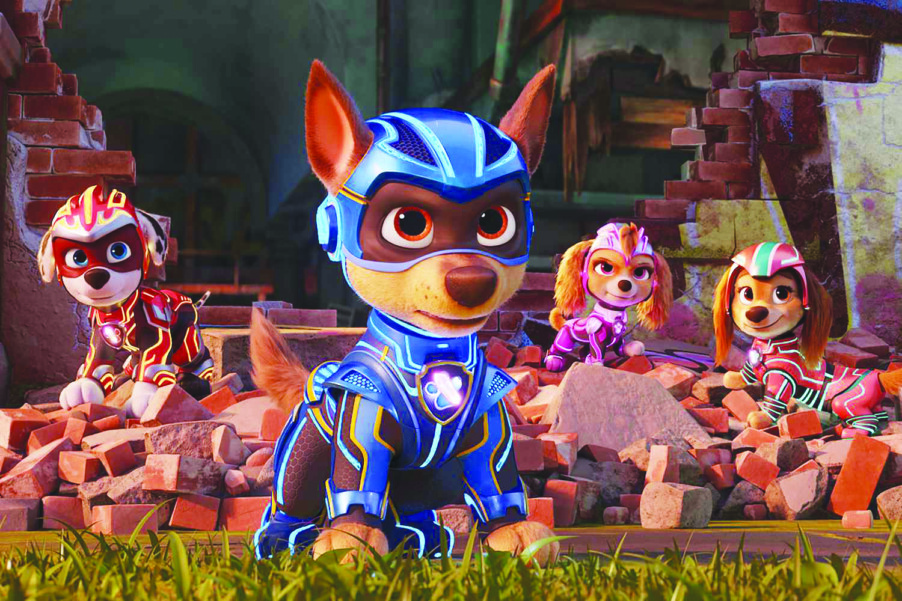
The pups of the Paw Patrol get superpowers and spiffy new outfits and vehicles — each sold separately— in the feature-length animated Paw Patrol: The Mighty Movie.
You (or really, your kids) don’t need to be knowledgeable in Paw Patrol lore to get the movie’s premise: Human child Ryder (voice of Finn Lee-Epp) is the leader of a team of puppies who can talk and ride around in vehicles serving as their community’s emergency response. It is, as the movie itself says, weird but go with it. The pups are police dog Chase (voice of Christian Convery); fire dog Marshall (voice of Christian Corrao); construction bulldog Rubble (voice of Luxton Handspiker); recycling dog Rocky (voice of Callum Shoniker); water rescue dog Zuma (Nylan Parthipan); airplane-flying dog Skye (voice of Mckenna Grace), who was the first core-team girl dog and the pup who gets the backstory in this movie, and Liberty (voice of Marsai Martin), another girl dog who first showed up in the first movie. In the TV show, the pups live in Adventure Bay — in the movies, the action is in Adventure City, which is similar but with tall buildings.
The movie’s first big mission for the pups is putting out fire at a junkyard where someone has stolen a giant crane with a magnet on it. The pups save the day, of course, but the missing big magnet suggests further plots afoot. Victoria Vance (voice of Taraji P. Henson), a mad scientist, plans on using the magnet to help catch a meteor that she’s discovered has some sort of power source in it. Rather than pull the meteor to her, she ends up sending it right to the heart of Adventure City and right into the Paw Patrol’s Ultimate City Tower Playset, which retails for $109.99 at Target — I mean, the Paw Patrol’s headquarters, where it smashes through the tower and onto the city’s main street, sending out pulses of energy. The Patrol takes it to their Aircraft Carrier HQ, where Skye accidentally causes the meteor to crack open and reveal seven crystals. The crystals attach themselves to each pup’s pup tag and give each pup a different power, leading them to rename themselves the Mighty Pups.
Victoria Vance wanted those powers for herself. But before she can recover the crystals, she’s sent to jail for causing the meteor to crash into the city and finds herself sharing a cell with Mayor Humdinger (voice of Ron Pardo), the (former? who knows) mayor of Foggy Bottom and schemer whom the Paw Patrol are frequently having to foil.
An aside: so many questions from the scene at Adventure City’s prison, which is disturbingly large for this city where “giant magnet theft” is one of the top crimes. And yet, despite its size, a lady mad scientist is sharing a cell with a man and his cats (Mayor Humdinger has a team of non-talking kitties who are neither as skilled nor as interested in human direction as the Paw Patrol)? Doesn’t matter — we don’t stay long in Baby’s First Arkham Asylum as Humdinger and Vance team up to break out and steal the Paw Patrol’s crystals for themselves.
Along the way, we get some backstory on Skye, who is frustrated at being the smallest of the pups. And Liberty is tasked with leading a team of Junior Patrollers — three fuzzy younger puppies who want to be on the Paw Patrol some day. Their small-dog can-do spirit helps underline the Skye storyline, gives Liberty something to do and adds yet more toy-able characters.
As with all Paw Patrol content, there is no reason to subject yourself to this movie if you aren’t watching with kids. So the main question is probably what kids is this movie for? The movie is bigger, louder and more explosion-y than the TV show and has a few pup-in-peril scenes. Maybe for ages 4 and up, depending on your kid’s temperament (Common Sense Media gives it a 5+ rating) and ability to stick it out for 90 minutes in one location. There was a point, probably somewhere around the 50-minute-to-an-hour mark, where the theater where I saw this movie seemed to fill with fidgeting, walking around and light chatter — the “bathroom o’clock” that happens when a movie loses some of the kids.
Paw Patrol: The Mighty Movie is actually similar to a run of “the pups get superpowers” stories on the TV show itself. It isn’t breaking any new ground but it is a perfectly fine, familiar adventure with these familiar characters. B-
Rated PG mild action/peril, according to the MPA on filmratings.com. Directed by Cal Brunker with a screenplay by Cal Brunker and Bob Barlen, Paw Patrol: The Mighty Movie is an hour and 32 minutes long and is distributed in theaters by Paramount Pictures, where it is preceded by the colorful short Dora and the Fantastical Creatures.
Spy Kids: Armageddon (PG)
A new set of spy parents turn to their kids for help in defeating a bad guy in Spy Kids: Armageddon, a clever reboot/rebirth of the movie series.
As with previous generations of spy kids, siblings Tony (Connor Esterson) and Patty (Everly Carganilla) Tango-Torrez don’t know that parents Terrance Tango (Zachary Levi) and Nora Torrez (Gina Rodriguez) are spies. Tony’s biggest life concern is finding ways to foil his parents’ tech restrictions and get more time playing video games. Younger sister Patty doesn’t like all of his sneaking and cheating to get what he wants, though she does participate by, for example, making a map of all the floor squeaks in the hallway between the kids’ rooms and the family’s media room. This comes in handy after Tony wins (by cheating) a new game called Hyskor, which he downloads to the family’s network so he and Patty can play.
What he doesn’t realize is that his early access to the game is part of a plan by developer Rey Kingston (Billy Magnussen) to hack into the Tango-Torrez system and steal the Armageddon Code, a program that Terrance and Nora use in their OSS spy work to break into any network in the world. Kingston’s plan is to use the Armageddon Code to plant a virus in every computerized system in the world. Once in control, Kingston will force everybody to play Hyskor to do things like access their ATM or drive their smart car. The difference between Kingston and every other tech mogul trying to force their product on everybody all the time is that Kingston plans to use Hyskor to gamify teaching people to make better choices so that they will help heal the world. It’s an interesting take on the “villain was right” school of Wants to Rule the World motivations. And it’s an interesting component to Patty’s belief, as she learns about spying, that her parents’ kicky-punchy-explodey means of saving the day has long-term negative consequences and that truth and peace are a better approach to all situations than deception and butt-kicking.
Patty and Tony find out about their parents when Hyskor characters — an Aztec-giant-made-from-a-cardboard-box-looking robot called the Heck Knight and some minions with Aztec or conquistador stylings — come smashing into their home. Nora sends the kids off in a supercharged go-kart to a safe house, where they learn the rules of spying, get gadgets and a cool spy suit, and receive some spy training. Soon, the bad guys are also after Patty and Tony, who agree to help OSS, the organization their parents work for, to find their parents, who are being held at Kingston’s lair.
When I say the Heck Knight has a sort of cardboard-box-y look, I mean it in the best possible way. The movie, smartly, gives its bad guy an affinity for late 1990s video games, which allows for a certain amount of purposeful B-movie-ness in the way everything looks. It also sort of kid-ifies the scariness factor — like this is a monster-type thing we need to defeat but it’s not going to give anybody (anybody maybe 8 and up, at least) nightmares.
There is an overall good-heartedness to the action adventure here, which makes it solid family viewing. B
Rated PG for sequences of action, according to the MPA on filmratings.com. Directed by Robert Rodriguez and written by Robert Rodriguez and his son Racer Rodriguez, Spy Kids: Armageddon is an hour and 37 minutes long and available on Netflix.
The Roald Dahl Collection
Wes Anderson has directed and adapted four Roald Dahl stories as short films streaming now on Netflix: The Wonderful Story of Henry Sugar (39 minutes) and three 17-minute films — The Swan, Poison and The Rat Catcher.
All of the films have a PG rating, but I probably wouldn’t show them to kids. They definitely lean in to the darker side of Dahl’s storytelling. The movies contain some combination of Benedict Cumberbatch, Dev Patel, Ben Kingsley, Richard Ayoade, Ralph Fiennes (playing, among other characters, Dahl himself) and Rupert Friend. As you might expect from the Dahl-Anderson combination, the movies are a delight (a dark delight, but still) of artful wordiness and artful physical design. Everything from the position of people and things in the frame to the tactile nature of all the items in the scene — a typewriter, a notebook, a cup of tea — is purposeful and grabs at least a little piece of your attention. In The Rat Catcher, Fiennes’ character (the titular rat catcher) even “holds” items like a tin of poison or a ferret, neither of which are actually there but the combination of narration (sometimes by Fiennes’ Dahl and sometimes by characters in a scene) and the way the actors work pantomime the missing item makes even these things feel like some of Anderson’s self-conscious props. The sets and backgrounds are often presented as pieces wheeled in or music box-like mechanisms that fold and unfold. It all gives the films a bit of a live theater vibe, which adds to both the oddness and the charm of the stories.
Of the short films — which are all darker in tone than The Wonderful Story of Henry Sugar — I think The Rat Catcher was my favorite, with its creepy performance by Fiennes and its elements of stop-motion animation. The Wonderful Story of Henry Sugar likewise feels like Cumberbatch having fun with fourth-wall-breaking and his intensity. The movies all have the feel of someone saying, “Have at it, do your thing” to Anderson and him fully embracing that challenge. B
Rated PG for things like violent material, thematic elements, peril, language and smoking, according to the MPA on filmratings.com. Directed by Wes Anderson, who also wrote the screenplays, The Wonderful Story of Henry Sugar, The Rat Catcher, Poison and The Swan are streaming on Netflix.

Flora and Son (R)
A young woman and her teenage son find a way to talk to each other in Flora and Son, a movie from writer-director John Carney of Once fame.
And Begin Again. And Sing Street. And like those movies, Flora and Son uses music as a way out, a way for characters to unstick themselves from their turmoil and the parts of their lives that don’t work and find new ways to be. And, like those movies, Flora and Son is so much sweeter, funnier and more charming than expected.
Dublin-based Flora (Eve Hewson) is just a whisper over 30 but seems stuck in her young adulthood — perhaps because she had 14-year-old Max (Orén Kinlan) when she was a teenager. Max is perpetually in trouble and constantly angry at Flora. Flora is constantly angry at the world, easily has her temper triggered by Max and is still raw over the end of her relationship with Ian (Jack Reynor), Max’s dad, who is now living elsewhere with another woman. Flora tries to make up for forgetting Max’s birthday by getting him a gift — or rather by finding a guitar in the trash and paying to have it somewhat fixed. Max is not impressed — and over the course of the movie we learn that this may be in part because he already makes music, but largely dance music with a laptop. Flora decides on a lark to learn to play the guitar herself and finds online lessons from Jeff (Joseph Gordon-Levitt), a musician living in the Los Angeles area. Their first lesson goes all kinds of yikes with Flora flirting with Jeff and eventually asking him to play for her without his shirt on. She apologizes and convinces him to try again, and over time their lessons create a bond between them as he not only teaches her guitar but they find themselves working on one of his songs together.
One day Flora comes home to Max blaring music and is incensed — until she realizes it’s his original dance track. Together, they flesh it out, with her adding vocals to go along with his rap. While they both seem hazy on life trajectory, over music they can collaborate.
Even that description doesn’t quite capture the pleasant surprise of a movie that Flora and Son is, with characters starting out as potentially one-dimensional figures — the party-girl mom, the aimless dad, the juvenile delinquent. But, thanks not only to the way the story develops but also to solid performances all around, they quickly become more complex than that — and music doesn’t “save” them in some fairy tale way but just kind of pushes them outside their ruts in life and in their relationships with each other. A
Rated R for language throughout, sexual references and brief drug use, according to the MPA on filmratings.com. Written and directed by John Carney, Flora and Son is an hour and 37 minutes long and is distributed by Apple Films on Apple TV+ as well as in theaters. Want to check out other Carney works? 2007’s Once is available for rent and is currently streaming on the Roku channel. 2013’s Begin Again is on Netflix and available for rent. 2016’s Sing Street is on Tubi, Pluto TV and Vudu and is available for rent.
Dumb Money (R)
The internet’s hype of the GameStop stock results in huge paper fortunes for everyday investors in Dumb Money, a movie based on the book The Antisocial Network by Ben Mezrich. Which I kinda want to read now, because I feel like this story of “here is a weird thing that happened” is probably better-suited to nonfiction narrative where there isn’t some cinematic pressure to Say Something About The World We Live In.
After one of those “I’ll bet you wonder how I got here”-like flash forwards, the movie begins in the autumn of the Pandemic Era, with Keith Gill (Paul Dano) a financial analyst living in Brockton, Mass. When he isn’t working or taking care of his young daughter with wife Caroline (Shaliene Woodley), he, as a hobby, posts videos to a Reddit forum about investing. Calling himself Roaring Kitty (and also “Deep Value” with a word between Deep and Value but one day this movie will be edited for TV, so mostly the movie calls him Roaring Kitty), Keith shows his balance sheet and talks about why he likes specific stocks. Recently, he has been hot on GameStop, the video game store that he feels has been undervalued by Wall Street professionals. As he talks up GameStop, his viewers follow his lead, with their purchases pumping up the price. Eventually, GameStop becomes not just a tip several people are taking but a cause — because the stock is being short-sold by a hedge fund run by Gabe Plotkin (Seth Rogen) and because the increase in stock price is giving ordinary investors, many of them investing via the Robinhood app, crazy returns, there is a “stick it to the rich” attitude about the stock. Buy and hold — or “HODL” or “diamond hands” etc. as The Internet says — even though the first to sell would be hugely rewarded. Because one middle-class guy in his basement and one rich guy in his Miami mansion are only so compelling, we also get a peek into the lives of several of those regular-folks investors: Marcus (Anthony Ramos), who works at a GameStop; Jenny (America Ferrera), a single mom nurse; college students Harmony (Talia Ryder) and Riri (Myha’la Herrold), who are six figures in debt because of their college loans. We also meet Keith’s brother Kevin (Pete Davidson), who is largely here for comic relief and to call Keith a nerd. On the rich bro side, we also meet even richer-than-Gabe hedge fund manager Ken Griffin (Nick Offerman) and Robinhood founders Baiju Bhatt (Rushi Kota) and Vlad Tenev (Sebastian Stan), who particularly gives off a tech-guy snake oil salesman vibe.
Dumb Money has good details about this very odd point in history — all the pandemic things, the emptiness of roads and public transportation, the mask etiquette, the way a claim of “essentialness” could help a business stay open (GameStop can open its doors to the public because it sells computer mice). It’s interesting, even at this short remove, to remember just how weird this all was and how hot emotions were running about so many things. And the details about how this odd financial flash mob played out are also interesting in the “huh, interesting” sense. But the movie seems to feel a need to Say A Thing about all of this in a way that this story doesn’t really lend itself to. This story doesn’t feature a triumphant ending with all the struggling people coming out on top. Some do, some don’t. Nor are the guys the movie paints as the predatory rich particularly punished. The facts of the ending very much reminded me of the end of Burn After Reading, when the J.K. Simmons character asks “what did we learn” with no particular answer other than not to do whatever it was they did again. It’s a shrug of an ending, which is also what happens here — with a lot of “no charges filed after an investigation”-type end title cards.
Dumb Money has the feel of one of those HBO TV movies where the point is more in the accurate recounting of events than the story told. And, like those movies, it will be perfectly fine to view some lazy day from your couch. B-
Rated R for pervasive language, sexual material (which I think is just this one particularly dumb “Margot Robie in a bathtub to make you pay attention to this financial discussion” scene) and drug use, according to the MPA on filmratings.com. Directed by Craig Gillespie and written by Lauren Schuker Blum & Rebecca Angelo, based on the book, Dumb Money is an hour and 45 minutes long and is distributed by Sony Pictures Entertainment.
Featured photo: courtesy photo.