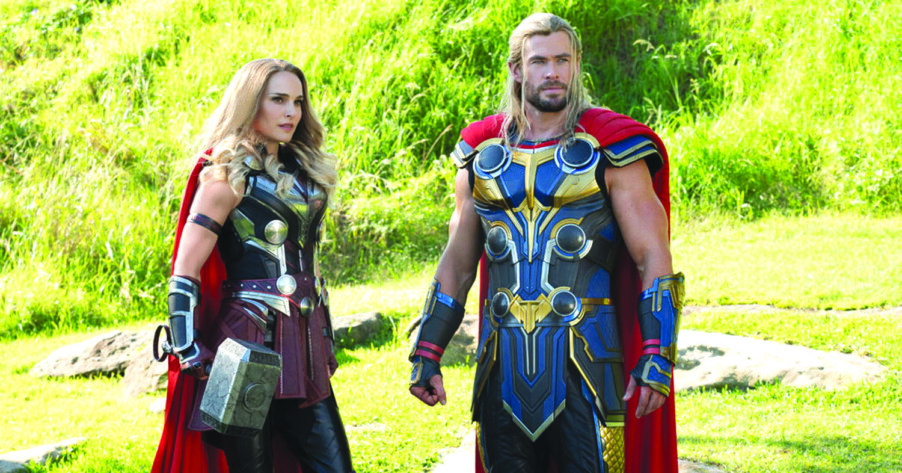
Thor: Love and Thunder (PG-13)

Thor: Love and Thunder (PG-13)

Thor has regained his “god bod” but not necessarily his life’s purpose in Thor: Love and Thunder, a loose, fun sequel in the spirit of Thor: Ragnarok.

Since we last saw Thor at the end of Avengers: Endgame, he’s been hanging out with the Guardians of the Galaxy, going on what he calls “classic Thor adventures” and joining the battles just in time to save the day. After one such battle, Thor and the gang learn that people across the galaxy are calling for help as their local gods have been slain, leading to chaos. Thor decides to go off with his buddy Korg (voice of Taika Waititi, who also directs and co-wrote this film), who is made of rocks as you’ll recall, to find Sif (Jaimie Alexander), the last of Thor’s surviving Asgard warrior posse, who was one of the people calling for help. (This speedy goodbye to Chris Pratt et al. is a wise choice.)

Once Thor meets up with Sif, he learns about Gorr the god butcher (Christian Bale), who in the movie’s opening scenes we saw kill the god his people had worshiped after that god had callously let the entire civilization, including Gorr’s daughter, die of thirst and hunger. Gorr, aided by a cursed god-killing sword, has made it his mission to thusly slay all gods.

Thor, Sif and Korg return to New Asgard (on Earth), now doing a bustling tourism business thanks to the steady kingship of Valkyrie (Tessa Thompson). They plan to protect the Asgardians from Gorr, who terrorizes a population when he comes searching for its god. Thor is surprised to find, however, that New Asgard also has a new Thor — the Mighty Thor, as Dr. Jane Foster (Natalie Portman) in her new supercharged incarnation calls herself.

As only a few close friends — Darcy (Kat Dennings) and Erik (Stellan Skarsgard) — know, Jane, Thor’s human ex, is currently undergoing aggressive chemotherapy for a fairly hopeless-sounding stage four cancer diagnosis. When the pieces of Mjolnir, Thor’s hammer that was crushed by Hela back in Ragnarok, call to her, she goes to New Asgard, hoping that maybe the otherwordly properties of the hammer can accomplish what medicine can’t and improve her health or at least buy her extra time. And it appears to work; at least while Jane holds Mjolnir, she is transformed into a buff “lady Thor,” complete with sleek costume and fashion-shoot-ready blond hair. However, when she puts Mjolnir back down, we see a Jane who is looking gaunt and weak.

Together Thor, the Mighty Thor/Jane and Valkyrie must fight off Gorr, who has the potential to Destroy the Universe but whose more immediate danger is that he takes the Asgardian children hostage. (And the “rescue the children” aspect gives the whole to-do better stakes than the standard “save the galaxy” goal of Marvel movies.) Their mission involves travels to other realms and some fun visits with other gods, which all keeps the action moving while also keeping the tone slightly off kilter in that Taika Waititi way.

I’ve just laid down a lot of “magical hammer from this Phase Three MCU movie” and “god butcher who is wielding Necrosword, the legendary god-killing weapon” but this movie isn’t actually that heavy with comic book homework and Marvel movie plot points. Or, perhaps it would be more accurate to say, that stuff is in there but knowing all the trivia isn’t required to get the vibe of the story. One of the nice things that Waititi has done here and in Ragnarok — and that carried over to the Thor of the last two Avengers movies — is make Thor, underneath the Hemsworth handsomeness and charm, weird. Thor isn’t just a muscley hero; he’s also a mass of regret and sadness and insecurities. His godly confidence is a thin veneer covering very human-style neediness. He still hasn’t figured out what to do with his grief over the many Thanos-related losses he suffered, not to mention all the losses that came before (his parents, his people’s kingdom of Asgard, his hammer Mjolnir, which is as much a friend as it is a weapon), which included a breakup with Jane, his true love. Hanging with the Guardians might have kept him busy, but they didn’t help him find peace. Meditation just made him angrier, he explains in a line that is played for laughs but is actually rather a good descriptor of how he is and isn’t dealing.

That character moving through a kind of quest adventure makes for a good mix — something a little richer, more interesting and shaggier (but in the good way) than the more formulaic mid-series Marvel movies or the emotionally flatter Dr. Strange and the Multiverse of Madness. And more fun — I know what I’ve just described sounds like another one of those “characters dealing with trauma” things that have become so prevalent but it actually feels more like “characters dealing with life,” but with the superhero movie trappings of costumes and magical weaponry. There are genuine laughs here, nice character moments (in particular a few between Valkyrie and Jane; this movie could have used even more of these two lone-wolf in charge ladies having moments of sisterhood), and an increasingly enjoyable Thor as he is allowed to mature and grow in a way that not all of the other Marvel characters have been. And the movie has some just good silliness, such as the return of the Asgard theatrical troupe (some great cameos there) and the general metal and hard rock sensibility (the movie makes great use of Guns N’ Roses).

Thor: Love and Thunder might not be the lightning bolt of originality and fun that Thor:Ragnarok was but it offers up a genuinely enjoyable two hours with an increasingly likeable character. B

Rated PG-13 for intense sequences of sci-fi violence and action, language, some suggestive material and partial nudity, according to the MPA on filmratings.com. Directed by Taika Waititi and written by Taika Waititi & Jennifer Kaytin Robinson, Thor: Love and Thunder is an hour and 58 minutes long and distributed in theaters by Walt Disney Studios.

Extra credit: If you have Disney+ and want a little more of Waititi’s Thor, check out the shorts called Team Thor: Part 1, Team Thor: Part 2 and Team Darryl from 2016. A post-Civil War Thor is bumming around Australia, sharing a flat with “average sorta everyday guy” Darryl, who seems quietly dismayed to realize that one of Earth’s mightiest Avengers is not the best roommate.

Featured photo: Thor: Love and Thunder
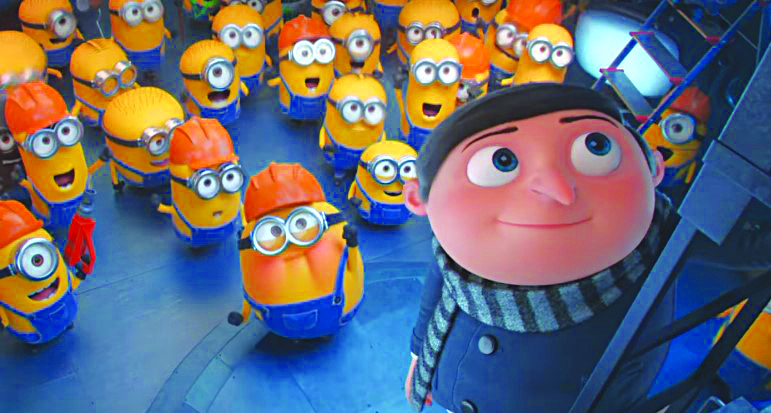
Minions: The Rise of Gru (PG)

Eleven- (and three-quarters!) year-old Gru tries to join the league of villains he idolizes in Minions: The Rise of Gru, maybe the silliest of these movies and I mean this as a compliment.

When young Gru (voice of Steve Carell) finds out that the adult villains the Vicious Six are now only five and have an opening, he is excited to go meet the gang, now led by Belle Bottom (voice of Taraji P. Henson, doing some fun villain vocal work). But they quickly say “next” when they realize he’s just a kid. To prove himself to them, Gru steals the mystical ancient amulet from them that they have recently stolen.

Or rather, Wild Knuckles (voice of Alan Arkin), formerly the sixth member, stole the amulet right before the other five stole it from him and kicked him out of the group. So as Gru runs off with his thrice-stolen prize, not only are Belle and her gang after him but so is Wild Knuckles. Gru makes a getaway with the help of his Minion henchmen (voiced by Pierre Coffin) but then one of them falls in love with a pet rock (it’s the 1970s) and loses the amulet. In a fit of anger Gru fires them but then he is quickly kidnapped. While a group of Minions heads off in search of Gru, another one tracks down the amulet. And of course Belle is still looking for Gru, breaking up Gru’s mother’s (voice of Julie Andrews) Tupperware party, where the Minions have been demonstrating the product’s fart-noise-producing features.

Wild Knuckles, trying to prove he’s still got it, and Gru, trying to prove he’s got it already, eventually make a crabbily sweet mentor-mentee team while elsewhere some Minions take a little time out to learn kung-fu from Master Chow (voice of Michelle Yeoh). We don’t linger on any one scene or any one idea very long and even though there are emotional beats to this movie, they take a back seat to, well, backseats (there are, of course, occasional Minion butts, which got big laughs from my elementary school-age kids). And fart jokes and silly Minion talk and Minions doing puppy-dog eyes and general Three Stooges-ness. If you’re still fighting the good fight against sassiness and cartoon-on-cartoon head-bonks, I can see how this movie might be a bit much (there are also some big scary animals at the end, including a pretty great Taraji P. Henson dragon). But if you’ve given in or your kids are old enough, this movie has a bouncy silliness that has good energy without feeling like a total sugar rush and keeps the movie snapping along through its not quite 90 minutes.

“It’s awesome; you gotta go,” was the review one of my kids gave. And if you like Looney Tunes-style goofiness — or just watching the enjoyment your kids get from Looney Tunes-style goofiness — I agree. B+

Rated PG for some action/violence and rude humor, according to the MPA on filmratings.com. Directed by Kyle Balda, Brad Ableson and Jonathan del Val, Minions: The Rise of Gru is an hour and 27 minutes long and distributed in theaters by Universal Studios.

Featured photo: Minions: The Rise of Gru

Elvis

Elvis (PG-13)

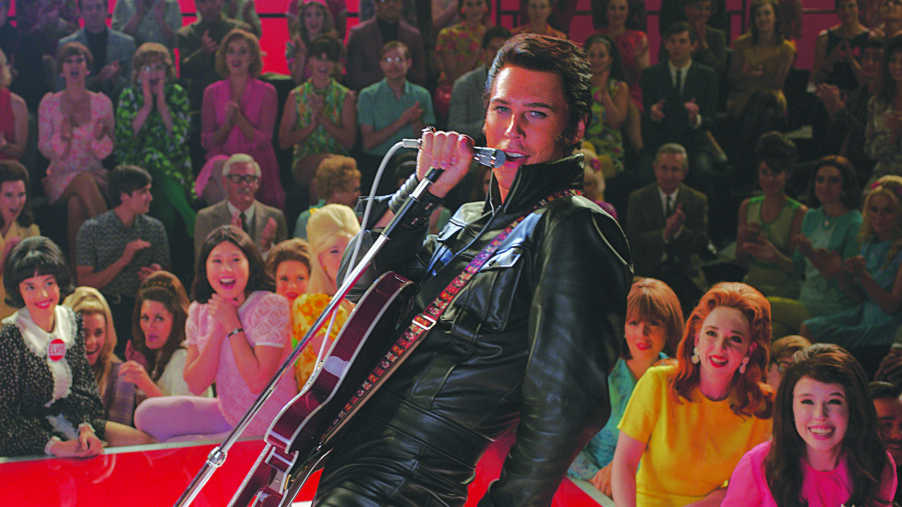
Elvis Aaron Presley gets the biopic treatment — sorta — in Elvis, the bonkers and exhausting movie from Baz Luhrmann.

We meet Elvis (Austin Butler, an absolute ball of magnetism in the middle of this thing) when he is a young musician, having just caught a break with the popularity of his recording of “That’s All Right” and still playing radio shows and county-fair-type events. It’s here that Colonel Tom Parker (Tom Hanks) first sees Elvis. Parker, who narrates the movie from his unreliable viewpoint, describes himself as basically a carnival showman always in search of an act that will draw the crowds and make them happy to fork over their money. When he watches Elvis sing and shake his hips and he sees women and girls in the audience all but lose their minds, Parker believes he has found the greatest show on Earth. First, he has to entangle Elvis in a crushing contract, which he does, winning over both Presley and his parents, Gladys (Helen Thomson) and Vernon (Richard Roxburg). Then he pulls him onto a traveling country music show. But the squaresville country performers don’t like sharing a stage with the “wild” Elvis and his music with its elements of Black musical styles. Young people might be going nuts for Elvis but the white establishment is way more interested in keeping segregation alive and well. The more popular Elvis gets, the more girls are hanging outside his window (and later outside the gates of Graceland), the more adult society seems determined to tamp him down, with threats to jail him if he continues his wiggling.

Parker, not particularly interested in Elvis’ music as art but extremely interested in Elvis’ performance contracts and various merchandising opportunities, tries to make Elvis more “family friendly” on a TV performance, dressed in formalwear and singing to a hound dog. Elvis rebels against the “New Elvis” and goes back to his preferred method of performance. Parker decides that the way for Elvis to ride out the firestorm is to accept being drafted into the U.S. Army; the haircut and two years of military service will prove that Elvis is a clean-cut all-American boy, Parker believes.

And it sort of works, with Elvis returning to show business with a wife, Priscilla (Olivia DeJonge), and a career in Hollywood. But Elvis and Parker continue to clash over Elvis’ desire for more artistic fulfillment and Parker’s desire for commercial success — if The Beatles are where rock ’n’ roll is, how about make a Christmas album?

Throughout, we see how Elvis’ childhood (Chaydon Jay plays young Elvis), frequently living in Black neighborhoods and soaking in blues and gospel music, influenced his own talent. The movie directly shows the inspiration/appropriation aspect of Elvis’ music and how part of what made him such a draw, artistically and commercially, is that he was performing the music of Black artists such as Big Mama Thorton, Sister Rosetta Tharpe and Arthur “Big Boy” Crudup in a way that fit with the rock of the era and was accepted by white audiences — younger white audiences, at least — in a segregated country. The argument of the movie on this score — at least I think this is the movie’s argument — is that Elvis is both an exceptional musical talent and someone who, because of the times he lived in, was able to take advantage of the artistry of these equally talented and more talented musicians who had few opportunities for Elvis-sized success.

This aspect of Elvis is one of the more engaging elements of the movie. I don’t know that it rights any historical wrongs but it gives some kind of spotlight to the original performers (or, at least, acknowledges that Elvis wasn’t coming up with this music in a vacuum) and that’s, you know, something. These scenes are often a little bonkers but they are interesting bonkers, which is what you hope for from a Baz Luhrmann movie.

Overall, however, I wish Elvis, which clocks in at two hours and 39 minutes, had been about 30 percent shorter and 40 percent more bonkers. When Baz Luhrmann is being weird or over the top or getting us right up next to sweaty Vegas Elvis to see him pour every bit of whatever’s left of himself into performances for, if not artistic fulfillment, a few moments of crowd adoration, Elvis is sort of fascinating. I mean, it also feels like a mess and I’m not fully sure I understand the story the movie is telling (or even if the movie knows what story it is telling) but at least in these scenes we are getting a portrait of a person, played by a person (Butler) who also feels like he’s going all in.

Then there is the whole deal with Hanks’ Tom Parker, with his extremely extreme nose (which I feel like we see A Lot of in shadow or in profile) and his whole crazy accent (which is I guess true-ish to life, it’s sort of Southern with a lot of Dutch inflection, “Parker” having been an invention of a carnival worker from the Netherlands who immigrated, without legal documents, in the late 1920s and then sometimes tried to pass himself off as being from West Virginia, Wikipedia explains). Hanks’ Parker is always leering from a shadow or slinking around, like he’s the devil who met this musician at the crossroads. But are we supposed to see him as some great villain? Or just a huckster whose goals sort-of aligned with Elvis’? There are a lot of facets to the character — his hazy background, his gambling problem that puts him in the debt of shady mob-types in Vegas, the air of neediness behind all the bluster. But I feel like the movie throws it all at us, similar to how it throws a lot of interesting music all together, without really pulling any character or theme into a coherent throughline in the movie. This movie about Elvis and told by Parker ends up being about both of them and neither of them.

So here are my takeaways from Elvis:

• Austin Butler is deeply compelling. Even when they’ve put him in some pretty silly sideburns, you can’t not watch him with all of your attention. He gives you a sense of how this random country-blues musician became Big Deal Elvis Presley and why he was still a good show even when the culture had sort of passed him by in the traditional rock sense.

• The soundtrack, both in the movie and the album, is weird but intriguing (Eminem makes a very purposeful appearance; think on that for a bit) and I’m definitely going to give it a listen. It almost pulls off that trick, like 2019’s Yesterday did with The Beatles, of letting you pull this extremely familiar music out of its place in your cultural consciousness and consider it anew.

• Baz Luhrmann is always interesting, even when it feels like parts of his movies are kind of a mess. This movie had me wanting to rewatch The Great Gatsby and Romeo + Juliet. He understands spectacle and presentation in a way that makes his movies fun to watch even if you’re not totally sure what you’re watching.

So, B?

Rated PG-13 for substance abuse, strong language, suggestive material and smoking, according to the MPA on filmratings.com. Directed by Baz Luhrmann with a screenplay by Baz Luhrmann & Sam Bromell and Craig Pearce and Jeremy Doner, Elvis is two hours and 39 minutes long and distributed in theaters by Warner Bros.

Featured photo: Elvis

Lightyear (PG)

Lightyear (PG)

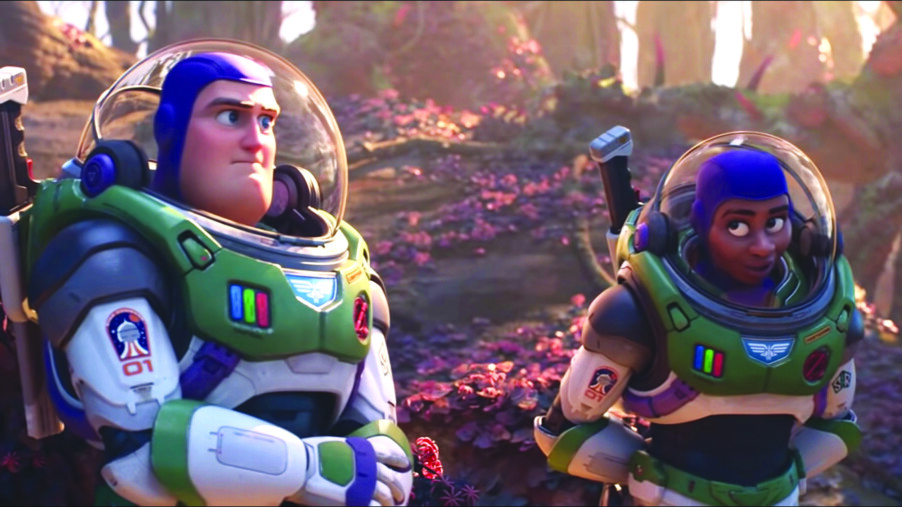
Space Ranger Buzz Lightyear is stuck on a vine-and-bug-filled planet but he still seeks to go “to infinity and beyond” in Lightyear, Pixar’s thought experiment about the origins of Buzz Lightyear.

Not the Toy Story Tim Allen-voiced toy Buzz Lightyear who was beloved by human child Andy and became best friends with fellow toy Woody. This is the character that toy was based on, as a title card explains, and we are watching the movie that Andy watched. So we in the audience are — in the Toy Story universe? It’s a concept that sort of pulls you through the looking glass if you think about it too hard.

Here, Buzz (voice of Chris Evans) and fellow Space Ranger Alisha Hawthorne (voice of Uzo Aduba) are crew members aboard a giant spaceship that is, I think, searching for life throughout the galaxy. He decides to investigate a promising-looking Goldilocks zone-type planet but this peaceful-seeming world is full of giant attack bugs and aggressive vines that try to pull people and the ship under the dirt. Buzz and Alisha, who along with a rookie (voice of Bill Hader) have gone exploring on the planet, barely make it back to the ship. When they take off, the pull of the vines makes the launch trajectory less than perfect, but Buzz is determined to clear a large mountain that the ship is suddenly heading right for.

And he almost does.

The crystal fuel cell that allows the ship to take off and to reach hyperspace traveling speeds breaks in the attempt to launch. Alisha tells her friend that they’ll wake up the scientists and other crew members in cryosleep and use the planet’s resources to regroup. After about a year, it seems that they have. Buzz boards a jet-ish spaceship to test a new fuel cell and slingshots around the planet’s nearby sun. But the fuel cell doesn’t quite make it up to speed and he returns to the planet to find that while he has only aged a few minutes the people back on the ground have aged four years.

Buzz is shocked — one crew member suddenly has a large beard, Alisha is engaged. But Buzz is determined to keep working on the fuel cell to try to fix the situation (the stranding of the ship, landing on the planet in the first place) that he feels deeply responsible for. So he goes up again and again. And comes back to learn that Alisha and her now-wife are expecting a baby, and then after a few more missions sees them celebrating their son’s graduation and then their celebrating their own multi-decade anniversary with their grown son and his partner looking on. And then one time Buzz comes back to find not Alisha but a recorded message she has left for him.

Through the decades (for everybody else) that only read as days or maybe weeks to Buzz, his constant non-aging companion is Sox (voice of Peter Sohn), a robot cat from Alisha. During one of Buzz’s brief stays, Sox asks what he can do to help Buzz out and Buzz offhandedly says Sox could figure out the whole fuel cell re-creation conundrum. It’s a big job, but Sox does have a lot of alone time in Buzz’s seldom-visited apartment.

While Buzz is laser-focused on getting off the planet and getting everyone “home” — to include a great many people who are probably a generation or two removed from wherever home was — the people on the planet seem to have largely lost interest in the fuel cell problem and are more focused on making life better there. Buzz takes one more desperate mission to prove that he can get the ship going again, but finds himself returning to a society facing threats from a mysterious ship and a bunch of robots called Zurg. Fighting the Zurg is a young woman with a familiar last name: Izzy Hawthorne (Keke Palmer), the now twentysomething granddaughter of Buzz’s old friend Alisha.

Sox, the movie’s standout supporting character, helps to amp up the kid-friendly silliness of the movie, which features a lot of adults talking. I’ve felt that some recent Pixar movies — Soul and Toy Story 4 come to mind — feel so invested in adulty-seeming characters and their adult, midlife problems about career fulfillment or being an empty-nester that I didn’t see the kid appeal of the story. Here, while there is a lot about Buzz learning to face up to a mistake and move on from it and learning to be part of a team, I feel like the movie approaches these rather complex concepts in kid-accessible ways. How do you deal with a mistake that you made without letting that mistake consume you? How do you live life from where you are now and move forward? I found myself being impressed with how the movie delivered these concepts in a way that I think kids (dealing with not making their travel soccer team or being in a different class from their bestie) will get, emotionally, even if it’s not something they could express in words.

Lightyear is, of course, beautiful to look at. It has a few truly lovely moments in space and in the sky. In particular, there is a shot with clouds that was stunning in the same way that the rendering of water in the short Piper was, where I may have actually said “wow” out loud.

Lightyear doesn’t grab you by the heart like recent Pixar offerings Turning Red or Luca. And while there’s nothing too frightening for younger kids — there are some scary robots, many of whom are also goofy, and some giant spiders — I did wonder if there was enough silliness or bounciness for kids younger than, say, 7 or 8 (Common Sense Media rated the movie as being for 6+ and they tend to be fairly accurate in their age assessments in my experience). It’s a nice movie, in the kindness sense, without being particularly delightful, and it’s a fun movie while still having moments that feel, if not sluggish exactly, just not as peppy as they could be.

Lightyear is not the most memorable Pixar offering but a perfectly acceptable option for families looking for entertainment and air conditioning. B

Rated PG for action/peril, according to the MPA on filmratings.com. Directed by Angus MacLane with a screenplay by Angus MacLane (based on characters by Pete Docter & Andrew Stanton & Joe Ranft), Lightyear is an hour and 40 minutes long and distributed by Walt Disney Studios in theaters.

Featured photo: Lightyear.

Jurassic World Dominion

Jurassic World Dominion (PG-13)

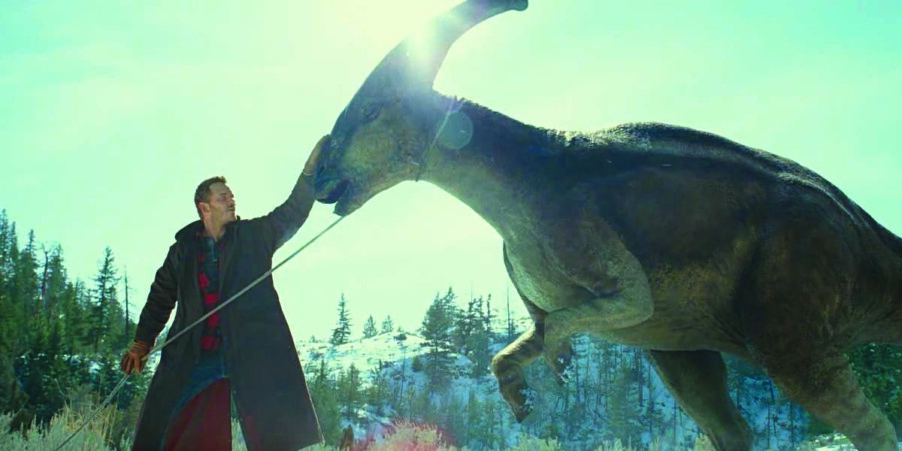
Original Jurassic cast and new Jurassic cast collide in the underwhelming Jurassic World Dominion, the final movie in the Jurassic World trilogy and the conclusion of the six total Jurassic movies.

Wikipedia and other sources report that filmmakers say this is the final film of these two trilogies, but I have a hard time believing this is “The End” of this franchise. Something this long-running, and with CGI dinosaurs and not specific actors as the principal attraction, feels like it will always have reboot potential. You know — life finds a way.

Previous movie Jurassic World: Fallen Kingdom ended on a dark but interesting note (spoiler alert for that 2018 film): What if dinosaurs were suddenly reintroduced to the planet, not just in some controlled theme park but out in the wild with other animals and soft, squishable humans. Dominion takes that idea and, well, basically does nothing with it. Dinosaurs are out there running around on land and swimming in the world’s oceans. And there is also an illegal market in dinosaurs — but somehow none of that really seems to matter. Like, at the end of this movie, we see a kid just feeding a small dinosaur in the park, like it’s a friendly duck, and it’s no big whoop.

The big whoop of Dominion is actually an infestation of particularly large, aggressive locusts that are destroying huge chunks of farmland. Ellie Sattler (Laura Dern!) figures out that these locusts have Cretaceous DNA and gets her old friend Alan Grant (Sam Neill) to go with her to Biosyn, the company that has the government contract to deal with all the loose dinos in the world and that, totally coincidentally, is the source of the seeds used in the only fields that the locusts won’t eat. Their colleague Ian Malcolm (Jeff Goldblum) works for Biosyn and has invited them to come visit him at the Biosyn facility in Italy where they have their dino preserve and also a building with multiple underground levels where you can do all sorts of shady DNA stuff.

Meanwhile, out in The Wilderness, Claire (Bryce Dallas Howard) and Owen (Chris Pratt), one-time coworkers at the revived but now-re-defunct Jurassic World theme park, are now an official couple and co-parents to Maisie Lockwood (Isabella Sermon), a clone or something who they rescued in the last movie. In addition to being some kind of scientific marvel who is being hunted by poachers, Maisie is a sulky teen who wants to ride her bike wherever I want, Mom, because you can’t hide me in this off-the-grid cabin forever. Naturally, after one such tantrum, she is kidnapped, along with Beta, the small baby raptor of Blue, Owen’s raptor buddy who lives in the nearby wilderness. I’ll bring back your baby, Owen tells Blue — and to this movie’s credit, they do let Ian make fun of this later.

Eventually, all of these characters — along with bad-ass pilot Kayla (DeWanda Wise); scientist Henry Wu (BD Wong), who is always messing with DNA in these movies and, like, never learns, and Biosyn flunky Ramsay (Mamoudou Athie) — wind up at the Biosyn facility in Italy run by cartoonishly evil Lewis Dodgson (Campbell Scott, who never seems to completely land on which tech CEO he’s parodying).

There are, of course, plenty of scenes of dinosaurs chasing our characters — trained attack dinosaurs chasing a motorcycle-riding Owen through the streets of Malta, those dino-locusts swarming on a farm, a T-Rex on the hunt for meat. But there are also enough scenes of not-dinosaurs in this nearly two-and-a- half-hour movie that I found myself thinking “it’s been a while since we’ve seen any dinosaurs in this dinosaur movie.” There’s a lot of very goopy talk about genetics and humanity, a scene of people listening to Ian Malcolm just sorta riff in a lecture hall, a whole undercurrent about Ellie and Alan’s relationship that I think we’re supposed to find nostalgic and cute, the parenting dynamics of Owen and Claire, the genetically engineered Maisie dealing with the nature of herself (which the movie confuses more than it explains). When dinosaurs show up, it is at least nice to break away from these plots and people that I could never really bring myself to care about. But the dinosaur action also felt sort of muted; there was kind of an amusement park ride quality to some of the dinosaur scenes, as though we were riding through little tableaus about dinosaurs in the world without really engaging with them.

I’m sure that, side by side, these 2022 dinosaurs would look realer than the 1990s dinosaurs of the original movies, but this movie isn’t presenting them in any way that is significantly more exciting or visually arresting than back then. We don’t get any “clever girl” or raptors testing the fences moments here. And I felt nothing but eye-roll-y about the movie wanting me to root for the underdog T-Rex in a fight against the bigger badder Giganotosaurus. Yep, cool, I feel a really strong emotional connection to this one section of the green screen over this other section of the green screen.

Jurassic World Dominion was probably never going to be great but it had a setup that could have found its way to fun if it had built itself on the “dinosaurs in the human world” idea instead of getting all Star Wars: The Rise of Skywalker about smooshing together separate trilogies and then basically putting the big climax back in a Jurassic Park-like setting. C-

Rated PG-13 for intense sequences of action, some violence and language, according to the MPA on filmratings.com. Directed by Colin Trevorrow with a screenplay by Emily Carmichael & Colin Trevorrow, Jurassic World Dominion is an unnecessary two hours and 26 minutes long and is distributed by Universal Studios.

Featured photo: Jurassic World Dominion.

The Bob’s Burgers Movie (PG-13)

The Bob’s Burgers Movie (PG-13)

As ever, the Belcher family’s burger restaurant teeters on the brink while the Belcher kids involve themselves in hijinx in The Bob’s Burgers Movie, a fun feature-length presentation of the animated TV series.

Bob’s Burgers apparently just wrapped up its 12th season, which is probably something like 10 more seasons than I watched. I didn’t stop watching for any specific reason; it’s just one of those shows that fell off my regular viewing rotation list. This movie will likely put it back, especially since off-kilter but ultimately kind comedy is especially appealing to me at the moment.

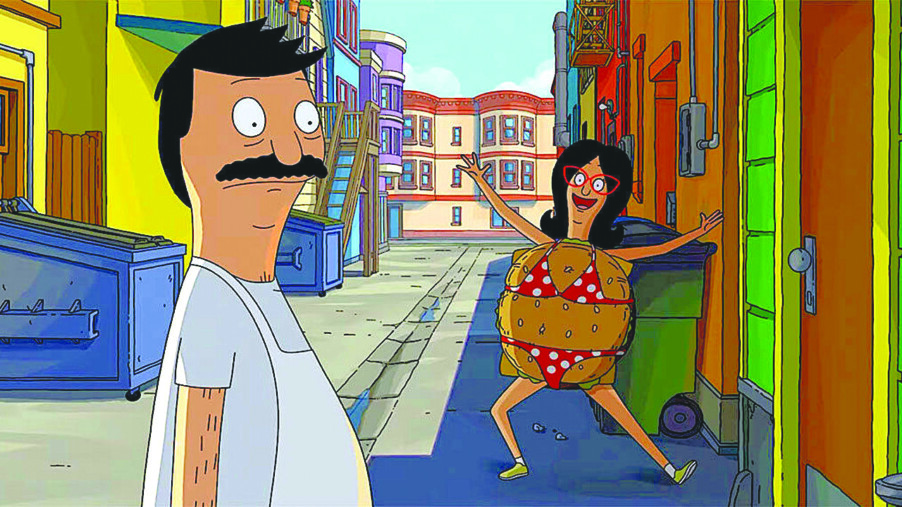
As in the show, Bob Belcher (voiced by H. Jon Benjamin, a vocal talent for the ages) and his wife, Linda (voiced by John Roberts), own Bob’s Burgers, a burger-based restaurant that always feels like it’s on the edge of closing. At the moment, the restaurant is literally one week from losing its equipment to repossession by the bank to whom the Belchers are behind on a loan payment. So things were looking rough even before a giant sinkhole opened right in front of the restaurant, making it hard for customers to even get inside.

The Belcher kids — eighth-grader Tina (voice by Dan Mintz), 9-year-old Louise (Kristen Schaal) and somewhere-in-between brother Gene (Eugene Mirman) — like all kids both root for and pity their parents while dealing with various dramas of their own. Tina is struggling with whether to ask Jimmy Pesto Jr. (also voiced by Benjamin) to be her summer boyfriend. Gene is trying to keep a band together to play at an upcoming festival. Louise is worried that she might not be brave, and that the pink bunny-eared hat that she always wears really is, as a classmate says, a sign that she’s a baby.

Louise decides that the way to prove her badassedness is to video herself going into the sinkhole, which leads to the discovery of a long-buried body, which leads to murder charges for the burger restaurant’s building owner, Calvin Fischoeder (Kevin Kline). Fischoeder’s legal woes further imperil the restaurant, so Louise decides it’s up to her to save the family by proving that he is innocent and uncovering the real murderer.

Somewhere in the middle of watching this movie I realized that I was deeply enjoying two elements in particular: joke density and small nuggets of surprising earnestness. A concept regularly discussed on the podcast Extra Hot Great and in other TV commentary, joke density is the fast-and-furiousness of the jokes, not just the “set up, laugh” but the small asides, little nuances of delivery, bits of sight business and small gestures that can pack oodles of laughs into every minute of a TV show or movie. It’s been long enough since I watched Bob’s Burgers that I forgot that this is often a high joke density property, with layers of humor in every line. It keeps the energy up without being messily frenetic and, even though maybe it shouldn’t, it adds to the “genuine oddballs” nature of these characters. Though everything about the Belcher family should read as, well, cartoony, they feel tonally real because if you’re lucky, every family is a charming gang of weirdos who love each other in part because of their weirdness.

Which brings me to the earnestness. Like unexpectedly large chunks of cookie dough in your cookie dough ice cream, this movie had a few moments of familial sweetness that delighted me. Because of how un-saccharine these characters are, they can really sell these moments and grab you in the throat right in the middle of, say, a fart joke.

All this is packaged inside a bit of capering on the part of the adults — their schemes to keep the restaurant afloat lead to an unlicensed food cart and Linda dressed like a burger that for some reason is wearing a bikini — and vaguely Scooby-Doo-ish mystery adventure for the kids, what with their bike rides to the nearby amusement park on the wharf and their uncovering of secret passages. And there is a wonderfully fitting bit of song work that actually has to be quite skilled to seem as “we are not professional singers” as it is.

The Bob’s Burgers Movie doesn’t require in-depth knowledge of the series to enjoy it, just a willingness to get to know (or renew your acquaintance with) this delightfully relatable cartoon family. B+

Rated PG-13 for rude/suggestive material and language, according to the MPA on filmratings.com. Directed by Loren Bouchard and Bernard Derriman with a screenplay by Loren Bouchard and Nora Smith, The Bob’s Burgers Movie is an hour and 42 minutes long and is distributed in theaters by Twentieth Century Studios.

Featured photo: The Bob’s Burgers Movie.

Stay in the loop!

Get FREE weekly briefs on local food, music,

arts, and more across southern New Hampshire!