
Cyrano (PG-13)

Cyrano (PG-13)

Peter Dinklage is the poet who woos with his words but fears he repels with his looks in the Joe Wright-directed Cyrano, an uneven but interesting adaptation of a stage musical.

Peter Dinklage has, of course, been charming as all heck since before he was fan favorite Tyrion Lannister on Game of Thrones so it’s kind of a “nerd girl takes off glasses to reveal she’s a supermodel”-level suspension of disbelief that women in general and Roxanne (Haley Bennett) in particular, portrayed here as kinda flighty and romantic in a way that would seem to make her attuned to men who adore her, wouldn’t be smitten with the titular Cyrano.

But people are also singing and dancing in the streets, so it’s one of a few things you gotta just go with here.

You probably know the outlines of the story: In olden days France, noted poet, wit and swashbuckling dueler Cyrano loves Roxanne, an orphan who needs one of those advantageous marriages to stay financially solvent but who dreams of True Love. And she thinks she’s found it when she falls in love at first sight with Christian (Kelvin Harrison Jr.), a new guy in Cyrano’s regiment. She rushes to tell her dear friend Cyrano about this romantic thunderbolt — breaking Cyrano’s heart just a little because he clearly hoped that maybe her romantic realization was her love for him. But Cyrano is so in love and so friendzoned that he agrees to help Roxanne meet Christian and look after him as the new guy in the army barracks.

Christian, who was also enchanted when he first saw Roxanne, is delighted with Cyrano’s help. But he doesn’t have the words to win Roxanne over, so he takes help from Cyrano — using Cyrano’s sincere love letters to Roxanne (Christian doesn’t quite realize how sincere) and the lines Cyrano feeds Christian when he talks to Roxanne from beneath her window balcony, Romeo & Juliet style. Cyrano is willing to do it because he feels like his height gives him no chance with Roxanne.

So, basically, these two guys are olden days catfishing Roxanne but as they are both pretty decent we’re OK with it? Her bigger problem is her relationship with powerful noble De Guiche (Ben Mendelsohn). He’s a vindictive, grabby jerk whom she’s reluctantly been hanging out with and he has the power to put both Cyrano and Christian in harm’s way.

“Nimble” was how I found myself thinking of this movie’s wordplay and general mood (and Dinklage’s overall performance), especially in scenes between Roxanne and Cyrano or Christian and Cyrano, where the dramatic irony gives us a Cyrano’s-eye-view at everybody’s thoughts and feelings and gives an extra bit of double-edged wit to his lines. It’s subtle and delicate in a way that gives a lightness even to heartbreak. These elements also at times feel stagey in a way that I think would work if it were on an actual stage, with an audience’s laughter and responses serving as the setting of this party and pulling it all together. On screen, you sometimes get punchlines going out into the quiet void (especially if you tend to go to emptier screenings). It’s sort of — missing something. The movie isn’t quite as rooted in a real world as, say, In the Heights but it isn’t on a literal stage the way the Hamilton filmed version was (to use two Lin-Manuel Miranda plays as an example). I feel like if it were presented in a way that could give us some of that live theater energy it would make the first chunk of the movie more of a musical-theater good time.

The second chunk of the movie is tonally quite different, with the love triangle taking a back seat, at least in terms of on-screen action, to Cyrano and Christian at war. This section of the movie includes a surprisingly earnest and affecting song called “Wherever I Fall.” It’s a really heartrending moment of men facing battle, fairly certain they’re going to die, and thinking of the people they’re leaving behind. The three on-screen singers taking the lead on the song include Glen Hansard of Once fame. But this really grab-you-by-the-throat moment does not include either Dinklage or Harrison, an odd choice that puts you in the story of the men in the song but pulls you out of the story of the movie itself. The movie frequently does odd little things like this or the way that Cyrano and Roxanne are positioned in the shot of some of their more emotional scenes that undercut some of the emotion we should be getting from the relationships that make up the core of the movie.

For all this unevenness, the performances of that core trio of characters are thoroughly engaging. Bennett is hampered with some flightiness in her character (but is given some really great costuming and makeup; the movie’s sole Oscar nomination is for costuming) but manages to make her Roxanne seem appealing enough as a person that it is believable that both of these nice-seeming dudes would be so gaga for her. Harrison is sweet in exactly the right way; I feel like in the stories that have riffed on this idea, that character tends to be painted a little more meatheaded than he is here. Here, Christian is a nice guy you are also rooting for. Of course, above all we root for Dinklage, who is just thoroughly appealing and attention-grabbing throughout, even when the movie doesn’t fully build the case for whatever it’s doing with his character. B

Rated PG-13 for some strong violence, thematic and suggestive material, and brief language, according to the MPA on filmratings.com. Directed by Joe Wright with a screenplay by Erica Schmidt, Cyrano is two hours and four minutes long and distributed by MGM in theaters.

Featured photo: Cyrano.

Dog (PG-13)

Dog (PG-13)

A former Army Ranger and a former Army Ranger dog, both dealing with trauma from their time in battle, road trip in Dog, a movie that answers the question “how charming is Channing Tatum?”

The answer: charming and charismatic enough that this relatively thin-soup dramady is an OK watch.

This movie, co-directed by Tatum, shouldn’t be as watchable as it is. It should be more of a downbeat slog. But he makes his character, Jackson Briggs, the right amount of affable and vulnerable, self-aware and in denial and generally good playing opposite a dog to carry this whole movie. I left the theater thinking “huh, not bad” even if I doubt I will ever think of this movie much again.

When we meet Briggs he is grinning and bearing it as he works a job making sandwiches for jerks while waiting to see if he’s cleared to work for a private military contractor. He has left the Army due to an injury that we later learn has left him with anxiety, headaches, occasionally blurred vision, a sometimes ringing in his ear and seizures that could potentially kill him. But he has managed to get a clean bill of health from someone and now needs only his former commander to sign off to get him back in some form of battle.

His former captain is reluctant to do so — Briggs has serious, well-documented injuries — but he makes a deal with Briggs. A fellow former ranger, one Briggs served with, has died and his family wants his service dog Lulu at the funeral. As it turns out, Lulu was also injured in battle and is also suffering from trauma, exhibited largely by trying to attack everybody she comes in contact with. Nevertheless, the captain tells Briggs that if he can drive Lulu (she refuses to fly) from Washington state to the funeral in Arizona (and then to the base where this hard to handle dog will likely be put down), the captain will give Briggs the clearance he needs to get the contractor job he’s so desperate to have.

Who is going to save whom, you might think if you’ve never seen any movie with a dog before. This plays out exactly the way you think it will, with the human-canine duo having a series of adventures along the way that range from lighthearted (a psychic played by Jane Adams telling Briggs that the dog wants a comfy mattress and Indian food) to more serious than the movie has the ability to really examine (the manner of Riley’s death, Briggs’ non-existent relationship with his young daughter, really everything to do with war-related trauma). But the magic of Tatum is that the movie still works well enough to hold your interest and attention. C+

Rated PG-13 for language, thematic elements, drug content and some suggestive material, according to the MPA on filmratings.com. Directed by Reid Carolin and Channing Tatum with a screenplay by Reid Carolin, Dog is an hour and 41 minutes long and is distributed in theaters by MGM Pictures.

Uncharted (PG-13)

Tom Holland and Mark Wahlberg play Indiana Jones in Uncharted, a movie based on a video game but molded in the tradition of every broad action adventure that ever National Treasured its way to low-effort wide-appeal viewing.

Or maybe it’s not so much “wide appeal” as “widely not unappealing.” I mean, Tom Holland, who can be mad at that little face, even if it is often accompanied by the too smirky face of Wahlberg?

Nathan “Nate” Drake (Holland) is a bartender and pickpocket who is recruited by Victor “Sully” Sullivan (Wahlberg) to take part in a search for the lost treasure of Magellan. The mystery is a favorite of Nate’s because it was one his older brother Sam talked about when they were kids. Nate hasn’t seen Sam in years; Sully tells Nate that Sam disappeared during the search for the treasure so finding the treasure — boats filled with gold — might lead to Nate’s finding Sam as well.

Thus begins some globe-crossing to follow this golden cross to that clue to this map to find that clue — like the Indiana Jones and Pirates of the Caribbean movies this movie references but also like the Robert Langdon movies based on Dan Brown’s books with a dash of Goonies and an older-swashbuckler/younger-trainee relationship that has notes of Han Solo and Luke Skywalker.

At least, I think that’s what we’re supposed to see when we watch these two banter and adventure. But Wahlberg does not have that Harrison Ford sparkle, that ability to convey both cynic and good guy at heart. He comes off not as charming but as smirky and flat. Holland, so winning all these years as eager good-doobie Peter Parker, isn’t required to do anything radically different here as Nate but he is nevertheless a charismatic and amiable screen presence. He’s had good screen partners in similar roles (Robert Downey Jr., Jake Gyllenhaal, Benedict Cumberbatch) but Wahlberg is not playing at his level here.

Similarly, the supporting cast feels uneven. Sophia Ali as an occasional third member of the expedition isn’t given enough to do to feel like a strong team player. Antonio Banderas provides some of the villainy as a member of a Spanish family that has long had claims on Magellan’s gold but he doesn’t get to be as extravagantly mustache-twisting as he would need to to make this movie be the kind of buoyant good time it clearly wants to be.

Uncharted has a lot of good popcorn movie ideas — big action set pieces, sunny locales, quips. But the execution is uneven enough that sitting through this movie in a theater feels like more of a chore than a snack-food treat. I mention this because I think when you watch this movie next holiday season at home on some streaming service for zero extra dollars it will feel just fine for the broad audience of kids old enough to view PG-13-style gun-related violence through great-grandparents we still get embarrassed to watch sexy business around. As something you purposefully plan to consume to the exclusion of all other stimuli, Uncharted just doesn’t offer enough — sometimes even the efforts of Tom Holland can’t save the day. C+

Rated PG-13 for violence/action and language, according to the MPA on filmratings.com. Directed by Ruben Fleischer with a screenplay by Rafe Judkins, Art Marcum and Matt Holloway, Uncharted is an hour and 56 minutes long and distributed in theaters by Columbia Pictures.

Blacklight (PG-13)

Liam Neeson is yet another aging shadowy dude with a particular set of skills in Blacklight, a movie that looks like it’s going to be every Liam Neeson movie since Taken 2 but is actually less than that.

Travis Block’s (Neeson) skill set involves helping FBI agents who have physically or mentally gotten trapped in deep cover assignments or super secret work. He helps them find their way out — literally, like the agent whose cover is blown in a white nationalist compound and who has to be extracted, or, figuratively, like Dusty Crane (Taylor John Smith), an agent who is having a breakdown after a recent assignment. What we know that Travis doesn’t is that that assignment involved the death of charismatic politician Sofia Flores (Mel Jarnson), a woman who is the voice of her generation and who wants to make real change, which several characters in the movie say several times. Despite Travis’ efforts to “bring Dusty in,” whatever that actually means, at the behest of FBI director (and Travis’ longtime friend) Gabriel Robinson (Aidan Quinn), Dusty keeps trying to contact Mira (Emmy Raver-Lampman), a journalist working in some news organization with way too nice an office (floor-to-ceiling windows!).

As Travis starts to ask questions about why, exactly, Dusty has gone off the rails, he finds himself at odds with Robinson, for whom he has always worked off the books and whom he thus has no real ability to challenge. And he is also dealing with drama in his home life: We’re told Travis was a bit of an absent dad to now-grown daughter Amanda (Claire van der Bloom) but he wants to make up for that by being “there” for her young daughter Natalie (Gabriella Sengos). Amanda isn’t so sure that she wants Travis and his whole shady deal to be all that “there” for the daughter who is starting to pick up some of his paranoid habits.

In a lot of ways, this is exactly the movie you sign up for when you go see a winter-release Liam Neeson action movie: There’s his secret past in a tough-guy job, there’s a cute little kid, there’s a disappointed family to make amends to, there is some past emotional turmoil, there is a one-man-against-the-world-like quest. But this movie also feels at points like almost a parody of the Liam Neeson movie you expect, particularly in a scene where he delivers a monologue about his dark backstory that is so bleak it calls to mind that sketch of Liam Neeson doing improv comedy with Ricky Gervais. And while nit-picking the plot points of this kind of movie seems silly, this movie has a real “box of broken and off-brand Legos” feel with nothing really fitting together and huge chunks of the story just not holding up at all. Sure, there are plenty of car chases/crashes and hand-to-hand combat scenes, but there are also lots of laugh-out-loud moments that I’m pretty sure were not intended to be comedy.

I like the simplicity of early late-career Neeson’s “guy finds daughter” or “guy fights wolves” movies or even of recent films like Ice Road where the gist is literally that Neeson drives a truck on an ice road. Blacklight piles a few too many half-formed story bits on its rickety setup. C-

Rated PG-13 for strong violence, action and language, according to the MPA on filmratings.com. Directed by Mark Williams with a screenplay by Nick May, Blacklight is an hour and 44 minutes long and distributed by Briarcliff Entertainment.

Featured photo: Dog.

Marry Me (PG-13)

Marry Me (PG-13)

J. Lo plays a pop star who makes the pop decision to marry a rando at her concert in Marry Me, a series of music videos with rom-com-ery squished in between and I am fine with that.

Kat Valdez (Jennifer Lopez) is a pop megastar engaged to fellow pop megastar Bastian (Maluma). After performing their hit song “Marry Me” at a lavishly costumed Kat Valdez concert, the two plan to get married on stage in front of the sold-out audience of concert-goers and millions more online. But during the costume change between the ballad and the ceremony, a story about Bastian cheating on Kat goes viral and Kat sees the report of his infidelities just as a riser brings her up on stage in her dazzling wedding dress, one of many awesome “ooo, nice!” outfits sported by Lopez and others in this movie.

Shocked, heartbroken and already killing it in a great dress, Kat Valdez decides she might as well marry somebody and says “yes, I’ll marry you” to a random guy in the audience holding a “Marry Me” sign: math teacher Charlie Gilbert (Owen Wilson).

Charlie knows basically nothing about Kat or Bastian or their music or what really is going on. He accepted teacher buddy Parker’s (Bedford’s own Sarah Silverman) invitation to the concert mostly because he thought it would improve his coolness standing with his daughter Lou (Chloe Coleman), who recently started attending Charlie’s school and had been bragging about how fun her mom’s new husband is. He was only holding the sign so that Parker could take a selfie. In the moment he is maybe a little bit dazzled by Kat, a little bit sympathetic to the idea of somebody going through a difficult situation and a little bit just stunned. When she pulls him on stage to marry her, he just sorta goes with it. Later, when her manager, Collin (John Bradley), asks him to basically date Kat for a while so they both look less crazy, Charlie agrees to it in part because she agrees to fundraise for his math team and in part because he genuinely wants to get to know her better.

We seem to have entered some phase in the culture where, at least for certain feel-good rom-com properties, nobody is that bad. Even Bastian isn’t a horrible villain. Nobody has to degrade anybody, nobody has to be an active jerk. We don’t have to see our heroine humiliated, we don’t have to like our hero in spite of anything. I’m liking this kindness and maturity approach to romance. It makes for a more pleasant viewing experience and it makes a whole lot more sense (wacky setup aside) with these characters who are “north of 35” as someone describes Kat at one point which, like, sure, they’re that, but those actors are also in their young 50s and it would probably be OK if the movie described them that way too.

But, baby steps, I can be happy with people having grown-up responses to things.

As mentioned, large parts of Marry Me do feel like their primary purpose is to get me to buy the Marry Me soundtrack, with songs by Jennifer Lopez and Maluma, which I’m strongly tempted to do because it’s solid pop music, frequently with Latin flair. Lopez is, of course, great at this and at blending the pop-star-performance part with the rom-com-heroine part of this role. Wilson’s role largely just requires him to not get in the way and occasionally be quietly funny — and he performs these functions absolutely fine, even if he doesn’t bring much in the way of his own sparkle to the proceedings.

Marry Me feels very traditional in its story beats and its characters but with just enough tweaks to keep it from feeling fusty and to make the entire experience more chocolate cake than stale candy bar. “Extremely pleasant and surprisingly enjoyable” doesn’t feel like a rave you’ll see on any movie posters but it does feel like a welcome addition to rom-com offerings. B

Rated PG-13. Directed by Kat Coiro with a screenplay by John Rogers & Tami Sagher and Harper Dill (based on the graphic novel by Bobby Crosby), Marry Me is an hour and 52 minutes long and distributed by Universal Pictures in theaters and via Peacock.

Death on the Nile (PG-13)

Kenneth Branagh mustaches back up as detective Hercule Poirot in Death on the Nile, another Agatha Christie adaptation that seems like a really elaborate live-action role-play game of Clue.

Branagh, for the record, is the only one winning at this particular game night. Well, Branagh and all the “below the line” costume, set design, hair and makeup types, who seem like they are also having a ball.

After a flashback to young Poirot that feels like vaguely interesting but irrelevant filler, we see Poirot in 1937 London, where he visits a nightclub that just happens to have a slew of people who will be important to the plot later. We see Jacqueline de Bellefort (Emma Mackey) and her fiance, Simon Doyle (Armie Hammer, bringing a whole layer to this movie that was almost certainly not intended at the time of shooting back in 2019), sexy dancing to the music of blues singer Salome Otterbourne (Sophie Okonedo), who is managed by her niece, Rosalie Otterbourne (Letitia Wright). Then Jacqueline’s (and, as we learn at some point, Rosalie’s) old friend Linnet Ridgeway (Gal Gadot) arrives. Linnet is exceptionally wealthy and famous and looks like Gal Gadot. Simon, who had just been all but making out with Jacqueline on the dance floor, is instantly smitten with her.

Months later Poirot is vacationing in Egypt when he runs in to his old friend Bouc (Tom Bateman), who is also vacationing in Egypt with his mother, Euphemia (Annette Bening). As it turns out, they aren’t just there on a spontaneous holiday; they are also part of a larger party celebrating the recent wedding of Simon and Linnet. The group includes Linnet’s assistant Louise (Rose Leslie), her financial manager Katchardourian (Ali Fazal), her ex-boyfriend Dr. Windlesham (Russell Brand) and her godmother, Marie Van Schuyler (Jennifer Saunders), who has her own assistant, Bowers (Dawn French).

Also part of the group are the Otterbournes — because Salome was singing the night they met, the new couple brings them along.

Decidedly not invited is Jacqueline, who nevertheless seems to be following the group, insisting that Simon still loves her. Her behavior is so unhinged that Linnet decides to rent a boat so her group can be in its own controlled bubble. But naturally a locked room can still result in a murder and it is soon up to Poirot to catch “ze killah.”

Actually, in fairness, I don’t think he ever says exactly that; it’s more like “dhe mer-der-ehr” but it’s a whole to-do every time he says it. Poirot saying murderer or murder or killer is probably 60 percent of what works in this movie.

I didn’t hate this movie as much as some of the headlines for reviews I’ve been trying to avoid seemed to suggest I’d hate it. But that’s probably about the best I can say for it. This movie takes its pretty people and puts them in a pretty (if stagey) locale but it can’t bring much in the way of liveliness to that scenario. If anything, this movie highlights the flatness that Gal Gadot sometimes brings to her performances and the soap opera smarm of Armie Hammer (which kind of works here but maybe shouldn’t for this to actually be a mystery). Yes, Branagh seems to be having fun with his Agatha Christie cosplay, but he’s almost off in his own movie, having emotional beats where everybody else’s performance is at least 92 percent costume and hairstyle.

As a take on the locked room mystery, I could see a version of this movie with a sort of goofy puzzleness (and some fewer number of characters and shorter runtime) that would be above-average entertaining. I’m not saying genuinely funny in the Knives Out sense or campy like the old Clue movie; more like a kind of National Treasure meets Pirates of the Caribbean level of goofiness where everything feels like an amusement park ride version of a set and the characters aren’t afraid to go hammy. Here, Branagh hits those notes but everybody else is just too thin to add up to much more than backdrop for his Poirot.

Looking back at my review for Murder on the Orient Express, I think I disliked this movie less than that one, which might say more about me and my openness to any level of movie spectacle than it does about achievement of this particular movie. It isn’t a failure, but it is set up to only succeed as light popcorn adventure and on that level it just doesn’t offer the fun and chills that it needs to. C+

Rated PG-13 for violence, some bloody images, and sexual material, according to the MPA on filmratings.com. Directed by Kenneth Branagh with a screenplay by Michael Green (based on the book by Agatha Christie), Death on the Nile is two hours and seven minutes long and is distributed in theaters by Twentieth Century Studios

Featured photo: Marry Me.

Oscar movie season!

Welcome to the new class of Oscar nominees! The nominations for the 94th annual Academy Awards were announced on Feb. 8 and this year there are 10 contenders for best picture (the Oscar winners will be announced on March 27). If you’re still looking to catch up on the films of 2021, the list of nominees is an excellent place to start. Here are the best picture nominees and where to find them:


• Belfast (PG-13) Kenneth Branagh wrote and directed this semi-autobiographical tale of a boyhood amid the unrest of Northern Ireland in the 1960s. It is available for rent at home and it is still in theaters, including Red River Theatres in Concord, where it returns starting Friday, Feb. 11.
• CODA (PG-13) This excellent story about a teen who discovers her singing talent and her changing relationship with her parents might be my favorite of this group. It is available on Apple TV+.
Don’t Look Up (R) Adam McKay directed and wrote the screenplay for this satire, which you can find on Netflix, that stars Leonardo DiCaprio and Jennifer Lawrence.
• Drive My Car (NR) This Japanese film also nabbed a Best International Film nomination as well as nominations in other categories and is the one movie of this group I haven’t seen yet. It is currently in theaters in the Boston area.
• Dune (PG-13) Not surprisingly, this beautiful-to-look-at adaptation also nabbed several nominations for the look and sound of the film. It is currently available for rent or purchase and will return to HBO Max on March 10.
• King Richard (PG-13) Will Smith also got a Best Actor in a Lead Role nod for this movie about Richard Williams, the father of Venus and Serena Williams. The movie is available for purchase.
• Licorice Pizza (R) For me, the San Fernando Valley of the 1970s was this real star of this Paul Thomas Anderson story about a precocious 15-year-old and the twentysomething girl he falls for. The movie is currently in theaters.
Nightmare Alley (R) This movie from director Guillermo del Toro was another one that wowed me more for its aesthetics. It is currently playing in theaters in the Boston area and available via HBO Max.
The Power of the Dog (R) This Jane Campion-directed movie nabbed a slew of nominations, including nods in three acting categories and for Campion in the director category (making her the only woman nominated in that category this year). Find it on Netflix.
• West Side Story (PG-13) Steven Spielberg’s very good adaptation of the musical got Ariana DeBose a much deserved nomination in the Best Actress in a Supporting Role category for Anita, among its many nominations. It is currently in theaters.

Moonfall (PG-13)

Moonfall (PG-13)

The moon is suddenly headed toward collision or something with Earth in Moonfall, a movie that is both even dumber than that sounds and yet somehow not nearly as dumb as it needs to be.

Lean in to your dumbness, you dumb dumb movie — was my feeling throughout.

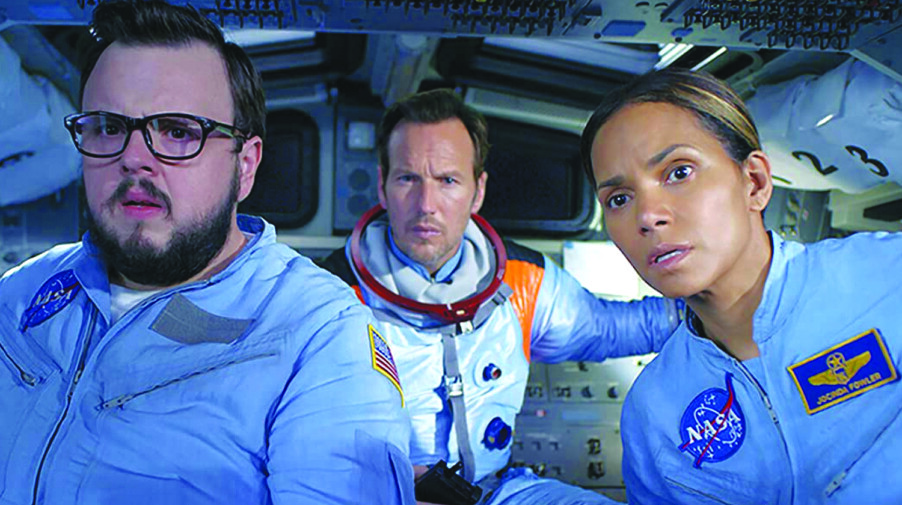
Astronaut Brian Harper (Patrick Wilson) is kicked out of NASA after an incident in space results in the death of one of his crew members. His public downfall also leads to his getting divorced, being estranged from his kid, going broke and even cutting contact with his former close coworker Jocinda Fowl (Halle Berry), who was on the doomed mission but was knocked unconscious and can’t back up his story that the incident was caused not by human error but by a Space Thing.

What kind of Space Thing, you ask? Well, the thing that causes the destruction to Brian’s mission looks like a floaty cloud made of pencil lead bits and ball bearings. He last sees it in the vicinity of the moon and then — then nothing. He’s drummed out of NASA and labeled a nutcase and nobody ever mentions the Thing again for like a decade until the events of this movie start with NASA scientists figuring out that the moon’s orbit has changed. Jocinda is now number two at NASA and wants the team to figure out what’s up with the moon and why it seems to be suddenly getting closer to Earth, which will eventually cause chunks of the moon to ram into Earth. Also she’d like everybody to keep quiet about it for a bit.

What she doesn’t know is that at the same time, amateur astronomer/professional pastrami sandwich maker KC Houseman (John Bradley), long the holder of some really wild theories about the moon, has also figured out that it has changed its orbit and is heading toward Earth. He tweets it out and suddenly the world is in chaos at our impending destruction while NASA and the military work on competing ideas for preventing the disaster.

Naturally, KC, Brian and Jocinda eventually come together to tackle the moon crisis. All three have family situations that lead to harrowing near-misses in “meanwhile” scenes — or at least they would if we ever really got to know anybody’s kids and moms or if any of them behaved in recognizably human ways, which they don’t.

I have so many questions about the making of this movie. I want to know the total backstory, soup to nuttiness — starting with how did Halle Berry, Patrick Wilson and John Bradley end up in this movie together? My theory: somebody challenged Roland Emmerich (this movie’s director and co-writer) to make a movie starring whoever happened to be the guests on, say, Jimmy Fallon one night. Halle Berry, Patrick Wilson and guy from Game of Thrones feels like a solid late night show lineup; please don’t ever tell me if I’m wrong about this because I like this theory and anything else would just make me feel sad for these actors.

You know that expression “building the plane while we’re flying it”? This movie feels like it was thought up as it went along with holes for dialogue and plot to be filled in later — but “later” never came. Like, Emmerich was standing over one of his co-writers saying “come on, just print out the script for this scene” and the writer was saying, “But it’s not finished. The dialogue doesn’t sound like normal human speech and we don’t really understand what motivates anybody’s characters or what their relationships to each other are” and Emmerich says “So what? We’ll just make the moon bigger and say some nonsense about gravity, no one will notice” and that’s how every scene came to be. (Though I could also see some kind of Mad Libs situation being at play.)

I won’t spoil the exact nature of the moon as presented here, mostly because it’s stupid, but I will say that it wasn’t what I was sort of rooting for, which was giant space egg holding some kind of about-to-hatch space lizard. Or chicken, space chicken would also be fun. It is much more muddled than that, with some interesting ideas but nothing ever well-developed enough to be even as “just go with it” fun as, like, The Day After Tomorrow and its whole ice age thing or 2012 and its worldwide flood. Again, you suspect the writers were writing page three while they were printing page two and the cast was shooting page one — with no chance to go back and fill in details or massage story points to flow more smoothly.

And yet, none of this would have necessarily mattered if the movie had really leaned into how dumb it is and let the characters be as ridiculous as the situation. Remember the various people who died in ridiculous ways in Independence Day? Or Woody Harrelson as the wild-eyed volcano guy in 2012? This movie needs some of that energy. Of the core group, only Bradley really seems to understand the exact speed to be at. Berry (who was great in John Wick: Chapter 3 — Parabellum and knows how to be awesome in nonsense) and Wilson feel as though they’re in different movies — different from the movie they’re in and possibly different from each other. Everybody in this movie needs to be thinking “what would Geostorm-era Gerard Butler do” and then do that, but bigger and louder.

I fully expected and wanted Moonfall to be really dumb. I’m completely uninterested in gritty, realistic apocalypse movies right now. I want space chickens to hatch from the moon or whatever and I want the saving of all of humanity to come down to three randos in some patched together old space shuttle. So crank the volume on that silliness all the way up, movie. At the current muted and muddled level, Moonfall is just the kind of dumb you wonder why you even bothered to watch, not the kind of dumb you want to watch again and again. C-

Rated PG-13 for violence, disaster, strong language and some drug use, according to the MPA on filmratings.com. Directed by Roland Emmerich with a screenplay by Roland Emmerich, Harald Kloser and Spencer Cohen, Moonfall is two hours and 10 minutes long and distributed by Lionsgate in theaters.

Featured photo: Moonfall.

Parallel Mothers (R)

Parallel Mothers (R)

Writer and director Pedro Almodóvar tells a story of mothers and daughters, secrets and reckoning with the past in the Spanish-language movie Parallel Mothers.

I mean, OK, he does that in most of the movies of his that I’ve seen — Pain and Glory felt like a striking departure because it was about a mother and son — but Almodóvar knows how to build fascinating relationships between imperfect women.

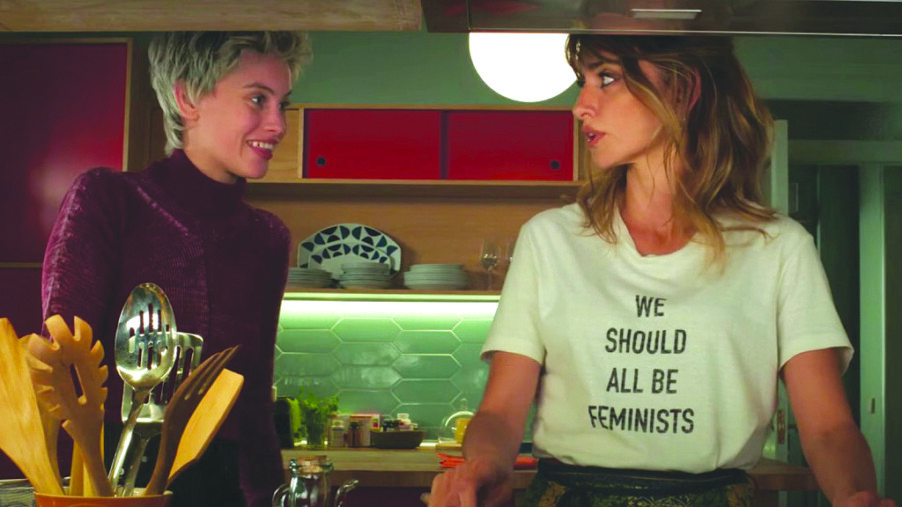
Here we see Janis (Penélope Cruz) and Ana (Milena Smit), sharing a hospital room, as they are about to give birth to their babies. Both are single. Janis is a settled professional woman nearing 40; Ana is a teenager (how old exactly I’m not sure — high school or young college). Janis is grateful for this unexpected pregnancy, the result of an enjoyable (but concluded, maybe) affair. Even before we hear the details, it’s clear that there is some trauma attached to Ana’s pregnancy. Both women have their babies — Janis’ daughter Cecilia and Ana’s daughter Anita — and both have some emotional support in their corner: Janis has her longtime friend Elena (Rossy de Palma) and Ana has Teresa (Aitana Sánchez-Gijón), the mother with whom she’s had a difficult relationship. At least, Ana has her mother’s financial support; a stage actress, Teresa lands a career-defining role and has to go on tour early in Ana’s new mom-hood.

Janis is managing with help from her housekeeper and, eventually, a good daycare, thanks to some photography work thrown her way by Elena. But she hits an unexpected emotional bump when Arturo (Israel Elejalde), baby Cecilia’s father, comes to see them. Though she ended their relationship — he’s married and wasn’t too keen on her keeping the baby — she is disappointed when he leaves moments after seeing Cecilia. Later he tells her he didn’t feel a kind of instant recognition for the baby, which sets Janis’ mind going in all sorts of directions, perhaps connected to the fact that she didn’t know her own father and was raised by her grandmother.

While Janis and Ana deal with their present-day motherhood, a story unfolds in the background connected to how Janis and Arturo first met. Arturo is an archaeologist whose work includes looking into the remains of those executed during the Spanish Civil War. Janis and the village she is from are looking to get help excavating an unmarked grave that they believe holds 10 men, including Janis’ great-grandfather. When Janis works a photo shoot for Arturo, she asks him if he will help the village work on the excavations — with the great-grandchildren and grandchildren and even at least one living child of the men eager to see them properly laid to rest.

It’s odd to have a melodramatic — to the point of soapiness — tale of Janis and Arturo and Ana layered over the top of this more searing historical tale of wrongs and the attempts to bring some sort of justice or at least recognition of what happened. There is a clear throughline — about having to acknowledge wrongs, despite the personal sacrifices, and make attempts to make amends. But it’s still jarring, at times.

That said, this is, as always, a well-crafted, thoroughly engrossing tale of women and their relationships to each other, of mothers and their difficult (but fiercely loving) relationships with their daughters, of coming to terms with sorrow and heartache and moving forward. Almodóvar does such a great job of getting to the raw emotion of these tangles — and of getting an emotionally raw performance from Cruz — that it overcomes what occasionally feel like dips into “too much”-ness, storywise. B+

Rated R for some sexuality, according to the MPA on filmratings.com. Written and directed by Pedro Almodóvar, Parallel Mothers is two hours and three minutes long and distributed by Sony in theaters.

Featured photo: Parellel Mothers.

Stay in the loop!

Get FREE weekly briefs on local food, music,

arts, and more across southern New Hampshire!