Double play

Orchestral rock and Scorpions music from Uli Jon Roth

On his current Pictures of Destiny tour, Uli Jon Roth balances the music he made with Scorpions and his solo material by playing two full shows in three hours. He begins with the classical rock he began making after he left the group, with his original films and artwork on a screen behind him. The set often ends with a new arrangement of “Sails of Charon.”

Perhaps his best-known song with the German hard rocker band, it’s also a bridge to the fan-pleasing second half. With his full band, Roth does a front-to-back performance of Virgin Killer, to help celebrate its 50th anniversary this year, followed by a best-of from his time in Scorpions. Usually there’s a faithful take of “Sails of Charon.”

Roth is realistic that the Scorpions material made his name, while the more complex work that followed didn’t cross into the mainstream.

“I have a new Uli audience who are more into the new stuff,” he said from a tour stop in Denver. “Then there are those brought up with Tokyo Tapes and that kind of stuff. My performances reflect that.”

For many years Roth chafed at the nostalgia of it all, but he now leans into pleasing Scorpions fans.

“Actually, I do enjoy playing it,” he said — particularly 1976’s Virgin Killer. “It feels really fresh. We are doing it slightly differently from the originals, and it feels like it was written now in some strange way.”

The key, it seems, has been learning to bring his current sensibility to the older songs rather than merely recreating them — “Sails of Charon” is a good example. “That’s undergone lots of transformations over the years,” he said. “Simply because I was never satisfied with the original arrangement; I always thought it was slightly unfinished.”

At his upcoming Tupelo Music Hall show Roth will preview material from Requiem for an Angel, a project he returned to recently after shelving it for two decades. Over the past year strings, percussion, drums and guitar tracks were recorded in the studio, and parts of it were performed on a recent Japan tour.

Requiem for an Angel is a large-scale orchestral tribute to Monica Dannemann, an artist Roth met in the mid-1970s. The two were life partners until her death in 1996. Dannemann was crucial to his creative growth, creating artwork for his records and co-writing songs.

“She was always an inspiration; I was really privileged to have even met her,” Roth recalled. “She is still part of my life, because when she passed away, she’s basically irreplaceable — not just for me, but for all of our circle of friends. She is one of these people who is really sorely missed.”

For the first half of the show Roth relies on computer-backed orchestral music. That’s due both to modern music industry economics and personal preference going back years.

“I’m utilizing technology to the max; I always have,” he said. “We can’t carry an orchestra around with us, but I am playing everything live.”

A multimedia show utilizing film, his projected paintings (also on display in the lobby), and time-synced visual footage allows Roth to bring a hundred-piece orchestra’s worth of ambition to small venues like Tupelo. Not that he wouldn’t like the real thing.

“It would be a lot of fun,” he said. “But nobody would pay for it.”

Roth is equally unbothered by AI’s encroachment on creative fields.

“Unlike most of my peers, I’m not afraid of AI — I love it,” he said, adding that he uses it to refine compositions for his videos and assist in the early stages of his paintings before committing to oil on canvas.

He’s also not worried about things like the recent Spotify dustup when an AI “artist” built up big streaming numbers with human-free music. He welcomes it.

“If the day comes that AI creates a better piece of music, then so be it,” he said. “You know, let the best computer win.”

There is one genre that Roth is not at all interested in, machine made or otherwise.

“I’m really not a heavy metal fan,” he said. “The worst is death metal and black metal. I can’t stand it because there’s no wholesomeness in it. It’s just a bunch of question marks and no answers.”

Uli Jon Roth
When: Friday, April 24, 7 p.m.
Where: Tupelo Music Hall, 10 A St., Derry
Tickets: $50 at tupelohall.com

Featured photo: Uli Jon Roth. Courtesy photo.

Collective effervescence

Sunny Jain’s Love Force hits New Hampshire

For his debut theatrical project, Love Force, Sunny Jain is performing his hypnotic, percussive brand of Bhangra-inspired jazz for a congregation. He’s on a mission to blur the lines between band and crowd, to make them one with the music and capture the energy of the shows he does in sweaty clubs with his band Red Baraat.

“What I’ve always enjoyed about music is that kind of communal experience … where you really rely on the energy in the room as a performer,” Jain said by phone recently. “I wanted to bring that element to a theatrical space … storytelling and narrative just through sound; how that impacts people, and how we vibe off of it.”

The message of Love Force comes from the concept of satyāgraha — the existence of truth. In the early 20th century, it underscored Gandhi’s nonviolent protests against British colonialism in India. It was later adapted by B.R. Ambedkar and, during the U.S. civil rights movement, employed by Martin Luther King Jr.

Jain, who plays drums and the dhol, combines it with music and personal stories of the immigrant experience, using Love Force to confront social oppression.

“You can’t fight back with more tyranny,” he said. “You have to lead with love and just melt away any kind of evil doing.”

The stage is a pulpit, he continued, and music a sermon delivered in a common language.

“I’m trying to really tap into that energy of music really unifying people, putting aside these differences we have,” he said. “Recognizing places of worship, the thing that really unifies people in there is the chants, the mantras, the songs, the hymns, everything that we sing.”

Jain’s Love Force ensemble consists of longtime accompanists Alison Shearer on sax and bassist Almog Sharvie, along with horn players David Adewumi (trumpet) and Jasim Perales (trombone) and with Julia Chen on keyboards. As they play, images flash behind them, as well as word collages — one a phrase that provides a lot of the evening’s energy.

Jain discovered “collective effervescence” after a conversation with Ash Fure, a Dartmouth associate professor of sonic arts, a few years back. The two were discussing Jain’s developing project and his interest in music’s coalescing power. Fure pointed him to Barbara Ehrenreich’s 2006 book Dancing in the Streets: A History of Collective Joy.

“Ehrenreich talks about this shared activity, almost akin to religion, that you find nowadays in the rave scene,” Jain said. “Then she points back to Emile Durkheim, the French sociologist, [who] coined the term collective effervescence.” His research found that it was key to the early beginnings of organized religion.

“People came together around a totem … reflective of their group or clan, and stomped in unison to give reverence to one another or to the human being,” Jain said. “Something just stuck to me about that — being engaged with and a lover of Sufi music, especially Sufi dhol drumming. Where the essence is of music and sound enabling you to reach the omnipotent.”

One fun fact learned in the interview was that a different twist of fate might have led Sunny Jain to join a rock ’n’ roll band. When he was 12 his brother took him to see Mötley Crüe and Whitesnake, his first concert. It inspired an interest in percussion, and he enrolled in drum class to learn Tommy Lee and Neil Peart. “Because I loved Rush as well,” Jain said. But his first teacher was a bebop jazz drummer and taught him that instead. “That’s how I fell in love with jazz.”

Does performing Love Force differ from working with his best-known band? “Yes,” Jain said. “There’s a lot more expression. Red Baraat is very much a musical force of the club and festival circuit of like just really amped up party music [and] this has a much more dynamic expression of emotion, just with the fact of the storytelling.”

Sunny Jain’s Love Force
When: Saturday, April 18, 7 p.m.
Where: 5 Pinkerton St., Derry
Tickets: $28 and $33 at pinkertonacademy.org
Also Thursday, April 16, 7:30 p.m., Hopkins Center, 12 Lebanon St., Hanover, $30+ at dartmouth.org

Featured photo: Courtesy photo.

Hometown jam

Hayley Jane Band grooves into town

As the Hayley Jane Band’s third show of a tour-opening weekend began in Delaware in late March, the group played their leader to the microphone, and she began “Daydream,” a perfect choice. The singer danced dervish-like while belting out lyrics with celebratory verve, lost in a moment of ecstasy.

This happens every performance, dating back to when she fronted Hayley Jane & the Primates, a band born in her days at Berklee College of Music. She hypnotically sways, twists, throws her long hair to the sky, then grooves to the microphone, channeling rock and soul standard bearers like Janis Joplin and Lydia Pense.

“In these moments, I’m awash in pure unadulterated joy,” she wrote in February 2025. “Letting the music flow through me. Nothing can touch me when I’m in that enveloping womb of frequency. I couldn’t care less what it looks like to anyone. It’s the best feeling in the world.”

Hayley Jane and her current lineup of guitarist Jackson Bower, keyboard player Parker McQueeney and the combo of Sam Lyons and Tom Gladstone on drums and bass return to Shaskeen Pub on April 11 for a show with Espejismo Band opening. It’s a hometown gig for Hayley Jane, who moved to nearby Litchfield a couple of years ago.

Their most recent album is 2021’s Late Bloom, and the single “One More Day” arrived in late 2024, but there’s new music on the way. “The first song we put together is called ‘Origami Ghost,’” Hayley Jane said. I got to paint this beautiful picture over this awesome funk song … there’s a lot of funk.”

She described another new one called “Hope” as big and anthemic. “It’s got a late 2000s emo, Dashboard Confessional vibe,” she said. “I don’t know how to explain it because I’ve never been good at describing genre. I should take a music history class or something.”

Or probably not. The charm with her music, both in the Primates and in her new band, is it’s a moving target.

“I love rock ’n’ roll, I love exploratory jams, I love letting the boys cut loose,” she said. “I love storytelling, old blues, Taj Mahal and I love drama. So I don’t know how to talk about genre, because that’s not where I’m coming from.”

When Hayley Jane and the Primates reunited for the 2022 Northlands Festival, it was a one-off show.

“We’ve all got lives and babies, everybody’s in their 40s now,” she said. “They were kind of like, ‘Hey, we’re not really looking to tour,’ and I said, ‘That’s fine.’ So I found some guys that were really looking to get out there.”

The Hayley Jane Band will return to this year’s Northlands Festival at the Cheshire Fairgrounds in Swanzey June 19 to June 21. They’re also at another familiar gathering, Strange Creek Campout in rural Greenfield, Mass., May 22 to May 25. Fans will hear some older material originally meant for her old band, due to appear on an upcoming record by her new one.

“Justin Hancock of the Primates was my co-writer for years; I didn’t want these songs to disappear, so it makes me really happy that they’re going to be going on this album,” she said. “I’ve been touring with this band now for two years, and so we’re finally getting into that comfort zone.”

At one point while she was swaying, shouting and singing her way through “Daydream” that Sunday in Delaware, Hayley Jane quoted a line from the Monkees hit “Daydream Believer.” It was a fitting nod to a time in music for which she has a clear affinity. When compared to a dancer at a tie-dyed Grateful Dead concert, she took the compliment with glee.

“I carry that spirit and the energy of the ’60s and ’70s,” she said. “It’s in me, just embedded. My parents listened to the music, like my dad was really into CCR and Janis [and] that whole time always called to me. I always feel like maybe in a past life I was there.”

Hayley Jane Band
When: Saturday, April 11, at 9 p.m.
Where: Shaskeen Pub, 909 Elm St., Manchester
Tickets: $15 at ticketleap.com

Featured photo: Courtesy photo.

Good chemistry

Jon Butcher and Diane Blue join together at Tupelo

Collaborations make the rock and blues world go ’round. Like Shades of Blue, led by psychedelic guitar hero Jon Butcher and singer Diane Blue, also a talented harmonica player. The band includes a rhythm section of AJ Vallee and John Ryder on drums and bass, along with guitarist Chuck Farrell.

Farrell, the force behind revival band Once An Outlaw, made the group happen.

“He put together a combo and said, ‘I’d like to have you and Jon Butcher featured in front,’” Blue recalled recently. “The first time we performed together, it was undeniable chemistry on stage. We were like, ‘We should make this a thing.’ Now it’s a thing.”

There is inspiring give and take between the fiery Stratocaster playing of Butcher, a New England Music Hall of Fame inductee, and Blue’s soulful singing. The two move between blues rockers like “Born Under A Bad Sign,” Bill Withers’ soulful “Use Me” and a blistering rendition of Hendrix’s “Red House.”

Another set highlight is a revved-up duet of the ’60s nugget (later a Grand Funk hit) “Some Kind of Wonderful.” Butcher will use the song to introduce Blue on harmonica and ask her how she learned to play it. “Nothin’ to it, you just suck and blow,” she’ll reply with a laugh, adding, “that’s what an old blues man told me, anyway.”

The real story about that goes back to Blue’s beginnings as a performer, singing in her living room with guitar player Paul White and later cutting her professional teeth in Newport, Rhode Island, venues like the Blues Café. She took up the mouth harp at White’s behest.

“‘Honk on this and see what you can do,’” she recalled White telling her. “‘Because there are a lot of chicks who can sing, but you’ll differentiate yourself from the crowd if you have something special that you can offer … see if you can get good at it.’ So I tried, and I just kept trying. I’m still trying.”

Blue got a big boost when Ronnie Earl caught her in a coffee shop in the early 2010s and invited her to sit in at his shows. In 2014 she became the first female member of the Boston blues legend’s band.

“What struck me was her ability to sing anything, from Sam Cooke to blues,” Earl said in a 2025 Blues Blast story. “She has a natural voice, a beautiful voice.”

She’s still with them, but performing with Shades of Blue is different.

“My job is to sing and to make sure that he’s OK on stage,” she said of Earl. “John Butcher and I have a mutual respect; we egg each other on to really strut our stuff. This is a chance for me to shine with a very strong backing band and all the encouragement to be the star of the show.”

Some of Blue’s solo cuts are in the set, like a rocking cover of Carol Fran’s Louisiana jump blues nugget “Knock Knock,” from her 2019 LP Look For The Light. The high points, however, happen when Butcher and Blue trade off. Bo Diddley’s “Mona” and “Spider In My Web,” a growling blues song written by Alvin Lee of Ten Years After, are good examples.

After doing just a few shows last year, Shades of Blue’s calendar is filling. A Tupelo Music Hall show on April 4 will be a twofer, with high-kicking harp player and singer James Montgomery sharing a band.

“James and I have co-billed on some of these Chuck Farrell productions in the past,” Blue said. “What usually happens is I do a set, and then he’ll do one.”

Shades of Blue w/ special guest James Montgomery
When: Saturday, April 4, at 8 p.m.
Where: Tupelo Music Hall, 10 A St., Derry
Tickets: $45 at tupelohall.com

Featured photo: Courtesy photo.
Not a mellow cello

Rocking up a staid stringed instrument

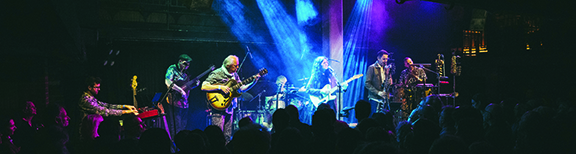
According to common wisdom, one way to deal with stage fright is to imagine the audience is naked. But what if they’re in the buff already? That’s what cellist Rebecca Roudman and her bandmates in Dirty Cello were thinking when they played at a nudist resort a few years back.

The Northern California quartet has toured the world with a revved-up brand of rock, blues and bluegrass that’s driven by Roudman’s cellist talents. Songs like “Dream On” by Aerosmith and AC/DC’s “Long Way to the Top” are transformed into grassified booty-shakers, and their originals are also stellar.

Luckily for the naked crowd that day, Roudman was the opposite of shy, as she worked her carbon fiber cello like Hendrix on a Strat. Nonetheless, guitarist Jason Eckl, who’s also Roudman’s husband, recalled in a recent Zoom interview with the couple that the gig was still a bit distracting.

“We’re playing our groovy music and people are dancing, which is funny,” he said. “Then all of a sudden without thinking about it I call out a very fast bluegrass song, and the dancing just kicks into high gear. The hula hoops are coming out, and Rebecca’s giggling through the whole thing.”

The gig was one of the few available during the social distancing days of the pandemic, but it put Dirty Cello on a special speed-dial list.

“We keep getting hired to go play at naked people places,” Eckl said. “But we always like to say we keep our clothes on.”

Roudman had a lifetime playing classical music in symphony orchestras when she decided to push the cello’s boundaries.

“I wanted to let my hair down, do something else,” she said. “I’d started performing with a blues band, and one day they asked me to solo and improvise on the blues. I didn’t know how, and I realized this is a skill that I wanted to learn.”

While her cello-playing stays front and center, Roudman has a powerful voice, one reason why Dirty Cello convincingly rocks songs like Led Zeppelin’s “Black Dog.” But she never planned on being a singer, and deflected a compliment that compared her vocal style to Heart’s Ann Wilson.

“I always consider myself just a cellist but thank you very much,” she said, explaining that the band hired a singer or two, but none of them could keep up. “Jason encouraged me. He said, ‘Look, you can sing, you should sing with the band.’ I was very stubborn, but after a while I was like, ‘OK, well I guess I’ve got to do it.’ … Now I’m very comfortable.”

Beginning with the 2018 release By Request, Dirty Cello has made five albums; the latest, By the Seat of Our Pants, came out in late February. Cello-fied covers include a version of “Sympathy for the Devil” with a female Lucifer, Guns N’ Roses’ “Sweet Child of Mine,” and “Run Through the Jungle,” a Creedence Clearwater Revival deep cut.

They balance the record out nicely with solid songs of their own. Despite its title, “Go Slow” moves along at a heady clip, while “Feelin’ Frisky in Frisco” is a nod to the band’s home base. “Further Down the Road” closes out the album. A blues rocker that also ends many of their shows, it’s a barn-burner.

Though cellists like Rushan Eggleston and Ben Sollee have redefined the instrument in the recent past, Roudman didn’t look to them for cues when pivoting from classical to more raucous, rousing music. “I wanted to be completely different,” she said.

With Dirty Cello, Roudman decided to “focus more on rock and blues, and maybe throw in some bluegrass and Americana … be the Swiss Army knife of cello-playing. So when people come to our shows, they’re going to hear a whole bunch of stuff reimagined on the cello. We wanted to stand out and be unique, and it’s been working for us.”

Dirty Cello
When: Sunday, March 29, at 3 p.m.
Where: BNH Stage, 16 S. Main St., Concord
Tickets: $34 at ccanh.com

Featured photo: Dirty Cello. Courtesy photo.

Rhythm kings

James Fernando Trio swings into Concord

Piano player James Fernando believes improvisational jazz is a conversation between musicians that begins before the first note is played. Parameters are established, relationships understood. It’s similar to two friends meeting for coffee — there’s no agenda, but they both know their talk will be more genial than a chat about the financial markets.

“I think improvisation is misunderstood, largely by people who aren’t really in the jazz world,” Fernando said in a recent phone interview. “They think there’s nothing to it because they’re just making it up as they go along, and that’s true, to an extent … but you know who you’re talking to.”

Chord changes, an established tempo and a song’s key are among the elements that provide a jumping-off point, he continued.

“The melody that we played before we begin the improvisation is the same, and all of these contextual elements make it so you’re not just starting from absolutely nothing,” he said. “There’s a lot of information surrounding it, and that makes your decision-making a little bit easier.”

Even so, one of Fernando’s most memorable shows was performed with musicians that he barely knew.

For years the pianist had wanted to start a dedicated jazz trio. Many of his favorite pianists had led their own trios, and the piano-bass-drums format is an enduring configuration in jazz. Though he’d performed with trios many times, he’d never built one of his own.

The chance came in late 2023, with an invitation to play at the Kennedy Center.

“I was asked on very short notice,” he said. “I think some Irish band had their head person get Covid or something like that … obviously, very unfortunate for them, but it was a nice opportunity for us.”

Though long based in Washington, D.C., Fernando had relocated to Philadelphia when he got the call. So he decided to kickstart the project with musicians from his new hometown.

“I called some strangers, really,” he said. “I even met the drummer on stage at the Kennedy Center that same evening.”

The show was a solid success.

“We got a nice recording and video of us at the Kennedy Center, which was very useful in booking more shows,” he said. “I was able to leverage those videos into more performances, and it went so well that I kept working with the same guys … and the rest is history.”

Earlier this year, the trio released Philly 3. Their first album together consists of eight Fernando compositions and a cover of Erroll Garner, one of his key influences.

“I composed with this band in mind, playing to their strengths,” he said, “We performed and rehearsed and kind of developed the music through live performances.”

The disc reflects Fernando’s desire to make music that’s both sophisticated and swinging, playful yet meticulous. He’s aiming for a sound that, as he told an interviewer a while back, “couldn’t have been written by just anyone with a jazz degree, and certainly not by an algorithm.”

On March 21, the James Fernando Trio will perform a fundraiser for Concord Community Music School. It’s his second visit — he did a set at the Bach’s Lunch series last April. The school, he said, “is a well-rounded beacon for music [that’s] very clearly open to people coming and expressing themselves and learning the ways that they’re most passionate about.”

In addition to performing, Fernando has taught classes for several years at D.C.-based Levine Music. He’s a frequent guest instructor, recently hosting a workshop at an Arizona high school, and he’s at UNC Pembroke for a similar event ahead of his stop in New Hampshire.

“So I’ve gotten the chance to see a lot of different programs and see the energy around the schools and whatnot,” he said. “And Concord Community Music School seems absolutely lovely.”

CCMS Jazz Night Fundraiser w/ James Fernando Trio
When: Saturday, March 21, 5:30 p.m.
Where: Concord Community Music School Recital Hall, 23 Wall St., Concord
Tickets: $80 and up includes reception, call 228-1196

Featured photo: Courtesy photo.

Stay in the loop!

Get FREE weekly briefs on local food, music,

arts, and more across southern New Hampshire!