Kill or be killed

Aaron Berg brings his take-no-prisoners act to Moka Pot

Watching Aaron Berg walk on stage at a comedy club, two thoughts compete for space in one’s head at the same time: he’s either going to make people laugh or totally destroy them. The truth, as Berg tells it, is that he’d really like to do both, metaphorically speaking.

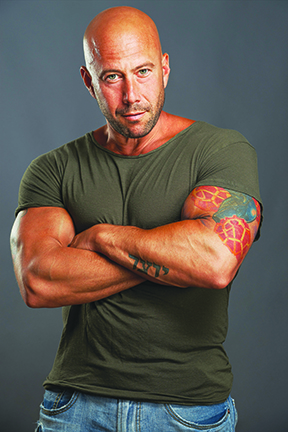
The second thought makes sense because Berg is a competitive bodybuilder, who created his physique the way he builds a set — obsessively, with no shortcuts. He looks less like a comedian than something that wandered off a movie poster, thick-necked, broad-shouldered, all traps and forearms. Along with punchlines, he probably has a deadly right hook.

“I wanted to murder these people,” he said by phone recently, hearkening back on the mentality he brought with him from bodybuilding in his 20s to the comedy stage. “I wanted these people to laugh so hard they were crying. There’s definitely a kill-or-be-killed mentality up there; that does come from bodybuilding.”

Physical conditioning is the throughline in Berg’s career these days, on stage and off. He recently returned to competition, and talks openly now about training, TRT, and the discipline of prepping for competition. His days start at 4:30 a.m. with a quick posing practice, 45 minutes of cardio, a training session, followed by six or seven meals during the day.

“I go all the way in on everything,” he said.

Subject matter that would have seemed like a novelty act a decade ago now resonates with an audience increasingly fluent in peptides and gym culture. Fans now show up specifically for the gym material, then stick around for the rest. Berg keeps busy, doing roughly 20 stand-up sets a week around New York City.

That all-in ethic extends to Berg’s family.

He and his wife, comic Christine Berg, are raising an 8-year-old daughter, Piper, who is now a black belt in taekwondo and, apparently, a fairly sharp critic of his material. “She’ll come to a set, and she’ll go, ‘Dad, that was really offensive,’” Berg said. “And I go, ‘Yeah, but the audience was laughing.’ And she’s like, ‘It doesn’t change the fact it was offensive.’”

Christine chimed in partway through the conversation with her own assessment. Her husband, she said, is “very odd, but very lovable,” and added that there’s no malice behind his material, however far it pushes.

“I’m a very kind person that says horrible things,” Berg said, agreeing with her.

That balance between provocation and warmth is something Berg has had to recalibrate over the years. Roughly a decade ago, around the time he wrote his second book, American Etiquette, he found himself drifting toward overtly political material and a podcast built around it — an effort he now describes as a “grift” that curdled.

“The dog-whistle mentality would allow for fans to basically embrace it just for the purpose of, ‘Oh, they’re saying racial stuff,’ which would then turn into racist stuff,” he said. He walked away, though he did worry about supporting his family. He found assurance from comic friends who insisted he’d land on his feet.

He did. These days the material comes from a more current, more personal place — marriage, fatherhood, and his return to bodybuilding. However, Berg’s stated goal hasn’t changed.

“I want 99 percent of people to love what I do, and I want one percent to be like, what the hell is this?” he said. “And I accomplish that.”

It’s a needle he’s still actively threading on stage, not a settled formula, he continued, and the difference between an edgy joke landing and just being mean is something he checks himself on set to set. The stories he tells trace back to an instinct he found in childhood, that comedy is both a weapon and refuge.

Berg’s best-known feat remains 25 Sets, the 2015 documentary chronicling his attempt to break the record for most stand-up sets performed in a single night. The plan was to hit 26 clubs across New York City, but a car breakdown forced him onto foot and into cabs and cost him a set in Times Square. It left him with 25, still a record, and a title for his movie.

He’s about to make his first appearance in Manchester, at the Moka Pot. Fittingly for the all-or-nothing comic, it’s a two-night run. Berg is learning more about the city and the newly relocated venue, which has several summer shows booked.

“I know the Moka Pot is supposed to be a great little spot for comedy, and there’s a thriving local scene there,” he said. “Everybody seems so excited, but I have no idea where it is. I don’t even know how far the drive is going to be — or if I need to fly or take a small boat.”

Aaron Berg
When: Friday, July 31, and Saturday, Aug. 1, at 8 p.m.
Where: Moka Pot, 8 Hanover St., Manchester
Tickets: $25, eventbrite.com

Featured photo: Aaron Berg. Photo by David Genik.
Carrying the torch

Dwight & Nicole salute their Kings & Queens at Tupelo

When talking with Dwight & Nicole, there’s a fine line between an interview and eavesdropping.

The married couple, who’ve performed together for more than 20 years, first bonded over a love of traditional blues music, and that’s clearly endured. Answers to questions frequently veer off into discussions between the two, on subjects like whose version of “Ain’t Nobody’s Business” is the best (both agree on Jimmy Witherspoon’s).

It happens so naturally that it’s easy to wonder if their home in Burlington, Vermont, is this way every night — charming banter about clubs played back in the day, how Dwight once nearly booked a show on the Cape with Honeyboy Edwards, the night Nicole saw him open for Otis Rush at the original House of Blues in Cambridge and became instantly smitten.

The answer, it turns out, is yes.

“This is what we do all the time,” Nicole Nelson said as Dwight Ritscher laughed along.

That’s the spirit driving Kings and Queens, a tribute show to a galaxy of influences that the two will bring to Tupelo Music Hall on July 24. The night is built entirely from the songs and singers who first pulled them into blues clubs as teenagers and who, years later, pulled them into each other’s orbit.

The idea had been percolating for years, rooted in a scene the duo watched flourish and eventually fade.

“Both of us came up almost entirely out of the blues scene, which was such a vibrant, thriving thing 20 years ago,” Nelson said, rattling off the rooms that shaped her, like the Rynborn in Antrim, where she played underage, the YardRock in Quincy, which closed in 2003 and where Ritscher remembers catching Toni Lynn Washington and Ronnie Earl.

“We just kind of miss it,” Nelson said. “We’re like, let’s get people together and do that.”

Ritscher views the Derry venue as a natural home for their revival.

“I always saw Tupelo as a blues club,” he said. “Maybe if we’re lucky this could turn into an annual thing. Even if it’s just a gift we can share once a year, just to show that we can break even, I’d be glad to be part of it.”

Picking eight artists out of a lifetime of influences was never going to be an easy task. Leonard Cohen was non-negotiable, as Nicole’s take on “Hallelujah” has become something of a signature. Also in a setlist swinging from Delta grit to lyrical poetry are songs from B.B. King, Lightnin’ Hopkins, Johnny Cash, Etta James, Aretha Franklin and more.

The night leans into American roots music from the ’60s and ’70s, while spanning the 20th century, with blues and jazz from the big-band era. Some choices came down to what still gives them chills, like Hopkins’ “Trouble in Mind,” a song that Nelson begins a cappella.

“One long note out into the crowd, holding it, making eye contact,” she said. “It’s so fun.”

Others arrived after years of deliberately avoiding them. For example, Nelson once sidestepped the Queen of Soul entirely.

“I always felt like everybody sings Aretha,” she said. Then a friend pushed back, telling her she had a gift not many could claim, and she relented. “The first time I sang ‘Natural Woman,’ I nearly lifted off the stage,” she said. “My whole body was tingling, and everyone felt it. Standing ovation. Now I’m like, OK, I’m going to lean into that a little.”

They won’t be doing it alone. Ali McGuirk and Jesse Dee, longtime collaborators, top a confirmed list of guests.

“Ali’s not really a blues singer,” Nelson said. “But she carries the tradition of songwriters deeply rooted in blues music; you hear it in her voice … she’s one of my favorite singers and closest friends.”

Dee, she added, is “phenomenal, a legend … anyone who knows him and has seen him is blown away.” To round out a lineup heavy on musicians they’ve shared stages and studios with for years, Ritscher invited horn player John McBride, “our brother up here” — and bandmate; when not gigging with Nelson, Ritscher plays drums in McBride’s group.

There will be more names. Pressed on surprises, the couple lit up talking about the Boston-scene elders who shaped them — Ronnie Earl, whom Ritscher has stayed in touch with, and Toni Lynn Washington, a singer Nelson suggested during the phone interview. “We can give her a call for sure,” she said. “She’s super wonderful and so inspirational.”

Asked if they were angling for a grand entrance to match Paul McCartney’s helicopter arrival to sing “Hey Jude” at Billy Joel’s final Shea Stadium show, Nelson didn’t hesitate. “That’s what we’re going for, we want some copters landing,” she exclaimed. “We’ll see what we can do.”

Kings & Queens
When: Friday, July 24, 8 p.m.
Where: Tupelo Music Hall, 10 A St., Derry
Tickets: $35, tupelohall.com

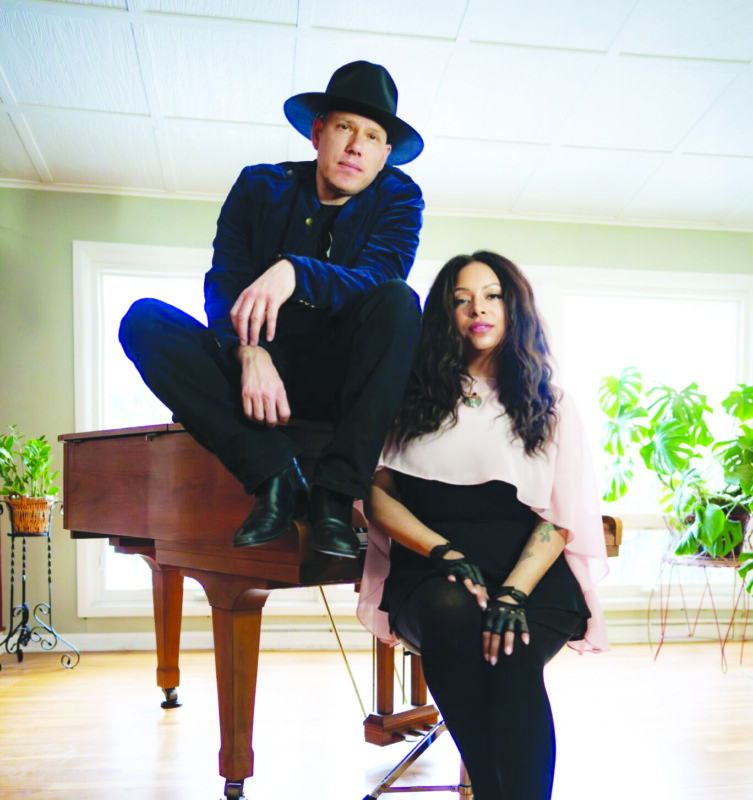
Featured photo: Dwight+Nicole. Photo Credit Josh Steele.

Pump up the volume

Hell Beach / American Television mini-tour hits Shaskeen

When their debut album Beachworld dropped in October 2024, Hell Beach celebrated with a local show at Shaskeen Pub. The big moment, though, came a week later with an appearance at Fest, a pop-punk rival to SXSW, spanning the Florida city of Gainesville. It was a triumph for the Manchester band, and it paid dividends beyond validation.\

“In our genre, if you’re on a tour that includes Fest, you know Fest will be the best show,” Hell Beach frontman Jordan Hill said in an interview at the time. Connecting with other bands is one reason. Hill and his mates met Washington, D.C., punk stalwarts American Television at Fest, and almost two years later they’re joining forces.

A mini-tour — “four shows in three days,” Hill said by phone recently — stops at Shaskeen Pub on July 17. Hell Beach has a new lineup; Hill is on lead vocals, having handed bass duties to Franklin Siplas. Kory Boutin is on drums, with guitarists Brenden Meade and Tim Williams rounding out the band.

Their sound evolved as well, as the synth-rich “keytar era” ended. Megan Simon, who played the guitar-shaped keyboard, left amicably to focus her band Megan From Work.

“I’d have done the same thing,” Hill said of her departure. “This takes up all of my time outside my regular 9-to-5; there’s no way to really do a second band alongside it.”

On an album just completed for new label Counterintuitive Records, the synth of Beachworld gives way to snarl. “It’s got a much more aggressive vibe, more rock and roll,” Hill said. Some of that, he continued, reflects a decision to eschew pop instincts for a heavier sound, but the current zeitgeist is another factor.

“A lot of people are probably writing songs that maybe sound more aggressive, maybe sound darker, and I think that goes with the aggression and darkness in everyday life in the last however many years,” Hill said. “Things are highly politically charged. There’s a lot of stress for everybody, and I think that comes through in people’s art.”

The upcoming Shaskeen show is a stacked night, with Portland, Maine’s Borderlines joining after an attempted booking in Biddeford fell through.

“They’re a perfect fit between us and American Television,” Hill said, adding that their drummer is filling in behind the kit for Hell Beach at the show.

Rounding out the bill is Lovewell, whose inclusion is its own bit of reciprocity, as well as a testament to the cohesiveness that sustains the area’s pop/punk scene. “They’ve always been sweet to us and asked us to play shows, so this is returning the favor,” Hill said.

They’re looking forward to the short run, which starts July 16 in Easthampton, Mass., and ends with day/night shows in Poughkeepsie and Kingston, New York. Hill is happy to share a bill with American Television.

“They’re a punk band, but they have a lot of pop elements as well, and I think our sounds work well together,” he said.

The Manchester date falls just after Hill’s birthday, and he’s not averse to leveraging the occasion a bit. “I’m going to guilt people into coming,” he said with a laugh.

The group’s latest studio effort is a part of a voluminous Green Day tribute album. From Kerplunk!, the band’s final indie release, “Android” has been a favorite of Hill’s since middle school.

“It felt fitting to cover a song about a long stretch of a life, now that we’re all in our mid-30s,” he said. “The vibe and the lyrics made sense, and it’s just a great song.”

Curated by music blog and indie platform Punk Rock Radar and released on Coffin Curse Records, the tribute project has more than 50 bands and benefits no-kill animal shelters. It’s a color vinyl release — Dookie Color Splatter, to be precise. Hill is a big fan of the format, pointing to Hell Beach’s sold-out first pressing of their Beachworld 12-inch with pride.

For the scrappy band, that’s an important milestone, as is the new label deal. The best measure, however, is the sense that their efforts are taking hold with audiences, whatever the size.

“We can play shows and people are singing along, dancing and they’re familiar with the music,” Hill said. “That to me is a huge mark of success.”

Hell Beach, American Television, Borderlines, Lovewell
When: Friday, July 17, 9 p.m.
Where: Shaskeen Pub, 909 Elm St., Manchester
Tickets: $15

Featured photo: Courtesy photo.

Joni’s jazz revisited

Hejira channels the spirit of beloved Mitchell period

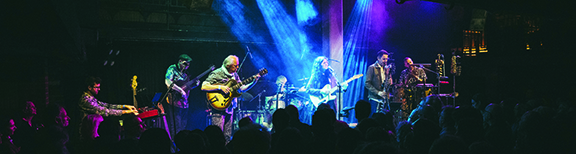
Guitarist and composer Pete Oxley spent decades building a solo catalog, along with a reputation as one of Britain’s most thoughtful jazz improvisers. A band dedicated to Joni Mitchell’s music wasn’t in his plans, nor a first-ever U.S. tour, yet that’s what’s happening. The story of how it came to be reads less like a career move than a series of improbable gifts.

Named for Mitchell’s 1976 album Hejira, the band was initially a one-off 2022 Christmas gig at a club in Oxford run by Oxley. The show was dedicated mainly to Mitchell’s late ’70s Shadows and Light live album, and it went well enough for Oxley to add a second date two months out and post tickets on his website.

“By 11 a.m. the next day it was sold out,” he said in a recent Zoom interview. “So I thought, maybe this is a project worth pursuing.”

Since his conservatory days, Oxley had been a fan of Mitchell’s jazz-inflected period, which ran from 1974’s Court and Spark through the extraordinary live album that captured her 1979 touring band featuring Pat Metheny, Jaco Pastorius, Wayne Shorter and Lyle Mays.

“I had Hejira on cassette, and I played it so often that all the treble end was gone,” he recalled. “I just fell in love with it.” Shadows and Light became something of a north star for him. “It just fizzes with electricity when you put it on, yet at the same time it’s really warm, really beautifully produced. It’s always been one of my desert island discs.”

Oxley wanted a singular sonic identity rather than a note-for-note replica of source material. He put together a seven-piece band of players drawn from the British jazz world — bass clarinet, synths, percussion layered with drums.

“It’s not a tribute act,” he told them. “We want to serve the songs and reproduce the vibe … but we’ve got our own colors.”

Surprisingly, he’s found that arranging someone else’s music is harder than composing his own.

“When I’m writing, I have no constraints, but here, my challenge is to keep the melody — that’s what people know — but still make it our own,” he said. “People come up after a show and say, ‘I love the way you respect the songs, but you’ve made it yours,’ and that’s the most heartening response to get.”

Oxley’s Joni is Hattie Whitehead, a jazz singer and songwriter with a solid solo career including her highly regarded debut album, Bloom, released in 2024. She’s also the daughter of British saxophone player Tim Whitehead. The story of how she ended up in the band is its own comedy of near misses.

Three others came and went before Whitehead. One wanted to completely reframe the concept, another demanded that her boyfriend play bass, and a third asked to use her own band. Then Hejira bassist Dave Jones asked Oxley if he knew about a video Whitehead posted on YouTube of her performing songs from Shadows and Light.

“I found it, and it was just totally like yeah, she’s the singer,” Oxley said. He rang up Whitehead, who was quite happy for a chance to sing nothing but Joni. There was one hiccup; she already had a gig that night. But she found a substitute, came to one afternoon rehearsal, and the band was complete.

What she does, Oxley is careful to say, isn’t imitation. When an interviewer asked her how she could sound so much like Joni, Oxley interrupted to disagree. “She sounds like herself,” he insisted. “She sings in tune [and] she’s got a big vibrato like Joni, but she still sounds like Hattie. She’s dedicated and committed to the song, which is a beautiful thing.”

Kismet with a New Hampshire angle helped make Hejira’s American run possible. Milford resident Gary Connolly found their videos on YouTube and was so smitten that he flew to England to see them play. He even offered to drive the van if they made it to the States, and later helped book a show at Andres Institute of Art in Brookline to open the tour; it sold out.

Another crazy twist of fate came when an email arrived from the director of the Syracuse Jazz Festival, a devoted Shadows and Light fan who had also seen the videos. He offered Hejira a main stage slot and, when Oxley mentioned needing more dates to make a trip viable, doubled their fee and covered airfares.

“We kind of talked about it as a pipe dream every now and again — if we could get to America, there’s a big market there,” Oxley said. “Then there was … a ridiculous amount of luck.”

Hejira: Celebrating Joni Mitchell
When: Wednesday, July 15, 7:30 p.m.
Where: Jimmy’s Jazz & Blues Club, 135 Congress St., Portsmouth
Tickets: $23 and up at ticketmaster.com

Featured photo: Hejira. Courtesy photo.

Rockin’ the Fourth

Eclectic music slate precedes Nashua fireworks

This Fourth of July will mark 250 years of U.S. independence, but Eleanor Luna’s American roots run deeper than that.

Her ancestors came to Maine from Scotland in 1648, eventually making their way south to Nashua. A few centuries later, give or take, she followed them there. Upon arrival, Luna embraced her new community as a resident, and she became a force behind reshaping the city’s alternative arts scene.

New Hampshire Underground, founded by Luna a few years ago, regularly hosts shows at Terminus Underground on Haines Ave., along with downtown Nashua events. The next one happens ahead of the Independence Day fireworks at Holman Stadium. Eight acts will appear, ranging from rock to country, hip-hop and experimental art rock.

Headlining is Dead Harrison, the doom metal band led by Andre Dumont, who’s Luna’s partner and, more recently, her husband. It’s the third year for the event honoring veterans, part of NH Underground’s ongoing support efforts, which include a “Buy Dinner For a Vet” program and collaborations with groups like Nashua Veterans Promise.

The veterans focus isn’t incidental; along with Luna’s DAR lineage, Dumont comes from a military family. His father was a Marine, his sister serves in the Army, and Andre himself is a Navy veteran.

“We just really have very strong core values for the people that fought for the country,” Luna said by phone recently. “That’s why we do what we do.”

The event has evolved since it began at Nashua’s Liquid Therapy in 2024. This year it happens closer to Holman Stadium, on a community stage near Centennial Pool. Last year Dumont equipped it with sound to make it attractive for rentals, but only the city has used it thus far.

“We decided to set an example,” Luna said, “and take advantage of the stage.”

Timing alleviates any potential issues with the show’s beneficiaries, she continued. “Before … this was done in a different area because a lot of the veterans that we were serving had PTSD and didn’t want to be around the fireworks, and they can still do that, because we stop right before the fireworks … they can leave right after the show.”

The lineup reflects a curatorial philosophy — book acts broad enough to pull in people who wouldn’t normally go to a rock show, but still please regulars. Nashua rapper Six Minds Combined opens, followed by Aaron Bolido, who Luna worked with in the studio when she fronted Eternal Embrace. “People think he’s metal, but he’s really alt art rock,” she said.

From Boston, psychedelic rock band Superchild and alt hard rockers Born Fools perform. Sunset Electric are a regular at Terminus, while country rockers Shotgun Alice were booked for their accessibility. They’re friends with NHU mainstay Lone Wolf James.

“We try to get bands that won’t hit those pinch points of being too dark or too heavy,” Luna said.

Headlining is Dead Harrison, Luna’s favorite band for obvious reasons. She describes them as “spooky doom metal” in the same breath she calls them “enjoyable to everybody, if they can understand that it’s not going to be scary.” It’s a pitch that sounds like early Black Sabbath landing at a community Fourth and somehow making it work.

Between sets, flow artist Nicolette Reed Gracey will perform AirFlow Projection Art around the stage, combining dance, movement and light as she twirls and spins flags with designs projected onto them. During daylight hours she will work in color. As it gets darker, her projections will shift to images of America and veterans, timed to the music.

Hiring the unique Nashua-based visual artist Gracey is the kind of touch that fits Luna’s instinct for spectacle without provocation. The national semiquincentennial celebration may be fraught with partisanship, but she’s not here for that.

“We’re not political in any way,” she said. “We just want people to get together and have fun.”

Beyond the Fourth, Luna is eyeing a larger downstairs space for NH Underground that would add disability access and room to grow. She’s also working on a Porch Fest, a Misfits Farmer’s Market featuring alternative acts, a night market for artisans, and a winter market; all are events the city hasn’t provided space for, so she’s building them herself.

“I personally don’t like roadblocks,” she said with certainty in her voice. “I want to be able to do things that I know are good for this community without having to jump through hoops or red tape.” Her Scottish ancestors, one suspects, would recognize and approve of the attitude.

Independence Day Rock Concert
When: Saturday, July 4, 2 p.m.
Where: Centennial Park, Sargents Ave., Nashua
More: newhampshireunderground.org

Lineup:
Daytime Stage, 2-5 p.m.
6 Minds Combined (alt hip-hop)
Aaron Bilodeau (experimental art rock)
Superchild (psychedelic rock)
Sunset Electric (alt rock)

Evening Stage, 6-9 p.m.
Shotgun Alice (country rock)
Born Fools (alt hard rock)
Lone Wolf James (hard rock)
Dead Harrison (doom metal)

Featured photo: Dead Harrison performs last year. Courtesy Photo

Music as a movement

Martin Toe brings activism and Afrobeats to BNH Stage

There’s no line between work and music for Martin Toe, the organizer and hip-hop artist behind albums like Civic Leader and last year’s Love Is Godly. Alongside fellow New Hampshire artists B. Snair, Vincent Tesoro and Marxo Phenix, Toe performs in Concord on June 27 in a show that’s both a homecoming and a statement about the state’s music scene.

Toe has been organizing for over a decade, first as an intern with American Friends Service Committee, the Quaker social-justice group. Later, he co-founded Change for Concord (later rebranded as Hope Project New Hampshire) and eventually landed at the Granite State Organizing Project, bringing together faith leaders and communities of color across the state.

In a recent Zoom interview, he described the connection between his day job and performing as natural and vital.

“It’s super authentic for me, it doesn’t feel like work,” he said when asked how organizing feeds his songwriting. “What I say in my music doesn’t feel forced. I have an endless pool of inspiration to pull from because I am interacting with that world every single day.”

The BNH Stage show won’t be Toe’s first time in the Concord listening room. He headlined a Black History Month Unity concert there in February 2023 with friend and collaborator Destin Boy. He said this lineup came together through a series of Zoom calls among artists who’d long wanted to work together but hadn’t had the chance.

“The music scene can seem very scattered here in New Hampshire, but I think the state’s working very hard to pull artists together and highlight … a very talented pool of artists that we have,” he said, adding that despite sharing a stage, the three acts don’t sound alike, and that’s the point.

“These guys pull from all different sorts of creative spaces, and the music is not the same, which is awesome,” he said. “Phenix might throw some R&B stuff in there, more of the funk vibes. B. Snair comes in with a fusion mix of rock and hip-hop. Then you got me in there with the Afrobeats and hip-hop.”

What unites them, he said, isn’t genre but geography and circumstance, a shared expression of having grown up in New Hampshire, and an instinct to write about real life.

“Whether it’s the cost of rent or groceries,” he said. “We’re trying to paint a picture of, yeah, we can have fun. At the same time, we can feel what’s happening emotionally across the state.”

History and hope permeate many of Toe’s songs. On “Free,” a standout track from Love Is Godly, he sings “Can’t you see, 1847 we’re free,” referencing Liberia’s declaration of independence — the African country was founded that year by former slaves from the United States.

The song then gently moves in a meditation on what that may have felt like. “Sweet Liberty Bell is ringing from the high seas, whistling through the high trees,” he continues. “Let them know for sure that I am free.” And for Toe, freedom isn’t an abstraction, it’s something he’s writing from memory.

When he was 7, Toe and his family were forced to flee when civil war fighting reached his Ivory Coast town, part of the broader Ivorian and Liberian conflict that displaced hundreds of thousands.

“It was very difficult,” he recalled. “The sound of gunshots, seeing smoke billowing in the air, and fleeing, not knowing if you’re ever going to go back.” He still carries that experience vividly, and it shapes how he talks to his American friends who grew up without knowing war firsthand.

“War leaves a wound, and whenever specific stories come up, it festers that wound again,” he said. “Then, you have to sit with it … let it heal.”

Music is, for him, part of healing, and a reminder — to fight for peace and be sure that life’s beauty isn’t taken for granted. That spirit continues with a forthcoming album, The Gaffa, due to drop on Aug. 28, the anniversary of the 1963 March on Washington. It opens with MLK’s voice, saying he’s tired of marching for what should have been his at birth.

What follows are fierce lyrics, about “boardrooms that feel like a battlefield” and a generation organizing for a seat, or as Toe puts it, deciding to “move the whole table” instead. It’s a fitting next step from an artist who’s spent a decade learning that the fight for dignity and the urge to make music have never really been separate.

Martin Toe, B. Snair & Vincent Tesoro, Marxo Phenix
When: Saturday, June 27, 8 p.m.
Where: BNH Stage, 16 S. Main St., Concord
Tickets: $18, ccanh.com

Featured photo: Martin Toe. Courtesy photo.

Stay in the loop!

Get FREE weekly briefs on local food, music,

arts, and more across southern New Hampshire!