Album Reviews 24/08/29

Bill Leeb, Model Kollapse (Metropolis Records)

If you’re an OG techno-goth who gave up on this column owing to the lack of love I’ve showered on your favorite genre for many months now, it’s me, not you (or goth); my email box is nowadays a hopeless trash heap of messages in bottles from bands and labels looking for a little attention, and as far as goth goes I have no idea how many emails from Metropolis I’ve unintentionally missed. This is a great one for playing catch-up, though. Leeb is of course the prime mover behind Front Line Assembly and all the other stompy Skinny Puppy-ish bands you know and love (including Skinny Puppy itself), so what I was looking for here was a little risk-taking on Leeb’s part after so many years of lording over the space. Fat chance, of course, turns out. There’s Rammstein jackboot-stomping on the Shannon Hemmet-assisted “Terror Forms,” and tribal, Last Rites-era Skinny Puppy stuff on “Demons,” etc.; it’s all very nice but formulaic (I hate to burst any bubbles, but that’s of course not a shocking development). I mean, if you’re looking for kickass background ambiance for playing Wolfenstein: The New Order, you can’t go wrong here, and I’d prefer to just leave it at that if you don’t mind. B

Marquis Hill, Composers Collective: Beyond The Jukebox (Black Unlimited Music Group)

This Chicago-based jazz trumpeter is big on mixing genres; he views jazz, hip-hop, R&B, Chicago house and neo-soul as essential cogs in the African-American creative context. “It all comes from the same tree,” quoth Hill, “they simply blossomed from different branches.” Of course, promises are one thing, delivering on them is another, but he certainly does right out of the gate with “A Star Is Born,” a refreshingly courageous genre-salad that deftly moves from a timbales-driven (or sample thereof) shuffle to a sparklingly clean post-bop horn exercise with a dubstep drumbeat underneath it. Next is “Joseph Beat,” featuring guest sax guy Josh Johnson helping decorate a stubbornly rhythmic pattern that’s too sophisticated for Weather Channel backgrounding but wouldn’t be terribly out of place as some sort of 1970s game-show incidental riff. “Pretty For The People” is a dazzling, prog-referencing slow-burn; “Enter The Stargate” is an ambitiously nimble bit showcasing the understated abilities of drummer Corey Fonville. A relaxing, fun, terrific record. A+

PLAYLIST

A seriously abridged compendium of recent and future CD releases

• I give up, the summer’s over, the next Friday haul of new CDs will arrive on Aug. 30, which is tomorrow, according to this newspaper’s publishing schedule!

The first one we should probably talk about, not that we have to, is the 18th studio album from Nick Cave & The Bad Seeds, titled Wild God. Cave has always been something of an acquired taste that I never, you know, acquired, but even if you don’t like his proto-goth baritone voice or any music he’s ever done, one thing’s for sure: It’s usually expressive and revealing in some way. Far as that goes, I reviewed his Ghosteen album in this space in 2016; the album was dedicated to the memory of his son Arthur, who slipped and fell off a cliff while under the influence of LSD. It was a very impressive album that, you may dimly recall, was strong enough to tie Kendrick Lamar’s To Pimp a Butterfly album on Metacritic’s scorecard that year. Before that, a short-lived relationship with PJ Harvey — actually its breakup — inspired the 1997 album The Boatman’s Call. As for Wild God, Cave is enthusiastic about it, saying that the band was “happy” when they put it together. That’s usually a bad sign in my experience, like it’s always better when the main songwriters are going through a breakup or some other trauma, not that I’d ever wish such things on anyone, but it is what it is. Now, despite the fact that the band was feeling happy, the title track is haunting, moody and occasionally sweeping; it starts out with a vanilla mid-tempo beat, Cave’s Sisters Of Mercy-prototype vocalizing leading into a noisy bliss-out that’s interesting enough I suppose.

• OK, and with Nick Cave out of the way, it’s out of the frying pan and into the art-rock fire, let’s look at American avant-garde lady Laurie Anderson’s new album, Amelia! If you’re old and tried a lot of different drugs in the early ’80s you’re probably familiar with Anderson’s 1982 sort-of-hit “O Superman,” an eight-minute-long exercise consisting of two notes, some vocoder-tweaked singing and some normal, minimalist warbling from Anderson. You probably have no idea what that song even is, but like I said, it was a surprise hit that year, and people still remember it; in fact it was used in one of the alternative endings to the 2018 interactive Netflix film Black Mirror: Bandersnatch. OK, so now we know where this is going, let’s go have a listen to one of the tunes, “India And On Down to Australia feat. Anohni.” So OK, this is a soft, tastefully decorated, electronically enhanced joint that’s got a tinge of Enya to it. It’s quite soothing and pretty; I don’t hate it.

• London, England-based pan-continental underground band Los Bitchos specialize in instrumental music in the style of 1970s/1980s “cumbia,” a folklore-based dance genre from Colombia. It is danced in pairs with the couple not touching one another as they “display the amorous conquest of a woman by a man,” in other words it’s basically twerking except Americans can’t understand what’s actually going on. Talkie Talkie is the band’s new album, which leads off with “Don’t Change,” a dance-y beachy folk instrumental that may remind you of Tangerine Dream with a little bit of prog in there.

• And finally it’s John Legend, Chrissy Teigen’s husband, with a new album of children’s music, called My Favorite Dream! Apparently Chrissy uploaded a video of Legend playing and singing “Maybe” on a Fisher Price piano to one of their kids and then somehow Sufjan Stevens got involved, whatever. “L-O-V-E” is annoyingly happy, not Nick Cave-level happy or anything, more like Raffi/Barney-dinosaur-level happy, which makes me really unhappy.

The Midnight Feast, by Lucy Foley

The Midnight Feast, by Lucy Foley (William Morrow, 350 pages)

The jacket of Lucy Foley’s The Midnight Feast promises a “deliciously twisty murder mystery,” which is more a nod to the title than a description of the book itself.

Foley, a British author who has been compared to Agatha Christie, has enjoyed success in the genre (her 2020 book The Guest List was a Reese’s Book Club pick) despite a parade of cookie-cutter covers that may be all the rage but to me suggests that the content within lacks originality.

That can’t be said of The Midnight Feast, which is complexly plotted and tries at times to deliver cultural commentary within the core mystery. But the novel suffers from an unsatisfying pileup of perspectives that prevents readers from developing any real connection with the characters.

The Midnight Feast begins at the gala opening of an opulent resort called “The Manor,” which overlooks a cliff on the Dorset Coast in southern England. The owner, Francesca Meadows, is a wealthy wellness influencer of sorts reminiscent of Gwyneth Paltrow, and is determined to give her guests a goopy good time despite the objection of locals who believe her dream estate has desecrated sacred ground.

Francesca, “very good at living in the now,” wears a black opal ring because the stone signifies “purification for the body and soul” and “provides you with a shield against energy.” She’s very much into crystals. Every room at The Manor has a selection of stones in it for the guests’ well-being and sticks of sage to burn “for cleansing.” The place has signature scents and a signature cocktail whose ingredients include ginger, vodka and a dash of CBD oil. The guests themselves are “carefully curated” to keep out the wrong kind of people.

Francesca, newly married to the architect who designed The Manor’s infinity pool, is introduced as something of a dopey villain. Disdainful of the locals and their spooky folk tales, she is scheming to acquire an old farm down the road where “the animals look sad, like they’re begging for a better life. They honestly do!”

She inherited the property from her grandmother, and she had treated her grandfather poorly in his last years of life, thinking that he was simply daft when he warned her repeatedly, “You must keep the birds happy; don’t upset the birds.”

The birds, of course, aren’t literal birds in this context, although there are plenty of them in the story, which is heavy-handed with the bird imagery. According to local legend, The Birds are human-size creatures with beaked faces that occupy the woods and demand sacrifices and on occasion take a life for themselves, leaving behind a feather or two.

Snippets of this are revealed as the story unfolds in staccato, told by five narrators interspersed with excerpts from the diary of one of the characters, and yes, this is just confusing as it sounds. In fact it’s more confusing than it sounds because the story also jumps around in time, from June 2025 to July 2010, and back and forth between the day before the solstice (i.e. the titular “midnight feast”) and the day after it. There’s so much whiplash here that the book could be a ride at the Big E.

The narrators include Bella, a single mother who has come alone to opening weekend for reasons that we learn right away are Very Mysterious, since she has brought with her a folder of articles about Francesca.

There’s also Eddie, a young employee at The Manor, whose family owns the dilapidated farm down the road and who is hiding from his family the fact that he works here. There’s Owen, Francesca’s new husband, who doesn’t seem to be a very happy newlywed; and a DI (detective inspector) named Walker who is tasked with investigating a fire and mysterious deaths at the property. Along with Francesca, they all take turns narrating what’s happening in real time and revealing snippets of the past that connect them to each other and to the land.

Although the language is simple (too much so, one might say) and the chapters short, the constant change of perspective is wearisome and diminishes character development. Also, for a book that is heralded for its plot twists, alert readers can see many of them coming, and there is nothing revealed at the end that will leave us mulling the story in disbelief for days afterward. More likely, the ending is likely to result in a feeling of relief — we’re glad things are resolved so we can move on to a more compelling book.

On the plus side, for a murder mystery, there is very little gore involved, and only a couple of scenes that might be problematic for PETA.

Credit the author for managing to neatly tie up all the loose ends at the close of the novel; she had a destination in mind and gets us there eventually. No doubt some people will consider her a mastermind for navigating such a complicated plot, but it comes at the expense of the reader. C

Album Reviews 24/08/22

Bek, Derby Girl [EP] (Amber Blue Recordings)

This mononymed DJ is a well-established player in the (reportedly vibrant) Hamburg, Germany, velvet-rope scene. He’s steadily made a name for himself as a producer as well, releasing tracks on such imprints as Traum, What Happens, Ohral and Natura Viva, and back in 2015 he won the Mixmag + ANTS Ibiza DJ competition over 300 other participating DJs. With all the resume nonsense out of the way, we can proceed to what’s on this four-songer (actually three, but the label owners added a remix to the second track, “Cannibal Licornes,” a Calvin Harris-style joint that doesn’t do much other than make you wish you were sipping mai tais in the Maldives, not that we don’t need more of that sort of vice in this loveless world). The title track is a lightly syncopated bounce-along whose (actually pretty raucous) drop comes halfway though its six minutes; overall it’s a lot more experimental than what I expected. Sure, this is fine. A

Alison Moyet, Key (Cooking Vinyl Records)

As a celebration of 40 years of releasing records, this is one for the books, a mix of reworked songs with only a pair of new ones, but the rerubs are reflective of the changes she’s undergone personally over the years. In fact, she’s outgrown some of the tunes since her days releasing her first solo record, Alf, as a 22-ish-year-old. Like Siouxsie Sioux, Moyet’s distinctive contralto has probably been mistaken for a male tenor on many an occasion; Andy Bell mainlined her music while preparing to audition for Erasure, a RIYL name-check relative to her sound. Here, she reshapes her most famous track, “Is This Love” (from the 1986 album Raindancing and featured in the film All of Us Strangers), as an epic chillout ballad as opposed to the (very) ’80s slow-dance track it’d originally been. Major hits “All Cried Out” and “Love Resurrection” are here, updated for the times; newcomer songs “Such Small Ale” and “Filigree” are nice-enough slowbie bringdowns. A+

PLAYLIST

A seriously abridged compendium of recent and future CD releases

• A Friday is ahead, specifically the one that falls on Aug. 23, and you know what that means: People will be crowding the malls to buy all the new albums! Yes yes, your friends will be dressing up just like the cool but awkward kids in Pretty In Pink and making fun of all the mall cops (aren’t adults so stupid, lol) and buying plenty of albums, for your Sony Walkman audio devices, aren’t you glad Stranger Things made the ’80s come back? Right, I have no idea where I’m going with this, I’m just waiting for the ’90s-rock echo boom to take over from this tedious ’80s wave once and for all, until we’re all sick of hearing bands that sound exactly like Nirvana and Indigo Girls (I’m way ahead on both scores), and in the meantime, let’s try to ease our suffering by finding something that might be relevant to our current era of music, that’d be great. We’ll start with Philadelphia electro-psych/slowcore band Spirit Of The Beehive, which releases You’ll Have To Lose Something on Friday! They’re on a post-indie trip and insist on being weird, so the video for the first single, “Something’s Ending / I’ve Been Evil,” is moderately annoying. As for the song itself, it’s a slapdash slowcore mess that’s somehow listenable, and like many bands are doing nowadays, there’s a dubstep layer in there that serves pretty well as a sort of binding force. The vocals are faraway and over-reverbed, in other words there’s government-issue oldschool-shoegaze afoot in this business but despite the performative, androgynous gloom there’s a hint of 1960s Spanky And Our Gang sunshine-pop at work as well. If all this sounds good to you, you can catch them live at Brighton Music Hall in Allston, Mass., on Sept. 24.

• Wow, it’s the first album in 24 years from Pacific Northwest-based minimalist indie-pop/cuddlecore duo The Softies, isn’t that special? I hadn’t realized I sort of missed hearing about them, and come to think of it, I never did, but I will listen to something from their new album, The Bed I Made, because I am an equal opportunity hater, just let me pop a few Dramamine to settle my stomach first. Ack, I used to confuse these guys with The Swirlies for obvious reasons; an AllMusic reviewer nailed it on the head when he said The Softies’ stripped-down, two-voices/two-guitars aesthetic was too boring to build entire albums around. But hey, maybe they’ve added some layering, who knows, let’s go listen to the single, “I Said What I Said.” Yep, it’s twee-pop, happy and upbeat and catchy in its way, and jangly and minimalist and decidedly dated, and one of the girls is wearing nerd glasses, and both girls are wearing the spring line equivalent of Christmas sweater fashion. But like I was saying, you’d better get used to this vanilla-frappe-blooded nonsense, because it’s gonna be everywhere before you can say “Oh no, please don’t, I beg of you.”

• New York City-based industrial metal/noise-rock fivesome Uniform release their fifth album, American Standard, this Friday! They’re my kind of dark-futurist-type guys, having used samples of gunshots and explosions to produce rhythm tracks, why haven’t more bands done stuff like that? The single, “This Is Not A Prayer,” is psychotic, deranged and awesome, like “Stumbo” from Jim Thirlwell’s Wiseblood project. That’s another thing, why haven’t more bands ripped off Wiseblood?

• Lastly let’s check out Sabrina Carpenter, a nepo singing person who used to be on the Disney Channel series Girl Meets World; her aunt is Nancy Cartwright, the voice of Bart Simpson on The Simpsons. “Espresso,” the single from her new LP, Short n’ Sweet, is disposable Britney bubble-pop. I’m sure 6-year-old girls would like it, aren’t they growing up so fast these days (world’s loudest eyeroll)?

Frostbite, by Nicola Twilley

Frostbite, by Nicola Twilley (Penguin Press, 327 pages)

In 1911, a grand banquet was held in Chicago to showcase an exciting new kind of food.

At the event, put on by the national Poultry, Butter and Egg Association, the five-course meal featured food that had been preserved in cold for six months to a year. The purpose of the event was to prove to a skeptical public that it was safe to eat previously frozen food.

“At the time, suspicion of refrigerated food was widespread,” Nicola Twilley writes in Frostbite, her deep dive into “the vast synthetic winter we’ve built to preserve our food.”

While most of us take refrigeration for granted, just a little more than a century ago it was new technology that didn’t inspire confidence. The 400 diners at that Chicago banquet were considered brave. At the time, gastrointestinal infections were the third leading cause of mortality; people were dying of cheese and ice cream poisoning, and the purveyors of manufactured cold were desperate to convince people that meat and produce that had been stored for months were not only safe, but healthier than fresh food.

It took some time, but they succeeded, and in doing so they revolutionized the American diet. Today there is a largely unseen industry called the “the cold chain,” compromising warehouses, trucks, shipping containers and other apparatus that enable a dizzying array of food choices at supermarkets and restaurants. You may think your own office is too chilly at times, but at companies like Americold and NewCold, workers have to wear specialty clothing in order to endure sub-freezing temperatures during their eight-hour shifts.

In Frostbite, Twilley descends into the chill, donning thermal underwear to work in an Americold warehouse for two weeks and criss-crossing the planet to explore how artificial cold is generated, the mechanics of refrigeration and how the food supply has changed because of it. Amazingly, she manages to make all this all compelling.

She begins with an explanation of how cooling works, a process that seems simple enough now but took decades to develop, with a few tragedies along the way. One was at the 1893 Chicago World’s Fair, where “the Greatest Refrigerator on Earth” — a five-story cold storage building — attracted admiring crowds until it caught fire, killing 16 people, some of whom jumped to their deaths in front of horrified onlookers.

For the better part of a century, the development of refrigeration was a process marked by trial and error, with multiple entrepreneurs advancing the technology for their own purposes. They included a Trappist monk in France who created the first hermetically sealed compressor because he wanted to cool his wine.

While how a refrigerator works is fairly simple — Twilley travels to Pawtucket, Rhode Island, to watch the construction of a rudimentary one in a garage — it’s not so simple to know exactly how to store food for optimal results and a long life. That involved a long process of trial and error, too.

Apples, for example, remain edible for a year or more when the conditions are right, but fractions of degrees determine whether an apple will rot, and the perfect temperature range changes with the variety of apple. A century of research, however, allows us to buy “fresh” apples at the Market Basket year-round.

“Today, we know more about how to lengthen an apple’s lifespan than a human’s,” Twilley writes.

Which is a good thing, because in Twilley’s telling, harvesting produce sounds practically inhumane. Celery and bananas, for example, don’t immediately die when they are picked, but continue to “breathe” and burn through their own sugars and enzymes “in a desperate attempt to get their cell metabolism going.”

Cold works to preserve the life of produce by slowing the rate of respiration, which is why a green bean you select at the supermarket has typically spent less than two hours in temperatures above 45 degrees, having been rushed from the field to chilling machines and then one of the massive cold-storage facilities.

But the biggest way that refrigeration has altered our eating, and by extension, the planet, is how cold storage has driven the rise of meat consumption. Prior to refrigeration, humans ate only the meat on their farm or their neighbor’s, or animals that were walked to slaughterhouses in cities. Later, animals destined for slaughter were shipped cross-country on box cars, but that was inefficient and costly. It wasn’t until cold storage became widely available that animals themselves were not shipped, but their frozen parts, and this upped the demand for meat, not only because of the accessibility but because freezing improves the texture and taste.

As Twilley writes, “muscle … needs time and cold to ripen into meat.” It also benefits from electric shocks given to the animal carcass, which is information many people might prefer to not know. (“… Shocked beef is brighter red, which consumers prefer.”) Most notably, cold storage gave birth to the factory-farm industry that raises, slaughters and processes animals in numbers that are hard to imagine. To supply our poultry needs alone, Twilley notes that “there are approximately 22.7 billion broiler chickens living out their five-to-seven week spans on Earth at any given moment.”

Twilley takes the slow road to her final chapter, in which she travels to the ultimate frozen warehouse, the “doomsday vault” of seeds kept underground in Svalbard, a Norwegian archipelago in the Arctic Ocean.

Along the way, she segues into refrigerator-related topics that are much less serious, such as the man who ran a dating service based on what the inside of people’s refrigerators look like. (John Stonehill was very impressed with Twilley’s — seeing photos, he said, “Your fridge is one of the most date-ready fridges I’ve seen in a hell of a long time. Are you married?”). As a writer for The New Yorker and The New York Times magazine, she says she has been “thinking and talking about refrigeration for a decade now,” and it’s hard to imagine that anyone is more well-versed in the topic. While refrigeration isn’t, on the surface, one of the most compelling of conversation topics, it’s a testament to Twilley’s skills as a writer and researcher that she has managed to make this niche subject engrossing. A

Album Reviews 24/08/15

Dummy, Free Energy (Double In Mind Records)

I’m usually not a big fan of bands that shift genres within albums, as it makes it hard for listeners to settle in; it’s not like we’re living in a terribly cerebral zeitgeist, more like a seriously dysfunctional era of art in which noise is often confused with signal. But this one grabbed me from the beginning and held on, starting with “Intro – UB,” a peaceful EDM joint that evokes Orbital and Aphex Twin while tabling some in-your-face drum sampling. I’d been warned through the informational one-sheet that there was some My Bloody Valentine vibe on here, which obviously isn’t wildly compatible with 1990s/Aughts techno, but it’s exactly that sort of bliss that happens next on “Soonish,” which, as it proceeds, may remind you of some of the harder stuff on Wire’s 2013 LP Change Becomes Us but with an REM tint to it. I really like what these folks are doing. A+

Egosex, 15 Minutes Of Fame [EP] (self-released)

Originally from Lagos, Nigeria, Wekaforé Jibril leads this Afro-tech wetwork outfit, which, it’s said, weaves an “abstract narrative that delves into the heart of modern society’s narcissistic obsession with recognition.” This ain’t your daddy’s Fela Kuti-style Afrobeat, of course, but it does have some deep roots in it, and those tendrils can be felt all through this release. I’m saying that it does have a deeply African sound, but when you turn up the vibe-ometer to see what Afrobeat has become in modern times, we hear Black Eyed Peas lurking around the corner (listen to “Yes We Are In Love” for proof), egging us on to dance blissfully, encouraging us to accept that our era’s sound may be rooted in ringtone-brained individualism but that there are good points to that. The trance- and dubstep-adjacent beats settle into hip-hop-infused tribal jams (“Can U Make Me Feel”) that feel urban-fashion-minded, which makes sense, given that Wekaforé is pushing his own clothing line. Relevant tuneage for hip outlet malls. A+

PLAYLIST

A seriously abridged compendium of recent and future CD releases

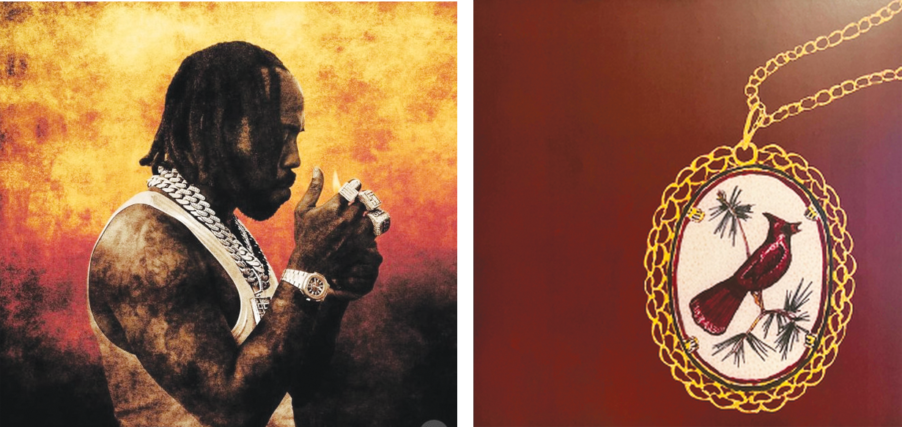
• The brand new CD releases of Friday, Aug. 16, are upon us, guys, so it’s off to Metacritic we go, to see what unlistenable swill new music we will be subjected treated to this week, as the summer winds down and the autumn eyes us with its awfulness and threatens to unleash early ice storms and such! I am not sure what all my New Hampshire neighbors are listening to these days (I assume twerking music and Led Zeppelin). But as for me, for the past week, I’ve been back to listening to 1930s big band music from the likes of Al Jolson and Paul Whiteman, because I’ve been out and about driving far away to estate sales in such quaint New Hampshire towns as West Lebanon and New London, and there’s nothing more appropriate than 90-year-old tuneage playing in your jalopy when you’re hunting antiques! Oddly, while visiting these bucolic towns, where chickens and goats run around loose in the streets, I didn’t see WMUR’s Fritz Wetherbee hanging around at any general store. Remember last year when I wanted to ask him if I could co-host his New Hampshire Chronicle segments and a few people on the internet actually tried to help me add “TV star” to my resumé? My offer still stands, for the record, but what we must address now is F-1 Trillion, the new album from nice-enough person Post Malone! The teaser single, “Pour Me A Drink,” features a guest artist, of course, and — nope, it’s not Snoop Dogg — no, not Kendrick Lamar either, let me finish, it’s actually country music star Blake Shelton! This song is not your typical hip-hop fare, more like a honky-tonk song for drunken cowboy rappers; it’s so hated by undergrounders that some YouTuber named @BigPacVsAllYall went right to work releasing a diss track, cleverly titled “Diss Track,” in which he “spits rhymes” about how Post “hasn’t actually rapped in seven years” and is now “wearing farmer jeans” and a bunch of other hurtful stuff! It’s all dumb, I know, but chances are good that Post will catch wind of it, because somehow, BigPacVsAllYall was able to get his song to the very top of YouTube’s search results if one searches for “Post Malone F1 Trillion!” That, my friends, is trolling at its finest, you have to admit; you can hate the game but not the playah!

• Good lord, anyway, what’s next, what could possibly — OMG, ha ha, look everyone, it’s last decade’s indie-pop darlings Foster The People, you can stop checking WhosAliveAndWhosDead.com, because they are very much alive! Their fourth album is Paradise State Of Mind, their first since 2017’s Sacred Hearts Club, which (if you were even aware it ever existed) stalled at No. 47 in the Billboard and received a lowly Metacritic score of 56, but who cares, let me go listen to something from this new album, which is said to be in line with Sacred in that it’s inspired by “late 1970s music with elements of disco, funk, gospel, and jazz.” Yep, the album starts with “Take Me Back,” a totally funky-poppy thing that’s too uncool for Jamie Lidell or even David Guetta, but your grandchildren might like it, I don’t know.

Beabadoobee, aka Beatrice Laus, is a Filipino-born space-rocker who opened for label-mates The 1975 a few years ago. Her new LP, This Is How Tomorrow Moves, starts with “Ever Seen,” a really nice, poppy little number that combines Jewel-style acoustic guitar-pop with spazzy anime soundtracking. Normal people will like it.

• We’ll end the week with Brooklyn, N.Y.-based power poppers Charly Bliss, whose new album, Forever, includes the song “Waiting For You,” a ’90s-chick-pop-tinged tune that’s actually catchier than anything I’ve heard from Sleater-Kinney, which is the obvious motivation behind this.

Sandwich, by Catherine Newman

Sandwich, by Catherine Newman (Harper, 229 pages)

Since it’s set in an idyllic village at Cape Cod, Catherine Newman’s novel Sandwich could refer to the town of that name, the oldest on the Cape. It’s more of a nod, however, to the “sandwich generation,” the term for adults who are caring for their aging parents and their own children.

That’s the life stage of the protagonist, Rachel, who (somewhat bewilderingly) goes by the name Rocky, and who, at 54, is “halfway in age between her young adult children and her elderly parents.” Rocky has been married nearly 30 years to Nick, “a beautiful man who understands between twenty and sixty-five percent of everything she says.”

I will confess right now that I love her, and did by the beginning of the second chapter, when she dubbed a toilet malfunction “Plungergate.”

Rocky and her husband have been renting the same modest cottage for a week every summer since the children were young, and as the novel begins, they are headed there again, as Rocky muses on how time whitewashes our perception of experiences, and how a beach vacation is often filled with things that have little to do with the actual beach.

“You might picture the wild stretches of beach backed by rugged dunes or quaintly shingled houses with clouds of blue hydrangea blossoming all over the place. … Which is funny because most of the time you’re actually at the surf shop or the weird little supermarket that smells like raw meat, or in line at the claim shack, the good bakery, the port-a-potty, the mini-golf place. You’re buying twenty-dollar sunscreen at the gas station.”

On this particular trip, Rocky and her husband are accompanied by their daughter, Willa, who is a junior in college; their son Jamie, who works for a start-up in New York, and his girlfriend, Mya. (Also, the family cat, named Chicken — which was the only deeply unrelatable part of the book for me — taking a cat on vacation.) Rocky’s parents are due to arrive later in the week.

Rocky and Nick, who bicker constantly, are glad to have their children with them in this familiar space, as they are still navigating their almost empty nest, having to “make nervous small talk over our early dinners, as if we’re on an awkward zillionth date at a retirement home.”

Their quarreling is obvious to all; at one point, their daughter asks Rocky if something is wrong, but there is also clearly a deep affection between husband and wife that is tested as the week unfolds and a couple of secrets from Rocky’s past are slowly revealed. These revelations are related tangentially to a storyline involving Jamie’s girlfriend and a health issue she is having. There is a plot here that is thoughtfully crafted, but honestly, it doesn’t matter.

Newman is the kind of writer who could write 200 pages about paint drying and keep the reader entranced throughout. She has a gift for taking ordinary experiences and draping them in gorgeous language, the kind that stays with you, as when Rocky reminisces that when her kids were young they would “vibrate with excitement” at the mere mention of a visit to a Cape candy store.

She also has a sharp wit and bestows Rocky with a self-deprecatory wryness that stays at the ready whether she’s trying on a swimsuit (“One big wave and my boobs will definitely be celebrating their dangly freedom”; smelling zero SPF tanning oil (“the scent of my future squamous cell carcinomas”); or revisiting memories (“ … Jamie at four, Willa a baby in the sling, me with my permanently trashed perineum”).

The joy of Sandwich, in other words, isn’t about the plot, but instead about Newman’s charming and funny musings about decades of family vacations at the beach. Much of this book could have been a memoir, and we suspect some of it is, at least the parts about parents and children vacationing together at the beach: the small happiness of rubbing sunscreen on the backs of grown children whose bodies used to be so familiar but are now off limits to you; the weird time warp that takes over at the beach (“It is always one o’clock when we leave for the beach, regardless of when we start readying ourselves”); the constant scanning for shark fins, ticks and other dangers that never stops no matter how old your children are; and the relative ease of going to be beach with older children as opposed to the physical labor of going to be beach with young ones and their paraphernalia, everyone “breaded with sand.”

People who also rent the same beach house every year will also enjoy the observations relative to that — such as Rocky mourning that the old coffee maker has been replaced with something shiny and new, and the family assessing the changes to the house since they’d last been there. (Willa says, “Is it weird that I’m kind of offended when they replace stuff? Like, they didn’t even consult with us!”)

At the beginning of Sandwich, the novel felt physically thin to me, which sometimes feels foreboding, as if the book didn’t ripen and the author didn’t take the time to develop it fully. But Sandwich turned out to be short for the same reason that A Christmas Carol is short — the author said exactly what needed to be said, in the ordained time frame, and didn’t waste words or the reader’s time on the superfluous. Sandwich is a lovely and disciplined novel that accomplishes something remarkable: It’s a book about the beach that is too good to be considered a beach read. A

Stay in the loop!

Get FREE weekly briefs on local food, music,

arts, and more across southern New Hampshire!