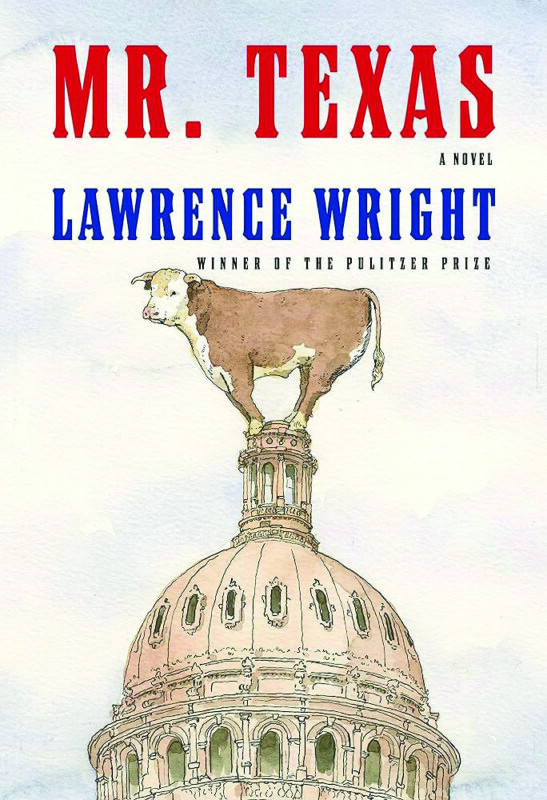
Mr. Texas, by Lawrence Wright (Knopf, 336 pages)
Sonny Lamb is a rancher who lives with his wife, Lola, in the middle of nowhere, Texas. It takes them 45 minutes to get to the nearest Dollar General. He is a kind-hearted man, the sort who, when he takes a prized bull to the livestock auction, can’t stomach it when the animal is about to go to a slaughterhouse, so he buys his bull back, even though the animal was only at auction because he was so broke.
This could explain why Lamb is just getting by in life, and suffering a bit of an early midlife crisis, sensing that “his life was ebbing, inevitably, pointlessly.” His wife loves him, but her large, fertile extended family exacerbates her husband’s feeling of everlasting mediocrity: The family “all carried themselves with an air of importance that Sonny could never hope to achieve.”
Then one day Lamb gets himself on the map when he saves a young girl and her horse from a barn fire. This happens around the time that a Texas state legislator dies mid-term, and a political mover-and-shaker is seeking a replacement in line with his interests. He’s looking for “Someone who stands for good, conservative values. Someone who commands the respect of all who know him. Someone with ideas. A patriot. A hero. A Republican.”
Sonny Lamb is none of these things, really. He’s adrift in a red state with “blue measles.” But someone had taken a photo of him riding a terrified horse out of a burning barn, and he’s hero enough.
Such is the beginning of Mr. Texas, a rollicking novel by New Yorker writer and Pulitzer Prize winner Lawrence Wright. A Dallas native who lives in Austin, Wright has said he came up with the character of Sonny Lamb more than two decades ago, and what is now Mr. Texas had earlier lives as a failed screenplay, a failed HBO pilot and even a failed musical. Which is fine, because it’s now a first-rate novel.
The person who plucks Sonny Lamb from obscurity is a lobbyist named L.D. Sparks, who at one point observes, “Funny how a person can live his whole life being good or bad, but there’s nothing on the record, nothing that you can hold in your hand and say, here, take a look, this is who I really am.”
But after Sonny’s heroics at the barn fire, he has a photograph that says exactly that, and even though Sonny also has a history of womanizing and drug abuse after a war injury in Iraq, Sparks realizes he could construct a winning candidacy around the man — with the help of a PR firm, of course. Sparks needs a legislator he can control since he is one vote short in the General Assembly to pass all the things he needs, and Sonny seems perfect, possessed of “youth, looks, good teeth, and naivete.”
Sonny and Lola are initially taken aback when Sparks appears on their doorstep, but Sonny decides this is the chance he needs, since he’s been struggling with the fact that he’s never set an important goal and achieved it. Despite the angst, hilarity ensues. When Sonny appears on a local talk show, his mother calls in to ask why he didn’t consult her before deciding to run. “Don’t just assume you’ve got my vote,” she says.
His Democratic opponent, Valerie Nightingale, is ahead by 25 percentage points. Things are going so poorly that Sonny is starting to think that Sparks was working for Nightingale and scammed him into running. After a debate in which Nightingale mops the floor with him, however, Sparks and the other consultants decide it’s time to exchange the moral high ground for street-fighting, albeit through a political action committee, keeping Sonny’s hands clean.
Meanwhile, Lola has announced that she desperately wants children and they need to try harder. So the couple embark on a “breeding schedule” — sex twice a day, between campaign events, as they throw themselves into a new life that will upend their current one in ways neither can foresee.
While Sonny and his handlers are Republicans, Mr. Texas is partisan, but not problematically so. Wright says he is politically independent and the book skewers all of us, not just the political establishment, mocking people who loathe government while living on Social Security and food stamps, and those who see elected officials as Santa Claus, existing to grant their every wish.
Sonny’s world is our contemporary one; his state is populated by real people and places, like Ted Cruz and the McDonald Observatory at the University of Texas, although it’s sometimes hard to tell what’s real and what’s not. A scene where legislators go pig-hunting seems made up but is based on reality, similar to an event held simply for Sonny to collect lobbyist checks.
While Mr. Texas gets a tad preachy toward the end and concludes a bit abruptly, this does not diminish the overall pleasure of the novel. This is no Mr. Smith Goes to Washington, the classic 1939 film starring Jimmy Stewart, but it’s a version for our time, at least in book form. A —Jennifer Graham